Want more images or videos?
Request additional images or videos from the seller
1 of 10
Important Ancient Chinese Trio Women Handmade Hand Glazed, Ming Dynsty 1368-1644
Price:$2,450
About the Item
- Dimensions:Width: 4 in (10.16 cm)Length: 12.5 in (31.75 cm)
- Style:Ming (Of the Period)
- Materials and Techniques:
- Place of Origin:
- Period:
- Date of Manufacture:1500
- Condition:Wear consistent with age and use.
- Seller Location:South Burlington, VT
- Reference Number:1stDibs: LU128926774213
About the Seller
5.0
Platinum Seller
Premium sellers with a 4.7+ rating and 24-hour response times
Established in 1990
1stDibs seller since 2015
2,425 sales on 1stDibs
Typical response time: 1 hour
Authenticity Guarantee
In the unlikely event there’s an issue with an item’s authenticity, contact us within 1 year for a full refund. DetailsMoney-Back Guarantee
If your item is not as described, is damaged in transit, or does not arrive, contact us within 7 days for a full refund. Details24-Hour Cancellation
You have a 24-hour grace period in which to reconsider your purchase, with no questions asked.Vetted Professional Sellers
Our world-class sellers must adhere to strict standards for service and quality, maintaining the integrity of our listings.Price-Match Guarantee
If you find that a seller listed the same item for a lower price elsewhere, we’ll match it.Trusted Global Delivery
Our best-in-class carrier network provides specialized shipping options worldwide, including custom delivery.You May Also Like
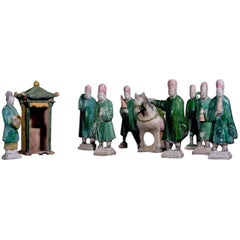
Impressive Terracotta Funerary Procession - Ming Dynasty, China
1368-1644 AD
Located in San Pedro Garza Garcia, Nuevo Leon
Impressive Funeral Ensamble of 10 Terracotta Glazed Figures in green and caramel colors depicting a votive procession with a palanquin, his four carriers, a horse, a stableman, two musicians, and an offering carrier.
This ensemble is accompanied by a Certificate of Authenticity, and Certificate of Expertise by Jean-Yves Nathan - Specialist in Asian Arts for the CEDEA (The European Confederation of Art Experts).
Burial figurines of graceful dancers, mystical beasts, and everyday objects reveal both how people in early China approached death and how they lived. Since people viewed the afterlife as an extension of worldly life, these figurines, called mingqi, sometimes referred as “spirit utensils” or “vessels of ghosts” disclose details of routine existence and provide insights into belief systems over a thousand-year period.
The Ming dynasty was the ruling dynasty of China – then known as the Empire of the Great Ming – for 276 years (1368–1644 AD). Founded by Chu Yuan-chang, the rebel leader that was successful in removing the mongols from the throne. Chinese control was re-asserted in China and eastern Asia. Literature became more important, schools were created, and the justice system was reformed. The Ming dynasty is described by some as "one of the greatest eras of orderly government and social stability in human history,” was the last imperial dynasty in China ruled by ethnic Han Chinese.
The practice of burying ceramic objects with the deceased went into decline from the 10th to the 14th Century AD. There was a revival in placing miniature representations of glazed terracotta objects such a furniture, food offerings, horses, miniature statues...
Category
Antique 15th Century and Earlier Chinese Ming Antiquities
Materials
Terracotta
$15,625
H 8.5 in W 4 in D 4 in
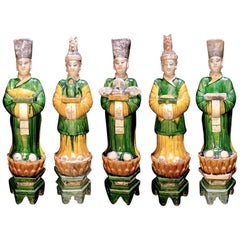
Superb Set of 5 Elegant Court Attendants, Ming Dynasty, 1368-1644 AD TL Tested
Located in San Pedro Garza Garcia, Nuevo Leon
A stunning set of 5 graceful terracotta figurines from the Ming Dynasty '1368-1644' AD. These elegant attendants are standing on a yellow glazed lotus flower over a high hexagonal green plinth and wear fine robes in matching green and yellow glazes. The unglazed areas have pigmented colors in red, black and white. Each is carrying essential offerings for the royal family. The head is detachable as often seen on the larger figures from this period. Meticulously detailed facial expressions have been hand-painted.
Condition: Mint, finely preserved glaze and pigment, undamaged and no repairs.
Provenance: Ex. Danish Collection.
This set is guaranteed authentic and comes with a Certificate of Authenticity and TL Test from Laboratory Kotalla in Germany (The Oldest Thermoluminescence Testing Laboratory in the World).
Dimensions: Average 54 H cms
Burial figurines of graceful dancers, mystical beasts, and everyday objects reveal both how people in early China approached death and how they lived. Since people viewed the afterlife as an extension of worldly life, these figurines, called mingqi, sometimes referred as “spirit utensils” or “vessels of ghosts” disclose details of routine existence and provide insights into belief systems over a thousand-year period.
The Ming dynasty was the ruling dynasty of China – then known as the Empire of the Great Ming – for 276 years (1368–1644 AD). Founded by Chu Yuan-chang, the rebel leader that was successful in removing the mongols from the throne. Chinese control was re-asserted in China and eastern Asia. Literature became more important, schools were created, and the justice system was reformed. The Ming dynasty is described by some as "one of the greatest eras of orderly government and social stability in human history,” was the last imperial dynasty in China ruled by ethnic Han Chinese.
The practice of burying ceramic objects with the deceased went into decline from the 10th to the 14th Century AD. There was a revival in placing miniature representations of glazed terracotta objects such a furniture, food offerings, horses, miniature statues...
Category
Antique 15th Century and Earlier Chinese Ming Antiquities
Materials
Terracotta
$34,000
H 21.25 in W 5.5 in D 5.5 in
Two Glazed Court Attendants, Ming Period (1368-1644)
Located in seoul, KR
Two finely hollow-moulded terracotta statuettes from ancient China, dating to the Ming Dynasty. The figure is depicted standing, dressed in long, flowing robes, painted in vibrant blue or green and deep amber yellow. The hair is styled into an elaborate top-knot, painted in a muted brown. Areas left unpainted would have been 'cold-painted' after firing, contrasting with the vivid fired blue or green and amber pigments. The figure is shown with the left hand raised to the chest, as if holding something, possibly an offering or incense. Figurines like this were placed in tombs to guide the deceased on their journey to the afterlife.
The Ming Dynasty was known for its exceptional artistic achievements, partly due to its economic prosperity. Since the Han Dynasty, it was customary to bury terracotta miniatures of everyday objects with the deceased. These items, known as mingqi, or "spirit utensils" and "vessels for ghosts," were believed to help and assist the deceased in the afterlife. Mingqi were crafted in the form of cooking utensils, miniature replicas of houses, temples, furniture, and other items. Anthropomorphic and zoomorphic terracotta figures were also popular, designed to assist, entertain, and recreate the living world for the deceased.
Period: Ming Dynasty
Medium: Green/blue-glazed Pottery
Type: Figure
Provenance : Acquired in late 1990s from Hongkong
Reference :
1) Ancient & Oriental - Terracotta Tomb Attendants
(Type : Highly related)
2) La Maison De La Petite Sara S.r.l. - Archaeology section - A Black glazed Terracotta Statuette, Servant with Trumpet, Ming Dynasty
(Price realised : 700 GBP / Type : Highly related)
* Ming Dynasty Glazed Pottery Figures
Ming Dynasty glazed pottery figures are renowned for their bold color palette, intricate detailing, and lifelike forms, distinguishing them from earlier traditions. These figures, which depict officials, warriors, animals, and mythical creatures, are characterized by high-gloss lead-based glazes in green, amber, ochre, and sancai (three-color) combinations. The thickly applied glaze pools in recesses, creating depth and enhancing sculptural details. With dynamic postures, expressive facial features, and meticulously rendered drapery, these figures reflect the period’s advancement in ceramic craftsmanship, offering a greater sense of movement and realism compared to the rigid and stylized forms of earlier dynasties.
A defining characteristic of Ming glazed pottery is its elaborate surface detailing, often achieved through raised relief elements and contrasting glazes. Equestrian figures, for example, feature carefully sculpted saddles, harnesses, and decorative embellishments, while human figures are adorned with intricate robes and headdresses. The large scale of these tomb figures, often more imposing than those from previous periods, underscores the increasing importance of funerary art during the Ming era. Unlike later Qing Dynasty figures...
Category
Antique 15th Century and Earlier Hong Kong Ming Antiquities
Materials
Pottery

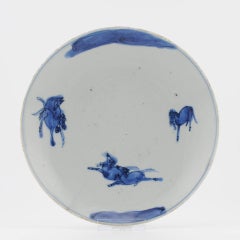
Antique Ming 1620-1644 Chinese Porcelain Kosometsuke 5 Horses Plate Tianqi
Located in Amsterdam, Noord Holland
A Chinese blue and white porcelain Dish of beautiful shape and design. Central scene of 5 horses.
Early 17th century, marked at base.
In symbolism a horse is a wish for a Good job. ...
Category
Antique 17th Century Chinese Ming Ceramics
Materials
Porcelain
$2,344 Sale Price
20% Off
H 1.46 in Dm 8.04 in
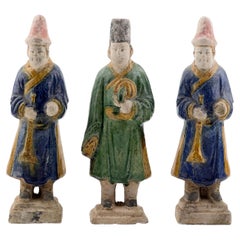
Three Glazed Figures of Musicians, Ming Period (1368-1644)
Located in seoul, KR
Statues of Chinese musicians crafted from terracotta, featuring glazes in green, blue with nice condition. Set on rectangular bases. Compared to other figures, musician figures are relatively rare, two figures with distinctive instrument from that era.
Period: Ming Dynasty
Medium: Green and Blue glazed Pottery
Type: Figure
Provenance : Acquired in early 2000s from Hongkong
Reference :
1) V&A Museum - Accession number C.1501913
(Type : Closely related)
* Ming Dynasty Glazed Pottery Figures
Ming Dynasty glazed pottery figures are renowned for their bold color palette, intricate detailing, and lifelike forms, distinguishing them from earlier traditions. These figures, which depict officials, warriors, animals, and mythical creatures, are characterized by high-gloss lead-based glazes in green, amber, ochre, and sancai (three-color) combinations. The thickly applied glaze pools in recesses, creating depth and enhancing sculptural details. With dynamic postures, expressive facial features, and meticulously rendered drapery, these figures reflect the period’s advancement in ceramic craftsmanship, offering a greater sense of movement and realism compared to the rigid and stylized forms of earlier dynasties.
A defining characteristic of Ming glazed pottery is its elaborate surface detailing, often achieved through raised relief elements and contrasting glazes. Equestrian figures, for example, feature carefully sculpted saddles, harnesses, and decorative embellishments, while human figures are adorned with intricate robes and headdresses. The large scale of these tomb figures, often more imposing than those from previous periods, underscores the increasing importance of funerary art during the Ming era. Unlike later Qing Dynasty figures...
Category
Antique 15th Century and Earlier Hong Kong Ming Antiquities
Materials
Pottery
6 Elegant Ming Dynasty Court Attendants in Glazed Terracotta, China 1368-1644 AD
Located in San Pedro Garza Garcia, Nuevo Leon
A fine set of a six court attendants as in the Forbidden City of Beijing, elegantly dressed in a Green & Red Daopao – a traditional men’s formal attire from the Ming Dynasty dated 1368-1643 A.D. – with glazed robes and Red Pigment remains in their hat and belts. They stand in an honorary posture atop a red plinth, some with orifices in their hands, where spirit objects were placed to comfort or satisfy the deceased. The heads are detachable, as often seen on the larger figures from this period.
They are accompanied by a Certificate of Authenticity, and Certificate of Expertise by Jean-Yves Nathan - a leading authority specialized in Far East Archaeology from the CEDEA (The European Confederation of Art Experts).
Burial figurines of graceful dancers, mystical beasts, and everyday objects reveal both how people in early China approached death and how they lived. Since people viewed the afterlife as an extension of worldly life, these figurines, called mingqi, sometimes referred as “spirit utensils” or “vessels of ghosts” disclose details of routine existence and provide insights into belief systems over a thousand-year period.
The Ming dynasty was the ruling dynasty of China – then known as the Empire of the Great Ming – for 276 years (1368–1644 AD). Founded by Chu Yuan-chang, the rebel leader that was successful in removing the mongols from the throne. Chinese control was re-asserted in China and eastern Asia. Literature became more important, schools were created, and the justice system was reformed. The Ming dynasty is described by some as "one of the greatest eras of orderly government and social stability in human history,” was the last imperial dynasty in China ruled by ethnic Han Chinese.
The practice of burying ceramic objects with the deceased went into decline from the 10th to the 14th Century AD. There was a revival in placing miniature representations of glazed terracotta objects such a furniture, food offerings, horses, miniature statues...
Category
Antique 15th Century and Earlier Chinese Ming Antiquities
Materials
Terracotta

$19,000
H 15.25 in W 5.25 in D 4 in
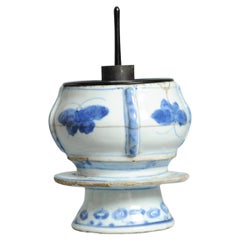
Antique Ming 1620-1644 Chinese Porcelain Kosometsuke Incense Burner Decorated Bu
Located in Amsterdam, Noord Holland
A Chinese blue and white porcelain incense burner. Pictured in the book of Tang Ying Academy about the Kosometsuke exhibition in the Jingdezhen Yanshan Art Museum. Also with beuatifu...
Category
Antique 17th Century Chinese Ming Ceramics
Materials
Porcelain
$4,612
H 3.94 in Dm 3.75 in
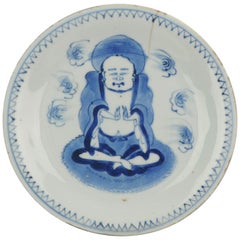
Antique Chinese Wanli / Tianqi Kosometsuke Plate 1600-1644 Porcelain Ming Monk
Located in Amsterdam, Noord Holland
Lovely plate great scene of a monk
Marked at base.
Condition
1 line to rim and some rimfritting/mushikui. 2 firing flaws in base, 1 next to rim and 1 in circle. Size: 188 x 23...
Category
Antique 17th Century Chinese Ming Ceramics
Materials
Porcelain
$2,884 Sale Price
20% Off
H 0.91 in Dm 7.41 in
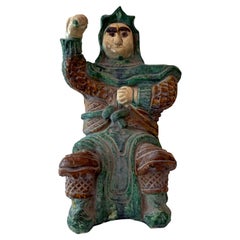
Chinese Ceramic Glazed Guardian Ming Dynasty
Located in Atlanta, GA
A stoneware figure depicting a seated armored warrior with a striking pose circa 15th-17th century. He is likely one of the four heavenly kings, th...
Category
Antique 16th Century Chinese Ming Ceramics
Materials
Stoneware
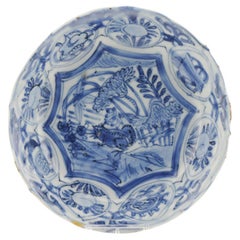
Antique Ming 1600-1644 Chinese Porcelain Wanli / Tianqi Kraak FROG scene Plate
Located in Amsterdam, Noord Holland
A Chinese blue and white porcelain Dish of beautiful shape and design. With a stunning frog scene
Early 17th century, marked at base.
Condition
1 small filled fritspot to rim and ...
Category
Antique 17th Century Chinese Ming Ceramics
Materials
Porcelain
$2,344 Sale Price
20% Off
H 1.58 in Dm 5.63 in
More From This Seller
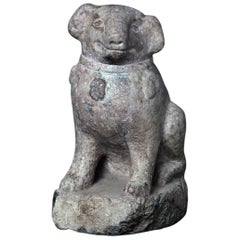
View AllImportant Ancient Chinese Effigy Pug Dog, Ming Dynasty 1368-1644
Located in South Burlington, VT
China, a carving of a canine “Pug”, Ming Dynasty, 1368-1644 CE
Dimensions: 38 cm, 15” High
Photographs taken indoors and out of doors for your viewing pleasure.
The hand carved limestone beast shown on its haunches with naturalistic joyful expression and a well defined compact head, ears, noes, eyes, feet, and tail parted to one side on reverse with distinctive collar ornament seated four square on a thick base all-over showing a weathered surface from significant age.
Formerly exhibited “Asia Week” New York City, Fuller Building, Hutton Gallery 2006.
Provenance: ex collection luoyang, Henan Province, China.
Includes custom display base as shown
Catalog reference: 35 years collecting 35 treasures, Number 35, p.76 (photo)
In ancient China, it is a well-known fact that several types of small dogs were bred and were favored pet gifts between emperors and kings including Lion Dogs, Pekingese and Lo-sze breeds. Some Lo-sze are pictured wearing collars with bells a frequent combination fancied by European royalty of the seventeenth and eighteenth centuries. Lo-sze or pugs were prized for their compact body, good bones, flat face, square jaw, short coat, curled tail, side set back ears, and temperate disposition.
History:
Placing stone animals in important tombs can be traced back at least to the Qin Dynasty (221-206 BCE), some two thousand years ago. In ancient times, stone animals and human figures placed before imperial tombs symbolized royal power and privilege in addition to decorative functions.
The first Ming tomb...
Category
Antique 15th Century and Earlier Chinese Ming Sculptures and Carvings
Materials
Limestone
$6,650 Sale Price
21% Off
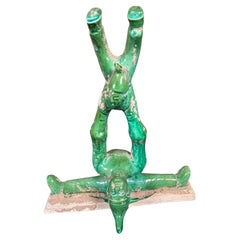
Chinese Ancient Acrobat Entertainers Collection, Ming Dynasty 1368-1644
Located in South Burlington, VT
Ancient Chinese collection of twelve (12) acrobatic entertainers each performing a unique twisting profile , some with with cymbal and drum attributes, Ming Dynasty 1368-1644.
Unmi...
Category
Antique 15th Century and Earlier Chinese Ming Sculptures and Carvings
Materials
Ceramic, Pottery
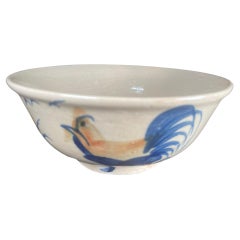
Japanese Fine Large Rooster And Birds Tea Bowl, Hand-Built and Hand Glazed
Located in South Burlington, VT
Mint Kyo ware bowl
From Japan, a beautiful hand-built, painted and glazed, Kyo ware large bowl or large tea bowl with a proud rooster and birds motif created in the 1930s.- over se...
Category
Vintage 1930s Japanese Showa Ceramics
Materials
Ceramic, Pottery
$76 Sale Price
20% Off
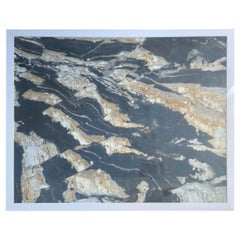
Chinese Extraordinary "Moonlight Peaks" Natural "Painting"
Located in South Burlington, VT
Extraordinary natural stone work of art, one of a kind.
This Chinese extraordinary natural stone "painting" suggestive of a group of mountain peaks landscape features light and dark colors, white, cream, yellow and dark green. This is called a dream stone Shih-Hua. They are cut from historic Dali marble found in the Cangshan Mountains of western China. These mysterious mountains, unique in the world, are known for yielding incredible and fantastic natural landscaped works of art created over tens of millions of years from mineral inclusions that affected the process of ancient organic material which transformed into limestone and finally resulted in marble- a metamorphic hard stone. It is a round cut stone and is set in a circular mat- the image suggests the appearance of a planet.
This art form is centuries of years old since the Ming dynasty. Dream stones became favored art in the west particularly since the 19th century when French collectors named them Pierres de reve.
This thin marble stone is approximately 1/4" thick and is cut from a large slab of rough material revealing incredible patterns in soft white and gray colors. Its weight is surprisingly modest- easily hung with standard hardware.
On occasion, private collectors would invite an artisan to inscribe a poetic description onto their more important dream stones and in this case the artists' seal mark and calligraphy translation reads:
Dimensions:
Frame: 21 inches high and 24 inches wide.
Site: 13 inches by 15 inches
Provenance: Private Chinese collection, Yunnan, China.
History of dream stone "moon light" works of art:
Moonlight...
Category
Late 20th Century Chinese Chinese and East Asian Rugs
Materials
Marble
$760 Sale Price
30% Off
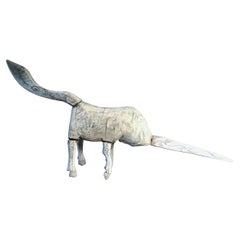
Chinese Ancient Hand Carved Unicorn
Located in South Burlington, VT
A Chinese hand carved and hand painted wooden effigy of an extraordinary unicorn dating to the Song dynasty before 1279 AD.
Please enjoy the beautiful remnants of its aged original ...
Category
Antique 15th Century and Earlier Chinese Antiquities
Materials
Wood
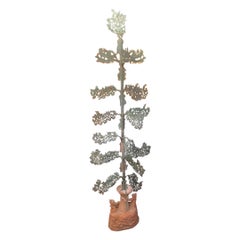
Important Chinese Ancient Bronze Money Tree, 25BC-220AD
Located in South Burlington, VT
China, Ancient Bronze “Money Tree” Yaoqian Shu with original pottery base, Han dynasty (25 BCE – 220 CE)
Dimensions: 155cm, 62 inches high
A sculpted terracotta pottery base in the form of a tortoise with attendants and inserted with five individual bronze pole segments with twenty four individual hanging bronze open work money “branches” attached in tiers, four per tier and topped with a figure of a bronze phoenix as apex most bearing varying degrees of malachite and azurite encrustation from ancient burial.
Important Description Details:
Pottery "tortoise" base: 14.5" high and 11" wide
Bronze sections:
7pcs pole bronze sections approximately 8" length each
1pc top "phoenix" bronze section approximately 7" high and 6" wide
20 pcs long bronze hanging wings approximately 10" long and 5" wide each
4 pcs short bronze hanging wings (near top) approximately 7" long and 4" wide each
Total 32 pcs with ancient green and blue azurite patina.
Catalog reference: Schneible Fine arts catalog - 35 Years Collecting Treasures- Number 11p. 28 (see photos)
Provenance: Provenance: Private family collection formerly exhibited “Asia Week” New York City, Fuller Building, Zabriskie Gallery, 2008.
History of money trees:
In the late Han Dynasty tombs...
Category
Antique 15th Century and Earlier Chinese Han Antiquities
Materials
Bronze
$100,000 Sale Price
33% Off
Still Thinking About These?
All Recently ViewedMore Ways To Browse
Hand Painted Made In Hong Kong Vase
End Table Wood Glass Top
French Iron And Marble Table
Mid Century Curved Arm Chair
Mid Century Green Lounge Chairs
Midcentury Modern Sectional
Resin Base
Wabi Sabi Wood
Wood Bar Stool With Back
Antique Conservatories
Antique Conservatory
Antique Wood Handle
Century Furniture Cane Back Dining Chairs
French Mid Century Tapestry
Peruvian Vintage
Vintage Rattan Seating
Wall Hanging Sculptures
1950s Glass Top Coffee Table