Armchair by Ico Parisi, Gio Ponti, Gianfranco Frattini
About the Item
- Creator:
- Dimensions:Height: 31.89 in (81 cm)Width: 34.65 in (88 cm)Depth: 26.19 in (66.5 cm)
- Materials and Techniques:
- Place of Origin:
- Period:
- Date of Manufacture:1954
- Condition:Wear consistent with age and use. 66,5 x 88-106 x back h 81-102 cm.
- Seller Location:Milan, IT
- Reference Number:Seller: 43641stDibs: LU106181715992
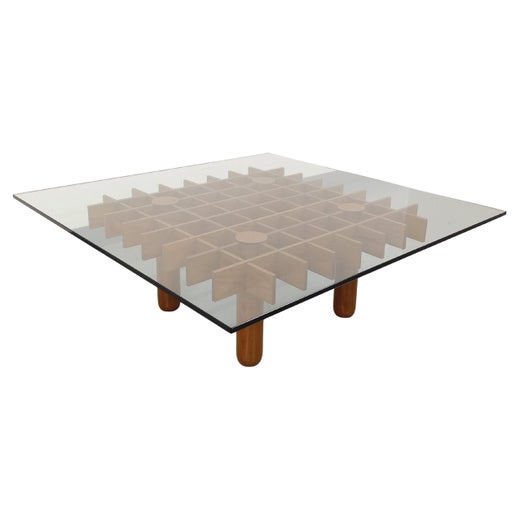
Gianfranco Frattini
Gianfranco Frattini is widely regarded as a mid-century master of Italian modern design. He was an award-winning architect and designer, and specialized in creating furniture and decor that is both decorative and practical — Frattini’s vintage desks, armchairs, nesting tables and other works are celebrated for their sophisticated merging of function and form.
Born in Padua in 1926, Frattini studied architecture at the Polytechnic University of Milan. He later apprenticed with his teacher and mentor, Gio Ponti. Through Ponti — arguably the most important figure in 20th-century Italian architecture and design — Frattini met many notable modernist designers such as Oscar Niemeyer and Le Corbusier, but an introduction to famed Italian entrepreneur Cesare Cassina would prove incredibly significant in helping launch his career.
During the mid-1950s, Frattini began to collaborate with Cassina’s eponymous company. He designed the brand’s acclaimed leather and walnut Model 849 lounge chair — a winner of the Compasso d’Oro award — the Marema nesting tables and the iconic Sesann collection. The latter, an enduring 1970s suite of impossibly welcoming leather-covered seating, is now produced by Tacchini. In addition to Cassina, Frattini created furniture and lighting for other manufacturers such as Bernini, Arteluce, Artemide, Knoll and more.
While many of his designs incorporate glass, tubular steel and other materials, Frattini loved working with wood. The sculptural Albero bookcase — an innovative floor-to-ceiling structure made in walnut that swings on a 360-degree vertical swivel axis — is a striking example of Frattini’s dedication to traditional woodworking techniques. In the early 1970s, he traveled to Japan with friend and collaborator Pierluigi Ghianda — a master Milanese cabinet maker — in order to study the work of artisans in Kyoto. The trip inspired his design of the Kyoto table, a work of solid beech with Canaletto walnut inserts that is part of the permanent collection of the Milan Triennale’s Design Museum. The Kyoto and Albero have been revived by Poltrona Frau.
Frattini’s designs are in the permanent collections of prestigious museums such as the Museum of Modern Art and the Cooper Hewitt, Smithsonian Design Museum.
Find vintage Gianfranco Frattini furniture, lighting and decor on 1stDibs.
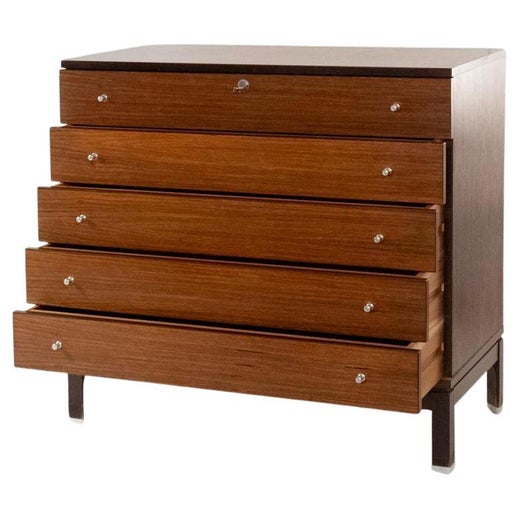
Ico Parisi
Domenico “Ico” Parisi was one half of a prolific postwar design duo he comprised with his wife, Luisa. Their furniture designs are known for running the stylistic gamut, with celebrated mid-century modern pieces ranging from elegantly skeletal — like dramatic ebonized dining chairs — to plush and shapely, like the iconic 1951 Egg chair, in a plethora of materials.
The son of an art teacher father, Ico Parisi was exposed to art at an early age. Born in 1916 in the Sicilian capital of Palermo, he and his family moved to Como in 1925. There, the young Parisi would begin to develop his interest in architecture and design. After earning a degree as a building inspector in 1936 and working as a civil engineer, Parisi took on an apprenticeship in the studio of Giuseppe Terragni, the modernist, fascist Italian architect, pioneer of the Rationalist movement and creator of the iconic Casa del Fascio.
While working for Terragni, Parisi crossed paths with such contemporary design talents as Lucio Fontana, Bruno Munari and Pietro Lingeri, though he briefly moved away from design and architecture to explore photography and film. His artistic work would soon be interrupted, however, by the outbreak of World War II, during which he served at the front before returning to Como in 1943. There, he resumed work as a designer and architect, founding two architecture groups: the Alta Quota and the Gruppo Como.
Through his creative circles, Parisi met Luisa Aiani, a former student of the prolific architect and furniture designer Gio Ponti, who was affiliated with the Alta Quota. They married in 1947 and founded the studio La Ruota — a cross between a design firm and an intellectual salon — in Como shortly thereafter. In 1950, Parisi finally completed his architectural schooling, studying under the nationalist architect Alberto Sartoris at the Athenaeum Architecture School in Lausanne, Switzerland. He and Aiani began several decades of sophisticated output, designing curved sofas upholstered in yellow velvet and armchairs with slender mahogany frames for enduring Italian manufacturers such as Cassina and others.
Much like Charles and Ray Eames in America, the Parisis worked as a team and relied on experimentation in style and material for many of their designs. Ico Parisi died in Como in 1996.
Find a collection of vintage Ico Parisi coffee tables, dining chairs and more on 1stDibs.
You May Also Like
Vintage 1950s Italian Modern Ottomans and Poufs
Iron
2010s Italian Mid-Century Modern Armchairs
Metal
2010s Italian Mid-Century Modern Armchairs
Metal
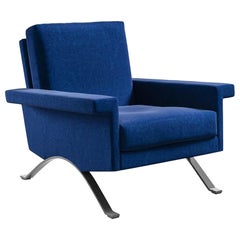
2010s Italian Mid-Century Modern Armchairs
Metal
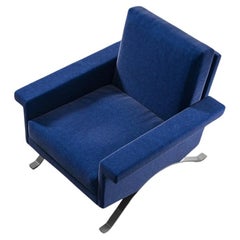
Vintage 1950s Italian Mid-Century Modern Armchairs
Fabric, Wood
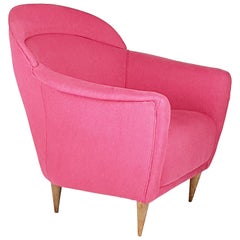
2010s Italian Armchairs
Leather, Fabric
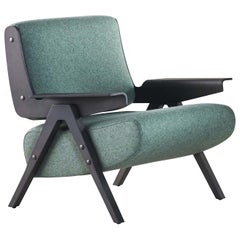
2010s Italian Armchairs
Leather, Fabric
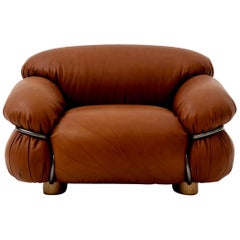
Mid-20th Century Mid-Century Modern Armchairs
Bamboo, Cane
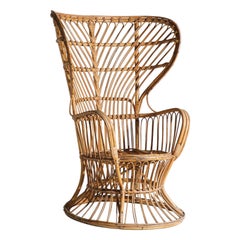
Mid-20th Century Italian Mid-Century Modern Armchairs
Leather, Rosewood, Walnut
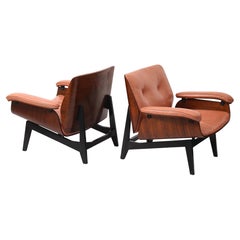
Vintage 1950s Italian Mid-Century Modern Armchairs
Oak
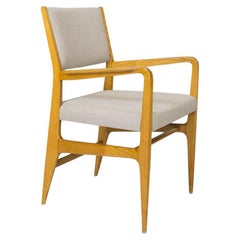
Still Thinking About These?
All Recently ViewedRead More
Billy Cotton Layers His Interiors with Lived-In Comfort
The Brooklyn-based designer is adept at styles ranging from austere to over-the-top, espousing an architectural, detail-oriented approach also evident in his line of furniture and lighting.
Italian Design Legend Giò Ponti Makes a Splash in Paris
A blockbuster exhibition at the Musée des Arts Décoratifs shows the work of the modernist master in a brilliant new light.