Items Similar to Pair of Consulat Ebony-Inlaid Birchwood Armchairs Stamped Jacob Frères
Want more images or videos?
Request additional images or videos from the seller
1 of 9
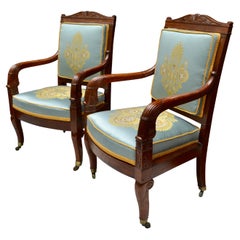
Pair of Consulat Ebony-Inlaid Birchwood Armchairs Stamped Jacob Frères
$17,500per set
£13,362.67per set
€15,213.88per set
CA$24,572.76per set
A$26,862.84per set
CHF 14,211.65per set
MX$321,457.06per set
NOK 180,822.86per set
SEK 165,525.03per set
DKK 113,638.24per set
Quantity
About the Item
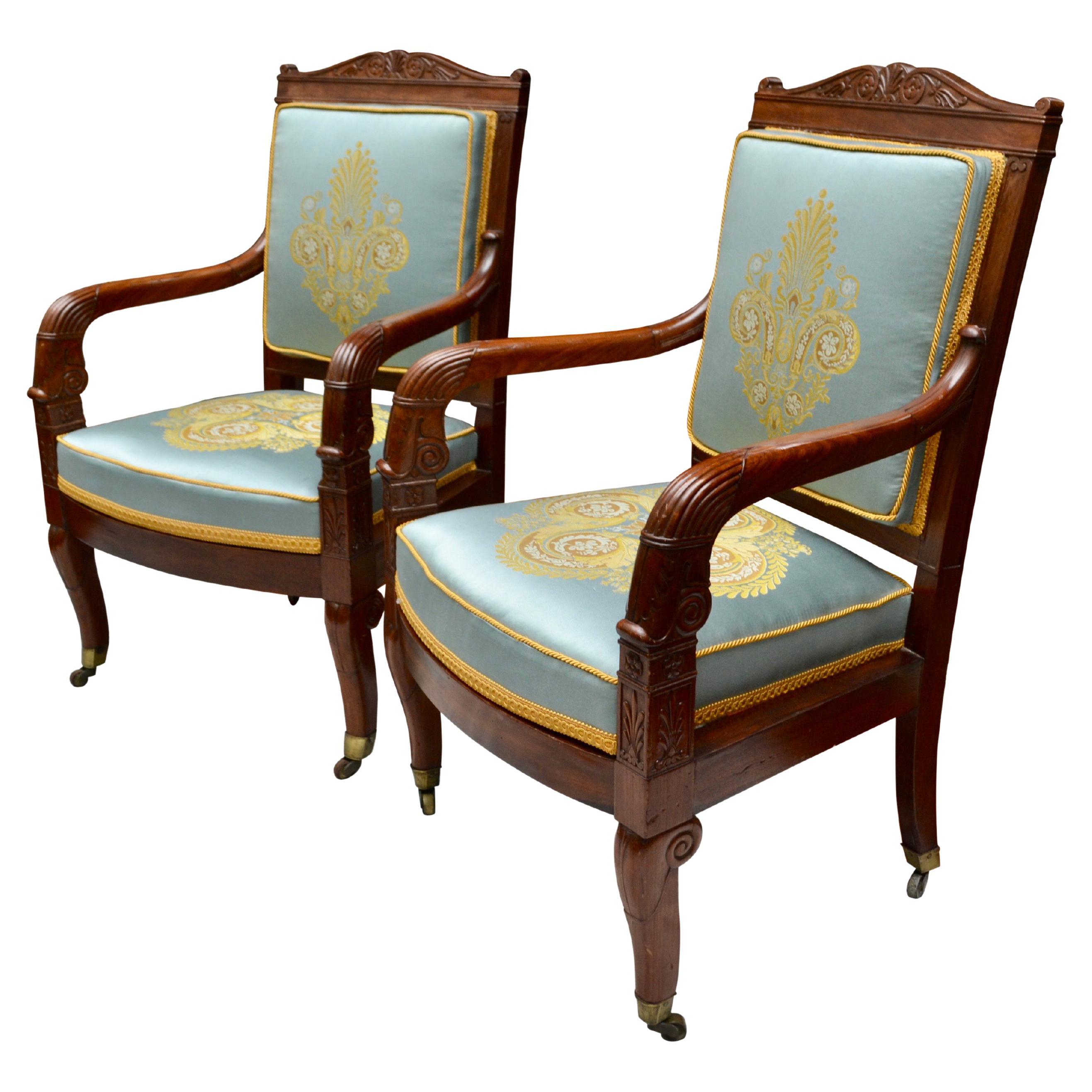
The curved pierced back with a palmette-inlaid shaped splat terminating in dolphin supports raised on an upholstered seat, on front carved joined hairy animal legs (pieds de bîches) and hoof feet and back sabre legs; stamped: JACOB FRERES RUE MESLEE under the front rail. For a similar dolphin support, see Madeleine Jarry and Pierre Devinois, Le Siège Français, pp. 267 and 271 illustration 264 for an armchair at the Musée Marmottan stamped G. Jacob and executed in 1792.
Provenance: Millicent Rogers
her son, Arturo Peralta Ramos II
Jacob Frères was the stamp used by brothers Georges II (1768-1803) and Francois-Honore Jacob (1770-1841) from 1796 to 1803. They were sons of Georges Jacob (1739-1814), arguably the best-known chair maker who worked for aristocracy and royalty during the reign of Louis XVI.
The Jacob Frères firm's most famous client was Josephine, wife of Napoleon Bonaparte. She would have most likely seen the work of their father during the revolution in a progressive aristocrat's house. She used them to decorate various Imperial residences, such as the Tuileries palace, and remained a loyal customer, using them almost exclusively, until her death. When Georges II (the elder brother) died in 1803, Georges came out of retirement to help the remaining son, Francois-Honoré (who changed his named to Jacob Desmalter) from a new partnership called Jacob Desmalter Et Cie. (stamped Jacob D. R. Meslée, on two lines), which continued to be an influential supplier for the Imperial period and is credited with helping to define the Empire style as it is known today.
Millicent Rogers, born Mary Millicent Abigail Rogers, was a Standard Oil heiress, but she wasn’t a poor little rich girl or a pushover, and she changed her fashion, decorating and living styles a number of times during her relatively brief life. At one time, the heiress’ art collection had included as many as a dozen paintings by Henri de Toulouse-Lautrec, along with canvases from Claude Monet and Paul Cezanne. Because of a childhood bout with rheumatic fever, she had then-difficult-to-treat lifelong problems with her heart and died at only 51 in 1953.
A 5’9” beauty with arching brows, alabaster skin and a biting wit, Rogers was a popular debutante whose first marriage at 21 to Austrian Count Ludwig von Salm-Hoogstraeten, with whom she had her first son, Peter, was opposed by her parents. Because of this, her father, Henry Huttleston Rogers II — the son of H.H. Rogers, who founded Standard Oil with John D. Rockefeller, and who also had interests in U.S. Steel and Anaconda Copper — gave her only a tiny allowance.
Rogers never made the mistake of angering her father again. Her second marriage was to Arturo Peralta-Ramos, the playboy scion of a wealthy Argentinian family, and she had two sons with him, Arturo II and Paul. Her third husband, Ronald Balcom, was an American stockbroker and she lived with him in the Arlberg mountains of Austria until Adolf Hitler’s rise to power made that impossible. Later, her beaux included Clark Gable, Ian Fleming and Roald Dahl. She bred dachshunds, and when she returned to the U.S. in 1940, had large groups of them in tow.
- Creator:Jacob Freres (French) (Cabinetmaker)
- Dimensions:Height: 34 in (86.36 cm)Width: 20.75 in (52.71 cm)Depth: 24 in (60.96 cm)Seat Height: 19 in (48.26 cm)
- Sold As:Set of 2
- Style:Empire (Of the Period)
- Place of Origin:
- Period:
- Date of Manufacture:Early 19th Century
- Condition:Wear consistent with age and use. Minor losses.
- Seller Location:Kittery Point, ME
- Reference Number:Seller: 20051stDibs: LU83768752073
About the Seller
5.0
Gold Seller
Premium sellers maintaining a 4.3+ rating and 24-hour response times
Established in 2004
1stDibs seller since 2007
86 sales on 1stDibs
Typical response time: 1 hour
- ShippingRetrieving quote...Shipping from: Kittery Point, ME
- Return Policy
More From This Seller
View AllPair of Consulat Mahogany Armchairs
Located in Kittery Point, ME
The rectangular arched padded back above a padded seat and tapering front legs topped with the head of a sphinx and ending in paw feet.
Category
Antique 19th Century French Empire Armchairs
Materials
Wood, Fabric, Mahogany
$10,000 / set
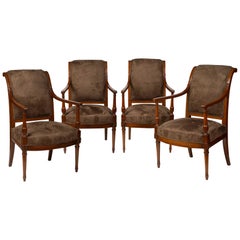
Set of Four Directoire Mahogany Armchairs by Jacob Freres
By Jacob Freres (French)
Located in Kittery Point, ME
Each upholstered backrest with backscrolled top rail above an upholstered seat flanked by arm rests, raised on ring-turned legs; each stamped JACOB FRERES / RUE MESLEE on back rail, three with old inked inscription M Julien...
Category
Antique 1790s French Directoire Armchairs
Materials
Mahogany
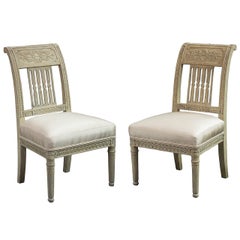
Pair of Directoire Cream-Painted Slipper Chairs
Located in Kittery Point, ME
Each with a rectangular carved panelled top rail above a pierced vertical splat and an upholstered seat, raised on front tapering circular legs and saber back legs.
The exquisite qu...
Category
Antique Late 18th Century French Directoire Chairs
Materials
Silk, Wood
$7,750 / set
Directoire Mahogany Bergère Attributed to Georges Jacob
By Georges Jacob
Located in Kittery Point, ME
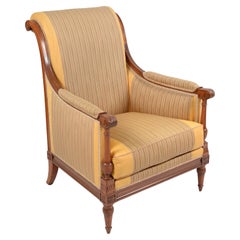
A Directoire Mahogany Bergère Attributed to Georges Jacob, its curved back and padded armrests with finely carved baluster-shaped supports raised on turned front legs and sabre back legs.
With a spurious Jacob stamp to back rail.
The term "Directoire" refers to a historical period following the French Revolution (1789) and preceding the First Empire when Napoleon reigned, but also to a style of furniture and decoration covering a longer period from 1789 to 1804. It is characterized by the production of furniture with simplified forms and ornaments, inspired by antique decorations.
The profound social and political upheavals that marked this period had a direct impact on the production of Directoire furniture. The stripping down of furniture pieces, which had begun in the 1780s under the influence of Greek art, was accentuated during this period. The abolition of guilds by the revolutionaries also forced manufacturers in the Faubourg Saint-Antoine to simplify shapes and materials.
Elegant and graceful, the furniture is generally small-scale. They retain the Louis XVI structure. The Directoire style adopts clean shapes, straight lines, simple curves, flat surfaces and right angles. Lines accentuate geometric shapes inspired by Antiquity. A typical trait is the pronounced rolled-over back, similar to a scroll illustrated in our bergere, evocative of the klismos chair. Only the more luxurious pieces of furniture use mahogany, an exotic and expensive wood.
Despite his humble origins, Georges Jacob rose to become one of the most renowned menuisiers of his day. Unlike many artisans who joined their fathers or brothers in the middle-class family trade of furniture making, Jacob was from a peasant family and moved to Paris at sixteen to begin his career. He apprenticed in a joinery workshop and eventually became a master in 1765. He developed a reputation for producing inventive designs for chairs, beds, and screens carved with such motifs as twisted ribbons, guilloches, beading, and fluting.
Jacob's reputation grew quickly, eventually spreading outside France; the future King George IV of England, Gustavus III of Sweden, and several German princes...
Category
Antique Late 18th Century French Directoire Bergere Chairs
Materials
Mahogany
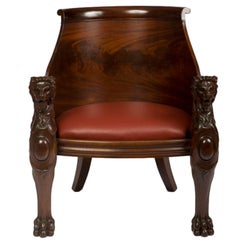
Regency Mahogany Desk Armchair
Located in Kittery Point, ME
The mahogany barrel back with an outscrolled crestrail and a dark red leather bowed seat raised on back saber legs and lion's mask and cartouche-carved monopodia.
Category
Antique 19th Century English Regency Office Chairs and Desk Chairs
Materials
Mahogany
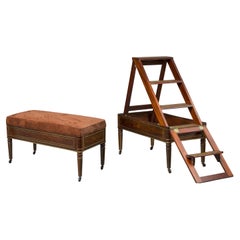
Regency Brass Inlaid Rosewood Metamorphic Bench
Located in Kittery Point, ME
The rectangular padded seat covered in brown leather, opening to reveal a set of library steps, over a solid inlaid seat-rail and ring-turned tapering legs ending in castors.
18in. high, 34 1/2in. wide and 16 1/2in. deep. Opened, 36in. high and 49in. wide.
Rooms organized during the Regency period as libraries often had floor-to-ceiling bookshelves. The upper shelves were difficult to reach, so movable library stairs were invaluable. Further, libraries were one of the most important rooms in a stately house, symbol of its owner's wealth, culture and status. As a consequence, designers, architects and cabinet or chair makers devoted much attention to its architecture and decoration. Hence, the emrgence of innovative ideas such as our bench.
Enter the Regency era metamorphic library chair/bench (chairs are more common than benches)!
The tables, chairs and stools containing library steps were patented in Great Britain by Robert Campbell in 1774 but this innovative chair-based design did not become immediately popular. Once the Regency was established, a neo-classical interpretation of Campbell’s Metamorphic Library Chair concept started to become popular in London. Any early attributions rely heavily on two contemporary sketches...
Category
Antique Early 19th Century English Regency Benches
Materials
Brass
You May Also Like
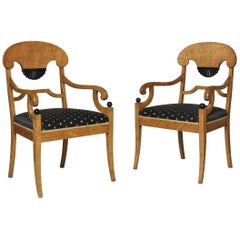
Pair of Biedermeier Style Satin Birchwood and Ebonized Armchairs
Located in London, GB
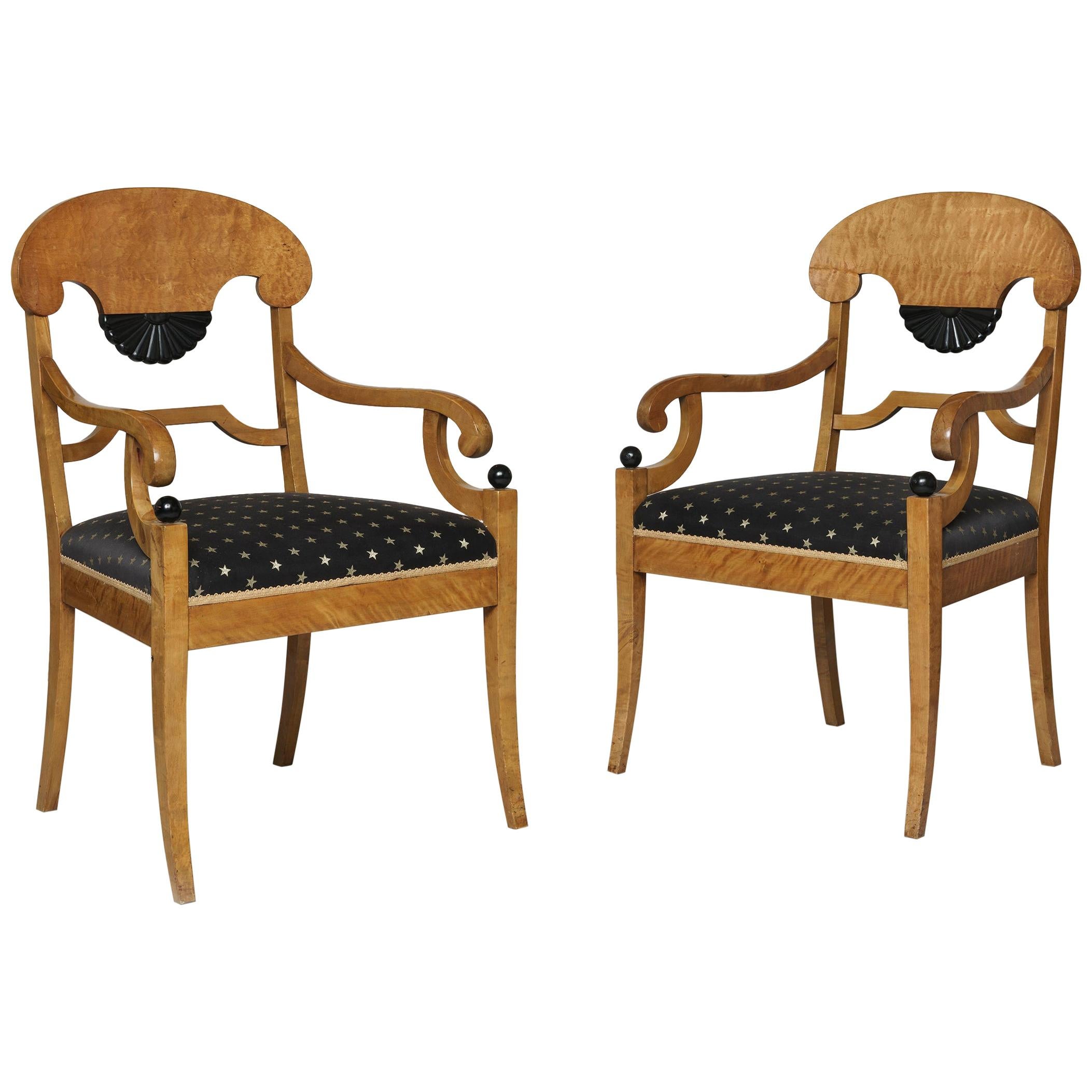
A fine pair of Biedermeier style satin birchwood armchairs
The plume shaped top rail extending to midway between the stiles, terminating in an ebonised fan shaped splat, above a s...
Category
Antique Late 19th Century Austrian Biedermeier Armchairs
Materials
Upholstery, Birch
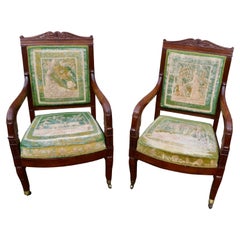
Pair of French Empire Mahogany Armchairs One Stamped J Louis
By Jean Pierre Louis
Located in Vancouver, British Columbia
A classic pair of French Empire period open armchairs each with a square back topped by a bow shaped carved frieze featuring folliate rosettes and downscrolled arms. Where the arms ...
Category
Antique Early 19th Century French Empire Armchairs
Materials
Mahogany
Pair of Austrian Biedermeier Veneer Armchairs
Located in Queens, NY
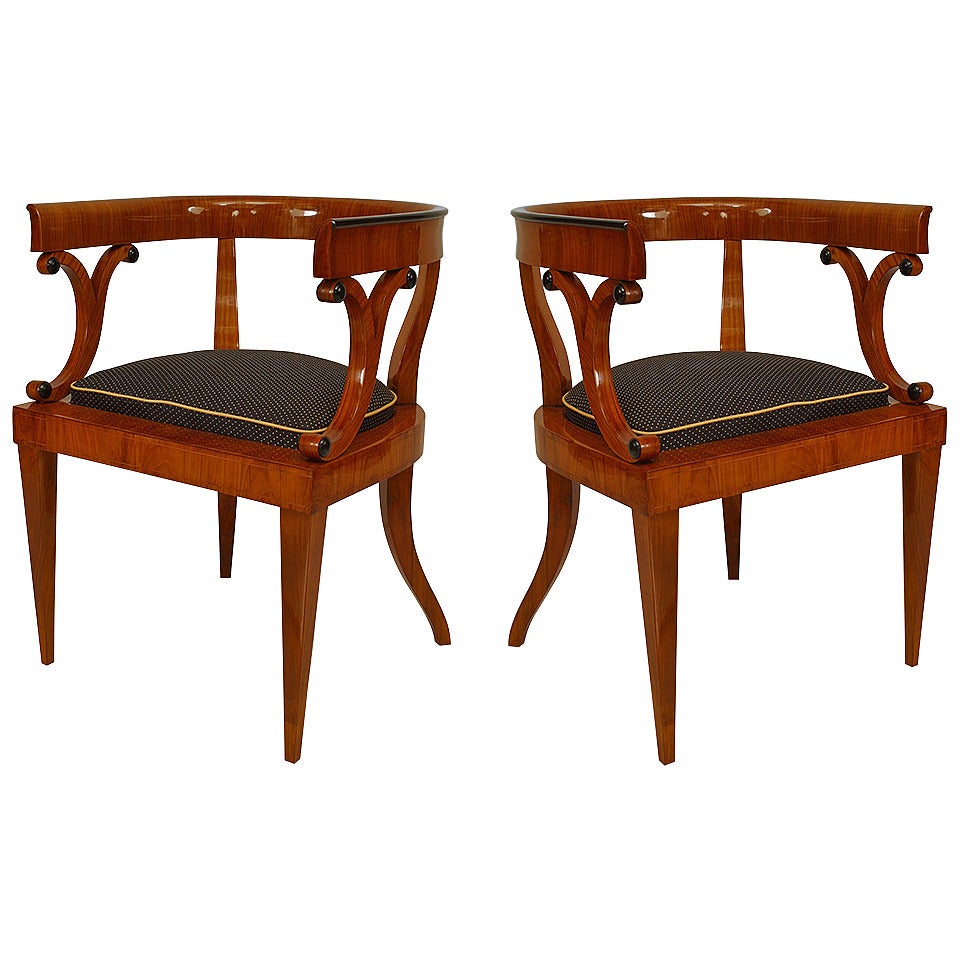
Pair of Austrian Biedermeier (1830s) cherry veneer armchairs with round back design and maple inlay
ebonized details with an inset upholstered seat.
Category
Antique 19th Century Austrian Biedermeier Armchairs
Materials
Cherry, Maple, Wood, Upholstery

$22,500 / set
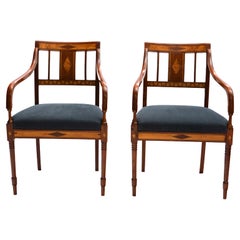
Pair of Danish Empire Mahogany With Inlay Arm Chairs
Located in Kastrup, DK
A pair of elegant Danish early 19th century empire armchairs.
Crafted in mahogany with ebony and satinwood marquetry on backrest and apron.
Apron and upper part of backrest decorated...
Category
Antique Early 19th Century Danish Empire Armchairs
Materials
Hardwood, Mahogany, Satinwood
Pair of French Empire Mahogany Armchairs Attributed to Jean-Pierre Louis
By Jean Pierre Louis
Located in Vancouver, British Columbia
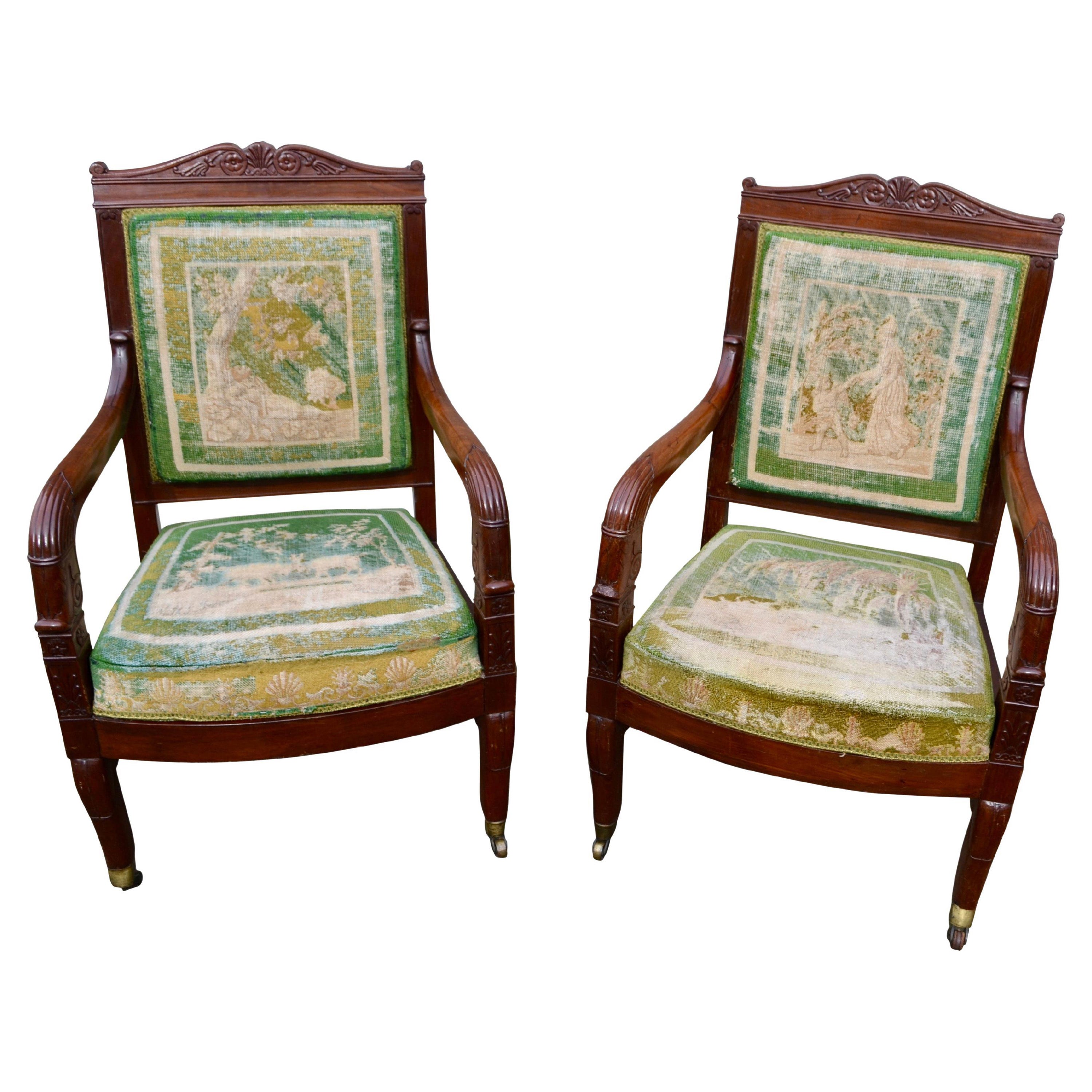
A classic pair of French Empire period open armchairs in well figured and carved mahogany; each with a square back topped by a bow shaped carved frieze featuring folliate rosettes and downscrolled arms. Where the arms join the chair rail there are carved anthemians and palmettes. These two chairs are presented in the original now faded and worn gros point green upholstery and have their original casters.
These two armchairs are actually part of a set of six. The set was split up in three sets of two's to make them more saleable. Four of the six have been re-upholstered in sympathetic empire fabric...
Category
Antique Early 19th Century French Empire Chairs
Materials
Mahogany, Silk
Pair of Geo Smith English Regency Ebonized Bergére Armchairs
Located in Queens, NY
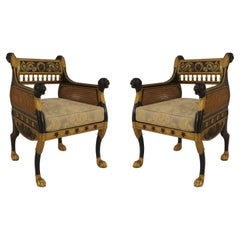
Pairof English Regency (20th Century) ebonized and gilt trimmed bergere Armchairs with cane sides and carved lion heads on back and arms. (Reproduction of Geo Smith design) .
Category
20th Century Regency Chairs
Materials
Cane