Items Similar to pair of secessionist armchairs Joseph Maria Olbrich Friedrich Otto Schmidt 1898
Want more images or videos?
Request additional images or videos from the seller
1 of 12
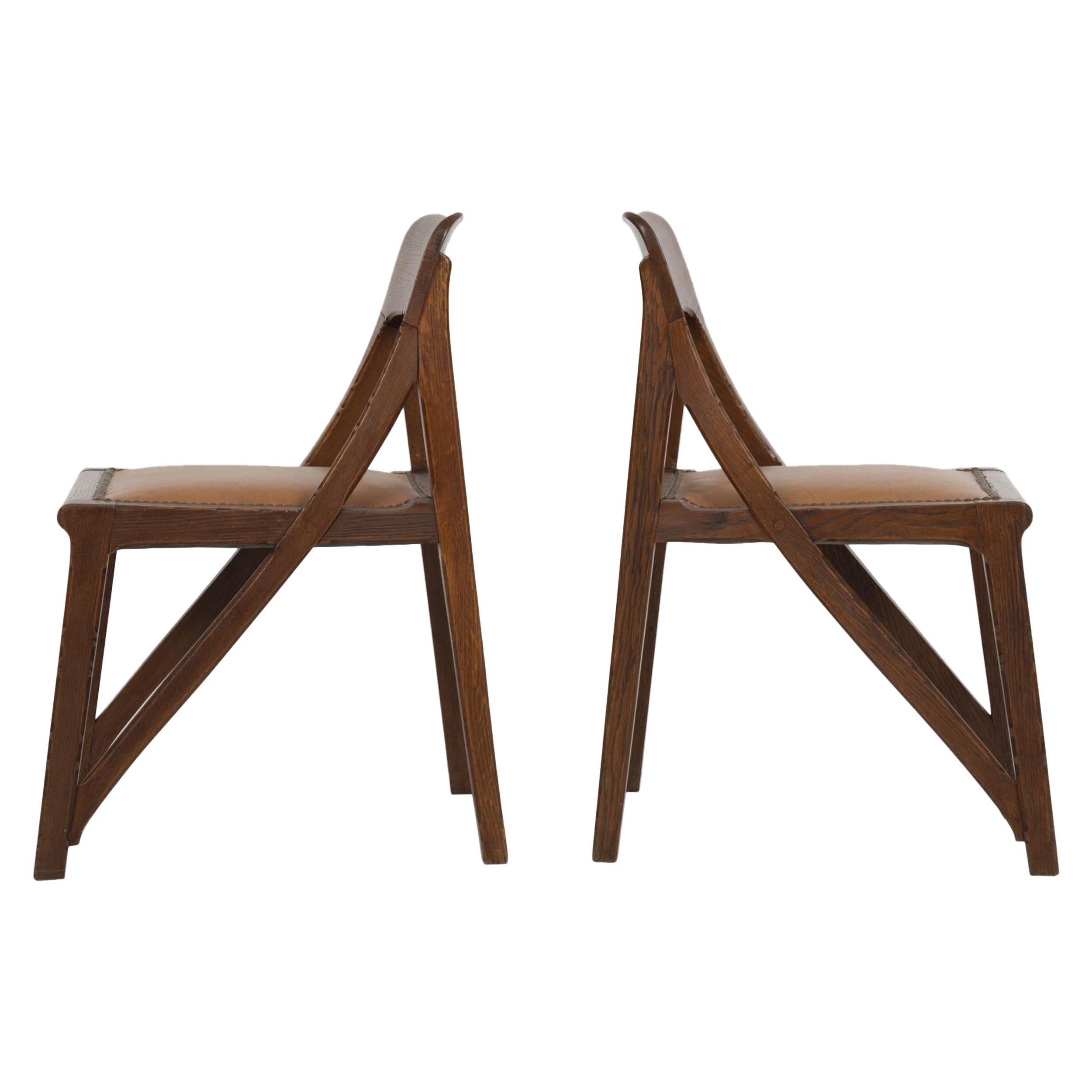
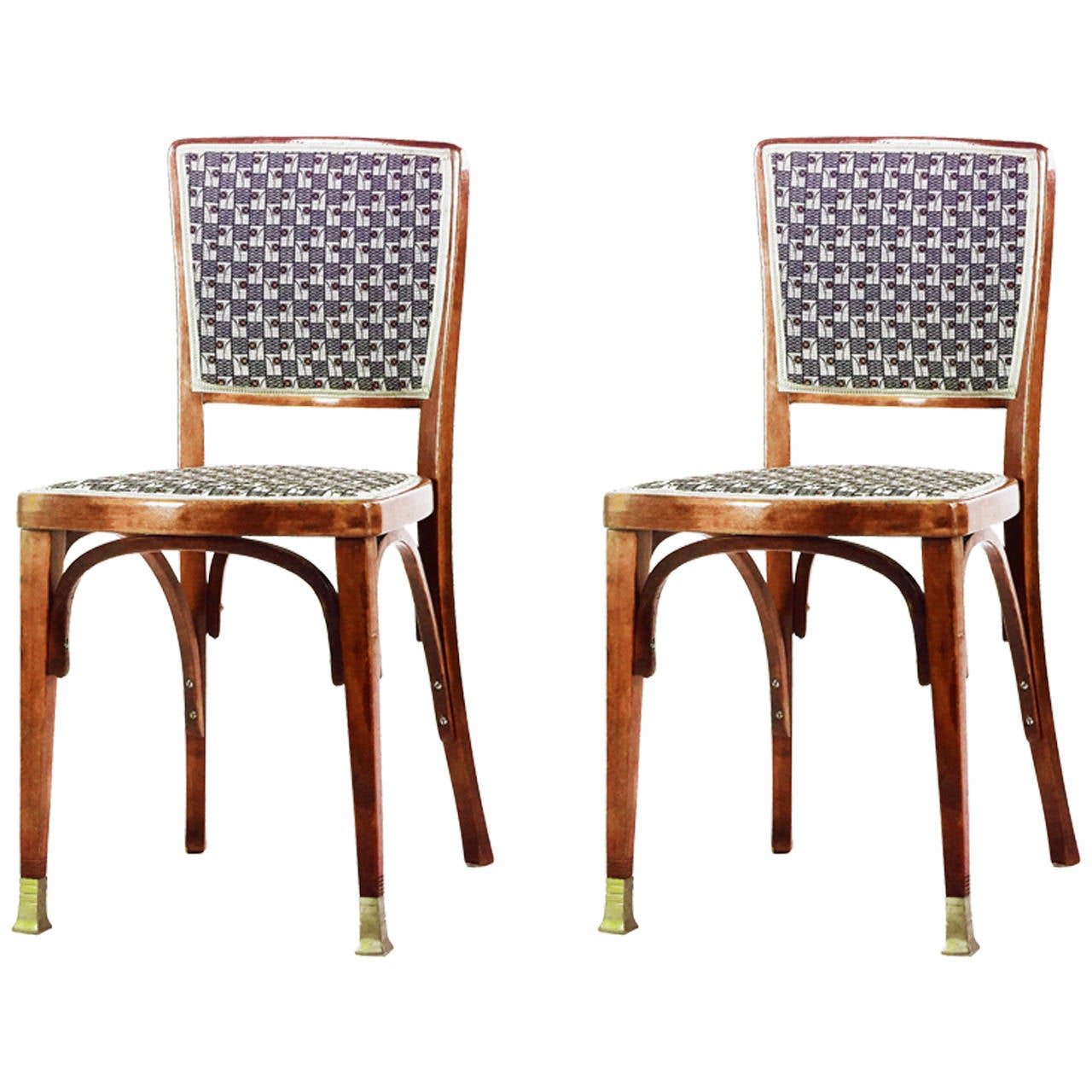
pair of secessionist armchairs Joseph Maria Olbrich Friedrich Otto Schmidt 1898
$628,993.02
£469,187.91
€530,000
CA$875,463.93
A$939,216.15
CHF 503,776.23
MX$11,308,036.47
NOK 6,350,690.90
SEK 5,790,950.01
DKK 4,039,003.18
About the Item
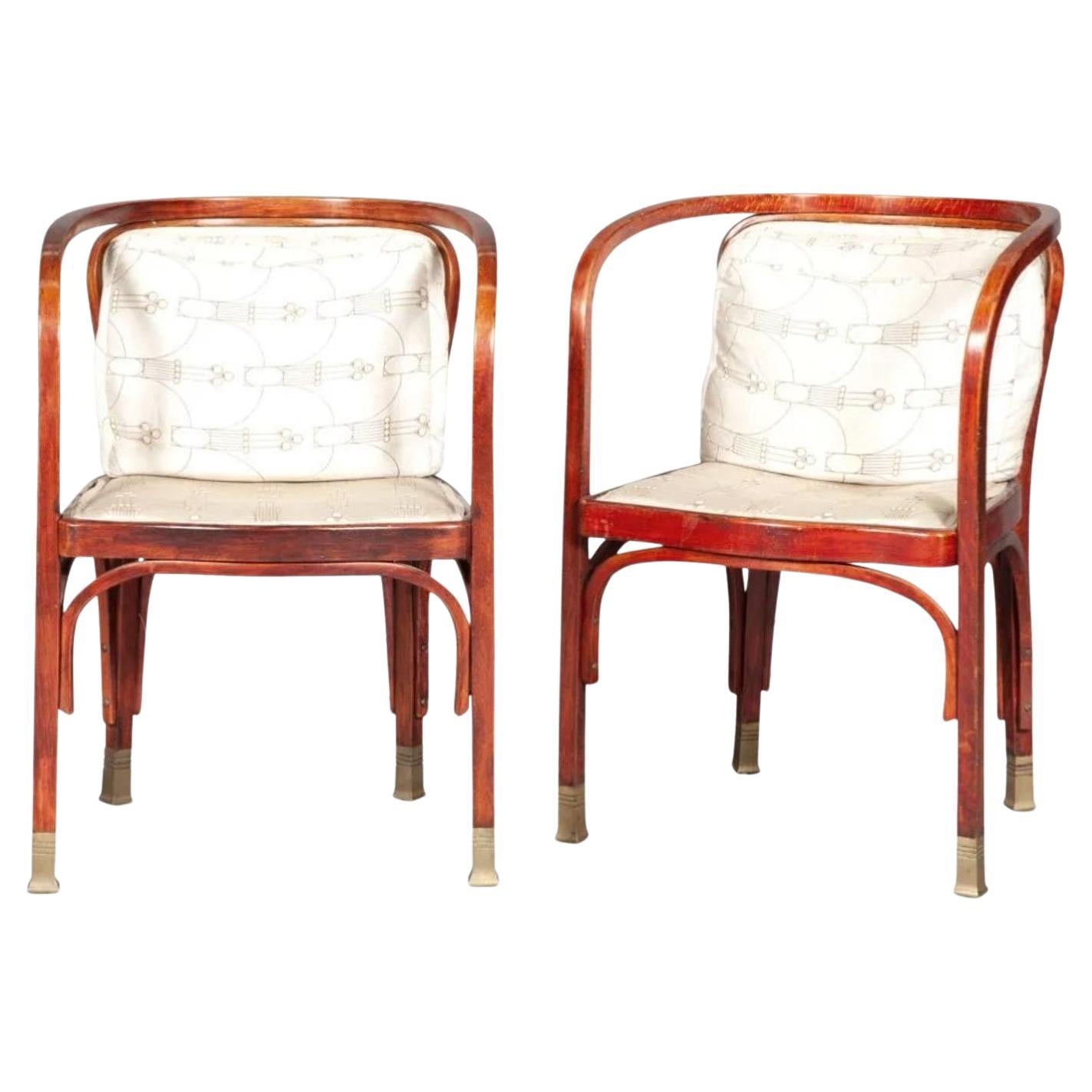
pair of secessionist armchairs, Joseph Maria Olbrich (design), Friedrich Otto Schmidt (execution), 1898
technique: solid oak, brass, fabric (Backhausen, model “Abimelech”, designed by Koloman Moser 1899)
lit.: Dekorative Kunst - Illustrierte Zeitschrift für angewandte Kunst, Band 2, 1898, p. 260 / Deutsche Kunst und Dekoration, Band 3, 1898-1899, Alexander Koch, Darmstadt, p. 208 / Deutsche Kunst und Dekoration, Band 3, 1898-1899, Alexander Koch, Darmstadt, p. 209 / Ver Sacrum, Heft 19, 1900, S. 288 / Ver Sacrum, Heft 19, 1900, p. 289 / Ver Sacrum, Organ der Vereinigung bildender Künstler Österreichs, 1. Jahrgang, 1898, p. 26 / Fabric: Kolo Moser, Doldentraum "Abimelech", 1899, Backhausen
The two armchairs were created in 1898 based on designs by Joseph Maria Olbrich for the second exhibition of the Vienna Secession, which was officially opened on November 12 in the newly constructed Secession building at Friedrichstraße 12, 1010 Vienna. This presentation is considered the most significant in the early history of the Secession, as it was the first to take place in the specially constructed building and showcased the new exhibition venue to its full effect. The chairs were displayed in the “Arts and Crafts Room”—a space in which the association's new aesthetic program, the removal of boundaries between art and applied design, was expressed in a harmonious unity of form, material, and idea. The strict lines, geometric clarity, and focus on basic tectonic forms are closely related to other seating furniture that Olbrich created for this exhibition, especially those in the “vestibule” and the “main exhibition hall.” While Josef Hoffmann designed the famous “Ver Sacrum” room and chose a much more restrained design language there (chairs with lower backrests), these armchairs bear Olbrich's unmistakable signature. The pieces were most likely produced by the Vienna workshop “Friedrich Otto Schmidt.” Founded in Vienna in 1859, the company developed from a wallpaper business into a leading studio for interior design and maintained close ties to artists and architects of the Vienna Modernism movement. Under Max Hermann Schmidt, the company collaborated with Adolf Loos, Josef Hoffmann, and the Vienna Secession, among others, took on major commissions for exhibitions, and had a decisive influence on modern interior design. The catalogue's expression of gratitude to Schmidt “for the decorative furnishings of our house and our exhibition” supports the assumption that the chairs originated from his workshop. For the new upholstery, the fabric “Abimelech” by Koloman Moser for Backhausen
Söhne was chosen – a design from 1899 that had already been used for curtains and a sofa at the 1900 Paris World's Fair. “Abimelech” means “father of the king” or “my father is king” and lends the chairs a symbolic depth: the high backrests create a throne-like presence, while the name refers to dignity, authority, and sovereign calm. The combination of form, material, and name blends craftsmanship, artistic vision, and symbolic meaning into a unity that lends the furniture not only elegance but also an almost mythical aura. At the same time, the choice of fabric illustrates the close cooperation within the Secession and builds an aesthetic bridge between Olbrich's design and Moser's visionary textile design.
- Creator:Friedrich Otto Schmidt (Manufacturer),Joseph Maria Olbrich (Designer)
- Dimensions:Height: 49.41 in (125.5 cm)Width: 21.66 in (55 cm)Depth: 24.81 in (63 cm)Seat Height: 19.1 in (48.5 cm)
- Style:Jugendstil (Of the Period)
- Materials and Techniques:
- Place of Origin:
- Period:
- Date of Manufacture:1898
- Condition:Reupholstered. Wear consistent with age and use.
- Seller Location:Klosterneuburg, AT
- Reference Number:Seller: 11301stDibs: LU5830247719932
About the Seller
5.0
Vetted Professional Seller
Every seller passes strict standards for authenticity and reliability
Established in 2013
1stDibs seller since 2021
19 sales on 1stDibs
Typical response time: <1 hour
- ShippingRetrieving quote...Shipping from: Vienna, Austria
- Return Policy
More From This Seller
View AllViennese Art Nouveau chair by Josef Hoffmann ca. 1902
By Josef Hoffmann
Located in Klosterneuburg, AT
This piece is a significant example of furniture designed by Josef Hoffmann, created as a variation of the furnishings for the apartment of Dr. Salzer. Its strict, architectural desi...
Category
Antique Early 1900s Austrian Jugendstil Chairs
Materials
Softwood
Set of 6 chairs Fritz Nagel Adolf Nagel Schule school of Josef Hoffmann ca. 1910
By Fritz Nagel
Located in Klosterneuburg, AT
Set of 6 chairs, Fritz Nagel (design), Adolf Nagel (execution), school of Josef Hoffmann, ca. 1910
The chairs are part of a complete set of furniture.
Technique: Solid oak, stained...
Category
Early 20th Century Austrian Art Nouveau Dining Room Chairs
Materials
Brass
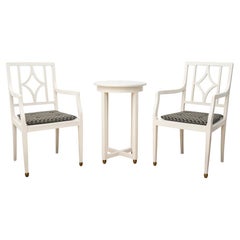
Viennese seating ensemble Mauritius Herrgesell school of Koloman Moser ca. 1902
By Mauritius Herrgesell
Located in Klosterneuburg, AT
Table height: 77 cm diameter: 50.5 cm.
Armchairs height: 96 cm width: 55 cm length: 55 cm
His famous teacher was none other than Josef Hoffmann. Herrgesell benefited above ...
Category
Early 20th Century Austrian Art Nouveau Tables
Materials
Beech
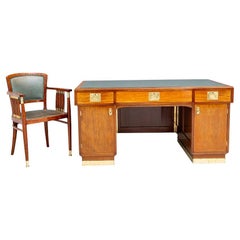
Viennese Jugendstil desk and armchair J.W. Müller ca. 1905
By J.W. Müller
Located in Klosterneuburg, AT
Table dimensions: H 78 cm x W 152.5 cm x D 83 cm Armchair: H 90 cm x W 58 cm x D 52 cm
The K. u. K. Hoftischlerei J. W. Müller was one of the leading workshops. It regularly prese...
Category
20th Century Austrian Art Nouveau Desks and Writing Tables
Materials
Mahogany
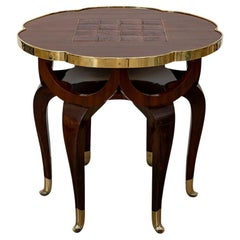
A. Loos "Elefantenrüsseltisch" Jugendstil ca. 1910
By Adolf Loos, Friedrich Otto Schmidt
Located in Klosterneuburg, AT
The famous Viennese architect and designer Adolf Loos was one of the pioneers of modern architecture. In particular, his hollistically designed residential projects, in which he drew up both the building and the interior furnishings, receive special art historical attention today.
Loos first used this design, called the "elephant trunk table...
Category
Vintage 1910s Austrian Jugendstil Coffee and Cocktail Tables
Materials
Brass
$27,414 Sale Price
30% Off
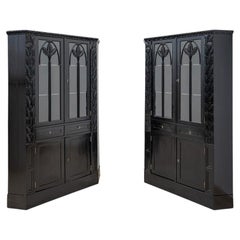
Corner cabinets Hans Bolek attr. late 1910s
By Hans Bolek
Located in Klosterneuburg, AT
These two corner display cabinets showcase Austrian Art Noveau Design perfectly. They are attributed to Hans Bolek who studied in Josef Hoffmann's class of architecture. The cabinets...
Category
Early 20th Century Austrian Jugendstil Cabinets
Materials
Oak
$27,295 / set
You May Also Like
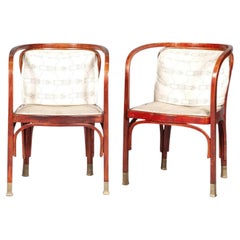
Pair of Austrian Secessionist Bentwood Open Armchairs
By Gustav Siegel, Jacob
Josef Kohn
Located in NYC, NY
A Classic pair of Austrian Secessionist bentwood open armchairs.
The legs ending in brass sabots.
Paper label and also stamped JJ Kohn underside.
Category
Early 20th Century Austrian Vienna Secession Chairs
Materials
Brass
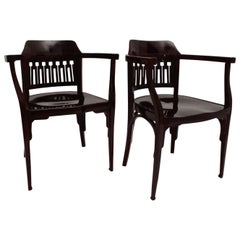
Jugendstil Vintage Armchairs Office Chair No 714 Jacob
Josef Kohn circa 1902
By Jacob
Josef Kohn
Located in Vienna, AT
Jugendstil armchairs model no 714 designed in Style Otto Wagner, and produced by Jacob & Josef Kohn, 1902.
Documented in the company´s catalogue Kohn from 1903.
The chairs were made out of mahogany stained beechwood and shellac hand polished. While the frame was made out of beechwood, the back and seat were made of perforated plywood...
Category
Antique Early 1900s Austrian Jugendstil Armchairs
Materials
Plywood, Beech
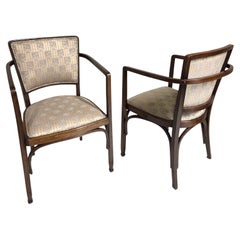
Pair of Wiener Werkstatte armchairs by Koloman Moser for J
J Kohn, Austria
By Jacob
Josef Kohn, Koloman Moser
Located in New York City, NY
A fine pair of Austrian Secessionist bentwood chairs in walnut stained beechwood with upholstered seat and back.
Designed by Koloman Moser: March 30, 1868 – October 18, 1918
Manu...
Category
Early 20th Century Austrian Jugendstil Armchairs
Materials
Beech
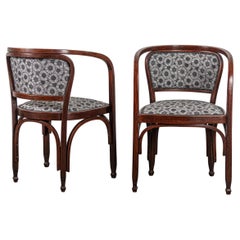
No. 715 Pair Of Armchairs by Gustav Siegel for Jacob
Josef Kohn, Vienna 19
By Jacob
Josef Kohn, Gustav Siegel
Located in Budapest, HU
A pair of bentwood armchairs, model 715/F, conceived by Gustav Siegel in 1899 and produced by Jacob & Josef Kohn in Vienna around 1905.
The chairs measure 76.5 cm in height, 53 cm in...
Category
Antique Early 1900s Austrian Jugendstil Armchairs
Materials
Beech
Pair of Riemerschmidt Armchairs Chairs
By Richard Riemerschmid, Liberty
Co.
Located in Chicago, IL
Pair of Riemerschmidt armchairs for Liberty & Co., oak, upholstered seats.
Category
Antique Early 1900s German Art Nouveau Armchairs
Materials
Oak
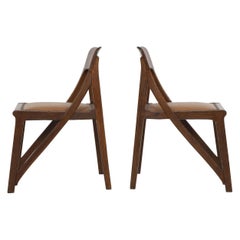
$16,800 / set
Pair of Kohn Chairs No. 719 Attributed to Koloman Moser
By Koloman Moser, Jacob
Josef Kohn
Located in Vienna, AT
Pair of Vienna Seccesion chairs by Kohn (model no. 719) attributed to Koloman Moser.
Chairs are unrestored and the restoration can be made on request
Beech, bentwood, mahogany/nut ...
Category
Early 20th Century Austrian Vienna Secession Side Chairs
Materials
Brass
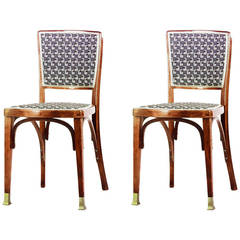
$1,760 Sale Price / set
26% Off