Items Similar to French Empire Mahogany
Egyptian
Bergère Attributed to Desmalter, circa 1805
Want more images or videos?
Request additional images or videos from the seller
1 of 20
French Empire Mahogany
Egyptian
Bergère Attributed to Desmalter, circa 1805
$12,875
£9,623.71
€11,104.34
CA$18,023.70
A$19,043.65
CHF 10,243.26
MX$228,016.97
NOK 128,336.04
SEK 117,537.19
DKK 82,918.61
About the Item
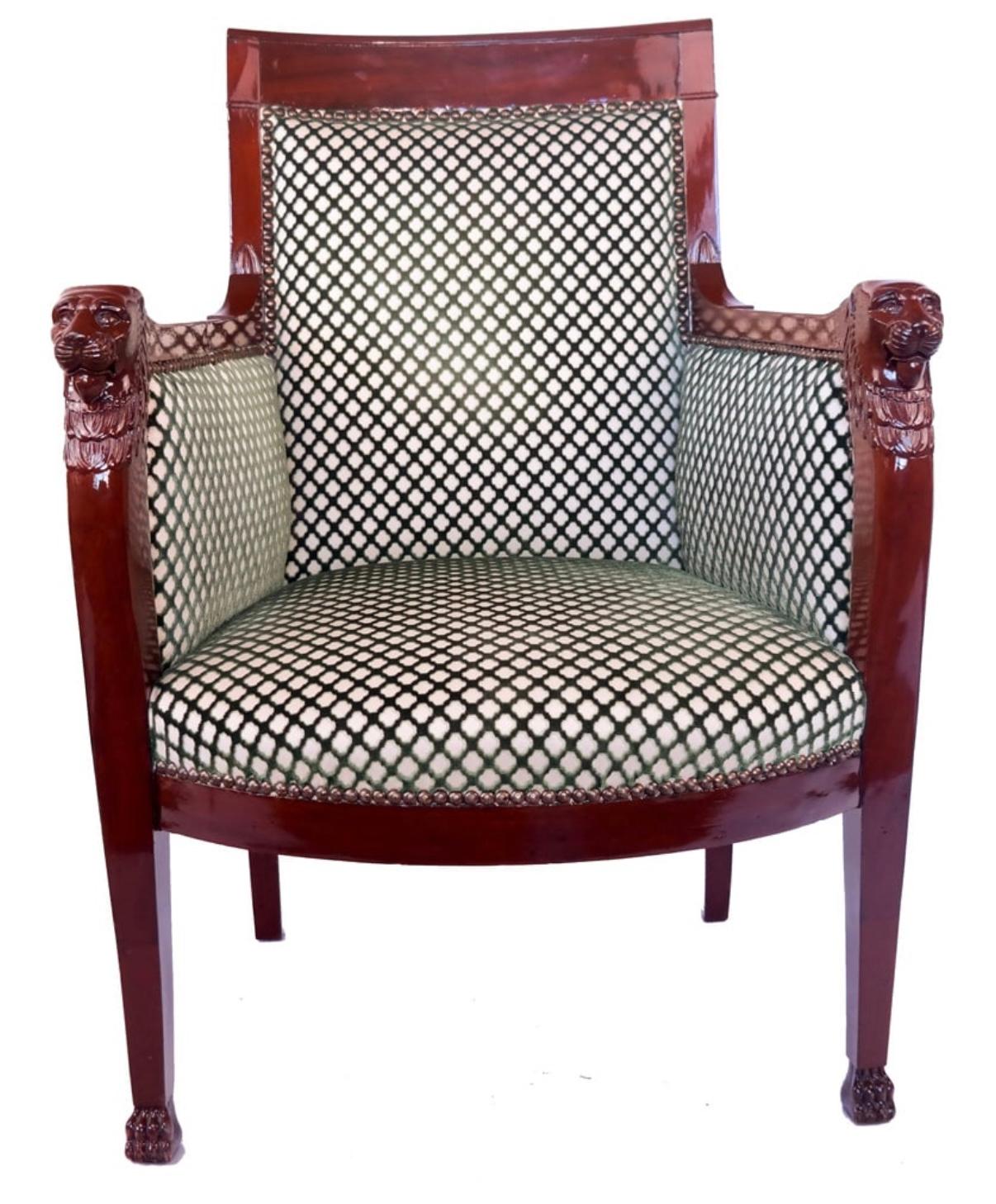
A rare and important circa 1805 'Egyptian-style' bergère believed to be an early work of famed French Empire furniture-maker François-Honoré-Georges Jacob-Desmalter of 'tub-chair' form having upholstered solid mahogany frame, the semicircular back with rounded continuous crest rail ending in dramatically carved 'lioness' heads atop sloping arm supports ending in tall rosette-carved corner-blocks connecting to D-shaped seat on naturalistically carved lion front and rear legs as supports.
Although apparently unsigned, this armchair is most certainly an early work of Jacob-Desmalter and is believed to predate 'The Denon Chair' (once owned by Thomas Hope and now in the collection of the Victoria
Albert Museum, London) he made between 1803 and 1813 and designed by Baron Dominique Vivant Denon shortly after his seminal work "Fragments d'hiéroglyphes de grandeur naturelle" was published in 1802. Sharing nearly identically carved lion-leg supports, the difference being this chair with 'canted' rear legs and the 'Denon' chair with legs-aligned; the earlier ascription is due to the rosette carved corner blocks being a lingering 'remainder' motif from earlier Louis XVI and Directoire styles.
The Victoria
Albert Museum describe 'The Denon Chair' as: Based on drawings published by Baron Dominique Vivant Denon (born in Chalon-sur-Saône, France, 1747, died in Paris, 1825); made by the firm of Jacob-Desmalter, Paris. One of a pair of armchairs that were first recorded at the Christie's sale of the Hope heirlooms from Deepdene, Surrey, the country house of Thomas Hope (1769-1831) on 18 July 1917, lot 140. (They sold for £21.) No certain record exists to confirm that the chairs were in the house during the 19th century. However, in 1819 the novelist Maria Edgeworth visited Deepdene, and described 'a bed made exactly after the model of Denon's Egyptian bed, a sofa bed wide enough for two aldermen'. This bed was probably en suite with the pair of arm chairs. A similar pair of chairs were in the collection of Baron Dominique Vivant Denon (1747-1825), a museum director in Paris and a great Egyptologist. He was in Egypt during Napoleon's campaigns there, quickly writing up his experiences as Voyage dans la Haute et Basse Egypte, published in 1802. His monumental Description de l'Egypte appeared between 1809 and 1822. Denon copied a number of designs for chairs from the walls of ancient Egyptian tombs, including several which relate to this chair. Thomas Hope, in turn, may either have bought the chairs from the sale of Denon's collection or commissioned chairs and a bed to be made in Denon's Egyptian style.
Biography: François-Honoré-Georges Jacob-Desmalter (1770–1841)
François-Honoré-Georges Jacob-Desmalter ran one of the most important and prosperous furniture workshops in Paris at the beginning of the 1800s. The son of a well-known chairmaker, Georges Jacob, Jacob-Desmalter took over his father's business with his older brother in 1796. When his brother died six years later, Jacob-Desmalter hired his father back as his partner and began to develop one of the largest furniture workshops in Paris. By 1808 he employed 332 workmen to produce pieces worth over 700,000 francs per year. A third of this stock was destined for export; his warehouse alone held over 500,000 francs' worth of furniture.
Furniture produced by the firm of Jacob-Desmalter et Cie (Co.) was mainly made from mahogany in the Empire style, where geometric shapes and straight lines prevailed. The clients included Pauline Borghese, Napoleon I's sister, and the Empress Josephine, for whom he supplied numerous pieces for the imperial residences. One particularly important commission was a magnificent cradle built for the infant Napoleon II, king of Rome.
Greatly dependent on orders from Napoleon's household, the business went bankrupt in 1813, when the Emperor fell from power. Jacob-Desmalter, however, managed to resurrect the company and continued to run it until his son, Alphonse-George, succeeded him in 1825.
Biography courtesy of The Getty Center and Museum.
Literature:
Collard, Frances. 'Regency Furniture'. Woodbridge, Suffolk: Antique Collectors’ Club, 1985, p. 265.
Watkin, David and Philip Hewat-Jaboor. 'Thomas Hope: Regency Designer'. New Haven and London: Yale University Press, 2008, pp. 436-8.
- Attributed to:Jacob Desmalter (Cabinetmaker)
- Dimensions:Height: 34.5 in (87.63 cm)Width: 29 in (73.66 cm)Depth: 27 in (68.58 cm)Seat Height: 19 in (48.26 cm)
- Style:Empire (Of the Period)
- Materials and Techniques:
- Place of Origin:
- Period:
- Date of Manufacture:circa 1805
- Condition:Wear consistent with age and use. Minor non-detracting historical repairs to crest-rail as to be expected with age and use; newly recovered in muslin, ready to be upholstered.
- Seller Location:Kinderhook, NY
- Reference Number:1stDibs: LU1002147920522
About the Seller
5.0
Vetted Professional Seller
Every seller passes strict standards for authenticity and reliability
Established in 2012
1stDibs seller since 2013
160 sales on 1stDibs
Typical response time: <1 hour
- ShippingRetrieving quote...Shipping from: Kinderhook, NY
- Return Policy
More From This Seller
View AllGeorge III English Regency Mahogany Bergere or Armchair, circa 1815
Located in Kinderhook, NY
An unusual English Regency period upholstered bergere or armchair having concave backrest corners and carved mahogany acanthus and panel motifs on arm terminals, corner blocks, and s...
Category
Antique Early 19th Century English Regency Bergere Chairs
Materials
Brass
English Late Regency William IV Rosewood Leather Bergere, circa 1835
Located in Kinderhook, NY
A fine and elegant circa 1835 English late regency William IV period armchair or bergere of large scale and clean design having solid rosewood frame and buff-colored leather upholste...
Category
Antique 1830s English Regency Bergere Chairs
Materials
Brass
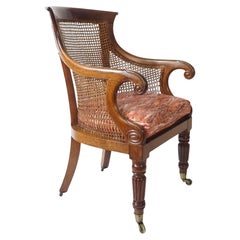
English Regency Caned Mahogany Armchair or Bergere, circa 1830
Located in Kinderhook, NY
An elegant circa 1830 English Regency armchair or bergere of solid mahogany construction having shaped crest rail and scroll arms with lotus carved terminals and volute arm supports ...
Category
Antique Early 19th Century English Regency Armchairs
Materials
Brass
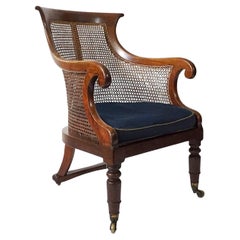
English Regency Caned Mahogany Armchair or Bergere of Unusual Form, circa 1830
Located in Kinderhook, NY
An unusual English circa 1830 George IV, William IV period regency form armchair or bergere, the solid mahogany frame having shaped crest rail and scroll arms with caned back, sides,...
Category
Antique Early 19th Century English Regency Armchairs
Materials
Brass
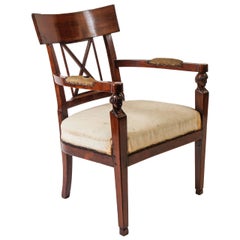
Neoclassical Consulate Fauteuil or Armchair, Italy, circa 1800
Located in Kinderhook, NY
Elegant Italian, French Consulate style and period carved walnut fauteuil having Klismos style tablet form backrest above central X-form open splat, a...
Category
Antique Early 19th Century Italian Directoire Armchairs
Materials
Mahogany
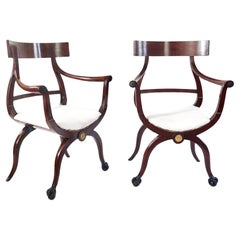
Baltic Neoclassical Klismos and Curule Form Mahogany Armchairs, Pair, circa 1800
Located in Kinderhook, NY
A chic, rare, and unusual pair of circa 1800 Baltic Directoire style armchairs or fauteuils of both klismos and curule variant form, the solid mahogany frames gilt-metal rosette moun...
Category
Antique Early 19th Century Russian Neoclassical Armchairs
Materials
Metal
You May Also Like
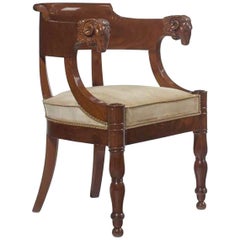
Empire Mahogany Fauteuil de Bureau, Early 19th Century
Located in Spencertown, NY
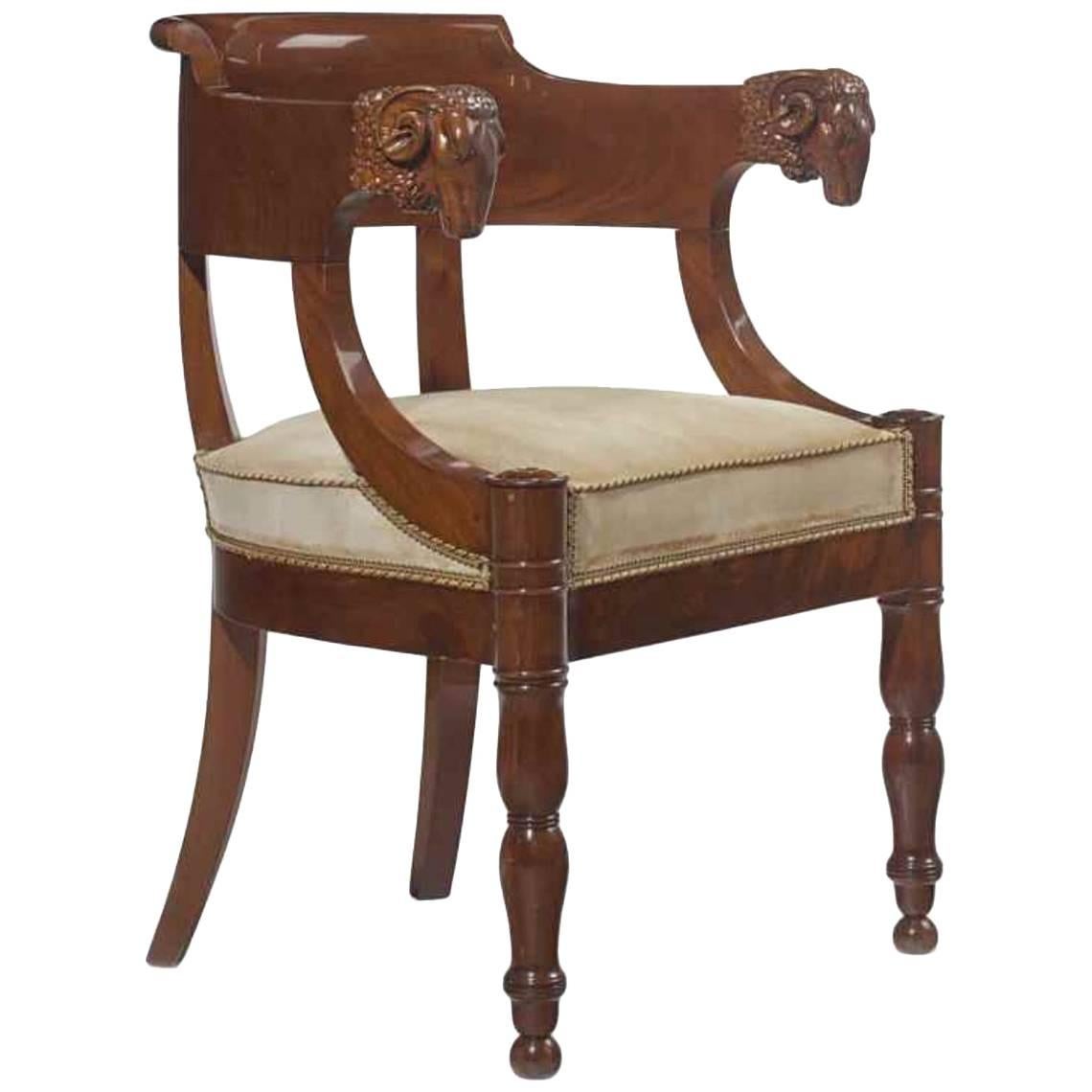
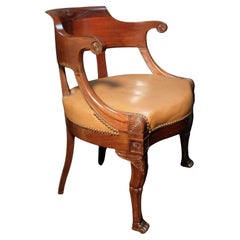
The early 19th century desk chair with ram's head arms and turned legs, is attributable to Jacob Desmalter and dates to circa 1805.
Category
Antique Early 1800s French Empire Office Chairs and Desk Chairs
Materials
Mahogany
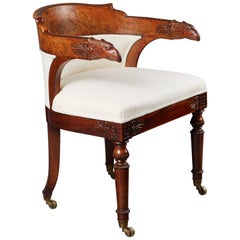
Neoclassical Empire Early 19th Century Mahogany Desk Armchair
Located in Worpswede / Bremen, DE
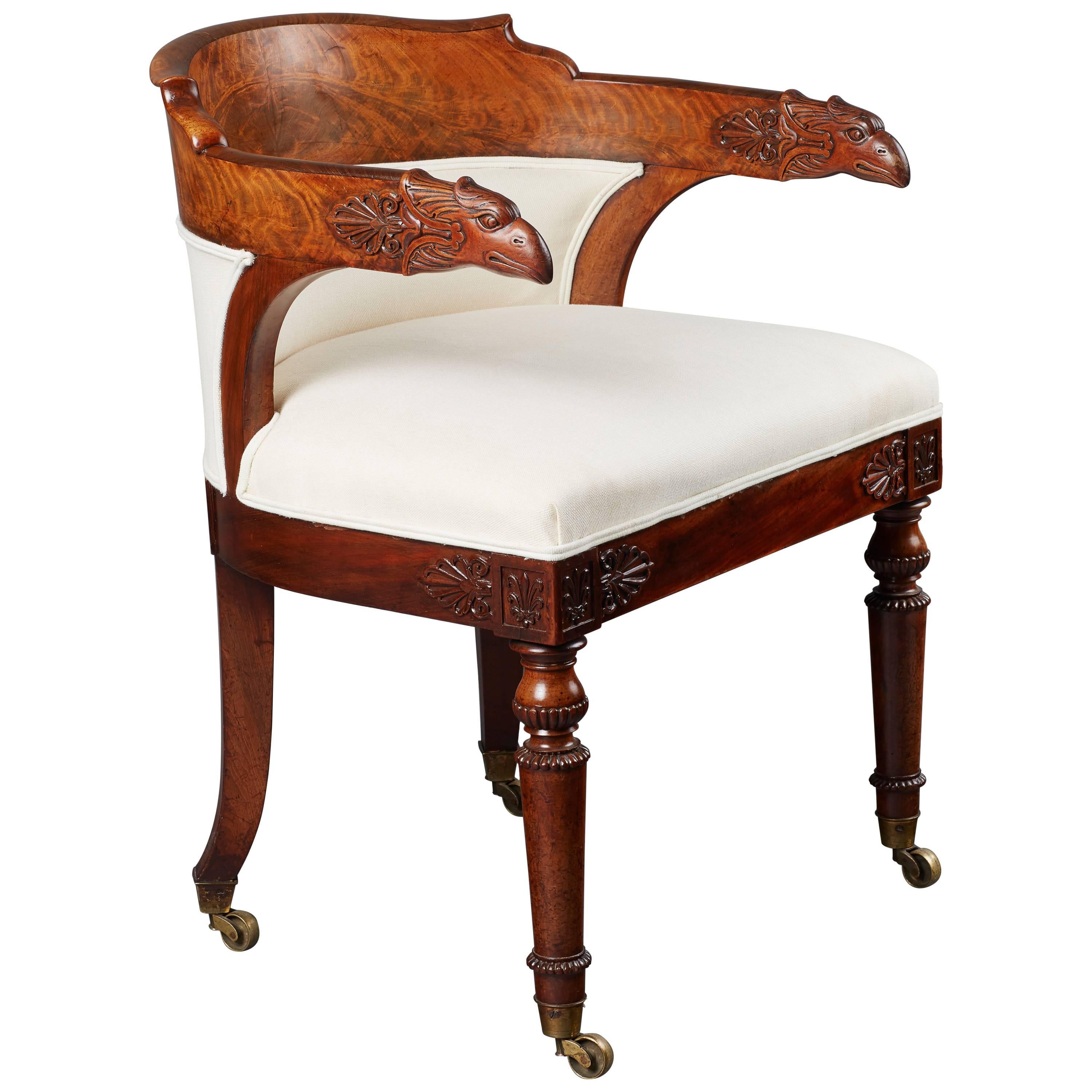
An unusual North European mahogany desk armchair with original brass castors. Fully carved armrests with eagle heads, the design probably by a designer from Berlin or Copenhagen (e.g...
Category
Antique Early 19th Century German Empire Armchairs
Materials
Brass
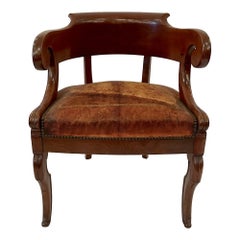
Antique French Empire Period Mahogany Desk Chair, Circa 1810-1820.
Located in New Orleans, LA
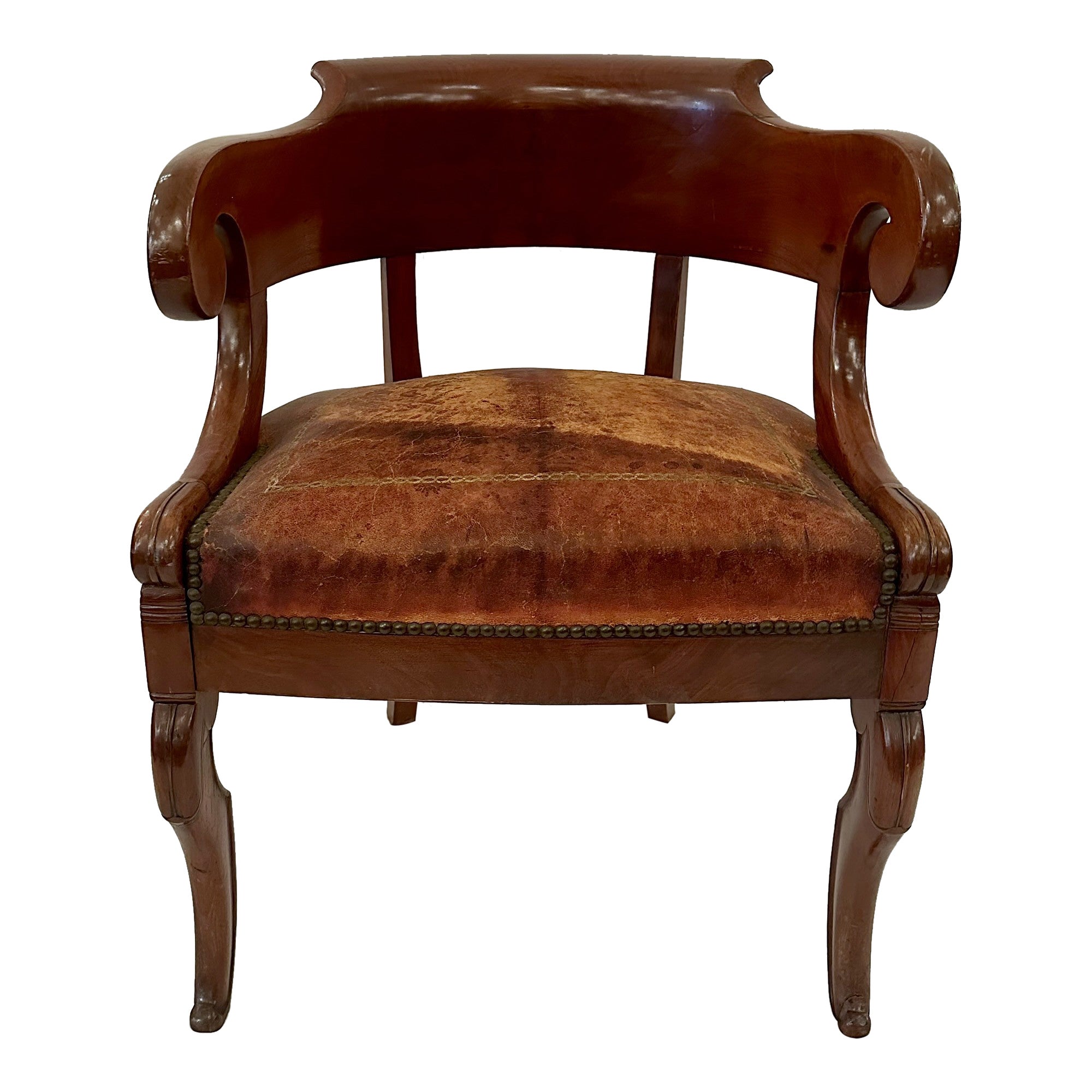
Antique French Empire Period Mahogany Desk Chair, Circa 1810-1820.
Category
Antique Early 19th Century French Empire Office Chairs and Desk Chairs
Materials
Leather, Mahogany
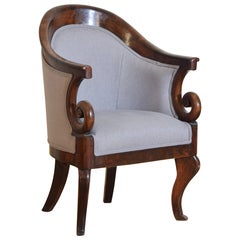
French Empire Period Walnut
Upholstered Officer’s Bergere, early 19th century
Located in Atlanta, GA
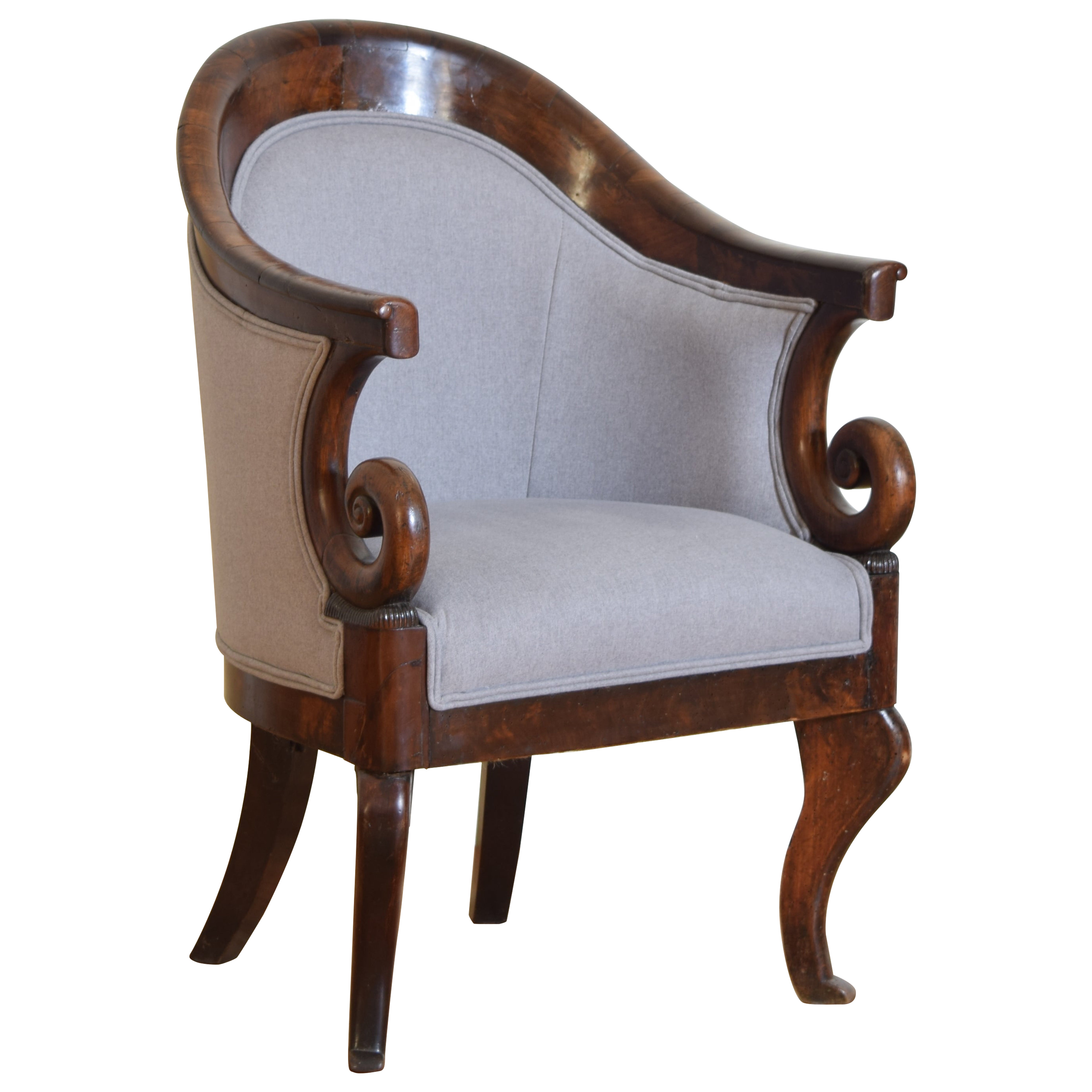
having a concave and arched backrest, the with shaped open armrests allowing a sword and scabbard to remain on the sitter, raised on carbriole legs, the inside of legs with antique i...
Category
Antique Early 1800s French Empire Bergere Chairs
Materials
Walnut
Empire Mahogany Desk Chair, Early 19th Century
Located in Spencertown, NY
The desk chair with carved diamond motif on crest and richly carved griffin wings above articulated paw feet with tan colored leather upholstery. Height: 30" Seat height: 17" Depth: ...
Category
Antique Early 19th Century French Empire Office Chairs and Desk Chairs
Materials
Leather, Mahogany
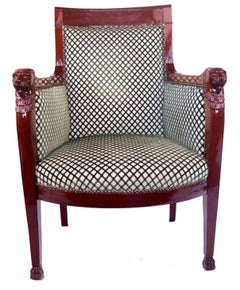
19th Century Empire Carved Mahogany
Cut Velvet Upholstered Bergere
Located in Atlanta, GA
This striking armchair is a fine example of 19th-century Empire furniture, marrying neoclassical authority with updated decorative luxury. The frame, likely crafted from mahogany or ...
Category
Antique 19th Century French Empire Bergere Chairs
Materials
Upholstery, Wood
$2,240 Sale Price
20% Off