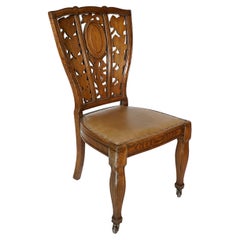
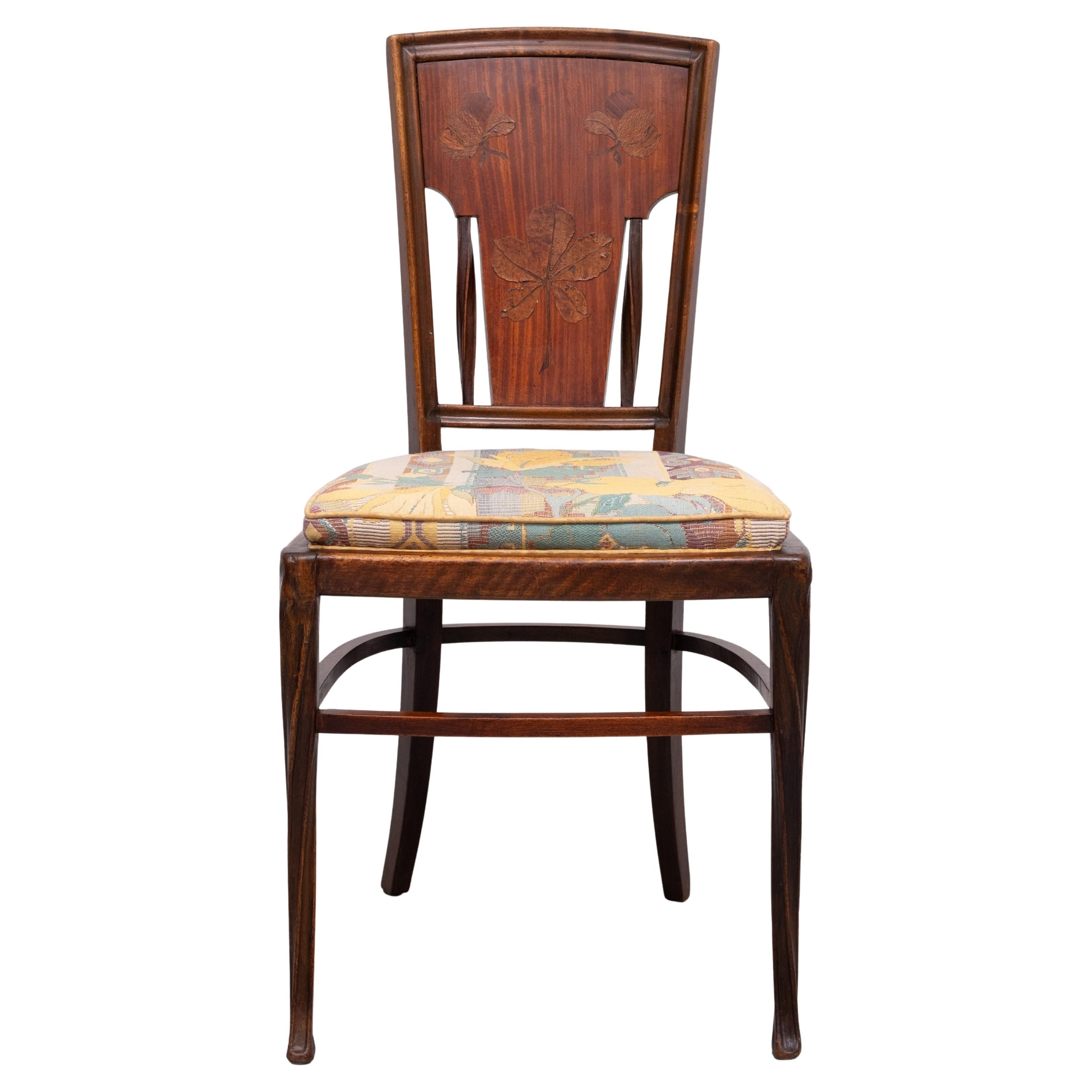
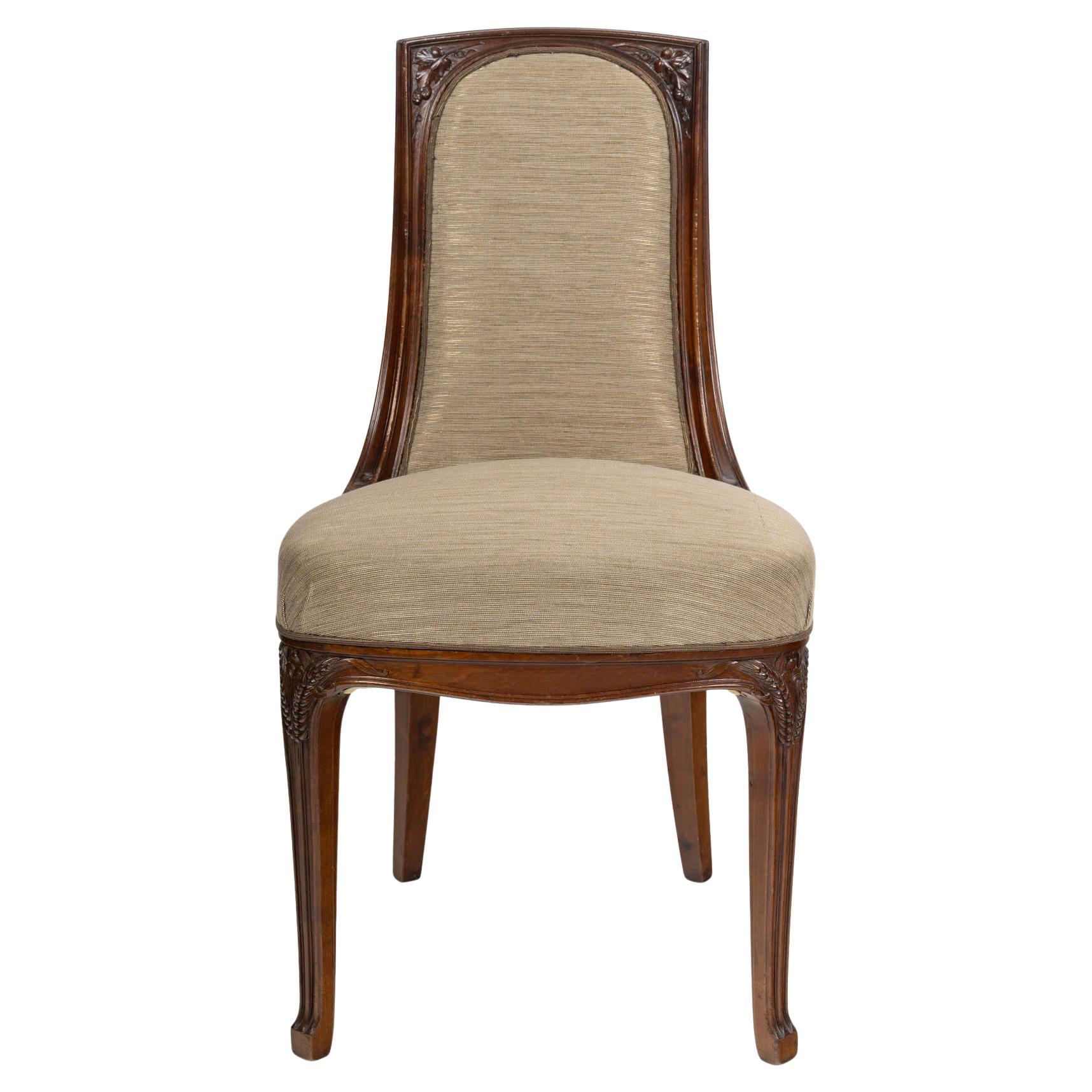
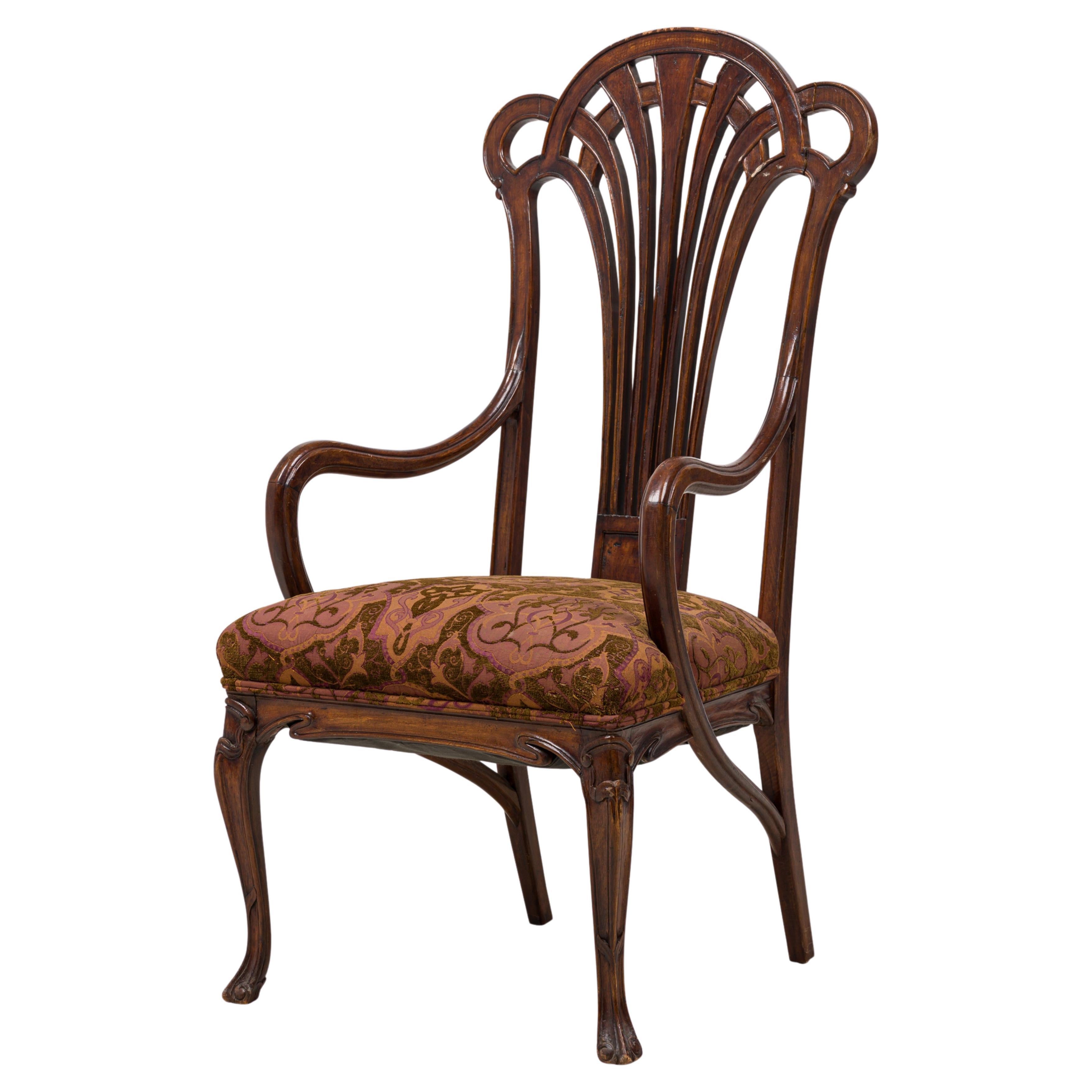
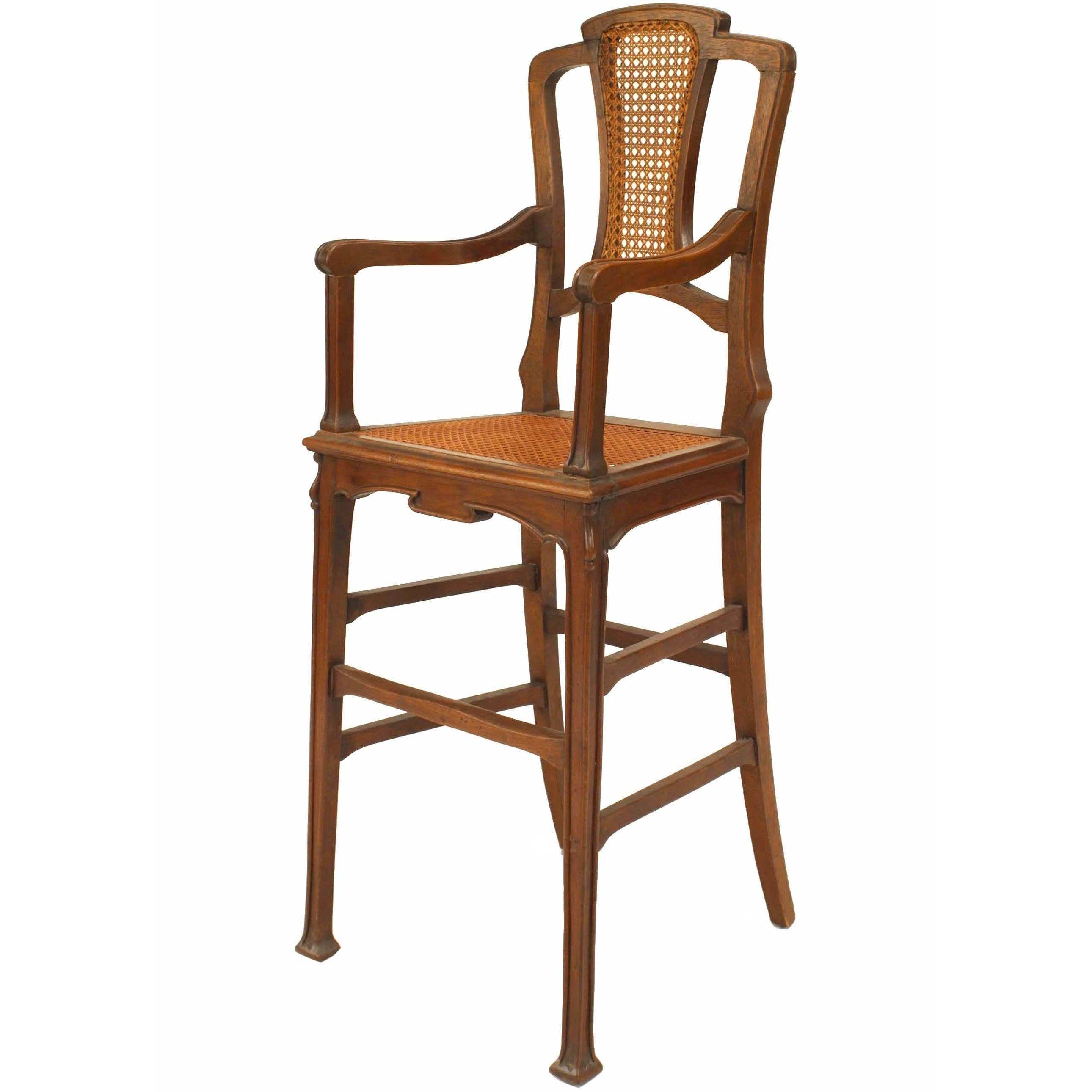
Want more images or videos?
Request additional images or videos from the seller
1 of 8

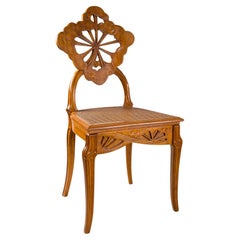
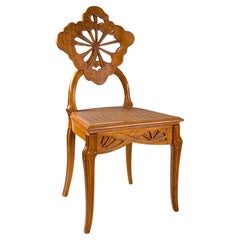
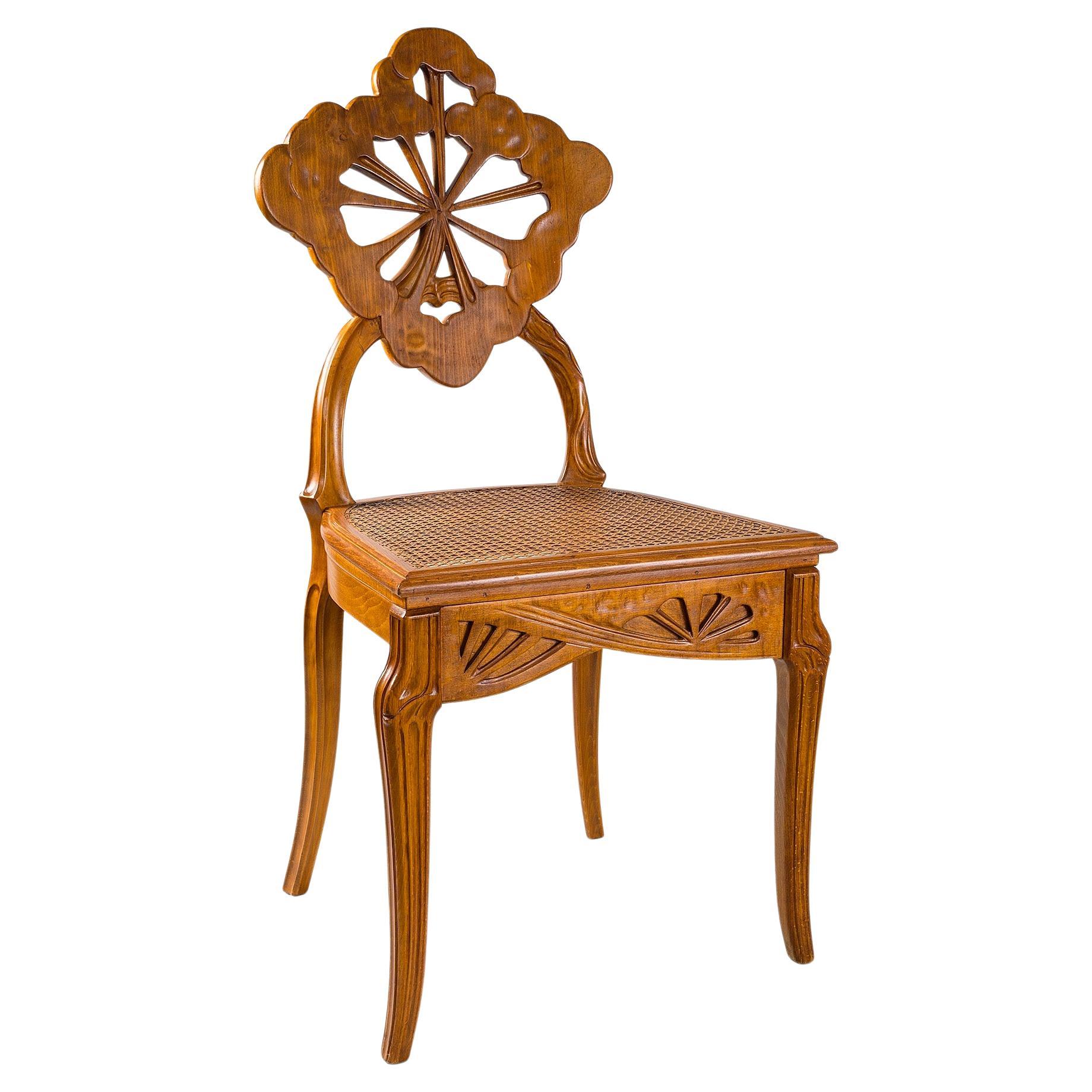
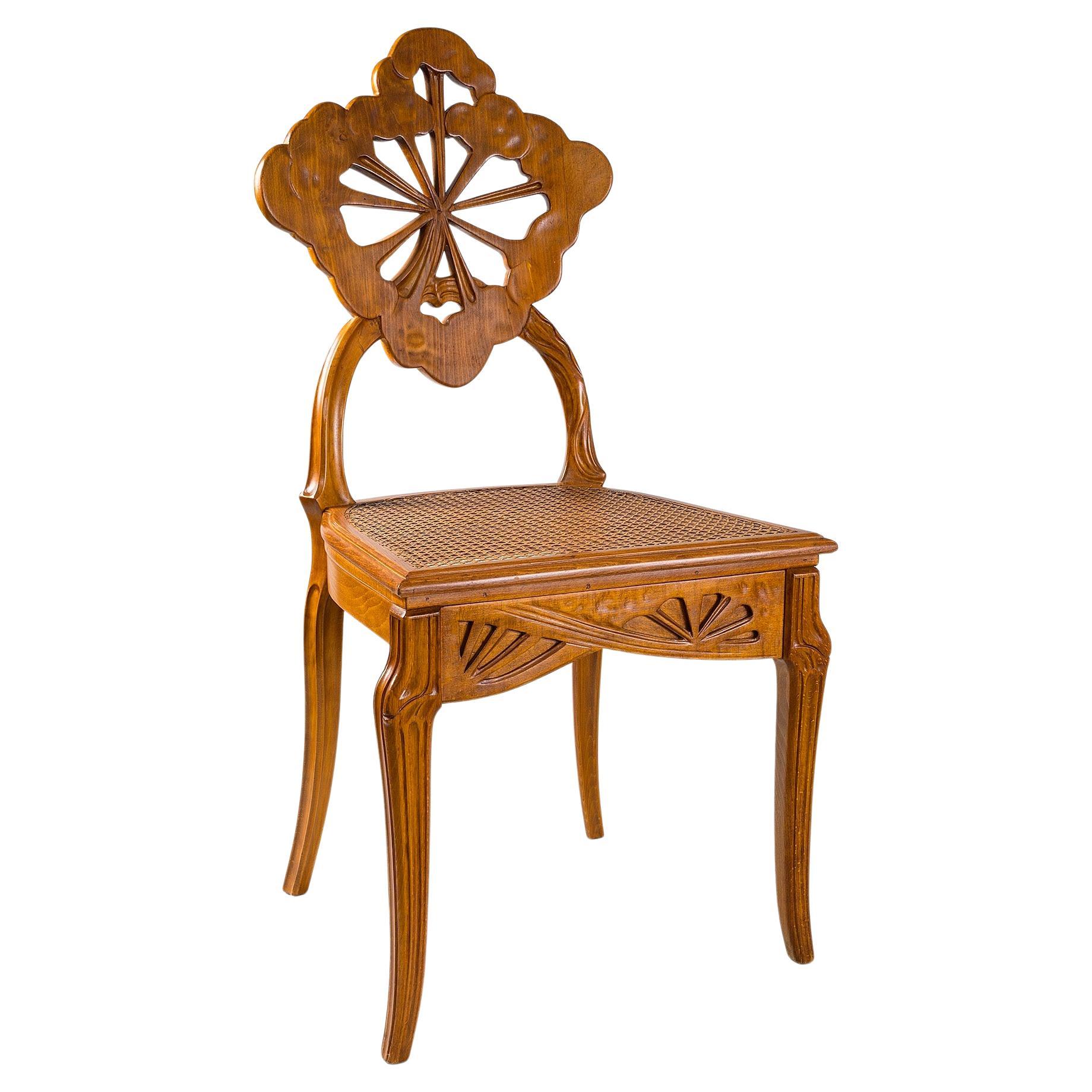
Émile Gallé "Ombelle" Side Chair

$22,500
£17,094.45
€19,645.11
CA$31,604.01
A$34,400.17
CHF 18,227.42
MX$413,714.07
NOK 231,756.97
SEK 212,379.62
DKK 146,747.76

About the Item

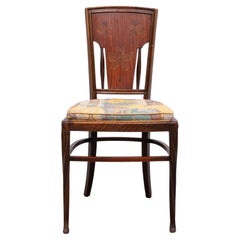
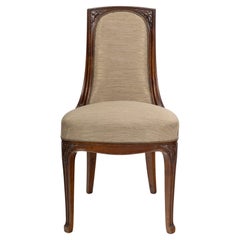
Gallé first designed the Ombelle chairs to great critical acclaim at the 1900 Exposition Universelle. The chairs were inspired by the umbellifer family. The species in this family, including the Giant Hogweed and poison hemlock, were favored by Art Nouveau artists for its simultaneous beauty and toxicity, a natural incarnation of the femme fatale archetype. Flowers, like the giant hogweed, were one of great significance to the Art Nouveau masters, symbolizing regrowth, rebirth, and regeneration, and so, even though they can technically classified as a weed, flowers like these were honored with a beautiful place of privilege in many a masterpiece during the Art Nouveau period. Over the next four years, he continued refining the original design. This particular version was created for the living room of Belgian engineer Édouard Hannon’s Brussels mansion, with the original design drawing housed in the Musée d’Orsay. The backrest features the silhouette of the Ombelle flower, with two delicate stems extending to connect with the seat. A symmetrical frieze of Ombelle flowers encircles the seat, which is finished with rattan caning on top. Item #: F-21817 Artist: Émile Gallé Country: France Circa: 1902 Dimensions: 37" height, 18.125" width, 18.25" depth. Materials: Walnut, Cane Signed: chair leg incised "Gallé" Literature: Yvonne Brunhammer, Alain Blondel, and Yves Plantin, Art Nouveau Belgium France, exh. cat. Institute for the Arts, Rice University, Houston and the Art Institute of Chicago, Chicago, 1976, p. 225 Alastair Duncan, The Paris Salons 1895-1914, Volume 3, New York, 1996, p. 232 Macklowe Gallery Curator's Notes: Gallé discusses the particular satisfaction he has found in the application of certain plant forms. The umbellifer Heraclaeum Mantegazzium, popularly called Giant Hogweed, first used by him in furniture design in 1894, became a particular favourite, and, certainly, this plant lent itself readily to elegant abstractions. Giant Hogweed inspired cabinets, vitrines, tables, chairs, even bedroom suites. One critic, commenting on the chaise aux ombelles of 1902, finds an element of Japanese inspiration in this design, drawing a parallel between the form of the chair back and certain Japanese tsuba or sword-guards. Others see Giant Hogweed as a symbol of local pride, for the plant grew in abundance around Nancy. One may, however, uncover less obvious and more morbid an explanation for the powerful attraction it held for Gallé. Another plant of the same family la grande Cigüe', Conium maculatum, is the source of the poison that filled Socrates' deadly cup, hemlock.
  • Creator:
    Émile Gallé (Artist)
  • Dimensions:
    Height: 37 in (93.98 cm)Width: 18.125 in (46.04 cm)Depth: 18.25 in (46.36 cm)
  • Style:
    Art Nouveau (Of the Period)
  • Materials and Techniques:
  • Place of Origin:
  • Period:
  • Date of Manufacture:
    1902
  • Condition:
  • Seller Location:
    New York, NY
  • Reference Number:
    1stDibs: LU885446226942

More From This Seller

View All
Émile Gallé "Ombelle" Side Chair
By Émile Gallé
Located in New York, NY
Gallé first designed the Ombelle chairs to great critical acclaim at the 1900 Exposition Universelle. The chairs were inspired by the umbellifer family. The species in this family, i...
Category

Early 20th Century French Art Nouveau Chairs

Materials

Cane, Walnut

Émile Gallé "Ombelle" Side Chair
By Émile Gallé
Located in New York, NY
Gallé first designed the Ombelle chairs to great critical acclaim at the 1900 Exposition Universelle. The chairs were inspired by the umbellifer family. The species in this family, i...
Category

Early 20th Century Side Chairs

Materials

Cane, Walnut

Louis Majorelle French Art Nouveau Armchair
By Louis Majorelle
Located in New York, NY
A French Art Nouveau walnut armchair by Louis Majorelle, featuring sinuously curved arms and legs. The top of the chair is decorated with an intricately carved floral motif. It is up...
Category

Early 20th Century French Art Nouveau Armchairs

Materials

Upholstery, Walnut

Louis Majorelle "Les Pins" Carved Mahogany Armchair
By Louis Majorelle
Located in New York, NY
This hand-carved wooden armchair, named "Le Pins," embodies the Art Nouveau style of Louis Majorelle, featuring intricate carvings of pine needles and pinecones. Reflecting Majorelle...
Category

Early 20th Century French Art Nouveau Armchairs

Materials

Upholstery, Mahogany

French Art Nouveau Wooden Pedestal by Emile Gallé
Located in New York, NY
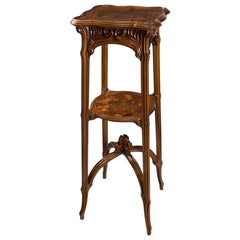
A French Art Nouveau selette by Émile Gallé. Gallé made very few selettes of this quality and design during his career, and even fewer of those with curved lower pieces that reunite ...
Category

Antique Early 1900s French Art Nouveau Pedestals

Materials

Wood

French Art Nouveau Wooden Pedestal by Emile Gallé
By Émile Gallé
Located in New York, NY
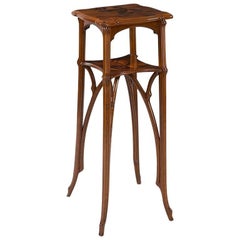
A French Art Nouveau two-tiered square pedestal with carved and marquetry decoration by Emile Gallé. The pedestal has two marquetry shelves depicting leaves. Its four sinuous legs ar...
Category

Antique Early 1900s French Art Nouveau Pedestals

Materials

Wood

You May Also Like

Art Nouveau side chair Louis Majorelle anno 1900
By Louis Majorelle
Located in Den Haag, NL
Very nice Art Nouveau Marquetry side Chair . Comes with Flower inlay . using all kinds of wood . twisted legs. New upholstery . Handmade . attributed to Louis Majorelle
Category

Antique Early 1900s French Art Nouveau Side Chairs

Materials

Wood

Art Nouveau Period Desk Chair in Carved Wood, Circa 1900.
Located in Saint-Ouen, FR
Art Nouveau period desk chair in carved wood, circa 1900. Carved wood Art Nouveau period desk chair, circa 1900. H: 89cm, W: 47cm, D: 40cm
Category

20th Century French Art Nouveau Chairs

Materials

Wood

Eugene Gaillard Art Nouveau French Mahogany Upholstered Armchair
By Eugène Gaillard
Located in Queens, NY
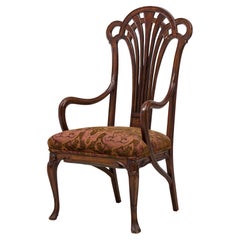
French Art Nouveau mahogany armchair with a pierced fan form high back connected to curved arms having a seat upholstered in a textured mauve...
Category

20th Century French Art Nouveau Armchairs

Materials

Fabric, Upholstery, Wood, Mahogany

French Art Nouveau High Chair
Located in Queens, NY
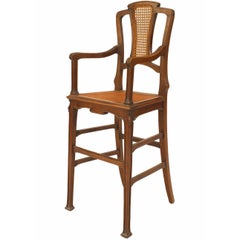
French Art Nouveau walnut childs high chair (signed)
Category

Antique Late 19th Century French Art Nouveau Armchairs

Materials

Cane, Walnut

Art Nouveau, Liberty-Chair , 1900, Germany
Located in Hannover, DE
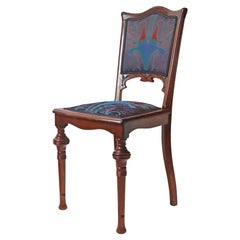
An Art Nouveau chair whose shape and design perfectly reflect this art period. Finely crafted walnut wood covered with a dark, fine glaze. This chair has been artfully restored and r...
Category

Antique Early 1900s German Art Nouveau Chairs

Materials

Wood, Nutwood

Art Nouveau, Liberty-Chair , 1900, Germany
$915 Sale Price / item
26% Off
Arthur Heygate Mackmurdo for the Century Guild. An Important Art Nouveau Chair
By Arthur Heygate Mackmurdo
Located in London, GB
Arthur Heygate Mackmurdo (1851-1942), a highly important oak chair, with an Art Nouveau floral back. Mackmurdo's influence in Europe is recognized as having produced the earliest examples of Art Nouveau, particularly in the styling of a chair-back designed in 1882 and the title page for Wren's City Churches a year later. The present chair was designed for the head of Rainhill hospital St Helen's south Lancashire/Merseyside (now demolished), an institute for the mentally ill, as part of an interior scheme for his study. It was almost certainly designed and made only for this interior, unlike the earlier chair which was designed in 1882 and made and sold until 1888. It was originally thought this interior was designed by the Liverpool architect Edmund Rathbone whose brother, Harold Rathbone, founded the Della Robbia Pottery factory in 1894. A picture is shown in Jeremy Cooper's Victorian and Edwardian Furniture and Interiors, p. 199, illus. 516, from the Bedford Lemere archive at the National Monuments Record, apparently credited as 'Rainhill, Edmund Rathbone'. But Edmund Rathbone was actually the Century Guild...
Category

Antique 1880s English Art Nouveau Chairs

Materials

Oak