Want more images or videos?
Request additional images or videos from the seller
1 of 3
The Isaac Bell Set of Ten Dining Chairs
$200,000List Price
About the Item
- Dimensions:Height: 33 in (83.82 cm)
- Sold As:Set of 10
- Place of Origin:
- Period:
- Date of Manufacture:about 1810
- Condition:Please contact dealer.
- Seller Location:New York, NY
- Reference Number:Seller: FAPG 20331D/3.21stDibs: U111220903246
You May Also Like
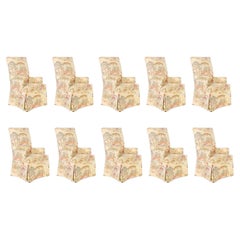
Set of Ten Upholstered Dining Chairs
Located in Palm Beach, FL
Standout set of ten dining armchairs crafted in mahogany in classic form, built for comfort and style and upholstered in an exotic anglo Indian silk fabric depicting landscapes and g...
Category
Mid-20th Century American Anglo-Indian Dining Room Chairs
Materials
Upholstery
Set of Ten Upholstered Dining Side Chairs.
Located in Philadelphia, PA
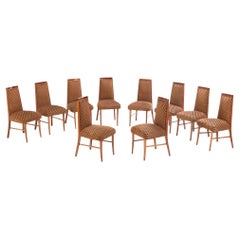
Elegant and finely proportioned, this set of ten dining chairs reflects the refined Neoclassical Modernism associated with several French makers. Each chair features a gracefully tap...
Category
Mid-20th Century French Mid-Century Modern Dining Room Chairs
Materials
Upholstery, Wood
Set of Ten Chinese Chippendale Dining Chairs
Located in Stamford, CT
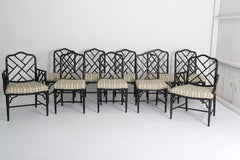
Set of ten black painted wood Chinese Chippendale dining chairs.
Good quality, fine condition.
Two armchairs: 25 wide, 21.5 deep, 37 high, ...
Category
Vintage 1970s Dining Room Chairs
Materials
Wood
Set of Ten Chippendale Style Dining Chairs
Located in Woodbury, CT
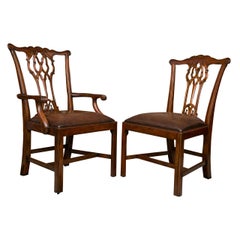
Classic George III style carving defines these dining chairs. Lyrically executed, the lines traverse the back while providing comfortable support in a chair that on first inspection looks as though it may have placed form over function. Add the pliable seats covered in antiqued leather upholstery...
Category
21st Century and Contemporary American Chippendale Dining Room Chairs
Materials
Mahogany
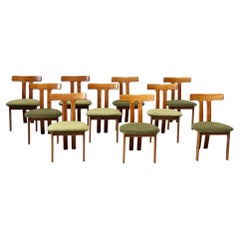
Xl set of ten T-shape dining chairs
Located in Nijlen, VAN
What a extraordinary big set of 10 dining chairs.
These chairs are from the 1960s from france. Sadly we don't know the origin of them but this is clearly a piece of craftsmanship. ...
Category
Vintage 1960s French Dining Room Chairs
Materials
Fabric, Wood
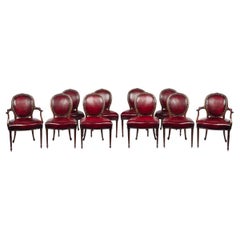
A set of ten Victorian mahogany dining chairs in the style of Hepplewhite
Located in Lymington, Hampshire
A set of ten Victorian mahogany dining chairs in the style of Hepplewhite, comprising two carvers and eight side chairs, each carver with a rounded back and wide double scroll arms, ...
Category
Antique Late 19th Century English Hepplewhite Dining Room Chairs
Materials
Mahogany
$25,687
H 37 in W 25.5 in D 19 in
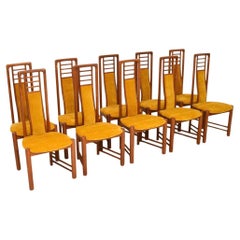
Set of Ten Danish Vintage Teak Dining Chairs
By Boltinge Stolefabrik 1
Located in London, GB
A stunning set of ten Danish vintage teak dining chairs, made by Boltinge and dating from the 1970-80’s.
They are of superb quality, with beautifu...
Category
Vintage 1970s Danish Mid-Century Modern Dining Room Chairs
Materials
Velvet, Teak
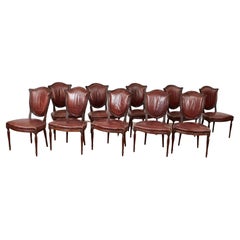
Set of Ten Shield Back Leather Dining Chairs
Located in Greenwich, CT
Set of ten very fine quality mahogany and tooled morocco leather dining chairs having shield shaped backs with crisply carved rosettes and "lamb's tongue" borders, the leather with g...
Category
Antique 1890s English George III Dining Room Chairs
Materials
Leather, Mahogany
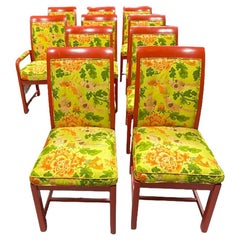
Set of Ten Painted Mid Century Dining Chairs
Located in Dallas, TX
A charming set of ten dining chairs. Painted orange wood with ornate yellow fabric. Stylized birds, butterflies, vines, and floral patterns. Black felt bottom. Materials indicated be...
Category
Vintage 1960s American Mid-Century Modern Dining Room Chairs
Materials
Wood
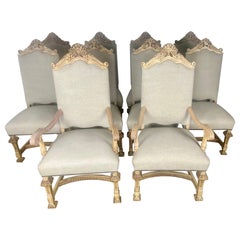
Set of Ten French Carved Wood Armchairs, Louis XV–Inspired, Early 20th Century
Located in Los Angeles, CA
A distinguished and substantial set of ten French carved wood armchairs, dating to the early 20th century and inspired by the elegant lines of Louis XV seating. Unified in form yet r...
Category
Early 20th Century French Louis XV Dining Room Chairs
Materials
Wood, Linen
$12,000 / set
H 50 in W 26 in D 24 in
More From This Seller
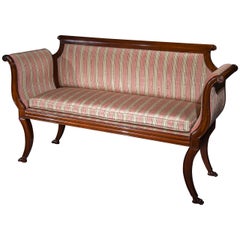
View AllSmall Settee in the Neoclassical Taste
Located in New York, NY
Small Settee in the neoclassical taste
Boston, Massachusetts (active 1804–17), about 1810
Mahogany (secondary woods: ash)
Measures: 35 1/8 in. high, 59 3/4 in. long, 19 1/8 in. deep
Although the diminutive scale of this settee places it in a unique category, the piece itself partakes of a vocabulary that is common in Boston furniture of the Late Federal period. Its sabre legs, for example, as seen straight on from the left and right ends, are closely related to the legs, as seen from the front, on a group of chairs of undisputed Boston origin, including a spectacular armchair with scrolled arms (see Stuart P. Feld, Boston in the Age of Neo-Classicism, 1810–1840, exhib. cat. [New York: Hirschl & Adler Galleries, 1999], p. 37 no. 6 illus. in color), as well as a number of side chairs, including a set made for Nathan Appleton (see Page Talbott, “Boston Empire Furniture, Part I,” The Magazine Antiques, CVII [May 1975], p. 887 fig. 12). In all, the legs are ornamented with two bold, somewhat flattened reeds set between corner beads, a pattern which is repeated here on the front and end seat rails as well. The superb quality of the piece is further demonstrated in the finely drawn profile of the arms, as well as the delicately bulbous surface of the fronts of the arms and legs. As in the best of the related chairs, the sabre legs end in delicately carved paw feet. The added refinement of the beautifully carved rosettes at both the fronts and backs of the arms suggests that the piece may have been designed to be used in the round.
Stylistically harmonious with these pieces is also a group of larger sofas with frontally set sabre legs and scrolled arms (see Page Talbott, “Seating Furniture in Boston, 1810–1835,” The Magazine Antiques, CXXXIX [May 1991], p. 963 pl. 11) that represent an indigenously Boston form. Although none of the furniture in this group has been effectively attributed, they can certainly be related to various Boston card tables...
Category
Antique Early 19th Century American Neoclassical Settees
Materials
Wood
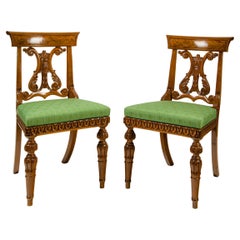
Pair Side Chairs with Lyre Back
Located in New York, NY
“I know of no other chair like the single [sic] ‘lyre back’ one. . . . I certainly recognize it as a Boston chair considering all the individual elements, but the combination is particularly elegant.” So wrote noted scholar of Boston furniture Page Talbott when a set of four chairs of this design originally surfaced in the 1980s. Although the existence of four chairs in a specific pattern might imply that the chairs were originally part of a larger set, no additional chairs of this form have appeared in the intervening years.
The lyre became a popular motif during the Neo-Classical period, and is frequently encountered as the back splat of klismos chairs, in no example more familiar than in a group of Duncan Phyfe chairs...
Category
Antique 1820s American Neoclassical Chairs
Materials
Mahogany
$30,000 / set
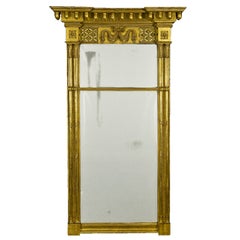
Pier Mirror in the Neoclassical Taste
Located in New York, NY
New York, circa 1815-1820.
Wood, gessoed and gilded, with mirror plate.
75 1/2 in. high, 44 1/8 in. wide (at the cornice), 8 1/2 in. deep (at the cornice).
Condition: Some restorati...
Category
Antique 19th Century American Neoclassical Pier Mirrors and Console Mirrors
Materials
Mirror, Wood
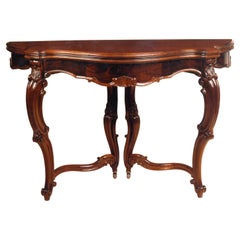
Card Table in the Rococo Taste
By Charles A. Baudoine
Located in New York, NY
RECORDED: cf. Anna Tobin D’Ambrosio, ed., Masterpieces of American Furniture from the Munson-Williams-Proctor Institute (Syracuse University Press, Utica, New York, 1999), pp. 85, 86, 87 illus. the Munson-Williams-Proctor tables // cf. The Metropolitan Museum of Art, New York, 19th Century America–Furniture and Other Decorative Arts (1970), exhib. cat., [n.p.] no.133
This table is identical to a pair of card tables bearing the stenciled label of Charles A. Baudouine of 335 Broadway, New York, which were acquired by James and Helen Munson Williams of Utica, New York, in May 1852 for their home, Fountain Elms, which is where they remain today as part of the Munson-Williams-Proctor Art Institute collection. The Williams tables were billed as “1 Rosewood Multiform Table” at $160 for the pair, and they were indeed “multiform” in that they could be used separately and folded as a pair of console tables, opened as a pair of card tables, or joined together as a center table. The present table varies essentially in the fact that it does not include the mechanism that would have allowed it to be attached to another to form a center table.
Of French descent, Baudouine was born in New York in 1808. He made his debut as a cabinetmaker in the New York directory of 1829/30, where he is listed at 508 Pearl Street. By 1839/40 he relocated to Broadway, where he remained in business at various addresses until about 1854. A sense of the scale of Baudouine’s operation is given by German immigrant cabinetmaker Ernest Hagen...
Category
Antique Mid-19th Century North American Rococo Revival Card Tables and T...
Materials
Wood, Rosewood
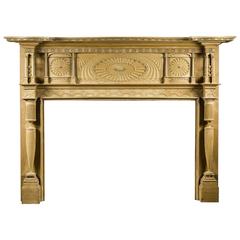
Fan-Carved Wood Mantel in the Federal Taste
Located in New York, NY
New York,
Fan-carved mantel in the Federal taste, circa 1812
Pine
Measures: 66 1/4 in. high, 90 3/8 in. wide, 13 1/4 in. deep
Within the genre of carved rather than plasterwork mantels of the Federal Period, no example that has come to light is more perfectly designed or more carefully wrought than the present one, which is an amazing symphony of fans, urns, beads, and other Neo-Classical devices, all ultimately influenced by the plasterwork designs of the English architects Robert (1728–1792) and James (1732–1794) Adam.
Of a type that proliferated in the area bounded by the northern New Jersey counties of Bergen and Passaic, the Hudson Valley, and western Long Island, the mantel is representative of work that flourished in the first couple of decades of the 19th century. While most of the woodwork of this style that has survived is found in interiors, various examples of exterior doors and other trim have been noted, but most examples have disappeared as a result, variously, of natural deterioration and purposeful demolition in anticipation of development.
Although considerably larger in scale and more elaborate in ornament than a mantel that has been in the collection of the Brooklyn Museum since 1944 (acc. no. 44.55; photograph in Hirschl & Adler archives), the present mantel is so close in style and conception to that example that it likely originated in the same house.
The Brooklyn mantel is documented as having been removed from a house built by Judge Isaac Terhune (1762–1837), an eminent lawyer and judge. The house was situated on King’s Highway, at the corner of Mansfield Place, at the edge of South Greenfield, a village in northern Gravesend, Brooklyn. A photograph of the house, taken by the German e´migre´ photographer, Eugene Armbruster (1865–1933), is in the collection of the New-York Historical Society.
Terhune is ultimately descended from the Dutch-Huguenot e´migre´ Albert Albertson Terhunen, who died in Flatlands, Brooklyn, in 1685.The family eventually spread out through New Amsterdam, Long Island, and Bergen County, New Jersey. Terhune’s great-grandson, also Albert (1715–1806), left a sizable estate to his six surviving children, including his second child and second son, Isaac.
Judge Terhune lived in the house until his death in 1837, at which time, according to an article in The New York Times for November 27, 1910, he, having died without issue, “left the White Frame Mansion with its exquisitely carved doorway, beautiful mantels, and other interior adornments to his brother John” (Part Six, p. 11).
The article continues:
After the latter’s death, the house and its estate of about 70 acres passed through several owners, eventually being purchased in 1853 by Benjamin G. Hitchings [1813–1893].
The house next passed to Benjamin’s son, Hector, who had been born in the house, and then lived there for 25 years. He sold it in 1910 in partial payment for a Manhattan apartment house. After thus having been sold to a real estate developer, the Hitchings property was subdivided into Hitchings Homestead. The house survived until about 1928, at which time it was razed and a Deco-style apartment house with the address 2301 Kings Highway was constructed on the site and occupied in 1935.
By 1910, the fate of the house, in an area of Brooklyn that was being rapidly developed, was becoming obvious. The Times article reported:
The house has been well kept up, but fearing lest the hand of time or vandals might deal harshly with some of its choice bits of carving, Mr. Hitchings removed a few years ago a few beautifully carved wood mantels...
Category
Antique 1810s American Neoclassical Fireplaces and Mantels
Materials
Wood
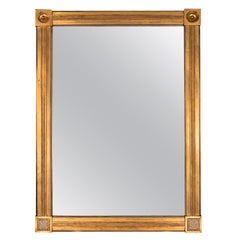
Monumental Overmantel or Pier Mirror in the Aesthetic Taste
Located in New York, NY
American, third quarter of the 19th century.
Pine, gessoed and gilded, with mirror plate.
Measures: 81 ½ in. high, 59 ½ in. wide.
Condition: Excellent. The gilding has been cleaned and very, very slightly inglided as necessary. The ball at the upper left was missing and has been replicated based upon...
Category
Antique 19th Century American Aesthetic Movement Pier Mirrors and Consol...
Materials
Mirror, Pine
More Ways To Browse
Stanley Dining Chairs
Thonet 9 Chair
Thonet Sweetheart
Tulip Chair Cast Iron
Vol Au Vent Chair
1914 Dining Room Chairs
1930 Kitchen Chairs
Antarenni Chairs
Drexel Profile Chair
Harvink Zino
Herman Miller Seal Brown
Hickory Chair Queen Anne Dining Chairs
Hulmefa Propos
Moller 70
Nanna Ditzel 150
Palladian Chairs
Philadelphia Arm Chair
Pier 1 Chairs
About the Seller
No Reviews Yet
Recognized Seller
These prestigious sellers are industry leaders and represent the highest echelon for item quality and design.
Established in 1952
1stDibs seller since 2010
Associations
Art Dealers Association of America
Authenticity Guarantee
In the unlikely event there’s an issue with an item’s authenticity, contact us within 1 year for a full refund. DetailsMoney-Back Guarantee
If your item is not as described, is damaged in transit, or does not arrive, contact us within 7 days for a full refund. Details24-Hour Cancellation
You have a 24-hour grace period in which to reconsider your purchase, with no questions asked.Vetted Professional Sellers
Our world-class sellers must adhere to strict standards for service and quality, maintaining the integrity of our listings.Price-Match Guarantee
If you find that a seller listed the same item for a lower price elsewhere, we’ll match it.Trusted Global Delivery
Our best-in-class carrier network provides specialized shipping options worldwide, including custom delivery.