Items Similar to Midcentury set of 2 solid cherry wood wingback armchairs
sofa Karl Nothhelfer
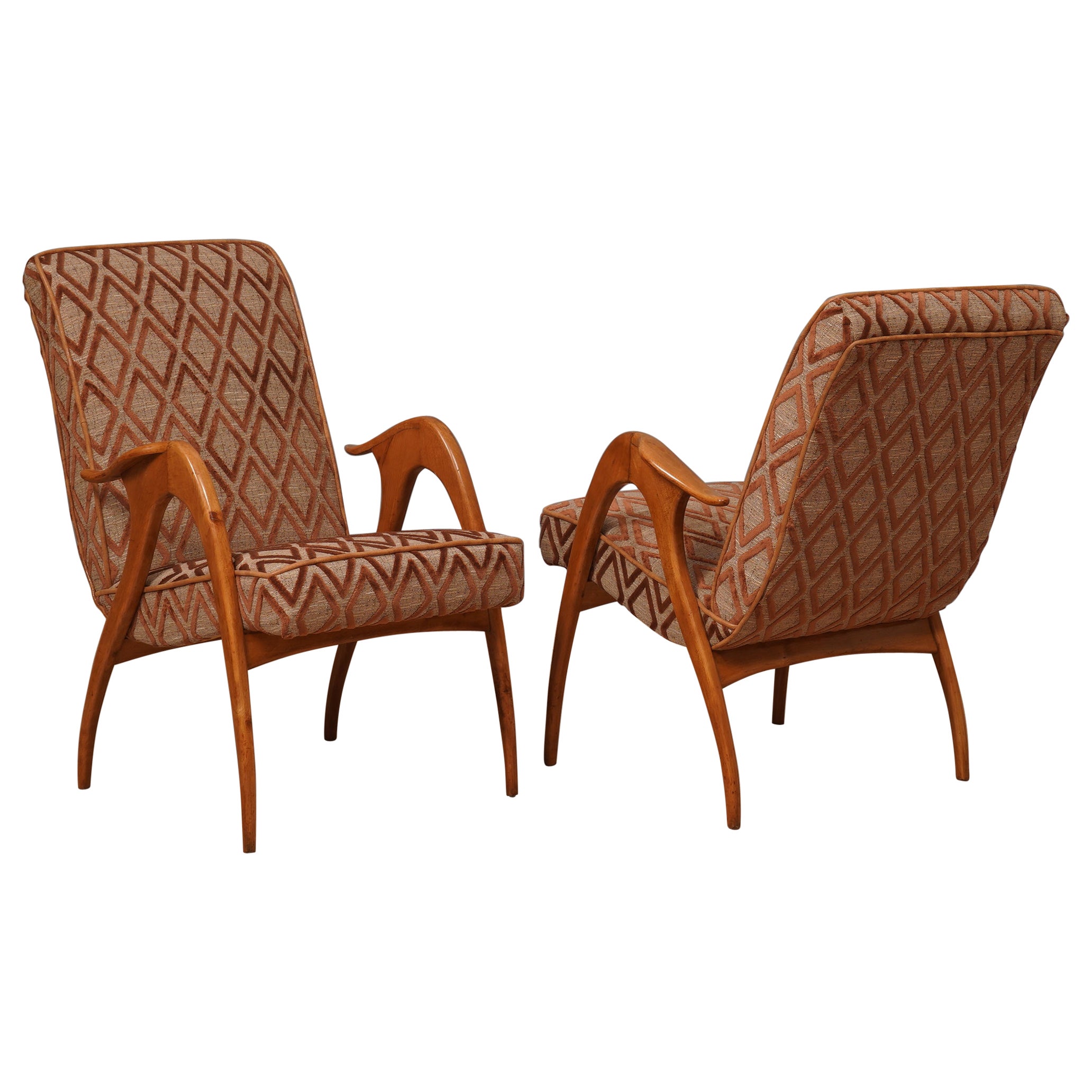
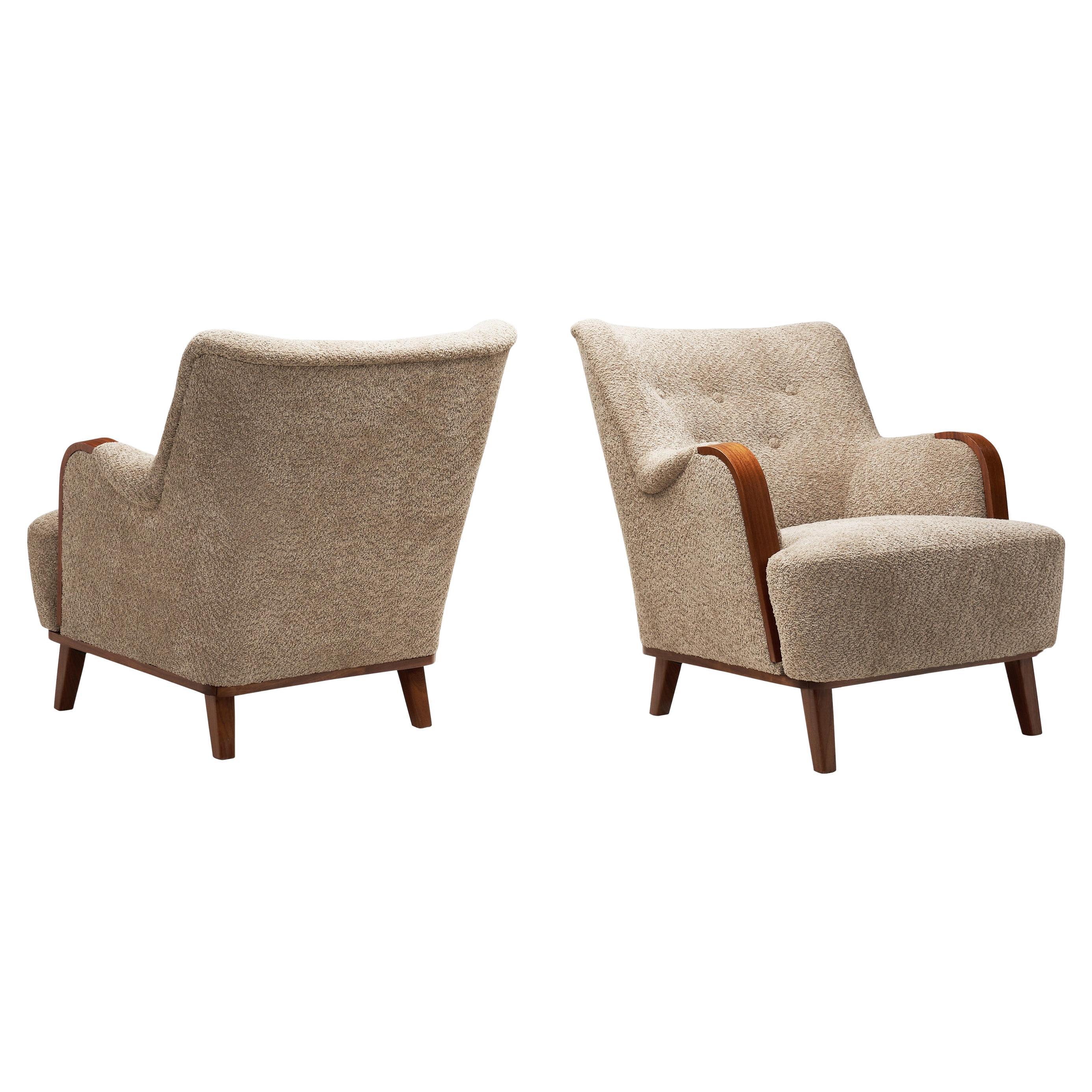
Want more images or videos?
Request additional images or videos from the seller
1 of 20
Midcentury set of 2 solid cherry wood wingback armchairs
sofa Karl Nothhelfer
$14,813.96per set
£11,071.22per set
€12,400per set
CA$20,436.60per set
A$22,384.42per set
CHF 11,785.40per set
MX$267,150.59per set
NOK 150,194.34per set
SEK 137,300.27per set
DKK 94,514.58per set
About the Item
It's just beautiful and easy to reupholster in a fabric of your choice.
(just fabric - as upholstery is PERFECT)
Set of sofa and two wingback armchairs.
Designed by Prof. Karl Nothelfer in 1957.
Maker: Schörle
Gölz in Stuttgart-Bad Cannstatt.
Solid cherry wood.
New upholstery and fabrics in 1998, according to the last owner. Since then, it has only been used for two years, so the upholstery is in perfect condition!
The seat rests can be removed and fixed by clips on the belts.
High class.
Measurements:
Easy chair: 70 cm wide. Sofa: 178 cm wide.
Both have a seating height of 40 cm and a seating depth of 57 cm.
Condition: all firm and in very good condition with no damage.
The furniture has been fully and accurately cleaned.
Three steps: A: air pistol, B: industrial hoover, C: the latest Kärcher "wash
hoover" technology.
The woods have been polished several times.
Note: please ask for a shipping quote by sending us your postcode/destination.
Prof. Karl Nothelfer
* 14 June 1900 – 20 May 1980
Since the beginning of the 15th century, the Nothelfer family of carpenters has lived continuously in the former
town of Überlingen. Every carpenter at that time mastered
all aspects of woodworking, and the Nothelfers were no exception.
They could even carve altars and figures and adorn them with gold, silver and paint.
(Churches in Owingen and Hödingen). Some family members lived and worked
in Hedingen or Hödingen, as the jubilarian Karl Nothelfer did in 1975.
However, his father, Karl Anton Nothelfer, was the eldest of seven siblings and was therefore able to take over his father's carpentry business in Überlingen.
However, Karl Anton Nothelfer was unable to take over his father's carpentry business in Überlingen.
Instead, he moved to the industrial town of Singen with his young wife, Rosalie Hanner, and founded his own carpentry workshop.
Hohenzollern in 1896, and he moved to the former Poststraße, where he founded his own carpentry workshop.
He had a high sense of quality and form, and was a member of the German Werkbund before 1914.
Karl Nothelfer and his three siblings grew up in such an environment.
After attending primary and secondary school in Singen, Karl learnt the carpenter's trade in his father's workshop, before moving on to the Badische Landes-Kunstschule in Karlsruhe.
, where he studied architecture. The well-known furniture professor also worked there at that time:
Fritz Spannagel (born Freiburg, 1891; settled Ittendorf Castle near Meersburg in 1938; died 1957).
burg (died 1957). In 1928, the gifted young architect received a teaching assignment at the
Karlsruhe School of Art, but he followed his teacher Spannagel to Berlin in the same year.
Berlin. He worked there as a teacher from 1928 to 1945, becoming a professor in 1931.
Berlin Tischler-Schule, later known as the Bauschule für Raumgestaltung.
The furniture he created in Berlin gained international recognition through numerous exhibitions and lectures.
He became nationally known and influential. His furniture designs ushered in a new era of German and European furniture design.
European furniture design. At the World Exhibition in Paris
in 1937, Prof. Nothelfer was awarded the Golden Medal for his work in the furniture sector.
For his work in the furniture sector. The first summary and evaluation of his furniture designs is presented in his seminal work,
Das Sitzmöbel, published in 1942, was the first compendium of its kind in the world.
world. In 1950, he published his second book, Furniture. Both books and a
series of brochures were published by Verlag Otto Maier in Ravensburg.
Karl Nothelfer continued to work intensively on seating furniture design in the years after 1945.
In 1950, he made the important invention of the two-legged skid-base chair, which has since become widely accepted.
Even the most distinguished American furniture companies, such as Miller and Knoll International,
, use the skid as the main design feature of desks and chairs. At the same time, N. was pioneering
in redesigning German school furniture and seating for industry.
He succeeded in adapting his furniture designs, which originated in woodworking and craftsmanship, to modern technical possibilities of the industry. He thus became a leading figure in the redesign of schoolroom furnishings.
The architect Nothelfer reflects on his own work,
that his main contribution was in the field of seating furniture, although this was not
really his profession.
After the war, Prof. Nothelfer, like so many others, had to start again from scratch. He settled
in his hometown of Hödingen on Lake Constance in 1945, working as a freelance architect.
involved in all areas of construction in the years after the war. As early as 1935, he had designed many
examples of American prefabricated buildings and recommended serial housing,
This was at a time when no one in Germany was even thinking about mass production. He developed
Several types of mass-produced houses were manufactured in Baiersbronn.
More than 800 of these houses were built in France (types Paris, Provence and Normandie).
In 1946, as part of the reparations in Strasbourg, there was an exhibition of houses featuring Swedish, Danish and French designs.
These included Swedish, Danish, Finnish, English and German houses, and the French occupation
For this exhibition, six different types were sent from the French occupation zone.
Nothelfer's house design was considered the best in the exhibition.
Karl Nothelfer was also involved in developing chipboard. In 1946, he founded the first
magazine, Bauen und Wohnen (Building and Living), after the war, and remained its co-editor for many years.
By presenting his own work, he interpreted what the magazine's essence was.
interpreted the essence of what the magazine wanted to be. Building in order to live in it and live humanely in the built environment. Karl Nothelfer designed his houses
The furniture and ground plans were designed with the need for living in mind. In 1948, he was appointed Honorary Senator of the State of Building
School in Holzminden.
Karl Nothelfer did not build much in Singen. The first post-war house was Haus
Fahr on the slope of the Hohentwiel (Domäne), for which the building materials were sourced from a demolished
log cabin that a French officer had built for himself on the Schienerberg.
nerberg. In 1952, he also constructed the administrative building for the aluminium rolling mill in Singen.
This building featured reliefs and wall paintings by C. G. Becker. In Überlingen, he built
Among others, he built the Buchinger Sanatorium and the Riese+Hähnel radio house.
various reconstructions in the old town, including Haus Kitt with the Glockenspiel. Haus Kitt with the Glockenspiel, the Haus mit dem
Bacchus in Überlingen village and the Dolphin Fountain in Hödingen (1975). Probably the most beautiful
The Haus Nothelfers, also known as the Haus Himmelheber, is located in Baiersbronn-Tonbach. On the airfield
In Mengen, Nothhelfer built the casino with the 30-square-metre faience painting 'Ikarus' by
C. G. Becker. In 1954, he established a second office in Düsseldorf with the architect Hans Schwingen.
This office primarily focused on housing construction, true to the motto: from the inside out.
planning from the outside'. The Minister of Housing awarded a prize for the best social housing project in North Rhine-Westphalia, and it came from the Nothelfer+Schwingen studio in Düsseldorf. The idea of Nothelfer+Schwingen also promoted the new idea of home ownership.
To celebrate the anniversary of the condominium ownership law,
In 1961, Nothelfer gave a lecture in Essen on condominium ownership in Europe, which was published as a brochure.
From Düsseldorf, among many others, in the silk city of
Krefeld, there are four mosaics on the facade, each 25 metres long, titled 'From the Caterpillar to Silk'.
From the Caterpillar to Silk" by C. G. Becker, as well as the Geological Institute and many
green residential areas. Nothelfer's special interest is the protection of the landscape.
In his speeches and concise writings, he expresses his opposition to the proposed freeway route near the lake.
The route is planned for the northern shore of Lake Constance.
However, this is not the full picture of Nothelfer, who remains incredibly fresh and full of ideas. As well as his work, he loves water sports and sailing. At the age of 60, he and his wife obtained their deep-sea sailing licence, enabling them to sail extensively in the Mediterranean.
The fruits of these
travels was a series of cultural and historical lectures with films and slides. In the Footsteps of
Odysseus.
Karl Nothelfer has been a member of the Bodensee-Yachtclub since 1949 (and is now an honorary member).
Überlingen, and he presided over the club as president from 1967 to 1971. He is also the club's house architect.
of the club and rebuilt and modernised the clubhouse, redesigning the harbour facilities in Überlingen. We would also like to mention that Karl Nothelfer is an excellent painter.
Herbert Berner, Singen, 1975 (- partly translated)
- Dimensions:Height: 29.14 in (74 cm)Width: 70.08 in (178 cm)Depth: 27.56 in (70 cm)Seat Height: 15.75 in (40 cm)
- Sold As:Set of 3
- Style:Mid-Century Modern (Of the Period)
- Materials and Techniques:
- Place of Origin:
- Period:
- Date of Manufacture:1957
- Condition:Rewoven. Minor fading.
- Seller Location:Landshut, DE
- Reference Number:1stDibs: LU8587235777342
About the Seller
5.0
Vetted Professional Seller
Every seller passes strict standards for authenticity and reliability
1stDibs seller since 2023
22 sales on 1stDibs
Typical response time: 7 hours
- ShippingRetrieving quote...Shipping from: Bodenkirchen , Germany
- Return Policy
More From This Seller
View AllMODUS by Kristian Solmer Vedel SET of 3 lounge chairs 1 stool
2 coffee tables
By Kristian Solmer Vedel
Located in Landshut, BY
This set was designed by Kristian Solmer Vedel for the renowned Søren Willadsen Møbelfabrik in Denmark.
It boasts excellent original condition.
The set includes two lounge armchair...
Category
Vintage 1960s Danish Scandinavian Modern Stools
Materials
Aluminum
pair of 1960s lounge chairs green velvet - beech WG solid make uph. easy chairs
Located in Landshut, BY
This set of two West German lounge chairs is in very good condition
It was made in the mid 1960s
The armrests have been professionally restored (sanded - stained and lacquered tw...
Category
Mid-20th Century German Mid-Century Modern Lounge Chairs
Materials
Wood, Velvet, Beech
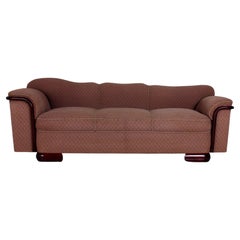
STRAIGHT classic art deco SOFA Dresden around 1930 or. fabric - wood refinished
Located in Landshut, BY
""~!~** STRAIGHT **~!~**
This classic art deco sofa was produced in the Dresden area in the 1930s
Its shape is quite unique and very well proportioned
Its spring upholstery is still strong and fully undamaged
All wooden parts have been demounted sanded and stained - then treated (sprayed) with a transparent Acrylic Silk Matt Paint
finish and professionally remounted.
The sofa has fully been accurately cleaned ::
:: 3 steps: A: air pistol...
Category
Vintage 1930s German Art Deco Sofas
Materials
Wood, Fabric, Beech
$3,572 Sale Price
35% Off
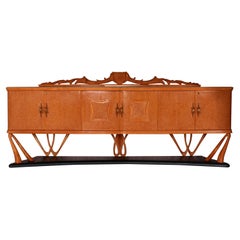
One of a Kind Italian Midcentury Sideboard with Bar Cabinet a. Vittorio Dassi
By Vittorio Dassi
Located in Landshut, BY
Italian 1950s
one of a kind
BAR / SIDEBOARD
attributed to Vittorio Dassi
birch root veneer - solid birch "feet" - stained glass top - mirrored bar compartment - carved upper orna...
Category
Vintage 1950s Italian Mid-Century Modern Sideboards
Materials
Stained Glass, Burl, Birch
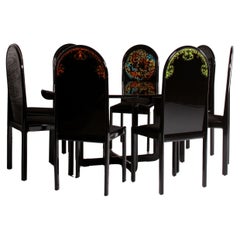
Björn Wiinblad for Rosenthal limited art series dining room set table
8 chairs
By Bjorn Wiinblad
Located in Landshut, BY
THE FOUR CARDINAL POINTS
Rosenthal Kunstmöbelreihe
This noteworthy design is the work of Bjørn Wiinblad.
The furniture pieces were produced in a limited edition of 300 in 1976.
E...
Category
Vintage 1970s German Space Age Dining Room Sets
Materials
Wood, Beech, Bentwood, Lacquer
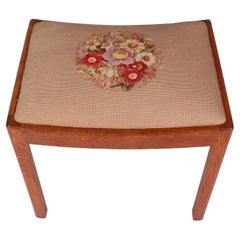
art nouveau oak stool chair Jugendstil Rabenau embroidery a. 1910 exc condition
Located in Landshut, BY
solid built oak
Jugendstil
CHAIR
made in Rabenau / Saxonia
upholstered with care - fitted with hand embroidered jute fabric
Rabenau's chairmaking tradition is almost 400 years ol...
Category
Vintage 1910s German Art Nouveau Chairs
Materials
Wool, Jute, Oak
You May Also Like
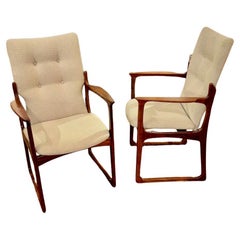
Pair of Mid Century Modern Rosewood Danish Armchairs
Located in Dallas, TX
Nice pair of mid-century modern rosewood Danish armchairs from the 1960s. These vintage chairs perfectly capture the retro and mid-century style popular during that time period. Made...
Category
Mid-20th Century Danish Mid-Century Modern Armchairs
Materials
Rosewood
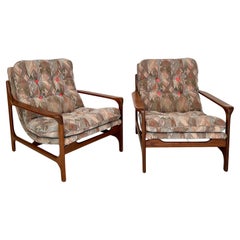
Mid Century Pair of Armchairs in Teak in the Style of Eugen Schmidt, around 1960
By Eugen Schmidt
Located in Berlin, DE
This stylish pair of mid-century armchairs, crafted around 1960, reflects the refined modernism characteristic of Eugen Schmidt’s design aesthetic. Made from beautifully grained teak...
Category
Vintage 1960s German Mid-Century Modern Armchairs
Materials
Upholstery, Teak
$2,771 Sale Price / set
20% Off
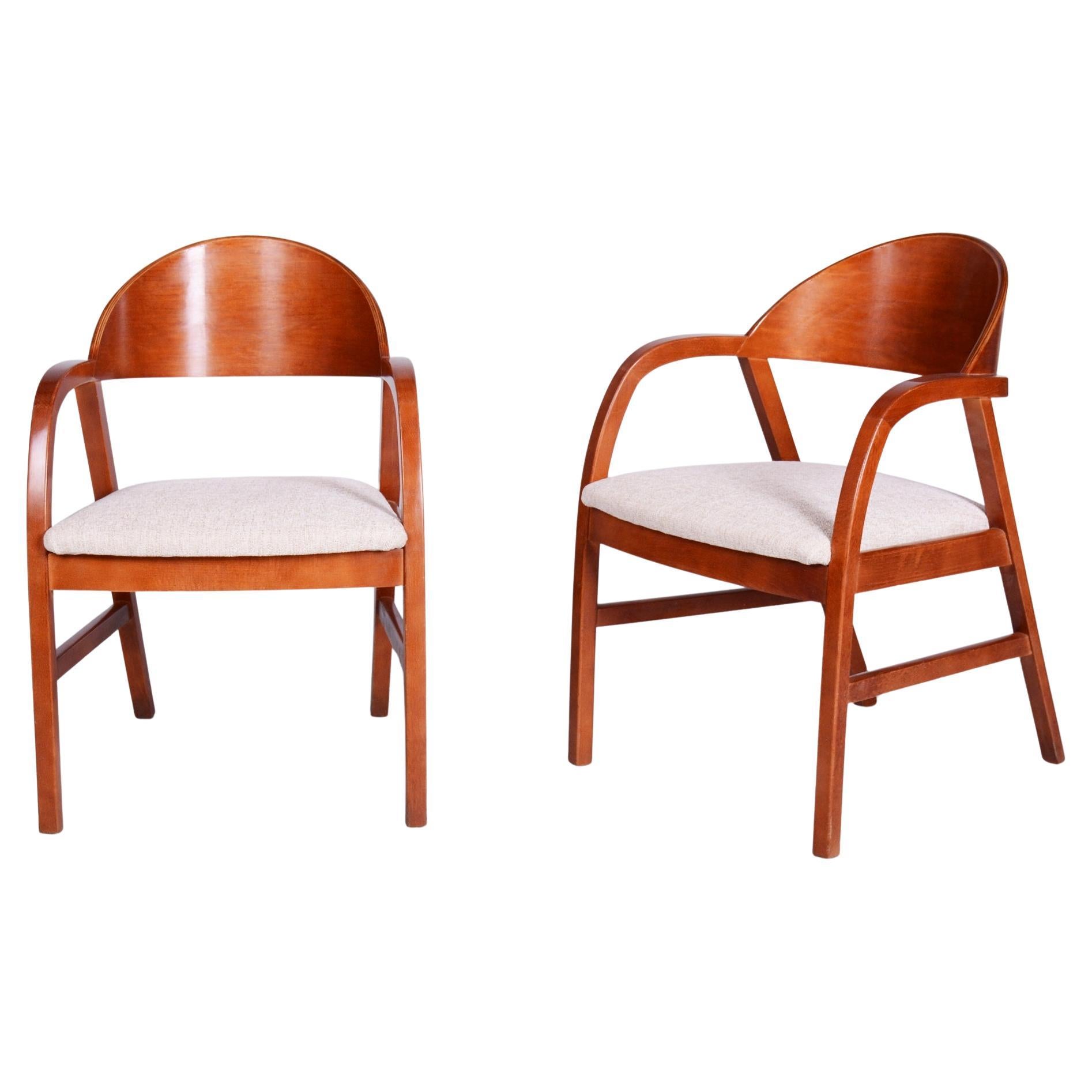
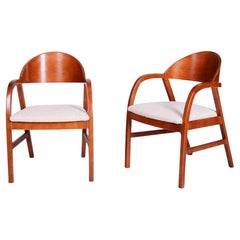
Pair of Restored Mid-Century Armchairs, Reupholstered, Cherry Wood, Czech, 1970s
Located in Brandys nad Labem, Středočeský kraj
This elegant pair of Mid-Century armchairs comes from Czechoslovakia from the second half of the 20th century. They are made of solid beech with cherry veneer.
The armchairs have un...
Category
Vintage 1970s Czech Mid-Century Modern Armchairs
Materials
Fabric, Upholstery, Wood, Lacquer, Cherry
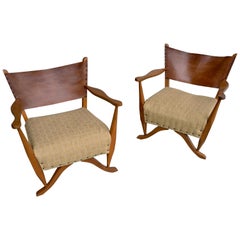
Pair of Mahogany Armchairs with Natural Sling Leather Back, Denmark, 1960s
Located in Den Haag, NL
Pair of mahogany armchairs with natural sling leather back, Denmark 1960s.
Category
Mid-20th Century Danish Mid-Century Modern Armchairs
Malatesta e Mason Beech Wood and Fabric MidCentury ArmChairs, 1950
By Malatesta and Mason
Located in Roma, Lazio
Icon of the Malatesta and Mason company, these armchairs are a project that has characterized and influenced all the seats of the last century. Amazing design and amazing comfort.
T...
Category
Vintage 1950s Italian Mid-Century Modern Armchairs
Materials
Velvet, Beech
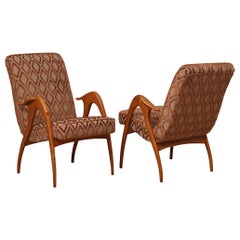
Pair of Mid-Century Modern Armchairs with Wooden Arm Details, Europe 1950s
Located in Utrecht, NL
Mid-century modern, a design movement devoted to timeless functionalism, established itself in the post-war period with furniture that appealed to the senses. Furniture design was gu...
Category
Vintage 1950s European Mid-Century Modern Armchairs
Materials
Wood, Fabric
More Ways To Browse
Mid Century Modern Rolling Chair
Church Silver
Wingback Couch
Altar Set
Set Of 2 Wingback Chairs
American Seating Company School Desk
Vintage Rolling Mill
Hering Berlin
Brass Legs Coffee Table
Drop Leaf Dining Table Casters
French Louis Table Mirror
Gold Bracket
Hand Carved Mahogany Desk
Handmade Oak Coffee Table
Hollywood Regency Brass Glass Console Table
Italian Neoclassical Side Table
Large Glass Centerpiece Bowl
Low French Seating