H. Pander
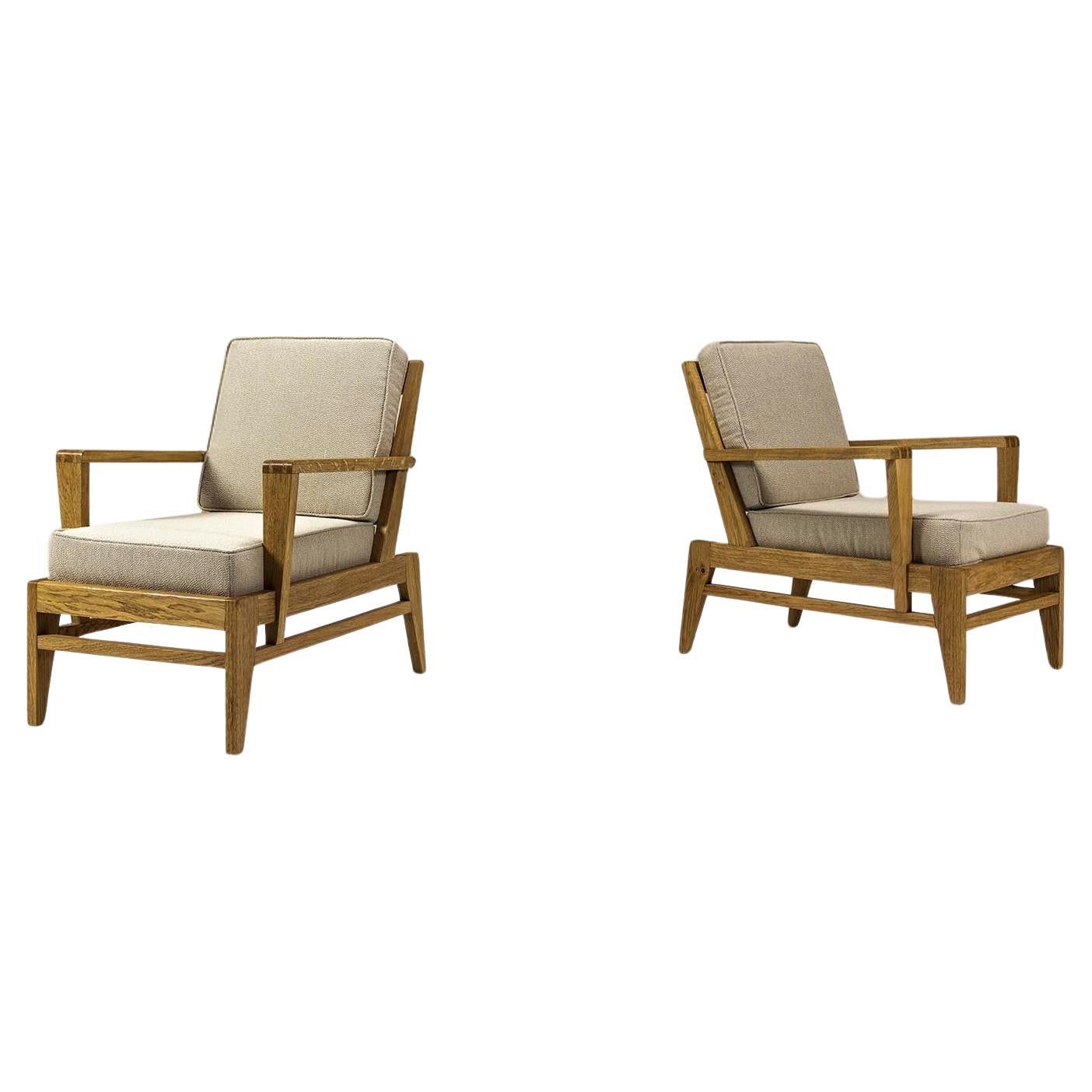
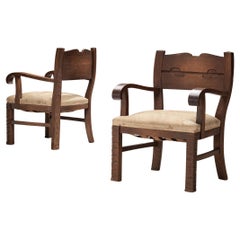
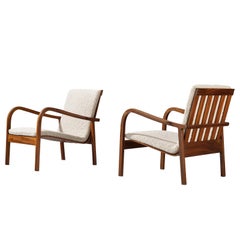
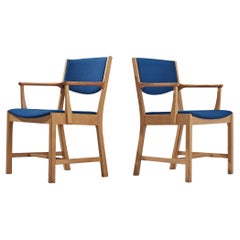
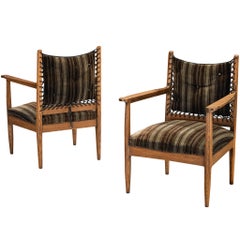
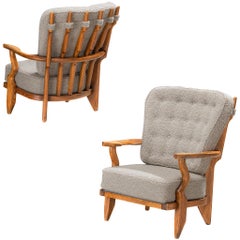
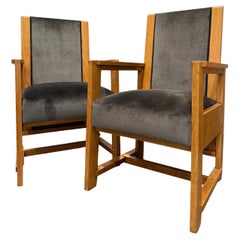
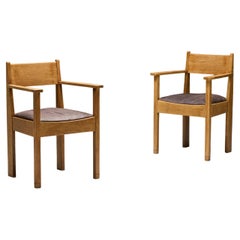
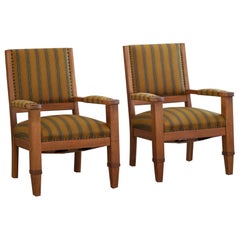
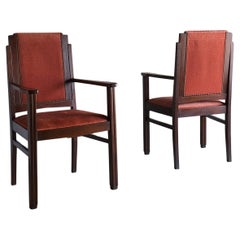
Zonen, pair of lounge chairs, oak, fabric, the Netherlands, 1930s
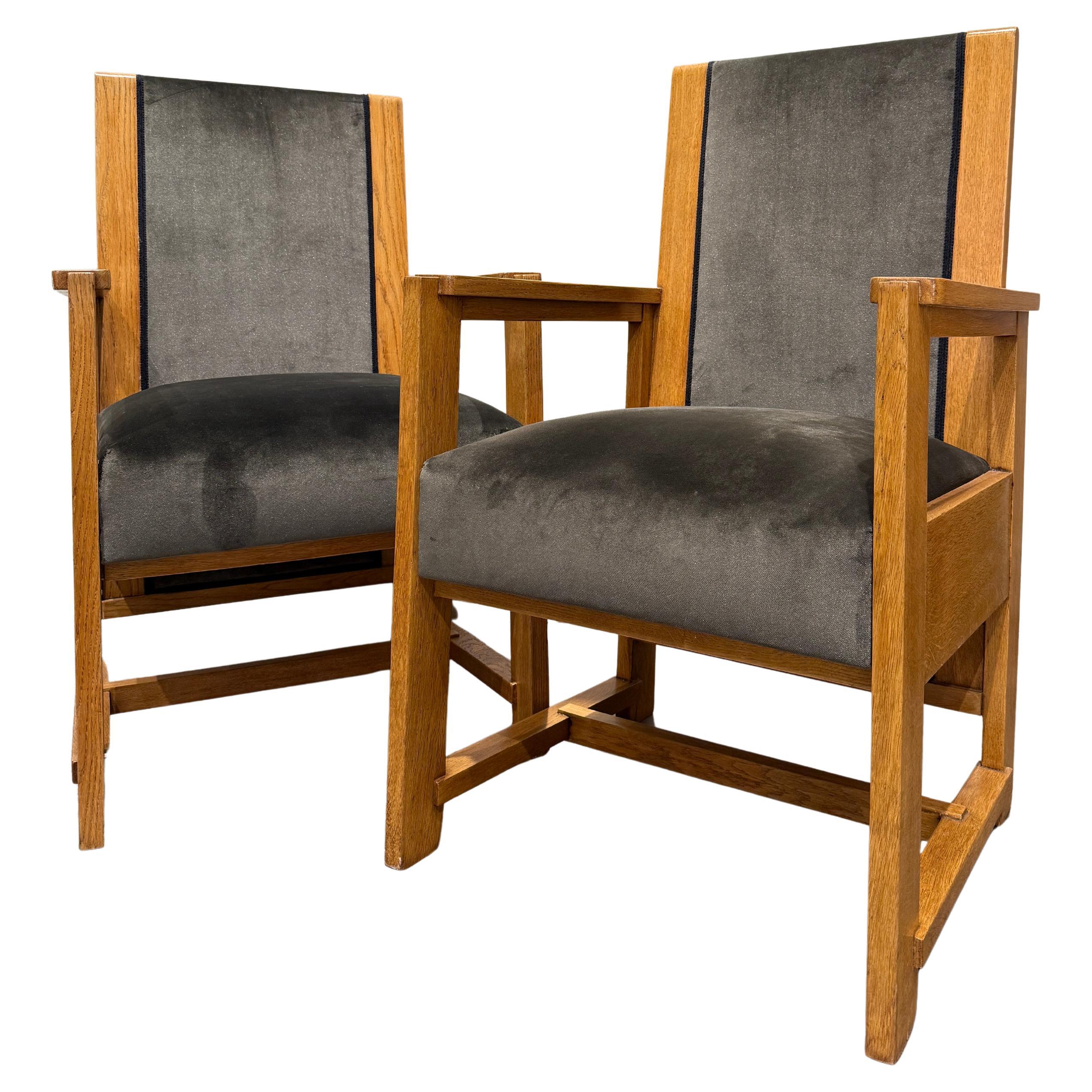
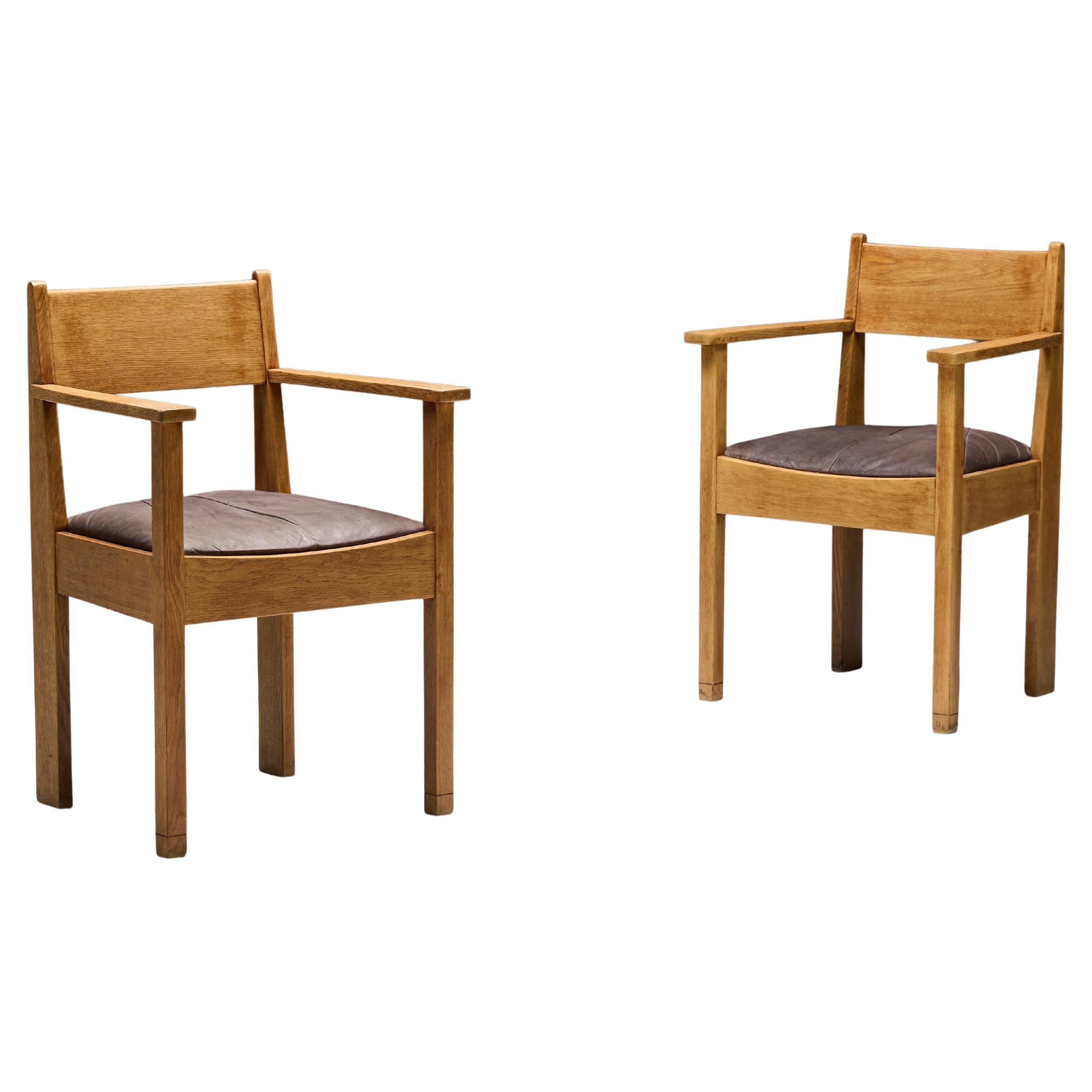
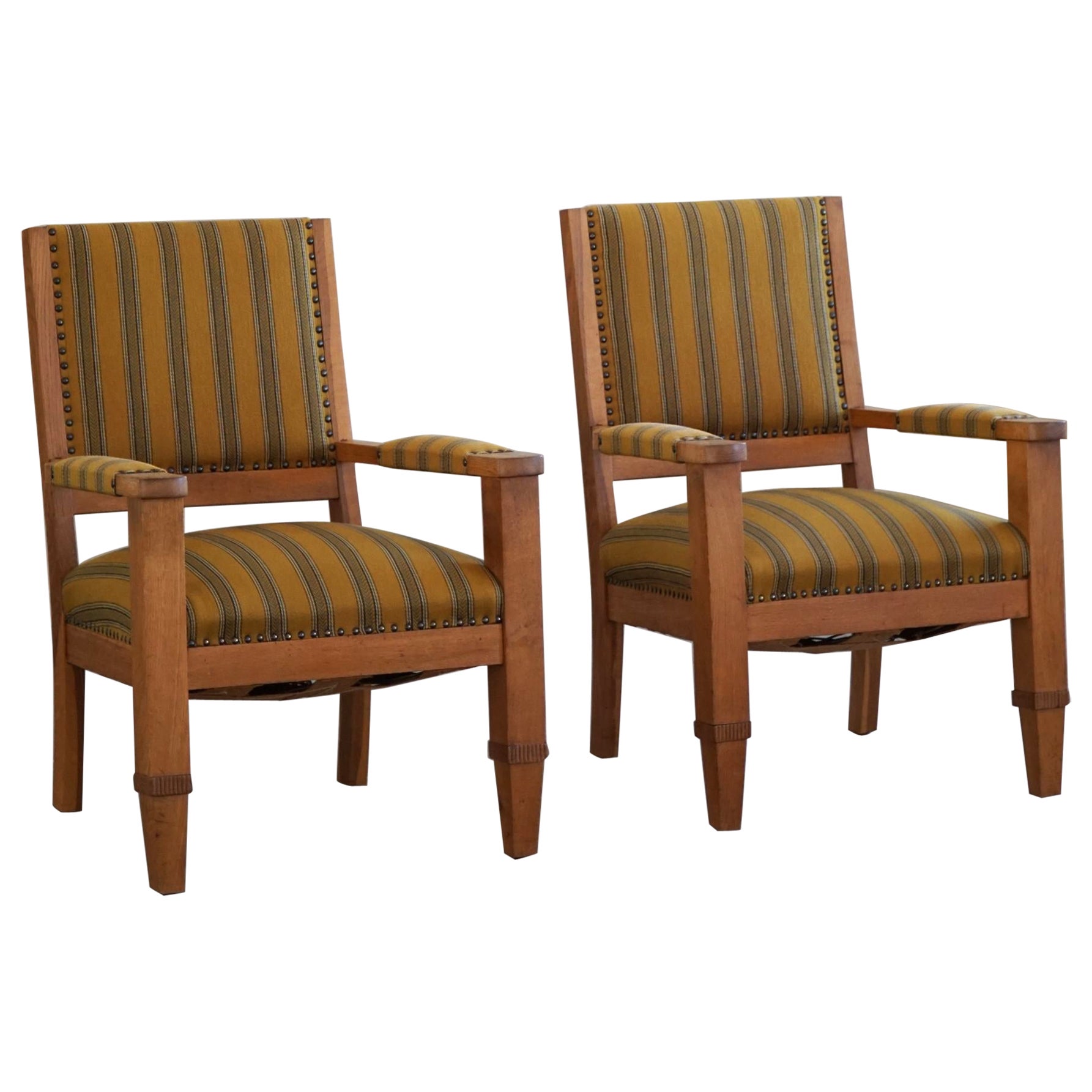
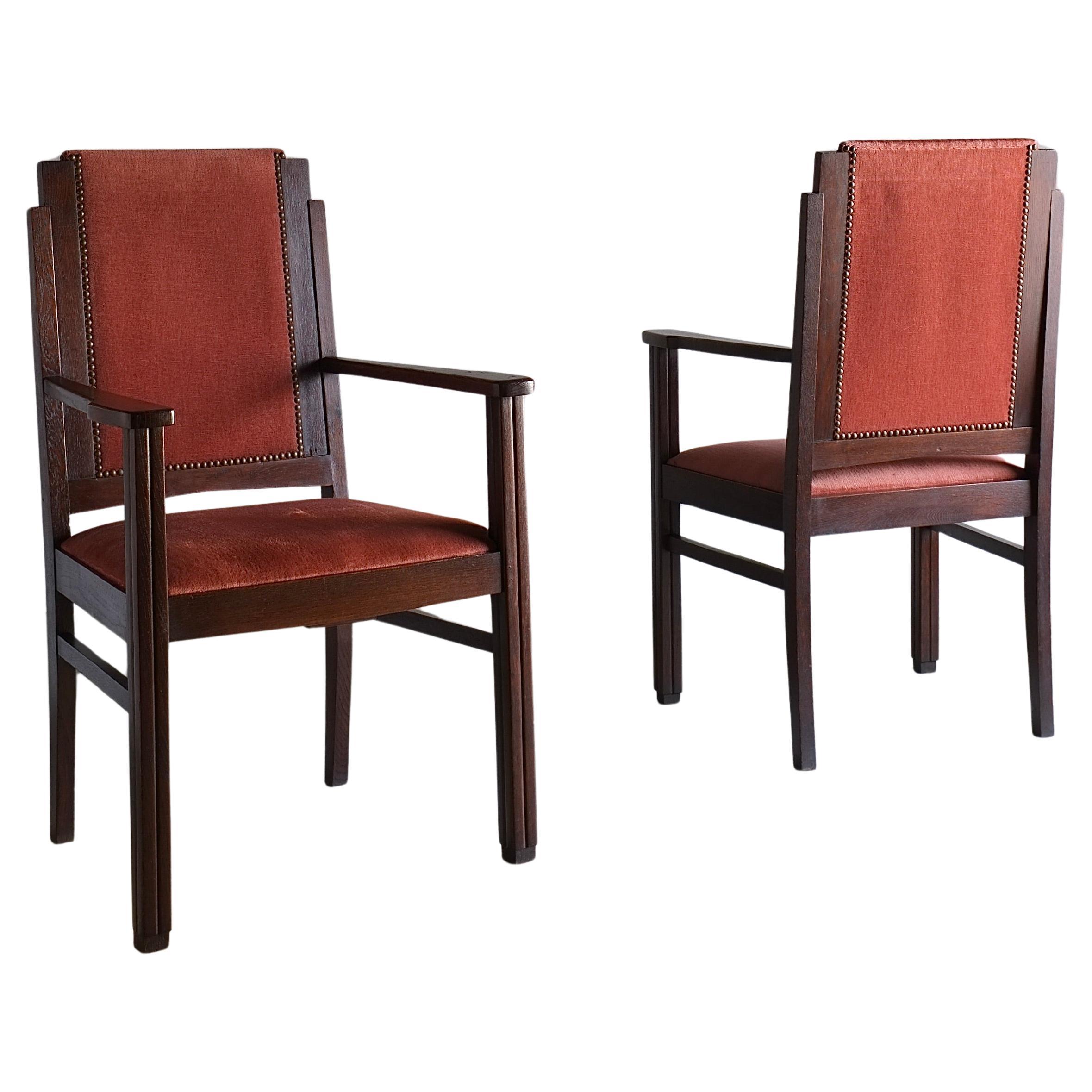
These lounge chairs, produced by H. Pander
Zonen during the 1930s, exemplify the restrained monumentality characteristic of the Hague School. Constructed in solid oak, the overall silhouette is rectilinear and grounded. The armrests are among the few elements where the designer allowed a sculptural gesture. They extend outward and curve gently at the ends, softening the otherwise angular composition. This curvature functions both ergonomically and aesthetically. The diagonally tapered legs rise from the floor with poise and firmness. The seat and backrest are upholstered in a dark blue fabric, and framed within a continuous wooden outline. The grain of the oak articulated as a visible, integral component of the design, imparting the pieces with an organic allure. These chairs translate the Hague School’s ideals of rational construction, material honesty, and formal restraint into domestic scale. They embody the ethos of interwar Dutch modernism: functional, sober, and enduringly dignified.
H. Pander
Zonen (1850-1985)
The Dutch furniture manufacturer H. Pander
Zonen occupies a distinctive position in the history of nineteenth- and twentieth-century design, both as a pioneering commercial enterprise and as one of the principal exponents of the Hague School in interior and furniture design. Its story begins with the entrepreneurial activities of Klaas Pander (1819-1897), a travelling merchant from Blokzijl who, with his small freight boat, traded woven reed mats, carpets, and mattresses along the Dutch coasts of Holland and Zeeland. His modest but flourishing trade inspired his son, Hendrik Pander (1842-1893), to establish a permanent business in 1863 in Gouda, specializing in carpets and wallpapers. Only two years later, in 1865, he relocated to The Hague, recognizing the commercial potential of the expanding capital.
By the 1870s the firm had grown steadily, adding multiple shopfronts along the Wagenstraat, and by 1882 it even opened a branch in Amsterdam managed by Hendrik’s son, Klaas Gerard Pander. A decisive step followed in 1887, when the company purchased the former flour mill Hollandia on the Zuid Binnensingel in The Hague. There, Hendrik Pander established a large-scale furniture factory.
The modernized Pander establishment increasingly mirrored the model of the Parisian department store, which fascinated the Panders. Hendrik and Klaas Gerard were both deeply influenced by the French retail and design world, particularly the grand magasins of Paris. Their admiration for the French system of complete, styled interiors prompted them to reorganize their own showrooms along similar lines. The Hague store became a prestigious woonwarenhuis (home department store) of international allure, with fully furnished model rooms presenting different stylistic ensembles to customers. This approach – combining retail spectacle, design ambition, and artistic education – was remarkably progressive for the Dutch market of the 1880s and 1890s.
By the late nineteenth century, the management and design departments of H. Pander
Zonen had become aware of international developments in furniture art. Their early awareness of new styles is evident in the inclusion, as early as the late 1880s, of displays labeled “the modern English style” in their showrooms. This reveals that Pander’s directors already recognized the commercial and artistic value of modern form. Though rooted in Dutch tradition, their aesthetic orientation remained strongly influenced by French taste, filtered through the eclecticism of the fin de siècle.
Around the turn of the century, Pander had already accumulated over a decade of experience with what it called the “modern interior.” The firm produced a wide range of furniture – from custom pieces for villas and institutional buildings to series-produced models for smaller homes – while simultaneously modernizing its production methods. Pander was commissioned to supply interior furnishings for notable buildings, such as the Peace Palace (Vredespaleis) in The Hague. Its strong commercial network, with branches in The Hague, Amsterdam, and later Rotterdam, allowed Pander to become one of the largest and most visible furniture enterprises in the Netherlands.
A decisive new phase began in 1917, when the company established an independent Afdeling voor Moderne Interieurkunst (Department of Modern Interior Art). This move was prompted by the unprecedented boom in the domestic furniture industry during the First World War, when German and Belgian imports had virtually ceased. To seize the opportunity for artistic and commercial renewal, Pander appointed the young interior architect Hendrik Wouda (1885-1946) as head of the new department. Wouda, trained in The Hague and steeped in the ideals of modern design, brought a new spirit of experimentation and clarity to the firm’s output. Shortly after his appointment, he was joined by the recently graduated Cor Alons (1892-1967) and the slightly older Jan Brunott (1889-1951), who together helped shape the visual identity of Pander’s modern collections.
Under Wouda’s leadership, the Pander design office became an important center for Dutch modernism and a key force in defining what would come to be recognized as the Haagse School (Hague School) in furniture and interior design. The Hague School, as an architectural and artistic movement, emphasized sobriety, geometric composition, structural logic, and the honest expression of materials. In contrast to the expressive and sculptural Amsterdam School, the Hague style projected a calm, rational monumentality, deeply influenced by the work of architect H. P. Berlage, the Arts
Crafts movement, and Frank Lloyd Wright’s ideas about the integrated home.
The furniture created in Pander’s modern department exemplified these principles: rectilinear forms, balanced proportions, and minimal ornamentation; functional pieces executed in oak or other high-quality woods; and a sense of harmony between object and space. Pander’s designers conceived their interiors as Gesamtkunstwerken, total works of art in which architecture, furniture, and decoration formed a coherent whole. This aesthetic found expression in the company’s many commissions for both private residences and public institutions, ranging from small urban apartments to large villas and government offices.
By the mid-1920s H. Pander
Zonen had grown into one of the largest furniture industries in the Netherlands and began to assert itself within the national debate on design reform. The company sought a presence in leading journals and exhibitions, recognizing the importance of visibility in the discourse of modern applied arts. A landmark in this process was its participation in the Exposition Internationale des Arts Décoratifs et Industriels Modernes held in Paris in 1925 – the world exhibition that gave its name to “Art Deco.” Pander’s involvement signified not only its international orientation but also its ambition to align Dutch furniture production with the highest standards of European design culture.
Parallel to its design innovation, Pander was also a pioneer in modern marketing. It was the first furniture company in the Netherlands to publish its own lifestyle magazine for clients: Thuis (“At Home”). Lavishly printed and aimed at an affluent clientele, the periodical presented complete interiors, illustrated new collections, and communicated the company’s design philosophy. Through Thuis, Pander promoted a vision of modern domesticity in which functional elegance and aesthetic coherence went hand in hand; ideals that resonated with the Hague School’s orderly approach to modern living.
Throughout its existence, Pander maintained a dual identity: an industrial manufacturer capable of large-scale production and a design institution fostering artistic renewal. This combination enabled it to serve both mass and elite markets, from custom-designed interiors for villas to serially produced furniture for urban apartments. Its showrooms, exhibitions, and collaborations with architects positioned it at the intersection of art, commerce, and modern life.
In later decades, the company diversified further, furnishing ships and public buildings, and even establishing an aviation branch, Pander
Sons Aircraft, which was ended in 1935. By the 1950s, H. Pander
Zonen merged with other companies to form N.V. Verenigde Meubileringsbedrijven (United Furnishing Companies), though by the 1980s, faced with shifting markets and industrial restructuring, the enterprise ceased operations after more than a century.
In retrospect, the evolution of H. Pander
Zonen encapsulates a central trajectory in Dutch design history: the transformation of a small artisanal trade into a large, sophisticated manufacturer attuned to international currents and national cultural ideals. Through its sustained engagement with the Hague School and its pioneering role in promoting modern interior art, Pander contributed profoundly to shaping the visual and material culture of the Netherlands in the twentieth century.