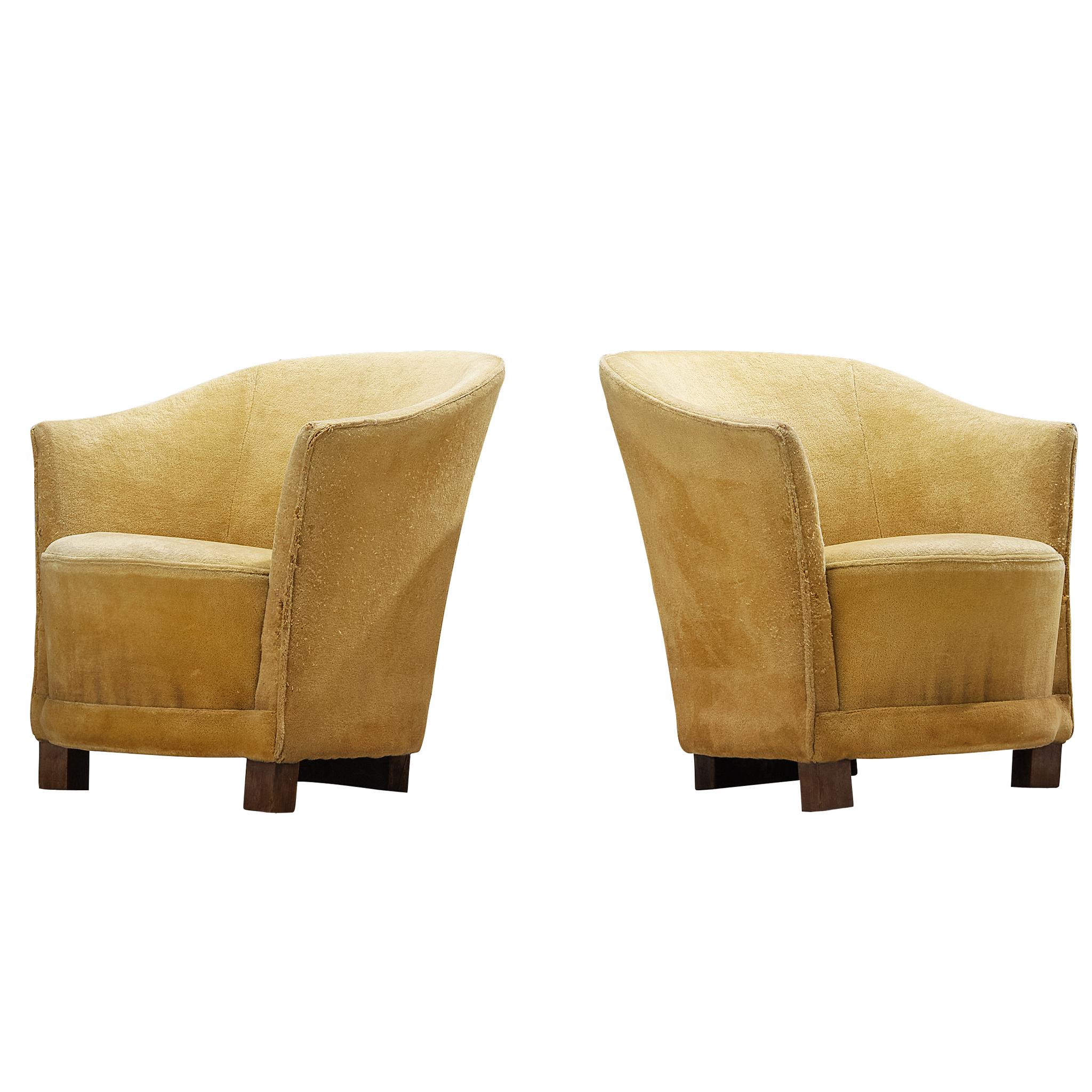
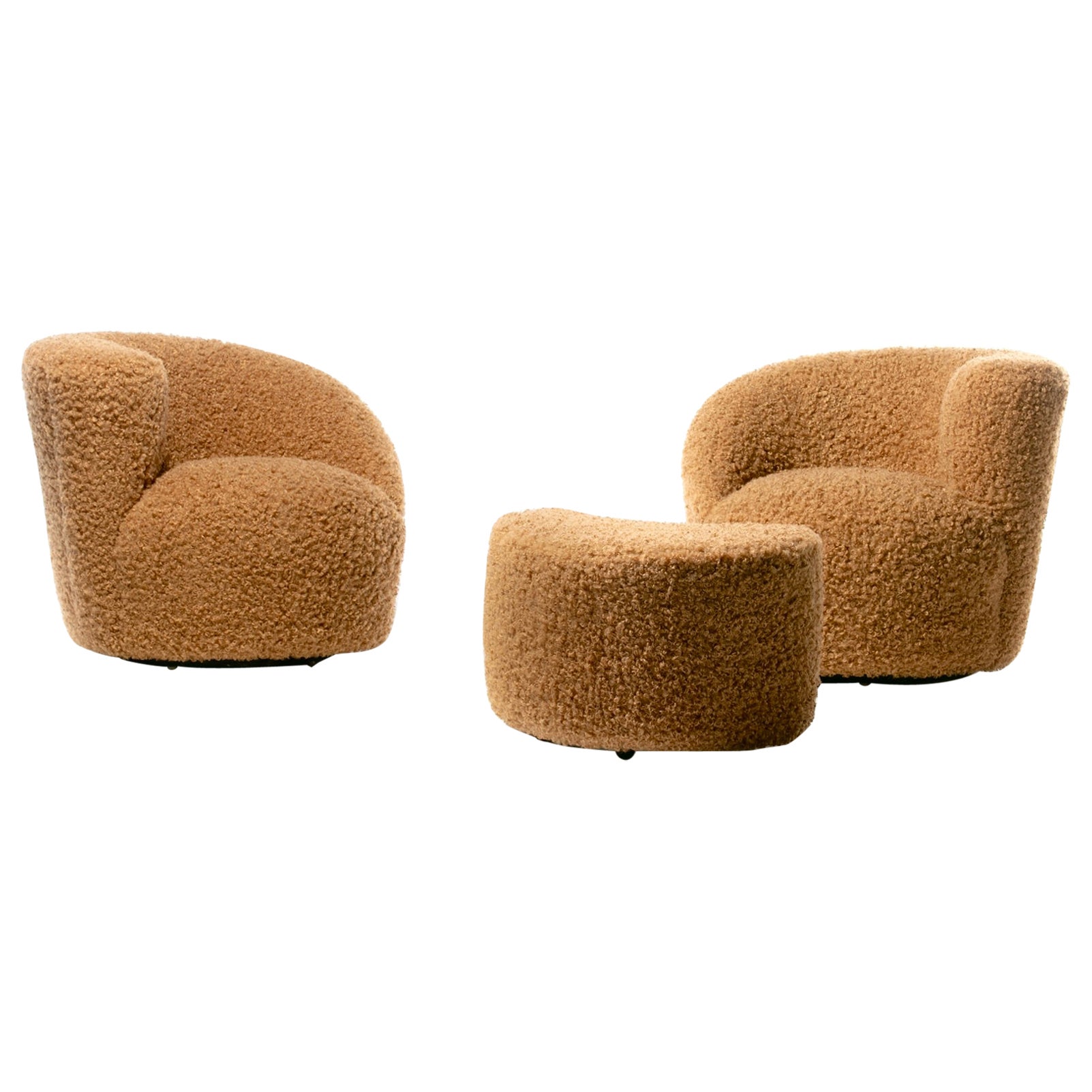
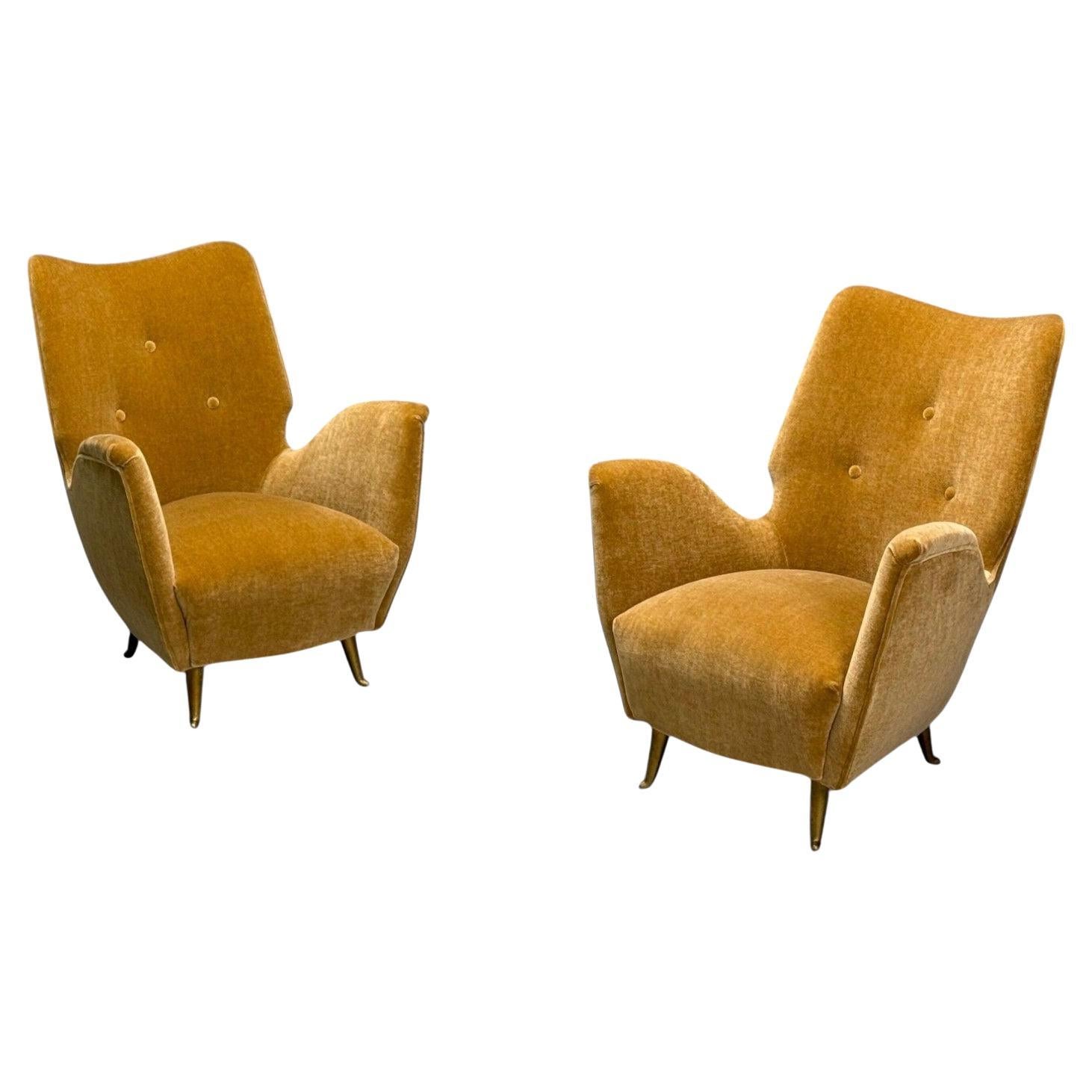
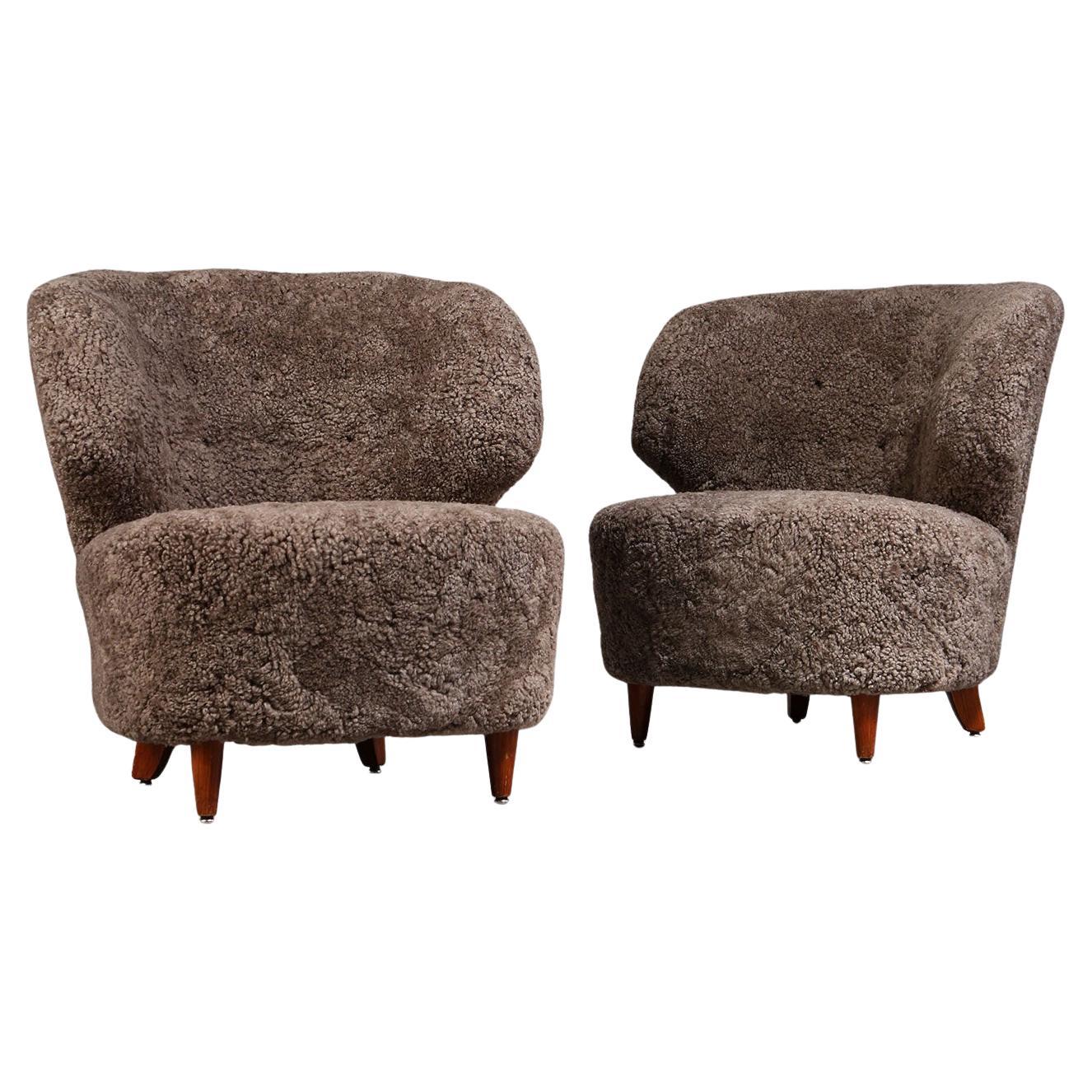
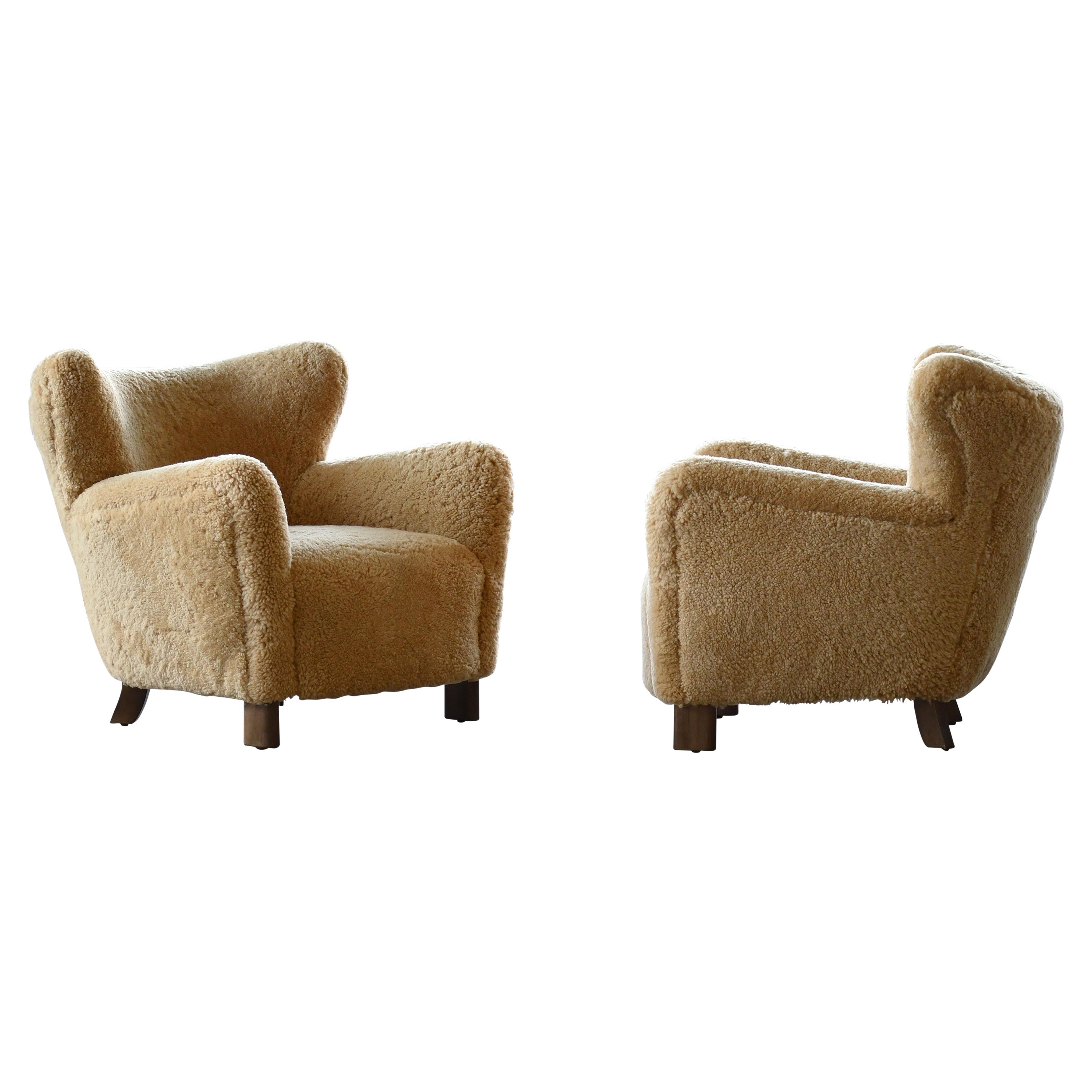
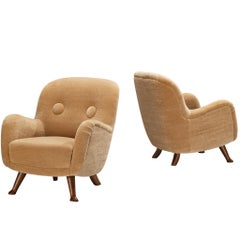
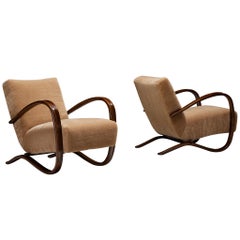
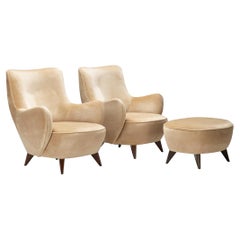
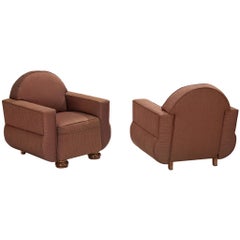
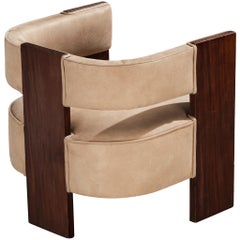
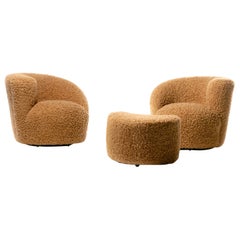
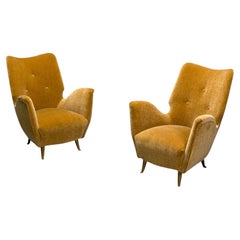
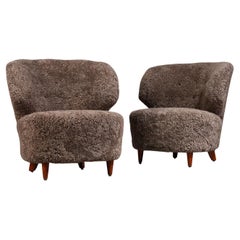
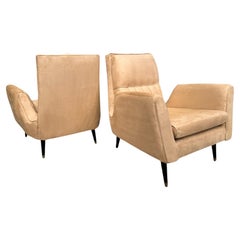
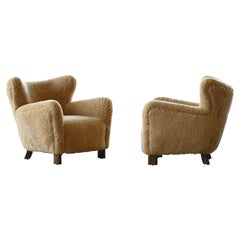
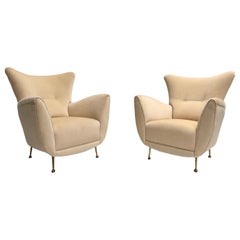
Otto Schulz for Boet, pair of lounge chairs, model 'B. 109', reupholstered in Caramel mohair, lacquered birch, Sweden, circa 1934
The pair of lounge chairs designed by Otto Schulz (1882-1970) in the early 1930s reflect an alternative approach to the emerging functionalist ideals that were beginning to shape Swedish modernism. In an era when the ideals of rationalism, technological progress, and social utility were celebrated as the hallmarks of design, Schulz and his firm Boet cultivated a language of comfort, craft, and decorative individuality. His furniture, of which these rounded lounge chairs are emblematic, embodied a different vision of modern life: one grounded not in abstraction and efficiency, but in domestic warmth and sensory pleasure.
By the end of the 1920s, functionalism had begun to gain ground among progressive architects and designers in Sweden, a movement that would become dominant after the Stockholm Exhibition of 1930. With over four million visitors, this landmark event introduced the general public to the aesthetics and social ambitions of modernism. Organized according to the principles of rational planning and industrial production, the exhibition promoted simplicity, light surfaces, and the reduction of ornament as visual expressions of social and technological progress. As Uno Åhrén (1897-1977) and other functionalist theorists argued, the new style was not merely a matter of form, but also of social responsibility. Design was to serve the collective needs of a modern society rather than the decorative desires of the individual.
Otto Schulz’s response to this new order was neither overtly oppositional nor reactionary. Rather, he occupied an in-between position that reveals the pluralism of early modern Swedish design. While many of his contemporaries embraced simple shapes and inexpensive materials, Schulz continued to produce furniture that spoke to a cultivated bourgeois audience – consumers who valued comfort, quality, and visual richness. At Boet, the store he founded in Gothenburg, interiors were composed not of functionalist austerity but of upholstered chairs and sofas, polished woods with marquetry, and patterned textiles. He also created modular systems with modernist details like metal feet, yet their forms remained soft, tactile, and expressive.
The lounge chairs exemplify this synthesis. Their circular construction and continuous backrest create a sense of enclosure and intimacy. Historical pictures and drawings showcase decorative, patterned upholstered sofas and chairs with stylized floral motifs and contrasting color bands. The craftsmanship is evident in every detail: the precise seams, the subtle curvature of the seat, the rhythm of the ornament. In these features, Schulz’s design challenges the dichotomy between functionalism and decoration, suggesting that utility and beauty can coexist within the same object.
During the mid-1930s, Swedish design entered a new phase that softened the austerity of early functionalism. What would later be termed Swedish Modern emerged from this period, uniting modernist clarity of form with artisanal craftsmanship, natural materials, and an emphasis on comfort and domesticity. This aesthetic gained international recognition at the Paris World’s Fair in 1937 and the New York World’s Fair in 1939. The arrival of Josef Frank (1885-1967) at Svenskt Tenn in 1934 signaled this shift toward a softer, more human modernism that embraced history, color, and comfort. Schulz’s work anticipated many of these tendencies. His designs never fully abandoned tradition; instead, they evolved within it, designing exclusive and handcrafted furniture that balances tradition with function.
In retrospect, these chairs embody what might be called a bourgeois modernity: a design ethos that accepted modern form but refused to abandon the values of home, tradition, and craft. Schulz’s work reminds us that the story of modern design was never linear or uniform. Even at the height of functionalism’s influence, there were designers who, through subtle means, resisted its dogma. Schulz’s lounge chairs assert that modern life could be not only rational and efficient, but also warm, beautiful, and deeply human.
Boet
In central Gothenburg, one of Sweden’s most exclusive interior design shops, Firma Boet, was established during the interwar period. The store was founded in 1920 by the architect Otto Schulz, together with the Stockholm architect Adolf Nordinberg. Boet soon developed into a fully-stocked store with competitors in Sweden, and within a few decades, the shop was comparable – but also competitive – with the furnishing department at Nordiska Kompaniet or Firma Svenskt Tenn in Stockholm. In his solo efforts, Schulz continued to develop furniture designs that adapted to the changing times, and in relation to the trends of leading firms of the time, such as Swedish Grace during the 1920s and the Swedish Modern movement from the 1930s onwards. Schulz repeatedly emphasized his position as owner and artistic leader for Firma Boet. Schulz was also recognized for creating designs and individual furniture pieces featured in the firm’s magazine, Boet. However, it is likely that many other employees played a crucial role in supporting and boosting the production capabilities of the company.
The magazine Boet was a monthly magazine for home culture, crafts, and industrial art, published monthly from 1928 to 1938, with a special anniversary issue in 1945. The magazine primarily featured photographs and editorial texts about Firma Boet’s furniture and interiors, but it also contained a number of articles, reviews, and commentary. Boet enlisted a diverse group of contributors, including museum curators, theorists, critics, architects, craftsmen, designers, and representatives from the art industry. Many of these writers were actively involved in Gothenburg's cultural scene. They explored Boet from various angles, covering topics such as advancements in furniture design, architecture, interior decor, lighting, formal events, lighting fixtures, wallpapers, textiles, modern paintings, tapestries, decorative arts, and table settings.
Short Biography
Otto Schulz (1882-1970) was a German designer and architect schooled at the Technical University in Berlin-Charlottenberg and the Architectural School in Berlin amongst others. The majority of his career was however spent in Sweden. He worked as a draftsman and interior designer for several years after his arrival in Sweden. In 1920, he founded Boet together with Adolf Nordic Borg, the head of Nordiska Kompaniet's design offices, a company that came to be a well-established interior design shop that also published a magazine under the same name. Schulz design was often so inventive, that he patented some of his techniques such as his characteristic decorative brass nail designs referred to as Bopoint. His design is known for its capability to blend traditional elements and techniques with a modern style.