Items Similar to MODUS by Kristian Solmer Vedel SET of 3 lounge chairs 1 stool
2 coffee tables
Want more images or videos?
Request additional images or videos from the seller
1 of 21
MODUS by Kristian Solmer Vedel SET of 3 lounge chairs 1 stool
2 coffee tables
$11,713.50per set
£8,716.82per set
€9,800per set
CA$16,209.36per set
A$17,399.23per set
CHF 9,264.20per set
MX$206,074.35per set
NOK 117,074.14per set
SEK 106,921.35per set
DKK 74,674.66per set
About the Item
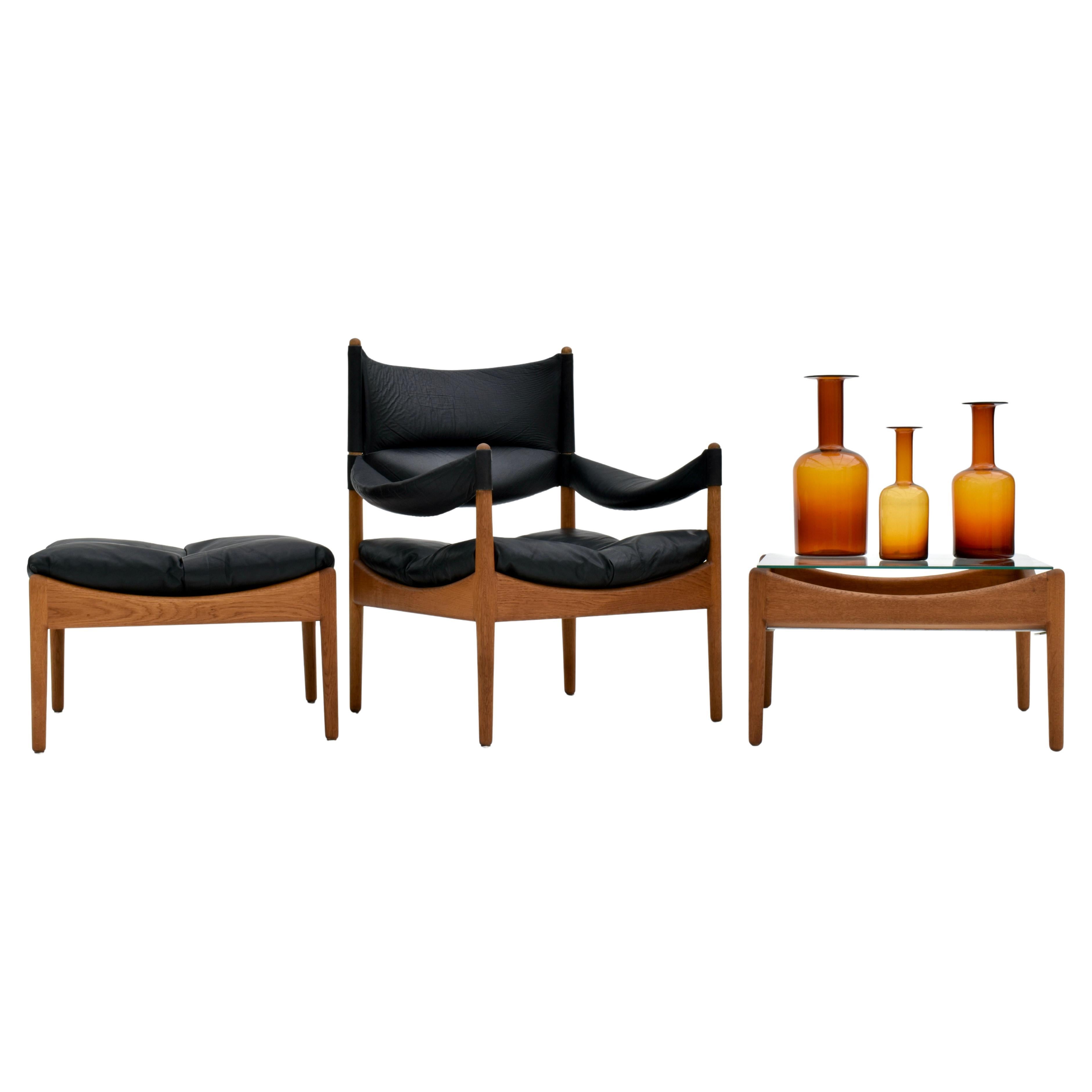
This set was designed by Kristian Solmer Vedel for the renowned Søren Willadsen Møbelfabrik in Denmark.
It boasts excellent original condition.
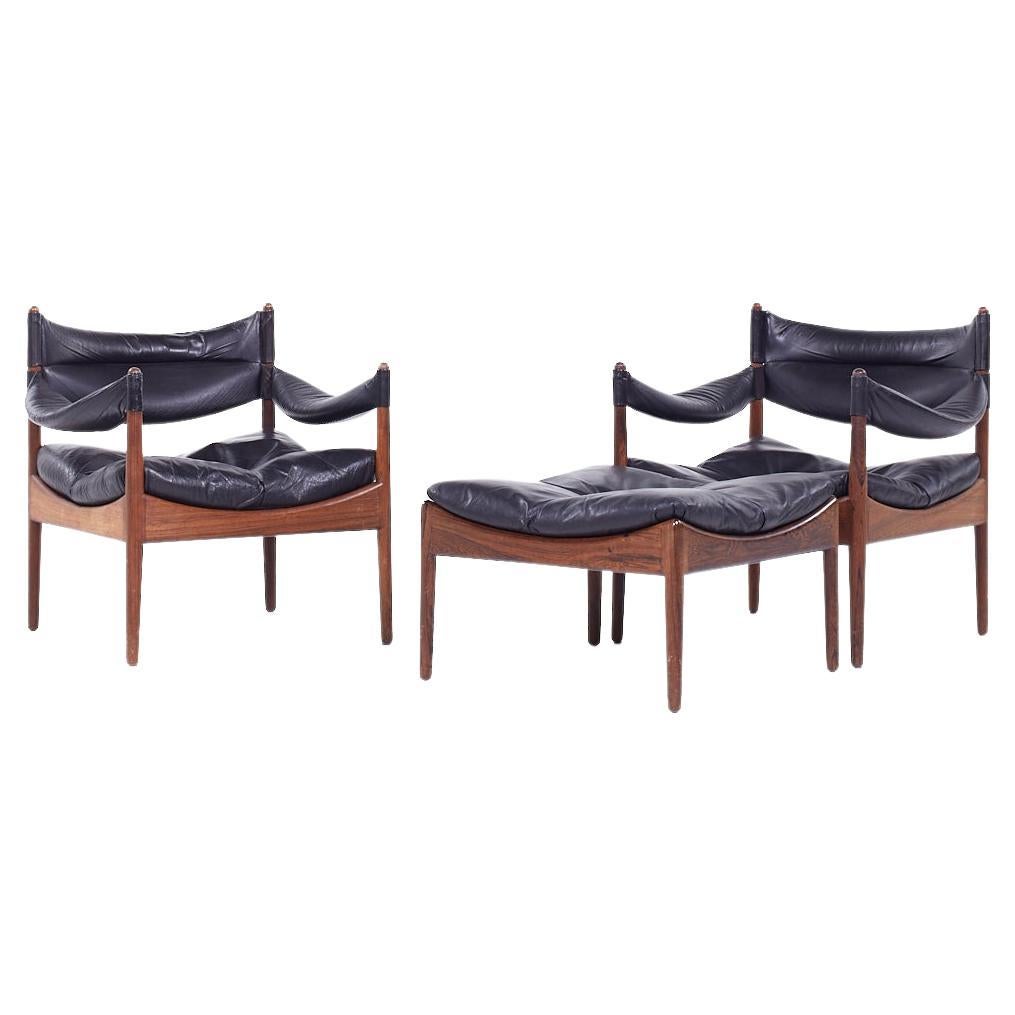
The set includes two lounge armchairs and a lounge armchair with a high backrest and an upholstered stool,
which can also be used as a footrest.
From a beautifully crafted and impressively sturdy tropical timber frame, a lightweight mesh serves as the seat straps, cradling supple and gracefully tufted leather cushions filled with goose down for optimal comfort and flexibility.
Two coffee tables with their removable original brushed aluminum table tops complete this exceptional set.
Kristian Solmer Vedel was a Danish industrial designer who made a significant impact in the field. Born on March 2, 1923, and passing away on March 5, 2003, Vedel's legacy continues to inspire and shape the world of design. He completed his carpenter apprenticeship in 1942. From 1944 to 1945, he was a guest student of Professor Kaare Klint at the furniture department of the Royal Academy of Fine Arts in Copenhagen. In 1946, he graduated from the Department of Furniture Design at the School of Arts, Crafts and Design in Copenhagen, where he also lectured from 1953 to 1956. From 1947 to 1949, he served as Chairman of the Danish Furniture Designers. He was the driving force behind the establishment of the Industrial Designers of Denmark and served as the inaugural chairman of the association from 1966 to 1968. His work is unmistakably shaped by the German Bauhaus style.
Kristian Vedel organized and headed the Department of Industrial Design at the University of Nairobi in Kenya between 1968 and 1971.
He and his wife Ane returned to Denmark in 1972 to open a design studio on Thyholm in northwest Jutland. On Thyholm, Kristian Vedel devoted most of his time to cultivating the surrounding landscape, breeding Shropshire sheep, and researching the use of their wool, hides, and meat.
Shipping ::
I'd be more than happy to offer you the most competitive shipping option if you just provide me with your postcode!
For the fastest and most secure shipping, your item will be shipped by air freight and packed in a custom-made wooden OSB board box (120cm x 80 cm x 140cm high) on pallet DAP (Delivery At Place).
- Creator:Kristian Solmer Vedel (Designer)
- Dimensions:Height: 30.32 in (77 cm)Width: 28.35 in (72 cm)Depth: 25.2 in (64 cm)Seat Height: 14.97 in (38 cm)
- Sold As:Set of 6
- Style:Scandinavian Modern (Of the Period)
- Materials and Techniques:
- Place of Origin:
- Period:
- Date of Manufacture:1960s
- Condition:in very good condition.
- Seller Location:Landshut, DE
- Reference Number:1stDibs: LU8587242440792
About the Seller
5.0
Vetted Professional Seller
Every seller passes strict standards for authenticity and reliability
1stDibs seller since 2023
22 sales on 1stDibs
- ShippingRetrieving quote...Shipping from: Bodenkirchen , Germany
- Return Policy
More From This Seller
View AllMidcentury set of 2 solid cherry wood wingback armchairs
sofa Karl Nothhelfer
Located in Landshut, BY
It's just beautiful and easy to reupholster in a fabric of your choice.
(just fabric - as upholstery is PERFECT)
Set of sofa and two wingback armchairs.
Designed by Prof. Karl Nothelfer in 1957.
Maker: Schörle & Gölz in Stuttgart-Bad Cannstatt.
Solid cherry wood.
New upholstery and fabrics in 1998, according to the last owner. Since then, it has only been used for two years, so the upholstery is in perfect condition!
The seat rests can be removed and fixed by clips on the belts.
High class.
Measurements:
Easy chair: 70 cm wide. Sofa: 178 cm wide.
Both have a seating height of 40 cm and a seating depth of 57 cm.
Condition: all firm and in very good condition with no damage.
The furniture has been fully and accurately cleaned.
Three steps: A: air pistol, B: industrial hoover, C: the latest Kärcher "wash & hoover" technology.
The woods have been polished several times.
Note: please ask for a shipping quote by sending us your postcode/destination.
Prof. Karl Nothelfer
* 14 June 1900 – 20 May 1980
Since the beginning of the 15th century, the Nothelfer family of carpenters has lived continuously in the former
town of Überlingen. Every carpenter at that time mastered
all aspects of woodworking, and the Nothelfers were no exception.
They could even carve altars and figures and adorn them with gold, silver and paint.
(Churches in Owingen and Hödingen). Some family members lived and worked
in Hedingen or Hödingen, as the jubilarian Karl Nothelfer did in 1975.
However, his father, Karl Anton Nothelfer, was the eldest of seven siblings and was therefore able to take over his father's carpentry business in Überlingen.
However, Karl Anton Nothelfer was unable to take over his father's carpentry business in Überlingen.
Instead, he moved to the industrial town of Singen with his young wife, Rosalie Hanner, and founded his own carpentry workshop.
Hohenzollern in 1896, and he moved to the former Poststraße, where he founded his own carpentry workshop.
He had a high sense of quality and form, and was a member of the German Werkbund before 1914.
Karl Nothelfer and his three siblings grew up in such an environment.
After attending primary and secondary school in Singen, Karl learnt the carpenter's trade in his father's workshop, before moving on to the Badische Landes-Kunstschule in Karlsruhe.
, where he studied architecture. The well-known furniture professor also worked there at that time:
Fritz Spannagel (born Freiburg, 1891; settled Ittendorf Castle near Meersburg in 1938; died 1957).
burg (died 1957). In 1928, the gifted young architect received a teaching assignment at the
Karlsruhe School of Art, but he followed his teacher Spannagel to Berlin in the same year.
Berlin. He worked there as a teacher from 1928 to 1945, becoming a professor in 1931.
Berlin Tischler-Schule, later known as the Bauschule für Raumgestaltung.
The furniture he created in Berlin gained international recognition through numerous exhibitions and lectures.
He became nationally known and influential. His furniture designs ushered in a new era of German and European furniture design.
European furniture design. At the World Exhibition in Paris
in 1937, Prof. Nothelfer was awarded the Golden Medal for his work in the furniture sector.
For his work in the furniture sector. The first summary and evaluation of his furniture designs is presented in his seminal work,
Das Sitzmöbel, published in 1942, was the first compendium of its kind in the world.
world. In 1950, he published his second book, Furniture. Both books and a
series of brochures were published by Verlag Otto Maier in Ravensburg.
Karl Nothelfer continued to work intensively on seating furniture design in the years after 1945.
In 1950, he made the important invention of the two-legged skid-base chair, which has since become widely accepted.
Even the most distinguished American furniture companies, such as Miller and Knoll International,
, use the skid as the main design feature of desks and chairs. At the same time, N. was pioneering
in redesigning German school furniture and seating for industry.
He succeeded in adapting his furniture designs, which originated in woodworking and craftsmanship, to modern technical possibilities of the industry. He thus became a leading figure in the redesign of schoolroom furnishings.
The architect Nothelfer reflects on his own work,
that his main contribution was in the field of seating furniture, although this was not
really his profession.
After the war, Prof. Nothelfer, like so many others, had to start again from scratch. He settled
in his hometown of Hödingen on Lake Constance in 1945, working as a freelance architect.
involved in all areas of construction in the years after the war. As early as 1935, he had designed many
examples of American prefabricated buildings and recommended serial housing,
This was at a time when no one in Germany was even thinking about mass production. He developed
Several types of mass-produced houses were manufactured in Baiersbronn.
More than 800 of these houses were built in France (types Paris, Provence and Normandie).
In 1946, as part of the reparations in Strasbourg, there was an exhibition of houses featuring Swedish, Danish and French designs.
These included Swedish, Danish, Finnish, English and German houses, and the French occupation
For this exhibition, six different types were sent from the French occupation zone.
Nothelfer's house design was considered the best in the exhibition.
Karl Nothelfer was also involved in developing chipboard. In 1946, he founded the first
magazine, Bauen und Wohnen (Building and Living), after the war, and remained its co-editor for many years.
By presenting his own work, he interpreted what the magazine's essence was.
interpreted the essence of what the magazine wanted to be. Building in order to live in it and live humanely in the built environment. Karl Nothelfer designed his houses
The furniture and ground plans were designed with the need for living in mind. In 1948, he was appointed Honorary Senator of the State of Building
School in Holzminden.
Karl Nothelfer did not build much in Singen. The first post-war house was Haus
Fahr on the slope of the Hohentwiel (Domäne), for which the building materials were sourced from a demolished
log cabin that a French officer had built for himself on the Schienerberg.
nerberg. In 1952, he also constructed the administrative building for the aluminium rolling mill in Singen.
This building featured reliefs and wall paintings by C. G. Becker. In Überlingen, he built
Among others, he built the Buchinger Sanatorium and the Riese+Hähnel radio house.
various reconstructions in the old town, including Haus Kitt with the Glockenspiel. Haus Kitt with the Glockenspiel, the Haus mit dem
Bacchus in Überlingen village and the Dolphin Fountain in Hödingen (1975). Probably the most beautiful
The Haus Nothelfers, also known as the Haus Himmelheber, is located in Baiersbronn-Tonbach. On the airfield
In Mengen, Nothhelfer built the casino with the 30-square-metre faience painting 'Ikarus' by
C. G. Becker. In 1954, he established a second office in Düsseldorf with the architect Hans Schwingen.
This office primarily focused on housing construction, true to the motto: from the inside out.
planning from the outside'. The Minister of Housing awarded a prize for the best social housing project in North Rhine-Westphalia, and it came from the Nothelfer+Schwingen studio in Düsseldorf. The idea of Nothelfer+Schwingen also promoted the new idea of home ownership.
To celebrate the anniversary of the condominium ownership law,
In 1961, Nothelfer gave a lecture in Essen on condominium ownership in Europe, which was published as a brochure.
From Düsseldorf, among many others, in the silk city...
Category
Vintage 1950s German Mid-Century Modern Living Room Sets
Materials
Fabric, Cherry, Upholstery
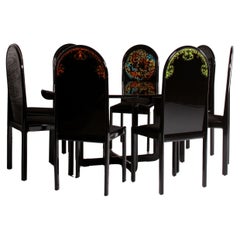
Björn Wiinblad for Rosenthal limited art series dining room set table
8 chairs
By Bjorn Wiinblad
Located in Landshut, BY
THE FOUR CARDINAL POINTS
Rosenthal Kunstmöbelreihe
This noteworthy design is the work of Bjørn Wiinblad.
The furniture pieces were produced in a limited edition of 300 in 1976.
A ...
Category
Vintage 1970s German Space Age Dining Room Sets
Materials
Wood, Beech, Bentwood, Lacquer
$17,713 Sale Price / set
35% Off
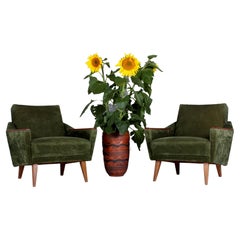
pair of 1960s lounge chairs green velvet - beech WG solid make uph. easy chairs
Located in Landshut, BY
This set of two West German lounge chairs is in very good condition
It was made in the mid 1960s
The armrests have been professionally restored (sanded - stained and lacquered tw...
Category
Mid-20th Century German Mid-Century Modern Lounge Chairs
Materials
Wood, Velvet, Beech
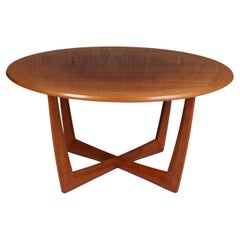
skandinavian modern huge round coffee table by KONDOR Möbel-Perfektion 1960s
By Kondor Möbel-Perfektion 1
Located in Landshut, BY
This item represents a significant chapter in the history of the German furniture industry.
A coffee table by KONDOR Möbel-Perfektion
This piece of furniture features a top layer of ...
Category
Vintage 1960s German Scandinavian Modern Coffee and Cocktail Tables
Materials
Wood, Walnut
$963 Sale Price
35% Off
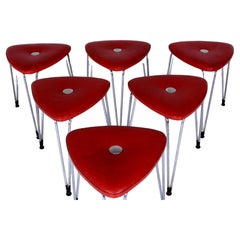
SET of SIX mid-century STOOLS by Günter Talos Vienna chrome iron pin legs 1950s
By Günter Talos
Located in Landshut, BY
SOLID HEAVY DUTY MADE FOR THE ETERNITY
Six mid-century stools designed and made in Vienna around 1950 by J. A. Talos, Vienna XII. Bezirk , Dörfelstraße 6-8 .
The architectually sig...
Category
Vintage 1950s Austrian Mid-Century Modern Stools
Materials
Chrome, Iron
$3,098 Sale Price / set
41% Off
Anders Pehrson Ateljé Lyktan SWEDEN set of 5 floor lamps f. Olympia 1972 Munich
Located in Landshut, BY
Anders Pehrson for Ateljé Lyktan
FLOOR LAMP "OLYMPIA"
set of five floor lamps
recommended with 2 E14 bulbs 25W and 40W as the lamp can be switched in...
Category
Vintage 1970s Swedish Mid-Century Modern Floor Lamps
Materials
Metal
You May Also Like
Midcentury Danish Kristian Vedel Modus Lounge Set For Søren Willadsen
By Kristian Solmer Vedel
Located in Shepperton, Surrey
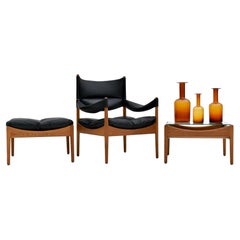
A Danish design classic. kristian Solmer Vedel designed the ‘Modus’ range of furniture in 1963 for cabinetmakers Soren Willadsen.
Crafted from solid Oak with black leather upholster...
Category
Vintage 1960s Danish Scandinavian Modern Lounge Chairs
Materials
Leather, Oak
Kristian Solmer Vedel easy chairs model Modus by Søren Willadsen møbelfabrik
By Kristian Solmer Vedel
Located in Limhamn, Skåne län
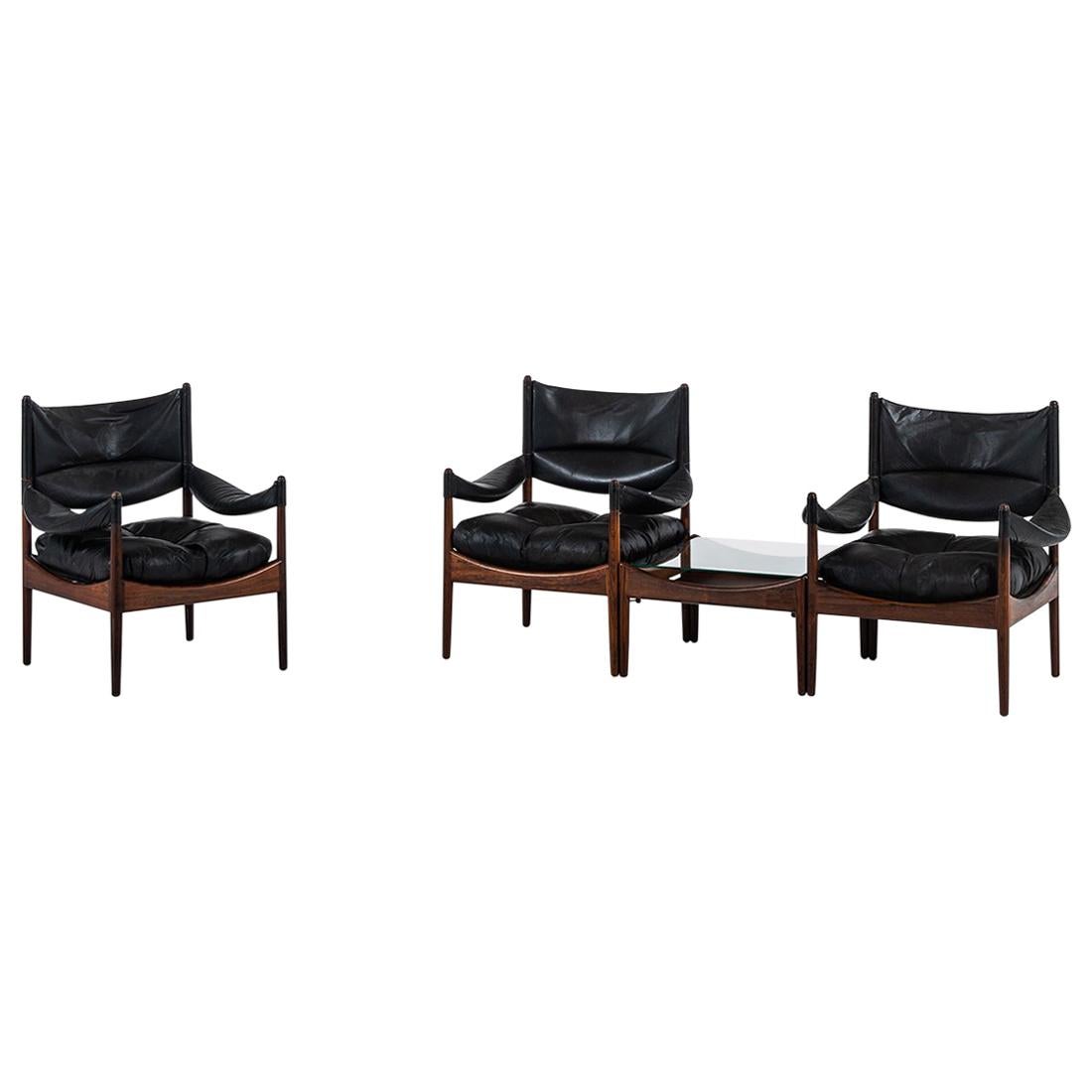
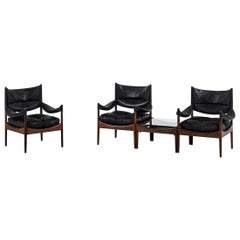
Rare set of 3 easy chairs with side table model Modus designed by Kristian Solmer Vedel. Produced by Søren Willadsen møbelfabrik in Denmark.
Category
Vintage 1960s Danish Scandinavian Modern Lounge Chairs
Materials
Leather, Glass, Rosewood
Modus Living Room Suite by Kristian Vedel for Soren Willadsen
By Soren Willadsen Mobelfabrik, Kristian Solmer Vedel
Located in Sagaponack, NY
A "Modus" living room suite consisting of, three lounge chairs with rosewood frame and original black leather upholstery (removable seat cushion has single button tuft and sling back...
Category
Vintage 1960s Danish Scandinavian Modern Living Room Sets
Materials
Aluminum
Erik Ole Jørgensen Easy Chairs with Stools Produced by Selectform in Denmark
By Erik Ole Jørgensen
Located in Limhamn, Skåne län
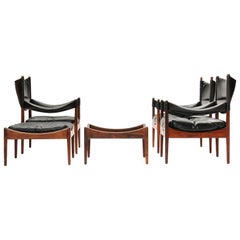
Rare pair of easy chairs with stools designed by Erik Ole Jørgensen. Produced by Selectform in Denmark.
Dimensions easy chairs (W x D x H): 73 x 90 x 94 cm, SH: 39 cm
Dimensions st...
Category
Vintage 1960s Danish Scandinavian Modern Lounge Chairs
Materials
Leather, Mahogany
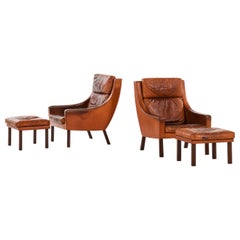
Kristian Vedel Willadsen Møbelfabrik Modus MCM Rosewood Leather Chairs Ottoman
By Soren Willadsen Mobelfabrik, Kristian Vedel
Located in Franklin Park, IL
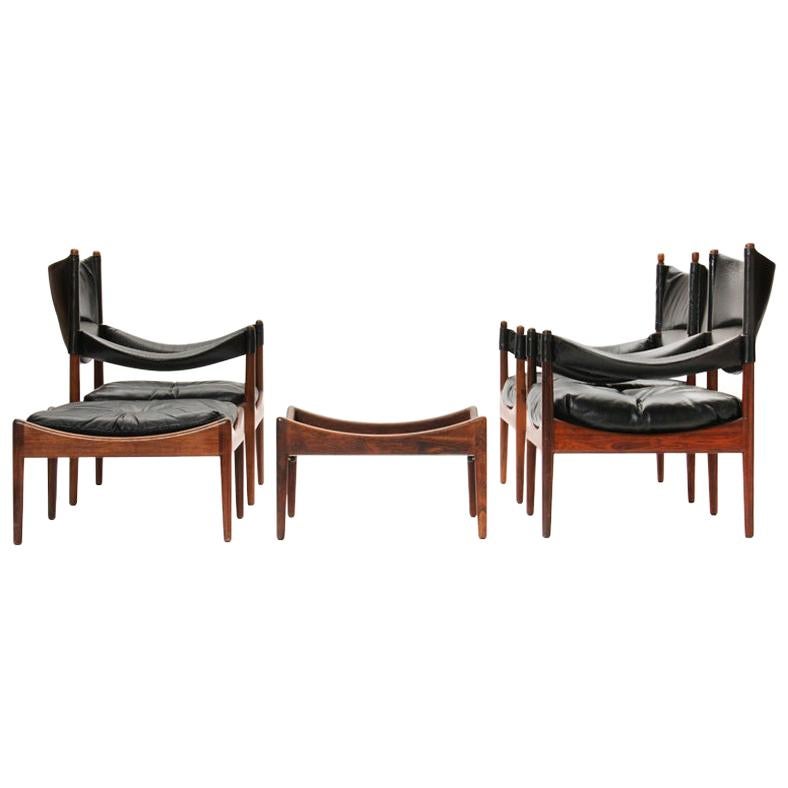
Kristian Vedel for Willadsen Møbelfabrik Modus Mid Century Danish Rosewood and Leather Lounge Chairs with Ottoman
Each chair measuress: 28 wide x 26 deep x 26 high, with a seat heig...
Category
Vintage 1970s Danish Mid-Century Modern Lounge Chairs
Materials
Leather, Rosewood
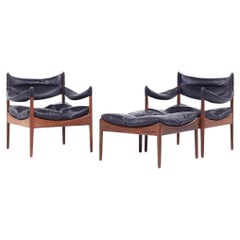
Knud Færch Armchairs Model 358 Produced by Slagelse Møbelværk in Denmark
By Knud Faerch
Located in Limhamn, Skåne län
Rare set of 6 armchairs model 358 designed by Knud Færch. Produced by Slagelse Møbelværk in Denmark.
Category
Vintage 1950s Danish Scandinavian Modern Armchairs
Materials
Brass