Want more images or videos?
Request additional images or videos from the seller
1 of 7
Exceptional Dutch Lacquered Chinoiserie Cabinet on Stand, 17th Century
$89,661.82List Price
About the Item
- Dimensions:Height: 75.79 in (192.5 cm)Width: 55.12 in (140 cm)Depth: 23.23 in (59 cm)
- Style:Chinoiserie (Of the Period)
- Materials and Techniques:
- Place of Origin:
- Period:Late 17th Century
- Date of Manufacture:1680-1700
- Condition:Wear consistent with age and use. Cabinet in rare original condition, only cleaned.
- Seller Location:Amsterdam, NL
- Reference Number:1stDibs: LU5458226431412
About the Seller
5.0
Recognized Seller
These prestigious sellers are industry leaders and represent the highest echelon for item quality and design.
Established in 1985
1stDibs seller since 2020
23 sales on 1stDibs
Typical response time: 2 hours
Authenticity Guarantee
In the unlikely event there’s an issue with an item’s authenticity, contact us within 1 year for a full refund. DetailsMoney-Back Guarantee
If your item is not as described, is damaged in transit, or does not arrive, contact us within 7 days for a full refund. Details24-Hour Cancellation
You have a 24-hour grace period in which to reconsider your purchase, with no questions asked.Vetted Professional Sellers
Our world-class sellers must adhere to strict standards for service and quality, maintaining the integrity of our listings.Price-Match Guarantee
If you find that a seller listed the same item for a lower price elsewhere, we’ll match it.Trusted Global Delivery
Our best-in-class carrier network provides specialized shipping options worldwide, including custom delivery.You May Also Like
17th Century Japanese Lacquer Cabinet On French Giltwood Regence Stand
Located in Benington, Herts
An Extremely Fine and Very Important 17th Century Japanese Lacquer Cabinet on French Giltwood Stand of Regence Period circa 1680-1690
Provenance
Likely acquired by Herman Willem ...
Category
Antique 17th Century Japanese Edo Cabinets
Materials
Giltwood, Lacquer
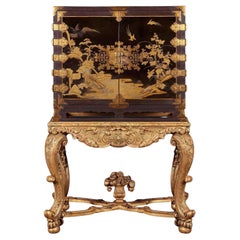
$116,169
H 61.82 in W 38.59 in D 22.05 in
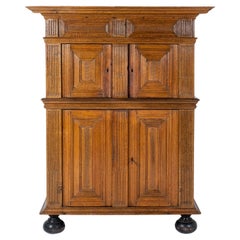
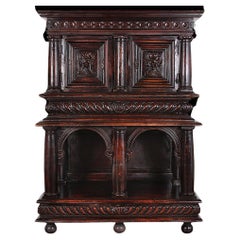
17th Century Dutch Oak Cabinet
Located in Gloucestershire, GB
A 17th century Dutch oak cabinet of nice small proportions and finely balanced carvings to the moulded panel doors. Having a moulded cornice top abov...
Category
Antique 17th Century Dutch Cabinets
Materials
Oak
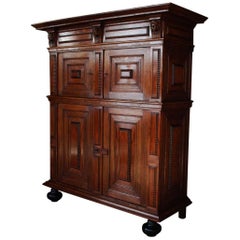
17th Century, Dutch Oakwood Cabinet
Located in Casteren, NL
Impressive Dutch Renaissance "kussenkast", four-door cabinet.
Solid oakwood with veneer.
large corniche with carved heads decor. Raised panelled doors and sides with ripple mouldings...
Category
Antique Late 17th Century Dutch Cabinets
Materials
Oak
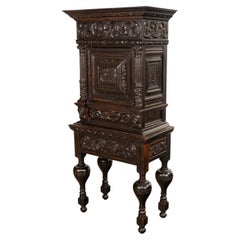
Antique 17th Century Dutch Carved Ebonized Oak Credence Cabinet on Stand 1680
Located in Portland, OR
A good antique late 17th Century carved ebonized oak cabinet on stand, circa 1680.
Such cabinets are commonly referred to as credence or chalice ...
Category
Antique 1690s Dutch Baroque Cabinets
Materials
Oak
$3,995
H 63.5 in W 29 in D 16.5 in
French 17th Century and Later Cabinet on Stand
Located in Vancouver, British Columbia
An ornately-carved walnut 17th century and later French cabinet on stand, the top with a pair of carved doors and paneled carved sides with co...
Category
Antique 17th Century French Renaissance Cabinets
Materials
Walnut
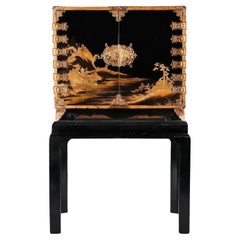
An Important Late 17th Century Japanese Lacquered Cabinet Edo Period on Stand
Located in Benington, Herts
An extremely fine, elegant and rare late 17th Century Japanese lacquer cabinet, from the Eco period, on later lacquered black stand.
Japanese circa 1690
Provenance
A private Scottish collection
This outstanding cabinet is a fascinating fusion of east and west. The cabinet itself would have been made in Japan, c.1690, and is decorated to the outside with hiramaki-e lacquer. This technique involves the use of sprinkled gold powder which adheres to the lacquer surface. On the best pieces, as with this example, many layers are added in order to create areas of high relief and give depth to the surface decoration. The taste of the Japanese workshops in this period was often for quite restrained pieces with plenty of the black background visible, unlike some of the busier Chinese lacquer or European japanned examples produced around the same time. The Japanese makers seemed content to rely on the outstanding quality of the lacquer itself, regarded by most experts as the finest lacquer ever produced, and did not see the need to cover every surface believing that less was more in this respect. The lacquer here is used to produce a mountainous scene with buildings on the bank of a river, the other side of the river with more buildings and a contrasting flatter and forested landscape. The fine perspective achieved is the result of the clever use of raised and flatter areas in the lacquer itself in combination with the drawing of the design itself.
Another remarkable aspect of this piece is the fine metalware throughout, but particularly the lockplate / hasp, hinges and foot mounts to the front. This is all beautifully cast and engraved contrasting against the black background. Interestingly another cabinet on stand with near identical metalwork was advertised in the Burlington Magazine, November 1913, with the dealer W. Williamson and Sons of Guildford. The lacquer on that piece is similarly refined and it seems likely that both pieces came from the same workshop.
The European influence in our piece can be seen in both the later ebonised stand and in the japanned decoration which has been applied to the inside of the doors and is also very fine indeed. This consists of two panels with birds of prey perched on branches in colours set against a golden background. The cabinet has a recent Scottish provenance and so it is likely that the ebonised stand was made in Britain though such pieces were made throughout Europe as a way of quite literally elevating these imported pieces of eastern lacquer as in Japan these would have been used on the floor. Inside the cabinet there is a combination of more Japanese lacquer and lock plates and European drawer handles. Most of the lacquer drawer fronts incorporate mountainous scenes and birds in combination, with a few purely one or the other of the two subjects. Again the lacquer is in excellent condition and is of exceptional quality with multiple layers of relief used in one single scene in many cases.
As mentioned above, Japanese lacquer is the most technically brilliant of the eastern lacquers and, as such, was highly prized by collectors and connoisseurs throughout Europe when this piece was made. The acquisition of such pieces would only have been possible for a small group of incredibly wealthy individuals, largely royal or high ranking courtiers or merchants connected with the East India trade...
Category
Antique 1690s Japanese Edo Cabinets
Materials
Lacquer
$43,461
H 61.82 in W 38.59 in D 22.05 in
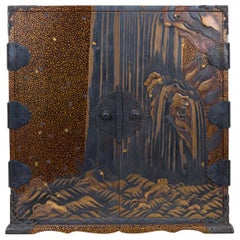
Japanese 19th Century Miniature Lacquer Chest with Waterfall
Located in Hudson, NY
Japanese 19th century miniature lacquer chest with waterfall. Late Edo to early Meiji period lacquer chest (mid to late 19th century) with two characters on the front reading Nuno an...
Category
Antique Late 19th Century Japanese Lacquer
Materials
Gold, Silver, Bronze
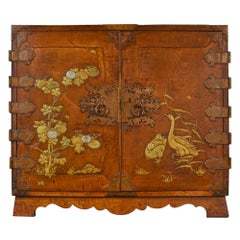
Fine and Rare 17th Century Japanese Mulberry Wood Gilt-Lacquer Cabinet on Stand
Located in Lymington, GB
An outstanding and rare, 17th-century Japanese mulberrywood gilt-lacquer cabinet raised on a later stand.
This fine and exceptional two-door, gilt-heightened cabinet - reputedly in mountain mulberry wood...
Category
Antique 17th Century Japanese Cabinets
Materials
Lacquer
$44,774
H 66.54 in W 35.44 in D 19.89 in
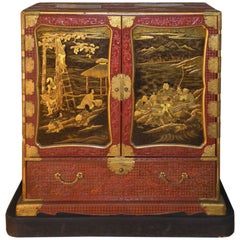
Japanese Lacquer and Cinnabar "Samurai" Cabinet, Inaba Family, Edo Period
Located in Troy, NY
Exceptionally large and rare lacquer cabinet. According to the heraldry, visible on the headgear in one of the panels, it was made for the Inaba family, a high ranking Daimyo family,...
Category
Antique Late 19th Century Japanese Edo Lacquer
Materials
Bronze
$385,000
H 38 in W 36 in D 21 in
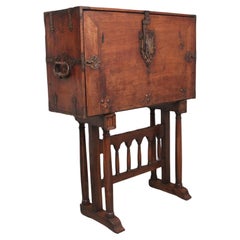
17th Century walnut Vargueno on stand
Located in Martlesham, GB
A superb quality 17th Century walnut Vargueno on stand, the rectangular case having the original iron carrying handles either side and strapwork decoration, the front having a shield...
Category
Antique 1690s Spanish Cabinets
Materials
Walnut
More From This Seller
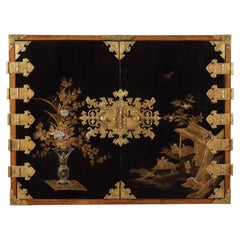
View AllExtremely Fine and Rare 17th-Century Japanese Export Lacquer and Inlaid Cabinet
Located in Amsterdam, NL
An extremely fine and important Japanese lacquer cabinet with gilt-copper mounts for the European market
Edo period, late 17th century
The pictorial style decorated rectangular...
Category
Antique Late 17th Century Japanese Lacquer
Materials
Brass
Price Upon Request
Free Shipping
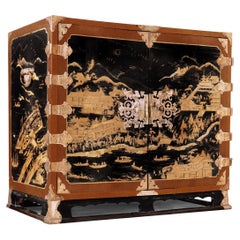
17th Century Japanese Export Lacquer Cabinet with Depiction the Dutch Tradepost
Located in Amsterdam, NL
A highly important Japanese export lacquer cabinet with depiction of the Dutch East India Company tradepost Deshima and the annual Dutch delegation on its way to the Shogun in Edo
Edo period, circa 1660-1680
H. 88 x W. 100.5 x D. 54 cm
This cabinet includes a later European japanned stand, but also a modern powder-coated steel frame.
The latter can be designed and added to your specific needs.
The sides and front of the rectangular two-door cabinet are embellished in gold and silver hiramaki-e and takamaki-e on a black roiro lacquer ground with a continuous design. The two doors depict a long procession of numerous figures travelling on foot and horseback along buildings and a pagoda into a mountainous landscape. This is the annual court journey, Hofreis, of the Dutch from Nagasaki to the Shogun’s court in Edo. Three horseback riders are dressed as Dutch merchants and a fourth figure, probably het Opperhoofd, is seen inside a palanquin, norimon. Just about to cross the bridge, two men are carrying a cabinet like the present one.
Many Japanese figures on either side of the procession are engaged in various activities; some play musical instruments on board of small boats, others are fishing; figures inside buildings are depicted playing go, and farmers are tending to their rice paddocks. The upper part of the right door shows a large mansion, probably the local daimyo’s castle, with men kneeling before a man in the central courtyard.
The court journey fits in with the foreign policy of the shogunate which accorded a role to the VOC alongside China, Korea, and the Ryukyu Islands who also had to pay tribute. However, the VOC employees were traders, having low status in Japan’s social hierarchy, and they were received with less deference than were the state embassies from Korea and the Ryukyu Islands. Nevertheless, the contacts with the Dutch were a welcome source of information to the Shogun about Europe and European science and technology.
The left side of the cabinet depicts, in mirror image, a rare view of the artificial fan-shaped Deshima Island, the trading post for the Dutch in Japan. The island, where the Dutch flag flies, is surrounded by small Japanese boats and an anchored three-masted fluyt (cargo ship), flying Dutch flags, with on the stern the VOC monogram. On the bottom right a busy street of Nagasaki is shown, bordered by shops and leading up to the stone bridge. On the island the trees are beautifully painted, two cows can be seen, and the flagpole, all in very fine detail. Dutchmen and enslaved Malay are visible outside the buildings and two Japanese figures, probably guards, sit in a small hut in the centre.
A maximum of fifteen to twenty Dutchmen lived on the island at any time and soldiers or women were not allowed. Restrictions on Deshima were tight, and the merchants were only allowed to leave the island by special permission. The Opperhoofd had to be replaced every year, and each new Opperhoofd had to make a court journey to pay tribute, present gifts, and to obtain permission to Margaret Barclay eep on trading. In the distance, many birds fly above the hills and a four-story pagoda can be seen. The right side of the cabinet is painted with other horse riders and their retinue journeying through mountains.
The pair of doors to the front open to reveal ten rectangular drawers. The drawers are decorated with scenes of birds in flight and landscapes with trees and plants. The reverse of the left door with two thatched buildings, one with a ladder, underneath a camelia tree with large blooms; the right door with a three-story pagoda nestled among trees and both doors with a flying phoenix, ho-oo bird. The cabinet, with elaborately engraved gilt copper mounts, hinges, lock plates and brass handles, is raised on an 18th-century English japanned wood stand.
A pair of large cabinets...
Category
Antique 17th Century Japanese Edo Lacquer
Materials
Copper, Gold
$1,494,363
Free Shipping
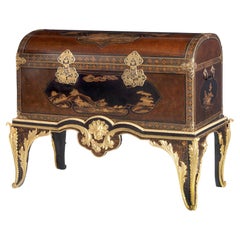
17th-Century Japanese Namban Lacquer Coffer on French Stand, Possibly by Boulle
By André-Charles Boulle
Located in Amsterdam, NL
An impressive and large Japanese 'Namban' transition-style lacquer coffer with fine gilt copper mounts on a French Re´gence base, possibly by André-Charles Boulle (1642-1732)
Kyoto, 1640-1650, the base 18th century
?The coffer with shaped cartouches on a nashiji ground on the lid, front and sides, with fine decorations in various techniques: takimaki-e (high relief), tsuke-gaki (drawing with narrow lacquer lines and over sprinkling with gold and silver), usuniku-takamei-e (demi relief), kimekomi (pushed inside) and accents of kirigane (small geometrical metal mosaics). Inside the cartouche on the lid a landscape with volcanos...
Category
Antique 17th Century Japanese Lacquer
Materials
Brass, Ormolu
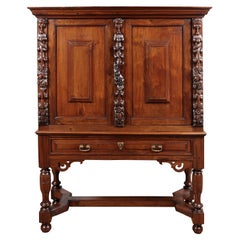
17th Century Dutch-Colonial Indonesian Sono Keeling Foliate Cabinet on Stand
Located in Amsterdam, NL
An Indonesian Sono keeling or Javanese rosewood foliate cabinet on stand or Rankenkast
Jakarta (Batavia), late 17th century
Measures: H 173 x W 133 x D 51 cm
The front of this cabinet is decorated with three carved swags of fruits and flowers coming out of cherub’s heads, a long drawer under two doors and two shelves behind the doors.
Usually, this type cabinet...
Category
Antique Late 17th Century Sri Lankan Dutch Colonial Cabinets
Materials
Rosewood
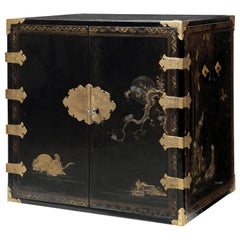
Rare Charming 17th Century Japanese Lacquer Cabinet with Gilt-Bronze Mounts
Located in Amsterdam, NL
A fine Japanese pictoral style lacquer cabinet with gilt-metal mounts
Kyoto, Edo period, 1670-1690
Decorated in Japanese relief lacquer work, black lacquer ground decorated...
Category
Antique Late 17th Century Japanese Furniture
Materials
Bronze
$44,830 Sale Price
25% Off
Free Shipping
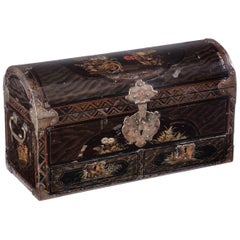
Fine Japanese Namban Lacquer Jewelry Casket, 17th Century
Located in Amsterdam, NL
Japanese Namban lacquer transition-style coffer with two drawers
Kyoto/Nagasaki, circa 1650
The cartouches with gilt and red decorations of leaves...
Category
Antique 17th Century Japanese Edo Lacquer
Materials
Cypress
Still Thinking About These?
All Recently ViewedMore Ways To Browse
Dutch Cabinets 17th 18th Century
17th Century Cabinet Dutch
Chinoiserie Cabinet On Stand
Chinoiserie Panels With Mother Of Pearl
Dutch Cabinet On Stand
Antique Curved Glass
English Regency Cabinet
Utility Furniture
Chinese Elm Cabinet
Door Cover
Antique Cabinet Circa 1880
Maple Kitchen Cabinet
Vintage Red Cabinet
German Oak Cabinet
Pull Out Tray
1950s Kitchen Cabinet
Antique China Display
Brass Display Cabinets