Want more images or videos?
Request additional images or videos from the seller
1 of 5
Exceptional Inlaid Cabinets Attributed to Victor Paillard
$138,500List Price
About the Item
- Creator:Victor Paillard (Maker)
- Dimensions:Height: 43.75 in (111.13 cm)Width: 50 in (127 cm)Depth: 17.63 in (44.79 cm)
- Sold As:Set of 2
- Style:Napoleon III (Of the Period)
- Materials and Techniques:
- Place of Origin:
- Period:
- Date of Manufacture:circa 1850
- Condition:
- Seller Location:New Orleans, LA
- Reference Number:Seller: 30-47071stDibs: LU89115787303
About the Seller
5.0
Recognized Seller
These prestigious sellers are industry leaders and represent the highest echelon for item quality and design.
Established in 1912
1stDibs seller since 2010
115 sales on 1stDibs
Typical response time: 5 hours
Authenticity Guarantee
In the unlikely event there’s an issue with an item’s authenticity, contact us within 1 year for a full refund. DetailsMoney-Back Guarantee
If your item is not as described, is damaged in transit, or does not arrive, contact us within 7 days for a full refund. Details24-Hour Cancellation
You have a 24-hour grace period in which to reconsider your purchase, with no questions asked.Vetted Professional Sellers
Our world-class sellers must adhere to strict standards for service and quality, maintaining the integrity of our listings.Price-Match Guarantee
If you find that a seller listed the same item for a lower price elsewhere, we’ll match it.Trusted Global Delivery
Our best-in-class carrier network provides specialized shipping options worldwide, including custom delivery.You May Also Like
Exceptional Marquetry Cabinet Attributed to Susse Frères, France, Circa 1880
By Susse Freres
Located in PARIS, FR
Blackened wood side-cabinet attributed to Susse Frères, opening with a central cupboard door underlined with gilt bronze rods, flanked by two small onyx c...
Category
Antique 1880s French Cabinets
Materials
Lapis Lazuli, Onyx, Marble, Brass, Bronze
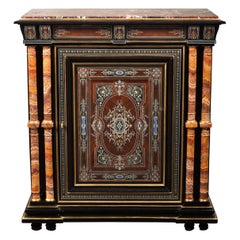
$61,952
H 44.1 in W 39.77 in D 18.12 in
French 1940s Brass Inlaid and Marquetry Cabinet attributed to Dominique
Located in CA, CA
French 1940s stunning marquetry cabinet inlaid with a fine brass diamond lattice work pattern, finished with a centrally positioned large, heavy brass circular pull handle, retaining...
Category
Vintage 1940s French Art Deco Cabinets
Materials
Brass
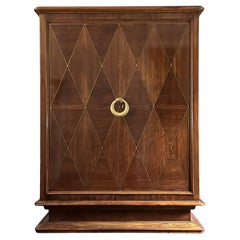
$36,000
H 63 in W 47.25 in D 17.33 in
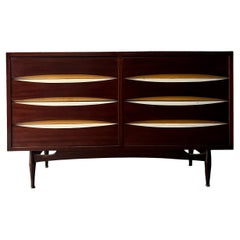
Cabinet, 1960s, Attributed to Arne Vodder
By Arne Vodder
Located in Barcelona, ES
Discover the timeless elegance of the cabinet attributed to Arne Vodder, a true gem of 1960s design. This exquisite piece of furniture captures the essence and distinctive finishes t...
Category
Vintage 1960s Danish Cabinets
Materials
Wood
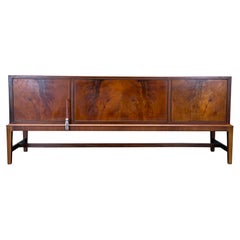
Mahogany Cabinet Attributed to Frits Henningsen
By Frits Henningsen
Located in Dallas, TX
Large scale flamed mahogany cabinet with drop down bar attributed to Frits Henningsen.
Category
Vintage 1950s Cabinets
Materials
Mahogany
Monumental Cabinet Attributed to Pietro Lingeri
By Pietro Lingeri
Located in Lake Worth Beach, FL
Artist/Designer: Pietro Lingeri (Italian, 1894 - 1968), attributed
Marking(s); notes: no marking(s) apparent
Country of origin; materials: Italy; wood, glass, metal
Dimensions: 24″h,...
Category
Vintage 1920s Italian Cabinets
Materials
Wood
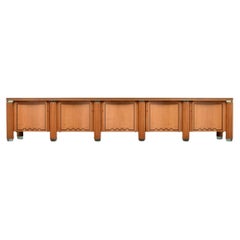
Exceptional Edwardian Display Case Attributed to Edward and Roberts
By Edward
Roberts
Located in Dublin, IE
An exceptional Edwardian mahogany display case attributed to Edward and Roberts, London, with gorgeous patination, line inlaid and with exquisite marquetry detail depicting Neoclassical motifs of urns, ribboned swags of foliate, scrolls and anthemions throughout. The broken swan neck pediment raised over moulded stepped cornice above twin glass glazed panel doors with decorative brass escutcheon and key, opening to lined, shelved interior. The serpentine base with four centred drawers flanked with two cupboard doors, all cross...
Category
Early 20th Century European Vitrines
Materials
Brass
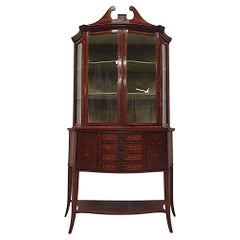
J S Henry attributed, Arts
Crafts Mahogany
Inlaid Display Cabinet
Located in London, GB
J S Henry attributed, An Arts & Crafts flame mahogany display cabinet with stylised floral inlays, the door has a very unusual stylized floral w...
Category
Early 20th Century Arts and Crafts Cabinets
Materials
Mahogany
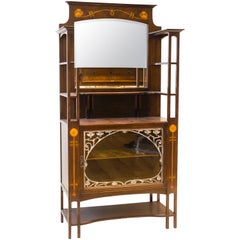
Cabinet Attributed to Majorelle Circa 1930 France
By Louis Majorelle
Located in Jersey City, NJ
Cabinet with two center doors in amboyna that open to show one shelf the two outside doors are in macassar ebony and open to reveal a top draw with a low...
Category
Vintage 1930s French Art Deco Cabinets
Materials
Marble
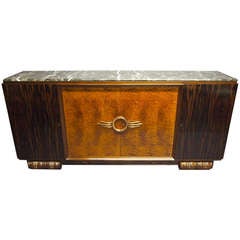
Art Deco Cabinet Attributed to Eliel Saarinen
By Eliel Saarinen
Located in Atlanta, GA
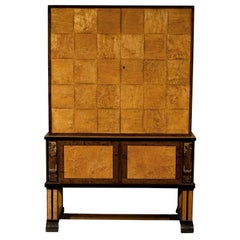
Rare dining cabinet attributed to Eliel Saarinen (father of Eero Saarinen) designed before his immigration to the United States. In a style that we now refer to as "Art Deco," this style was considered the "National Romantic Style" in Finland - essentially a twist on what became known worldwide as Art Deco - with its strong vertical lines and medieval references.
The workmanship of this cabinet and its materials is magnificent. Note the carefully matched panels of golden masurbjork (Burl Birch root), the intricate carvings of medieval knights (very similar to those guarding Saarinen's Helsinki Railway Station built in 1906) and the high contrast of golden and dark birch wood - seen again in Saarinen's furniture designed in the United States in the late 1920s.
While Saarinen's son Eero went on to become the more famous of the two, it was Eliel who could be considered the grandfather of Nordic Art Deco...
Category
Vintage 1920s Finnish Art Deco Cabinets
Materials
Birch, Burl
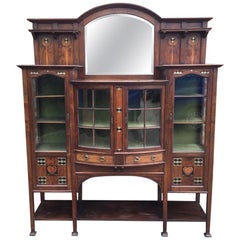
Waring and Gillows, an Exceptional, Bow Fronted Inlaid Display Cabinet
By Waring
Gillow
Located in London, GB
An outstanding Arts
Crafts display cabinet, with stylized ebony and pewter inlays. Arched bevelled mirror to the back above display area, flanked by two upper shelves stylized ...
Category
Antique 1890s English Arts and Crafts Cabinets
Materials
Pewter
More From This Seller
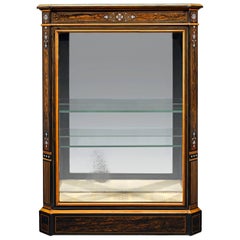
View All19th Century Coromandel Inlaid Vitrine
Located in New Orleans, LA
Highly-prized coromandel, or East Indian ebony, was used to create this beautiful Victorian vitrine. Featuring delicate inlay in the Victorian/Edwardian style and glass panels framed in the equally luxurious satinwood, this cabinet is constructed to fit flush against a wall with baseboards. Elegant cabinets such as this are perfect for displaying one's treasures, but with original locks, keys, mirrors and fleur-de-lis fabric, this case is a prized possession unto itself,
circa 1890.
Measures: 30" wide x 14 ½" deep x 41 ½" high.
Coromandel ebony is variegated brown and black, often called "streaky," wood. It is considered a highly valuable wood for turnery, fine cabinet...
Category
Antique 19th Century English Victorian Vitrines
Materials
Glass, Mirror, Ebony, Satinwood
English Upright Cane Cabinet
Located in New Orleans, LA
This English cane cabinet exhibits classical style and impeccable design. Crafted of lustrous Cuban mahogany, this upright case features a beautifully paneled door which opens to rev...
Category
Antique 19th Century English Cabinets
Materials
Brass
$28,500
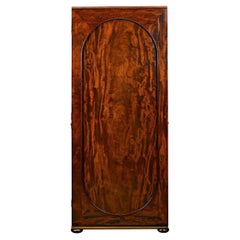
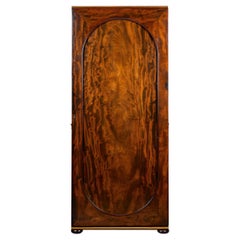
Mahogany Upright Cane Cabinet
Located in New Orleans, LA
Classical style and impeccable design distinguish this English upright cane cabinet. Crafted of lustrous Cuban mahogany, this case is comprised of a beautifully paneled door which op...
Category
Antique 19th Century English Cabinets
Materials
Brass
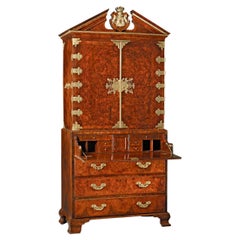
King George I Ambassadorial Secrétaire-Cabinet
Located in New Orleans, LA
This highly important secrétaire-cabinet was crafted for and specially ordered by King George I for the British Ambassador to Russia. From its craftsmanship and materials to its exceptional artistry, it is a work of royal and historic significance that exudes power in each and every detail. The broken pediment at its apex features the simplified royal coat of arms bearing the king’s crown, while the interior is adorned by portraits of the British Royal Family. Placed within the ambassador’s St. Petersburg home, this entirely unique piece of furniture would have been a potent reminder of England's grandeur and political importance.
Relations between England and Russia during this period were at an all-time high. Peter the Great had traveled to England in 1698 as part of his widely known “Grand Embassy” tour, wherein he attempted to gain foreign support against the Ottoman Empire. He spent a period of nearly four months there, meeting with King William III and his court on numerous occasions. Noted academic Arthur MacGregor wrote concerning the impact of the trip, “For two decades following Peter's visit, British influence in Russia reached a peak. It manifested itself in social custom, in craft practice and in ships and naval organization... it reached a significant sector of the population before relations cooled once again and the two nations pulled back from this era of unprecedented cordiality.”
First and foremost, however, it is a reminder of British might and influence. By the reign of King George I, England had come into its own as a world power. Unique in its design, this cabinet is a reflection of the country’s might. It is crafted from the highest-quality solid walnut and burr walnut adorned by gilded lock plates and engraved hinges. The presence of ormolu at its apex and lining the doors was a rarity for this period, and its addition makes manifest the importance of the design.
The outer doors open to reveal multiple interiors, including fifteen separate drawers around a central cupboard; the cupboard doors each bear mezzotint portraits of George I and his father, Ernest Augustus, Elector of Hanover. An etching after the portrait of George I dating to circa 1716 is in London’s Royal Academy. A second, inner pair of doors are adorned by mezzotints of the Prince and Princess of Wales (later Queen Caroline and George II), which are both after portraits by Sir Godfrey Kneller dated 1716 in the Royal Collection. A final portrait is revealed on the very interior of the cabinet, where a mezzotint of Frederick, Anne, Amelia and Caroline, children of the Prince of Wales, resides. An etching (circa 1715-1720) after this portrait can be found in the National Portrait Gallery (London).
Apart from its abundance of royal portraiture, the cabinet features stunning painted decoration, including floral designs as well as clouds, birds and trees in a bucolic motif reminiscent of Eden. Its lower portion is a study in both form and function, featuring a fitted secrétaire-drawer above three additional drawers for storage. The cabinet appears in The Shorter Dictionary of English Furniture by R. Edwards from 1964, a text that is regarded as the bible of British furniture design. Edwards describes it as a “writing cabinet...given by George I to the British Ambassador at the Russian court.”
The cabinet was likely made for the 18th-century German diplomat and writer Friedrich Christian Weber, who represented English interests at the Russian court from 1714 until 1719. Although Weber’s tenure as ambassador was relatively short, while in St. Petersburg, he authored his account entitled Das veraenderte Russland (The Present State of Russia), which was published in three volumes in 1721, 1739 and 1740. It may, however, also have been made for George Douglas, 2nd Earl of Dumbarton, who served as ambassador alongside Weber in 1716. Diplomatic relations ceased between the two countries in 1721.
In 1928, the cabinet appeared for sale at the International Exhibition of Antiques & Works of Art in Olympia. It had previously been in the collection of the Woltner family of Bordeaux, the celebrated vintners who owned the estate Château Laville Haut-Brion and produced wine of the same name. According to the family, Monsieur Woltner was given the cabinet as a gift from an aunt who lived in Russia for many years. After leaving the Woltner collection, the cabinet was acquired by William Berry...
Category
Antique 18th Century English Georgian Secretaires
Materials
Brass
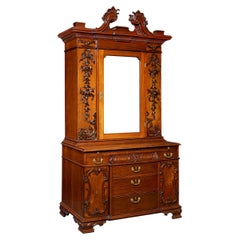
Mahogany Bureau Cabinet After Thomas Chippendale
By Thomas Chippendale
Located in New Orleans, LA
This extraordinary Irish bureau cabinet was crafted based on a design for a desk and bookcase drawn from Thomas Chippendale’s famed 1762 edition of The Gentleman and Cabinet-Maker's ...
Category
Antique 18th Century Irish Chippendale Cabinets
Materials
Mirror, Mahogany
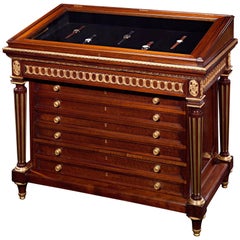
19th Century Watch Winding Display Cabinet
Located in New Orleans, LA
This incredible, one-of-a-kind watch display cabinet brings together the beauty of an antique with the functionality of modern technology. Crafted of mahogany, this 19th century jewelry display cabinet...
Category
Antique 19th Century Unknown Empire Cabinets
Materials
Mahogany
Still Thinking About These?
All Recently ViewedMore Ways To Browse
White Oak Media Cabinets
Antique Hardware Store Cabinet
Cleveland Twist Drill
Drexel Declaration Hutch
Fruitwood Curio
Jean Desnos
Sottsass Freemont
Vintage Addressograph
1890s China Cabinet
Amberg File Cabinet
Antique Bakery Display Case
Art Deco Entertainment Center
Biedermeier Hutch
Cole Steel Filing Cabinet
Cylindrical Pot Cupboard
Drexel Illuminated Cabinet
Drexel Triune
George Nelson Speaker