Want more images or videos?
Request additional images or videos from the seller
1 of 14
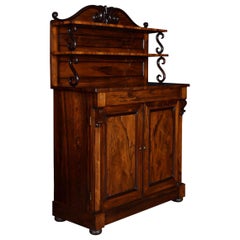
Fine Regency Brass Inlaid Rosewood Chiffonier of Narrow Proportions
$4,437.29List Price
About the Item
- Dimensions:Height: 55.91 in (142 cm)Width: 28.55 in (72.5 cm)Depth: 11.42 in (29 cm)
- Style:Regency (Of the Period)
- Materials and Techniques:
- Place of Origin:
- Period:
- Date of Manufacture:1815
- Condition:Wear consistent with age and use.
- Seller Location:Benington, GB
- Reference Number:Seller: 25721stDibs: LU1183218635482
About the Seller
5.0
Vetted Professional Seller
Every seller passes strict standards for authenticity and reliability
Established in 1969
1stDibs seller since 2015
128 sales on 1stDibs
Associations
LAPADA - The Association of Arts
Antiques DealersThe British Antique Dealers
Association
Authenticity Guarantee
In the unlikely event there’s an issue with an item’s authenticity, contact us within 1 year for a full refund. DetailsMoney-Back Guarantee
If your item is not as described, is damaged in transit, or does not arrive, contact us within 7 days for a full refund. Details24-Hour Cancellation
You have a 24-hour grace period in which to reconsider your purchase, with no questions asked.Vetted Professional Sellers
Our world-class sellers must adhere to strict standards for service and quality, maintaining the integrity of our listings.Price-Match Guarantee
If you find that a seller listed the same item for a lower price elsewhere, we’ll match it.Trusted Global Delivery
Our best-in-class carrier network provides specialized shipping options worldwide, including custom delivery.You May Also Like
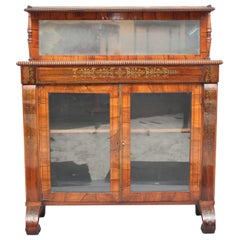
Regency Rosewood and Brass Inlaid Chiffonier
Located in Martlesham, GB
Early 19th century Regency rosewood and brass inlaid chiffonier, the cabinet having a mirror back and shelf decorated with beading and a brass gallery running along the front and sid...
Category
Antique 1820s English Regency Cabinets
Materials
Rosewood
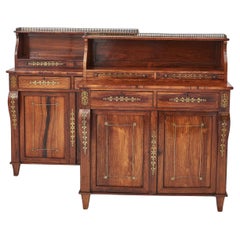
Pair Of Regency Period Rosewood
Brass Inlaid Chiffoniers
Located in London, GB
An exquisite pair of 19th Century rosewood & brass inlaid chiffoniers. These rare and beautifully presenting Chiffoniers feature a brass pierced gallery top, with finely detail...
Category
Vintage 1960s Regency Cabinets
Materials
Rosewood
$12,970 / set
H 31.89 in W 64.97 in D 17.33 in
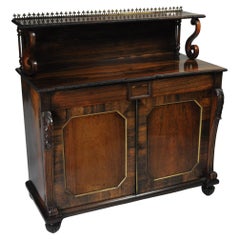
Regency Rosewood Chiffonier
Located in Folkestone, GB
A good quality early 19th century Regency period rosewood Chiffonier, the beaded edge, galleried superstructure raised on 'S' scrolled supports abo...
Category
Antique Early 19th Century English Regency Sideboards
Materials
Rosewood
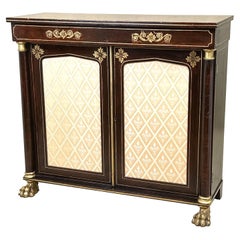
Regency Simulated Rosewood Side Cabinet
Located in Bedfordshire, GB
An Extremely Attractive Early 19th Century, Regency Period, Simulated Rosewood Side Cabinet, Having Elegant Parcel Gilt Decoration Throughout, The One Long Drawer Over Two Upholstere...
Category
Antique Early 19th Century English Regency Cabinets
Materials
Birch, Pine
Regency Chiffonier
Located in Cheshire, GB
Regency chiffonier, the raised panelled gallery back with S scroll brackets. The base section with single draw above two rosewood panelled cabinet doors enclosing two adjustable shel...
Category
Antique Early 19th Century English Regency Cupboards
Materials
Wood
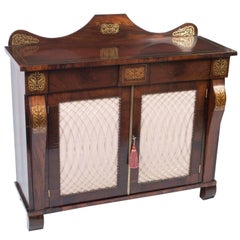
19th Century Regency Brass Inlaid Cabinet Chiffonier
Located in London, GB
This is an elegant antique Regency period brass inlaid goncalo alves chiffonier, circa 1820 in date.
This magnificent cabinet has an arched shaped back and features a pair of grilled doors with powder pink silk linings that open to reveal a cupboard with a central shelf.
There are two useful drawers in the frieze, the cabinet stands on elegant turned feet and the inlaid brass decoration compliments this piece beautifully.
The chiffonier is equipped with the original working lock and key.
Add a touch of class to a special place in your home with this beautiful antique sideboard...
Category
Antique 1820s English Regency Cabinets
Materials
Brass
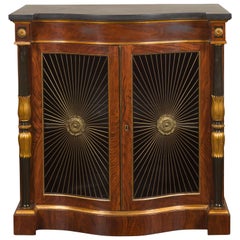
English Regency Style 1920s Faux Rosewood Painted Cabinet with Gilt Accents
Located in Atlanta, GA
An English Regency style faux rosewood painted console cabinet from the early 20th century, with gilt accents and marble top. Created in Englan...
Category
Early 20th Century English Regency Cabinets
Materials
Marble
$7,200
H 35.25 in W 34.5 in D 19.75 in
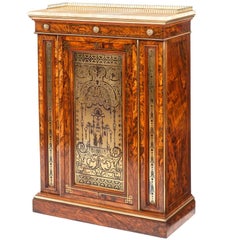
19th Century English Olivewood and Brass Inlaid Cabinet
By Town
Emanuel
Located in London, GB
A William IV cabinet attributed to Town and Emmanuel
Constructed in a strongly grained olivewood and dressed with gold brass inlays and an etched and engraved brass panel; rising from a plinth base, the lockable single door having an inset panel in the manner of Jean Berain, enclosing a shelved interior, and flanked by narrow vertical conforming panels; the apron being dressed with three bronze rosettes, and the Jura Jaune marble is dressed with a three quarter arcaded brass gallery,
circa 1830
The cabinet is illustrated and discussed in Christopher Payne’s “British Furniture 1820 to 1920” published in 2023. Payne singles out the rarity of the olivewood timber used as well as the necessity for hand cutting the large marquetry panel.
Literature:
Payne, Christopher. British Furniture 1820 to 1920 : The Luxury Market. ACC Art Books, 2023, pp. 38-39 (illus. fig. 1.33).
Town and Emanuel
Recorded in the 'Dictionary of English Furniture Makers 1660-1840', published by the Furniture History Society, as being situated at 103 New Bond Street between 1830 and 1840, and apart from being manufacturers of furniture, also dealt in 'curiosities and antiques'. The late renowned connoisseur Christopher Gilbert records in his 'Pictorial Dictionary of Marked London Furniture' London 1997, also published by the Furniture History Society, a writing table in the Transitional manner with similar plaques. Their label reads 'Town and Emanuel, manufacturers of Buhl Marquetrie, Resner (sic) & Carved Furniture, tripods, screens & c. of the finest and most superb designs of the Louis 14th. Splendid cabinets and tables inlaid with fine Sevres and Dresden china...
Category
Antique 19th Century English Regency Cabinets
Materials
Marble, Brass
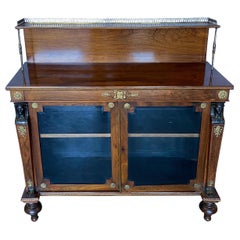
Fine 19th Century English Regency Bronze Mounted Rosewood Chiffonier
Located in Richmond, VA
Fine 19th century English Regency bronze mounted rosewood chiffonier. Great quality bronze mounts and caryatids forming the stiles. Beveled glass doors and handsome turned feet.
Category
Antique 19th Century British Regency Cabinets
Materials
Bronze
$4,800
H 43.5 in W 42.13 in D 15 in
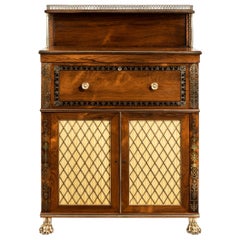
Regency Brass-Inlaid Rosewood Secretaire Cabinet
Located in Lymington, Hampshire
A Regency brass-inlaid rosewood secretaire cabinet, the rectangular top with a pierced galleried shelf with trellis work on the sides, above a secretaire drawer, banded with brass pa...
Category
Antique 1810s English Regency Cabinets
Materials
Brass
More From This Seller
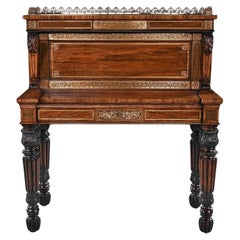
View AllAn Extremely Fine Rosewood and Brass Inlaid Writing Table Attributed To Gillows
By Gillows of Lancaster
London
Located in Benington, Herts
An Extremely Fine and rare Rosewood and Brass Inlaid Writing Table Attributed to the Oxford Street Workshop of Gillows.
English c.1820-1830
With a raised back comprising a thre...
Category
Antique Early 19th Century English Desks and Writing Tables
Materials
Brass
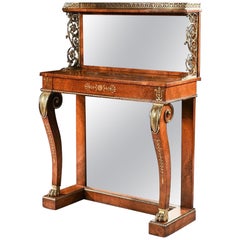
Regency Amboyna and Brass Inlaid Gilt Bronze Mounted Pier Table
Located in Benington, Herts
An extremely elegant, rare Regency amboyna and brass inlaid gilt bronze mounted pier table. Provenance Part of Sir William Whitfield Collection.
English Regency period, Circa 1815.
The raised back with open shelf, surmounted by a pierced anthemion three quarter brass gallery above a rectangular mirror plate, flanked by gilt bronze pierced foliate scrolled supports, over a finely coloured amboyna and banded top above cut brass inlaid frieze drawer decorated with anthemion and flower head motif.
The dual tapering scroll supports with palmette lappet surmounts and cut brass inlay terminate on gilt bronze claw feet, flanking a later large mirror plate to the rear, raised on a inverted breakfront plinth base edged with gilt bonze beading. Formerly in the collection of Sir William Whitfield.
This elegant Regency pier table is a superb example with its fine quality mounts and distinctive amboyna veneers which are rarely found on furniture of this period.
The condition is excellent, having the most wonderful colour and patination to the finest cuts of amboyna that would have been available, during the early 19th century this veneer was thought to be worth more in its weight than gold.
This table would have almost certainly been especially commissioned, further research maybe undertaken to find a comparative example and insight to a potential maker.
As such pieces in amboyna are far rarer, an example of pier table has yet to be found, but an amboyna sofa table with extremely similar brass inlay and form can be seen in Clifford Musgrave’s book Regency Furniture, published by Faber and Faber in 1961, plate 63.
It is from the Royal Collection and the caption includes ‘made about 1816 for Clarement,’ (Claremont) ‘ Esher, Surrey, home of the Princess Charlotte...
Category
Antique 19th Century British Regency Vanities
Materials
Brass, Bronze
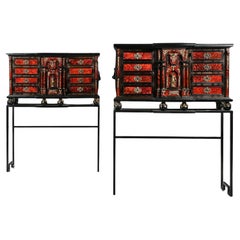
Pair of 17th Century Spanish Baroque Gilt Bronze Mounted Cabinets on Stands
Located in Benington, Herts
An Exceptional and rare pair of 17th Century Spanish Baroque gilt bronze and metal mounted ebonised and tortoiseshell cabine...
Category
Antique Late 17th Century Spanish Baroque Cabinets
Materials
Tortoise Shell, Ebony
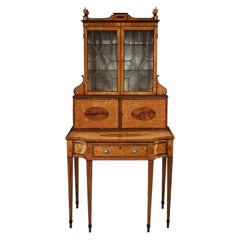
An Important 18th Century George Iii Satinwood and Sabicu Writing Cabinet
Located in Benington, Herts
A fine late 18th Century George III Satinwood and sabicu ladies writing cabinet with important provenance. (Possibly by George Simpson)
English London made - Circa 1785
Provenance
Exhibited by W. R. Harvey in their Old Bond Street showrooms in 1986 and 1987, the piece being chosen to be advertised in Country Life magazine in 1986 and in the Grosvenor House...
Category
Antique 1780s English George III Cabinets
Materials
Satinwood
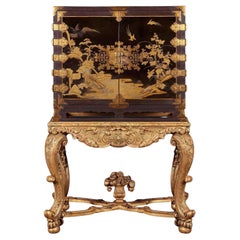
17th Century Japanese Lacquer Cabinet On French Giltwood Regence Stand
Located in Benington, Herts
An Extremely Fine and Very Important 17th Century Japanese Lacquer Cabinet on French Giltwood Stand of Regence Period circa 1680-1690
Provenance
Likely acquired by Herman Willem ...
Category
Antique 17th Century Japanese Edo Cabinets
Materials
Giltwood, Lacquer
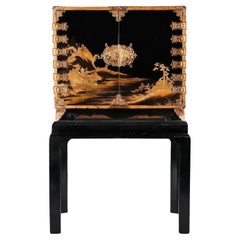
An Important Late 17th Century Japanese Lacquered Cabinet Edo Period on Stand
Located in Benington, Herts
An extremely fine, elegant and rare late 17th Century Japanese lacquer cabinet, from the Eco period, on later lacquered black stand.
Japanese circa 1690
Provenance
A private Scottish collection
This outstanding cabinet is a fascinating fusion of east and west. The cabinet itself would have been made in Japan, c.1690, and is decorated to the outside with hiramaki-e lacquer. This technique involves the use of sprinkled gold powder which adheres to the lacquer surface. On the best pieces, as with this example, many layers are added in order to create areas of high relief and give depth to the surface decoration. The taste of the Japanese workshops in this period was often for quite restrained pieces with plenty of the black background visible, unlike some of the busier Chinese lacquer or European japanned examples produced around the same time. The Japanese makers seemed content to rely on the outstanding quality of the lacquer itself, regarded by most experts as the finest lacquer ever produced, and did not see the need to cover every surface believing that less was more in this respect. The lacquer here is used to produce a mountainous scene with buildings on the bank of a river, the other side of the river with more buildings and a contrasting flatter and forested landscape. The fine perspective achieved is the result of the clever use of raised and flatter areas in the lacquer itself in combination with the drawing of the design itself.
Another remarkable aspect of this piece is the fine metalware throughout, but particularly the lockplate / hasp, hinges and foot mounts to the front. This is all beautifully cast and engraved contrasting against the black background. Interestingly another cabinet on stand with near identical metalwork was advertised in the Burlington Magazine, November 1913, with the dealer W. Williamson and Sons of Guildford. The lacquer on that piece is similarly refined and it seems likely that both pieces came from the same workshop.
The European influence in our piece can be seen in both the later ebonised stand and in the japanned decoration which has been applied to the inside of the doors and is also very fine indeed. This consists of two panels with birds of prey perched on branches in colours set against a golden background. The cabinet has a recent Scottish provenance and so it is likely that the ebonised stand was made in Britain though such pieces were made throughout Europe as a way of quite literally elevating these imported pieces of eastern lacquer as in Japan these would have been used on the floor. Inside the cabinet there is a combination of more Japanese lacquer and lock plates and European drawer handles. Most of the lacquer drawer fronts incorporate mountainous scenes and birds in combination, with a few purely one or the other of the two subjects. Again the lacquer is in excellent condition and is of exceptional quality with multiple layers of relief used in one single scene in many cases.
As mentioned above, Japanese lacquer is the most technically brilliant of the eastern lacquers and, as such, was highly prized by collectors and connoisseurs throughout Europe when this piece was made. The acquisition of such pieces would only have been possible for a small group of incredibly wealthy individuals, largely royal or high ranking courtiers or merchants connected with the East India trade...
Category
Antique 1690s Japanese Edo Cabinets
Materials
Lacquer
Still Thinking About These?
All Recently ViewedMore Ways To Browse
Hidden Tv Cabinet
Ice Box Refrigerator
Japanese Shodana
Jasper Company Chinoiserie Furniture
Parchment Front Cabinet
Primitive Shelving
Spanish Hutch
Sterilizer Cabinet
Swedish Wedding Cabinet
Walnut Jelly Cabinet
Antique Machinist Chest
Antique Typesetters Drawer
Art Deco Hi Fi Bar
Art Nouveau Breakfront
Baronet Maple
Baroque Hutch
Bead Board Cabinet
Biscuit Shop Display