1 of 17
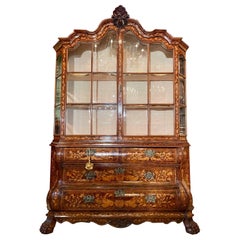
Highly Important Dutch Floral Marquetry Cabinet by Jan van Mekeren, circa 1700
About the Item
- Creator:Jan van Mekeren (Cabinetmaker)
- Dimensions:Height: 81.11 in (206 cm)Width: 67.33 in (171 cm)Depth: 24.02 in (61 cm)
- Materials and Techniques:
- Place of Origin:
- Period:Late 17th Century
- Date of Manufacture:circa 1700
- Condition:Replacements made: Overall in excellent condition for a marquetry cabinet from the 17th century, especially since all other cabinets known are in bad condition. For a full restoration and condition report, send us a message. Repaired: Overall in excellent condition for a marquetry cabinet from the 17th century, especially since all other cabinets known are in bad condition. For a full restoration and condition report, send us a message. Refinished. Wear consistent with age and use. Overall in excellent condition for a marquetry cabinet from the 17th century, especially since all other cabinets known are in bad condition. For a full restoration and condition report, send us a message.
- Seller Location:Amsterdam, NL
- Reference Number:1stDibs: LU5458229625622
Authenticity Guarantee
In the unlikely event there’s an issue with an item’s authenticity, contact us within 1 year for a full refund. DetailsMoney-Back Guarantee
If your item is not as described, is damaged in transit, or does not arrive, contact us within 7 days for a full refund. Details24-Hour Cancellation
You have a 24-hour grace period in which to reconsider your purchase, with no questions asked.Vetted Professional Sellers
Our world-class sellers must adhere to strict standards for service and quality, maintaining the integrity of our listings.Price-Match Guarantee
If you find that a seller listed the same item for a lower price elsewhere, we’ll match it.Trusted Global Delivery
Our best-in-class carrier network provides specialized shipping options worldwide, including custom delivery.You May Also Like
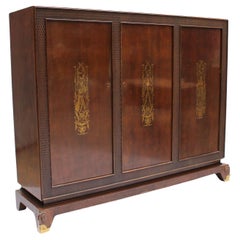
Fine French 1940s Cabinet - Armoire by Jean Pascaud
Marquetry by J.D Malcles
By Jean Pascaud
Located in Long Island City, NY
Jean Pascaud (1903-1996) - A fine French Art Deco walnut stained armoire/cabinet with a carved diamond pattern that frames three doors, each with a refined brass inlay by J.-D. Malcl...
Category
Vintage 1940s French Art Deco Cabinets
Materials
Brass
$24,000
H 59.06 in W 73.63 in D 19.69 in
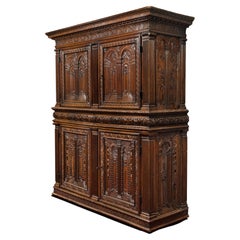
Important Renaissance Cabinet from Lyon
France
with a Decor of Perspectives
Located in Saint-Ouen, FR
As soon as 1540 France's second Renaissance is in the making, intimately linked to the rediscovery of the Antique world. The development of the printing and engraving industry allows the spread of artworks and models in many cities and countries. The Italian influence can be perceived in every artistic field. While the French king entrust the most talented Italian artists with major projects such as Il Rosso or Primaticcio in Fontainebleau, French artists also travel to Italy to form themselves to this new style. In Italy they get acquainted with the work of Leo Battista Alberti the first to theorize perspective (De Pictura, 1435-36) and architecture (De re oedificatoria, 1541). Those two publications would have a revolutionary impact on arts.
Furniture is marked by the work of the most famous Italian architects of the time as well as French architects. Indeed Philibert de l'Orme competes with Alberti and by the end of his life publishes several treaties including one devoted to a theory of architecture (1567). Unfortunately he would not live to complete the second volume. In this treaty he expresses his interest for mathematical norms applied to architecture, copied from the Antique. His journeys in Italy allowed him to accumulate the most sophisticated references. Jean Bullant, another architect of great talent also theorizes his practice. He establishes rules characterizing Greco-Roman art staying faithful to Vitruvius.
Following this new inspiration the structure of furniture evolves. From then on appear columns, capitals, cornices, friezes and architraves. The ornamentation uses this inspiration as well with egg-and-dart, palm leaf and rose adorning the most beautiful pieces.
In Lyon, crossroad where meet merchants from everywhere those new experiments are welcomed. Lyon florishing printing industry allows the spreading of models and treaties essential to the artist's work. Thus the first publication of Vitruvius' De Architectura in France would be printed in Lyon in 1532.
Artists from Lyon rediscover and familiarize themselves with the Antique knowledge very early. They adopt those new ideas and use them in their own creations. Lyon cabinet-makers re interpret Antique architecture and Italian Renaissance palaces to give their pieces a pure and harmonious architectural structure. Grooved pilasters are particularly favored. They are topped by capitals of diverse orders always respecting the sequencing with simpler ones for the lower levels and the richest ones on the higher levels. As for the ornamentation, one of the great distinctiveness of Lyon workshops remains the architectural perspective illusions, drawing inspiration from Tuscany.
True masterpiece of the Second French Renaissance this important cabinet illustrates Lyon workshops' taste for fine Italian architecture inspired by Antiquity. An architectural perspective of great quality is treated in symmetry on each panel.
This two-bodied cabinet without recess stands on four rectangular feet. The base comprises a molding, a palm leaf frieze and is bordered by a braid.
The lower body is divided by three grooved pilasters with Tuscan capitals framing two door-leaves. The two panels are encircled by a moudled frame with palm leaves. They are finely carved with a decor of fantasized architecture depicting an Italian Renaissance palace erected symmetrically on each side of a grooved pilaster. On the ground floor a door opens through a stilted arch while the stories are opened with mullioned windows, dormers and occuli. Two large pegged-boss cladded pillars support the entablature enriched by a palm leaf frieze upon which stands an arch whose coffered intrados is centred by a rose. Behind this arch a pyramid appears, standing in front of a second facade with a window topped by a broken curvilinear pediment under a cul-de-four with a shell.
The checker flooring gives depth to the low-reliefs creating vanishing points structuring the panels and guiding the eye of the observer.
A thin laurel braid highlights the belt of the cabinet where are located two drawers. Their facades are adorned by palm leaves in hoops.
The upper body is encircled with palm leaves. The same ternary division as in the lower body appears. However, the pilasters are topped by Ionic capitals with volutes and egg-and-dart. The door-leaves are framed with flowers. On the panels the artist has designed another architectural decor. On the foreground open two arches on top of grooved pilasters with rectangular capitals adorned with palm leaves. The arches are enriched with braids and the coffered intrados bears a decor of roses. The spandrels also bear a flower decor. In the background another arcature hosts a fluted grooved column topped with double basket acanthus capital, characteristic of Corinthian order. The triangular pediment is interrupted by a choux bourguignon.
A large cornice crowns the cabinet. It stands on pilasters and forms an entablature comprising a palm leaf frieze and an egg-and-dart, triglyph and palm leaf cornice.
The cabinet's sides have also been carefully considered. The lower body's panels are enriched with an arch rising above a broken pediment portico hosting a twisted column. Flowers garnish the spandrels. An architectural facade completes the decor. The upper body's panels present two arches supported by a facade opened with dormers and mullioned windows as well as cartouches (one bears the inscription 1580 dating the cabinet) suggesting the interior of an Italian Renaissance palace, confirmed by the chandeliers. The flooring leads our gaze to a second arch with a broken curvilinear pediment where stands a flower vase. This arch opens onto a perspective of another facade along a road.
Inside the cabinet, on the lower body door-leaves appear two designs. On the right door is depicted a Crucifixion. Saint Mary and Saint John flank the Christ on the cross. In the bottom part is inscribed « Dure uiator abis nihil haec spectacula curas / Pendenti cum sis unica cura Deo. / Tota suo moriente dolet natura Magistro. / Nil qui solus eras caussa dolenda doles. ». The signature [Christoff Swartz Monachiensis pinx[it] / Ioa[nnes] Sadeler sculp[it]] tells us it was made by Johan Sadeler I (1550-1600) after Christoph Schwartz (1548-1592). This engraving belongs to an ensemble depicting the Passion of Christ Johan Sadeler executed in 1589 after an altar piece painted by Christoph Schwartz for the private chapel of Renée of Loraine, wife of Duke William V of Bavaria. This altar piece made of nine copper panels has been destroyed during the 19th century. The Crucifixion panel once in the centre of the altar piece is the only one that survived and is today kept in Munich's Alte Pinakothek.
On the left door appears Saint Francis receiving the stigmata. The inscription says : « Signastidomine Servum Tuum. Franciscum. Signis Redemptionis Nostrae ».
This Renaissance cabinet with an architectural decor appearing as much in the structure faithful to Antique rules...
Category
Antique 16th Century European Renaissance Cabinets
Materials
Walnut
$178,875
H 87.41 in W 74.81 in D 27.17 in
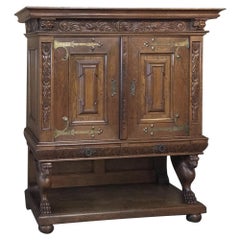
19th Century Dutch Hand Carved Renaissance Raised Cabinet
Located in Dallas, TX
19th century Dutch hand carved Renaissance raised cabinet was rendered from dense, old-growth quarter sawn oak, examples of which are on displa...
Category
Antique Mid-19th Century Dutch Renaissance Revival Wardrobes and Armoires
Materials
Steel
Dutch Marquetry Display Cabinet Circa 1800
Located in Brussels, Brussels
A superb and rare Dutch display cabinet from the late 18th/early 19th century made from marquetry of light woods such as boxwood and satinwood on a walnut background.
A superb examp...
Category
Antique Early 19th Century Dutch Louis XVI Cabinets
Materials
Walnut
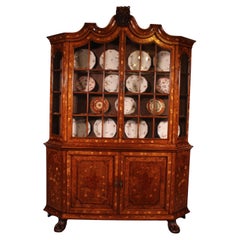
Antique Dutch Marquetry Cabinet, Circa 1800-1820
Located in New Orleans, LA
Antique magnificent quality Dutch marquetry cabinet, circa 1800-1820.
Category
Antique 19th Century Dutch Cabinets
Materials
Walnut
Unity Cabinet M by Phormy
Located in Geneve, CH
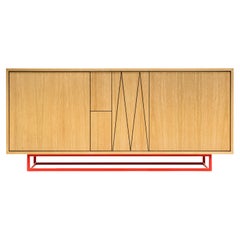
UNITY Cabinet M by Phormy
Dimensions: D 44 x W 148 x H 70 cm.
Materials: Lacquered oak / oak veneer / interior made of black MDF dyed in mass / powder ...
Category
2010s Polish Post-Modern Cabinets
Materials
Oak
UNITY Cabinet S by Phormy
Located in Geneve, CH
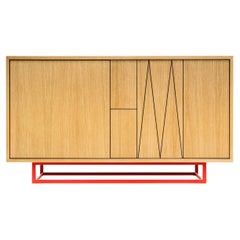
UNITY cabinet S by Phormy
Dimensions: D 44 x W 125 x H 70 cm.
Materials: Lacquered oak / oak veneer / interior made of black MDF dyed in mass / powder ...
Category
2010s Polish Post-Modern Cabinets
Materials
Oak
Cabinet by Jacques Adnet
Located in Pompano Beach, FL
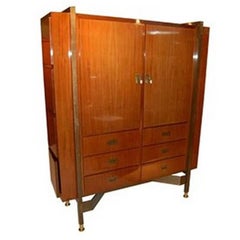
A mahogany and brass-mounted cabinet by Jacques Adnet. The pair of cupboard doors enclosing four adjustable shelves above six drawers, the sides with four hinged compartments.
Category
Vintage 1950s Cabinets
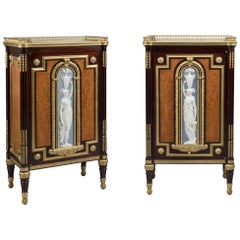
Highly Important Pair of Neoclassical Side Cabinets by Jules Piret, circa 1860
By Jules Piret
Located in Brighton, West Sussex
A rare and highly important pair of neoclassical style gilt-bronze and biscuit porcelain mounted mahogany side cabinets, by Jules Piret.
French, circa 1...
Category
Antique Mid-19th Century French Neoclassical Cabinets
Materials
Bronze
$130,864 / set
H 43.31 in W 24.81 in D 16.54 in
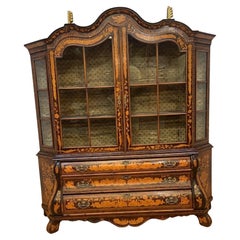
Antique Dutch Marquetry Cabinet
Located in Chicago, IL
Antique Dutch Marquetry Cabinet
This exquisite 19th Century Dutch Marquetry Cupboard showcases the intricate craftsmanship of its era, featuring two elegant glass doors that provide...
Category
Antique 19th Century Unknown Dutch Colonial Cabinets
Materials
Wood
Still Thinking About These?
All Recently ViewedMore Ways To Browse
Inlaid Wood Marquetry Case Furniture
Inlaid Marquetry Cabinet On Legs
Dutch Marquetry Furniture
Dutch Floral
H W B And Sons
Marquetry Flower
Antique Well Head
Floral Wood Cabinet
Inlaid Star
Dutch Inlay
18th Century Dutch Oak Cabinet
Dutch 18th Century Inlaid Furniture
Dutch Marquetry Cabinet
18th Century Dutch Walnut Cabinets
18th Century Dutch Painted Cabinet
17th Century Marquetry
Turtle Dove
Dutch Cabinets 17th 18th Century