Want more images or videos?
Request additional images or videos from the seller
1 of 17
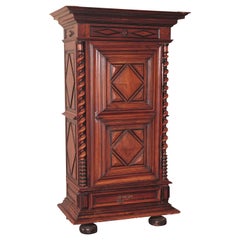
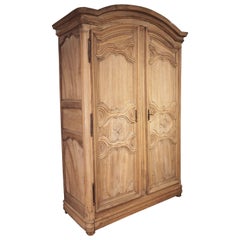
Louis XIII Style Diamond Point Homme Debout Cabinet from France
$3,900List Price
About the Item
- Dimensions:Height: 89 in (226.06 cm)Width: 56.5 in (143.51 cm)Depth: 25.5 in (64.77 cm)
- Style:Louis XIII (In the Style Of)
- Materials and Techniques:
- Place of Origin:
- Period:
- Date of Manufacture:Late 1800s
- Condition:Wear consistent with age and use. CONDITION: Good strong condition with some traces of old wood worm, and replaced sections including crown, base molding, internal boards.
- Seller Location:Dallas, TX
- Reference Number:Seller: 819-11stDibs: LU906316127721
About the Seller
5.0
Vetted Professional Seller
Every seller passes strict standards for authenticity and reliability
Established in 1983
1stDibs seller since 2011
885 sales on 1stDibs
Typical response time: 1 hour
Authenticity Guarantee
In the unlikely event there’s an issue with an item’s authenticity, contact us within 1 year for a full refund. DetailsMoney-Back Guarantee
If your item is not as described, is damaged in transit, or does not arrive, contact us within 7 days for a full refund. Details24-Hour Cancellation
You have a 24-hour grace period in which to reconsider your purchase, with no questions asked.Vetted Professional Sellers
Our world-class sellers must adhere to strict standards for service and quality, maintaining the integrity of our listings.Price-Match Guarantee
If you find that a seller listed the same item for a lower price elsewhere, we’ll match it.Trusted Global Delivery
Our best-in-class carrier network provides specialized shipping options worldwide, including custom delivery.You May Also Like
18th Century French Louis XIII Walnut Bonnetière Armoire from Périgord
Located in Dallas, TX
This elegant and tall antique bonnetière, or single-door armoire, was crafted in the Périgord region of France circa 1750. Built from rich fruitwood, the cabinet stands on turned bun...
Category
Antique Mid-18th Century French Wardrobes and Armoires
Materials
Walnut
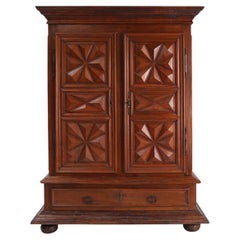
French Early 17th Century Louis XIII Wardrobe
Located in Meulebeke, BE
A French early 17th century large scale period Louis XIII oak wardrobe with two doors over one drawer, geometric décor and original hardware.
With this piece, we are in the middle o...
Category
Antique Early 17th Century French Rustic Wardrobes and Armoires
Materials
Oak
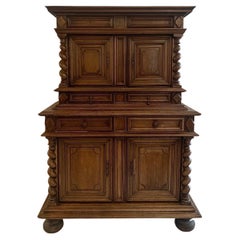
Louis XIII French Cabinet 17th Century
Located in Beuzevillette, FR
Small French buffet with two bodies from the 17th century. This old cabinet in carved walnut wood from the Louis XIII period has four doors, four d...
Category
Antique 17th Century French Louis XIII Buffets
Materials
Wood, Walnut
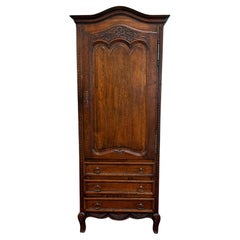
Antique French Louis XV Style Armoire Linen Cabinet Chest Bonnetiere Oak
Located in Tyler, TX
Beautifully Carved Antique French Louis XV Oak Bonnet Top Armoire, Wardrobe, Bonnetiere, Linen Closet or Cabinet Over 3 Drawer Chest ~~1900-1920
Perfect statement piece that can acc...
Category
Early 20th Century French Louis XV Wardrobes and Armoires
Materials
Oak
$3,875
H 81.25 in W 33.5 in D 17.5 in
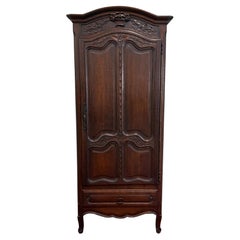
Antique French Louis XV Style Armoire Cupboard Linen Cabinet Bonnetiere Oak
Located in Tyler, TX
Beautifully Carved Antique French Louis XV Oak Armoire, Wardrobe, Bonnetiere, Cupboard or Cabinet ~~c. 1900
Perfect statement piece that can accommodate any number of storage needs...
Category
Early 20th Century French Louis XV Wardrobes and Armoires
Materials
Oak
$4,500
H 81 in W 35 in D 17 in
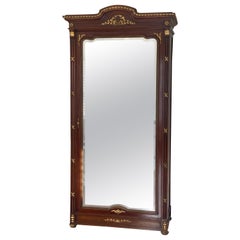
French Neoclassical Style Tall Mirrored Cabinet/Armoire
Located in Southampton, NY
French neoclassical style tall mirrored cabinet/armoire
Beautiful reproduction, originally with legs, legs were cut off. Selling as is.
Parcel-...
Category
21st Century and Contemporary American Neoclassical Cabinets
Materials
Mahogany
$1,600 Sale Price
36% Off
H 92 in W 46 in D 19.5 in
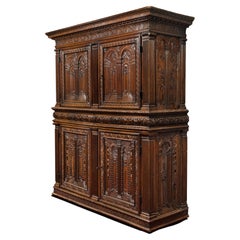
Important Renaissance Cabinet from Lyon
France
with a Decor of Perspectives
Located in Saint-Ouen, FR
As soon as 1540 France's second Renaissance is in the making, intimately linked to the rediscovery of the Antique world. The development of the printing and engraving industry allows the spread of artworks and models in many cities and countries. The Italian influence can be perceived in every artistic field. While the French king entrust the most talented Italian artists with major projects such as Il Rosso or Primaticcio in Fontainebleau, French artists also travel to Italy to form themselves to this new style. In Italy they get acquainted with the work of Leo Battista Alberti the first to theorize perspective (De Pictura, 1435-36) and architecture (De re oedificatoria, 1541). Those two publications would have a revolutionary impact on arts.
Furniture is marked by the work of the most famous Italian architects of the time as well as French architects. Indeed Philibert de l'Orme competes with Alberti and by the end of his life publishes several treaties including one devoted to a theory of architecture (1567). Unfortunately he would not live to complete the second volume. In this treaty he expresses his interest for mathematical norms applied to architecture, copied from the Antique. His journeys in Italy allowed him to accumulate the most sophisticated references. Jean Bullant, another architect of great talent also theorizes his practice. He establishes rules characterizing Greco-Roman art staying faithful to Vitruvius.
Following this new inspiration the structure of furniture evolves. From then on appear columns, capitals, cornices, friezes and architraves. The ornamentation uses this inspiration as well with egg-and-dart, palm leaf and rose adorning the most beautiful pieces.
In Lyon, crossroad where meet merchants from everywhere those new experiments are welcomed. Lyon florishing printing industry allows the spreading of models and treaties essential to the artist's work. Thus the first publication of Vitruvius' De Architectura in France would be printed in Lyon in 1532.
Artists from Lyon rediscover and familiarize themselves with the Antique knowledge very early. They adopt those new ideas and use them in their own creations. Lyon cabinet-makers re interpret Antique architecture and Italian Renaissance palaces to give their pieces a pure and harmonious architectural structure. Grooved pilasters are particularly favored. They are topped by capitals of diverse orders always respecting the sequencing with simpler ones for the lower levels and the richest ones on the higher levels. As for the ornamentation, one of the great distinctiveness of Lyon workshops remains the architectural perspective illusions, drawing inspiration from Tuscany.
True masterpiece of the Second French Renaissance this important cabinet illustrates Lyon workshops' taste for fine Italian architecture inspired by Antiquity. An architectural perspective of great quality is treated in symmetry on each panel.
This two-bodied cabinet without recess stands on four rectangular feet. The base comprises a molding, a palm leaf frieze and is bordered by a braid.
The lower body is divided by three grooved pilasters with Tuscan capitals framing two door-leaves. The two panels are encircled by a moudled frame with palm leaves. They are finely carved with a decor of fantasized architecture depicting an Italian Renaissance palace erected symmetrically on each side of a grooved pilaster. On the ground floor a door opens through a stilted arch while the stories are opened with mullioned windows, dormers and occuli. Two large pegged-boss cladded pillars support the entablature enriched by a palm leaf frieze upon which stands an arch whose coffered intrados is centred by a rose. Behind this arch a pyramid appears, standing in front of a second facade with a window topped by a broken curvilinear pediment under a cul-de-four with a shell.
The checker flooring gives depth to the low-reliefs creating vanishing points structuring the panels and guiding the eye of the observer.
A thin laurel braid highlights the belt of the cabinet where are located two drawers. Their facades are adorned by palm leaves in hoops.
The upper body is encircled with palm leaves. The same ternary division as in the lower body appears. However, the pilasters are topped by Ionic capitals with volutes and egg-and-dart. The door-leaves are framed with flowers. On the panels the artist has designed another architectural decor. On the foreground open two arches on top of grooved pilasters with rectangular capitals adorned with palm leaves. The arches are enriched with braids and the coffered intrados bears a decor of roses. The spandrels also bear a flower decor. In the background another arcature hosts a fluted grooved column topped with double basket acanthus capital, characteristic of Corinthian order. The triangular pediment is interrupted by a choux bourguignon.
A large cornice crowns the cabinet. It stands on pilasters and forms an entablature comprising a palm leaf frieze and an egg-and-dart, triglyph and palm leaf cornice.
The cabinet's sides have also been carefully considered. The lower body's panels are enriched with an arch rising above a broken pediment portico hosting a twisted column. Flowers garnish the spandrels. An architectural facade completes the decor. The upper body's panels present two arches supported by a facade opened with dormers and mullioned windows as well as cartouches (one bears the inscription 1580 dating the cabinet) suggesting the interior of an Italian Renaissance palace, confirmed by the chandeliers. The flooring leads our gaze to a second arch with a broken curvilinear pediment where stands a flower vase. This arch opens onto a perspective of another facade along a road.
Inside the cabinet, on the lower body door-leaves appear two designs. On the right door is depicted a Crucifixion. Saint Mary and Saint John flank the Christ on the cross. In the bottom part is inscribed « Dure uiator abis nihil haec spectacula curas / Pendenti cum sis unica cura Deo. / Tota suo moriente dolet natura Magistro. / Nil qui solus eras caussa dolenda doles. ». The signature [Christoff Swartz Monachiensis pinx[it] / Ioa[nnes] Sadeler sculp[it]] tells us it was made by Johan Sadeler I (1550-1600) after Christoph Schwartz (1548-1592). This engraving belongs to an ensemble depicting the Passion of Christ Johan Sadeler executed in 1589 after an altar piece painted by Christoph Schwartz for the private chapel of Renée of Loraine, wife of Duke William V of Bavaria. This altar piece made of nine copper panels has been destroyed during the 19th century. The Crucifixion panel once in the centre of the altar piece is the only one that survived and is today kept in Munich's Alte Pinakothek.
On the left door appears Saint Francis receiving the stigmata. The inscription says : « Signastidomine Servum Tuum. Franciscum. Signis Redemptionis Nostrae ».
This Renaissance cabinet with an architectural decor appearing as much in the structure faithful to Antique rules...
Category
Antique 16th Century European Renaissance Cabinets
Materials
Walnut
$177,514
H 87.41 in W 74.81 in D 27.17 in
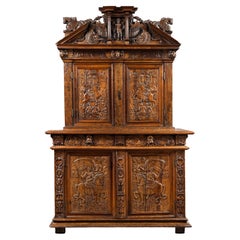
16th Century Cabinet with Knights Carving from Avignon Workshops
France
Located in Saint-Ouen, FR
Collection Jean Thuile
Around the mid-sixteenth century French furnishing evolves in its conception and ornamentation. The start of major archi...
Category
Antique 16th Century French Renaissance Cabinets
Materials
Walnut
$29,585
H 87.41 in W 55.91 in D 21.86 in
Red 2-Door Cabinet Égée in Ash Wood from Pefc-Certified French Forests
By Éric Gizard
Located in Landivy, FR
Shelf Cabinet designed by the parisian Designer Eric Gizard is equipped with 2 adjustable lacquered shelves and 2 doors with a push loose opening.
The Kube itself (without the fe...
Category
2010s French Scandinavian Modern Cabinets
Materials
Wood, Ash
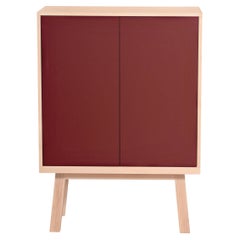
$2,366 / item
H 49.22 in W 35.44 in D 18.12 in
18th Century French Louis XV Armoire, Antique Walnut Armoire Louis XV Style
Located in Miami, FL
Magnificent 18th-century French armoire, a testament to Louis XV craftsmanship. This imposing walnut wardrobe showcases intricate carvings and a distinctive "chapeau gendarme" crown ...
Category
Antique 18th Century French Louis XV Wardrobes and Armoires
Materials
Brass
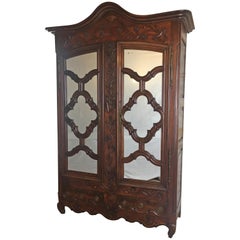
$35,000
H 101 in W 69 in D 24 in
More From This Seller
View All17th Century Painted Oak Homme Debout Cabinet from Southwest France
Located in Dallas, TX
A Homme debout is a two-bodied cabinet with a drawer separating the sections. This handsome Homme debout from southwest France was hand carved from oak in the 1600s. The period Louis...
Category
Antique 17th Century French Louis XIII Cabinets
Materials
Wood, Paint
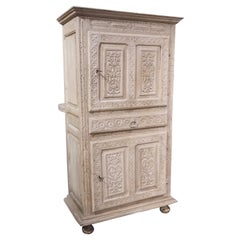
Antique Carved Oak Homme Debout Malouin Cabinet from St. Malo, France, C. 1700
Located in Dallas, TX
Known as an homme debout Malouin, this gorgeous cabinet from Saint-Malo, France, has luxurious and deep carvings paired with brass fittings. Hand-carved in oak, circa 1700, the turne...
Category
Antique Early 1700s French Louis XIII Cabinets
Materials
Metal, Brass
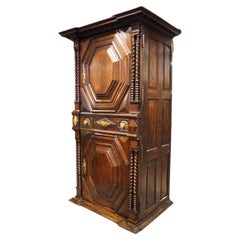
Early 18th Century Bleached French Walnut Armoire from the Île-de-France Region
Located in Dallas, TX
Typical of Ile-de-France furniture from the early 1700’s, this walnut armoire has unadorned panels, allowing the beautiful, curved moldings to take prominence. The walnut wood has be...
Category
Antique 18th Century French Louis XIV Wardrobes and Armoires
Materials
Iron
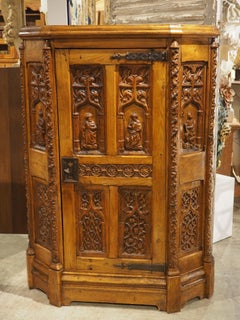
Circa 1870 Richly Carved French Gothic Style Cabinet in Golden Oak
Located in Dallas, TX
More information coming soon…
The half-octagonal form of this Gothic-style cabinet allows the amazing carved panels to be seen from all sides. Hand-carved circa 1870, the golden oa...
Category
Antique Mid-19th Century French Gothic Cabinets
Materials
Metal, Iron
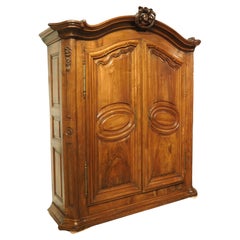
Early 18th Century Walnut and Olive Wood Armoire from Eastern France
Located in Dallas, TX
This unique armoire from the early 1700’s was made from walnut and olive wood and features a plinth base with central cherub mascaron along the crown. At just under 86 inches tall and 78 wide at the crown, this armoire has a more manageable size, compared to many of the very large armoires of the same period. The unique construction allows it to be easily disassembled for transport.
At one point, this walnut and olive wood armoire was the property of a chocoladefabriek (chocolate factory) in Strasbourg, located in the region of Alsace, near the German border. It was originally one armoire in a pair that were commissioned in Eastern France in the early 1700s. The ebeniste who created the armoire decided to use olive wood for the door panels and some of the side panels. Olive wood was a highly valued wood among wood workers of the 18th century because of its pretty color and the richness and nuances of its veining.
In the center of the crown is a foliate and floral ring surrounding a cherub mascaron. The crown and the top of the door frames have both been carved in an arch, mirroring the shape of the door moldings. Each door is mounted on iron hinges and separated by recessed molding into three uniquely shaped panels of olive wood (the rest of the armoire is constructed with walnut). Both upper panels of the doors are adorned with a series of undulating C-scrolls, while the bottom panels are rectangles with concave tops. The two sections are separated by a simple ovate center panel.
Armoires date back the 17th century when French menuisiers created the storage cabinet to house clothing. Early armoires such as this one were without feet (plinth style base) and were often seen in paneled boiserie...
Category
Antique Early 18th Century French Wardrobes and Armoires
Materials
Metal, Iron
Large Louis XIII Chateau Fireplace Mantel from La Meuse, France, 17th Century
Located in Dallas, TX
More information coming soon…
Hand-carved in 12 pieces of French stone, this fireplace mantel dates to the early- to mid-1600, placing it in the period of Louis XIII. Taken from a ...
Category
Antique 17th Century French Louis XIII Fireplaces and Mantels
Materials
Stone, Limestone
Still Thinking About These?
All Recently ViewedMore Ways To Browse
Names Of Antique Furniture
French Armoire With Bun Feet
Homme Debout
Corner Cabinets
Black Lacquer Storage Cabinet
Aluminium Cabinet
Used Glass Display Cases
Door Lock
Antique Oak Carved Cabinet 19th Century
Brass And Glass Display Cabinets
Marble Top With Two Door
Antique China Cabinet Furniture
Vintage Steel Storage Cabinets
Used Glass Display Cabinets
18th Century Kitchen Cabinet
Antique Fretwork
Antique Kitchen Cabinet Painted
Kitchen Display Cabinet