Items Similar to Renaissance Style "Four Seasons" Cabinet by M. Lerolle, France, Circa 1890
Want more images or videos?
Request additional images or videos from the seller
1 of 20
Renaissance Style "Four Seasons" Cabinet by M. Lerolle, France, Circa 1890
$76,951.11
£57,488.41
€65,000
CA$107,150.57
A$115,127.33
CHF 61,765.58
MX$1,356,332.59
About the Item
Signed " Meubles D’Art, M. Lerolle, Fabricant, 61, Rue des Sts-Peres. Paris "
Remarkable carved wood cabinet, richly sculpted in the Neo-Renaissance style, and inlaid with vert de mer marble cabochons and cartouches.
The upper part is formed by a scrolled broken pediment with a carved medallion supported by two putti at the centre. The facade features seven ionic columns adorned with ivy at their base and four female figures sculpted in the round, sheltered in niches and supported by cherub heads. The sculptures are allegories of the seasons. The upper part opens with three leaves and three drawers. In the lower part, the belt includes three drawers and is adorned with cartouches with mythological scenes. This piece of furniture is supported by two very richly sculpted winged sphinxes surrounding a central medallion adorned with a bacchanal scene, and stands on a moulded plinth and height feet.
This piece of furniture is a very fine example of the Neo-Renaissance style, which appeared in the years 1830 with Claude-Aimé Chenavard (ornemanist, 1798-1838), and was notably developed by the decorator Michel Liénard (1810-1870). This style followed the Neo-Gothic style and the cult of the Middle-Ages and succeeded on the long run. Inspiration sources were numerous in France and the iconographic richness of the mannerism flattered the taste of the Second Empire. Cabinet-markers notably took inspiration from the Henri II period and favored the use of richly sculpted solid and dark wood.
Our piece of furniture witnesses the interpretation and blending effort made by the artists of the nineteenth-century. It brings together the classicism of the Renaissance and its mythological subjects and the rigorous architectured structure, with a certain exuberance inherited from the Romanticism.
Related work :
Cabinet exhibited at the Exposition Universelle in 1867 (Fourdinois won a Grand Prix for his stand).
Museum of Decorative Arts, Paris (Inv. 29921).
Made by Henri-Auguste Fourdinois, Nivillier (ornaments design), Party (modelling of the bodies), Hugues Protat, Primo et Maigret (sculptures).
Illustrated in D. Ledoux-Lebard, Les Ebénistes du XIXe siècle, Ed. de l’Amateur, 1984, pp.205
Biography
The firm of Fourdinois, considered during the Second Empire as the greatest furniture manufacturer in Paris, was founded in 1835 by Alexandre-Georges Fourdinois (1799-1871). It was developed in the context of the Expositions Universelles. At the time, the firm already produces furniture of the Neo-Renaissance style, such as a dresser that won the Great Medal at the London Universal Exhibition of 1851. The son, Henri-Auguste Fourdinois (1830-1907), joined the firm in 1860 and will become head of the firm in 1867. The high quality of his designs was remarked at the Universal Exhibition in 1862, when the jury awarded him two medals « for Excellence of Composition and Execution ». Henri-Auguste, now sole in charge, brought the firm to the summit of its achievements at the 1867 Universal Exhibition in Paris by winning the Grand Prize for his stand. Apart from the commissions he executed for the « Mobilier de la Couronne », he also produced high quality furniture for the Parisian bourgeoisie. The firm is at its zenith during the years 1862-1880. At this time, it is considered as an example to follow for other cabinet-makers, whether they are French, British or American.
- Creator:Lerolle (Cabinetmaker)
- Similar to:Henri-Auguste Fourdinois (Cabinetmaker)
- Dimensions:Height: 94.1 in (239 cm)Width: 58.67 in (149 cm)Depth: 22.05 in (56 cm)
- Style:Renaissance Revival (In the Style Of)
- Materials and Techniques:
- Place of Origin:
- Period:
- Date of Manufacture:circa 1890
- Condition:
- Seller Location:PARIS, FR
- Reference Number:Seller: 14281stDibs: LU3860313068182
About the Seller
4.9
Vetted Professional Seller
Every seller passes strict standards for authenticity and reliability
Established in 1997
1stDibs seller since 2018
91 sales on 1stDibs
Associations
International Confederation of Art and Antique Dealers
Associations
- ShippingRetrieving quote...Shipping from: Saint Ouen, France
- Return Policy
More From This Seller
View AllRenaissance Style Wooden Cabinet Attributed to H.A. Fourdinois, France, 1893
Located in PARIS, FR
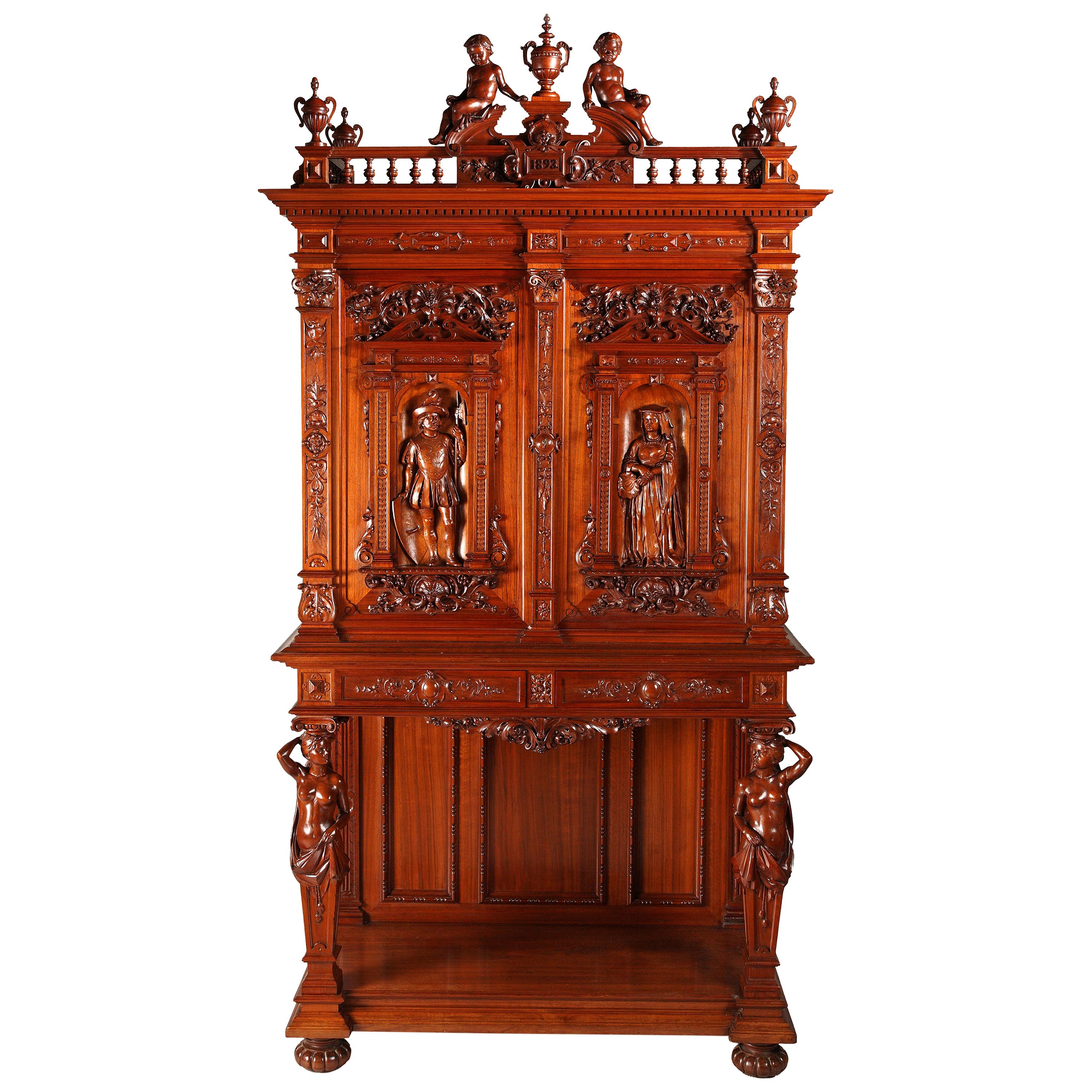
A wooden cupboard, elaborately carved throughout, dated "1893" on the crest and attributed to H.A. Fourdinois. The upper section with a pair of cherubs at the center of a balustrade ornamented with two-handled urns, two architectonic doors below, carved with lady and gentleman in niches surrounded by extensive carving with classical motifs. The lower section with two drawers above a standing female caryatid support at each front corner. The all reposing on four gadronned round feet.
The Fourdinois company was founded in 1835 by Alexandre-Georges Fourdinois (1799-1871). The Universal Exhibition held in London in 1851 was undoubtedly their first great artistic and public success. Winning the Great medal for a neo-Renaissance buffet...
Category
Antique 1890s French Renaissance Cabinets
Materials
Wood
$15,982 Sale Price
38% Off
Neo-Renaissance Cabinet by G.F. Quignon, Universal Exhibition of Paris 1889
By Frederic Gustave Quignon
Located in PARIS, FR
Presented at the Universal Exhibition of Paris in 1889
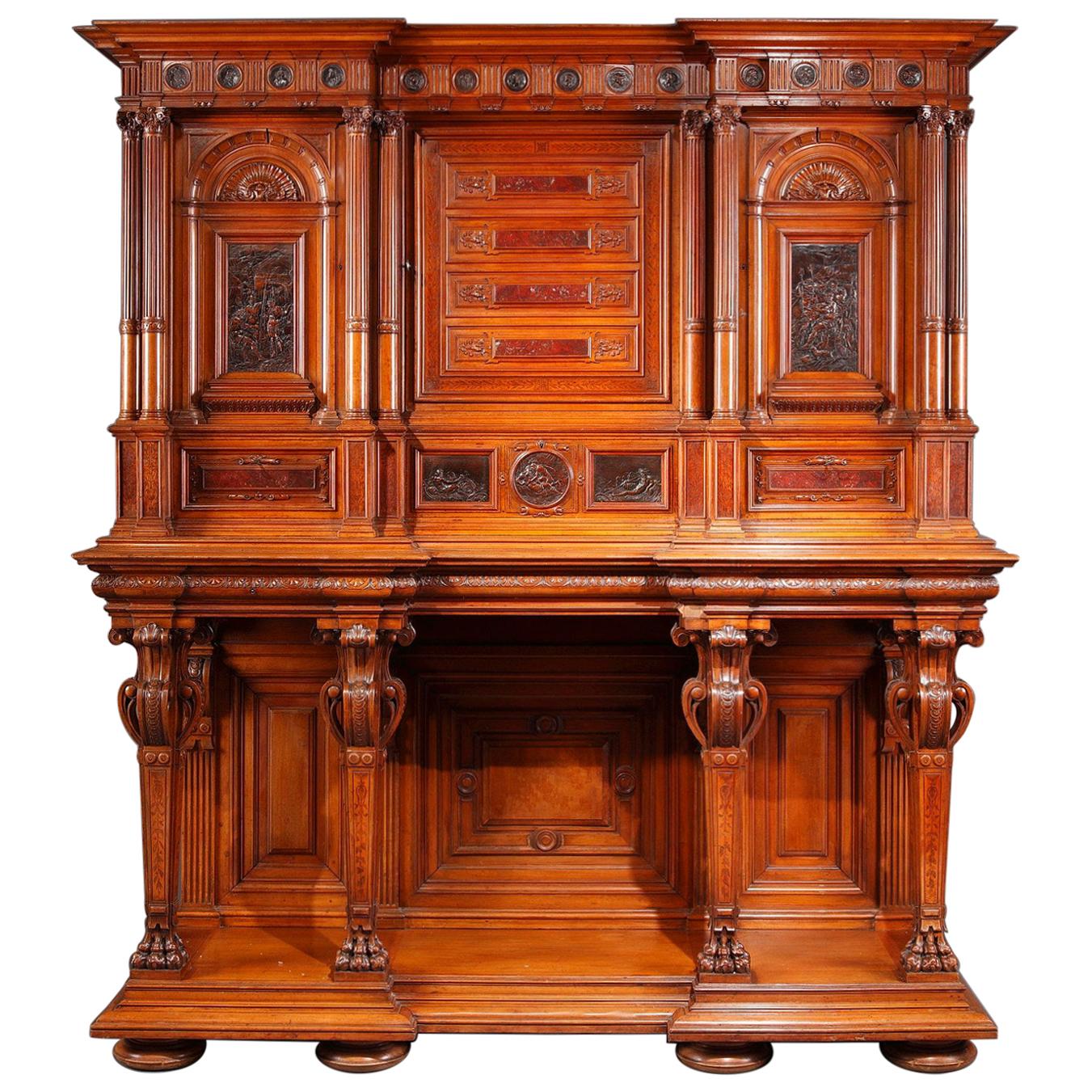
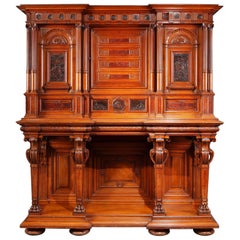
Important sculpted and engraved natural wood, patinated bronze and Griotte de Campan red marble inlaid Neo-Renaissance style cabinet.
The upper part is composed of a frieze of bronze medallions separated by triglyphs and supported by ribbed columns with Corinthian capitals. There are eight of these columns paired at the front and two simple columns at the rear. The facade presents an alternation of bronzes in niches and cartouches, of marble slates in cartouches sometimes flanked by palmettes, and of engraved motives of laurel and foliage scrolls. The upper part opens with three leaves and three mobile compartments. The belt carved with acanthus leaves opens with two drawers. This cabinet is supported by four richly sculpted tapered feet ending with claws. Four fluted pilasters are inscribed in the moulded back as counterparts. The whole ensemble stands on a moulded plinth and eight rounded feet.
Neo Renaissance Cabinet...
Category
Antique 1880s French Renaissance Cabinets
Materials
Marble, Bronze
$100,591 Sale Price
37% Off
Neo-Renaissance Cabinet by P. Sormani and attr. to E. Lièvre, France, Circa 1870
By Edouard Lievre, Paul Sormani
Located in PARIS, FR
Signed twice on the lock P. SORMANI 10 rue Charlot Paris
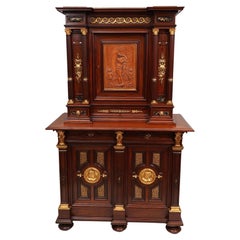
Rare neo-Renaissance cabinet in carved wood and Portor marble, adorned with chiseled and gilded bronze.
The upper, part, surmounted by a frieze of posts and marble cabochons, consists of a central door decorated with a carved panel representing the birth of Venus, framed by two pairs of ringed and fluted columns with Corinthians capitals in gilded bronze revealing two doors with secret opening. Two drawers with lion’s head shaped handles and a central drawer decorated with tracery in gilded bronze complete the upper part of this cabinet.
In the lower part, two drawers on the belt with diamond...
Category
Antique 1870s French Renaissance Cabinets
Materials
Marble, Bronze
$57,278 Sale Price
44% Off
Wooden
Enameled Display Sideboard Attributed to H.A Fourdinois, France, c1867
Located in PARIS, FR
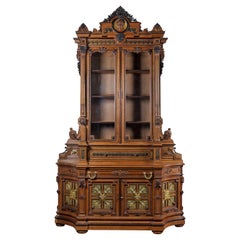
Important two-tiered sideboard attributed to H.A. Fourdinois made in natural and carved wood : the lower part made up of four panels, two concave ones and two doors, richly ornated with a polychrome enameled floral decoration and gilt bronze plaques.
A large dual drawer is surmounted by the upper part of the sideboard, opening with two glazed doors, framed by detached columns. The entire unit is topped with a pediment onto which a female bust is carved in relief within a medallion on a gilt background.
With a matching set of twelve chairs.
The Forney library in Paris preserves order registers of the Fourdinois as well as sketches books and pictures representing pieces of furniture made by the Fourdinois workshops. In this documentation, some elements enable us to link this sideboard with Henri-Auguste Fourdinois’ productions, such as the large scrolls linking the upper part to the lower part of the sideboard, as well as the detached columns carved at their lower third. (picture n°1 attached)
Notebook containing ink-sketches coming from the Fourdinois workshop shows a project for a pelmet, beautified with a centering trophy composed of a torch and a quiver within in a foliage wreath, this motif obviously reused by the Fourdinois on the central decoration of the panels of our sideboard. (picture n°2 attached)
The firm of Fourdinois, considered during the Second Empire as the greatest furniture manufacturer in Paris, was founded in 1835 by Alexandre-Georges Fourdinois (1799-1871). It was developped in the context of the Expositions Universelles. At the time, the firm already produces furniture of the Neo-Renaissance style, such as a dresser that won the Great Medal at the London Universal Exhibition of 1851. The son, Henri-Auguste Fourdinois (1830-1907), joined the firm in 1860 and will become head of the firm in 1867. The high quality of his designs was remarked at the Universal Exhibition in 1862, when the jury awarded him two medals « for Excellence of Composition and Execution ». Henri-Auguste, now sole in charge, brought the firm to the summit of its achievements at the 1867 Universal Exhibition in Paris by winning the Grand Prize for his stand. Apart from the commissions he executed for the « Mobilier de la Couronne », he also produced high quality furniture for the Parisian bourgeoisie. The firm is at its zenith during the years 1862-1880. At this time, it is considered as an example to follow for other cabinet-makers, whether they are French, British or American.
Through the quality of execution and the extreme care taken in the decoration of furniture, H.-A. Fourdinois was particularly appreciated by Napoleon III and Eugenie...
Category
Antique 1860s French Renaissance Sideboards
Materials
Enamel, Bronze
Rare Pair of Renaissance Revival Cabinet Attributed to F. Linke, France, c. 1880
By François Linke
Located in PARIS, FR
Cabinet 1 - Height : 152 cm (59,8 in.) ; Width : 96 cm (37,8 in.) ; Depth : 48 cm (18,9 in.)
Cabinet 2 - Height : 150 cm (59 in.) ; Width : 87,5 cm (34,4 in.) ; Depth : 42 cm (16,5 in.)
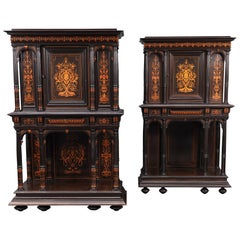
Rare near pair of French Renaissance style cabinets attributed to F. Linke. Composed of an architectured upper part, with inlaid panels alternated with Fine fluted columns, opening with a central door onto an exquisite filet framed veneered wood interior fitted with shelves. The decor of the panels is made of very Fine designed motifs such scrolls, grotesques and flowery vases, all characteristic of the Renaissance decorative repertoire. The lower section with three drawers above a three arched support ornated with columns, raised on a stepped base ; the back with similarly-inlaid decoration.
These neo-Renaissance style cabinets are very close to François Linke’s one presented in his private collection.
(photo attached, Reproduced and commented in François Linke (1855-1946), The Belle Époque of French Furnitures, Ch. Payne, pp.40-41).
If the style, characterizing François Linke, is mostly recognizable by its Rococo-Art Nouveau motifs, it occasionally appealed other historical ornaments, such from the French Renaissance. That reminds of the time, when the cabinet took the central place in the interior furnishings. This collector...
Category
Antique 1880s French Renaissance Revival Cabinets
Materials
Wood
Regence Style Wooden Display-Cabinet by C. Potheau, France, circa 1895
By Potheau
Located in PARIS, FR
Signed Constantin Potheau, ébéniste, Paris.
Measures: Height 275 cm (108,2 in., width 160 cm (63 in.);
Upper part depth 48 cm (18.8 in.) / inside 42 cm (16.5 in.)
Lower part dept...
Category
Antique 1890s French Régence Buffets
Materials
Wood
You May Also Like
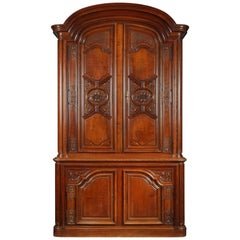
Late 19th C. French Renaissance Revival Cabinet w/ Relief Panels
Marble Tops.
Located in Los Angeles, CA
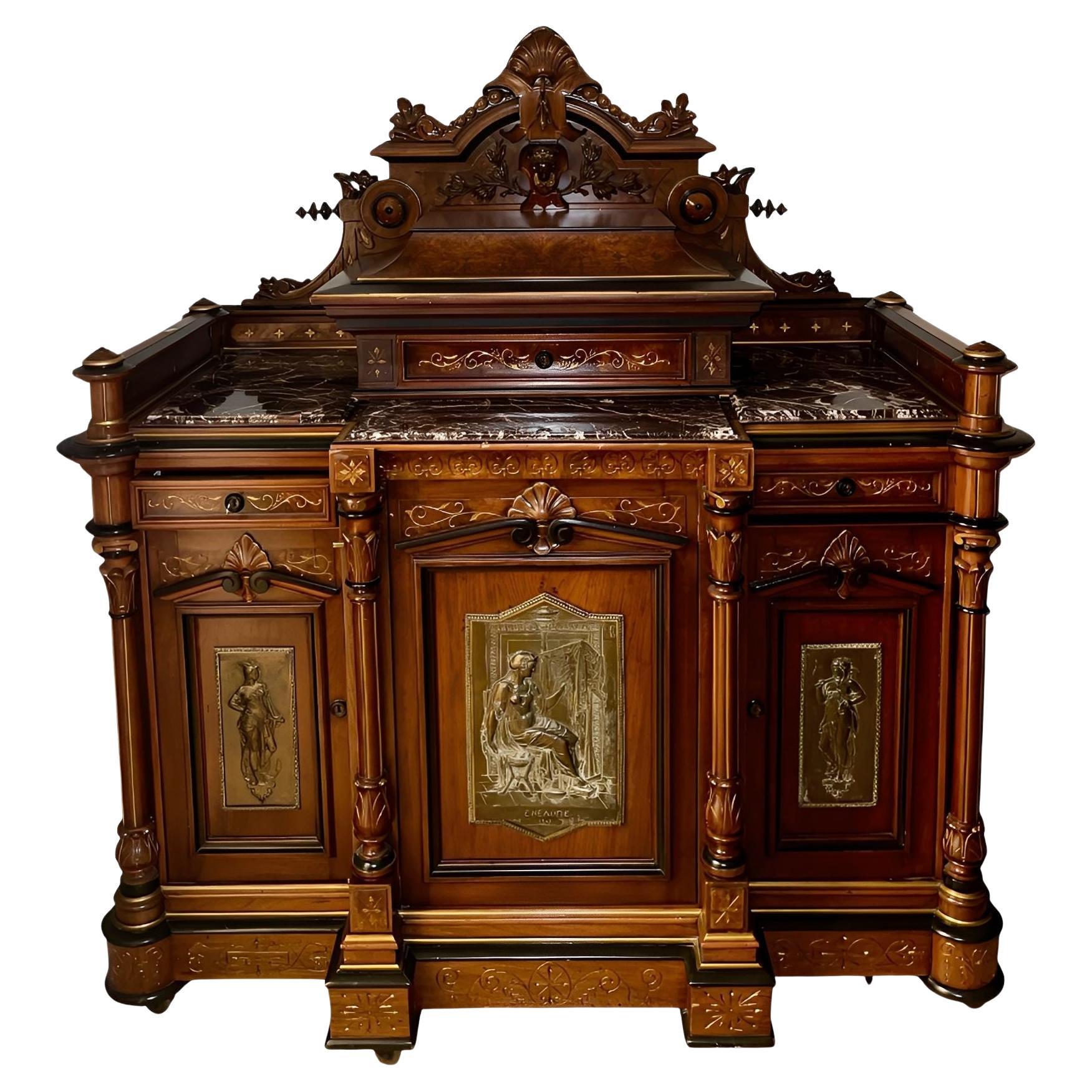
An extraordinary example of French Renaissance Revival craftsmanship, this monumental cabinet is richly executed in carved walnut and marquetry, with inset bronze relief plaques depi...
Category
Antique Late 19th Century French Renaissance Revival Cabinets
Materials
Marble
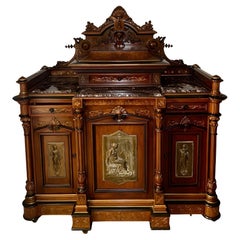
19th Century French Renaissance Revival Display Cabinet
Located in Tarry Town, NY
Early 19th century French renaissance revival hand carved walnut with marble inserted reserve display wall cabinet. The cabine...
Category
Antique 1810s French Renaissance Revival Cabinets
Materials
Marble
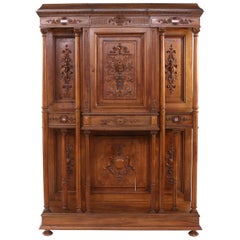
Figural Renaissance cabinet, France, around 1870.
Located in Chorzów, PL
Figural Renaissance cabinet, France, around 1870.
Very good condition.
Wood: walnut
dimensions: width 131 cm x height 175 cm x depth 52 cm
Category
Antique 1870s French Renaissance Cabinets
Materials
Walnut
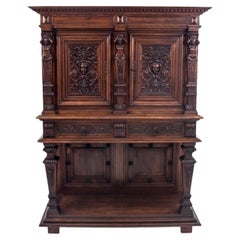
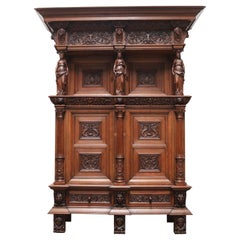
Impressive Dutch Renaissance Revival 19th Century Cabinet Carved Angels
Lions
Located in Ijzendijke, NL
Impressive & Breathtaking ! This Dutch 19th century Renaissance revival ''Beeldenkast'' (so called Statue cabinet) made out of solid oak.
The name refers to the carved statues that...
Category
Antique 19th Century Dutch Renaissance Revival Cabinets
Materials
Oak
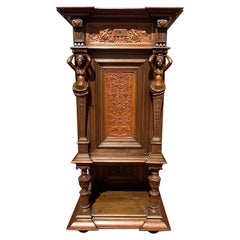
Henri Fourdinois, Walnut Renaissance Cabinet with Carriatides, 19th Century
Located in Beaune, FR
Renaissance style carved walnut cabinet or sideboard. The facade is decorated with a bust of a woman called "Carriatides" and opens with a drawer and...
Category
Antique 19th Century French Renaissance Revival Cabinets
Materials
Walnut
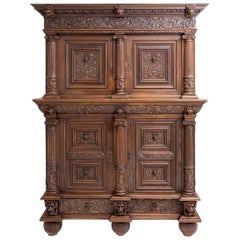
Neo-Renaissance Cabinet, Late 19th Century
Located in Greding, DE
A four-door cabinet in Renaissance style standing on ball feet with lion's head mascarons and half-columns with volute capitals. The doors with panels and vine decoration are separat...
Category
Antique 19th Century German Renaissance Revival Cabinets
Materials
Wood
More Ways To Browse
Carved Cabinet Renaissance
Antique French Carved Wood Cabinet
French Renaissance Cabinet
French Renaissance Style
1890 Kitchen Cabinet
Antique Dark Wood Furniture
Winged Sphinx
Second Empire Furniture
Cartouche Marble
Vert De Mer
Antique Victorian Cabinet
Storage Case With Glass Front
Antiques Antique Furniture Cabinets 20th Century
Display Cabinets Mid Century Modern
Small Cabinets
Large Case Pieces
Antique Wood Kitchen Cabinets
Wood And Glass Mid Century Cabinet