Items Similar to 16th Century Carved Walnut Credenza from Toulouse Workshops
Want more images or videos?
Request additional images or videos from the seller
1 of 5
16th Century Carved Walnut Credenza from Toulouse Workshops
$26,352.41
£19,705.67
€22,000
CA$36,307.03
A$39,597.92
CHF 20,976.31
MX$474,722.87
NOK 267,144.93
SEK 244,284.21
DKK 167,648.77
About the Item
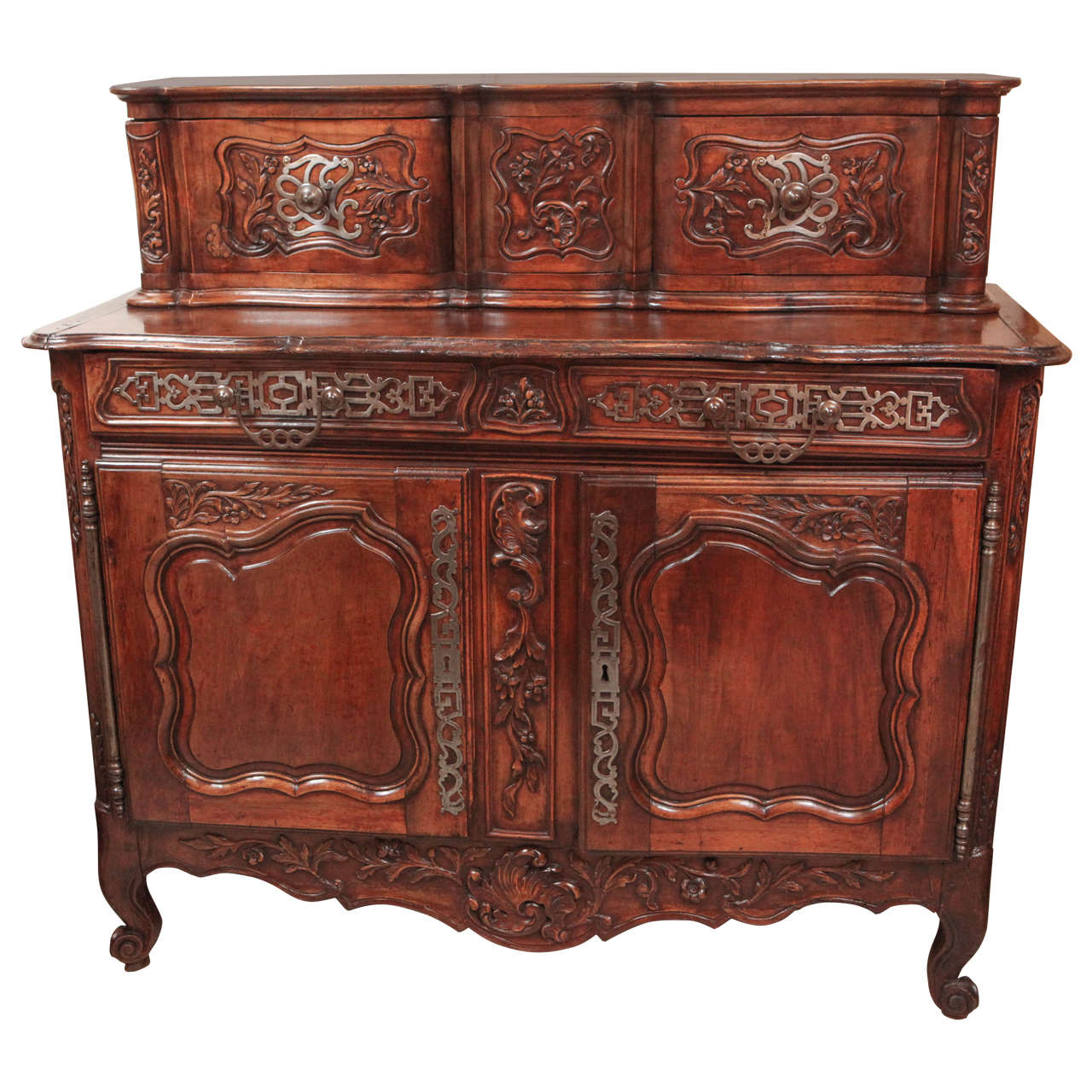
This two bodies cabinet shows in its upper part a triple arcature with four balusters. This architectural element gives depth to the body, highlighted by the gilt back upon which appears the carved elements.
Between two feather-quills the back is centred by concentric vegetal and flower motifs. This central decor is framed by two rectangle bearing similar ornaments. The decor follows the ternary rythm produced by the richly carved arcatures.
Carved between each baluster appears a lion mask accompanied by fruits and putti figures. The central part presents a smiling mask carried by two angels.
This credenza opens with two carved drawers in the belt separated by three putti headed consoles. Among leaved scrolls two winged putti hold a laurel wreath around the drawer knob.
The lower part is adorned by angel’s heads and fruit garlands around the two soberly moulded door-leaves panels. In between, the same ornament emphasizes the contrast of the panels and the carvings around, producing balance and harmony.
The credenza stands on four square feet.
The model of this cabinet appears during the 14th century. The purpose of the credenza is to present and keep valuable artifacts let it be tableware, jewels or even books.
- Dimensions:Height: 67.72 in (172 cm)Width: 51.58 in (131 cm)Depth: 20.87 in (53 cm)
- Style:Renaissance (Of the Period)
- Materials and Techniques:
- Place of Origin:
- Period:
- Date of Manufacture:circa 1580
- Condition:Repaired. Wear consistent with age and use. Minor fading.
- Seller Location:Saint-Ouen, FR
- Reference Number:1stDibs: LU3115327363952
About the Seller
5.0
Vetted Professional Seller
Every seller passes strict standards for authenticity and reliability
Established in 2016
1stDibs seller since 2017
209 sales on 1stDibs
Typical response time: 4 hours
- ShippingRetrieving quote...Shipping from: Saint-Ouen, France
- Return Policy
More From This Seller
View All16th Century French Walnut Cabinet with Marble Inlays
Located in Saint-Ouen, FR
On the left post of the lower body, is written the date 1596 in a cartouche
This cabinet has two bodies. The upper part, set back, is moulded and carved. At the bottom, the cabine...
Category
Antique 16th Century French Renaissance Cabinets
Materials
Walnut
A Rare Renaissance Walnut Cabinet With Its Freestanding Carved Columns
Located in Saint-Ouen, FR
A RARE RENAISSANCE WALNUT CABINET WITH ITS FREESTANDING CARVED COLUMNS
ORIGIN : FRANCE, BURGUNDY
PERIOD : 16th CENTURY
Height : 218 cm
Length : 152 cm
Depth : 67.5 cm
Walnut
Thi...
Category
Antique 16th Century European Renaissance Cabinets
Materials
Wood, Walnut
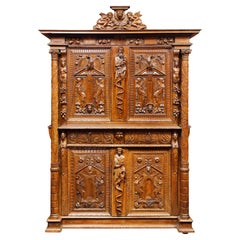
16th Century French Carved Renaissance Cabinet
Located in Saint-Ouen, FR
Rare carved Renaissance cabinet
Period : 2nd half 16th century, ca. 1570
Origin : France, Burgundy or Languedoc
This cabinet embody the produ...
Category
Antique 16th Century French Renaissance Cabinets
Materials
Walnut
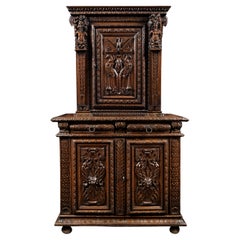
16th Century Cabinet with Knights Carving from Avignon Workshops
France
Located in Saint-Ouen, FR
Collection Jean Thuile
Around the mid-sixteenth century French furnishing evolves in its conception and ornamentation. The start of major archi...
Category
Antique 16th Century French Renaissance Cabinets
Materials
Walnut
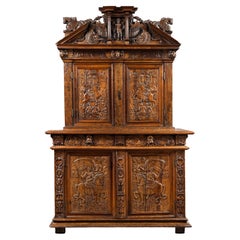
Rare Renaissance Dresser with Marquetry and Pastiglia, from Alsace
France
Located in Saint-Ouen, FR
This sideboard, with rich marquetry decoration, consists of two parts. The decorated upper body allows for the display of fine silverware. Superb carve...
Category
Antique Early 17th Century French Renaissance Dressers
Materials
Walnut
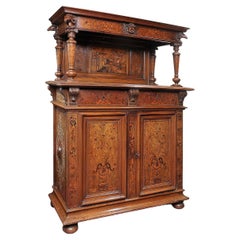
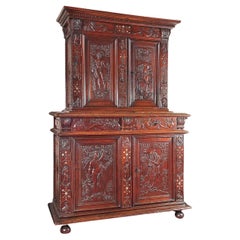
Rare Renaissance Cabinet Richly Carved
Located in Saint-Ouen, FR
This rare Renaissance cabinet is richly decorated on the doors and drawers with carvings depicting the four seasons, and on the uprights and the entablature, alternating flower bouquets inlaid with mother of pearl. This is a beautifully conceived piece of furniture, representing a crowned portico with its entablature and cornice.
The upper body
Articulated separately in a ternary rhythm, as with the lower body, the upper part opens with two carved doors. The doors are framed by both the lateral uprights and the casing. There are cartouches carved into the casing in which mythological figures are depicted with flower bouquets.
On the doors:
On the right: Spring, a female figure crowned with a wreath of leaves, holding a basket full of flowers. She is wearing necklaces and bracelets on each arm, with drapery discretely wrapped around her body and is standing on a winged putti’s head. On each side are depicted a tree and a village with a steepled church. Above her head floats the three signs of the zodiac corresponding to the season: Aries, Taurus and Gemini.
On the left: Summer, a bearded man crowned with ears of corn and bearing armfuls of corn. He is standing on a similar winged putti, flanked by a tree and an ear of corn. The following three signs of the zodiac appear: Cancer, Leo and Virgo.
On the uprights and the central casing a number of smaller figures seem to represent virtues and vices that newly wedded couples should aspire to and avoid.
On each side, at the bottom of the uprights, there is a dog representing fidelity. Above, a lion embodies power, wisdom, and justice.
In between, on the left upright, there is a figure of noncombatant Athena wearing a helmet and holding a spear, an arrow pointing down and in her left hand, a shield, symbol of protective power. On the right upright, the goddess Venus controls the arrow of Cupid.
The iconography here acts as a clear reminder of the required virtues that both parts of a young couple need to fulfill: fidelity, power, wisdom and justice. For him, the goddess Athena focuses on the power. Whereas for her, it is Venus who shows how to control Cupid’s arrow.
On the central casing at the bottom, by way of contrast, there is a peacock, a symbol of pride and at the top, a monkey representing lust and mischief. In between, a woman holding a chain and a cup full of precious stones while on the floor sits a half empty opened casket. This can be interpreted as a symbol of extravagance.
Above, the entablature, decorated with male figures resting on leaking urns, may symbolize the passing of time. They are flanked by two consoles decorated with acanthus leaves and separated by flower bouquets (inlaid with mother of pearl). Finally on top, a cornice acts as a crown for the piece of furniture.
The lower body
The moulded base stands on four round, flattened feet.
Represented on the doors:
On the left: Autumn, a stocky, naked man crowned with vine leaves, holding fruits in his right hand and with his left, picking a bunch of grapes from a climbing vine. Standing on a mound, he is surrounded by a vine and a hill, at the foot of which a man presses the grapes in a big vat after the harvest. Above the climbing vine appear the signs of Libra, Scorpio and Sagittarius.
On the right: Winter, an elderly man wearing a fur cloak...
Category
Antique 16th Century French Renaissance Cabinets
Materials
Walnut
You May Also Like
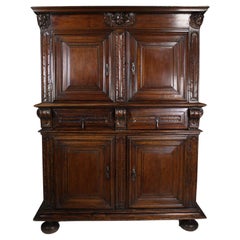
A 17th-18th Century French/Italian Renaissance Walnut Carved Credenza Cabinet
Located in Los Angeles, CA
A 17th-18th Century French/Italian Renaissance Walnut Figural Carved Credenza Cabinet or Cupboard. The two-part cabinet with a pair of upper coffered doors with metal key-hole hardwa...
Category
Antique Late 17th Century Renaissance Cabinets
Materials
Metal
$19,850 Sale Price
43% Off
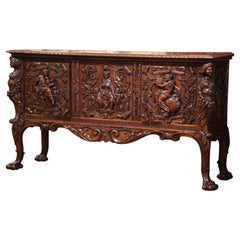
19th Century Italian Renaissance Carved Walnut Credenza with Figures
Paw Feet
Located in Dallas, TX
Bring elegance and artistry to your dining or living room with this richly carved antique sideboard. Crafted in Italy circa 1870, the long antique credenza is built of solid walnut a...
Category
Antique Mid-19th Century Italian Renaissance Credenzas
Materials
Walnut
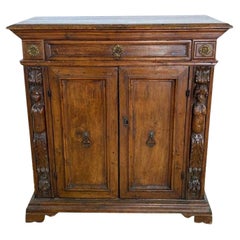
18th Century Italian Carved Walnut Cabinet
Located in Forney, TX
A rare 18th century Italian walnut chest / credenza, Renaissance Period, neoclassical influenced, having two elaborately carved figural statue c...
Category
Antique 18th Century Renaissance Credenzas
Materials
Ormolu
Late 19th Century Renaissance Sideboard Hand-Carved Walnut by G. Scalambrin
Located in Vigonza, Padua
Code: FG33
Antique Renaissance sideboard buffet in two parts late 19th century hand-carved massive walnut by Giuseppe Scalambrin. Six doors with ...
Category
Antique Late 19th Century Italian Renaissance Revival Credenzas
Materials
Walnut
16th Century Italy Ligurian Carved Oak and Chestnut Credenza Bambocci Sideboard
Located in Vigonza, Padua
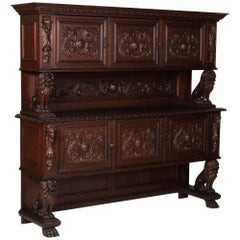
Valuable ancient noble 16th century, Italy Ligurian carved oak and chestnut credenza Bambocci, sideboard with display cabinet.
All original with exception ...
Category
Antique 16th Century Italian Renaissance Credenzas
Materials
Chestnut, Oak
18th Century Carved French Walnut Two-Part Sideboard
Located in Los Angeles, CA
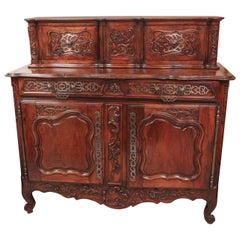
18th century very finely carved French walnut two-part sideboard with original iron hardware.
Category
Antique Early 18th Century French Credenzas
Materials
Iron
More Ways To Browse
19th Century Italian Cupboard
Spanish Carved Cupboard
Pine Cupboard Doors
Dalarna Sweden
Painted Primitive Antiques
Wooden Cupboard
Antique Kitchen Hutches
Old Cupboard
Court Cupboard
Used Wooden Cupboard
Antique Court Cupboard
Antique Manger
17th Century Oak Cupboards
1930 Kitchen Cupboards
Antique French Pine Cupboard
Green Storage Cupboard
Antique Larder
English Housekeepers Cupboard