Items Similar to Late 18th Century German Louis XVI Secretaire with outstanding Marquetry, c 1790
Video Loading
Want more images or videos?
Request additional images or videos from the seller
1 of 21
Late 18th Century German Louis XVI Secretaire with outstanding Marquetry, c 1790
$19,459.53
£14,527.48
€16,400
CA$27,035.17
A$29,080.19
CHF 15,541.30
MX$342,772.62
NOK 195,939.38
SEK 179,125.78
DKK 124,986.41
About the Item
Classicist top-mounted secretary with elaborate marquetry
Southern Germany
Walnut and others
Classicism around 1790
Dimensions: H x W x D: 213 x 115 x 57 cm
Description:
Exceptionally richly marquetry piece of furniture from the German classicism of the late 18th century.
The piece of furniture is dominated by extravagant marquetry. The tapered shape of the legs, which are set in brass sabots, is emphasised by corresponding inlay work. The pilaster strips are inlaid with trompe-l'œil fluting, friezes run above and below the writing compartment and fillet bands are present in incredible abundance.
There are a total of nine large marquetry panels on the front of the cabinet. The oval medallions feature elaborate floral arrangements.
The visual organisation of the chest-like base is not based on the height of the drawers, but is determined by the inlay work, which extends across two of the three sans traverse drawers, regardless of the drawer height. This design decision certainly emphasises the creator's claim to have made the secretary not simply as a piece of furniture, but as an artistic work. This theory is also supported by the omission of handles, which would have disturbed the picture, and even the omission of a lock in the second drawer from the bottom, which can only be opened if the drawer underneath is pulled out a little first.
A landscape of rivers and ruins appears as the central motif in the place described. In keeping with the taste of classicism, ruins were a favourite subject, as they were reminiscent of the great architectural achievements of antiquity and past eras.
However, the main focus is on the marquetry of the cylindrical writing flap. Here, too, we encounter historical architecture: on the left a castle-like complex, on the right a group of half-timbered houses.
In the foreground, on a hill in front of the river, a small group of figures can be recognised. The finely engraved facial features of the figure on the left are clearly recognisable in one of the detailed photos.
The quality of the fire shading, which lends both the architectural scenes and the surrounding flower arrangements a three-dimensional effect, is particularly noteworthy.
The single-door top of the piece of furniture has three high rectangular panels with corner leaves. On the risalike protruding central section, we see a memorial standing on a broad plinth with an urn vase positioned on a fluted column.
An eagle sitting with outstretched wings guards the monument, whose figure surrounded by ripe fruit in the medallion could possibly indicate the person who ordered the piece of furniture.
A shallow drawer, which is opened by a hidden release, is concealed in the cornice above the centrepiece. This secret drawer was probably added during an older restoration.
If we open the cylinder lock, we see a spacious writing and working area with four drawers and three open compartments.
Here, optimally protected from sunlight, the original, very well-preserved green colouring on the framing of the writing surface conveys an impression of the rich colouring in which the entire piece of furniture was once decorated.
The shade of green has also been well preserved on the inside of the top, otherwise the original bright colours of the flowers, the blue of the sky and the colourfulness of the landscapes have gradually faded over the 250 years or so since the piece of furniture was made.
The base of the piece of furniture was made using the classic gallery construction method: The legs serve as supporting posts, into which strong boards are mortised to form the sides and back. If we look at the photo showing the back wall of the piece of furniture, it is noticeable that the lower part consists of a single, wide wooden plank. This is unusual and speaks in favour of the high quality of the material used. Inferior or even scrap wood was not used, as is often the case with back panels, but the best oak wood was used throughout.
Worth knowing:
Originally, the marquetry was certainly all brightly coloured and the colourfulness of the furniture at the time was in stark contrast to its appearance today.
The fact that 18th century marquetry not only consisted of different coloured types of wood, but was often also coloured, is documented in numerous historical recipe books. The so-called peinture en bois, i.e. "wood painting", was a common practice among ebony artists of the time.
The natural ageing process - accelerated by sunlight and environmental influences - caused the colouring agents to fade or disappear completely, meaning that only traces of these colour nuances are still visible on most furniture today.
The colouring techniques involved considerable effort and were closely guarded by cabinetmakers. Walnut served as the common base veneer, maple was coloured: In addition to local plant colours, exotic woods and roots were used to prepare the dye brew. These colouring agents were traded in the colonial goods trade at prices similar to pepper or tea.
It was not until the end of the 18th century that chroniclers began to systematically document the processes for producing and colouring marquetry. By this time, however, contemporary tastes had already changed: The art of marquetry was becoming less important, simpler forms of Classicism and later Empire and Biedermeier were gaining ground in the art centres of Europe. In rural regions, however, the tradition of coloured marquetry lasted even longer.
Both the labour-intensive workmanship and the sometimes costly dyes used made furniture such as the one offered here expensive works of art even then, which only the nobility, high-ranking servants of the church or the very upper middle classes could afford.
Condition:
Restored and authentic condition suitable for everyday use with a beautiful age patina.
Similarly elaborate marquetry is known from the Franco-German border region. Please refer to the following literature:
Kreisel / Himmelheber - Die Kunst des deutschen Möbels - Band III - Klassizismus - Historismus - Jugendstil Fig. 169 and following
and:
Françoise Lévy-Coblentz - L’art du meuble en Alsace au siècle des Lumières P. 330 Fig. CXL
Work of this kind is also known from the greater Augsburg area:
Christoph Graf von Pfeil - Die Möbel der Residenz Ansbach from. S. 276
You can find out more about wood colouring in the following specialist book:
Stefan Baumeier - Feine Möbel aus Westfalen from p. 101
- Dimensions:Height: 83.86 in (213 cm)Width: 45.28 in (115 cm)Depth: 22.45 in (57 cm)
- Style:Louis XVI (Of the Period)
- Materials and Techniques:
- Place of Origin:
- Period:
- Date of Manufacture:1790
- Condition:Refinished. Wear consistent with age and use. Restored and authentic condition suitable for everyday use with a beautiful age patina.
- Seller Location:Greven, DE
- Reference Number:1stDibs: LU5419248336862
About the Seller
5.0
Platinum Seller
Premium sellers with a 4.7+ rating and 24-hour response times
Established in 2014
1stDibs seller since 2020
219 sales on 1stDibs
Typical response time: 1 hour
- ShippingRetrieving quote...Shipping from: Münster, Germany
- Return Policy
More From This Seller
View AllLate 18th Century Dutch Louis XVI Secretary With Impressive Marquetry
Located in Greven, DE
18th Century Louis XVI Secretary With Marquetry
The Netherlands
Amaranth, satinwood and others
Louis XVI around 1790
Dimensions: H x W x D: 149 x 89 x 46 cm
Description:
Elaborate...
Category
Antique Late 18th Century Dutch Louis XVI Secretaires
Materials
Satinwood
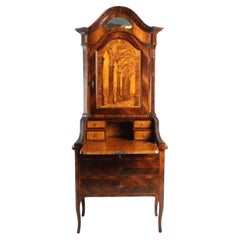
Late 18th Century Secretaire with Architectural Marquetry, Italy, circa 1770
Located in Greven, DE
Antique top secretary
Italy
various precious woods
second half 18th century
Dimensions: H x W x D: 219 x 89 x 50 cm
Description:
Slender and well-proportioned secretary with architectural marquetry.
Two-piece piece of furniture standing on slightly curved stud feet.
The three lower drawers are veneered diagonally and mirrored starting...
Category
Antique 18th Century Italian Secretaires
Materials
Wood
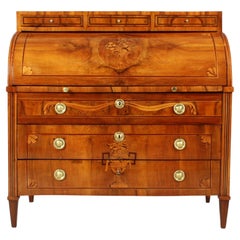
Late 18th Century German Louis XVI Secretary, Walnut, Marquetry, Cylinder Desk
Located in Greven, DE
Louis XVI cylinder desk with marquetry
Germany (Westphalia)
Walnut etc.
Classicism around 1795
Dimensions: H x W x D: 118 x 116 x 62 cm
Description:
Beautiful writing fur...
Category
Antique Late 18th Century German Louis XVI Secretaires
Materials
Maple, Oak, Walnut
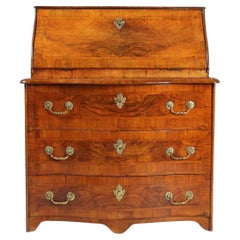
Small Swiss Louis XV Secretaire, Walnut, Writing Chest, circa 1760
Located in Greven, DE
SmallLouis XV or Baroque Secretary
Switzerland (Bern)
Walnut
Baroque around 1760.
Dimensions: H x W x D: 109 x 93 x 60 cm
Description:
Writing furniture standing on a ...
Category
Antique Mid-18th Century Swiss Louis XV Secretaires
Materials
Walnut
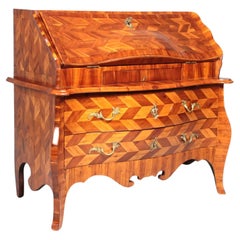
18th Century Swiss Made Secretaire
Located in Greven, DE
Antique secretary or chest of drawers
Switzerland
Yew, oak
second half of 18th century
Dimensions: H x W x D: 105 x 116 x 61 cm
Description:
Antique sloping flap chest of drawers ...
Category
Antique Mid-18th Century Swiss Baroque Secretaires
Materials
Oak, Yew
Late 18th Century German Louis XVI Top Mounted Chest with Marquetry, circa 1780
Located in Greven, DE
Louis XVI top-mounted furniture in patina condition
Germany (Saxony)
Satinwood, mahogany and others
Louis XVI around 1780
Dimensions: H x W x D: 203 x 124 x 63 cm
Description:
Che...
Category
Antique 1780s German Louis XVI Buffets
Materials
Wood
You May Also Like
Very Fine 19th Century French Louis XVI Marquetry Secretaire Abattant by Diehl.
By Charles-Guillaume Diehl
Located in Dallas, TX
A very fine 19th century Louis XVI marquetry inlay secretaire A Abattant by Charles Diehl. Kingwood, satinwood and tulipwood inlay with fine gilt bronze ...
Category
Antique Late 19th Century French Louis XVI Secretaires
Materials
Bronze
18th Century, French Louis XVI Inlaid Wood Secretaire with Marble Top
Located in IT
18th century, French Louis XVI inlaid wood secretaire with marble top and gilt bronzes.
This elegant secretaire Louis XVI was made in F...
Category
Antique Late 18th Century French Louis XVI Secretaires
Materials
Bronze
Louis XVI Cabinet with Secretaire, South Germany 1780
Located in Belmont, MA
Exquisite Louis XVI Secretary Cabinet, South Germany, 1780
This remarkable Louis XVI Secretary Cabinet, crafted in South Germany around 1780, showcases a sophisticated blend of waln...
Category
Antique 1780s Louis XVI Cabinets
Materials
Cherry, Walnut
Large Secretaire With Flap In Marquetry, Late 19th Century
By Jean-François Oeben
Located in MARSEILLE, FR
Massive secretaire with flap in marquetry of cubes on the doors and sides and bronzes (partly gilded): the flap covered with leather inside opens on...
Category
Antique 19th Century French Louis XVI Secretaires
Materials
Bronze
French 18th Century Large Louis XVI Marquetry Desk or Bureau à Cylindre
By Jean Kisling
Located in Berlin, DE
French 18th century large Louis XVI marquetry desk or bureau à Cylindre
An exceptional marquetry secrétaire in the form of a bureau with a cylinder front and on a stand with four ...
Category
Antique Late 18th Century French Louis XVI Secretaires
Materials
Bronze
Fine Antique French Louis XV Marquetry Rosewood Ormolu Secretaire Abattant 1880
Located in Portland, OR
A very fine quality antique French Louis XV rosewood, marquetry, ormolu and marble topped secretaire abattant, circa 1880.
The serpentine shaped secretary is modeled as a semainier (...
Category
Antique 1880s French Louis XV Secretaires
Materials
Marble, Ormolu