1 of 9
William IV Secretaire Cabinet in Rosewood
$4,530.71List Price
About the Item
- Dimensions:Height: 36 in (91.44 cm)Width: 27.25 in (69.22 cm)Depth: 17 in (43.18 cm)
- Style:William IV (Of the Period)
- Materials and Techniques:
- Place of Origin:
- Period:1730-1739
- Date of Manufacture:circa 1830
- Condition:Wear consistent with age and use.
- Seller Location:Whaley Bridge, GB
- Reference Number:Seller: sn46991stDibs: LU2273327816092
Authenticity Guarantee
In the unlikely event there’s an issue with an item’s authenticity, contact us within 1 year for a full refund. DetailsMoney-Back Guarantee
If your item is not as described, is damaged in transit, or does not arrive, contact us within 7 days for a full refund. Details24-Hour Cancellation
You have a 24-hour grace period in which to reconsider your purchase, with no questions asked.Vetted Professional Sellers
Our world-class sellers must adhere to strict standards for service and quality, maintaining the integrity of our listings.Price-Match Guarantee
If you find that a seller listed the same item for a lower price elsewhere, we’ll match it.Trusted Global Delivery
Our best-in-class carrier network provides specialized shipping options worldwide, including custom delivery.You May Also Like
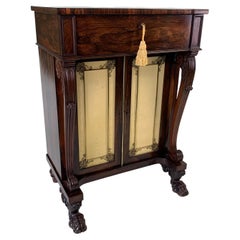
Regency Rosewood Secretaire Side Cabinet/Chiffoneer
Located in Folkestone, GB
A superior quality and unusual Regency rosewood Side Cabinet, the top drawer with fold-down, leather-lined front, fully fitted with drawers and pigeon holes. below are a pair of silk...
Category
Antique Early 19th Century English Regency Cabinets
Materials
Rosewood
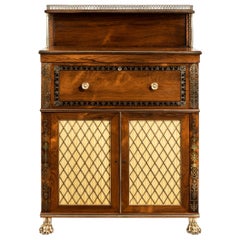
Regency Brass-Inlaid Rosewood Secretaire Cabinet
Located in Lymington, Hampshire
A Regency brass-inlaid rosewood secretaire cabinet, the rectangular top with a pierced galleried shelf with trellis work on the sides, above a secretaire drawer, banded with brass pa...
Category
Antique 1810s English Regency Cabinets
Materials
Brass
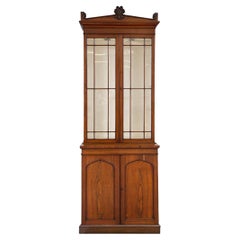
William IV Rosewood Cabinet
Located in Essex, MA
With removable triangular cornice with Greek inspired carved decoration over a pair of glazed doors enclosing glass shelves with silk lined interior with two professional mounted rec...
Category
Antique 1830s English William IV Cabinets
Materials
Glass, Rosewood
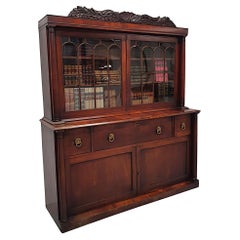
A Rare and Fine Early 19th Century William IV Irish Secretaire Bookcase
Located in Dublin, IE
A rare and fine early 19th Century William IV Irish flame mahogany secretaire bookcase, beautifully hand carved with a rich patina. The pediment with a stunning centred scallop shel...
Category
Antique Early 19th Century Irish Bookcases
Materials
Glass, Mahogany
$14,892
H 84.5 in W 72.75 in D 22.5 in
English Regency Rosewood Secretaire
Located in Queens, NY
English Regency rosewood secretaire cabinet with two upper shelves supported by a lyre form over a secretaire drawer fitted with a leather wri...
Category
Antique Mid-19th Century English Regency Secretaires
Materials
Rosewood
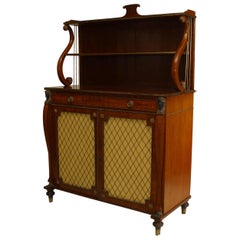
Tall Corner Cabinet/Secretaire in Mahogany, 1840s
Located in Lejre, DK
The tall corner cabinet/secretary in mahogany, in beautiful antique condition from the 1840s, is an impressive piece of furniture that exudes timel...
Category
Antique 1840s Danish Other Corner Cupboards
Materials
Mahogany
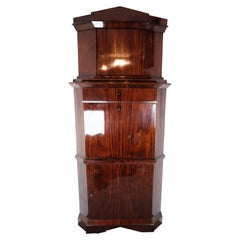
Midcentury Danish Rosewood Secrétaire, 1960s
Located in Breda, Netherlands
Easy does it: a writing desk when you want it to be one! This writing desk has it all is made in rosewood veneer and has a pull out desk. Could beauty up your living room and transform into a working...
Category
Vintage 1960s Danish Mid-Century Modern Commodes and Chests of Drawers
Materials
Rosewood
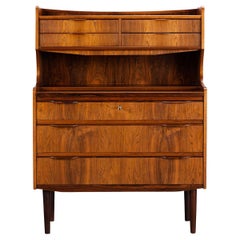
William IV Rosewood Breakfront Side Cabinet
Located in Lymington, Hampshire
A William IV rosewood breakfront side cabinet, with a later dark grey marble top above four doors each enclosing a shelf and re-lined in pleate...
Category
Antique 1830s English William IV Sideboards
Materials
Rosewood
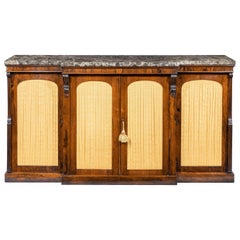
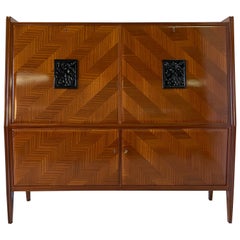
Italian Mahogany Secretaire Cabinet, 1950s
Located in Meda, MB
Precious cabinet secretaire produced in Italy in the 1950s,
The whole cabinet is veneered in mahogany with a fine solid wood carving in the center of the two doors representing two b...
Category
Vintage 1950s Italian Mid-Century Modern Cabinets
Materials
Mahogany, Maple
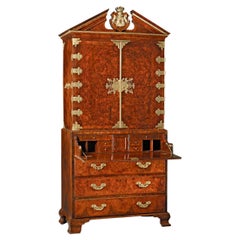
King George I Ambassadorial Secrétaire-Cabinet
Located in New Orleans, LA
This highly important secrétaire-cabinet was crafted for and specially ordered by King George I for the British Ambassador to Russia. From its craftsmanship and materials to its exceptional artistry, it is a work of royal and historic significance that exudes power in each and every detail. The broken pediment at its apex features the simplified royal coat of arms bearing the king’s crown, while the interior is adorned by portraits of the British Royal Family. Placed within the ambassador’s St. Petersburg home, this entirely unique piece of furniture would have been a potent reminder of England's grandeur and political importance.
Relations between England and Russia during this period were at an all-time high. Peter the Great had traveled to England in 1698 as part of his widely known “Grand Embassy” tour, wherein he attempted to gain foreign support against the Ottoman Empire. He spent a period of nearly four months there, meeting with King William III and his court on numerous occasions. Noted academic Arthur MacGregor wrote concerning the impact of the trip, “For two decades following Peter's visit, British influence in Russia reached a peak. It manifested itself in social custom, in craft practice and in ships and naval organization... it reached a significant sector of the population before relations cooled once again and the two nations pulled back from this era of unprecedented cordiality.”
First and foremost, however, it is a reminder of British might and influence. By the reign of King George I, England had come into its own as a world power. Unique in its design, this cabinet is a reflection of the country’s might. It is crafted from the highest-quality solid walnut and burr walnut adorned by gilded lock plates and engraved hinges. The presence of ormolu at its apex and lining the doors was a rarity for this period, and its addition makes manifest the importance of the design.
The outer doors open to reveal multiple interiors, including fifteen separate drawers around a central cupboard; the cupboard doors each bear mezzotint portraits of George I and his father, Ernest Augustus, Elector of Hanover. An etching after the portrait of George I dating to circa 1716 is in London’s Royal Academy. A second, inner pair of doors are adorned by mezzotints of the Prince and Princess of Wales (later Queen Caroline and George II), which are both after portraits by Sir Godfrey Kneller dated 1716 in the Royal Collection. A final portrait is revealed on the very interior of the cabinet, where a mezzotint of Frederick, Anne, Amelia and Caroline, children of the Prince of Wales, resides. An etching (circa 1715-1720) after this portrait can be found in the National Portrait Gallery (London).
Apart from its abundance of royal portraiture, the cabinet features stunning painted decoration, including floral designs as well as clouds, birds and trees in a bucolic motif reminiscent of Eden. Its lower portion is a study in both form and function, featuring a fitted secrétaire-drawer above three additional drawers for storage. The cabinet appears in The Shorter Dictionary of English Furniture by R. Edwards from 1964, a text that is regarded as the bible of British furniture design. Edwards describes it as a “writing cabinet...given by George I to the British Ambassador at the Russian court.”
The cabinet was likely made for the 18th-century German diplomat and writer Friedrich Christian Weber, who represented English interests at the Russian court from 1714 until 1719. Although Weber’s tenure as ambassador was relatively short, while in St. Petersburg, he authored his account entitled Das veraenderte Russland (The Present State of Russia), which was published in three volumes in 1721, 1739 and 1740. It may, however, also have been made for George Douglas, 2nd Earl of Dumbarton, who served as ambassador alongside Weber in 1716. Diplomatic relations ceased between the two countries in 1721.
In 1928, the cabinet appeared for sale at the International Exhibition of Antiques & Works of Art in Olympia. It had previously been in the collection of the Woltner family of Bordeaux, the celebrated vintners who owned the estate Château Laville Haut-Brion and produced wine of the same name. According to the family, Monsieur Woltner was given the cabinet as a gift from an aunt who lived in Russia for many years. After leaving the Woltner collection, the cabinet was acquired by William Berry...
Category
Antique 18th Century English Georgian Secretaires
Materials
Brass
Still Thinking About These?
All Recently ViewedMore Ways To Browse
William Iv Rosewood
Chiffonier Secretaire
Antique Painted Secretary
Early 20th Century Secretary Desk
19th Century Marble Top Secretaire
Antique German Secretaire
Antique Secretaire Chest
Mid Century Drop Down Desk
Swedish Secretary
Lacquered Secretary
18th Century Walnut Bureau
Antique French Secretary Desk
Drop Front Secretary Desk
Antique Oak Bureau
Oak Antique Secretary
Vintage Secretaries
Biedermeier Secretary
Secretary Bureau