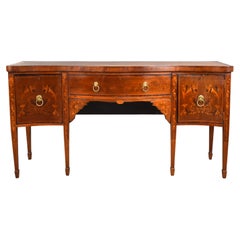
Items Similar to George III Period Inlaid Mahogany Serpentine Sideboard, English ca. 1790

Want more images or videos?
Request additional images or videos from the seller
1 of 21
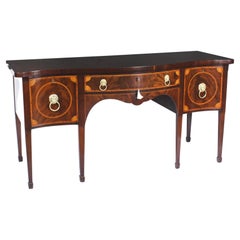
George III Period Inlaid Mahogany Serpentine Sideboard, English ca. 1790
$10,800
£8,206.14
€9,468.34
CA$15,314.73
A$16,505.43
CHF 8,824.98
MX$196,228.28
NOK 110,954.19
SEK 101,405.71
DKK 70,748.75
About the Item
A FINE GEORGE III SATINWOOD-INLAID SERPENTINE SIDEBOARD
London, circa 1790-1810
34 1/2" H x 75 1/8" W x 29 3/4" D
A very good George III period Cuban mahogany sideboard, the serpentine top with flared turret corners and an exaggerated projection over the conforming case, this fitted with a central silverware drawer lined in brown felt flanked by two full-height drawers on either side. The right features a deep cellarette lined in metal and divided into six compartments, the left lined in brown felt for storing larger silver serving pieces. It retains the original octagonal stamped brass pulls and escutcheons. The right side features a tiny door that gives access to a side storage space. The case is raised on square tapered legs terminating in spade feet, each outlined with delicate line inlay emphasizing the clean geometry of form.
The piece displays the balance and restrained ornament typical of late 18th-century English cabinetmaking, where fine veneers and proportion replaced earlier rococo exuberance. The old silky French polish is delightfully worn and mellowed throughout to create a warm translucent amber hue.
Condition: A nicely mellowed and gently worn historical surface with good color throughout. Front legs both with repaired cracks and added blocking behind. Appears to retain original brasses; one working key. Felt lining is 20th century with discolorations as expected. Veneer replacements around the edge of the top in several areas. Discolorations and blemishes consistent with age and use.
ref. 509MJX12S
About silla antiques
art
Established in 2009, we have available in our 9000 square foot brick-and-mortar gallery an ever-changing selection of carefully curated and catalogued furniture, decorative arts, paintings, sculpture and estate jewelry. Our company has long specialized in sculpture circa 1860 through 1930 and as such the gallery always has a very large collection of exceptional European and American sculpture available on display.
The gallery is located at 117 W Burd Street in Shippensburg, Pennsylvania and is open by appointment only. We welcome your visit and would love to meet with you at the shop. For clients located outside of the area, we are always available to discuss items by video conferencing or by phone.
- Dimensions:Height: 34.5 in (87.63 cm)Width: 75.13 in (190.84 cm)Depth: 29.75 in (75.57 cm)
- Style:George III (Of the Period)
- Materials and Techniques:
- Place of Origin:
- Period:
- Date of Manufacture:1790
- Condition:Repaired: Front legs repaired, various veneer patches, scuffing and historical surface as expected. See condition notes.
- Seller Location:Shippensburg, PA
- Reference Number:Seller: 509MJX12S1stDibs: LU1059047657752
About the Seller
4.9
Recognized Seller
These prestigious sellers are industry leaders and represent the highest echelon for item quality and design.
Platinum Seller
Premium sellers with a 4.7+ rating and 24-hour response times
Established in 2009
1stDibs seller since 2014
524 sales on 1stDibs
Typical response time: 1 hour
- ShippingRetrieving quote...Shipping from: Shippensburg, PA
- Return Policy
More From This Seller
View AllFine English George III Antique Mahogany Secretary Desk circa 1780
Located in Shippensburg, PA
Of exceedingly good quality, this fine George III secretaire features a molded cornice projecting over glazed doors, each composed of sixteen individual panes of glass divided by int...
Category
Antique 18th Century English George III Secretaires
Materials
Brass
English George III Mahogany Secretary Desk with Bookcase circa 1780
Located in Shippensburg, PA
GEORGE III MAHOGANY SECRETARY DESK WITH GLAZED UPPER BOOKCASE
England, circa 1780 formerly with Ginsburg
Levy
Item # 401HYF25Q
A rich and vibrant secretary desk from the late...
Category
Antique 18th Century English George III Bookcases
Materials
Bronze
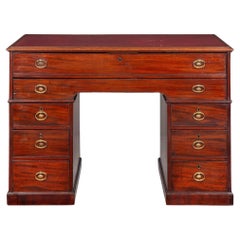
George III Mahogany Architect’s Desk attr. Gillows of Lancaster circa 1790
Located in Shippensburg, PA
GEORGE III MAHOGANY ARCHITECT'S DESK IN MANNER OF GILLOWS OF LANCASTER
England, circa 1790 with alphabetized rent drawers interior unmarked
Item # 405KYH28Z
This remarkable architect's pedestal desk was almost certainly crafted by Gillows of Lancaster, London circa 1790. It features a rectangular top inlaid with maroon gilt-tooled leather bordered by a molded edge. Below this is situated a full-width frieze drawer which is decorated to appear as two false drawers over pedestals containing three graduated drawers on either side of an open kneehole. The desk stands on a molded plinth base fitted with casters.
The top drawer reveals a sliding gilt-tooled leather writing surface with a central panel that can be lifted on ratchet supports to hold and display documents. This surface slides back to uncover a lower compartment with an open storage area, flanked by three lidded compartments labeled alphabetically within oval reserves. The back of the desk is designed for a tidy appearance, making it suitable for placement in the center of a room, featuring two full-width faux drawers above faux cabinet doors in the pedestals.
While the present example is not marked by Gillows, it is almost without question a product of their workshops and is firmly attributed to their design books. The alphabet inlaid drawers were inspired by designs popularized by Thomas Shearer’s The Cabinet Maker’s London Book of Prices (1788-1803). These were employed in designs published by Gillows, such as the 'bureau writing-table' with a double-ratcheted top made for the Earl of Shrewsbury in 1789 and a writing-table from 1794 (see Gillow Furniture Designs 1760-1800, L. Boynton, ed., 1995, pl. 24 and 41). A similar design appears in the firm’s 1798 Estimate Sketch Book (p.1481), preserved in the Westminster City Library. The drawer design is further seen on pedestal desks stamped by Gillows, including the library table provided by the firm in 1778 to Denton Hall (see C. Gilbert, The Life and Works of Thomas Chippendale, London, 1978, vol.II, p.246, pl.449).
Gillows produced many variations of this desk style, including those with ratcheting tops for standing use, enclosed kneehole designs, various types of pulls, and subtle dimensional adjustments. Examples can be seen well into the George IV period and the influence of this form on later desks by Gillows can be seen as the tastes changed into the second half of the nineteenth century.
Sir Walter Scott acquired a similar desk from Gillows for his Edinburgh house in Castle Street in 1810, later moving it to his study at Abbotsford in 1826. In a letter to J.B. Morritt of Rokeby Hall, Yorkshire, dated May 1810, Scott wrote: ‘You know I fell in love with your Library table and now the The Lady [The Lady of the Lake] has put crowns into my purse I would willingly treat myself unto the like...’ On 9 August, Scott wrote again to Morritt: 'I must not omit to tell you that Gillows table has arrived and gives great satisfaction. Everyone that sees it likes it so much I dare say I shall have some commissions to send him. His bill did not much exceed yours being about £30 ready money’. The Gillow archives from 1810 record: ‘pack for W.Scott Esq., Castle Street, Edinburgh, case containing mahogany bureau writing table Double Elevating tops cupboard in center complete writing drawers’. (See C. Wainwright, The Romantic Interior, Fig 162 & 163).
A few open-market examples of nearly identical desks...
Category
Antique 18th Century English George III Desks and Writing Tables
Materials
Leather, Mahogany
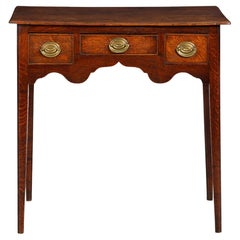
Circa 1780 English George III Patinated Oak Antique Writing Table
Located in Shippensburg, PA
GEORGE III PROVINCIAL PATINATED OAK THREE-DRAWER WRITING TABLE
England, circa 1780 with scrolled cupid's bow apron
Item # 312EKH07Q
A beautifully patinated writing table from the George III period, this intelligently conceived and finely proportioned table features a rectilinear top with an integral coved-bead edge projecting over three drawers, these each hand-dovetailed with applied cockbead molding surrounding ovular bail pulls. The shaped apron features a cupid's bow in the center of all three sides and the table is raised over straight tapering legs. It is a positively glowing table...
Category
Antique 18th Century English George III Desks and Writing Tables
Materials
Oak
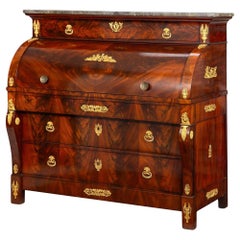
French Restauration Antique Mahogany Cylinder Roll-Top Desk circa 1830
Located in Shippensburg, PA
FINE RESTAURATION PERIOD ORMOLU-MOUNTED FLAMED MAHOGANY BUREAU À CYLINDER
France, circa 1830
Item # 403ZGP18C
An exceedingly fine bureau à cylinder from the Restauration period in F...
Category
Antique 19th Century English Empire Desks
Materials
Marble, Brass, Ormolu
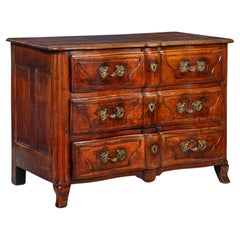
French Regencé Antique Walnut Commode Chest of Drawers ca. 1750
Located in Shippensburg, PA
REGENCÉ PERIOD WALNUT COMMODE WITH BIRD-FORM PULLS
France, circa 1750
Item # 010PXZ21Q-2
A fabulous French commode of the Regencé period, this substantial chest of drawers has been ...
Category
Antique 18th Century French Regency Commodes and Chests of Drawers
Materials
Brass
You May Also Like
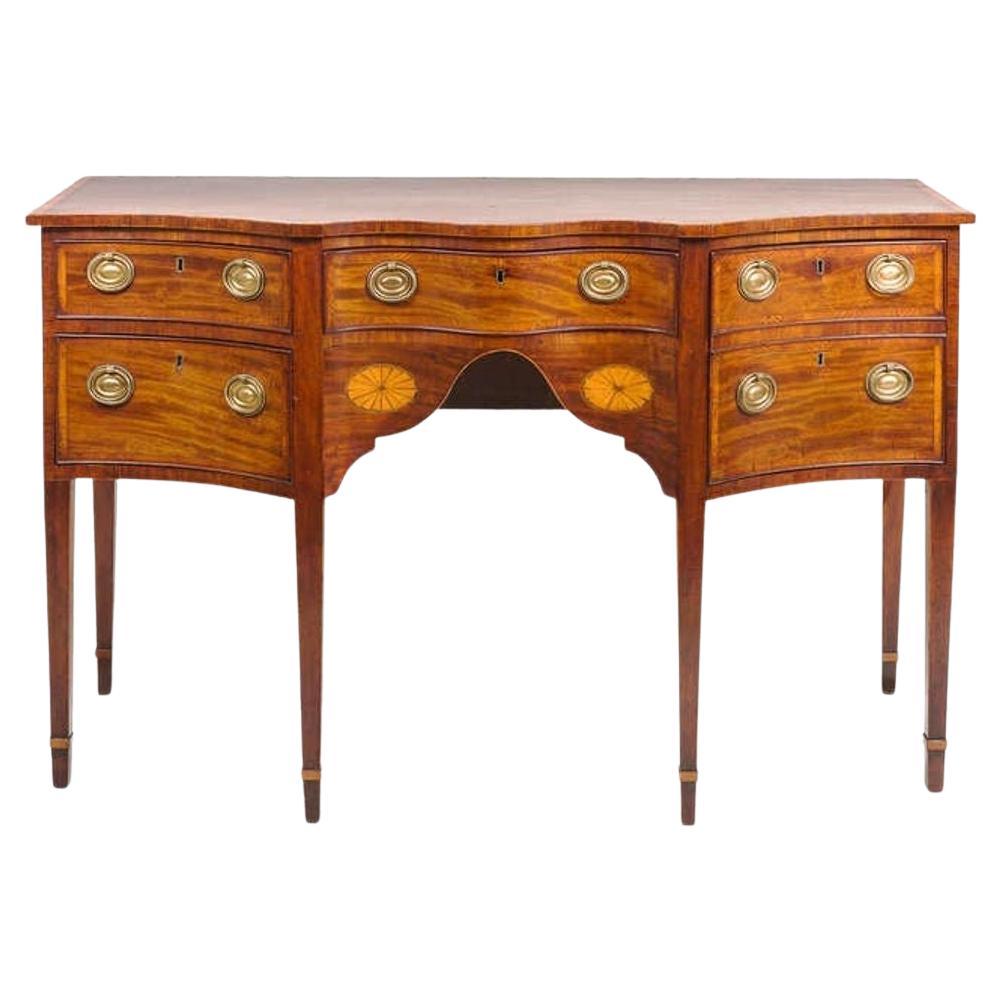
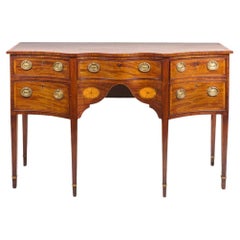
18th Century English Serpentine Inlaid Sideboard
Located in Long Island City, NY
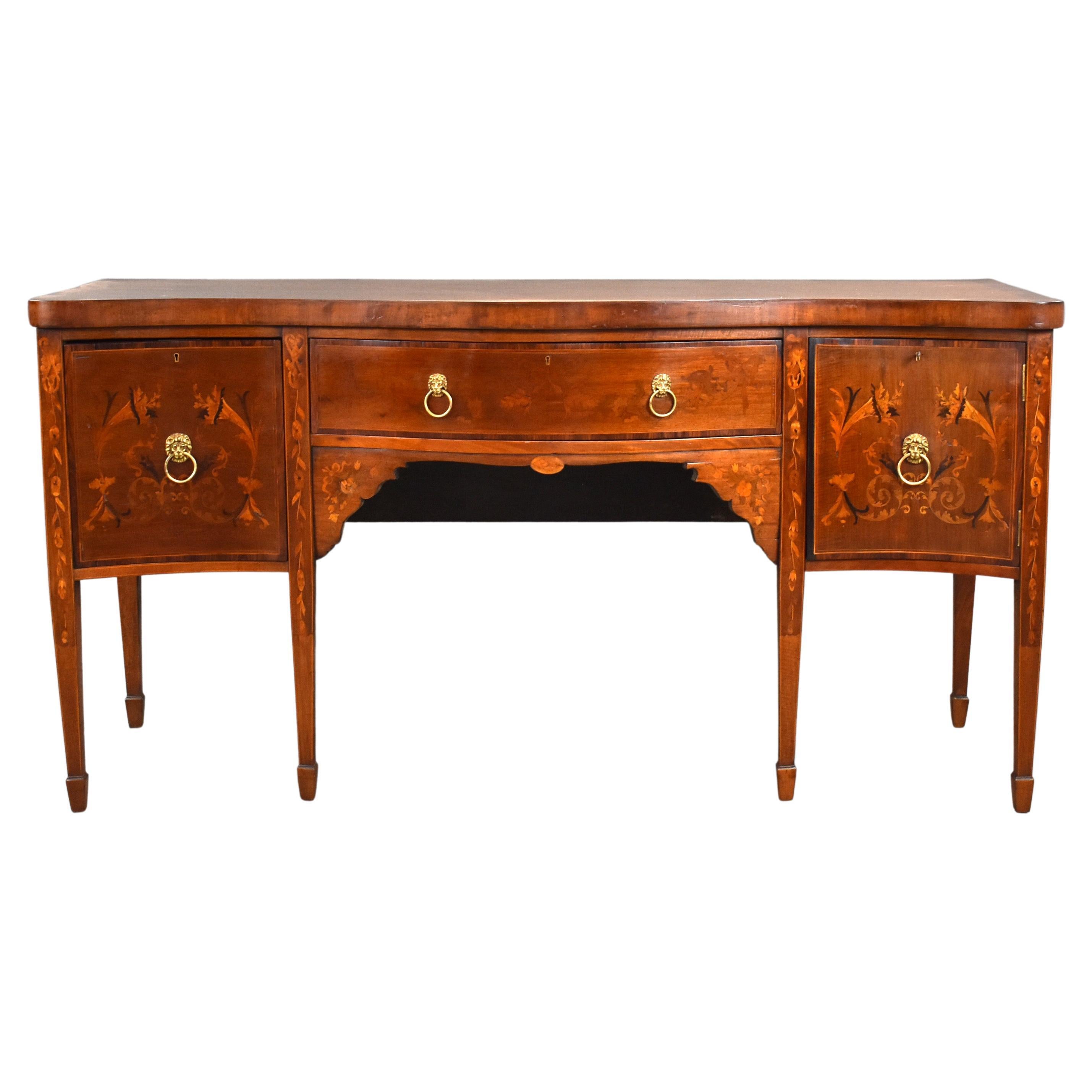
18th century English Sheraton walnut sideboard with inlay.
Category
Antique 1790s English George III Sideboards
Materials
Brass
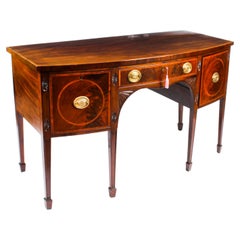
Antique George III Inlaid Flame Mahogany Sideboard, 18th Century
Located in London, GB
This is a superb antique George III inlaid flame mahogany bowfront sideboard, circa 1780 in date.
The top is banded in satinwood and...
Category
Antique 1780s English George III Sideboards
Materials
Mahogany
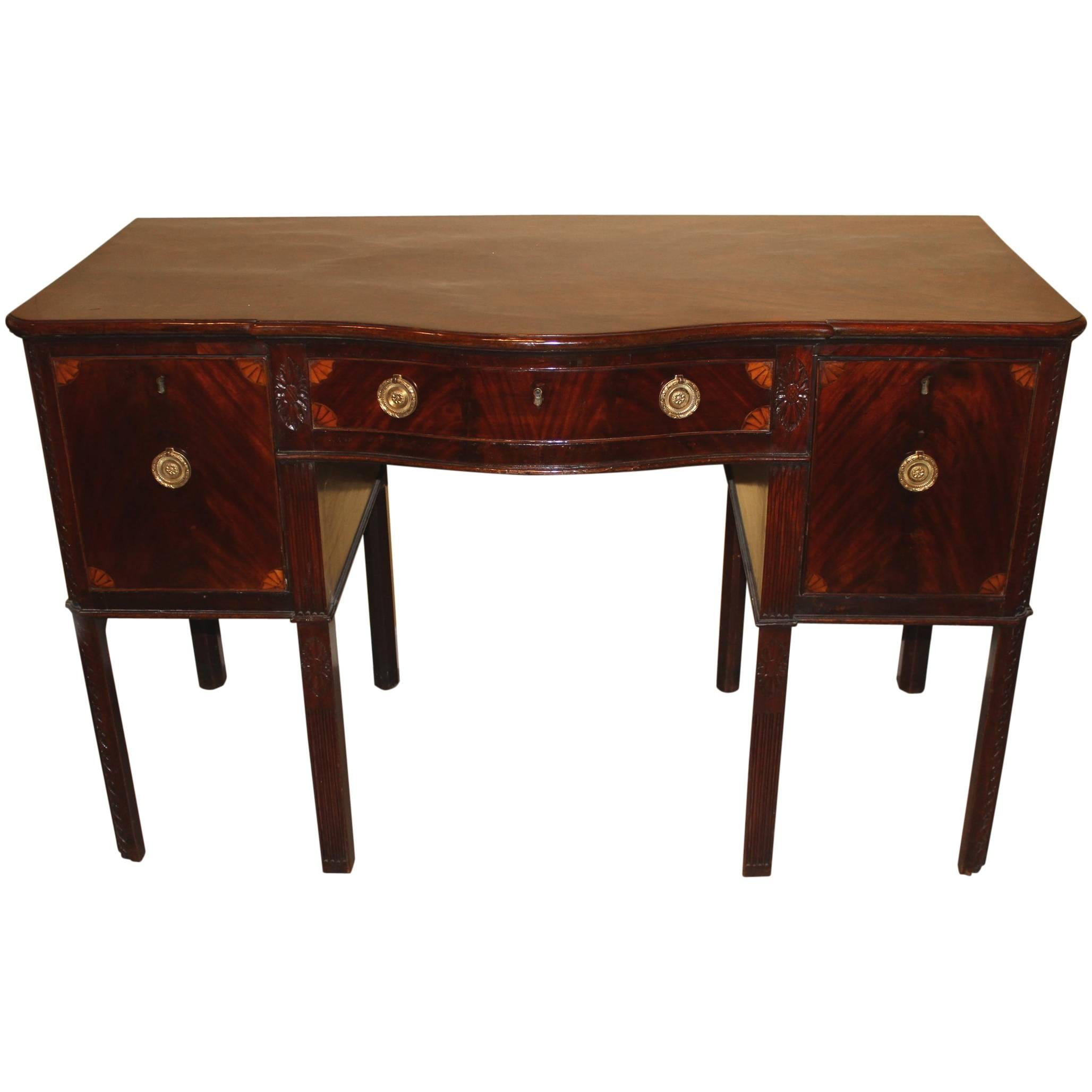
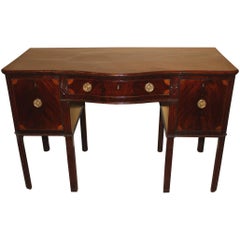
George III English Mahogany Serpentine Sideboard with Quarter Fan Inlay
Located in Milford, NH
A beautiful George III English crotched mahogany sideboard with conforming French polished molded edge top over a serpentine shaped case with...
Category
Antique Late 18th Century English George III Sideboards
Materials
Mahogany, Satinwood
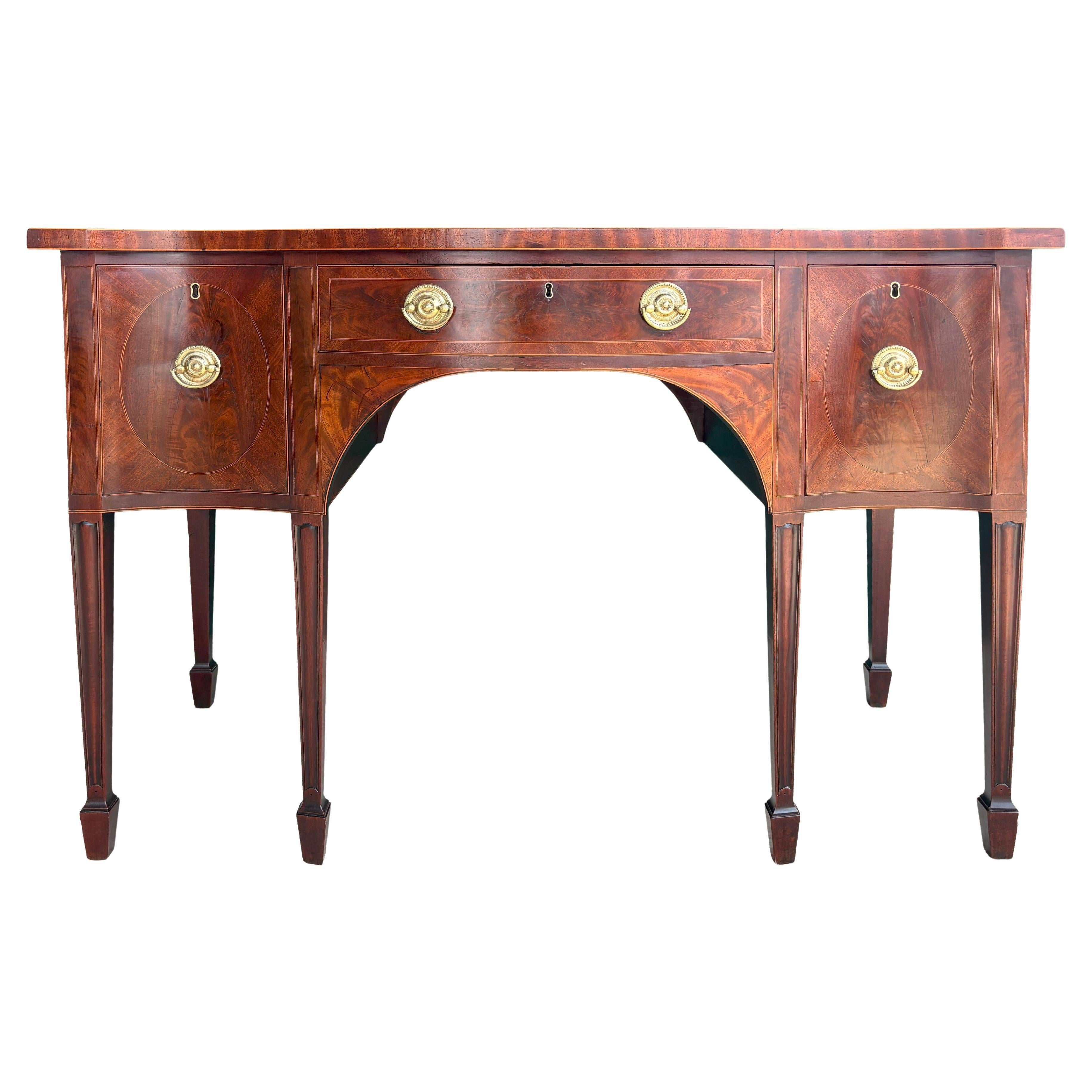
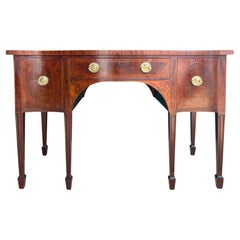
George III Mahogany Serpentine Sideboard
Located in Essex, MA
A nice model in great condition. Serpentine top over conforming long cutlery drawer flanked by two deep drawers. Square tapered legs with spade feet. Round brasses
Category
Antique 1790s English George III Sideboards
Materials
Brass
Antique George III Flame Mahogany Serpentine Sideboard, 18th Century
Located in London, GB
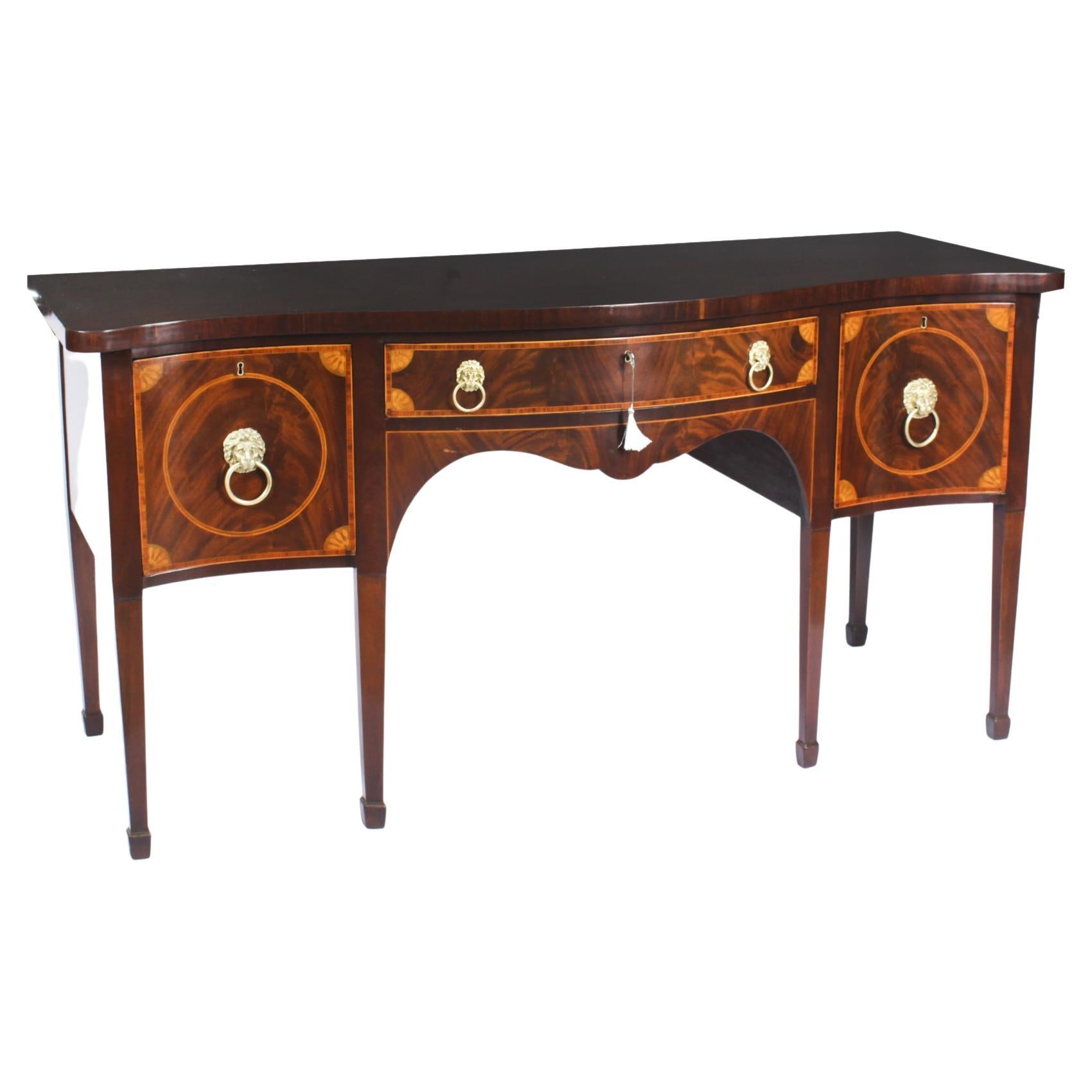
This is a superb antique George III inlaid flame mahogany serpentine sideboard, circa 1790 in date.
With wood banding and marquetry spandrels, the central frieze drawer flanked by deep drawers, the right side drawer with divisions for bottles. The drawers fitted with the original and beautiful ormolu lion's head ring handles.
It is raised on elegant square tapering legs on spade feet and is complete with working locks and key.
Add an elegant touch to a special place in your home with this superb antique serpentine shaped sideboard.
The botanical name for the mahogany this item is made of is Swietenia macrophylla and this type of mahogany is not subject to CITES regulation.
Provenance:
Major Edward Croft-Murray, Perivale, Ryde, Isle of Wight.
From the collection of Edward Croft-Murray CBE (1907-1980).
THE BOTANICAL NAME FOR THE MAHOGANY THAT THIS ITEM IS MADE OF IS SWIETENIA MACROPHYLLA AND THIS TYPE OF MAHOGANY IS NOT SUBJECT TO CITES REGULATION AND DOES NOT CONTAIN ANY RESTRICTED MATERIALS.
Condition:
In excellent condition having been beautifully cleaned, polished and waxed in our workshops, please see photos for confirmation.
Dimensions in cm:
Height 93 x Width 183 x Depth 74
Dimensions in inches:
Height 3 feet, 1 inch x Width 6 foot x Depth 2 foot, 5 inches
Flame Mahogany
Thomas Sheraton - 18th century Furniture designer, once characterized mahogany as "best suited to furniture where strength is demanded as well as a wood that works...
Category
Antique 1790s English George III Sideboards
Materials
Mahogany
20th Century English Edwardian Mahogany Inlaid Serpentine Sideboard
Located in Chelmsford, Essex
For sale is an Edwardian mahogany inlaid serpentine sideboard, remaining in very good condition, showing minor signs of wear commensurate with age and use.
Measures: width: 183cm,...
Category
Early 20th Century English George III Sideboards
Materials
Mahogany