Renaissance Case Pieces and Storage Cabinets

RENAISSANCE STYLE

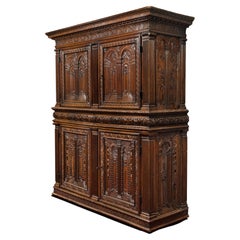
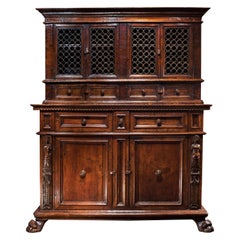
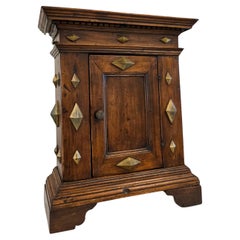
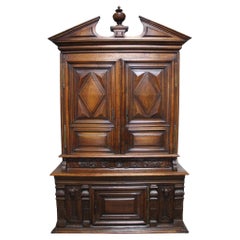
Spanning an era of cultural rebirth in Europe that harkened back to antiquity, the Renaissance was a time of change in design. From the late 1400s to the early 1600s, Rome, Venice and Florence emerged as artistic centers through the expansion of global trade and a humanist belief in the arts being central to society. Antique Renaissance furniture was ornately carved from sturdy woods like walnut, its details standing out against the tapestries and stained glass adorning the walls.

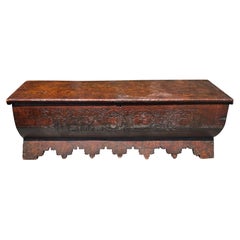
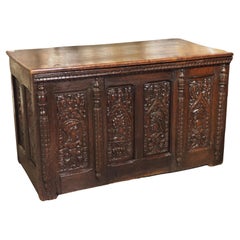
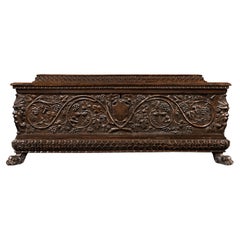
Renaissance chests, which were frequently commissioned for marriages, were often decorated with gilding or painted elements. Those that were known as cassoni were crafted in shapes based on classical sarcophagi. As opposed to the medieval era, when furniture was pared down to the necessities, a wide range of Renaissance chairs, tables and cabinets were created for the home, and the designs regularly referenced ancient Rome.

Large torchères of the Renaissance era that were used as floor lamps were inspired by classical candelabras, while marble surfaces evoked frescoes. The inlaid boxes being imported from the Middle East informed the intarsia technique, which involved varying hues of wood in mosaic-like patterns, such as those by architect Giuliano da Maiano in the Florence Cathedral.

Tapestry-woven cushion covers accented the variety of Renaissance seating — from conversation to study chairs — while bookcases for secular use reflected the migration of culture and knowledge from the church into the home. The aesthetics of the Italian Renaissance later spread to France through the publishing of work by renowned designers, including Hugues Sambin and Jacques Androuet du Cerceau. Centuries later, the 19th-century Renaissance Revival would see a return to this influential style.

Find a collection of antique Renaissance case pieces, decorative objects and other furniture on 1stDibs.

to
37
Height
to
Width
to
Depth
to
140
67
213
818
559
473
339
197
141
48
31
20
15
12
9
4
4
102
52
26
13
6
27
2
2
1
2
12
10
208
106
50
36
15
200
80
45
25
15
213
213
213
Style: Renaissance
Period: 18th Century and Earlier
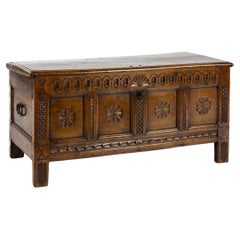
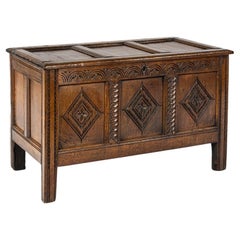
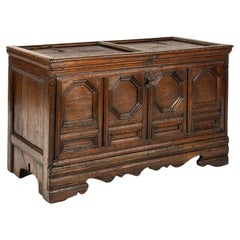
Antique late 17th century English honey color chest or trunk with rich carvings
Located in Casteren, NL
This antique oak chest, dating from the early 17th century, is a remarkable example of early European craftsmanship, combining strength with refined decorative detail. Made entirely ...
Category

Late 17th Century Antique Renaissance Case Pieces and Storage Cabinets

Materials

Oak

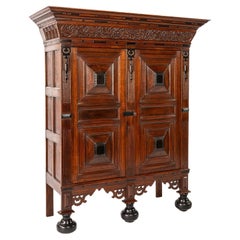
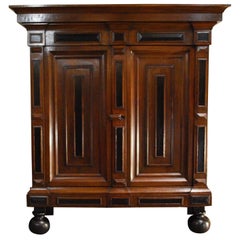
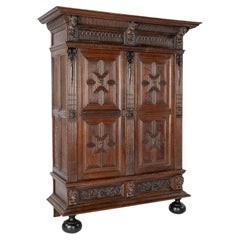
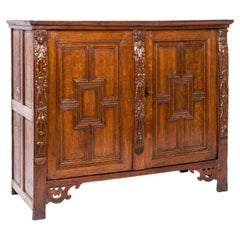
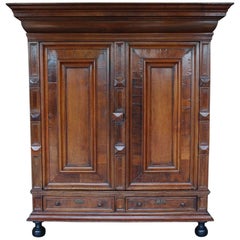
Antique mid 18th century Dutch Renaissance two door warm oak cabinet or Kussenka
Located in Casteren, NL
This impressive Dutch Renaissance cabinet, known as a Gelderse kussenkast, was crafted around 1750 and stands firmly in the tradition of Dutch cabinetmaking. The piece is made entire...
Category

Mid-18th Century Dutch Antique Renaissance Case Pieces and Storage Cabinets

Materials

Oak

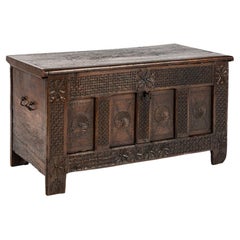
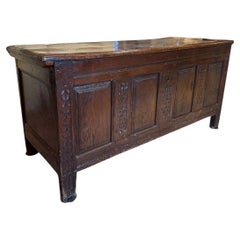
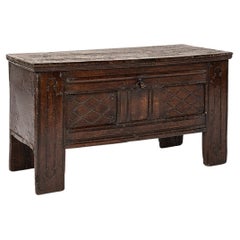
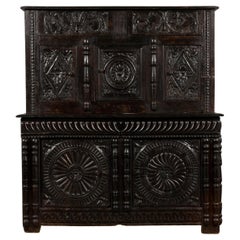
Antique 17th century English warm brown chest with rich geometric carvings
Located in Casteren, NL
This antique oak chest from the 17th century is a fine example of the rich woodcarving traditions practiced in England and the Low Countries during that era. Built with a solid const...
Category

Mid-17th Century British Antique Renaissance Case Pieces and Storage Cabinets

Materials

Oak

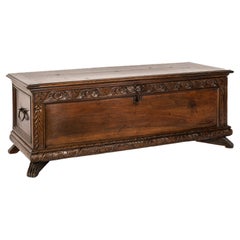
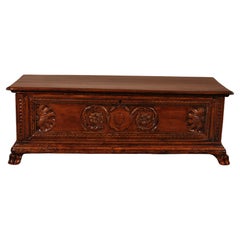
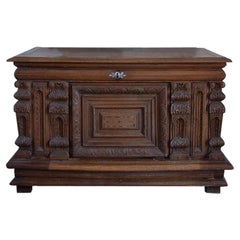
Antique 17th century Italian Renaissance Solid Walnut handcarved Cassone Chest
Located in Casteren, NL
This richly carved wooden chest is a fine example of an Italian cassone from the 17th century. The cassone, also known as a bridal chest, was an essential piece of furniture in the h...
Category

Early 17th Century Italian Antique Renaissance Case Pieces and Storage Cabinets

Materials

Iron

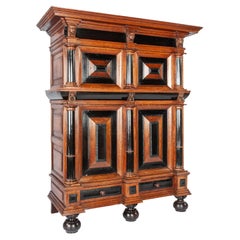
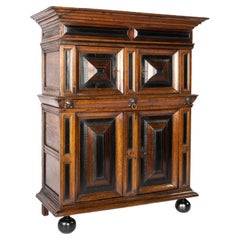
Antique 17th Century Oak Dutch Renaissance Cabinet with Ebony and Mahogany
Located in Casteren, NL
On offer here is an antique four-door cupboard, in Dutch, named “Kussenkast”, that was made in the Northern Netherlands in the late 17th century. This cupboard takes its name from th...
Category

Late 17th Century Dutch Antique Renaissance Case Pieces and Storage Cabinets

Materials

Brass, Steel

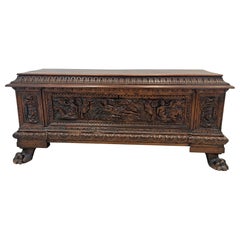
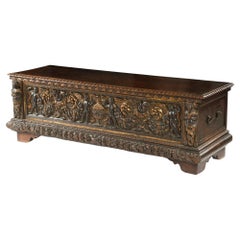
Large carved walnut cassone From Italian Renaissance Period
Located in Marcq-en-Barœul, Hauts-de-France
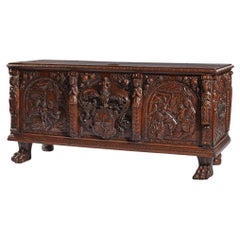
This very nice large cassone chest resting on four claw feet is made of walnut. The piece is richly carved with faces, cherubs and horse seenes. This is an Italian piece from Renaiss...
Category

17th Century Italian Antique Renaissance Case Pieces and Storage Cabinets

Materials

Walnut

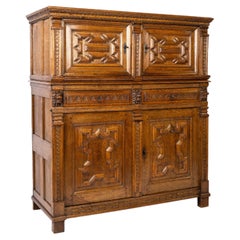
18th Century Dutch Renaissance Oak Cabinet
Located in Casteren, NL
A beautiful late 18th century cabinet in the best quality solid oak. This is a typical 'kussenkast' or pillow cabinet. Pillow refers to the shape of the...
Category

Late 18th Century Dutch Antique Renaissance Case Pieces and Storage Cabinets

Materials

Oak

Antique early 18th century English warm brown chest or trunk with rich carvings
Located in Casteren, NL
This fine oak chest was crafted in England around 1700 and stands as a beautiful example of the solid yet stylish furniture of the period. The front is richly decorated with geometri...
Category

Early 18th Century English Antique Renaissance Case Pieces and Storage Cabinets

Materials

Oak

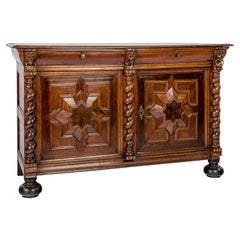
Antique 17th Century Dutch Renaissance Dresser of Buffet in Oak and Walnut
Located in Casteren, NL
This rare and rich decorated Renaissance dresser was made during the Dutch Golden age in the southern part of the Netherlands currently Belgium. It was made around 1670 and most likely in Antwerp. The dresser was made in the finest quality watered European oak and decorated geometric-shaped walnut veneer panels. The cabinet has two wide doors and two drawers above. The drawers are flanked by carved lion heads with brass rings. The right drawer is equipped with an authentic working lock and key. The doors are decorated with geometrical star-like walnut inlaid raised panels. The doors are flanked by large twisted Solomonic columns decorated with brass nails. The righthand door features its authentic lock and key with a brass ajour cut keyplate. The dresser has a wax finish with a great patina built up over 350 years. This piece of furniture was made by highly skilled craftsmen by the use of the best materials available. It is among the best furniture that was produced during the golden age and even now its craftsmanship is unprecedented. The dresser is highly original and in perfect shape for a piece of furniture over 350 years old. It was gently cleaned in our atelier and a new protective wax coat was applied. The Dutch golden age the 17th century was an important century for the Netherlands. The region separated from the Spanish Empire and formed its republic. Dutch merchants...
Category

Mid-17th Century Dutch Antique Renaissance Case Pieces and Storage Cabinets

Materials

Brass

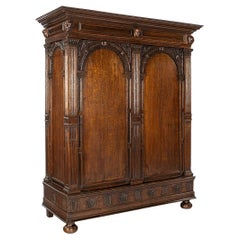
Exceptional Antique 18th century Dutch Renaissance Golden Age oak Portal Cabinet
Located in Casteren, NL
This extraordinary Utrecht “Poortkast” (portal cabinet) stands as one of the finest expressions of Dutch Renaissance furniture. Crafted in ...
Category

Early 18th Century Dutch Antique Renaissance Case Pieces and Storage Cabinets

Materials

Oak

Antique 18th century oak and walnut Dutch Renaissance honey color oak cupboard
Located in Casteren, NL
A beautiful early 18th-century four-door Renaissance cupboard in the best quality solid oak and walnut veneer. The cupboard boasts a warm honey color combined with deep gloss and a r...
Category

Early 18th Century Dutch Antique Renaissance Case Pieces and Storage Cabinets

Materials

Steel

Antique 17th Century Dutch Renaissance Solid Oak with Ebony Veneer Cupboard
Located in Casteren, NL
This beautiful and friendly-sized cupboard is made of the finest watered oak in the tradition of the Dutch Renaissance during the “Dutch golden age” It is a two-story four-door cabin...
Category

17th Century Dutch Antique Renaissance Case Pieces and Storage Cabinets

Materials

Ebony, Oak

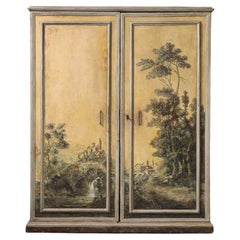
Antique 18th century Dutch Renaissancewarm brown oak two door cabinet
Located in Casteren, NL
This antique Dutch Renaissance cabinet was crafted in the southern Netherlands at the end of the 18th century, around 1780. It serves as a quintessential example of the furniture cra...
Category

Late 18th Century Dutch Antique Renaissance Case Pieces and Storage Cabinets

Materials

Oak

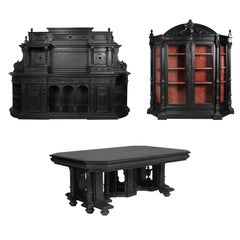
18th Century Renaissance Palladio Dining Room Set in blackening wood of walnut
Located in Vigonza, Padua
Monumental and important Renaissance Palladio dining room set all in solid hand-carved walnut from a Palladian Palace in Vicenza of a Venetian patrician family. The back of the showcase was rebuilt again at the end of the 800 first 900 with the application of damask fabric The table can be extended up to 4-6 meters The large sideboard and the display cabinet are in the process of conservative restoration and have therefore been disassembled, as seen from the last photos. Measures in cm: Sideboard H 240 x L 315 x D 70 Display cabinet H 240 x L 230 x D 60 Table H 78 L x 230 x D 140 Extendable to 4-6 meters Notes: The architectural design of Andrea Palladio...
Category

Late 18th Century Italian Antique Renaissance Case Pieces and Storage Cabinets

Materials

Glass, Pine, Walnut

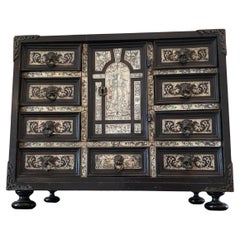
17th Century Italian Milano Renaissance Period Bone Ivory Ebony Tabletop Cabinet
Located in Forney, TX
A scarce nearly 400 year old fine quality Italian Lombard ebony rosewood bone and ivory tabletop curiosity cabinet with warm rich beautifully aged patina and interesting provenance. ...
Category

17th Century Italian Antique Renaissance Case Pieces and Storage Cabinets

Materials

Brass, Bronze

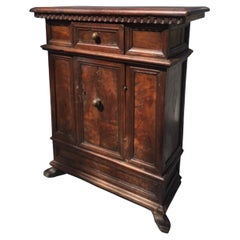
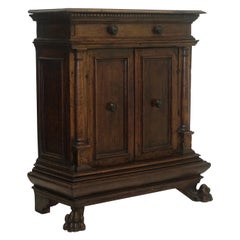
16th Century Period Renaissance Tuscan Walnut Credenzino
Located in Vero Beach, FL
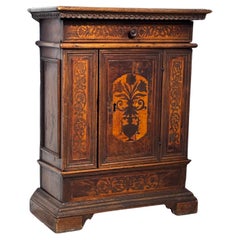
16th Century Period Renaissance Tuscan Walnut Credenzino Italian 16th/17th century Renaissance walnut small Credenza with a rectangular top above a single drawer centered over a s...
Category

16th Century Italian Antique Renaissance Case Pieces and Storage Cabinets

Materials

Walnut

Italian Renaissance Walnut Chest - Circa 1600
Located in Brussels, Brussels
Superb and rare Italian Renaissance chest from the end of the 16th century/beginning of the 17th century circa 1600 from Lombardy in walnut Very beautiful chest with a superb work o...
Category

Early 17th Century Italian Antique Renaissance Case Pieces and Storage Cabinets

Materials

Walnut

English Renaissance 17th Century Solid Oak Chest Trunk
Located in Vero Beach, FL
English Renaissance 17th Century Solid Oak Chest Trunk Spectacular period Renaissance oak chest, dating from the early 17th century. The antique piece features a front composed of p...
Category

17th Century English Antique Renaissance Case Pieces and Storage Cabinets

Materials

Iron

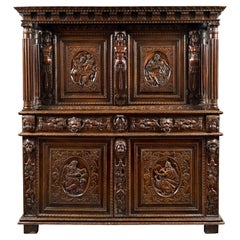
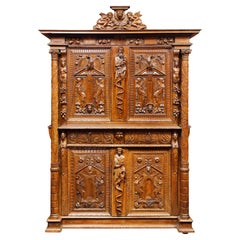
Burgundian Renaissance Cabinet Depicting the Four Evangelists
Located in Saint-Ouen, FR
The cabinet’s upper body, slightly recessed is topped by an overlapping entablature and cornice supported both in the front and the rear by four fluted columns. The lower body stands on four squared feet and a moulded base. Each door-leaf’s panel is centred by a low-relief carving presenting one of the four evangelists...
Category

16th Century French Antique Renaissance Case Pieces and Storage Cabinets

Materials

Walnut

Renaissance Cabinet from Burgundy or Lyon Region
Located in Saint-Ouen, FR
Renaissance cabinet from Burgundy Or Lyon Region Origin : Burgundy Or Lyon, France Period : Second Half 16th Century, C. 1580 Height : 209cm Length : 184cm Depth : 71cm Good condition Walnut wood, original keys and keyholes Around the middle of the 16th century the conception and ornamentation of French furniture evolves. The start of major building projects, such as the castle of Fontainebleau, gives artists a new impulse. Inventive and rich formulas are developed there, before spreading to all of Europe thanks to engravings and printed leaflets. Furthermore, Italian artists working on such construction sites bring French artists and patrons a renewed taste for the Antique. Regarding the art of furnitures, the most complex scenes and figures are drawn from illustrated books, ornament and emblem compendiums and engraving compilations. Rather than copying those images the artisans feed their inspiration and decline the motifs in numerous variations. The ornamental grammar marks a return to the Antique : palm leaf, acanthus, egg-and-dart, greek, scroll, fluted pilaster… It is in Primaticcio’s and Il Rosso’s stuccos made around 1540-1550 that we have to look for the origin of leather cut-outs, masks, chimaeras, harpies, sheathed figures, fruit and flower garlands that soon enrich every pieces of French furniture. The structure of the pieces of furniture also evolve thanks to the re discovery of Antique architectures, rigorously used as a model. This cabinet presents an imposing structure and a rich and original decor exemplifying the production of the late 16th century, infused with Italian, Antique and Fontainebleau influences. It stands on a moulded base ornate with palm leaves. It opens with four door-leaves and two drawers in the belt. Six whimsical terms divide the facade. The lower body is horizontally divided by three sheathed female terms. The two standing on the lateral posts are topped with fruits while the body is covered by acanthus leaves carved with precision, belted at the waist. The term standing on the central door-jamb is crowned with laurel leaves and is draped in the Antique fashion. A wincing mask hides the key hole. The two door-leaves are centred by a beautiful mask carved in a strong relief. They wear stylised feathered headdress and are set on draperies. Straps, leather scrolls, acanthus leaves and a shell are spread around the masks. The recessed panels are secured in frames ornate with acanthus leaves. The belt is flanked by two large mouldings enriched with variations of acanthus leaves. The drawers are carved with choux bourguignons and palm leaf motifs minutely executed. The consoles between each drawer bear tormented wincing masks, showing horns as if they were fauns or imps. The upper body is framed by two male terms characterised by a strong and nervous musculature, their manhood hidden by drapes secured thanks to a winged lion head. The term on the left appears to be younger and is wincing while the one on the right has a beard. The central female term brings contrast with her youth and sensuality. As it is the case on the lower body, the key hole is hidden behind the mouth of a faun’s mask placed on the drapes barely covering the intimacy of the caryatid. The panels of the upper body present an idealised architecture comprising pilasters and sinuous broken pediments. The pilasters are flanked by two satyrs with goat legs. In the centre appears an important lion mask. The terms of the upper body support the cornice. The entablature carries palm leaves and roses alternating as well as an egg-and-dart frieze. The cornice is adorned with acanthus motifs. On the sides, the carving is executed flat. A central rose is surrounded by scrolls, flowers and choux bourguignons. We can admire the variety of the elements employed. The artist vary with great genius many different ornamental motifs : palm leaf, egg-and-dart, laurel leaf, roses, scrolls … But the artist went even further as each profile and each face is individualised and presents different features. You can take a look at the faces of the satyrs flanking the upper body’s panels. The talent of the artist is undeniable. It makes no doubt the patron who commissioned this cabinet was an aesthete looking for the greatest quality. The artist who authored this cabinet had a great mastery of composition both in the general design and in the individual panels. They probably drew inspiration from engravings and drawings made especially for the making of this piece of furniture or not. They seem to be familiar with the style of Jacques Androuet du Cerceau. Indeed, we can find in Du Cerceau’s engravings the same juxtapositions of leather cut-outs, masks and fruits. The terms and caryatids used on the facade could very well be inspired by his work as well. The cabinet-maker was also undoubtedly observant of Hugues Sambin, the most famous cabinet-maker and sculptor in the Burgundy of the time. Like Du Cerceau, Sambin left an important ensemble of models particularly useful for the design of cabinets. His publication De l’Oeuvre de la diversité des termes dont on use en architecture (1572) was an essential book for every artisan. All the motifs testify of the artisan’s high knowledge of forms as well as the precision of their tools : super imposition of ornamental elements, foliages, architectural cut-outs, flat and high reliefs alternating, palm leaves inscribed in circular spaces, wincing faces. It is also a testimony of the artisan’s familiarity with Italian and Fontainebleau productions. Because of the proficiency of the cabinet-maker in so many different models, this cabinet truly is a master-piece authored by the hand of an authentic master. The generous carvings executed with great rigour and virtuosity evoke an origin close to Burgundy and Lyon workshops. This cabinet was made by a master of the region during the Second French Renaissance. Literature BOCCADOR Jacqueline, Le mobilier français du Moyen-Âge à la Renaissance, Édition d’art Morelle Mayot, 1996 BOS Agnès (dir.), Mobilier du Moyen âge et de la Renaissance, La collection du musée du Louvre, Louvre éditions...
Category

16th Century Antique Renaissance Case Pieces and Storage Cabinets

Materials

Walnut

18th C. Italian Renaissance Walnut "Studiolo" Cabinet with 38 Drawers Secrets
Located in Dallas, TX
Crafted in Italy circa 1760, this rare walnut “studiolo” cabinet — also known as a Cabinet of Curiosities — represents the height of 18th century craftsmanship, inspired by the Renai...
Category

Mid-18th Century Italian Antique Renaissance Case Pieces and Storage Cabinets

Materials

Walnut

Antique 16th Century German Dark Brown oak carved Stollentruhe Trunk or Chest
Located in Casteren, NL
Rare and early German Stollentruhe, dating from around 1620. This compact 17th-century oak chest combines historical significance with visual prese...
Category

Early 17th Century German Antique Renaissance Case Pieces and Storage Cabinets

Materials

Steel

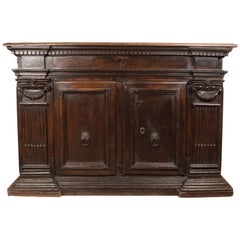
Early 17th Century Italian Walnut Credenza/ Cabinet
Located in San Francisco, CA
A wonderful and rare walnut credenza or sideboard, heavy patinated, original unrestored finish and original hardware. The hand-carved moldings and classic. Ionic swags above fluted ...
Category

Early 17th Century Italian Antique Renaissance Case Pieces and Storage Cabinets

Materials

Walnut

Genoese Cabinet Called Stipo From The Renaissance Period In Walnut - 16th Centur
Located in Brussels, Brussels
Exceptional Genoese cabinet called stipo "a bambocci" from the Italian Renaissance in walnut from the end of the 16th century with its original base Museum quality piece Provenance:...
Category

16th Century Italian Antique Renaissance Case Pieces and Storage Cabinets

Materials

Walnut

Antique 17th century German Light Warm Oak Chest or Trunk with geometric panels
Located in Casteren, NL
This German oak chest from the 17th century is a fine example of early modern craftsmanship, combining solidity with decorative refinement. The front is constructed with heavy, richl...
Category

Mid-17th Century German Antique Renaissance Case Pieces and Storage Cabinets

Materials

Oak

Antique 17th century Flemish solid brown oak Renaissance Carmelite cupboard
Located in Casteren, NL
On offer here is an Exquisite 17th Century Oak Two-Door Cabinet from the Carmelite Monastery in Bruges, Belgium. This antique piece, crafted in the Southern Netherlands around 1635, ...
Category

Early 17th Century Belgian Antique Renaissance Case Pieces and Storage Cabinets

Materials

Steel

18th Century French Renaissance Carved Oak Cupboard Buffet
Located in Astoria, NY
An exceptional 18th-century French Renaissance cabinet, sourced from the French Alps. Masterfully hand-crafted from solid oak, this two-piece ensemble showcases exquisite and elabora...
Category

18th Century French Antique Renaissance Case Pieces and Storage Cabinets

Materials

Oak

Renaissance Period French Hand Carved Chest / Trunk - 17th - France
Located in Beuzevillette, FR
Very beautiful trunk from the Renaissance period, very nicely carved with palm leaves and acanthus leaves in an architectural setting. Four Ionic co...
Category

17th Century French Antique Renaissance Case Pieces and Storage Cabinets

Materials

Wood

17th Century Italian Florentine Walnut Side Cabinet, Circa 1650
Located in San Francisco, CA
An extraordinary Renaissance Period walnut small side cabinet with fruitwood inlay detail. Of museum quality, in remarkable original condition (has not been reconstructed in any way)...
Category

17th Century Italian Antique Renaissance Case Pieces and Storage Cabinets

Materials

Fruitwood, Walnut

Fine Quality 18th Century Walnut Italian Carved Figural Side Cabinet Commode
Located in Swedesboro, NJ
This 18th century Italian walnut carved side cabinet commode is an exceptional example of fine craftsmanship and classical artistry. Hand-carved from rich walnut, the piece features ...
Category

1780s Italian Antique Renaissance Case Pieces and Storage Cabinets

Materials

Walnut

Swiss Chest richly carved, Riedmatten family, framed by two Holy conversations
Located in Saint-Ouen, FR
SWISS CHEST RICHLY CARVED WITH THE COAT OF ARMS OF THE RIEDMATTEN FAMILY FRAMED BY TWO HOLY CONVERSATIONS ORIGIN : SWITZERLAND, VALAIS CANTON PERIOD : END OF 16th CENTURY – EARLY 17...
Category

16th Century Swiss Antique Renaissance Case Pieces and Storage Cabinets

Materials

Wood, Walnut

Carved Spanish Oak Writing Cabinet, Estate of Vincente Blasco Ibanez
Located in Dallas, TX
Presenting an absolutely stunning 16th century carved Spanish oak writing desk and cabinet, with amazing provenance and historical and literary significance. This desk/cabinet was purchased by a wealthy Dallas family from a French antique auction held at the club room in the Stoneleigh court (hotel), Dallas on Wednesday the 2nd April 1930. (Now the meridian hotel). The auction was titled: “works of art and furnishings of the Chateau de Turique (Nancy) and the Conde-Rougemont home (Touraine). The cover of the catalog also has a seal of a coat of arms. The second page gives a brief description of the auction contents and states that " this exhibition will be presented by M. Fernand M. Adda of Paris France". The desk/cabinet was lot no: 565 and was described in the auction catalog as: "Carved Spanish writing desk and cabinet...... 16th century period....Upper section a cabinet with two doors which are paneled and display a fine carving. The interior is fitted with eight engraved drawers, and a writing tablet is disclosed in the lower portion. Sustained and central arcade of columns. From Fontana Rosa collection. Supported on four turned legs with bulbous feet." Fontana Rosa is a historic garden situated on the avenue Blasco Ibáñez in Menton, Alpes-Maritimes, on the French Riviera. The Spanish writer Vicente Blasco Ibanez (1869-1928) began to build it from 1922 on, and he set up home here with his second wife, Elena, and died there in 1928. Vicente Blasco Ibanez was a journalist, politician and best-selling Spanish novelist in various genres whose most widespread and lasting fame in the English-speaking world is from Hollywood films adapted from his works. The provenance is impeccable, it belonged to Ibanez and was part of his collection at Fontana Rosa when he died in 1928. The auction in which it was first sold in Dallas was in 1930, which makes perfect sense from a 'timeline' point of view. Ibanez is a very important literary figure. Having regard to the fact that this is a writing desk means that in all probability, Ibanez would have 'penned' some of his famous works at this very desk and using the surviving slope/shelf. Fontana Rosa is a historic garden situated on the Avenue Blasco Ibáñez in Menton, Alpes-Maritimes, on the French Riviera. The Spanish writer Vicente Blasco Ibáñez (1869-1928) began to build it from 1922 on, and he set up home here with his second wife, Elena, and died there in 1928. This garden with Spanish and Menton pottery is found in avenue Blasco Ibanez, near Garavan station, and was created a Historical Monument in 1990. It is also called “Le Jardin des Romanciers” (El Jardín de los Novelistas/The Garden of Novelists), and was frequented by celebrities such as Jean Cocteau. It was the place where Blasco Ibáñez wrote Mare Nostrum, a novel filmed later in 1926. The garden inspired by Andalusian and Arabian-Persian styles contains species such as Ficus macrophylla, Araucaria heterophylla , palm trees, banana trees or scented rosebushes. It is a tribute to Vicente’s favourite writers : Cervantes, Dickens, Shakespeare or Honoré de Balzac, whose busts can be found at the entrance and to whom he dedicated several fountains and rotundas. Its main buildings are a small elevated villa with polychromatic pottery which houses a library and a personal movie projector...
Category

16th Century Spanish Antique Renaissance Case Pieces and Storage Cabinets

Materials

Oak

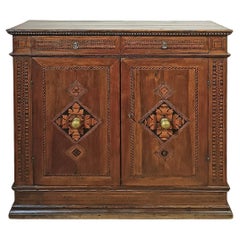
EARLY 16th CENTURY INLAID RENAISSANCE SIDEBOARD
Located in Firenze, FI
Refined and unique sideboard in solid carved walnut, decorated with "Carthusian" inlays in walnut and other woods. The sideboard features a linear shape, characterized by a base and ...
Category

16th Century Italian Antique Renaissance Case Pieces and Storage Cabinets

Materials

Bronze

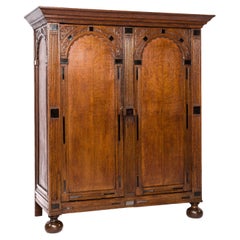
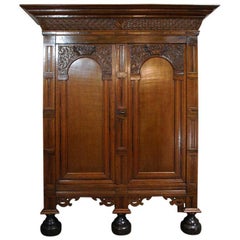
Antique 17th-century Dutch Renaissance Portal Cupboard in Solid Oak
Located in Casteren, NL
On offer here is an exceptional Dutch cupboard made of the finest European summer oak in the tradition of the Dutch Renaissance during the “Dutch golden age” This cabinet is made in the Provence of Utrecht, circa 1680. The arched doors are typical for this province and this type of cabinet is also known as “Utrechtse Poortkast”. The cabinet stands on bun feet and is with handsomely carved patterns and ebony veneer inlaid panels. The carving depicts elements that represent prosperity and Classic ornaments as is common in Dutch Renaissance furniture...
Category

Late 17th Century Dutch Antique Renaissance Case Pieces and Storage Cabinets

Materials

Steel

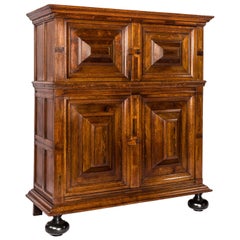
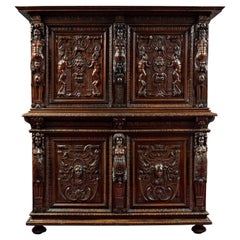
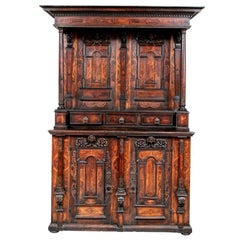
Notable circa 17th Century Carved Walnut Two-Tiered Cabinet in Renaissance Style
Located in Bridgeport, CT
A large and impressive 17th century European cabinet. Made in two parts, both with elaborate carved decoration and burled panels and details. The upper cabinet with heavy overhanging...
Category

17th Century European Antique Renaissance Case Pieces and Storage Cabinets

Materials

Wood

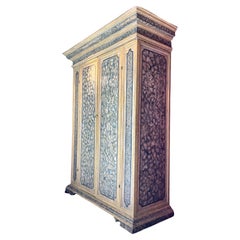
16th Century Italian Renaissance Painted Marble Lacquer Wooden Cabinet (1500s)
Located in Firenze, IT
16th Century Italian Renaissance Painted Marble Lacquer Wooden Cabinet (1500s) An extraordinary Italian Renaissance wooden cabinet from the 1500s awaits the discerning collector. Thi...
Category

16th Century Italian Antique Renaissance Case Pieces and Storage Cabinets

Materials

Iron

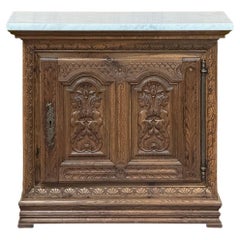
18th Century French Renaissance Cabinet with Carrara Marble
Located in Dallas, TX
18th Century French Renaissance Cabinet with Carrara Marble will make a great addition to any efficient floor plan! Crafted from solid old-growth chestnut, it features a neoclassica...
Category

Late 18th Century French Antique Renaissance Case Pieces and Storage Cabinets

Materials

Carrara Marble, Steel

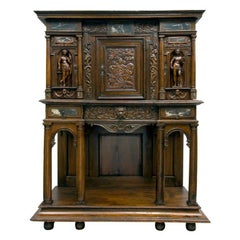
Very Rare and Important 16th C. French Renaissance Cabinet or Dressoir, ca. 1580
By Jacques Androuet Du Cerceau
Located in Miami Beach, FL
Walnut with verde antico marble inlay, with two wholly carved draped female allegorical figures within arched recesses, and a bas-relief on the central door. Rich and heavily carved...
Category

18th Century and Earlier French Antique Renaissance Case Pieces and Storage Cabinets

Materials

Oak, Walnut

18th Century French Oak Hunt Buffet with Game Bird and Fish Panels
Located in Dallas, TX
From the 1700s, this unusual French hunt buffet has expertly carved paneled doors portraying a game bird and a fish. The game bird is hanging from its feet with knotted ribbons, whil...
Category

18th Century French Antique Renaissance Case Pieces and Storage Cabinets

Materials

Oak

Carved Tuscan Wedding Cassone, Renaissance Period
Located in Saint-Ouen, FR
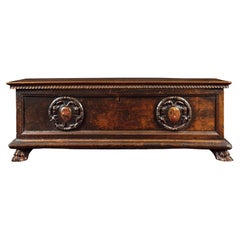
This cassone, remarkable for its sobriety, sits on two clawed lion’s feet and a moulded base. On the façade, there is one large, moulded frame, with two soberly carved medallions inside it. Each medallion has a painted coat of arms at the centre. The two coats of arms are different, suggesting that there was an alliance between two families through marriage. The thick lid has a fluted frieze at the front. On the sides, a wrought iron handle reminds us of the use of this piece, which was intended for storing the property of its owner and allowing them to travel between various residences. The square shaped handles highlight the earliness of this object in the century. The cassone is, along with the bed, a key piece of furniture of the Middle Ages and was still used in the Renaissance Period.
Category

16th Century Italian Antique Renaissance Case Pieces and Storage Cabinets

Materials

Walnut

A Rare Renaissance Walnut Cabinet With Its Freestanding Carved Columns
Located in Saint-Ouen, FR
A RARE RENAISSANCE WALNUT CABINET WITH ITS FREESTANDING CARVED COLUMNS ORIGIN : FRANCE, BURGUNDY PERIOD : 16th CENTURY Height : 218 cm Length : 152 cm Depth : 67.5 cm Walnut Thi...
Category

16th Century European Antique Renaissance Case Pieces and Storage Cabinets

Materials

Wood, Walnut

Italian Renaissance Walnut Cassone
Located in Essex, MA
With flat hinged top opening to a open compartment. The curved case carved with a crest and figures and various designs. Bracket feet with trefoil form apro...
Category

Early 1600s Italian Antique Renaissance Case Pieces and Storage Cabinets

Materials

Walnut

Rare and Important Renaissance "Judaica" Carved Oak Wood Cabinet
Located in Queens, NY
A Rare and Important Renaissance "Judaica" Carved Oak Wood Cabinet, circa 1680 We are pleased to present a rare and important Renaissance Judaica c...
Category

17th Century German Antique Renaissance Case Pieces and Storage Cabinets

Materials

Mother-of-Pearl, Oak

17th Century French Renaissance Hand-Carved Front Section of a Built in Cabinet
Located in Casteren, NL
This beautiful carved Renaissance front section was a part of a built in cabinet. The carvings are typical for Bretagne area in France and it can be ...
Category

Mid-17th Century French Antique Renaissance Case Pieces and Storage Cabinets

Materials

Oak

16th Century French Renaissance Chest in Carved Oak
Located in Dallas, TX
Whereas many pieces of furniture during the Italian Renaissance were heavily painted or inlaid with decorative motifs, French examples utilized hand-sculpted elements as the predomin...
Category

16th Century French Antique Renaissance Case Pieces and Storage Cabinets

Materials

Wood, Oak

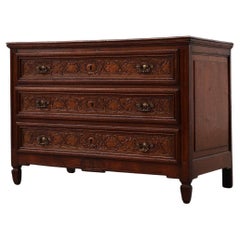
Italian Renaissance Oak Chest of Drawers, 17th Century
Located in Meulebeke, BE
Italy / 17th century / chest of drawers / oak, bronze / Renaissance A distinguished 17th-century Italian Renaissance chest of drawers...
Category

17th Century Italian Antique Renaissance Case Pieces and Storage Cabinets

Materials

Bronze

Dutch 18th Century Renaissance Oak and Walnut Cupboard
Located in Casteren, NL
This mid-18th century cabinet is a so called 'kussenkast' or pillow cabinet. The pillow refers to the shape of the raised panels in the doors. It is a ...
Category

Mid-18th Century Dutch Antique Renaissance Case Pieces and Storage Cabinets

Materials

Oak

Antique Dutch Renaissance Oak Cabinet
Located in Casteren, NL
This extraordinary cabinet is made of the finest oak in the tradition of the Dutch Renaissance during the “Dutch golden age” This cabinet is made in ...
Category

Early 18th Century Dutch Antique Renaissance Case Pieces and Storage Cabinets

Materials

Oak

GENUINE Renaissance Walnut Cabinet Buffet, Italian, Early 17TH Century
Located in San Francisco, CA
A tall walnut cabinet buffet, having a plank top with dentil moulding above a single drawer. The recessed paneled doors with iron pulls, flanked by Doric columns sitting on multi-moi...
Category

Early 18th Century Italian Antique Renaissance Case Pieces and Storage Cabinets

Materials

Walnut

Important Renaissance Cabinet from Lyon France with a Decor of Perspectives
Located in Saint-Ouen, FR
As soon as 1540 France's second Renaissance is in the making, intimately linked to the rediscovery of the Antique world. The development of the printing and engraving industry allows the spread of artworks and models in many cities and countries. The Italian influence can be perceived in every artistic field. While the French king entrust the most talented Italian artists with major projects such as Il Rosso or Primaticcio in Fontainebleau, French artists also travel to Italy to form themselves to this new style. In Italy they get acquainted with the work of Leo Battista Alberti the first to theorize perspective (De Pictura, 1435-36) and architecture (De re oedificatoria, 1541). Those two publications would have a revolutionary impact on arts. Furniture is marked by the work of the most famous Italian architects of the time as well as French architects. Indeed Philibert de l'Orme competes with Alberti and by the end of his life publishes several treaties including one devoted to a theory of architecture (1567). Unfortunately he would not live to complete the second volume. In this treaty he expresses his interest for mathematical norms applied to architecture, copied from the Antique. His journeys in Italy allowed him to accumulate the most sophisticated references. Jean Bullant, another architect of great talent also theorizes his practice. He establishes rules characterizing Greco-Roman art staying faithful to Vitruvius. Following this new inspiration the structure of furniture evolves. From then on appear columns, capitals, cornices, friezes and architraves. The ornamentation uses this inspiration as well with egg-and-dart, palm leaf and rose adorning the most beautiful pieces. In Lyon, crossroad where meet merchants from everywhere those new experiments are welcomed. Lyon florishing printing industry allows the spreading of models and treaties essential to the artist's work. Thus the first publication of Vitruvius' De Architectura in France would be printed in Lyon in 1532. Artists from Lyon rediscover and familiarize themselves with the Antique knowledge very early. They adopt those new ideas and use them in their own creations. Lyon cabinet-makers re interpret Antique architecture and Italian Renaissance palaces to give their pieces a pure and harmonious architectural structure. Grooved pilasters are particularly favored. They are topped by capitals of diverse orders always respecting the sequencing with simpler ones for the lower levels and the richest ones on the higher levels. As for the ornamentation, one of the great distinctiveness of Lyon workshops remains the architectural perspective illusions, drawing inspiration from Tuscany. True masterpiece of the Second French Renaissance this important cabinet illustrates Lyon workshops' taste for fine Italian architecture inspired by Antiquity. An architectural perspective of great quality is treated in symmetry on each panel. This two-bodied cabinet without recess stands on four rectangular feet. The base comprises a molding, a palm leaf frieze and is bordered by a braid. The lower body is divided by three grooved pilasters with Tuscan capitals framing two door-leaves. The two panels are encircled by a moudled frame with palm leaves. They are finely carved with a decor of fantasized architecture depicting an Italian Renaissance palace erected symmetrically on each side of a grooved pilaster. On the ground floor a door opens through a stilted arch while the stories are opened with mullioned windows, dormers and occuli. Two large pegged-boss cladded pillars support the entablature enriched by a palm leaf frieze upon which stands an arch whose coffered intrados is centred by a rose. Behind this arch a pyramid appears, standing in front of a second facade with a window topped by a broken curvilinear pediment under a cul-de-four with a shell. The checker flooring gives depth to the low-reliefs creating vanishing points structuring the panels and guiding the eye of the observer. A thin laurel braid highlights the belt of the cabinet where are located two drawers. Their facades are adorned by palm leaves in hoops. The upper body is encircled with palm leaves. The same ternary division as in the lower body appears. However, the pilasters are topped by Ionic capitals with volutes and egg-and-dart. The door-leaves are framed with flowers. On the panels the artist has designed another architectural decor. On the foreground open two arches on top of grooved pilasters with rectangular capitals adorned with palm leaves. The arches are enriched with braids and the coffered intrados bears a decor of roses. The spandrels also bear a flower decor. In the background another arcature hosts a fluted grooved column topped with double basket acanthus capital, characteristic of Corinthian order. The triangular pediment is interrupted by a choux bourguignon. A large cornice crowns the cabinet. It stands on pilasters and forms an entablature comprising a palm leaf frieze and an egg-and-dart, triglyph and palm leaf cornice. The cabinet's sides have also been carefully considered. The lower body's panels are enriched with an arch rising above a broken pediment portico hosting a twisted column. Flowers garnish the spandrels. An architectural facade completes the decor. The upper body's panels present two arches supported by a facade opened with dormers and mullioned windows as well as cartouches (one bears the inscription 1580 dating the cabinet) suggesting the interior of an Italian Renaissance palace, confirmed by the chandeliers. The flooring leads our gaze to a second arch with a broken curvilinear pediment where stands a flower vase. This arch opens onto a perspective of another facade along a road. Inside the cabinet, on the lower body door-leaves appear two designs. On the right door is depicted a Crucifixion. Saint Mary and Saint John flank the Christ on the cross. In the bottom part is inscribed « Dure uiator abis nihil haec spectacula curas / Pendenti cum sis unica cura Deo. / Tota suo moriente dolet natura Magistro. / Nil qui solus eras caussa dolenda doles. ». The signature [Christoff Swartz Monachiensis pinx[it] / Ioa[nnes] Sadeler sculp[it]] tells us it was made by Johan Sadeler I (1550-1600) after Christoph Schwartz (1548-1592). This engraving belongs to an ensemble depicting the Passion of Christ Johan Sadeler executed in 1589 after an altar piece painted by Christoph Schwartz for the private chapel of Renée of Loraine, wife of Duke William V of Bavaria. This altar piece made of nine copper panels has been destroyed during the 19th century. The Crucifixion panel once in the centre of the altar piece is the only one that survived and is today kept in Munich's Alte Pinakothek. On the left door appears Saint Francis receiving the stigmata. The inscription says : « Signastidomine Servum Tuum. Franciscum. Signis Redemptionis Nostrae ». This Renaissance cabinet with an architectural decor appearing as much in the structure faithful to Antique rules...
Category

16th Century European Antique Renaissance Case Pieces and Storage Cabinets

Materials

Walnut

Florentine Renaissance Cassone with decor of vines and grape clusters
Located in Saint-Ouen, FR
ORIGIN : ITALY, TUSCANY PERIOD : 16th CENTURY DIMENSIONS : Height : 73 cm Length : 180 cm Depth: 57 cm Good condition Walnut wood This significant Florentine cassone in the shape of a sarcophagus features a beautiful front panel flanked at the corners by two mascarons surrounded by voluted acanthus leaves. It rests on two lion's paw feet at the front. The decoration includes a beautiful frieze of scales at the bottom, which continues on the sides. Above this, in the center, a scrollwork cartouche once bore coats of arms. On either side, there is an abundant vegetal decor with vine branches and sumptuous grape clusters. The domed top lid is adorned around its edge with a wide frieze featuring a scale motif, harmoniously matching the lower cornice. This beautiful cassone is interesting for several reasons. The choice of ornamentation is not random. Grapes have numerous meanings and are often associated with fertility, especially when represented on a wedding cassone...
Category

16th Century Italian Antique Renaissance Case Pieces and Storage Cabinets

Materials

Wood, Walnut

Bargueño End of 16th Century Portugal "Writting Desk" with Drawers, Bargueno
Located in Miami, FL
Bargueño writing desk, cabinet in walnut tipical from Portugal. This sort of early chest of drawers were use for papers and documents, it was used as a transportable writing desk. ...
Category

16th Century Portuguese Antique Renaissance Case Pieces and Storage Cabinets

Materials

Walnut

Antique 17th century Dutch Renaissance two-door warm brown and black cupboard
Located in Casteren, NL
This beautiful and friendly-sized cupboard is made of the finest watered oak in the tradition of the Dutch Renaissance during the “Dutch golden age” It is a two-door cabinet over ebo...
Category

Late 17th Century Dutch Antique Renaissance Case Pieces and Storage Cabinets

Materials

Ebony, Rosewood, Oak

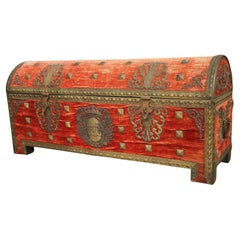
18th Century Domed Venetian Chest with Crimson Velvet and Wrought Iron Hardware
Located in Dallas, TX
Dating to the 1700s, this beautiful Venetian chest, which is covered in crimson velvet, has brass embellishments in the style of the Renaissance. The beautiful color of the velvet an...
Category

18th Century Italian Antique Renaissance Case Pieces and Storage Cabinets

Materials

Metal, Wrought Iron, Iron, Brass

Exceptional Italian Renaissance Cassone with Rich Carving on a Gilt Background
Located in Saint-Ouen, FR
The lower part of the facade is adorned with a foliated and fruit garland. The facade’s central panel bears a low-relief decor framed by a rais-de-cœur frieze. The central scene a...
Category

16th Century Italian Antique Renaissance Case Pieces and Storage Cabinets

Materials

Walnut

Antique 17th Century Dutch of Flemisch Honey Color Oak Rennaisance Cupboard
Located in Casteren, NL
This fantastic two-piece 17th-century oak cupboard was made in Antwerp, Flanders, circa 1680. It consists of two pieces, a lower and an upper cabinet. The lower cabinet can be used w...
Category

1680s Dutch Antique Renaissance Case Pieces and Storage Cabinets

Materials

Oak

17th C. Painted Cabinet with Chalk, Graphite Panel Drawings, Turin, Italy
Located in Brooklyn, NY
An incredibly unique find on a hill top Villa in Turin, this cabinet has resided in the same home since its creation and hence is in remarkably good condition. The drawings and pain...
Category

17th Century Antique Renaissance Case Pieces and Storage Cabinets

Materials

Wood, Paint

Tuscan Renaissance Wrought Iron and Walnut Cabinet
Located in Saint-Ouen, FR
The lower part It stands on an ogee molded base and four feet with two front legs more massive and detailed than the others. It opens with two doors and three drawers. The vert...
Category

16th Century Italian Antique Renaissance Case Pieces and Storage Cabinets

Materials

Wrought Iron

Antique Italian Renaissance Era Brass Mounted Walnut Table Cabinet Wall Cupboard
Located in Forney, TX
A rare and unusual antique Italian walnut table-top cabinet (now also wall hanging cupboard), 17th century and later elements, with handsome warm rich dark patina and interesting pro...
Category

17th Century Italian Antique Renaissance Case Pieces and Storage Cabinets

Materials

Brass, Iron

French 17th Century Cabinet
Located in Stockbridge, GA
What a wonderful piece, full of character with the ornaments at the base and the putties carved in the wood.
Category

Late 17th Century French Antique Renaissance Case Pieces and Storage Cabinets

Materials

Oak, Walnut

Renaissance case pieces and storage cabinets for sale on 1stDibs.

Find a broad range of unique Renaissance case pieces and storage cabinets for sale on 1stDibs. Many of these items were first offered in the 21st Century and Contemporary, but contemporary artisans have continued to produce works inspired by this style. If you’re looking to add vintage case pieces and storage cabinets created in this style to your space, the works available on 1stDibs include case pieces and storage cabinets, tables, more furniture and collectibles and other home furnishings, frequently crafted with wood, walnut and other materials. If you’re shopping for used Renaissance case pieces and storage cabinets made in a specific country, there are Europe, France, and Italy pieces for sale on 1stDibs. While there are many designers and brands associated with original case pieces and storage cabinets, popular names associated with this style include Europa Antiques, Arte Veneziana, Edouard Lievre, and Paul Sormani. It’s true that these talented designers have at times inspired knockoffs, but our experienced specialists have partnered with only top vetted sellers to offer authentic pieces that come with a buyer protection guarantee. Prices for case pieces and storage cabinets differ depending upon multiple factors, including designer, materials, construction methods, condition and provenance. On 1stDibs, the price for these items starts at $875 and tops out at $934,066 while the average work can sell for $6,065.

Still Thinking About These?

All Recently Viewed