Items Similar to Pair of Neo-Renaissance Vitrines, Attributed to H-A Fourdinois, France, c. 1860
Want more images or videos?
Request additional images or videos from the seller
1 of 10
Pair of Neo-Renaissance Vitrines, Attributed to H-A Fourdinois, France, c. 1860
$23,874.12per set
£17,688.45per set
€19,920per set
CA$32,922.26per set
A$34,856.09per set
CHF 18,863.13per set
MX$416,594.36per set
NOK 235,126.44per set
SEK 215,014.79per set
DKK 151,752.35per set
About the Item
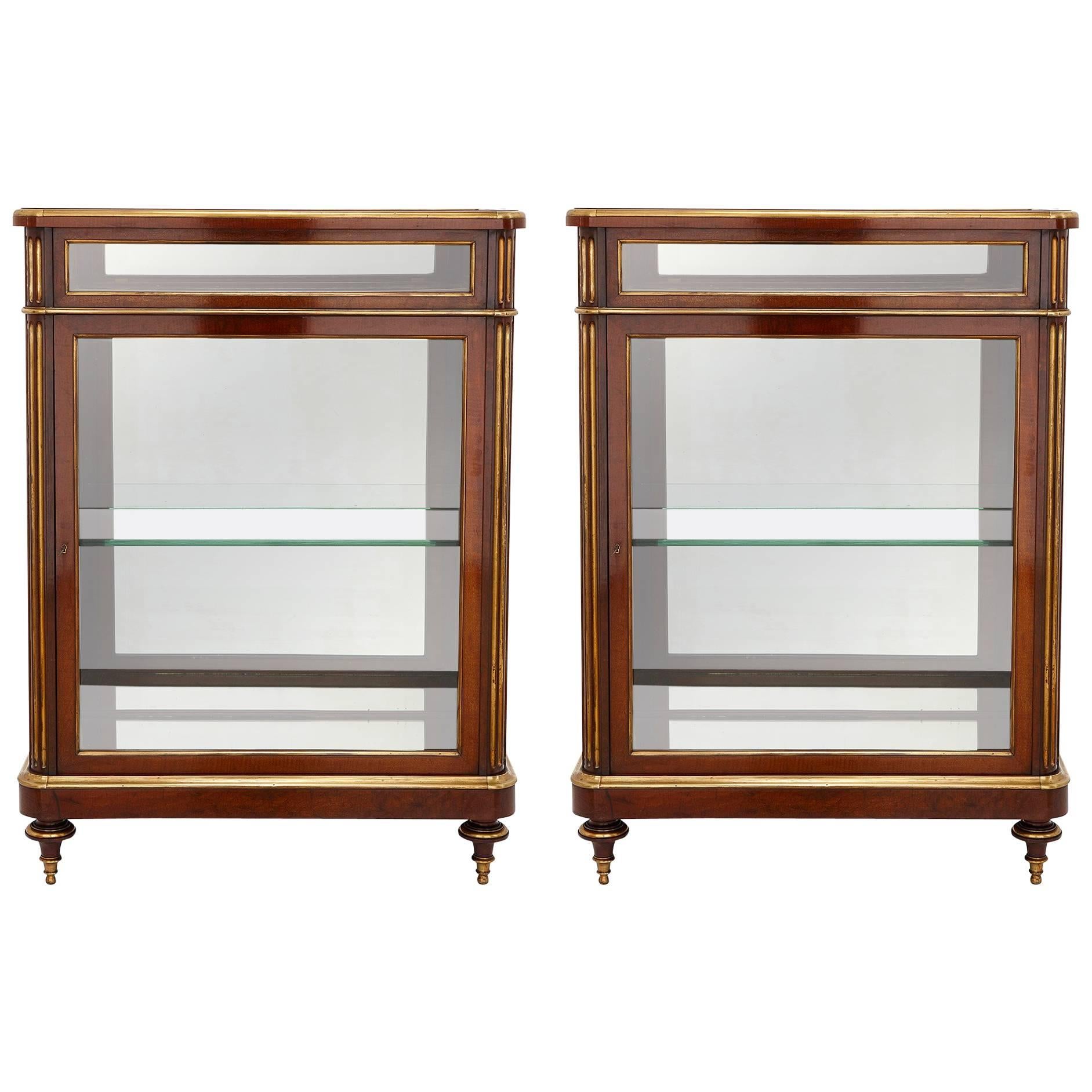
Fine pair of neo-Renaissance vitrines in richly carved wood, with three glazed sides framed by a relief frieze. Each opening to a drawer decorated with interlacing on the belt, and to a front door, they have two glass shelves. The uprights are composed of a couple of terms ending in a sheath, supporting a capital with acanthus leaves. They rest on lion paws and are topped with a green breccia molded marble top.
The Fourdinois company was founded in 1835 by Alexandre-Georges Fourdinois (1799-1871). The Universal Exhibition held in London in 1851 was undoubtedly their first great artistic and public success. Winning the Great medal for a neo-Renaissance buffet triggered a competition among other cabinetmakers, as the press was unanimously greeting their success. His son Henri-Auguste (1830-1907) was taught design by the architect Duban, then by the silversmith Morel in London, before working with the bronze founder Paillard. He joined the firm in 1860. His talent and the high quality of his designs drew attention at the 1862 World Exhibition in London, where the jury awarded him two medals for « Excellence in Composition and Execution ». Henri-Auguste, now sole in charge, brought the firm to the summit of its achievements at the 1867 Universal Exhibition in Paris by winning the Grand Prix (classes 14 and 15) as well as at the 1878 Exhibition. The 1862-1880 period marks truly the peak for the Fourdinois house, which remains for many cabinet-makers, whether French, English or American, an example to follow.
- Attributed to:Henri-Auguste Fourdinois (Cabinetmaker)
- Dimensions:Height: 42.52 in (108 cm)Width: 44.49 in (113 cm)Depth: 19.69 in (50 cm)
- Sold As:Set of 2
- Style:Renaissance Revival (In the Style Of)
- Materials and Techniques:
- Place of Origin:
- Period:
- Date of Manufacture:circa 1860
- Condition:Wear consistent with age and use.
- Seller Location:PARIS, FR
- Reference Number:Seller: 1803/01stDibs: LU3860329023192
About the Seller
4.9
Vetted Professional Seller
Every seller passes strict standards for authenticity and reliability
Established in 1997
1stDibs seller since 2018
91 sales on 1stDibs
Associations
International Confederation of Art and Antique Dealers
Associations
- ShippingRetrieving quote...Shipping from: Saint Ouen, France
- Return Policy
More From This Seller
View AllRare Pair of Renaissance Revival Cabinet Attributed to F. Linke, France, c. 1880
By François Linke
Located in PARIS, FR
Cabinet 1 - Height : 152 cm (59,8 in.) ; Width : 96 cm (37,8 in.) ; Depth : 48 cm (18,9 in.)
Cabinet 2 - Height : 150 cm (59 in.) ; Width : 87,5 cm (34,4 in.) ; Depth : 42 cm (16,5 in.)
Rare near pair of French Renaissance style cabinets attributed to F. Linke. Composed of an architectured upper part, with inlaid panels alternated with Fine fluted columns, opening with a central door onto an exquisite filet framed veneered wood interior fitted with shelves. The decor of the panels is made of very Fine designed motifs such scrolls, grotesques and flowery vases, all characteristic of the Renaissance decorative repertoire. The lower section with three drawers above a three arched support ornated with columns, raised on a stepped base ; the back with similarly-inlaid decoration.
These neo-Renaissance style cabinets are very close to François Linke’s one presented in his private collection.
(photo attached, Reproduced and commented in François Linke (1855-1946), The Belle Époque of French Furnitures, Ch. Payne, pp.40-41).
If the style, characterizing François Linke, is mostly recognizable by its Rococo-Art Nouveau motifs, it occasionally appealed other historical ornaments, such from the French Renaissance. That reminds of the time, when the cabinet took the central place in the interior furnishings. This collector...
Category
Antique 1880s French Renaissance Revival Cabinets
Materials
Wood
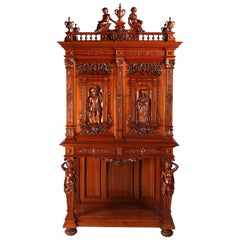
Renaissance Style Wooden Cabinet Attributed to H.A. Fourdinois, France, 1893
Located in PARIS, FR
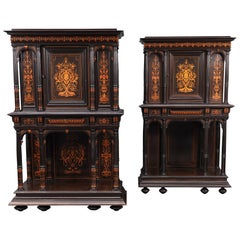
A wooden cupboard, elaborately carved throughout, dated "1893" on the crest and attributed to H.A. Fourdinois. The upper section with a pair of cherubs at the center of a balustrade ornamented with two-handled urns, two architectonic doors below, carved with lady and gentleman in niches surrounded by extensive carving with classical motifs. The lower section with two drawers above a standing female caryatid support at each front corner. The all reposing on four gadronned round feet.
The Fourdinois company was founded in 1835 by Alexandre-Georges Fourdinois (1799-1871). The Universal Exhibition held in London in 1851 was undoubtedly their first great artistic and public success. Winning the Great medal for a neo-Renaissance buffet...
Category
Antique 1890s French Renaissance Cabinets
Materials
Wood
$16,179 Sale Price
38% Off
Wooden
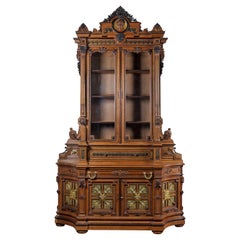
Enameled Display Sideboard Attributed to H.A Fourdinois, France, c1867
Located in PARIS, FR
Important two-tiered sideboard attributed to H.A. Fourdinois made in natural and carved wood : the lower part made up of four panels, two concave ones and two doors, richly ornated with a polychrome enameled floral decoration and gilt bronze plaques.
A large dual drawer is surmounted by the upper part of the sideboard, opening with two glazed doors, framed by detached columns. The entire unit is topped with a pediment onto which a female bust is carved in relief within a medallion on a gilt background.
With a matching set of twelve chairs.
The Forney library in Paris preserves order registers of the Fourdinois as well as sketches books and pictures representing pieces of furniture made by the Fourdinois workshops. In this documentation, some elements enable us to link this sideboard with Henri-Auguste Fourdinois’ productions, such as the large scrolls linking the upper part to the lower part of the sideboard, as well as the detached columns carved at their lower third. (picture n°1 attached)
Notebook containing ink-sketches coming from the Fourdinois workshop shows a project for a pelmet, beautified with a centering trophy composed of a torch and a quiver within in a foliage wreath, this motif obviously reused by the Fourdinois on the central decoration of the panels of our sideboard. (picture n°2 attached)
The firm of Fourdinois, considered during the Second Empire as the greatest furniture manufacturer in Paris, was founded in 1835 by Alexandre-Georges Fourdinois (1799-1871). It was developped in the context of the Expositions Universelles. At the time, the firm already produces furniture of the Neo-Renaissance style, such as a dresser that won the Great Medal at the London Universal Exhibition of 1851. The son, Henri-Auguste Fourdinois (1830-1907), joined the firm in 1860 and will become head of the firm in 1867. The high quality of his designs was remarked at the Universal Exhibition in 1862, when the jury awarded him two medals « for Excellence of Composition and Execution ». Henri-Auguste, now sole in charge, brought the firm to the summit of its achievements at the 1867 Universal Exhibition in Paris by winning the Grand Prize for his stand. Apart from the commissions he executed for the « Mobilier de la Couronne », he also produced high quality furniture for the Parisian bourgeoisie. The firm is at its zenith during the years 1862-1880. At this time, it is considered as an example to follow for other cabinet-makers, whether they are French, British or American.
Through the quality of execution and the extreme care taken in the decoration of furniture, H.-A. Fourdinois was particularly appreciated by Napoleon III and Eugenie...
Category
Antique 1860s French Renaissance Sideboards
Materials
Enamel, Bronze
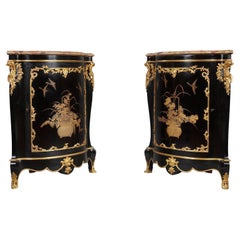
Pair of Lacquered Wood Encoignures, by A.E. Beurdeley, France, Circa 1890
By Alfred Emmanuel Louis Beurdeley
Located in PARIS, FR
Stamped twice A BEURDELEY A PARIS on the back.
Charming Louis XV-inspired pair of encoignures in lacquer and gilded bronze. The animated facade ope...
Category
Antique 1890s French Louis XV Corner Cupboards
Materials
Marble, Bronze
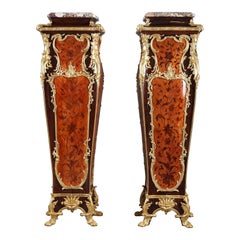
Pair of Marquetry Display Pedestals Attributed to Maison Millet, France, c. 1890
By Maison Millet
Located in PARIS, FR
Elegant pair of Louis XV inspired display pedestals attributed to Maison Millet. They are decorated on three sides with a beautiful marquetry of stylized flowers in “bois de bout”, i...
Category
Antique 1890s French Louis XV Pedestals and Columns
Materials
Breccia Marble, Bronze
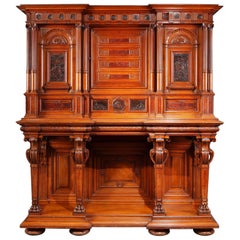
Neo-Renaissance Cabinet by G.F. Quignon, Universal Exhibition of Paris 1889
By Frederic Gustave Quignon
Located in PARIS, FR
Presented at the Universal Exhibition of Paris in 1889
Important sculpted and engraved natural wood, patinated bronze and Griotte de Campan red marble inlaid Neo-Renaissance style cabinet.
The upper part is composed of a frieze of bronze medallions separated by triglyphs and supported by ribbed columns with Corinthian capitals. There are eight of these columns paired at the front and two simple columns at the rear. The facade presents an alternation of bronzes in niches and cartouches, of marble slates in cartouches sometimes flanked by palmettes, and of engraved motives of laurel and foliage scrolls. The upper part opens with three leaves and three mobile compartments. The belt carved with acanthus leaves opens with two drawers. This cabinet is supported by four richly sculpted tapered feet ending with claws. Four fluted pilasters are inscribed in the moulded back as counterparts. The whole ensemble stands on a moulded plinth and eight rounded feet.
Neo Renaissance Cabinet...
Category
Antique 1880s French Renaissance Cabinets
Materials
Marble, Bronze
$101,872 Sale Price
37% Off
You May Also Like
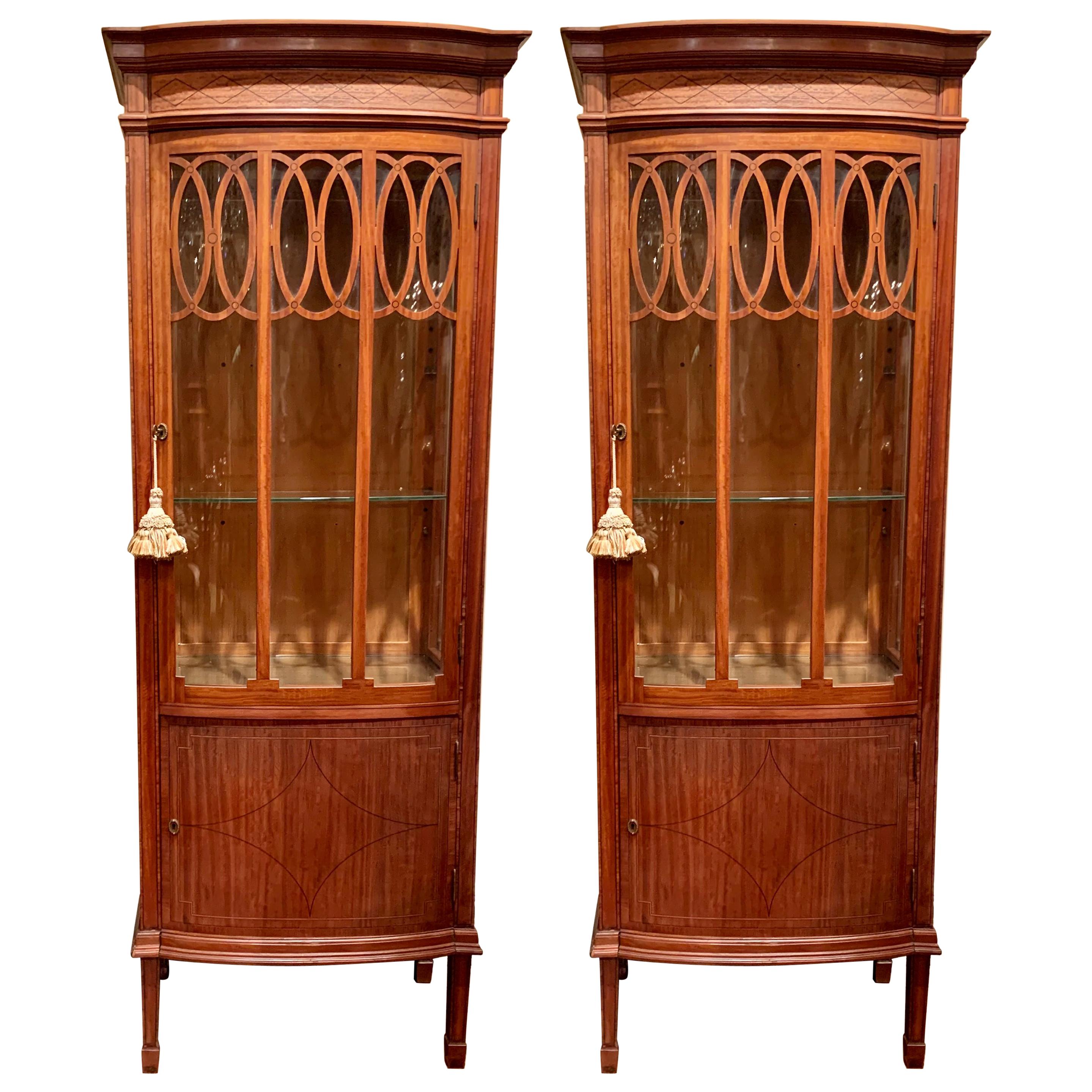
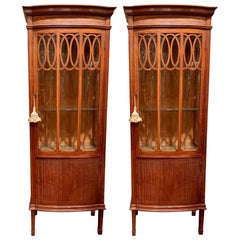
Pair Antique French Satinwood Vitrines
Glass Display Cabinets
, Circa 1880
Located in New Orleans, LA
Pair antique French satinwood vitrines (glass display cabinets), Circa 1880.
Category
Antique 1880s French Vitrines
Materials
Satinwood
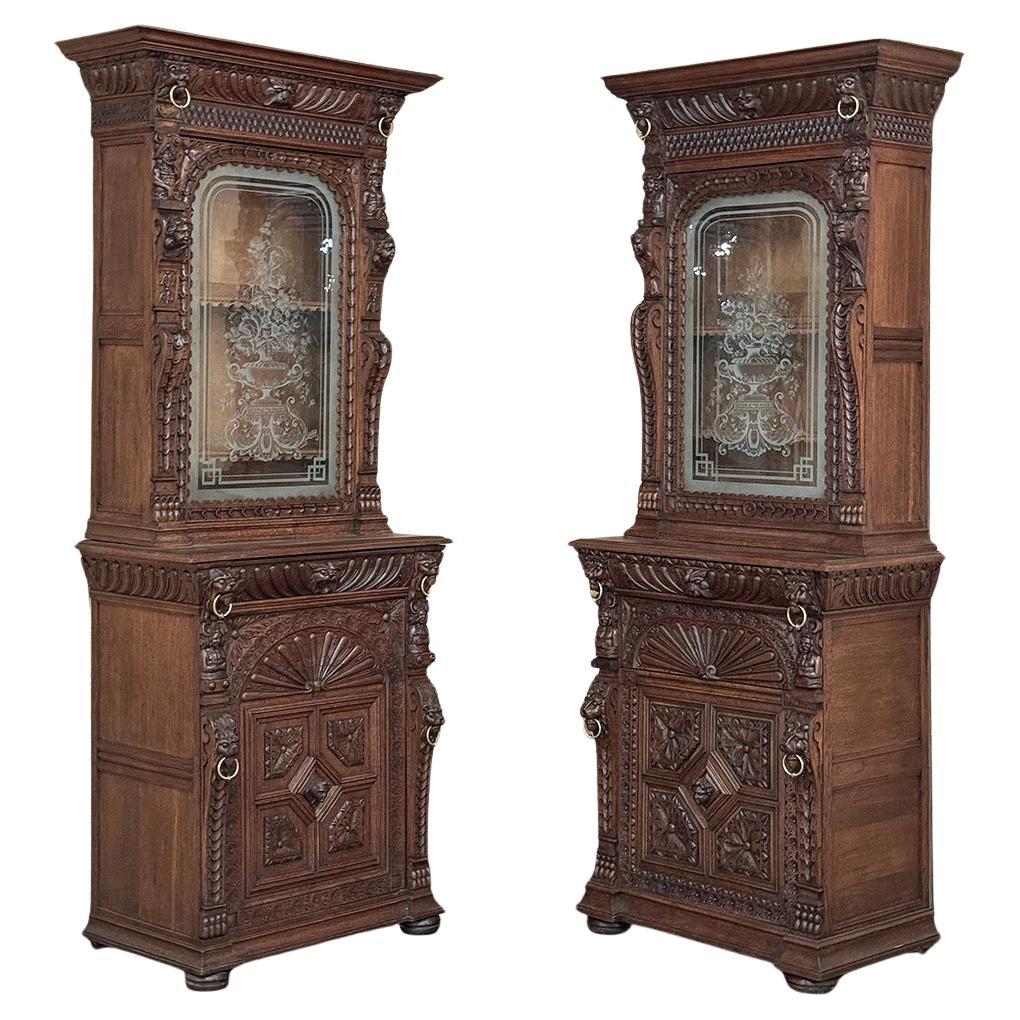
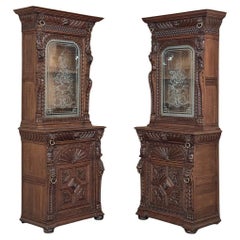
Pair 19th Century Flemish Bookcases with Etched Glass
Located in Dallas, TX
Pair 19th Century Flemish Bookcases with Etched Glass will make a perfectly symmetrical style statement for your favorite room! Crafted by master artisans from indigenous old-growth...
Category
Antique Mid-19th Century Belgian Renaissance Revival Bookcases
Materials
Brass
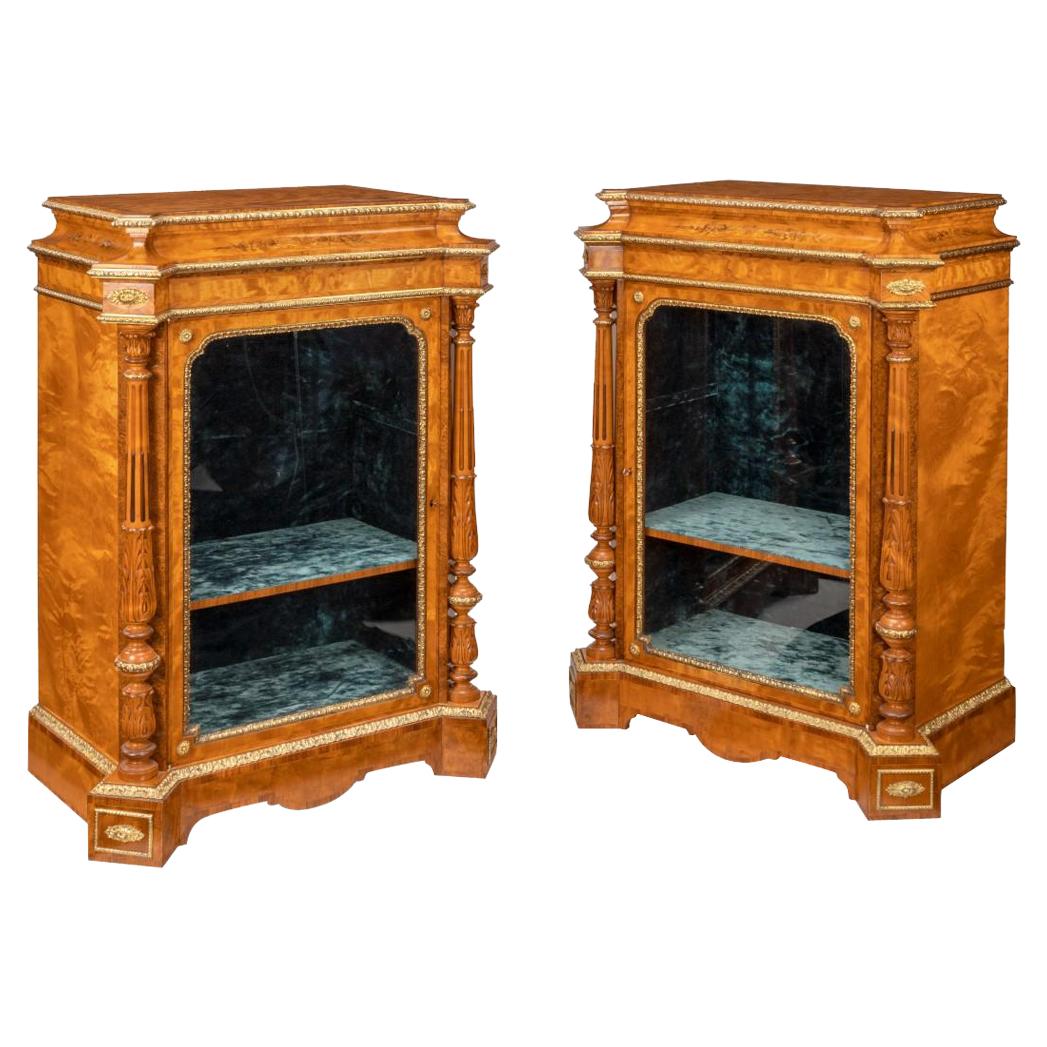
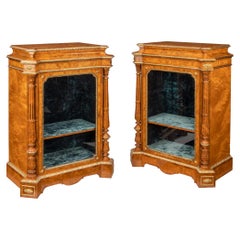
Pair of Victorian Satinwood Display Cabinets Attributed to Holland and Sons
Located in Lymington, Hampshire
A pair of Victorian satinwood display cabinets attributed to Holland and Sons, each of stepped, rectangular form with protruding square-cut corners holding turned stop-fluted and acanthus-carved pillars, with a central glazed door opening left- and right-handed, the blue velvet lined interior with an adjustable shelf, decorated in satinwood, amboyna and kingwood with marquetry floral...
Category
Antique 19th Century British Victorian Cabinets
Materials
Satinwood
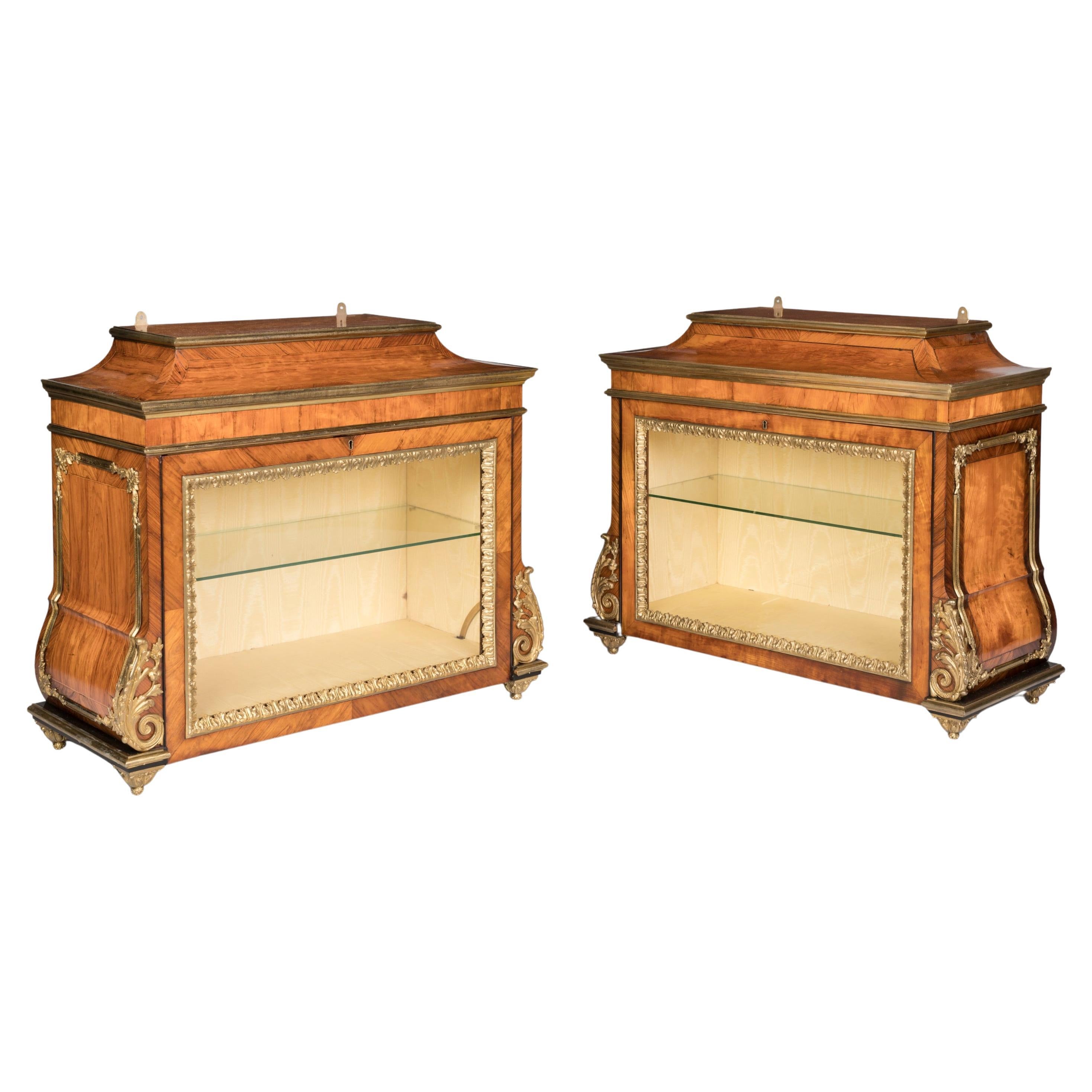
Matching Pair of 19th Century French Ormolu-Mounted Table-Top Cabinets
Located in London, GB
A Matched Pair of French Table Cabinets
Both cabinets lined with silk, enclosing a glass shelf and mounted with gilt bronze, one constructed from bookmatched tulipwood and the other employing satinwood throughout, with acanthus leaf pointed feet, stylised scrolls to the sides, and a fall front glass door...
Category
Antique 19th Century French Cabinets
Materials
Ormolu
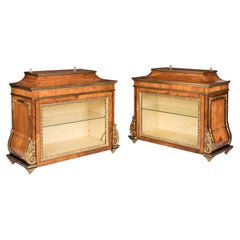
Pair of Wood, Bronze and Glass Showcases Vitrines, France, Late 19th Century
Located in Buenos Aires, Buenos Aires
Pair of wood, bronze and glass showcases vitrines. France, late 19th century.
Category
Antique Late 19th Century French Napoleon III Vitrines
Materials
Bronze
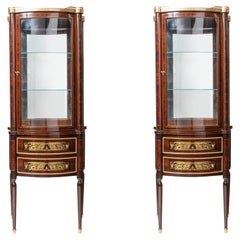
Two Glass and Mahogany Display Cabinets, 19th Century, France
Located in London, GB
These refined display cabinets, or vitrines, are perfect for elegantly complimenting the display of trinkets without outshining them. The cabinets are crafted in rectangular form fro...
Category
Antique Late 19th Century French Belle Époque Vitrines
Materials
Brass
More Ways To Browse
Exhibition 1862
Relief Frieze
French Empire Vitrine
Marble Top Vitrine
Mastercraft Brass Glass Cabinet
French Empire Vitrine Cabinet
Louis Xv Vernis Martin Vitrine
1880 French Vitrine
1930s Display Case
German Display Case
Biedermeier Display Cabinet
Corner Cabinet Dining Room
Bombe Vitrine
Glass Case Display Table
Iron Medical Cabinet
Antique Glass Display Table
German Display Cabinet
Small Vitrine