Louis XVI Furniture

LOUIS XVI STYLE

Reflecting the final era of royal opulence before the upheaval of the French Revolution, antique Louis XVI furniture features more angular shapes than the Rococo curves of the Louis XV style, harkening back to the imposing grandeur of Louis XIV.

Dating between 1750 and 1800, an era that overlapped with the last king of France whose reign was cut short by the guillotine, Louis XVI furniture, known as the goût grec, is emblematic of the neoclassical revision that French furniture underwent during the second half of the 18th century.

Authentic Louis XVI furniture characteristics include clean lines and carved details such as scrolls and acanthus flourishes that were inspired by ancient Greece and Rome. This was informed by a burgeoning interest in antiquity in the 18th century, owing to new archaeological excavations at sites including Pompeii and Herculaneum. It largely eclipsed the more East Asian–influenced ornamentation of Louis XV for something more geometric and symmetrical.

The Louis XVI style was defined by what was being created for the palatial rooms at Versailles and Fontainebleau, particularly for the queen, with cabinetmaker Jean-Henri Riesener being a favorite of Marie-Antoinette’s for his luxurious pieces accented with gilded bronze and marquetry. Furniture maker Jean-Baptiste-Claude Sené was also a major designer of the period, with his pieces for the royal residences adorned with giltwood and neoclassical touches like tapered columns for chair legs and laurel leaf carvings. Cabinetmaker Adam Weisweiler occasionally incorporated into his furniture porcelain panels produced by Sèvres, a popular manufacturer of European ceramics that served the crown with serveware, vases and other decorative objects.

Find a collection of antique Louis XVI seating, tables, cabinets and other furniture on 1stDibs.

to
75
1,213
6,733
3,080
1,203
6
4
20,185
19,787
7,942
3,415
2,419
2,050
1,253
947
860
848
654
652
651
641
612
445
401
114
687
402
10
170
77
25
22
14
24
9
10
9
14
3
2
3
763
572
456
381
202
1,025
891
43
37
36
1,213
1,209
1,209
25
18
16
15
8
Item Ships From: New York
Style: Louis XVI
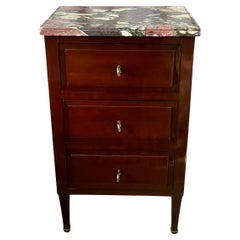
Louis XVI Amaranth Marble Top Side Table
Located in New York, NY
Louis XVI amaranth marble top side table. A Naples severe Louis XVI commode bedside table with three keyed drawers and purple cream and magenta f...
Category

Early 1800s Italian Antique Louis XVI Furniture

Materials

Marble

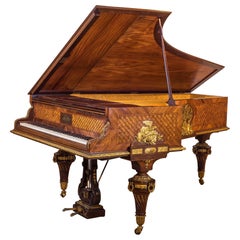
Important Ormolu-Mounted Amaranth, Kingwood and Satine Parquetry Grand Piano
Located in New York, NY
Attributed to Henry Dasson (d. 1896) Origin: French Date: circa 1885-q890 Dimension: (H) 35 1/4 in x (W) 54 in x (W) 78 in. Provenance: Acquired by Dr. J. T Nieto-Gomez from fi...
Category

Mid-19th Century French Antique Louis XVI Furniture

Materials

Bronze

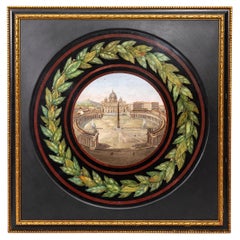
Large Antique Italian Micro Mosaic plaque of St. Peters Square, Rome mid 1800 s
By Vatican Mosaic Studio
Located in New York, NY
A Very Large and Exceptionally Fine Quality Antique Italian Micro-Mosaic Plaque Depicting "The Saint Peter Square" in Rome. The center medallion surrounded by a beautiful Laurel Wreath in multiple shades of Green Mosaic amidst a black Belgium Marble border. The interior rounded subject depicts Saint Peter Square which is found in Rome, Italy. The entire center panel is made up of a captivating array of tesserae in a variety of shapes and colors, which create this stunning mosaic construct. When inspected from up-close, small rectangular tesserae are found in an assortment of colors, which include: white, green, blue, red, black, brown, orange etc. When the subject is seen from afar, a fantastic image of the entire Saint Peter Square can be viewed as if a painting has been created. The oil on canvas of this scene, by was sold in Christie's Auction for over $2,000,000 USD. The plaque rests in a custom ebonized and gilt square frame. This can be used as a decorative object on the wall to serve as a painting, or, be converted to a table-top by mounting it on a table stand. Rome, Circa: 1850 Giovanni Paolo Panini (Piacenza 1691-1765 Rome), View of Saint Peter's Square, Rome. From Christie's Auction: Giovanni Paolo Panini arrived in Rome in 1711, painting capricci and architectural pieces in a vigorous if slightly eccentric style, and by 1719, when he was admitted to the Academy of St. Luke and the virtuosi al Pantheon, he was a rising star in the Roman art world. From around 1719-1726 he was much in demand for decorative frescoes, including quadratura, ornament and landscape and other genres, often in collaboration with figure or flower painters. During this period he worked for Cardinal Patrizi at Villa Patrizi, Cardinal Annibale Albani at Palazzo Albani (now del Drago) alle Quattro Fontane, Livio de Carolis at Palazzo de Carolis, Cardinal Alberoni at Palazzo Alberoni, Innocent XIII Conti in the Quirinal and in the library of S. Croce in Gerusalemme. In 1724 he married Caterina Gosset, the sister-in-law of Nicolas Vleughels, the director of the French Academy in Rome, to which he was admitted in 1732, and as a result he was much patronized by the French. During the 1720s he developed his figure style away from the awkwardness of his early works into one that concentrated on groups of stylishly-dressed aristocrats and skillfully modelled bystanders, sibyls and pseudo-antique figures. These he noted down in drawings (such as a sketchbook in the British Museum) that he drew upon to populate his paintings. He also began to receive commissions to design and record temporary festivals, often for French ambassadors to Rome. By the beginning of the 1730s Panini was developing a distinctive subgenre of the capriccio in which recognizable monuments are placed in imaginary topographical relationships, which were well-received in the classicizing era of Clement XII Corsini. In 1732 he was one of the panel of judges for the competition instituted by Clement for the Lateran façade, and in the following year painted an impressive View of Piazza del Quirinale for the pope. At about this time he was developing his best-known topographical subjects, interior views of St Peter's and the Pantheon, which were much in demand, to judge by the number of extant versions extending into the 1750s. By about 1734 he was beginning to attract the attention of English patrons, who ordered sets of Roman views, such as those at Marble Hill House (1738) and Castle Howard. In 1736, through Filippo Juvarra, he received important commissions from Philip V of Spain for scenes of the life of Christ in the Chinoiserie room at La Granja in Spain (1736). From as early as the 1720s he had been producing some vedute (view-paintings), initially based on prototypes by Gaspar van Wittel, and he developed the genre in subsequent decades in works that would include impressive panoramic views of the Forum or Palatine, although his staple genre was the capriccio rather than the veduta. He also expanded his repertory of church interiors, adding such churches as S. Paolo fuori le Mura and S. Agnese in Piazza Navona, as well as church interiors recording special events. His son by his first marriage, Giuseppe (1718-1805), began to support him in architectural and festival design projects. By the 1740s Panini was at the peak of his powers, and evidently had a considerable workshop helping him meet demand, especially of capricci to be used as overdoors and other decorative installations. Giovanni Paolo was successful in elevating himself socially above the usual artisanal status of genre painters, and would sometimes include a self-portrait in paintings commissioned by the great and powerful. He also appears to have been successful financially, and owned a substantial palazzo in via Monserrato. He increasingly concentrated on important commissions, such as a view of the Lottery in Piazza Montecitorio (London, National Gallery, 1743-1744), the designs for the festival decorations for the birth of the Dauphin in Palazzo Farnese (Waddesdon Manor, 1751), or the view of an imaginary picture gallery housing the collection of Cardinal Valenti Gonzaga (Wadsworth Atheneum, 1749). In the mid-1750s he received an important series of commissions from the Duc de Choiseul, French ambassador to Rome and soon to become one of the most powerful men in France, that included his best-known compositions, Ancient Rome (Roma Antica) and Modern Rome (Roma Moderna). These large paintings, of which there are three sets (in Boston and Stuttgart, the Metropolitan Museum, and the Louvre) represent imaginary picture galleries based on the Valenti Gonzaga composition but hung with what purport to be Panini's own vedute of ancient and modern sites respectively (with corresponding pieces of sculpture). These paintings sum up the eighteenth-century canon of the greatest works of architecture and sculpture, and the equivalence between modern and ancient Rome. By this time Panini was being assisted by his son by his second marriage, Francesco (1748-1800), who was a skilled draughtsman and painter who continued his father's work after his death in 1765. The Farnborough Hall paintings The Piazza S. Pietro and the Campidoglio are important vedute by Panini painted in 1750 and originally installed, with other works by Panini and Canaletto, in the seat of the Holbech family, Farnborough Hall, Warwickshire (National Trust). Farnborough Hall had been inherited in 1717 by William Holbech (circa 1699-1771), who is documented on the Grand Tour in Florence, Rome and Venice from late 1732 until his return home at the end of April 1734 with his brother Hugh. Holbech is said to have gone on the Grand Tour to recover from a broken heart and to have spent a considerable time there prior to these documented appearances. During his time in Rome he acquired two Paninis, which were seen by an anonymous antiquary around 1746, who referred to various sculptures "all brought from Rome with two pictures, one of the Rotunda, and the other of diverse buildings by Panino" (British Library, Add. MS 6230, pp. 31-32). The Rotunda (the Pantheon) is a painting now in a private collection in New York, and is signed and dated 1734. The Diverse Buildings, which was probably one of Panini's capricci, has not been identified. On his Grand Tour Holbech seems also to have acquired two Canalettos, although they are not mentioned by the antiquary, who may only have had eyes for things Roman. In about 1746-1747, Holbech remodelled the house by creating a Saloon, now the dining room, at the back of the house. This room, the entrance hall, the staircase, library and closet were stuccoed by William Perritt of York, and a bill for this work dated 14 November 1750 survives (or survived until recently; G. Beard, Decorative Plasterwork in Great Britain, London, 1975, p. 233). The two Canalettos acquired on the Grand Tour were installed in the Saloon, together with two new works commissioned from Canaletto, who was then in England and working nearby at Warwick Castle in 1748. The two Paninis acquired on the Grand Tour may have been installed in the Library, as Alastair Laing assumes (op. cit.), while three new works commissioned from Panini in Rome were placed in the Hall and Saloon: the Piazza S. Pietro for the overmantel in the Hall (fig. 1), the Campidoglio as the overmantel in the Saloon (fig. 2), and an Interior of St Peter's (now in Detroit) (fig. 3) on the adjacent wall facing the windows. Two of the Canalettos flanked the Campidoglio, while the others were on the opposite wall. The Interior of St Peter's was therefore effectively the fifth member of the Canaletto set, distinct from the two overmantels. Holbech's installation of his Canalettos and Paninis in fixed stucco frames was unusual for England in 1750, and had probably been inspired by what he had seen on his Grand Tour in Northern Italy, where fixed stucco installations of canvases were common in the 1720s and 1730s (Cornforth, II, p. 51). The Campidoglio and the Interior of St Peter's are both signed and dated 1750, a date that corresponds to the payments for the stucco. The commission for the new Paninis would have been made through an agent, possibly the Roman dealer in antiquities Belisario Amidei from whom some of the antique busts in the Hall were acquired in 1745, who was also a picture dealer; or perhaps the painter Pietro Berton, who on 7 December 1750 shipped a Panini to England. The paintings were sold to Savile Gallery in 1929 and replaced by copies by one Mohammed Ayoub. The four Canalettos were exhibited at Savile Gallery in 1930 and entered the London art trade, finding their way at various times to Augsburg, Melbourne, Ottawa and a private collection. The Paninis seem to have been resold immediately to Knoedler & Co. in New York. When the stucco was removed from the library by Holbech's great-grandson, another William Holbech, shortly after his succession in 1812, the Interior of the Pantheon and the Diverse Buildings may have been taken down. Although there is no record of either painting being at Farnborough subsequently, the Interior of the Pantheon at least must have remained there, since it appeared at Knoedler's in 1930 at about the same time as the other Paninis, and was presumably acquired at the same time from the same source. The Campidoglio was a rare subject for Panini: this is the only known extant version, apart from fictive versions in the Metropolitan Museum (1757) (figs. 4) and Louvre (1759) versions of his Roma Moderna composition (but not in the first Boston version of 1757). Probably Holbech insisted on the choice of subject in order to represent the centre of Rome's civic administration to complement the religious one of St Peter's. The Campidoglio may have been of interest to English patrons because it represented the seat of a form of government they were more comfortable with than the papacy. For example, Canaletto painted the subject, together with English subjects, for Thomas Hollis, 'the most bigoted of all Republicans' in 1755, who may have wanted to 'represent London as the heir to the legacy of Ancient Rome and Renaissance Italy' (see Michael Liversidge and Jane Farrington, eds., Canaletto and England, exhibition catalogue, Birmingham Museums and Art Gallery, London, 1993, p. 25). Canaletto also painted the subject for Sir Richard Neave, Ist Baronet (1731-1814) of Dagnam Park, Essex, at the end of his English stay or shortly afterwards (i.e. 1755-1766) (sold, Sotheby's, London, 10 July 2002, lot 8). Like Holbech, Neave mixed Venetian and Roman subjects, but his Roman subjects steer clear of St Peter's: the others were the Piazza del Quirinale and Piazza Navona. While Holbech had gone to both Venice and Rome and commissioned views of both cities, Rome sets the keynote for his decoration: antique busts line the Hall, and its religious and civic centres are the overmantels in the Hall and Saloon respectively. The Piazza S. Pietro The Piazza S. Pietro shows the piazza much as it appears today, apart from the absence of Valadier's late eighteenth-century clocks on the towers. Bernini's colonnade (1656-1667), both ends of which are visible, reaches out its arms to embrace the viewer. In the center of the piazza is the obelisk moved by Sixtus V in 1586 from the left side of the church where it had formed part of the Circus of Nero. On either side are two fountains, the one on the right by Carlo Maderno (1613) and the one on the left created to match it by Carlo Fontana in 1677. Beyond is the rectangular forecourt to the church, the piazza retta, leading to the façade by Maderno, completed in 1610, and the dome by Michelangelo, Giacomo della Porta and Domenico Fontana. To the right of the façade the roof of the Sistine Chapel is just visible, followed by the Cortile di S. Damaso, the palace of the Swiss Guards and the palace of Paul V. A Cardinal is being driven in a carriage across the piazza at the right in the direction of the Borgo Nuovo and Ponte S. Angelo with his blue-liveried retinue and subsidiary carriages. Unlike the later versions of the subject that depict the Duke de Choiseul, there seems to be no intent to portray any particular cardinal: the procession of a cardinal here is presented simply as characteristic activity within the piazza. Various groups of figures, including well-dressed women in brightly colored dresses, Swiss Guards, priests, gentlemen, idlers and a pilgrim are distributed around the piazza. In the foreground an imaginary heap of fallen masonry provides visual interest in an otherwise dead space. Panini painted the Piazza S. Pietro on a number of occasions, and his works falls into two types, one with the viewpoint shifted slightly to left of the axis, as in the Farnborough Hall version, and one with it shifted slightly to the right. The first type is based on a composition by Gaspar van Wittel, of which there are numerous versions from 1684 until 1721 (Fig. 9 van Wittel). The work by Panini that seems closest to Van Wittel and therefore probably the earliest is the version in the Circolo della Caccia, Rome, which has been dated to the second half of the 1730s, but is probably a decade or so earlier. Another, on the London art market in 2002-2009, and a version with workshop participation at Sotheby's, Milan (20 November 2007, lot 137) and currently on the art market in Rome, are closer to an important painting in Toledo (Arisi no. 308) that is signed and dated 1741 (fig. 6). Van Wittel employed a wide format (about 2:1), showed both of the end faces of the colonnade almost to their full extent, and introduced the theme of a heap of masonry to enliven the foreground. His choice of perspective implies a viewpoint located in the small piazza between the Borgo Nuovo and Borgo Vecchio, now the Piazza Pio XII at the top of the Via della Conciliazione. From this viewpoint a building at the left tended to interfere with the view of the end of the left arm, as can be seen from the Nolli map...
Category

1850s Italian Antique Louis XVI Furniture

Materials

Glass

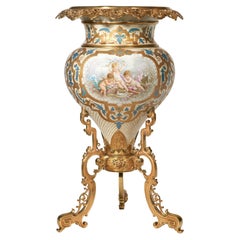
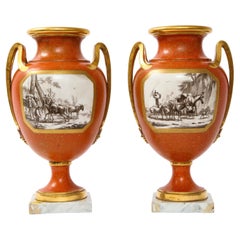
Large Important French 19th C. Sevres Porcelain Ormolu Mounted Jardiniere
Located in New York, NY
A Large & Important French 19th C. Louis XVI Style Sevres Porcelain Ormolu Mounted Jardiniere. This magnificent piece is of a baluster form wi...
Category

1870s French Antique Louis XVI Furniture

Materials

Bronze

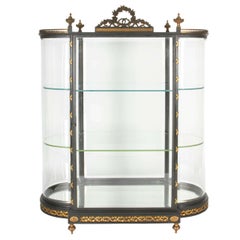
Antique Glass, Bronze and Steel Jewelry Showcase or Vitrine
Located in New York, NY
A beautiful antique French gilt bronze, patinated bronze, steel and glass jewelry vitrine or showcase, Paris, circa 1890-1910. It is very unusual to see these vitrines having the ori...
Category

20th Century French Louis XVI Furniture

Materials

Bronze

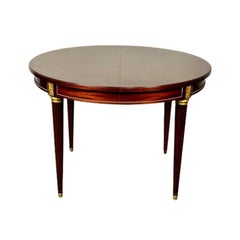
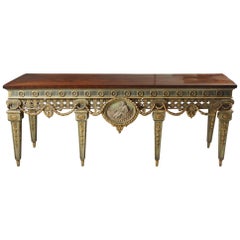
Louis XVI Style Bronze Mounted Center or Dining Table, Plum Pudding Veneer
Located in Manhasset, NY
Louis XVI Style Bronze Mounted Center or Dining Table, Plum Pudding Veneer Louis XVI style magnificently bronze mounted plum pudding veneer Centre or Dining Table having three insertable 19.5" leaves. This fine center or dining table has a stunning plum pudding table...
Category

1950s French Vintage Louis XVI Furniture

Materials

Bronze

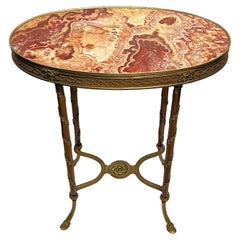
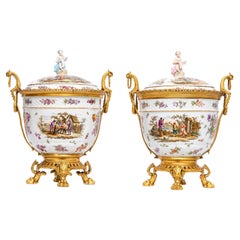
19th Century French Louis XV Style Marble and Bronze Side Table
Located in New York, NY
Exquisite French 19 century side table in the Louis XVI style with oval shaped variegated red marble top and frieze, decorated with neoclassical...
Category

Late 19th Century French Antique Louis XVI Furniture

Materials

Marble, Bronze

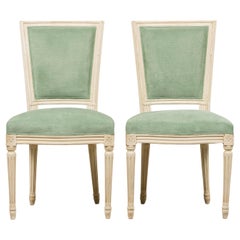
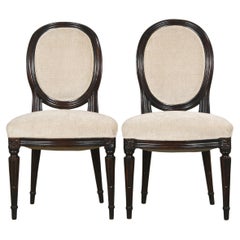
Antique French Louis XVI Style Painted Accent Side Chairs in Sea Green - A Pair
Located in Astoria, NY
An elegant pair of late 19th century French Louis XVI style side chairs, sourced in Provence. Each chair features a shield-shaped backrest and generous seat, newly upholstered in hig...
Category

Late 19th Century French Antique Louis XVI Furniture

Materials

Fabric, Paint, Hardwood

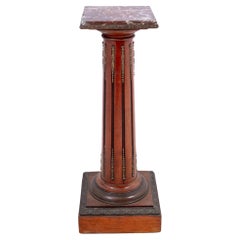
Louis XVI Style Mahogany and Marble Pedestal
Located in Astoria, NY
Louis XVI Style Gilt Metal Mounted Mahogany and Marble Pedestal, early 20th, the square top above a stop-fluted tapering pedestal, on a square plinth. 40.5" H x 15.5" W x 15.5" D.
Category

Early 20th Century French Louis XVI Furniture

Materials

Marble, Metal

Antique French Louis XVI Style Maple Side Chairs in Beige Chenille - A Pair
Located in Astoria, NY
A beautiful pair of early 20th-century French side accent chairs in the Louis XVI style, sourced from Provence. Each chair features a hand-crafted maple frame with an elegant oval ba...
Category

Early 20th Century French Louis XVI Furniture

Materials

Chenille, Maple

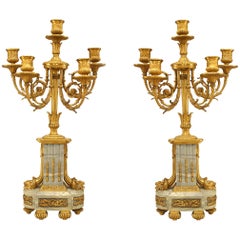
Pair of French Louis XVI Style Gilt Bronze and Marble Candelabras
Located in Queens, NY
Pair of French Louis XVI-style (19th Century) gilt bronze and grey marble base 5 scroll arm candelabra with cornucopia on side of base and foliate mounts. (PRICED AS Pair)
Category

19th Century French Antique Louis XVI Furniture

Materials

Marble, Bronze

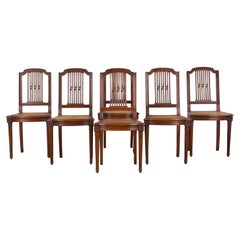
Antique French Louis XVI Style Maple Dining Chairs W/ Cane Seats - Set of 6
Located in Astoria, NY
An exceptional set of six late 19th-century French dining chairs in the timeless Louis XVI style, sourced directly from Provence, France. Expertly handcrafted from solid maple, each ...
Category

Late 19th Century French Antique Louis XVI Furniture

Materials

Cane, Maple

Tall Exquisite Austrian Antique Pair Continental Decorative Porcelain Vases
Located in Tarry Town, NY
This exquisite pair of Continental decorative vases showcases exceptional Austrian craftsmanship and artistic flair, making them a stunning focal point for any room or decor. Each ur...
Category

1840s Austrian Antique Louis XVI Furniture

Materials

Gold

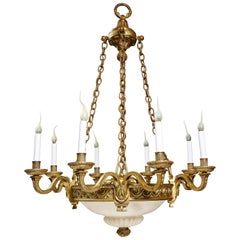
A French 19th Century Louis XVI Style Ormolu Carved Alabaster Chandelier
Located in New York, NY
A spectacular French Louis XVI style gilt bronze and carved alabaster chandelier. The chandelier is suspended from a domed gilt bronze canopy with acanthus leaf motifs and a heavy ch...
Category

19th Century French Antique Louis XVI Furniture

Materials

Alabaster, Bronze

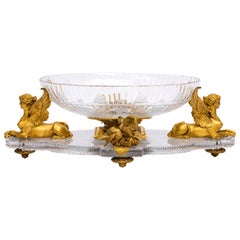
Hand-Diamond Cut Crystal Ormolu Mounted Baccarat Centerpiece/Surtout de Table
Located in New York, NY
A magnificent museum quality French 19th century hand-diamond cut crystal and ormolu-mounted Baccarat centerpiece/surtout de table in the Louis XVI style. This is truly an exemplary ...
Category

1870s French Antique Louis XVI Furniture

Materials

Crystal, Ormolu

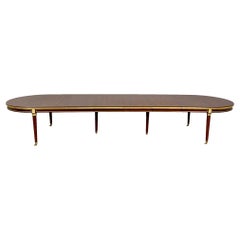
Monumental Louis XVI Hollywood Regency Dining Table, 15 Feet, Bronze Mounted
Located in Manhasset, NY
Monumental Louis XVI Hollywood Regency Dining Table, Conference Table, 15 Feet, Bronze Mounted, Maison Jansen Inspired. A table like this will not be found elsewhere. Simply Impressive is this larger than life fifteen foot long by 52 inch wide mahogany dining table in the fashion of Maison Jansen. A finely bronze mounted tastefully done dining or conference table having been fully refinished. The sleek tapering legs having bronze sabots with casters terminating in bronze circular caps leading to an apron that is bronze framed with cookie cutter corners. The exquisitely polished table top with a full bronze frame. The center having four strong center support legs each with wooden antiqued locking...
Category

Late 20th Century European Louis XVI Furniture

Materials

Bronze

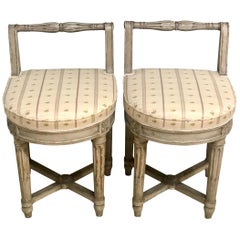
French Design, Louis XVI, Small Chairs, Ivory Painted Wood, Fabric, France 1740s
Located in Manhasset, NY
Pair of 18th century French Musician's chairs, Diminutive chair or stools each in a Swedish paint decorated original finish with new upholstery. Prov...
Category

Late 18th Century French Antique Louis XVI Furniture

Materials

Wood

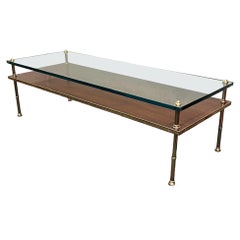
Gilt-Bronze, Walnut Glass Low Table
Located in Huntington, NY
1st Shelf 11.75’’ off ground 16’’ at table top.
Category

Mid-20th Century American Louis XVI Furniture

Materials

Bronze

Gilt-Bronze, Walnut 
Glass Low Table
Gilt-Bronze, Walnut 
Glass Low Table
$4,480 Sale Price
20% Off
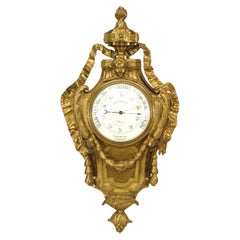
French Louis XVI Style Bronze Barometer
Located in Queens, NY
French Louis XVI-style bronze wall barometer with an urn finial top with a head above the round dial and draped with a ribbon design.
Category

20th Century French Louis XVI Furniture

Materials

Bronze

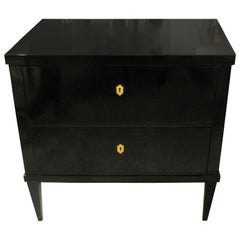
Custom Ebonized Louis XVI Style Chest/Commode on Tapered Legs
Located in New York, NY
Custom ebonized Louis XVI style chest/commode on tapered legs with ebony escutcheons. Please note that this chest is customizable and can be made in the wood of your choice- cerused ...
Category

21st Century and Contemporary American Louis XVI Furniture

Materials

Mahogany

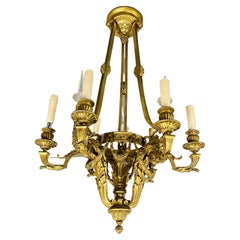
Louis XVI 19th Century Dore Bronze Chandelier, Six Light, Estate Item
Located in Manhasset, NY
Louis XVI 19th century dore bronze chandelier, This solid bronze six light, nine arm, chandelier was recently rewired about ten years ago. Having a very fine think bronze masculine f...
Category

1890s French Antique Louis XVI Furniture

Materials

Bronze

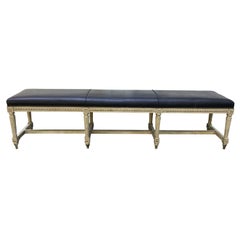
Jansen Neoclassical Louis XVI Bench
Located in New York, NY
Six foot six inch long neoclassical wood carved bench in original vintage condition with black leather tripartite upholstered top on eight wood car...
Category

1960s South American Vintage Louis XVI Furniture

Materials

Wood

Pair of Early 19th C. French Ormolu Covered Vases, Signed Clodion
Located in New York, NY
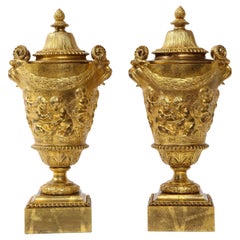
An Extraordinary Pair of Early 1800's French Ormolu Covered Vases, in the style of CLAUDE MICHEL, Signed Clodion. After the original terracotta vase by Clodion in 1763. These ormolu vases represent an extraordinary confluence of painting and sculpture in 18th century French art...
Category

1830s French Antique Louis XVI Furniture

Materials

Ormolu

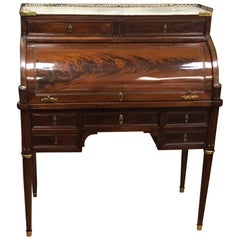
Louis XVI Mahogany and Brass Mounted Bureau a Cylindre, Late 18th Century
Located in Spencertown, NY
The desk with a 1/4 cylinder top that opens to reveal a leather writing surface with pigeon holes and drawers. The gallery with white Carrara marble top.
Category

Late 18th Century French Antique Louis XVI Furniture

Materials

Mahogany

A Pair of French Gilt Opaline Hand-Cut Crystal Pedestal Vases, Att. Baccarat
Located in New York, NY
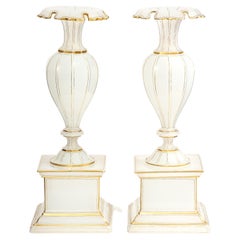
A Pair of French Hand-Cut White Opaline Crystal Pedestal Vases from the 2nd half of 1800s, Attributed to Baccarat. With their translucent porcelain-like appearance these vases consi...
Category

19th Century French Antique Louis XVI Furniture

Materials

Crystal

Very Large 19th Century Ormolu Mounted Sèvres Celeste Blue Ground Porcelain Box
Located in New York, NY
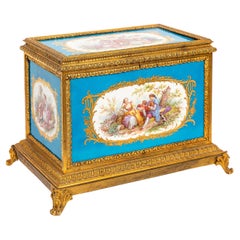
A Very Large 19th Century Ormolu Mounted Sèvres Celeste Blue Ground Porcelain Box with Watteau Scene Cartouches. This box consists of signature celeste blue ground of Sèvres porcela...
Category

1870s French Antique Louis XVI Furniture

Materials

Ormolu

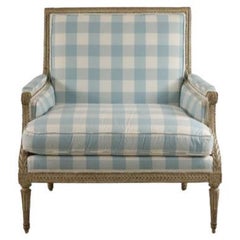
Louis XVI Blue and White Gingham Upholstered Marquise Armchair
Located in Queens, NY
French Louis XVI (18th Century) Marquise armchair with carved floral detail and modern blue and white gingham upholstery.
Category

18th Century French Antique Louis XVI Furniture

Materials

Fabric

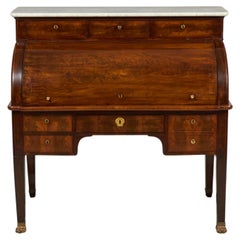
French Louis XVI Mahogany and Marble Roll Top Desk
Located in Queens, NY
French Louis XVI-style mahogany roll top desk with rectangular gallery marble top resting above 3 keyed drawers. The roll top reveals a gilt embossed leather desk top, under 3 brass ...
Category

20th Century French Louis XVI Furniture

Materials

Marble

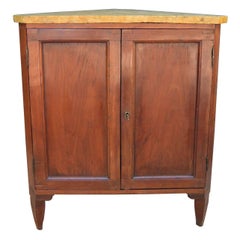
Neoclassical Italian Marble-Topped Angoliere Corner Cabinet
Located in New York, NY
Provincial Louis XVI period cherrywood encoignure / angoliere /corner cabinet with Siena gold marble top; with interior shelf and key, Italy, late 18th century. Dimension: 33.5" W x ...
Category

Late 18th Century Italian Antique Louis XVI Furniture

Materials

Marble

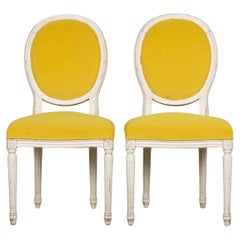
French Louis XVI Style Painted Side Chairs in Lemon Velvet - A Pair
Located in Astoria, NY
A truly delightful pair of French side accent chairs in the Louis XVI style, sourced from Provence, France. These chairs have a joyful presence—there’s something about their charm th...
Category

Mid-20th Century French Louis XVI Furniture

Materials

Velvet, Paint, Maple

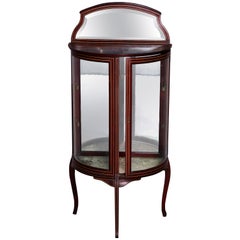
Antique French Louis XVI Mahogany Demilune Vitrine, circa 1900
Located in Big Flats, NY
An antique French Louis XVI vitrine offers mahogany construction in demilune form having shaped and mirrored backsplash over single do...
Category

20th Century French Louis XVI Furniture

Materials

Metal

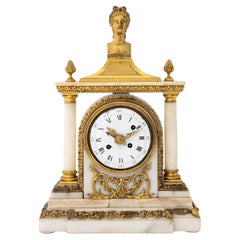
Louis XVI Gilt Bronze and Marble Mantel Clock
Located in Astoria, NY
Louis XVI Gilt Bronze and Marble Mantel Clock, late 18th century, of architectural form, the pediment surmounted by an Apollo portrait bust, supporting by tapering columns, centered ...
Category

Late 18th Century French Antique Louis XVI Furniture

Materials

Marble, Bronze

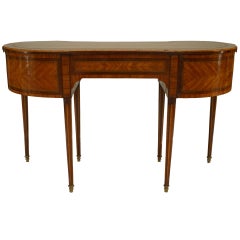
French Louis XVI Style Satinwood and Inlaid Kidney Desk
Located in Queens, NY
French Louis XVI style (19th Century) satinwood and inlaid 6 legged kidney shaped desk with side slides.
Category

19th Century French Antique Louis XVI Furniture

Materials

Satinwood

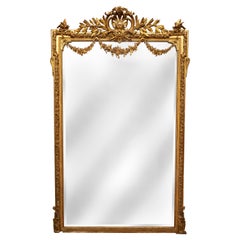
French Louis XVI Style Gilded Mirror
Located in Plainview, NY
An exquisite 19th century French Louis XVI gilded mirror. The rectangular mirror is embellished with a magnificent crown featuring scrolls and leaves. The frame is finely hand carved...
Category

Late 19th Century French Antique Louis XVI Furniture

Materials

Mirror, Giltwood

French Louis XVI Style Gilded Mirror
$1,475 Sale Price
50% Off
Pr. 19c Mintons Porcelain "Louis XVI Sevres Style" Blue Nouveau Ground Vases
Located in New York, NY
A fantastic and beautiful pair of antique 19th century mintons English porcelain Louis XVI style Sevres style blue nouveau ground hand-painted and hand-tooled-gilt, oval-shaped cover...
Category

1850s English Antique Louis XVI Furniture

Materials

Porcelain

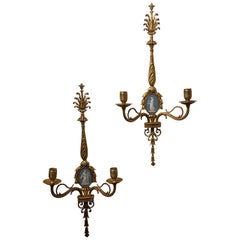
Wonderful Pair French Louis XVI Dore Bronze Wedgwood Sconces E F Caldwell
Located in Roslyn, NY
A wonderful pair of French Louis XVI style dore bronze & Wedgwood plaque two arm sconces in the manner of E. F. Caldwell. Wiring is available at no additional charge.
Category

20th Century French Louis XVI Furniture

Materials

Bronze

Large and Important Louis XVI Style Console Table from Blairsden House
Located in Hudson, NY
This very impressive console table comes from the famous American Country house Blairsden. This house built in Peapack NJ for C. Ledyard Blair and Mrs. Florence Blair between 1898 and 1903. The house was created and decorated by the important architectural firm of Carrere & Hastings. The firm produced many homes, churches, monuments and public buildings for America's gilded age notables. Blairsden boasts extensive landscaped gardens in the manner of the French Baroque in the tradition of Andre Le Notre. The interiors as well where extensively set out and incorporated appropriate French and English furniture complimenting the decorative schemes. No expense was spared to create this house and grounds based on the ideals of Edwardian splendor and the ideal modern residence. This house was listed in 1903 upon its completion in the survey of American Estates & Gardens published by Barr Ferree. While much was spoken of its location, setting, architectural accomplishments and style the summation of the listing called "Blairsden one of the most elaborate and extensive schemes of its kind ever carried out in America." This table was formally part of the dining rooms complete redecoration by the architectural firm carried out in 1913. The room was originally planned around dark paneling and a warm even family-style catering to their children. The new rooms scheme was greatly enlarged and lightened up considerably by extensive plasterwork and painting in the Adams style. This table and a mate was used to center two opposing walls and complimented the inset painted panels and plasterwork ceiling which contained many references to swags, pateria, and other classical motifs. This table has been pictured in several period photographs and the house is extensively spoken of in the comprehensive book published in 2006 by Acanthus Press encompassing the principles ideals and the extent of there work especially in the Beaux-Arts...
Category

Early 20th Century English Louis XVI Furniture

Materials

Gesso, Wood, Ebony, Mahogany

Pair 18th C. Meissen Porcelain Covered Tureens w/ 19th C. French Ormolu Mounts
Located in New York, NY
A Pair of 18th Century Meissen Porcelain Marcolini Period Covered Tureens with 19th Century French Ormolu Mounts. These tureens show the combination of iconic French and German porc...
Category

19th Century German Antique Louis XVI Furniture

Materials

Bronze

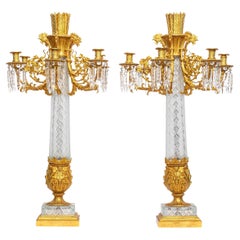
Pair French 19th C. Cut Crystal Dore Bronze Multi-Arm Candelabra w/ Roosters
Located in New York, NY
A Monumental Pair of French 19th Century Cut Crystal and Dore Bronze Multi-Arm Candelabra with Rooster Heads. This ornate, extravagant pair of monumental bronze candelabras exemplif...
Category

19th Century French Antique Louis XVI Furniture

Materials

Crystal, Bronze

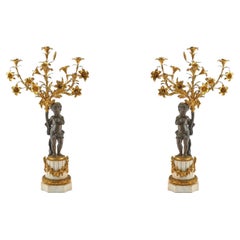
Pair 19th Century Louis XVI Patinated /Gilt Bronze and Marble Figural Candelabra
Located in New York, NY
Pair of large (19th century) five light candelabra in the French Louis XVI style with standing patinated bronze cherubs set upon carved white marble pedestals...
Category

Late 19th Century French Antique Louis XVI Furniture

Materials

Marble, Bronze

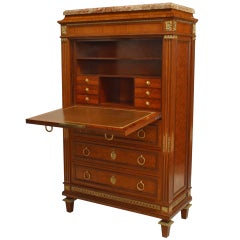
French Louis XVI Style Inlaid Secretary
Located in Queens, NY
French Louis XVI-style (19th Century) parquetry inlaid drop front secretary abattant with gilt bronze trim and ring hands with 4 drawers below a fitted interior with a leather writin...
Category

19th Century French Antique Louis XVI Furniture

Materials

Marble, Bronze, Gold Leaf

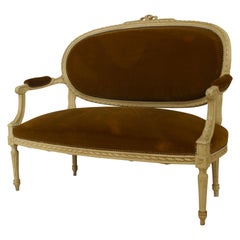
French Louis XVI Velvet Loveseat
Located in Queens, NY
French Louis XVI style cream painted loveseat with bow knot carved back crest and velvet upholstered seat and back Antique condition. Shows wear and tear
Category

19th Century French Antique Louis XVI Furniture

Materials

Upholstery, Velvet, Wood

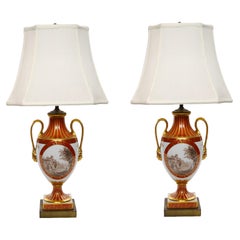
Pair Louis XVI Style French Porcelain / Dore Bronze Table Lamps
Located in Tarry Town, NY
Louis XVI style French porcelain and gilt gold dore decorative vase pair table lamp. Each lamp features on one side a painted pastoral promenade scenes signed by a famous artist in t...
Category

Mid-19th Century French Antique Louis XVI Furniture

Materials

Gold, Brass

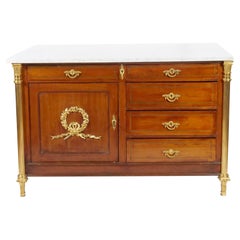
Early 19th Century Louis XVI Gilt Bronze-Decorated Mahogany Commode / Server
Located in Tarry Town, NY
This exceptional Louis XVI-style commode, crafted in France around 1820, embodies the elegance and craftsmanship of the early 19th century. Designed to impress, this piece features a...
Category

1820s French Antique Louis XVI Furniture

Materials

Bronze

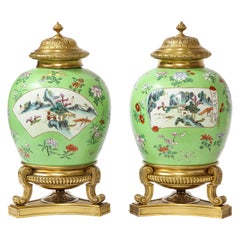
Pair of Dore Bronze Mounted Chinese Famille Rose Porcelain Vases
Located in New York, NY
A fabulous and quite beautiful pair of Louis XVI style dore bronze mounted Chinese Famille Rose porcelain, sgraffito ground covered vases or por pourries. Each is exceptionally hand ...
Category

Early 1900s Chinese Antique Louis XVI Furniture

Materials

Bronze

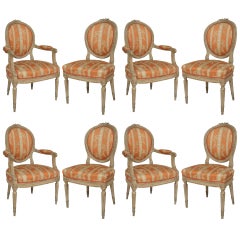
Set of 8 French Louis XVI Damask Dining Chairs
Located in Queens, NY
Set of 8 French Louis XVI style (19th Cent) white painted dining chairs with a carved bow knot top & oval back upholstered in pink & cream ...
Category

19th Century French Antique Louis XVI Furniture

Materials

Wood, Paint, Upholstery

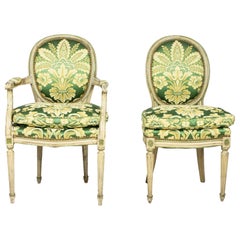
Set of 12 Louis XVI-Style Painted Green Damask Upholstered Dining Chairs
Located in Queens, NY
Set of 12 Louis XVI-style (1st half 20th Century) dining chairs with off-white painted frames with green trim and having oval channeled backs, upholstered in green and gold silk dama...
Category

20th Century French Louis XVI Furniture

Materials

Wood, Fabric, Upholstery

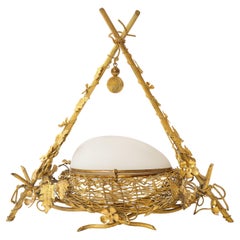
A 19th C. French Dore Bronze Mounted White Opaline Egg Form Covered Nesting Box
Located in New York, NY
A Fabulous and Unusual 19th Century French Dore Bronze Mounted White Opaline Egg Form Covered Nesting Box. The intricate craftsmanship of this piece is a ...
Category

19th Century French Antique Louis XVI Furniture

Materials

Opaline Glass

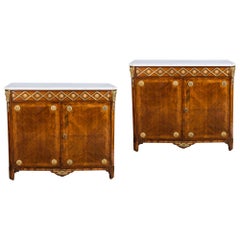
Pair of 18th Century Louis XVI Ormolu Mounted Parquetry Cabinets.
Located in New York, NY
Pair of Louis XVI kingwood parquetry ormolu mounted cabinets white marble top, over a pair of cupboard doors. French, circa 18th century Measures: H 44 in.; W 51 in.; D 19 in. P...
Category

18th Century French Antique Louis XVI Furniture

Materials

Bronze, Ormolu

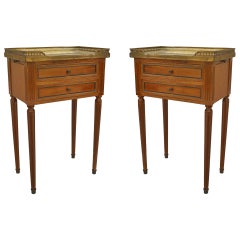
Pair of French Louis XVI Walnut and Brass End Tables
Located in Queens, NY
Pair of French Louis XVI-style walnut low end tables with brass trim and 2 drawers with a white marble top and filigree gallery. (PRICED AS Pair)
Category

19th Century French Antique Louis XVI Furniture

Materials

Marble, Brass

A Monumental 19th Century Antique French Giltwood Floral Love Birds Mirror
Located in New York, NY
A Monumental 19th Century Antique French Giltwood Floral Love Birds Mirror. Of large rectangular form, the mirror is very large. The entire frame and top are all made from hand-car...
Category

1880s French Antique Louis XVI Furniture

Materials

Mirror, Giltwood

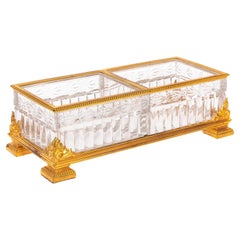
A Fantastic 19th Century French Baccarat Ormolu and Crystal Centerpiece, Signed
Located in New York, NY
A Fantastic, Rare, and Large 19th Century French Baccarat Ormolu and Crystal Centerpiece. The piece consists of two thick and dense crystal...
Category

1880s French Antique Louis XVI Furniture

Materials

Crystal, Ormolu

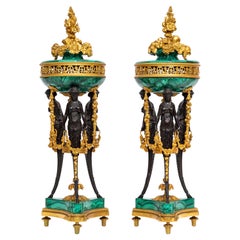
Pr. French Patinated Ormolu Mounted Malachite Figural Pot-Pourris H. Dasson
Located in New York, NY
A Large and Quite Magnificent Pair of Antique 19th Century French Patinated and Ormolu Mounted Malachite Figural Pot-Pourris/Covered Vases, Attributed to Henry Dasson. These brule-pa...
Category

1870s French Antique Louis XVI Furniture

Materials

Malachite, Bronze

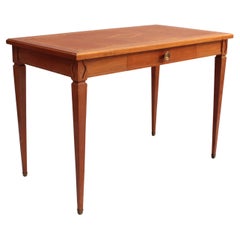
A Fine French 1940s Louis XVI Style Cherrywood Desk
Located in Long Island City, NY
A fine French Neoclassical cherry writing table in the style of Louis XVI with one drawer, bronze pull and sabots, and a leather top.
Category

1940s French Vintage Louis XVI Furniture

Materials

Bronze

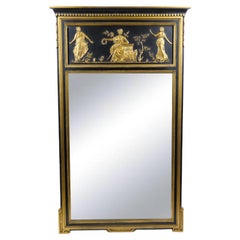
19th Century Gilt Wood Framed Painted / Decorated Top Trumeau Wall Mirror
Located in Tarry Town, NY
Immerse yourself in the enchanting world of French opulence with this extraordinary 19th century trumeau wall mirror, crafted with meticulous artistry...
Category

Late 19th Century French Antique Louis XVI Furniture

Materials

Wood, Mirror, Paint

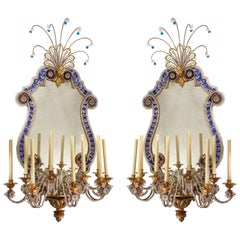
Pr French 20th C Dore Bronze Mnt Mirrored Beaded Crystal 9-Arm Sconces
Located in New York, NY
A monumental pair of antique french 20th century dore bronze mounted mirrored and breaded crystal nine-arm sconces attributed to Baguès. Ea...
Category

1920s French Vintage Louis XVI Furniture

Materials

Crystal, Bronze

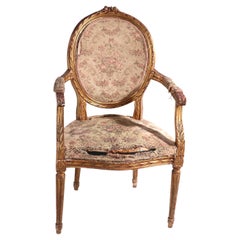
19th C Gilt Salon Chair
Located in New York, NY
We believe this is a Late 19th, or Early 20th C gilt wood salon chair in as found condition. This elegantly carved wood arm chair is structurally sound...
Category

Late 19th Century French Antique Louis XVI Furniture

Materials

Upholstery, Giltwood

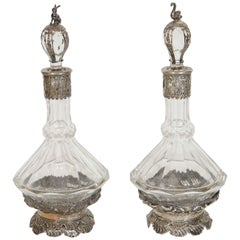
Pair of fine Antique German silver and cut crystal decanters
Located in New York, NY
A spectacular pair of fine antique German silver and cut crystal decanters. Each decanter is formed with a broad, faceted body rising t...
Category

19th Century German Antique Louis XVI Furniture

Materials

Crystal, Silver

Pair 18 C. Sevres Porcelain Faux Porphyry Vases w/ Blue Script Sevres R.F. Mark
Located in New York, NY
An Incredible and Very Rare Pair of 18th Century Sevres Porcelain Faux Porphyry Vases with Blue Script Sevres R.F. Marks. Each features a classic form with flared necks and bulbous ...
Category

1790s French Antique Louis XVI Furniture

Materials

Porcelain

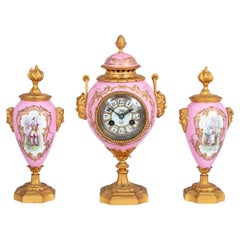
Louis XVI Style Gilt Bronze Sevres Clock Set, 3
Located in Astoria, NY
Louis XVI Style Sevres Gilt Bronze Mounted Pink Ground Three Piece Clock Set, late 19th century, the clock centered by a white enamel dial painted with flowers, two handles with masq...
Category

Late 19th Century French Antique Louis XVI Furniture

Materials

Bronze, Enamel

Louis Xvi furniture for sale on 1stDibs.

Find a broad range of unique Louis XVI furniture for sale on 1stDibs. Many of these items were first offered in the 21st Century and Contemporary, but contemporary artisans have continued to produce works inspired by this style. If you’re looking to add vintage furniture created in this style to your space, the works available on 1stDibs include decorative objects, tables, lighting and other home furnishings, frequently crafted with wood, metal and other materials. If you’re shopping for used Louis XVI furniture made in a specific country, there are Europe, France, and Italy pieces for sale on 1stDibs. While there are many designers and brands associated with original furniture, popular names associated with this style include Oggetti D'Arte, Manufacture Nationale de Sèvres, François Linke, and Maison Jansen. It’s true that these talented designers have at times inspired knockoffs, but our experienced specialists have partnered with only top vetted sellers to offer authentic pieces that come with a buyer protection guarantee. Prices for furniture differ depending upon multiple factors, including designer, materials, construction methods, condition and provenance. On 1stDibs, the price for these items starts at $3 and tops out at $833,747 while the average work can sell for $6,700.