Items Similar to Rare 19th Century Peters of Genoa Satinwood
Rosewood Centre Table
Want more images or videos?
Request additional images or videos from the seller
1 of 10
Rare 19th Century Peters of Genoa Satinwood
Rosewood Centre Table
$16,998.25
£12,450
€14,645.45
CA$23,669.21
A$25,431.25
CHF 13,643.81
MX$299,609.42
About the Item
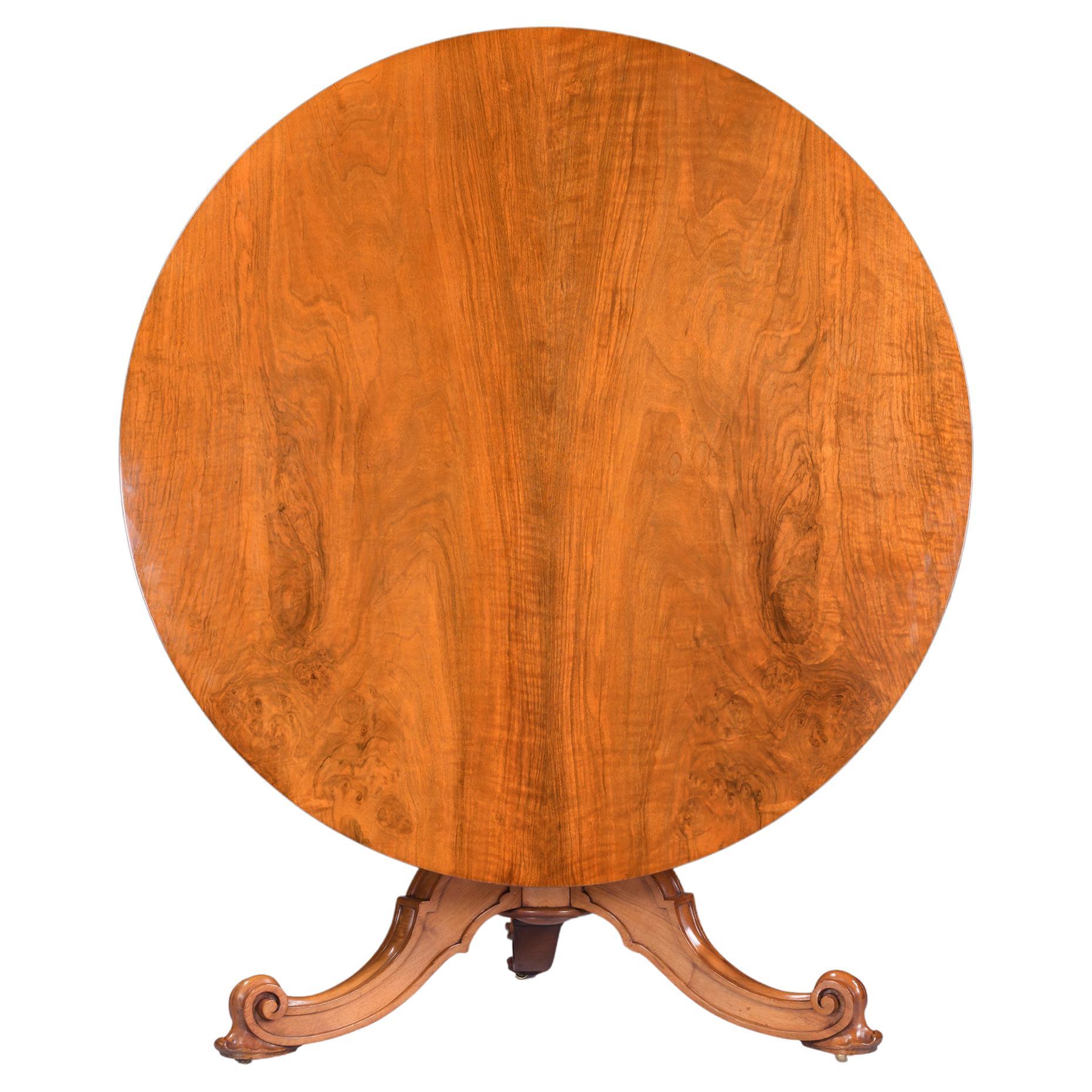
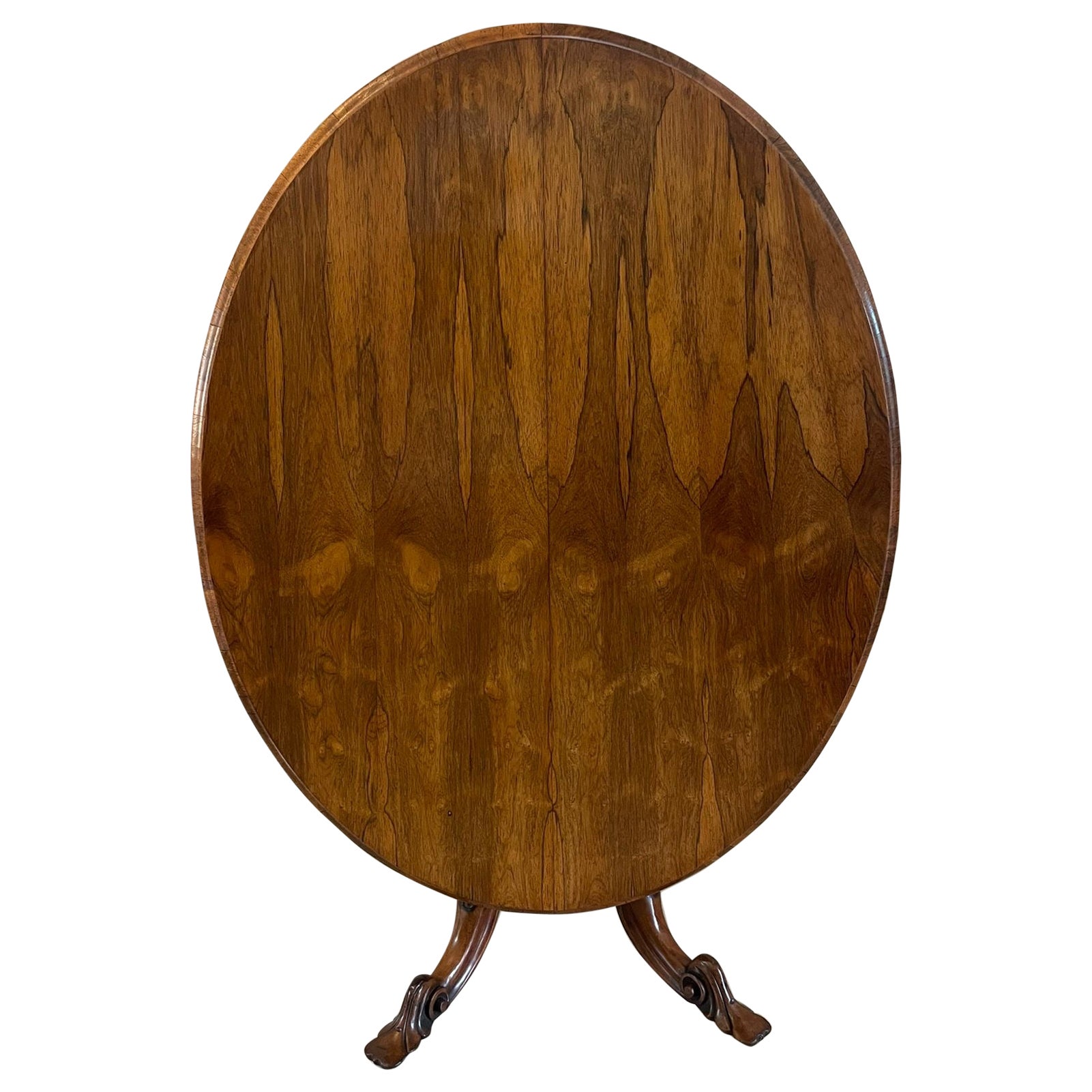
A rare and finely constructed circular satinwood centre table most probably by Henry Thomas Peters of Genoa.
Italy Circa 1830.
The circular tilt top having a finely chosen cuts of book-matched West Indian satinwood veneer with a rosewood banded and moulded edge over a splayed in-curved quatroform base, terminating on four acanthus carved scrolled rosewood lions paw feet raised on brass castors.
A very fine table with wide cuts of satinwood which would have been extremely expensive in the early 19th Century. Inspired by the French Empire design as viewed through the lens of English Regency, in particular the designs of Thomas Hope of 1807, along with the construction all point to Henry Thomas Peters being the maker, active in Genova around 1820 to 1850, being one of the leading cabinet makers of the period obtaining the title of ‘cabinetmaker of his Majesty’.
Henry Thomas Peters’ English antecedents remain obscure although he probably began his career in England. However, he is not listed in Beard and Gilbert’s Dictionary of English Furniture Makers 1660-1840. He arrived in Genoa in circa 1817, and by 1824 had established a workshop in Via Balbi, a neighbourhood in which the Royal Palace and other noble residences were located; today some of his works are preserved in the Palazzo Rosso, Genoa and were probably bequests from the various aristocratic families for whom he worked, including the Brignole Sale family.
Peters was appointed by the Court of Savoy and produced furniture for their palaces in Turin, Genoa and Racconigi including the Palazzo Reale. Notably, in 1841, furniture for the wedding of Prince Vittorio Emanuele. In 1846, Peters and his extensive workshop won the silver medal at the Esposizione dei Prodotti e delle Manifatture Nazionali. As pointed out Peters was famed for producing furniture with the technical accuracy typical of English but adapted to the late Italian Empire style.
A set of six Italian Giltwood Chairs by Peters realised a sum of £93,750 at Christies London sale 22nd March 2017 Lot 443.
This is a fine and rare table which would grace any home or collection.
Dimensions
Diameter 130cm
Height 75cm
Width: 51 inches - 130cm
Height: 29 1/2 inches - 75cm
Depth: 51 inches - 130cm.
- Creator:Henry Thomas Peters (Maker)
- Dimensions:Height: 29.53 in (75 cm)Width: 51.19 in (130 cm)Depth: 51.19 in (130 cm)
- Materials and Techniques:
- Place of Origin:
- Period:
- Date of Manufacture:c 1830
- Condition:Wear consistent with age and use. A rare and finely constructed circular satinwood centre table.
- Seller Location:Benington, GB
- Reference Number:Seller: 27981stDibs: LU1183223498522
About the Seller
5.0
Vetted Professional Seller
Every seller passes strict standards for authenticity and reliability
Established in 1969
1stDibs seller since 2015
128 sales on 1stDibs
Typical response time: <1 hour
Associations
LAPADA - The Association of Arts
Antiques DealersThe British Antique Dealers
Association
- ShippingRetrieving quote...Shipping from: Benington, United Kingdom
- Return Policy
More From This Seller
View AllExceptional 19th Century Marquetry Centre Table, Edward Holmes Baldock
By Edward Holmes Baldock
Located in Benington, Herts
An exceptional marquetry and ormolu centre table of exhibition quality attributed to Edward Holmes Baldock.
English, circa 1840.
Finely co...
Category
Antique Mid-19th Century British Early Victorian Center Tables
Materials
Ebony, Maple, Tulipwood
Fine Burl Amboyna and Marquetry Centre Table Attributed to George Blake and Co a
By George Blake
Co.
Located in Benington, Herts
A Fine Burl Amboyna and Marquetry Centre Table Attributed to George Blake and Co and Probably Retailed by Edward Holmes Baldock
English London made Circa 1845.
An exceptional table of wonderful colour, utilising the finest amboyna veneers as a background for a complex pattern of floral marquetry on the stem, feet and table top.
The tilt-top with segmented veneers and central floral inlay within an inlaid floral scroll surround and with a conforming inlaid outer border. The triform pedestal base with foliate inlay, carved leaf scroll feet with carved lateral flower head roundels with recessed castors.
The basic design for this table comes from the work of the designer Richard Bridgens and was published in 1838 as plate 16 in his Furniture with Candelabra.
As can be seen from the image of Bridgens' design, the outer scrolling border on the top of our table is very much in the style of that suggested in the design but the other marquetry is of a sophisticated floral type popularised slightly later, suggesting a date of c.1845 for our table. Marquetry of this sort was a speciality of the Blake family, marquetry experts and associates of the great dealer Edward Holmes Baldock. Baldock was responsible for building some museum quality collections of fine 18th century French furniture during this period for some of his famous aristocratic clients but he also supplied new furniture in the French taste, often incorporating marquetry by the Blake firm. The use of exotic amboyna as the ground for this marquetry is also in keeping with other pieces known to have been supplied by Baldock, for whom it appears only the best was good enough.
The sinuous lines of this table and the exotic veneers give the piece a more timeless feel than many other examples from this period and the colour means that it would work equally well in a contemporary interior or alongside pieces of Art Deco furniture as it would in a more traditional room. This is a piece of sublime quality that somehow manages to be both decorative and yet understated and as such is exactly the sort of piece we enjoy sharing with our clients.
Edward Holmes Baldock (1777-1845)
Born on the 14th May 1777 he established his business in 1805 in Hanway Street which over the years he expanded at this location. He soon was a prominent London furniture dealer to several members of the Royal Family and is responsible for supplying French-fashioned furniture to the 5th Duke of Buccleuch.
Edwards Holmes Baldock’s pieces have become a prized possession amongst collectors, museums and dealers alike. The use of a variety of specimen woods can often been seen on attributed and signed tables by Edward Holmes Baldock, reminiscent of those on the present table. Baldock was thought to have worked very closely to with the master of marquetry and inlay of the 19th Century Robert Blake who had workshops adjacent to Baldock’s retail premises.
Pieces in public collections with likely links to the Blake Family include a piano in the Metropolitan Museum of Art, a writing desk in Goodwood House, a centre table in Syon House, a circular table in Alnwick Castle, an octagonal table in the Leeds City Art Gallery at Temple Newsam House and also signed works in the Victoria and Albert Museum.
Baldock's works often imitated the important pieces of 18th-century French furniture that Francophile collectors including George, Prince of Wales, later George IV, William Beckford, Francis Seymour Conway, 3rd Marquess of Hertford and George Watson...
Category
Antique 1840s English Center Tables
Materials
Burl, Amboyna
Rare Early 19th Century Scandinavian Burr Root Maple Drum Table
Located in Benington, Herts
An elegant and rare early 19th century burr root maple drum top table on splayed triform base.
Scandinavian circa 1820.
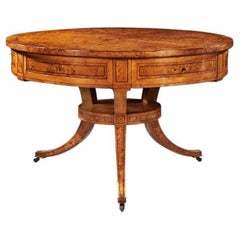
The circular top with ra...
Category
Antique 1820s Scandinavian Center Tables
Materials
Maple
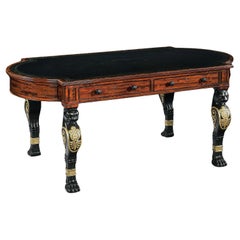
Regency Mahogany Partners Writing Table In The Manner Of George Smith
By George Smith
Located in Benington, Herts
An Important Regency period mahogany, ebonised and parcel gilt partners writing table on monopodia legs of exceptional quality and design, in the manner of George Smith, stamped Chas...
Category
Antique Early 19th Century English Regency Desks and Writing Tables
Materials
Leather, Mahogany
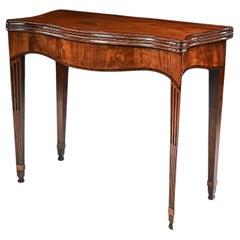
George III Mahogany Serpentine Tea Table of Exceptional Colour and Patination
Located in Benington, Herts
A Very Fine and Unusual George III Period Mahogany Serpentine Tea Table of Exceptional Colour and Patina
English c.1780
This fine table is a riot of serpentine curves. Broadly spe...
Category
Antique Late 18th Century English George III Tables
Materials
Serpentine
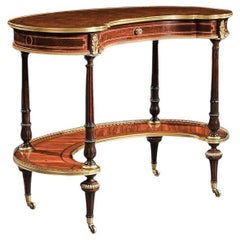
Fine 19th Century Gillows Parquetry and Gilt Bronze Kidney Shaped Table
By Gillows of Lancaster
London
Located in Benington, Herts
An extremely fine gilt bronze mounted parquetry kidney shaped writing table attributed to Gillows of Lancaster.
English Circa 1865
The rosewood lozenge trellis inlaid kidney shape...
Category
Antique 1860s English Desks
Materials
Bronze
You May Also Like
19th Century Satinwood Centre Table Stamped Holland
Sons
By Holland
Sons
Located in Dublin, IE
A very fine 19th century Satinwood centre table by Holland & Sons. The table is of finely figured Satinwood with a circular tilt-top above a baluster column with three S-scroll and l...
Category
Antique 1840s English Victorian Center Tables
Materials
Satinwood
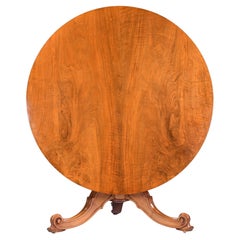
Early 19th Century William IV Period Rosewood Centre Table
Located in Petworth,West Sussex, GB
Fine Quality William IV Period Rosewood Centre Table with Faded Golden Colour & Patina
This William IV period early 19th-century centre table is crafted from well figured rosewood, ...
Category
Antique Early 19th Century British William IV Tables
Materials
Rosewood
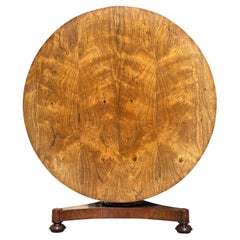
George IV Rosewood Centre Table, 19th Century
Located in Southall, GB
George IV rosewood centre table
A large early 19th century George IV rosewood centre or breakfast table.
The rosewood veneered circular top has a broad lappet carved edge and i...
Category
Antique 19th Century English Center Tables
Materials
Rosewood
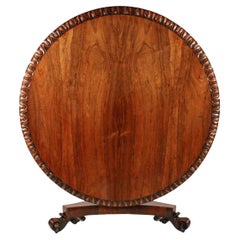
Early Victorian Rosewood Center Table
Located in Essex, MA
With a thick octagonal top with stylized leaf carved edge supported on a square tapered support with carved flower and leaves. The concave sided base with octagonal bun feet.
Category
Antique 1840s English Early Victorian Center Tables
Materials
Rosewood
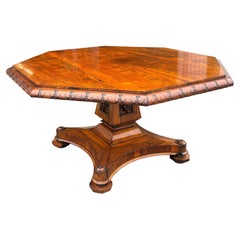
Fine Regency Mahogany Library Centre Table
Located in Lymington, GB
A fine Regency-period tilt-top brass inlaid mahogany and calamander library center table.
Raised on a concave-sided triform base, with well-modelled cast-brass scrolling feet.
Also referred to as a monopodium (table).
All in excellent condition, well figured, and of very good rich color.
Typical of designs by Thomas Hope (1769 - 1831).
This form of antique table is also associated with work by George Bullock (1777 - 1818) and George Oakley (circa 1765 - 1841).
Refs:
A similar table with a leather insert, in the manner of Thomas Hope, circa 1800 - 1805, was sold in London for £39,650 - December 2010.
This early 19th century table is reminiscent of the ‘Grecian’ style that the pioneering collector and designer Thomas Hope (1769-1831) popularized in Britain with the publication of ‘Household Furniture and Interior Decoration’ in 1807.
Thos. Hope (banker, born 1769, d. 1831)
The furniture manufacturer George Oakley (circa 1765-1841) was greatly influenced by Hope’s designs, and produced fashionable furniture in this style, using brass and star inlays similar to our table on offer. The firm’s designs and craftsmanship earned them royal patronage, and Oakley worked for the Prince Regent at Carlton House, as well as supplying furniture and upholstery for The Mansion House and The Bank of England. His work for the Cheere family - of Papworth Hall, Cambridgeshire, UK - is well documented.
The reference to Geo. Oakley relates to a known table of this pattern in calamander wood and brass marquetry of starred-ribbon guilloche, which corresponds to the brass marquetry in a table supplied by Oakley in 1810 to Papworth Hall.
Literature:
Parker, R. 'History of Papworth Everard...
Category
Antique Early 1800s English Regency Center Tables
Materials
Mahogany
Exceptional Quality Antique Victorian Rosewood Centre/Dining Table
Located in Suffolk, GB
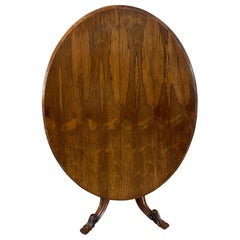
Exceptional quality antique Victorian rosewood centre/dining table having an outstanding quality oval rosewood top with a moulded edge, rosewood frieze supported on an attractive sha...
Category
Antique 19th Century English Victorian Dining Room Tables
Materials
Other
More Ways To Browse
Antique English Dictionary
Thomas Henry Thomas
Indian Regency Early 19th Century
Antique Inlaid Round Table
Empire Oval Table
Carved Chinese Center Table
Empire Round Center Table
Empire Style Round Tables
French Porcelain Plaque Table
Renting Antique Furniture
Center Drop Leaf Table
Marble Inlay Round Table
Regency Table Dolphin
Antique Turtle Table
Stone Center Table Round
Antique Walnut Parlor Table
Center Entrance Table
Large Round Center Table