Boxwood Writing Desk and Chair from the Palazzo Gualino
About the Item
- Creator:Giuseppe Pagano Pogatschnig (Designer)
- Dimensions:Height: 31.5 in (80.01 cm)Width: 55.13 in (140.04 cm)Depth: 27.5 in (69.85 cm)
- Materials and Techniques:Boxwood,Fir
- Place of Origin:
- Period:
- Date of Manufacture:1929
- Condition:Wear consistent with age and use.
- Seller Location:Beverly Hills, CA
- Reference Number:1stDibs: LU80801978252
Giuseppe Pagano Pogatschnig
An accomplished architect, exhibition designer, furniture maker and magazine editor, Giuseppe Pagano Pogatschnig helped direct Italy’s rationalist architectural movement until his death near the end of World War II. Wounded twice and captured twice in World War I, Pogatschnig left military service to work as the editor and director of Casabella architecture magazine and went on to design the V Milan Triennale and VI Milan Triennale alongside fellow Italian architect Gio Ponti.
Originally born in the Austro-Hungarian Empire, now modern-day Croatia, Pogatschnig studied Italian in Trieste before joining the Italian army to serve in the First World War. After that harrowing and traumatic experience, he became a founding member of the first Fascist Party in Parenzo. In 1924, he graduated from Turin Polytechnic with an architecture degree and began designing bridges, pavilions and buildings, including the Gualino office complex, in Turin. Nearing 1928, Pogatschnig began work on pavilions for the Turin International Exhibition.
Pogatschnig’s involvement in the V and VI Milan Triennales stand today as some of his greatest contributions to Italian architecture. He held full control over the design of the latter exhibition, in 1936, which led to the opportunity to design many of the interiors of the Italian Pavilion at the Paris Expo the following year.
Pogatschnig’s reputation as an architect and designer were overshadowed only by his outspoken nature as an editor. By 1942, he openly criticized the Italian regime and left the Fascist Party to join the resistance a year later. These activities led to his capture, imprisonment and escape from Brescia in 1944. Ultimately, Pogatschnig was recaptured, tortured and transferred across prisons to Austria’s Mauthausen concentration camp, where he died on April 22, 1945, less than a month before the end of fighting in Europe.
On 1stDibs, find vintage Giuseppe Pagano Pogatschnig seating, tables, and case pieces.
You May Also Like
Vintage 1950s Italian Mid-Century Modern Desks and Writing Tables
Teak
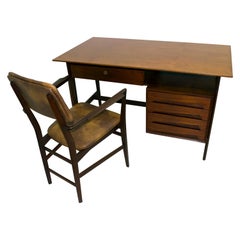
2010s American American Craftsman Desks and Writing Tables
Hardwood, Walnut
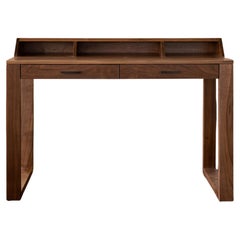
2010s American American Craftsman Desks and Writing Tables
Hardwood, Oak
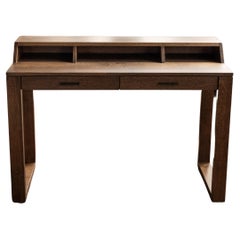
Mid-20th Century Italian Mid-Century Modern Office Chairs and Desk Chairs
Metal, Brass
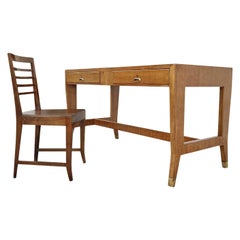
Early 20th Century French Art Deco Desks and Writing Tables
Wood
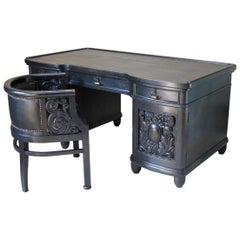
Vintage 1910s French Art Nouveau Desks and Writing Tables
Walnut
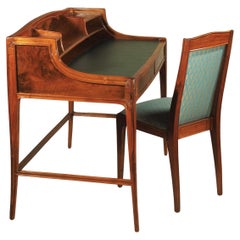
Mid-20th Century French Organic Modern Desks and Writing Tables
Hardwood
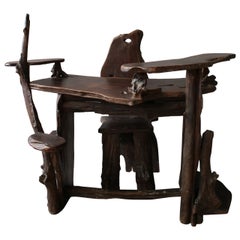
Vintage 1960s Italian Mid-Century Modern Desks and Writing Tables
Brass
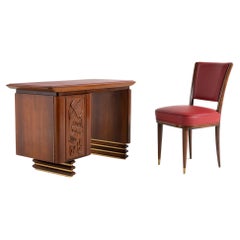
Vintage 1950s American Mid-Century Modern Desks and Writing Tables
Brass
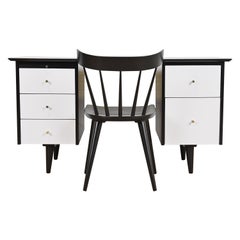
Vintage 1930s Italian Art Deco Desks and Writing Tables
Goatskin
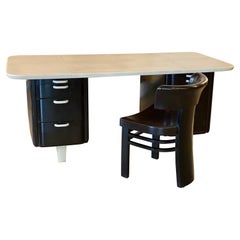
More From This Seller
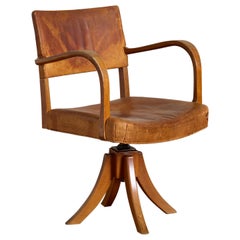
View AllVintage 1930s Danish Office Chairs and Desk Chairs
Leather, Beech
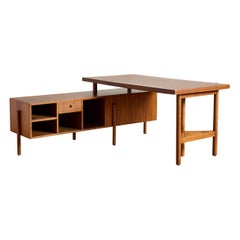
Vintage 1960s Indian Desks
Rosewood
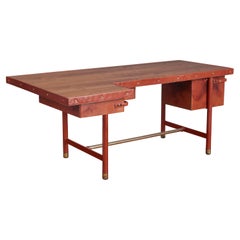
Vintage 1950s French Desks and Writing Tables
Leather, Walnut
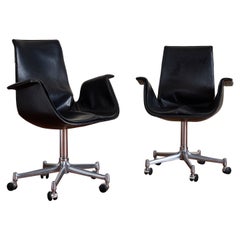
Vintage 1960s German Office Chairs and Desk Chairs
Metal
Vintage 1950s Indian Desks
Teak, Glass

21st Century and Contemporary American Swivel Chairs
Bouclé, Wood