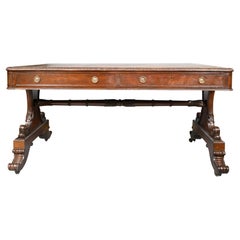
Items Similar to Regency Mahogany Partners Writing Table In The Manner Of George Smith
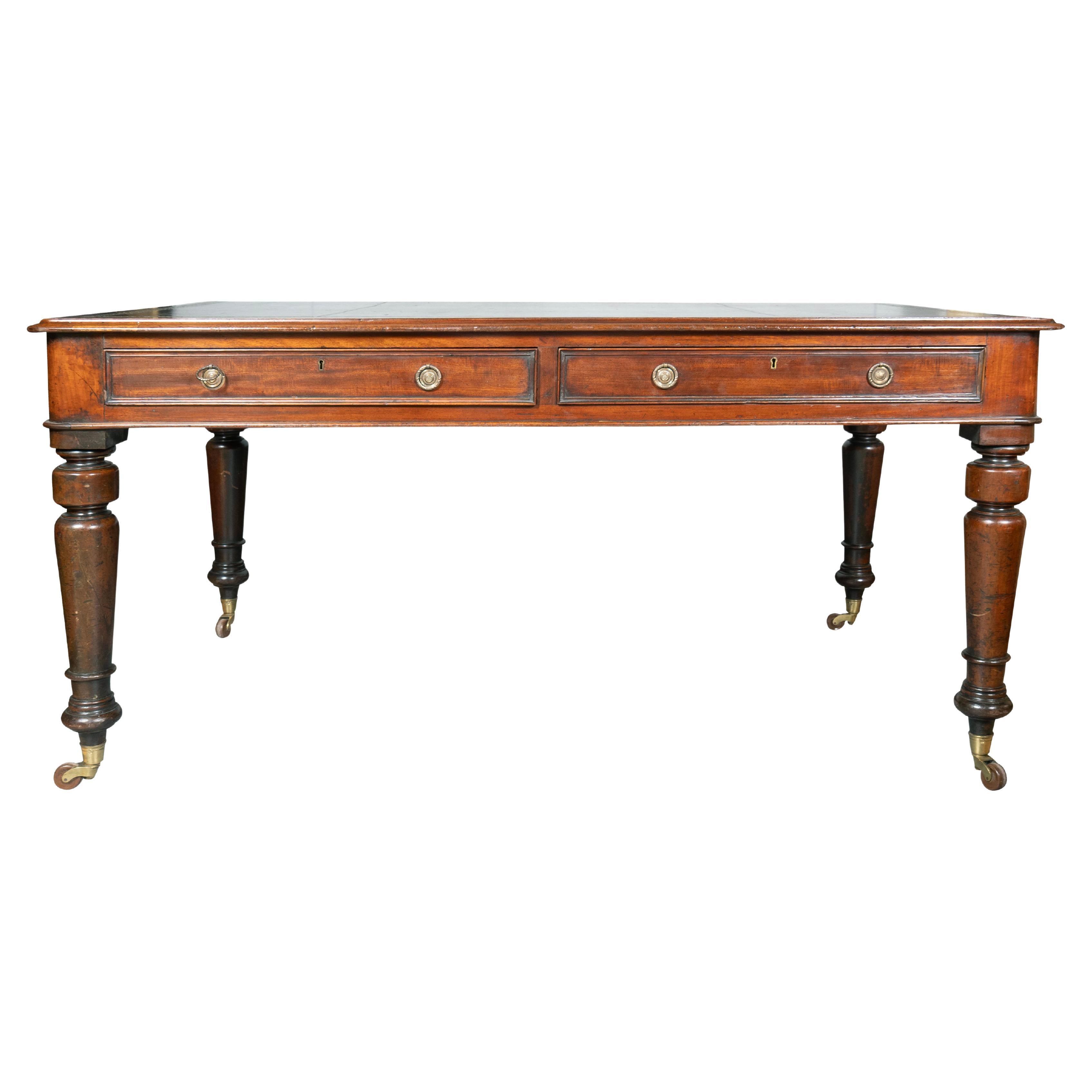
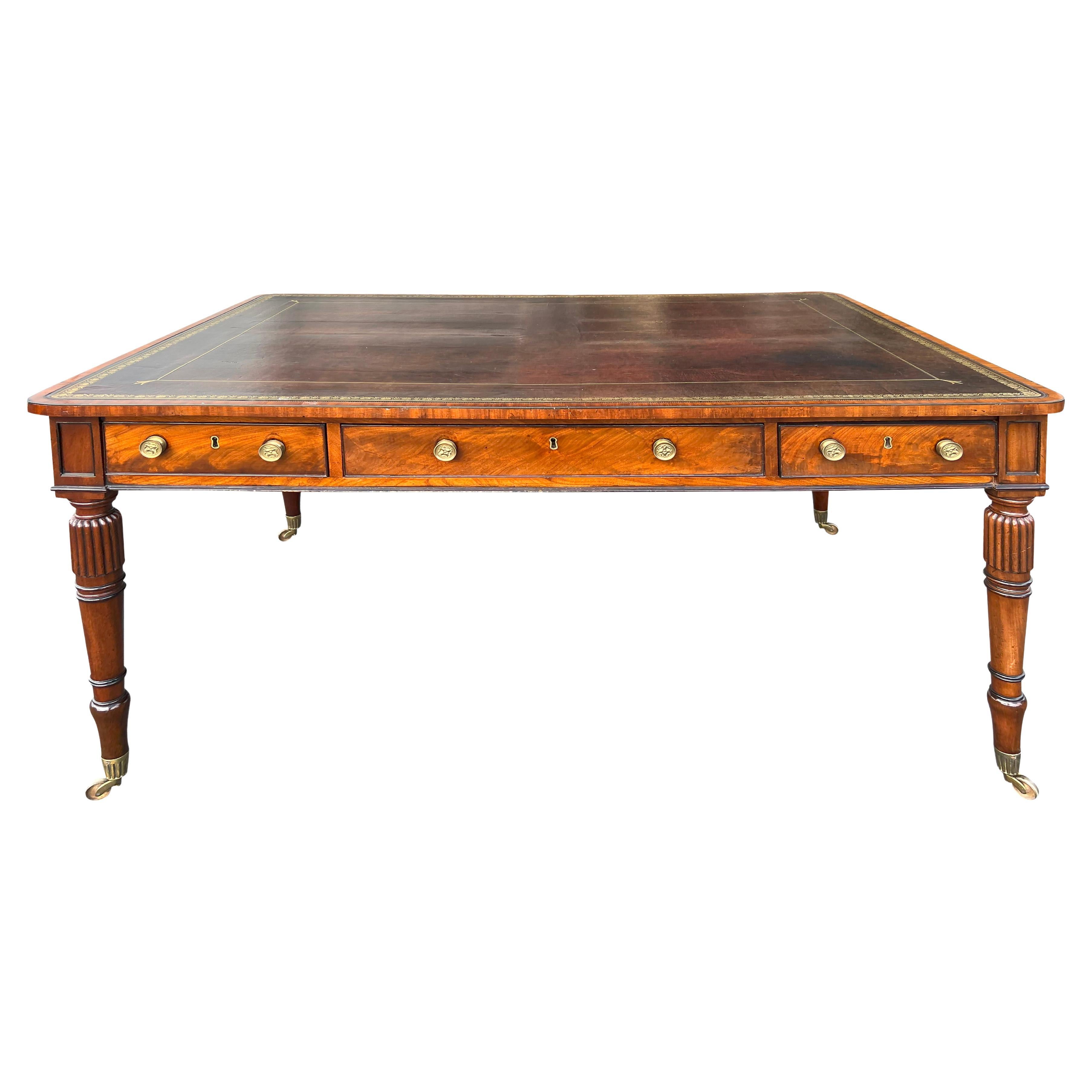
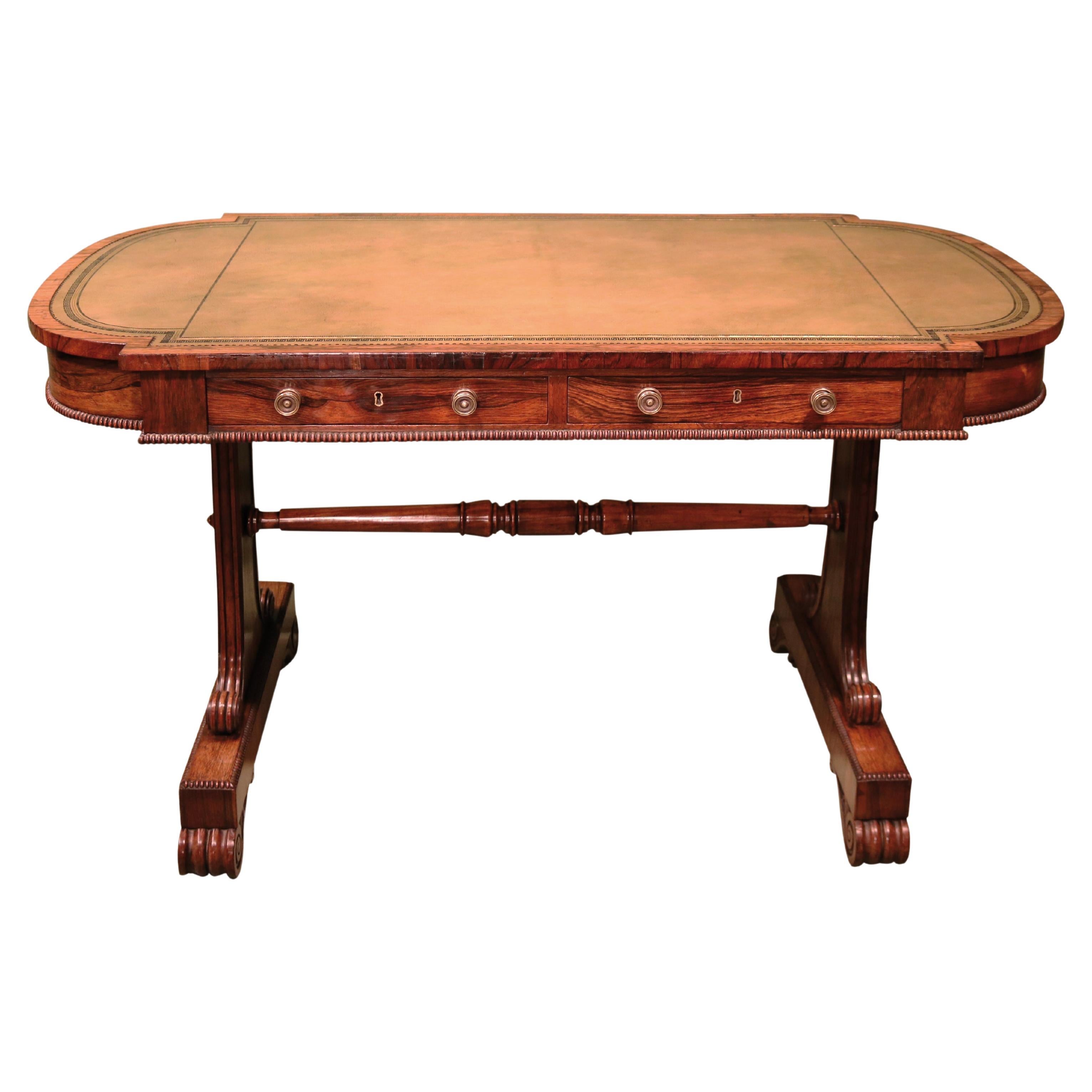

Want more images or videos?
Request additional images or videos from the seller
1 of 12
Regency Mahogany Partners Writing Table In The Manner Of George Smith
$26,845.55
£19,500
€22,847.28
CA$37,019.85
A$39,194.36
CHF 21,210.88
MX$468,444.73
NOK 264,390.87
SEK 241,776.07
DKK 170,639.83
About the Item
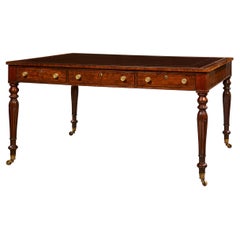
An Important Regency period mahogany, ebonised and parcel gilt partners writing table on monopodia legs of exceptional quality and design, in the manner of George Smith, stamped Chas Norman, Labelled ‘Morning Library’.
English, Regency period, Circa 1820.
Of sophisticated shape, the crescent shaped ended rectangular top is beautifully lined with the original gilt tooled leather writing surface, enclosed by a mahogany cross-banded border and reeded edge.
The frieze, containing four finely chosen fiddle-back mahogany drawers, two pairs to opposing sides, each retaining the original gadrooned carved ebonised knob handles. The perimeters having a finely ebonised cockbead, whilst the drawer liners, executed in mahogany, retain the original recessed brass locks which look to have never been removed. Flanking the drawers are bead-moulded ebonised panels which conform to either end above a reeded mould.
Raised on four boldly designed and imposing, crisply carved, ebonised and parcel gilt leopard monopodia supports in wonderful original waxed condition. Each of the Egyptian leopards' masks above a bold breast decorated with carved gilt anthemion and guilloche motifs, finishing on a finely detailed carved leg and paw foot.
The condition is excellent, retaining what looks to be the original hand-dyed and gilt tooled waxed leather writing surface along with locks, handles and gilt-work to the legs.
Labelled ‘Morning Library’ to the underside, whilst in this exemplary condition, this striking piece of Regency furniture would have furnished the library of an important house of the period when it was made and, given its exemplary "country house" condition, it probably remained in this house or at least the same family for the majority of its life.
This is a rare, elegant, writing table of exceptional colour, which corresponds with designs of the celebrated furniture maker and designer George Smith and is stamped to the underside Chas Norman four times.
George Smith (1756 - 1826) was one of the most influential furniture designers of the English Regency Period (1811-1830). Smith, who began his pattern-book in 1804, wrote of ‘the great taste and elegance’ of this design. In 1808 he published his influential and definitive text on Regency interior Design titled ‘ A Collection of Designs for Household Furniture and Interior Decoration’ and classed himself as ‘Upholder Extraordinary to His Royal Excellency the Prince of Wales’…The Prince Regent. Smith was inspired in his designs from his earlier career as an Egyptologist, producing drawings incorporating motifs of Leopards heads and paws, Lions, sphinx’s, anthemia, and griffons amongst others.
Charles Heathcote Tatham (1772-1842) published ‘Etchings, Representing the Best Examples of Ancient Ornamental Architecture; Drawn from the Originals in Rome, and Other Parts of Italy During the Years 1794, 1795, and 1796’, in which he illustrated an antique tripod table with similar monopodiae of leopard heads and paws, based on the original in the Vatican.
Thomas Hope (1769-1831) was also another influential figure to Smiths designs. A rich young man, being the eldest of three sons from a family of Dutch bankers, Hope had travelled extensively spending several years in the Middle East and Greece. He published his ‘ancient furniture’ designs in the ‘Household Furniture and Interior Decoration. 1807’, which was an important and influential book throughout the Regency period. George Smith interpreted Thomas Hopes Egyptian and Grecian themes (although the plates are dated 1804-7) into a more practical design with a greater regard for comfort and utility than for archaeological accuracy, which was widely accepted as the turning point in Regency furniture for the affluent gentry.
Literature for Design of Top and Monopodia Leg: The carved monopodiae on the present writing table related closely to Smith's design for a sofa table (plate 83, 1804) and also his design for a library table (plate 87, 1804). What can be seen in Smiths book is the similarity in design to the legs with embellished anthemion motifs on a lion-monopodia leg. For a similar table of shape on lion-monopodia legs see Margaret Jourdain, Regency Furniture, London, 1949, p128 , fig. 139 from Lord Huntingfield, Heveningham Hall. In the same book also the monopodia legs of a closely related design to that of a mahogany side table c.1810 from the Duke of Richmond, Goodwood House, page 104 fig 89. A daybed supported by similar monopodia was supplied by Gillows, which is now in the collection of the Victoria and Albert Museum, London is illustrated in Margaret Jourdain, Regency Furniture, London, 1949, p. 99, fig. 77.
Charles Norman
The present table was constructed by Charles Norman. One maker of that name is noted in the ‘Gillows of Lancaster and London 1730-1840’ book by Susan E. Stuart, where is it said ‘Lucy Wood has reported a similar set of chairs to “Edwards Library” pattern (for this design see Plate 198) stamped ‘Chas Norman’ (LL 4180, Letter 6.9.1999). There is, however, no evidence of his apprenticeship or foremanship in Lancaster.” The “Edwards Library” chair was a distinctive pattern introduced by Gillows in 1810 and one which became very popular for them.
Charles Norman is obviously a master cabinet maker with links to Gillows designed furniture, producing items at the same time of conception to the Gillows design book. There is obviously a strong link between both Charles Norman and Gillows, along with the rare shaped top being almost a signature of Gillows, the timbers used on this writing table are of the quality associated with the Gillows firm during this era. Due to the company directly importing timbers themselves they were able to secure an advantage over most of their competitors.
It is also very interesting to note that a Charles Norman is listed amongst the subscribers to Thomas Sheraton's Cabinet Directory published in 1803. Nothing is known of this man but our research in the newspaper archives has revealed a dynasty of makers, all seemingly named Charles Norman, working in the area around Richmond in Yorkshire throughout the 19th century. It is highly possible that our table was made by one of the members of this family of cabinetmakers and that the aforementioned chairs, cited by Lucy Wood, were also the products of their workshop whilst following a Gillows pattern.
For reference; a writing table with a very closely related top can be seen in the ‘Gillows of Lancaster and London 1730-1840 book by Susan E. Stuart, page 375, plate 444. It is the view of the Library at Tatton Park which was a highly important commission for Gillows. For other examples of Gillows attributed writing tables with related shaped top please see…. Christies London, 2 May 2002, Lot 157 sold for £59,750 albeit with lesser reeded legs. Christies London, 6 July 2000, Lot 88 sold for £47,000 with a similar leg to the above.
Literature for Overall Design:
For a similar table of overall design having ebonized lion-monopodia legs see Margaret Jourdain, Regency Furniture, London, 1949, p. 78, fig. 181.
This table was subsequently sold by Bonhams, London, Fine English Furniture, 7th March 2012, lot 225, £97250.
A Late George IV (later in date and oak lined not mahogany) Rosewood Library table Christies London 24 March 2004 realised £47,800 whilst
Christies note a further closely related Regency table with mahogany-lined drawers was sold from the Coke Collection, Jenkyn Place, Christie's London, 17 October 1996, lot 57 (£144,500).
A Fine Regency Parcel Gilt Rosewood Table in the manner of Gillows offered at Sotheby's New York 18 November 2011 sold for $230,500.
Lastly a similar design desk published in Ronald Philips 2016 Catalogue of Fine Antique English Furniture can be viewed on pages 72
73, item number 30.
As can be seen from the literature, this is a highly important stunning piece, of exceedingly rare design, derived from the most famous designers of the Regency period.
Dimensions
Width 64 1/2 inches - 164cm
Height 29 inches - 74cm
Depth 34 1/4 inches - 87cm
Height to underside 23 inches - 58.5cm
- Similar to:George Smith (Maker)
- Dimensions:Height: 29.14 in (74 cm)Width: 64.57 in (164 cm)Depth: 34.26 in (87 cm)
- Style:Regency (Of the Period)
- Materials and Techniques:
- Place of Origin:
- Period:
- Date of Manufacture:Circa 1820
- Condition:Wear consistent with age and use. The condition is excellent, retaining what looks to be the original hand-dyed and gilt tooled waxed leather writing surface along with locks, handles and gilt-work to the legs.
- Seller Location:Benington, GB
- Reference Number:Seller: 30741stDibs: LU1183247686282
About the Seller
5.0
Vetted Professional Seller
Every seller passes strict standards for authenticity and reliability
Established in 1969
1stDibs seller since 2015
128 sales on 1stDibs
Typical response time: <1 hour
Associations
LAPADA - The Association of Arts
Antiques DealersThe British Antique Dealers
Association
- ShippingRetrieving quote...Shipping from: Benington, United Kingdom
- Return Policy
More From This Seller
View AllGeorge IV Period Rosewood Library Table With Carved Lions Paw Feet
Located in Benington, Herts
A George IV Period Rosewood Library Table With Carved Lions Paw Feet
English Circa 1820- 1830
This handsome table would have been commissioned for a grand library or study. The ov...
Category
Antique Mid-19th Century English George IV Side Tables
Materials
Rosewood
George III Mahogany Serpentine Tea Table of Exceptional Colour and Patination
Located in Benington, Herts
A Very Fine and Unusual George III Period Mahogany Serpentine Tea Table of Exceptional Colour and Patina
English c.1780
This fine table is a riot of serpentine curves. Broadly spe...
Category
Antique Late 18th Century English George III Tables
Materials
Serpentine
An Extremely Fine Rosewood and Brass Inlaid Writing Table Attributed To Gillows
By Gillows of Lancaster
London
Located in Benington, Herts
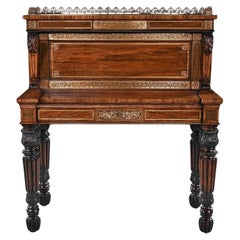
An Extremely Fine and rare Rosewood and Brass Inlaid Writing Table Attributed to the Oxford Street Workshop of Gillows.
English c.1820-1830
With a raised back comprising a thre...
Category
Antique Early 19th Century English Desks and Writing Tables
Materials
Brass
French 19th Century Gilt-Bronze Mounted Writing Table of Fine Quality
Located in Benington, Herts
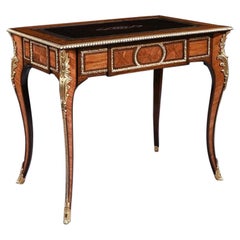
An extremely fine 19th century French Louis XV Revival gilt ormolu mounted Kingwood bureau de dame / writing table.
French, circa 1870.
A very attractive and of the finest qua...
Category
Antique 19th Century French Desks and Writing Tables
Materials
Ormolu
Rare 19th Century Peters of Genoa Satinwood
Rosewood Centre Table
By Henry Thomas Peters
Located in Benington, Herts
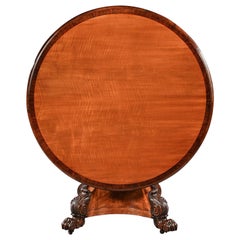
A rare and finely constructed circular satinwood centre table most probably by Henry Thomas Peters of Genoa.
Italy Circa 1830.
The circular tilt top having a finely chosen cuts of book-matched West Indian satinwood veneer with a rosewood banded and moulded edge over a splayed in-curved quatroform base, terminating on four acanthus carved scrolled rosewood lions paw feet raised on brass castors.
A very fine table with wide cuts of satinwood which would have been extremely expensive in the early 19th Century. Inspired by the French Empire design as viewed through the lens of English Regency, in particular the designs of Thomas Hope of 1807, along with the construction all point to Henry Thomas Peters being the maker, active in Genova around 1820 to 1850, being one of the leading cabinet makers of the period obtaining the title of ‘cabinetmaker of his Majesty’.
Henry Thomas Peters’ English antecedents remain obscure although he probably began his career in England. However, he is not listed in Beard and Gilbert’s Dictionary of English Furniture Makers 1660-1840. He arrived in Genoa in circa 1817, and by 1824 had established a workshop in Via Balbi, a neighbourhood in which the Royal Palace and other noble residences were located; today some of his works are preserved in the Palazzo Rosso, Genoa and were probably bequests from the various aristocratic families for whom he worked, including the Brignole Sale family.
Peters was appointed by the Court of Savoy and produced furniture for their palaces in Turin, Genoa and Racconigi including the Palazzo Reale. Notably, in 1841, furniture for the wedding of Prince Vittorio Emanuele. In 1846, Peters and his extensive workshop won the silver medal at the Esposizione dei Prodotti e delle Manifatture Nazionali. As pointed out Peters was famed for producing furniture with the technical accuracy typical of English but adapted to the late Italian Empire style.
A set of six Italian Giltwood...
Category
Antique 19th Century Italian Center Tables
Materials
Rosewood, Satinwood
Fine 19th Century French Neoclassical Style Amboyna and Gilt Bronze Mounted Writ
Located in Benington, Herts
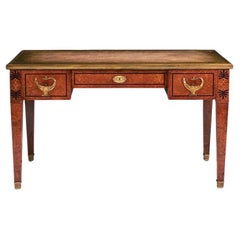
An extremely fine and unusual French Amboyan and gilt bronze bureau plat - writing table inspired by the Neoclassical designs.
French circa 1880-1900.
A superb amboyna writing ...
Category
Antique 19th Century French Neoclassical Desks and Writing Tables
Materials
Bronze
You May Also Like
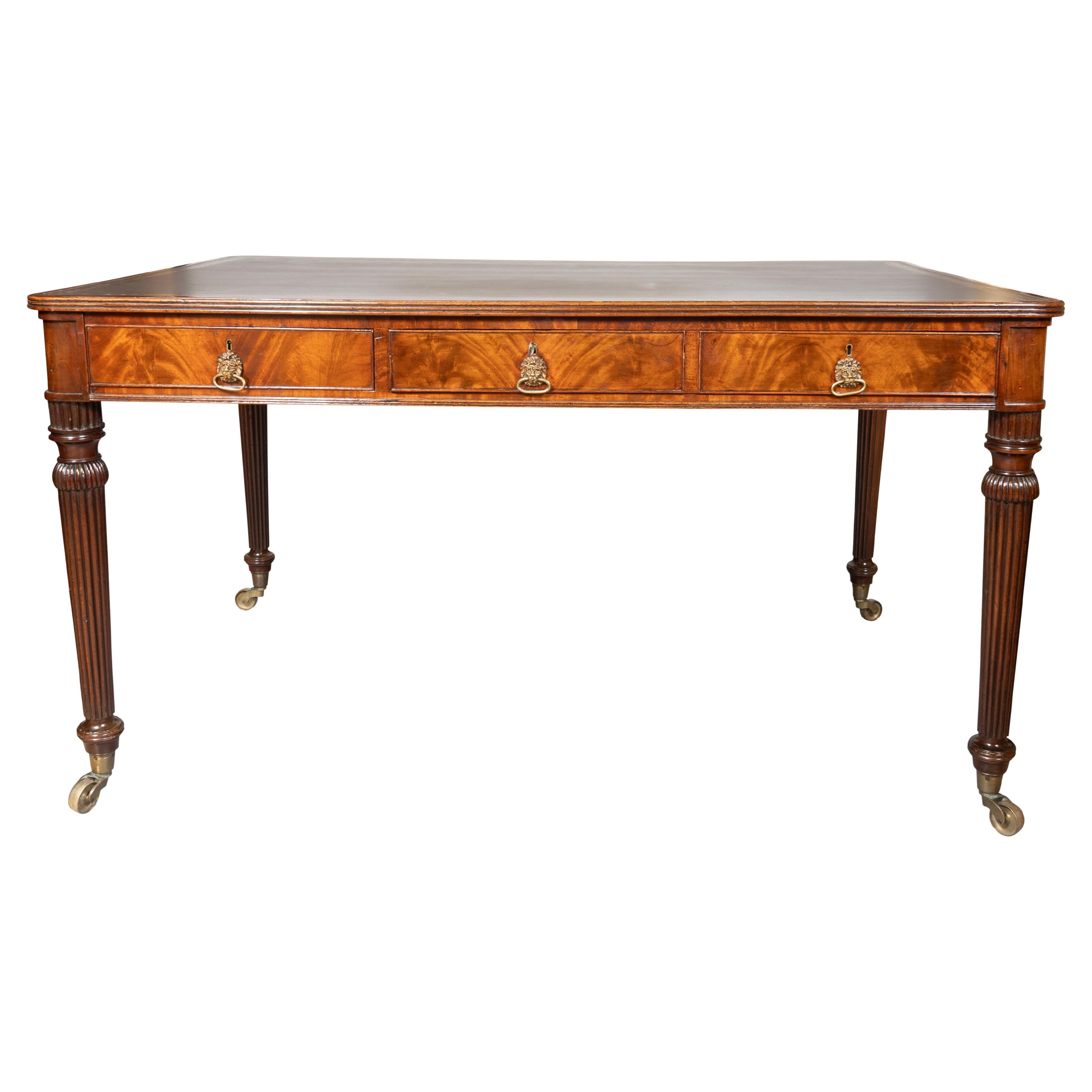
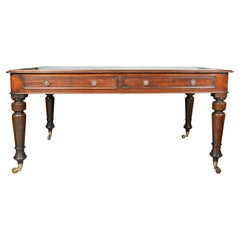
Late Regency Mahogany Writing Table
Located in Essex, MA
With a tooled olive green leather writing surface with wood border and molded edge over two drawers on front and back. Brass ring handles. Supported on turned tapered legs with casters.
Category
Antique 1820s English Regency Desks and Writing Tables
Materials
Brass
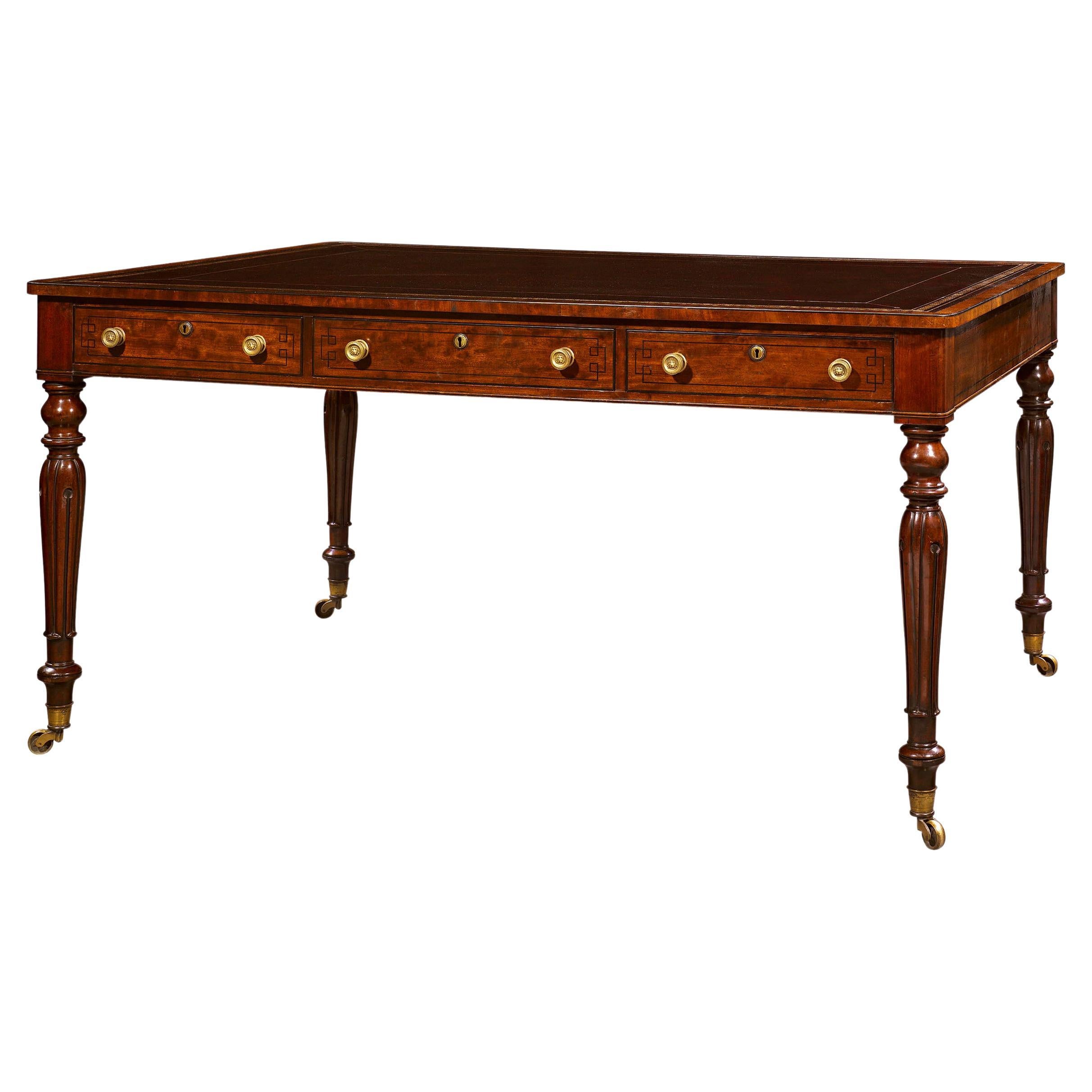
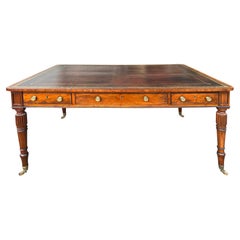
Regency Mahogany Writing Table
Located in Essex, MA
With inset tooled brown leather top with cross banded edge over a frieze containing three drawers and on the reverse three working drawers. False drawers on ends. All with brass knobs. Raised on turned tapered legs headed by reeding. Ending on cup casters. Sold Florian Papp...
Category
Antique 1820s English Regency Desks and Writing Tables
Materials
Brass
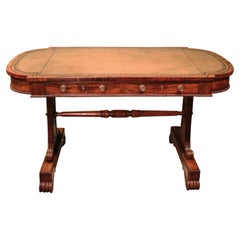
Early 19th Century Regency Period Rosewood Writing Table
Located in London, GB
A fine early 19th century Regency period rosewood writing table, having rectangular bow end tooled leather top, above beaded frieze with 2 real & 2 dummy drawers raised on end-suppor...
Category
Antique Early 19th Century English Regency Desks and Writing Tables
Materials
Rosewood
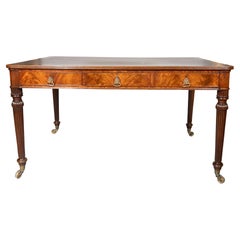
Fine Regency Mahogany Writing Table
Located in Essex, MA
With rectangular inset green leather with tooled border and banded edge. The frieze with three drawers on each side with lions head brass pulls. Turned reeded tapered legs ending on ...
Category
Antique Early 19th Century English Regency Desks and Writing Tables
Materials
Brass
English Mahogany Writing Table, Early 19th Century
Located in New Orleans, LA
This exquisite writing desk is crafted of rich mahogany and features the straightforward design prevalent in England during the early 19th century. A luxurious leather-covered top pr...
Category
Antique 19th Century English Regency Desks and Writing Tables
Materials
Brass
Regency Mahogany Writing Table
Located in Essex, MA
With a rectangular top with new tooled brown leather and banded and carved edge. Frieze with two drawers on each side with ring handles. False drawers on sides with handles. Elegantl...
Category
Antique 1820s English Regency Desks and Writing Tables
Materials
Brass