Want more images or videos?
Request additional images or videos from the seller
1 of 6
Russian Malachite And Gilt Bronze Gueridon
$34,850List Price
About the Item
- Dimensions:Height: 29.5 in (74.93 cm)Width: 18 in (45.72 cm)Depth: 18 in (45.72 cm)
- Style:Rococo (In the Style Of)
- Materials and Techniques:
- Place of Origin:
- Period:
- Date of Manufacture:19th Century
- Condition:
- Seller Location:New Orleans, LA
- Reference Number:Seller: 31-66931stDibs: LU891134574772
About the Seller
5.0
Recognized Seller
These prestigious sellers are industry leaders and represent the highest echelon for item quality and design.
Established in 1912
1stDibs seller since 2010
115 sales on 1stDibs
Typical response time: 6 hours
Authenticity Guarantee
In the unlikely event there’s an issue with an item’s authenticity, contact us within 1 year for a full refund. DetailsMoney-Back Guarantee
If your item is not as described, is damaged in transit, or does not arrive, contact us within 7 days for a full refund. Details24-Hour Cancellation
You have a 24-hour grace period in which to reconsider your purchase, with no questions asked.Vetted Professional Sellers
Our world-class sellers must adhere to strict standards for service and quality, maintaining the integrity of our listings.Price-Match Guarantee
If you find that a seller listed the same item for a lower price elsewhere, we’ll match it.Trusted Global Delivery
Our best-in-class carrier network provides specialized shipping options worldwide, including custom delivery.You May Also Like
19th Century Russian Malachite and Gilt Bronze Gueridon
Located in London, GB
This Russian gueridon (circular side table) is crafted from beautifully-contrasting green malachite and gold gilt bronze. Created in the 19th century, the table illustrates the fashi...
Category
Antique 19th Century Russian Neoclassical Gueridon
Materials
Malachite, Ormolu, Bronze
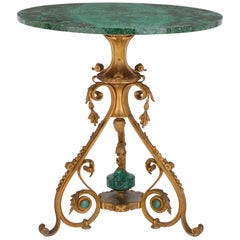
19th Century Gilt Bronze
Malachite Guéridon Table
Located in London, by appointment only
Important 19th Century Rococo Gilt Bronze & Malachite Guéridon. This magnificent table is designed and made in the most superb sculptural of rococo form, this finely cast polished & ...
Category
Antique 19th Century French Rococo Gueridon
Materials
Malachite, Bronze
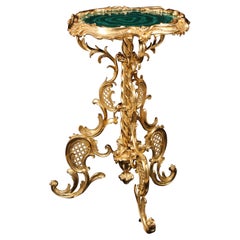
Nicholas I Period Russian Malachite Side Table with Gilt Bronze Base
Located in London, GB
Nicholas I period Russian malachite side table with gilt bronze base
Russian c. 1840
Measures: Height 77cm, diameter 89cm
This is a truly excepti...
Category
Antique 1840s Russian Neoclassical Gueridon
Materials
Malachite, Ormolu, Bronze
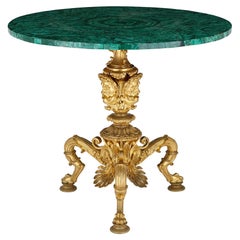
Incredible Russian Gilt Bronze Gueridon with a Granite Top, 19th Century
Located in Ottawa, Ontario
An Incredible Russian gilt bronze Gueridon with a granite top, 19th century.
The circular black painted top within a turned wood border frieze painted with laurel leaves and pink ri...
Category
Antique Mid-19th Century Russian Empire Gueridon
Materials
Granite, Bronze
$2,800
H 42.75 in Dm 10.25 in
Charles X Style Gilt Bronze and Mahogany Gueridon
Located in Essex, MA
Circular antico verde marble top with gallery raised on gilt bronze swan form supports joined by two lower shelves, paw feet.
Category
Early 20th Century French Charles X Gueridon
Materials
Marble, Bronze
French Gilt Bronze and Marble Gueridon Table
Located in Water Mill, NY
Antique French gilt bronze and marble Gueridon center/side table with eagle heads and feet H 29 x D 29". Gilding in very good condition.
Category
Antique Late 19th Century French Gueridon
Materials
Marble, Bronze
French Gilt Bronze and Malachite Centre Table
Located in London, GB
French gilt bronze and malachite centre table
French, 20th Century
Height 79cm, diameter 69cm
This very elegant 20th century French...
Category
20th Century French Empire Gueridon
Materials
Malachite, Ormolu
Louis XVI Gilt Bronze and Marble Gueridon Table
Located in Scottsdale, AZ
18th/19th Century Louis XVI Gilt Bronze and Marble Gueridon Table
Category
Antique 19th Century French Louis XVI Gueridon
Materials
Marble, Bronze
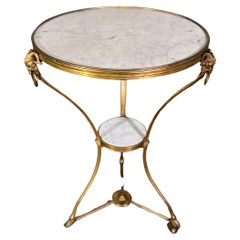
Marble Topped Tulipwood and Gilt Bronze Gueridon Table
By François Linke
Located in Vancouver, British Columbia
A highly decorative round occasional/centre table in the Louis XVI style; the Breche d’Alp marble top has a gilt bronze border above a skirt of Tulipwood decorated in the round with ...
Category
Antique Late 19th Century French Louis XVI Gueridon
Materials
Breccia Marble, Bronze
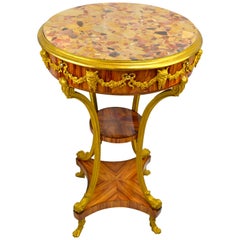
Louis XVI Style Gilt Bronze and Marble Guéridon
Located in Atlanta, GA
A magnificent Louis XVI style gilt bronze and marble guéridon by Victor Raulin, France, circa 1880.
Signature to wooden circular support beneath marble top.
Dimensions: Height 32 1...
Category
Antique 1880s French Louis XVI Gueridon
Materials
Marble, Bronze
More From This Seller
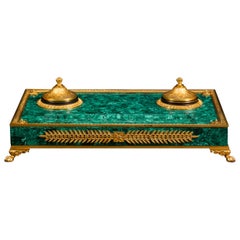
View AllRussian Malachite and Bronze Inkwell
Located in New Orleans, LA
Malachite is one of Russia’s most prestigious stones, and its use in the creation of this rare and opulent inkwell indicates commission and ownership by an individual of considerable status. Wonderful doré bronze accents are the perfect complement to the vivid green stone. Two dipping wells and pen tray make this inkwell as functional as it is beautiful,
circa 1890.
Dimensions: 18 1/4” wide x 11” deep x 5 1/2” high.
The 19th century proved to be the golden age of Russian malachite. The stone became a sign of prestige and a token of wealth so much so that Russian papers of the time wrote: “To afford having a big piece wrought in malachite is synonymous to owning diamonds.” Due to malachite's relatively close proximity, Russian tsars could easily obtain the malachite they needed to decorate their lavish palaces, such as the Winter Palace in St. Petersburg, paneling walls and commissioning beautiful inlaid works of art. Year after year the Russian (Romanov) treasury paid increasingly unreasonable prices to hoard the best malachite, much of which went into Romanov palaces and extravagant objects d’art. The Hermitage Museum possesses a collection of over 200 examples of this “palatial” malachite...
Category
Antique Late 19th Century Inkwells
Materials
Malachite, Bronze
Russian Malachite and Pietre Dure Plinths
Located in New Orleans, LA
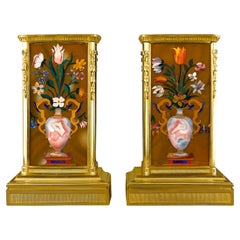
The exquisite art of pietre dure is at its absolute finest in this spectacular pair of Russian ormolu and malachite plinths. True works of art of the Restauration period, these plinths each feature a matching pietre dure mosaic crafted of the finest stones, all chosen to create a sense of depth and dimensionality in the final work. Depicting an onyx vase with tulips, roses, daffodils, magnolia and other flowers, these pietre dure panels are among the finest examples of this ancient art we have seen.
The pietre dure is complemented by malachite panels of the highest quality, exhibiting exceptional depth through its extraordinary cellular structure. Malachite is one of Russia’s most precious stones, and its presence in these plinths indicates commission and ownership by an individual of considerable status. Mounted in an excellent stepped ormolu base, these plinths originally served as bases for vases or candelabra.
The overall execution and appearance of these plinths is very characteristic of the taste associated with the immensely wealthy collector Nicolas Demidoff. As early as 1806, Demidoff had commissioned the Parisian goldsmith Henri August to supply a guéridon; in 1819, he ordered famed French bronzier Pierre-Philippe Thomire to supply mounts for a massive malachite vase (now in the Metropolitan Museum of Art, New York), as well as a console table with legs in the form of Nike. Other commissions included a table given as a gift to Grand Duke Leopoldo II of Florence, now in the Pitti Palace. Demidoff eventually settled in Florence in 1822 and became Russian minister to the Tuscan Court. Elevated to the rank of Count of San Donato by the Grand Duke, he built a magnificent villa at San Donato on the site of lands formerly owned by the Medici. The villa was later inherited by Anatole, his son, Prince of San Donato, and there are records which confirm transactions he had with the Opificio delle Pietre Dure.
The 19th century proved to be the golden age of Russian malachite. The stone became a sign of prestige and a token of wealth, so much so that Russian papers of the time wrote: "To afford having a big piece wrought in malachite is synonymous to owning diamonds." Year after year the Russian (Romanov) treasury paid increasingly unreasonable prices to hoard the best malachite, much of which went into Romanov palaces and extravagant objets d'art. The Hermitage Museum possesses a collection of over two hundred examples of this “palatial” malachite...
Category
Antique 19th Century Russian Pedestals
Materials
Malachite, Ormolu
$168,500 / set
Pair of Russian Malachite Tazze by the Imperial Lapidary Works
Located in New Orleans, LA
Pair of Russian Malachite Tazze
Imperial Lapidary Works
Circa 1830
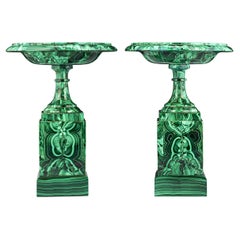
A magnificent example of early 19th-century Russian craftsmanship, this pair of malachite tazze was created by the Imperial Lapidary Works of Ekaterinburg, circa 1830. These works exemplify the period when malachite emerged as the principal decorative material in Russian hardstone...
Category
Antique 19th Century Russian Neoclassical Vases
Materials
Malachite
18th Century Russian Figural Bronze Candelabra
Located in New Orleans, LA
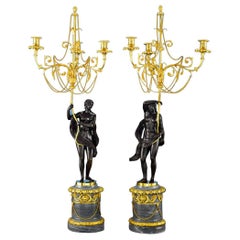
The epitome of Russian craftsmanship, this majestic and incredibly rare pair of candelabra would have been fit for the Czar. These superb Louis XVI style figural bronze candelabra were created in the Neoclassical taste that permeated Russia during the late 18th century. The chiselled gilt bronze work is in a class all its own – a trademark of only the most exceptional Russian ormolu craftsmen. Elegant patinated bronze nudes hold aloft delicate gilt bronze branches accentuated by gilt chains. Elevated atop classical columns crafted of polished gray marble, these lights perfectly express the outstanding grace and luxurious artistry of Russian decorative art.
In France during the late 18th century, Neoclassicism emerged as the most popular style after the exuberance of Rococo during the reign of Louis XV. The emphasis was on simplicity, straight lines and symmetry. Slenderness of proportion was stressed in furniture and decorating, and these patterns extended to other areas of the arts. French design taste has historically spread and influenced styles throughout Europe, and Russia in particular has a long history of adopting foreign stylistic trends considered to be the epitome of grand taste. Catherine the Great and her grandson Alexander I...
Category
Antique 18th Century French Louis XVI Candelabras
Materials
Marble, Bronze
$74,500 / set
Rosso Antico Marble and Gilt Bronze Potpourri Vases
Located in New Orleans, LA
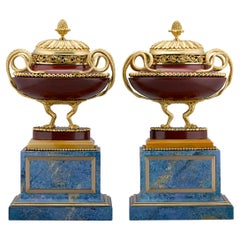
This exquisite pair of rosso antico marble and gilt bronze potpourri vases epitomize opulent artistry. A popular material for sculpture in ancient ...
Category
Antique 18th Century European Neoclassical Vases
Materials
Stone, Marble, Bronze
Christofle Gilt Bronze Vase
By Christofle
Located in New Orleans, LA
Gilt Bronze Vase
Christofle
Circa 1930
This exemplary Art Nouveau vase demonstrates Christofle's mastery of metalworking during the early 20th century. The graceful oviform vessel r...
Category
20th Century French Art Nouveau Vases
Materials
Bronze