Items Similar to Eero Saarineen Set of Two Black and White Low Tables in Wood and Aluminum 1990s
Want more images or videos?
Request additional images or videos from the seller
1 of 7
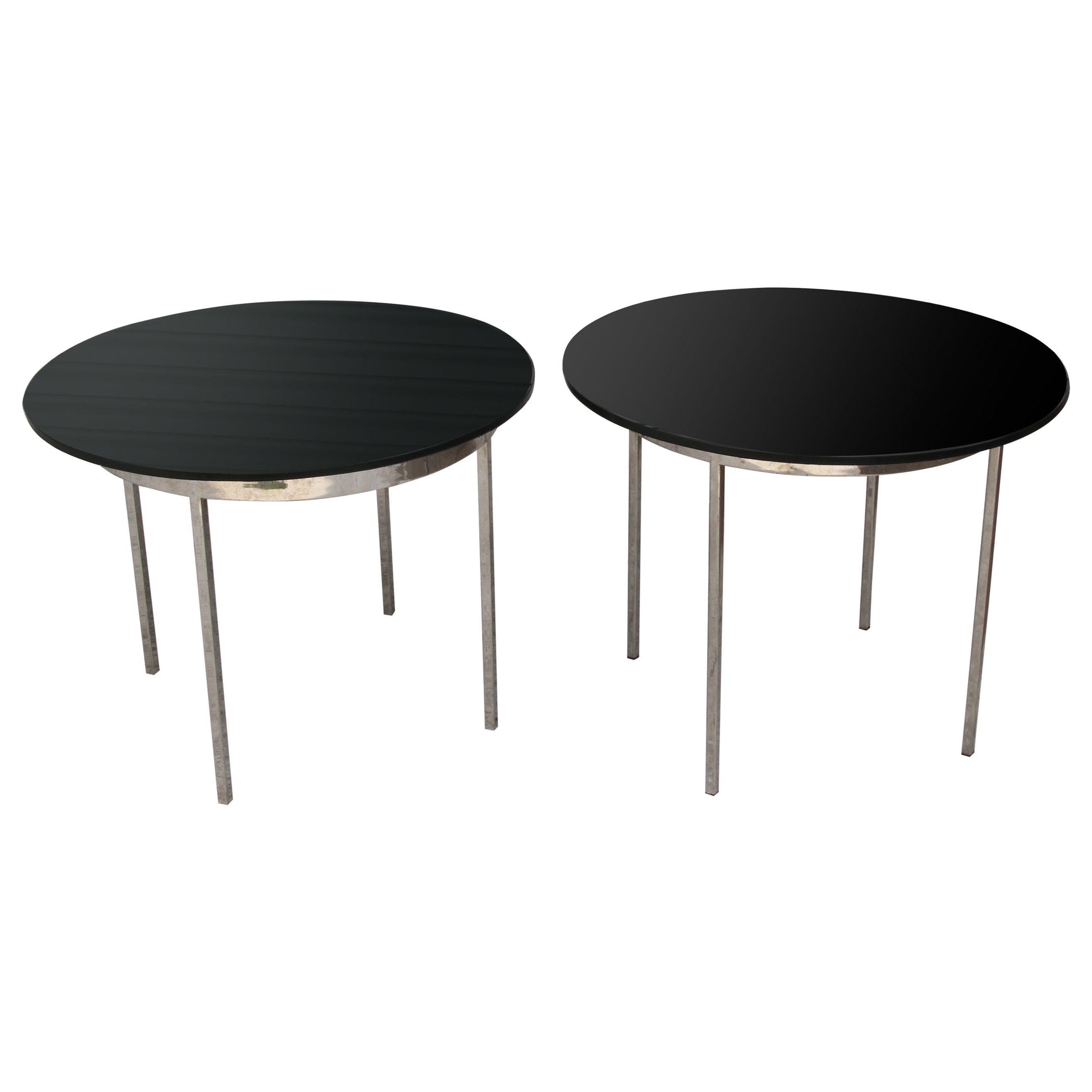
Eero Saarineen Set of Two Black and White Low Tables in Wood and Aluminum 1990s
$2,151.40per set
£1,608.84per set
€1,800per set
CA$2,966.11per set
A$3,255.37per set
CHF 1,710.75per set
MX$38,738.26per set
NOK 21,868.41per set
SEK 19,983.40per set
DKK 13,716.74per set
About the Item
Set of two coffee tables with a black pedestal base in painted die-cast aluminum and an oval-shaped top in white lacquered wood.
These two tables were manufactured in the 1990s in the style of the designer Eero Saarinen
Eero Saarinen was a Finnish-born-American architect born on August 20, 1910. Son of an architect and sculptor, Eero went to public schools in Michigan and in 1929 joined Académie de la Grande Chaumière in Paris to study studied sculpturing. Later he studied architecture at Yale University from 1931 to 1934 and won a chance to travel around Europe and North Africa from 1934 to 1935.
Eero started off his professional life from the United States by doing research about housing and city planning with the Flint Institute of Research and Planning in Michigan, in 1936. After working here for two years he joined his father’s firm in 1938. The first international recognition for Eero came during his collaboration with his father. It started off with a chair design and later in time, this duo of father and son managed to win many other competitions for their innovative designs and projects. Furthermore, he went on with furniture design for quite a long period of time.
After the death of his father in 1950, Saarinen founded his own firm ‘Eero Saarinen
Associates’ in Birmingham, worked there until the time of his death in 1961. During this time he dedicated a huge chunk of his time for furniture design and other home furnishing design ideas.
Some of his major architectural structures and contributions to the field of design are: the Bell Labs Holmdel Complex in Holmdel Township, New Jersey
Jefferson National Expansion Memorial (including the Gateway Arch) in St. Louis, Missouri the Miller House in Columbus, Indiana the TWA Flight Center at John F. Kennedy International Airport the main terminal of Dulles International Airport near Washington, D.C. General Motors Technical Center in Warren, Michigan.
Throughout his career Saarinen worked with fondness towards his field. He always seemed to be competing with his own designs, every time he set out to make something new. He would study all the stages of construction with great care and pay attention to all the details starting from client’s concerns and demands to final execution of ideas. He is held responsible for introducing the trend of experimentation and exploration of design in the field of architecture. He was one of those architects who didn’t have any other interests in life except for architecture and he didn’t even bother to pen down his ideas in the form of book or any other such script.
- Similar to:Eero Saarinen (Designer)
- Dimensions:Height: 22.45 in (57 cm)Width: 15.36 in (39 cm)Depth: 13.78 in (35 cm)
- Sold As:Set of 2
- Style:Post-Modern (Of the Period)
- Materials and Techniques:
- Place of Origin:
- Period:1990-1999
- Date of Manufacture:1990s
- Condition:Wear consistent with age and use.
- Seller Location:Cascina, IT
- Reference Number:1stDibs: LU5304229470512
About the Seller
4.9
Gold Seller
Premium sellers maintaining a 4.3+ rating and 24-hour response times
1stDibs seller since 2020
135 sales on 1stDibs
Typical response time: <1 hour
- ShippingRetrieving quote...Shipping from: Borgo a Buggiano, Italy
- Return Policy
More From This Seller
View AllEttore Sottsass Set of two Rocchettone Round Side Table by Poltronova 1960s
By Ettore Sottsass, Poltronova
Located in Cascina, Pisa
Rocchettone side table realized in lacquered walnut wood with bright orange decorations (under the table top and on the base), it was designed by Ettore Sottsass and manufactured by ...
Category
Vintage 1960s Italian Post-Modern Tables
Materials
Plastic, Wood, Walnut
Franco Albini TL30 Round Table in Metal and Wood by Poggi 1950s
By Poggi, Franco Albini
Located in Cascina, Pisa
TL30 table with a round top in wood and a base in black lacquered metal, designed by Franco Albini and produced by Poggi in the 1950s.
After spending his childhood and part of his youth in Robbiate in Brianza, where he was born in 1905, Franco Albini moved with his family to Milan. Here he enrolled in the Faculty of Architecture of the Polytechnic and graduated in 1929. He starts his professional activity in the studio of Gio Ponti and Emilio Lancia, with whom he collaborates for three years. He probably had his first international contacts here
In those three years, the works carried out are admittedly of a twentieth-century imprint. It was the meeting with Edoardo Persico that marked a clear turning point towards rationalism and the rapprochement with the group of editors of “Casabella”.
The new phase that that meeting provoked starts with the opening of the first professional studio in via Panizza with Renato Camus and Giancarlo Palanti. The group of architects began to deal with public housing by participating in the competition for the Baracca neighborhood in San Siro in 1932 and then creating the Ifacp neighborhoods: Fabio Filzi (1936/38), Gabriele D’Annunzio and Ettore Ponti (1939).
Also in those years Albini worked on his first villa Pestarini.
But it is above all in the context of the exhibitions that the Milanese master experiments his compromise between that “rigor and poetic fantasy” coining the elements that will be a recurring theme in all the declinations of his work – architecture, interiors, design pieces . The opening in 1933 of the new headquarters of the Triennale in Milan, in the Palazzo dell’Arte, becomes an important opportunity to express the strong innovative character of rationalist thought, a gym in which to freely experiment with new materials and new solutions, but above all a “method”.
Together with Giancarlo Palanti, Albini on the occasion of the V Triennale di Milano sets up the steel structure house, for which he also designs the ‘furniture. At the subsequent Triennale of 1936, marked by the untimely death of Persico, together with a group of young designers gathered by Pagano in the previous edition of 1933, Franco Albini takes care of the preparation of the exhibition of the house, in which the furniture of three types of accommodation. The staging of Stanza per un uomo, at that same Triennale, allows us to understand the acute and ironic approach that is part of Albini, as a man and as a designer: the theme addressed is that of the existenzminimum and the reference of the project is to the fascist myth of the athletic and sporty man, but it is also a way to reflect on low-cost housing, the reduction of surfaces to a minimum and respect for the way of living.
In that same year Albini and Romano designed the Ancient Italian Goldsmith’s Exhibition: vertical uprights, simple linear rods, design the space. A theme, that of the “flagpole”, which seems to be the center of the evolution of his production and creative process. The concept is reworked over time, with the technique of decomposition and recomposition typical of Albinian planning: in the setting up of the Scipio Exhibition and of contemporary drawings (1941) the tapered flagpoles, on which the paintings and display cases are hung, are supported by a grid of steel cables; in the Vanzetti stand (1942) they take on the V shape; in the Olivetti store in Paris (1956) the uprights in polished mahogany support the shelves for displaying typewriters and calculators. The reflection on this theme arises from the desire to interpret the architectural space, to read it through the use of a grid, to introduce the third dimension, the vertical one, while maintaining a sense of lightness and transparency.
The flagpole is found, however, also in areas other than the exhibition ones. In the apartments he designed, it is used as a pivot on which the paintings can be suspended and rotated to allow different points of view, but at the same time as an element capable of dividing spaces. The Veliero bookcase...
Category
Vintage 1950s Italian Mid-Century Modern Tables
Materials
Metal
Gabetti
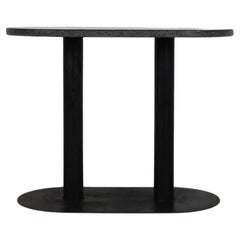
Isola Console Table in Black Lacquered Metal and Granite by Arbo 1970s
By Roberto Gabetti and Aimaro Isola, Arbo
Located in Cascina, Pisa
Console table with a base in black lacquered metal and an ovoidal table top in granite, originally designed by Aimaro Oreglia d'Isola and Roberto Gabetti f...
Category
Vintage 1970s Italian Post-Modern Console Tables
Materials
Granite, Metal
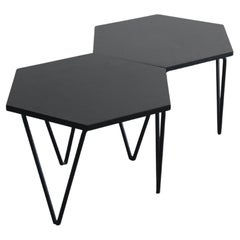
Gio Ponti Set of Two Hexagonal Coffee Tables in Wood and Metal I.S.A. 1950s
By Gio Ponti, I.S.A. Italy
Located in Cascina, Pisa
Set of two hexagonal coffee tables with legs in painted metal and wooden/laminate top, designed by Gio Ponti and produced by ISA, 1950s, Italy,
Literature: Fabio Fioroni, Alessandra ...
Category
Vintage 1950s Italian Mid-Century Modern Coffee and Cocktail Tables
Materials
Metal
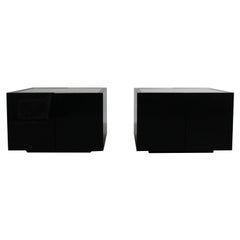
Massimo
Lella Vignelli Set of Two Black Saratoga Bar Cabinet by Poltronova
By Poltronova, Massimo and Lella Vignelli
Located in Cascina, Pisa
Set of two luminous side table/cabinet bar in black lacquered wood, these piece presents two openable opposite doors and inner shelves.
Designed by Massimo and Lella Vignelli and p...
Category
Vintage 1960s Italian Mid-Century Modern Side Tables
Materials
Polyester, Wood
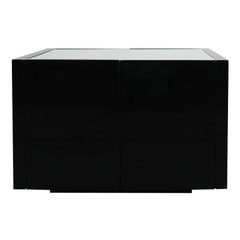
Massimo
Lella Vignelli Black Saratoga Side Table or Bar Cabinet by Poltronova
By Poltronova, Massimo and Lella Vignelli
Located in Cascina, Pisa
Saratoga luminous side table/cabinet bar in black lacquered wood, this piece presents two openable opposite doors and inner shelves.
Designed by Massimo and Lella Vignelli and prod...
Category
Vintage 1960s Italian Mid-Century Modern Side Tables
Materials
Polyester, Wood
You May Also Like
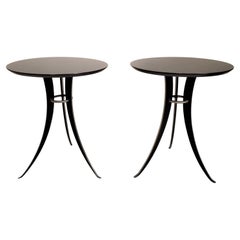
Pair of Steel and Ebonized Wood Circular Tables, Style of Osvaldo Borsani
By Osvaldo Borsani
Located in New York City, NY
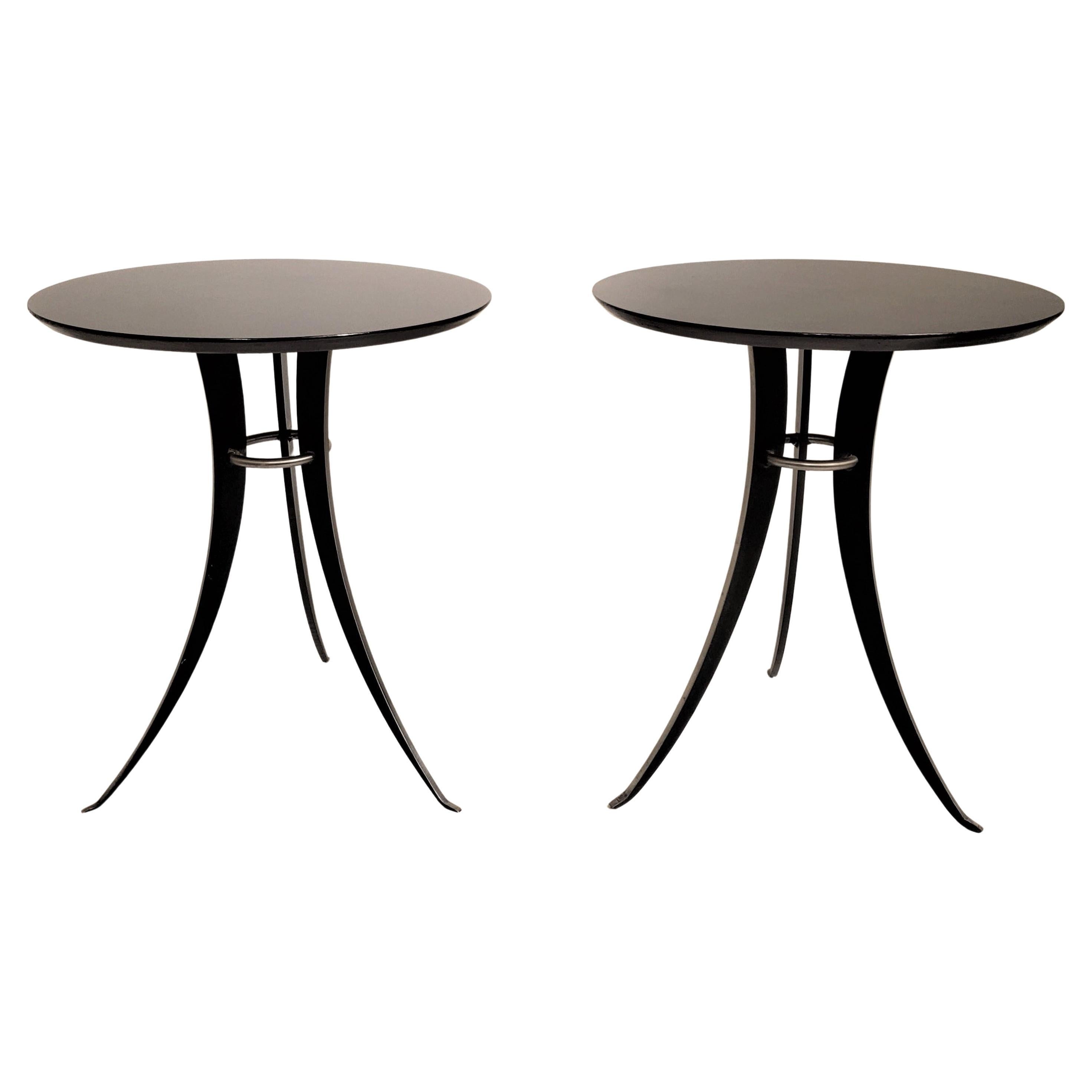
A Minimalist pair of tulip design, splay leg end tables in steel and lacquered wood.
The austere and streamline design make this pair appealing...
Category
Mid-20th Century Mid-Century Modern Side Tables
Materials
Steel
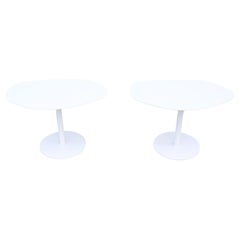
Mid-Century Modern Organic Forms Side Tables Attributed to Morten Voss - a Pair
Located in Secaucus, NJ
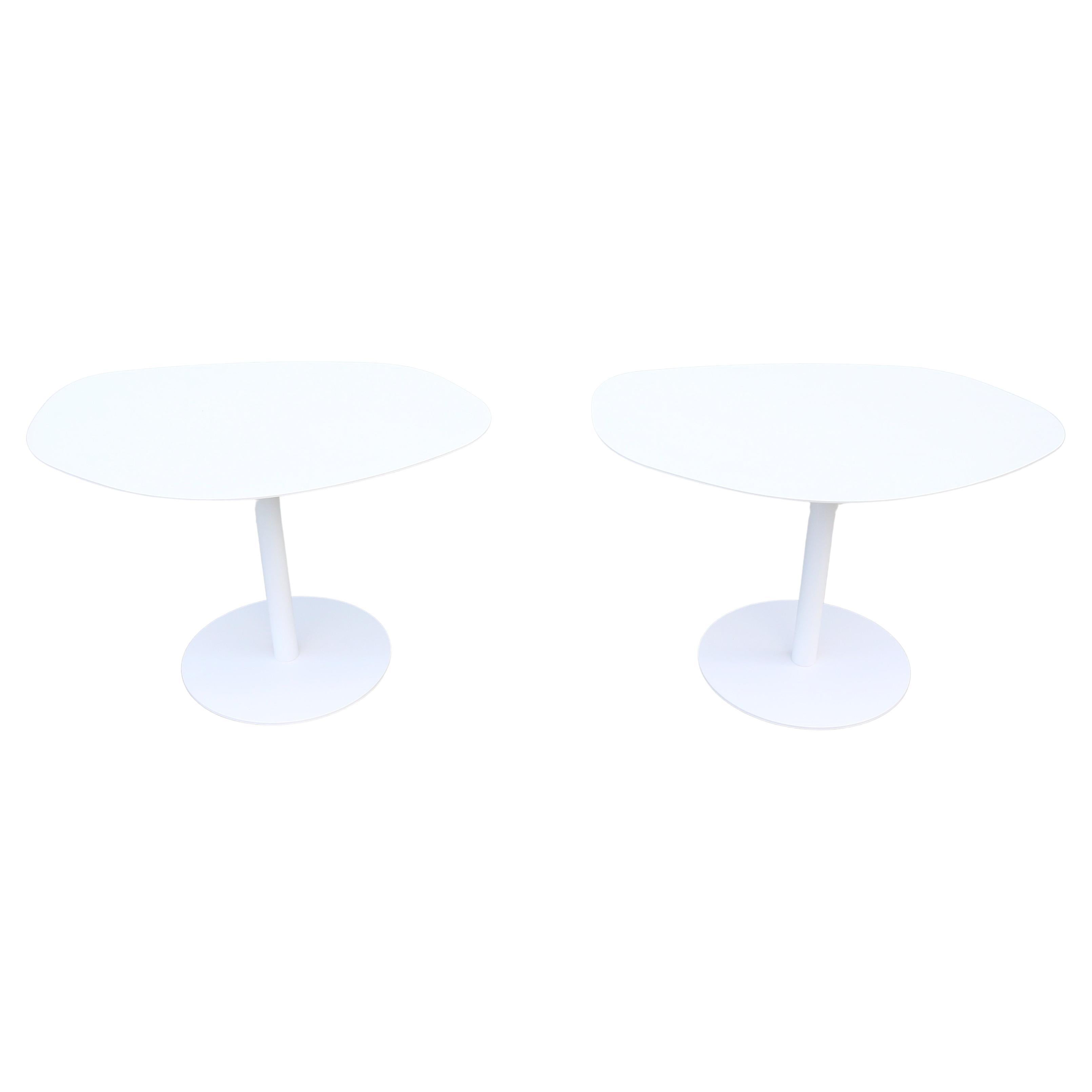
Fabulous pair of mid-century modern style large organic forms steel occasional side tables in snow white color. Attributed to Morten Voss.
An eye-catching design, the unique shape of...
Category
2010s American Mid-Century Modern Side Tables
Materials
Steel
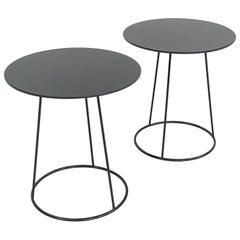
2019 Pair of Monica Forster for Swedese Breeze Side Tables in Black Wood
By Monica Förster, Swedese
Located in Philadelphia, PA
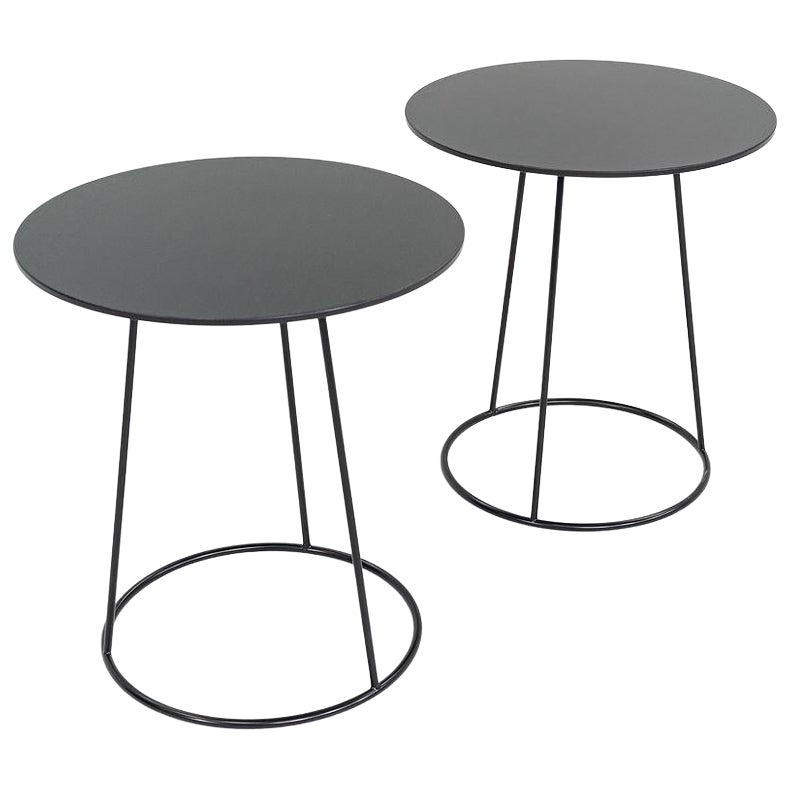
This is a pair of Breeze Side Tables, originally designed by Monica Forster for Swedese in 2007. These particular examples were produced in Sweden in 2019. The tables are comprised o...
Category
2010s Swedish Modern Side Tables
Materials
Steel
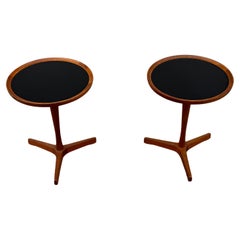
Pair of Hans C. Andersen Danish Teak Side Tables Black Tops by Artex of Denmark
By Hans C. Andersen, Artek
Located in St. Louis, MO
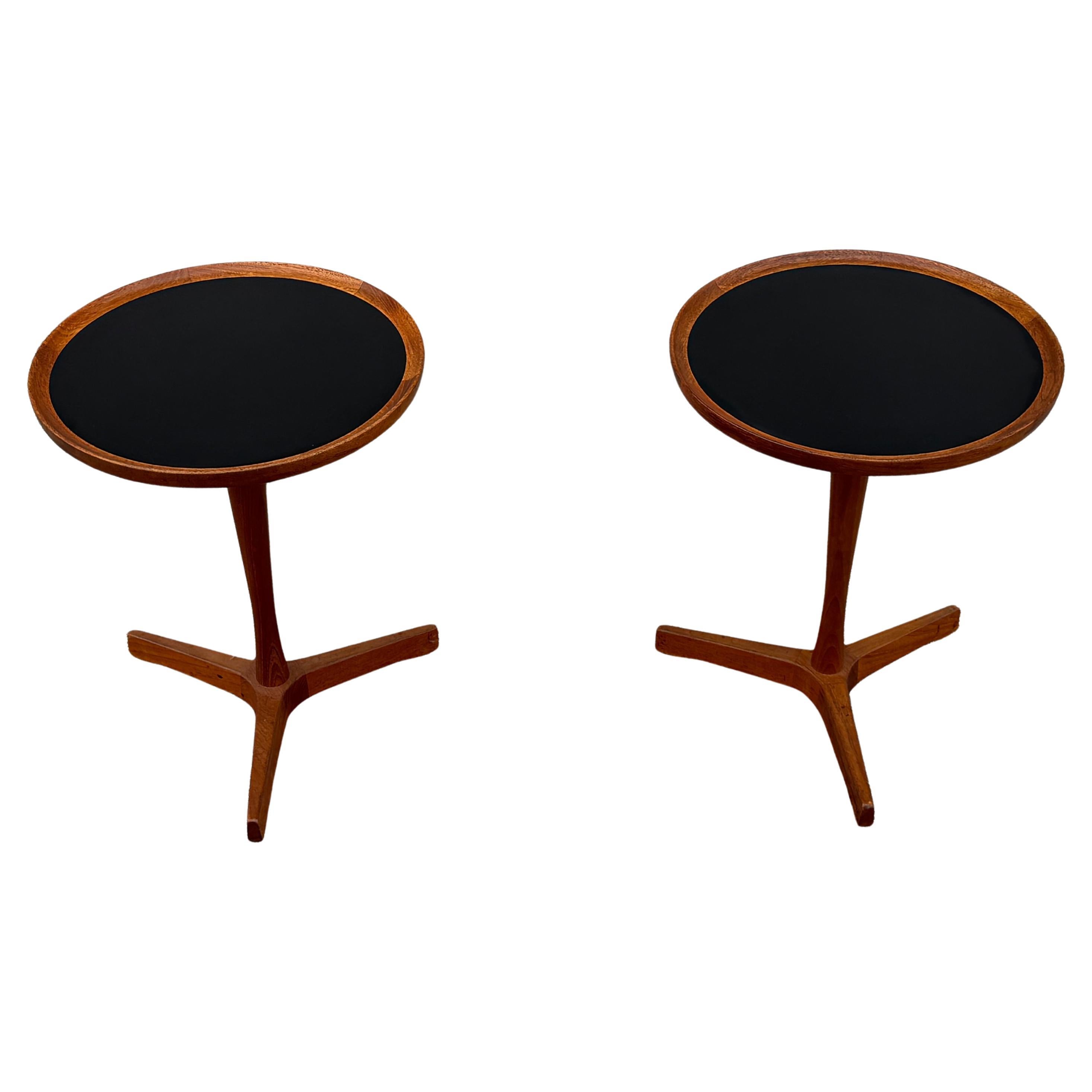
1960s Scandinavian Modern design at its best, simple but elegant. These matching pair of Hans C. Andersen tripod base teak side tables with round black laminate tops by Artex of Denm...
Category
Vintage 1960s Danish Scandinavian Modern Side Tables
Materials
Laminate, Teak
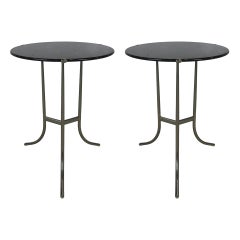
Pair of Nickel AE Side Tables with Black Marble by Cedric Hartman
By Cedric Hartman
Located in Danville, CA
Classic pair of AE side tables in our favorite materials; black Nero Marquina marble on the polished nickel base. The pair are in beautiful original condition.
Category
Late 20th Century American Modern Side Tables
Materials
Marble, Nickel, Steel
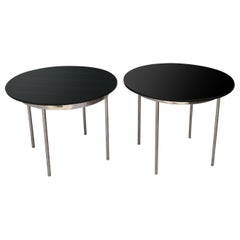
One Pair Mid Century Smoked Glass and Chrome Side Tables
By Nicos Zographos
Located in Pasadena, TX
One Pair Mid Century Style Chrome Glass Side Tables in the Style of Zographos
American Mid-Century round end / side tables with circular smoked glass tops resting on chrome bases.
...
Category
Late 20th Century North American Mid-Century Modern Side Tables
Materials
Chrome
$1,920 Sale Price / set
20% Off
More Ways To Browse
Milo Baughman Pedestal
Mirrored Pedestal Tables
Pedestals Made In Italy
Root Pedestal
Bentwood Plant
Columnar Pedestals
English Plant Stand
Marble Pedestal With Brass
Art Display Pedestal
Fern Table
Marble Display Table
Small Pedestal Tables
Wood Pedestal Plinth
Dolphin Pedestal
Mirrored Glass Pedestal
Pair Of Rosewood Pedestal Tables
Pedestal Inlaid Wood Tables
Plant Stand Bentwood