Items Similar to Antique Swiss Walnut Marquetry Occasional Table 19th Century


Want more images or videos?
Request additional images or videos from the seller
1 of 21
Antique Swiss Walnut Marquetry Occasional Table 19th Century
$1,730.32
£1,275
€1,488.14
CA$2,397.38
A$2,605.86
CHF 1,394.96
MX$31,498.83
NOK 17,579.21
SEK 16,212.60
DKK 11,114.01
About the Item
This is a superb antique 19th Century Swiss carved walnut and marquetry inlaid centre table, Circa 1870 in date.
It has a striking shaped top which is centred by a cartouche decorated with a chamois goat on a mountain top. The table is raised on a carved central column on three cabriole carved shaped legs.
It is a very handsome piece which would look perfect in any study or library.
Condition:
In excellent condition having only been beautifully cleaned and waxed in our workshops, please see photos for confirmation.
Dimensions in cm:
Height 74 cm x Width 80 cm x Depth 59 cm
Dimensions in inches:
Height 2 foot, 5 inches x Width 2 foot, 7 inches x Depth 1 foot, 11 inches
Marquetry
is decorative artistry where pieces of material of different colours are inserted into surface wood veneer to form intricate patterns such as scrolls or flowers.
The technique of veneered marquetry had its inspiration in 16th century Florence. Marquetry elaborated upon Florentine techniques of inlaying solid marble slabs with designs formed of fitted marbles, jaspers and semi-precious stones. This work, called opere di commessi, has medieval parallels in Central Italian "Cosmati"-work of inlaid marble floors, altars and columns. The technique is known in English as pietra dura, for the "hardstones" used: onyx, jasper, cornelian, lapis lazuli and colored marbles. In Florence, the Chapel of the Medici at San Lorenzo is completely covered in a colored marble facing using this demanding jig-sawn technique.
Techniques of wood marquetry were developed in Antwerp and other Flemish centers of luxury cabinet-making during the early 16th century. The craft was imported full-blown to France after the mid-seventeenth century, to create furniture of unprecedented luxury being made at the royal manufactory of the Gobelins, charged with providing furnishings to decorate Versailles and the other royal residences of Louis XIV. Early masters of French marquetry were the Fleming Pierre Golle and his son-in-law, André-Charles Boulle, who founded a dynasty of royal and Parisian cabinet-makers (ébénistes) and gave his name to a technique of marquetry employing brass with pewter in arabesque or intricately foliate designs.
Our reference: A4749
- Dimensions:Height: 29.14 in (74 cm)Width: 31.5 in (80 cm)Depth: 23.23 in (59 cm)
- Materials and Techniques:
- Place of Origin:
- Period:
- Date of Manufacture:circa 1870
- Condition:
- Seller Location:London, GB
- Reference Number:Seller: A47491stDibs: LU950647790962
About the Seller
5.0
Platinum Seller
Premium sellers with a 4.7+ rating and 24-hour response times
Established in 1983
1stDibs seller since 2012
1,439 sales on 1stDibs
Typical response time: <1 hour
Associations
LAPADA - The Association of Arts
Antiques Dealers
- ShippingRetrieving quote...Shipping from: London, United Kingdom
- Return Policy
More From This Seller
View AllAntique Sorrento Italian Marquetry
Parquetry Occasional Table 19th Century
Located in London, GB
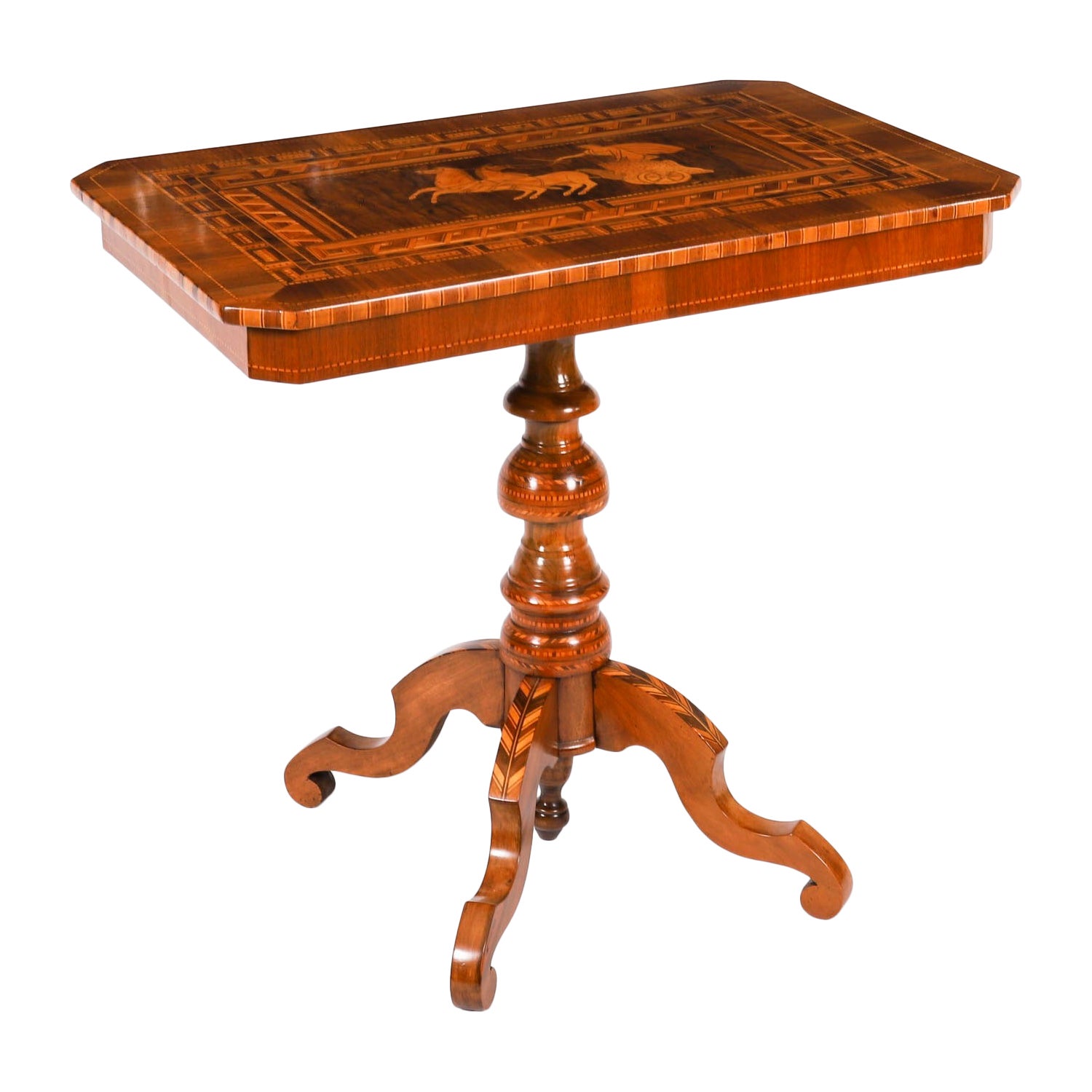
This is a beautiful antique occasional table, from Sorrento in Italy, c.1880 in date.
It was hand crafted from walnut and olive wood. The oblong top with canted corners is superbly...
Category
Antique 1880s Side Tables
Materials
Walnut
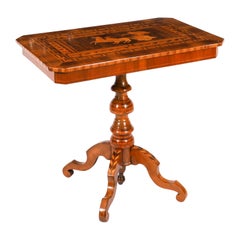
Antique 4ft 6" diam Burr Walnut Marquetry Dining / Center Table 1860s
Located in London, GB
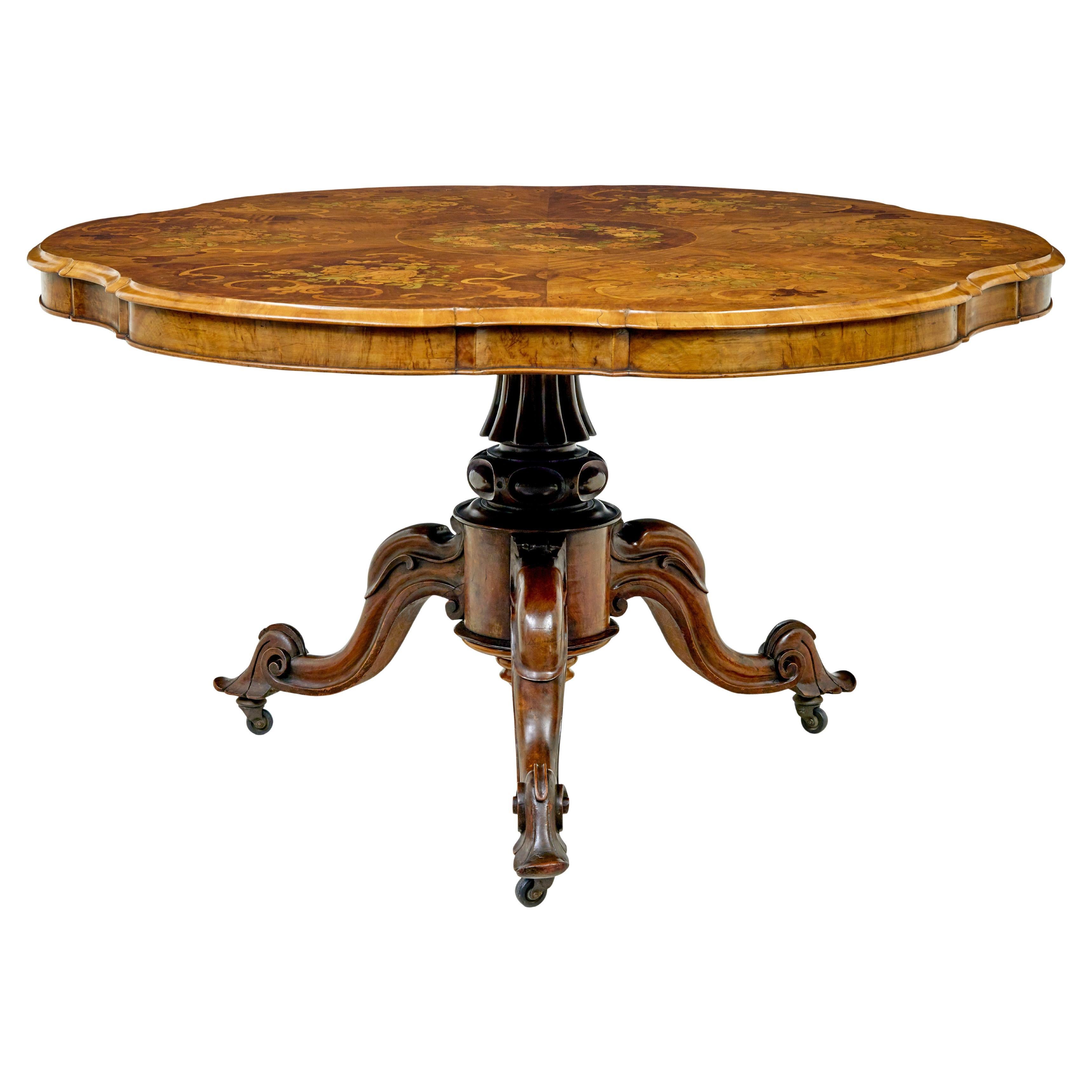
This is a fine and rare antique English mid Victorian, burr walnut, ebonised and fruitwood marquetry, centre table, in the manner of Edward Holmes Baldock and circa 1860 in date.
The shaped segmentally veneered circular top is beautifully marquetry inlaid with assorted flowers within shaped cartouches and features a beautiful scrolled foliate carved edge.
It sits on a cabochon and acanthus-wrapped baluster column with three cabochon-embedded, foliate-scrolled, rocaille-carved outswept legs, with clasped feet and recessed castors.
It is extremely versatile and can be placed in your hallway, living room, dining room, or reception.
Condition:
In excellent condition having been beautifully cleaned, polished and waxed in our workshops, please see photos for confirmation.
Dimensions in cm:
Height 74 x Width 145 x Depth 145
Dimensions in inches:
Height 2 foot, 5 inches x Width 4 foot, 9 inches x Depth 4 foot, 9 inches
In 1805 Baldock's name first appears as the freehold owner of 7 Hanway Street, London. Over the years he expanded his premises. By 1840 his property in this street comprised nos 1 and 2, both with back premises, and in addition he owned a yard and no. 3, which he let. It was in 1 and 2 Hanway Street that he carried on business up to 1843 when he retired, selling his stock and moving to a fashionable residential address, Hyde Park Place. According to one 19th-century source, the business was taken over by Frederick Litchfield's father. He was buried in St Pancras Church, Euston, where he is commemorated by a marble memorial tablet on the north wall, dedicated jointly to him and Mary Frances Westoby.
In 1805 he described himself as dealer in china and glass. By 1821 he was styled in the Post Office Directories as antique furniture and ornamental china dealer, and in 1826 he described his activities in a bill heading as ‘buying, selling, exchanging and valuing China, Cabinets, Screens, Bronzes etc.’. Though Baldock's business consisted primarily in dealing in antique porcelain and furniture — largely foreign — he repaired, remodelled and altered existing furniture. He also produced designs for new pieces and had them made.
In 1836 Baldock sold French eighteenth-century furniture to Lady Stafford (Countess of Sutherland) for Dunrobin Castle, and in 1842 Scotland’s leading country house architect, William Burns, recommended to his patron O. Tyndall Bruce of Falkland House that ‘for Cabinets and China, do not omit going to Baldock’s Hanway Street, Oxford Street… which is the first place in London’.
In 1841 the Duke of Buccleuch was sent drawings of bedroom furniture as well as working drawings of an octagonal table, a bookcase and three stalls. A design of a table in the Buccleuch papers which is annotated ‘No. 3 Amboyna wood ground with coloured flowers’ is almost certainly the preliminary sketch for a table which was later made. Robert Byng (1764-1847) and George Newport, 2nd Earl of Bradford were also customers of Baldock’s. In 1840 he supplied a two encoignures with slab tops to the latter (one illus. FHS Newsletter (February 2017, p. 5). A pair of china cabinets...
Category
Antique 1860s Dining Room Tables
Materials
Walnut
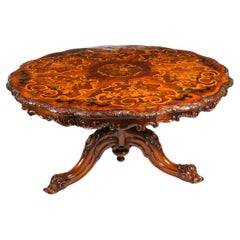
Antique Victorian Burr Walnut Wine/ Occasional Table 19th Century
Located in London, GB
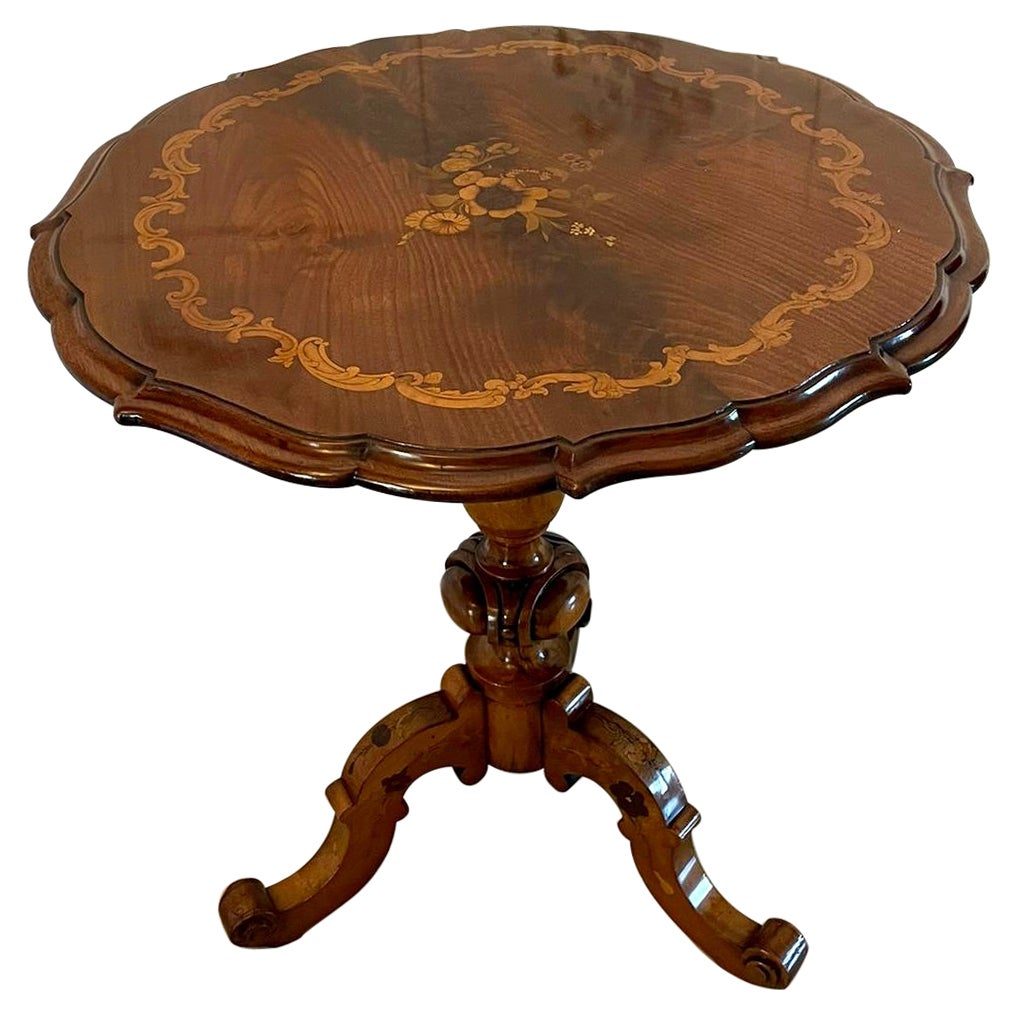
This is a beautiful English antique Victorian burr walnut, marquetry and ebonised occasional table, circa 1860 in date.
The turned and spiral twist stem and tripod base have been m...
Category
Antique 19th Century English Victorian Side Tables
Materials
Walnut
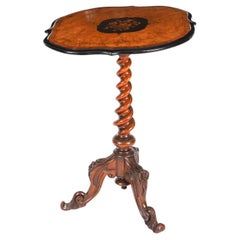
Antique Burr Walnut
Marquetry Inlaid Oval Coffee Table 19th Century
Located in London, GB
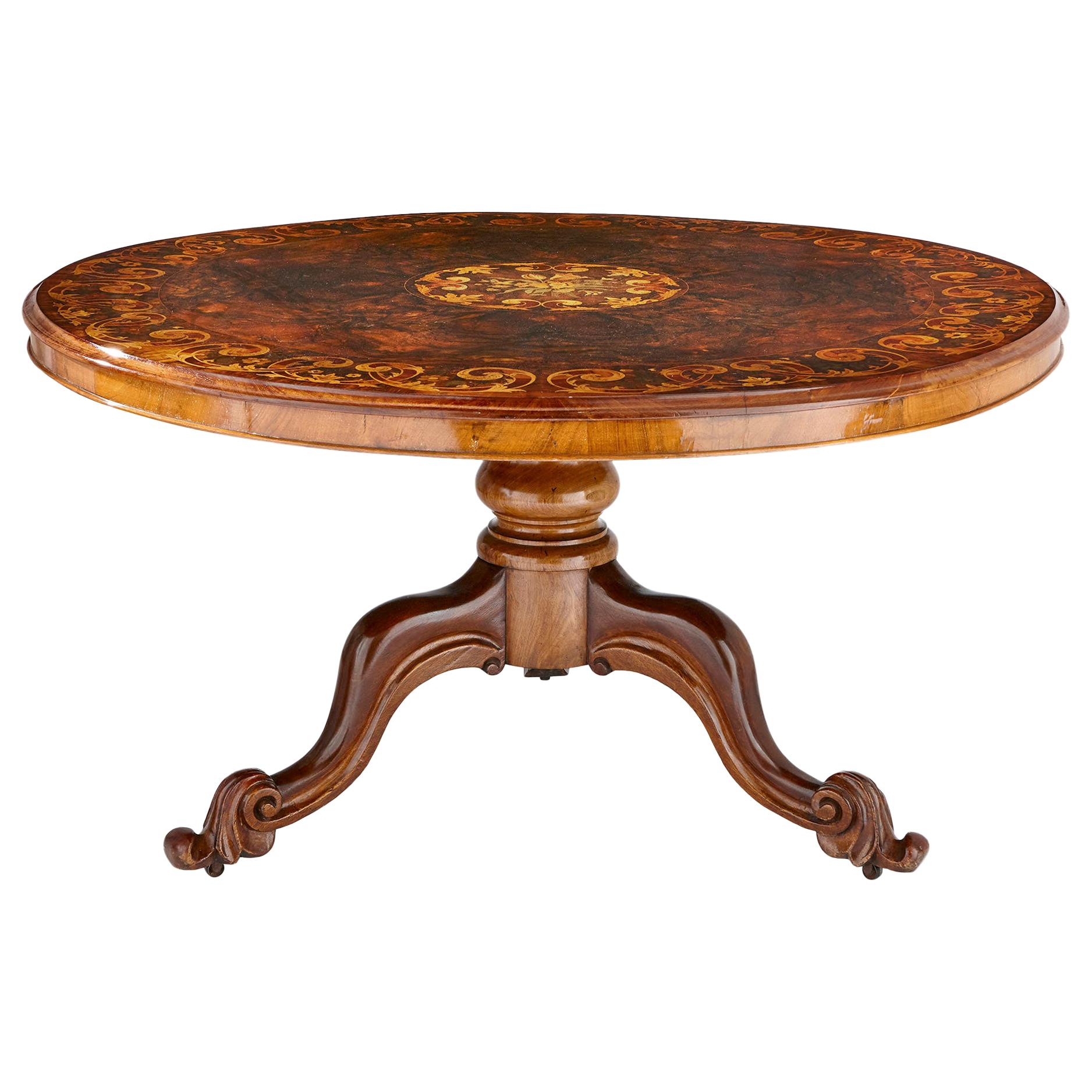
This is a superb Victorian burr walnut and marquetry coffee table, circa 1870 in date.
The table top is oval in shape and features wonderful burr walnut with superb marquetry inlaid...
Category
Antique Late 19th Century English Victorian Coffee and Cocktail Tables
Materials
Brass
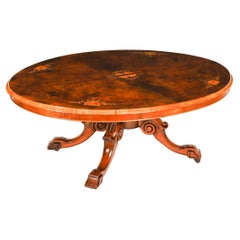
Antique Victorian Mahogany
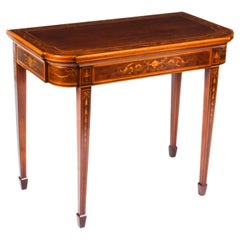
Inlaid Card Games Table 19th Century
Located in London, GB
This is a fabulous antique Victorian mahogany, satinwood and marquetry games table in the manner of Edwards & Roberts, circa 1860 in date.
It is made of beautiful flame mahogany and satinwood with elegant satinwood inlaid and penwork floral and foliate decoration of ribbons, bellfowers and garlands..
The shaped hinged top opens to reveal a fabulous green baize lined gaming interior for playing cards, above a frieze fitted with a drawer and decorated by a beautiful classical urn. The table is raised on elegant square tapering legs terminating in spade feet.
It is an elegant piece which will enhance a special room in your home.
THE BOTANICAL NAME FOR THE MAHOGANY THAT THIS ITEM IS MADE OF IS SWIETENIA MACROPHYLLA AND THIS TYPE OF MAHOGANY IS NOT SUBJECT TO CITES REGULATION AND DOES NOT CONTAIN ANY RESTRICTED MATERIALS.
Condition:
In excellent condition having been beautifully cleaned and polished in our workshops, please see photos for confirmation.
Dimensions in cm:
Height 74 x Width 89 x Depth 48
Dimensions in inches:
Height 2 foot, 5 inches x Width 2 foot, 11 inches x Depth 1 foot, 7 inches
Marquetry
is decorative artistry where pieces of material (such as wood, pewter or brass silver) of different colours are inserted into surface wood veneer to form intricate patterns such as scrolls or flowers.
The technique of veneered marquetry had its inspiration in 16th century Florence. Marquetry elaborated upon Florentine techniques of inlaying solid marble slabs with designs formed of fitted marbles, jaspers and semi-precious stones. This work, called opere di commessi, has medieval parallels in Central Italian "Cosmati"-work of inlaid marble floors, altars and columns. The technique is known in English as pietra dura, for the "hardstones" used: onyx, jasper, cornelian, lapis lazuli and colored marbles. In Florence, the Chapel of the Medici at San Lorenzo is completely covered in a colored marble facing using this demanding jig-sawn technique.
Techniques of wood marquetry were developed in Antwerp and other Flemish centers of luxury cabinet-making during the early 16th century. The craft was imported full-blown to France after the mid-seventeenth century, to create furniture of unprecedented luxury being made at the royal manufactory of the Gobelins, charged with providing furnishings to decorate Versailles and the other royal residences of Louis XIV. Early masters of French marquetry were the Fleming Pierre Golle and his son-in-law, André-Charles Boulle, who founded a dynasty of royal and Parisian cabinet-makers (ébénistes) and gave his name to a technique of marquetry employing brass with pewter in arabesque or intricately foliate designs.
Edwards & Roberts
The firm Edwards & Roberts was one of the best English antique furniture cabinet makers of the second half of the eighteenth century. The company was founded in 1845 and by 1854 was trading as ‘Edwards & Roberts’, 21 Wardour Street, Antique and Modern Cabinet...
Category
Antique 1860s English Victorian Card Tables and Tea Tables
Materials
Mahogany, Satinwood
Antique Victorian Satinwood Occasional Table, 19th Century
Located in London, GB
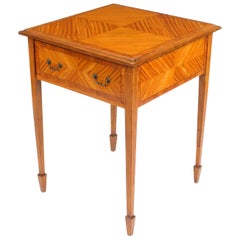
A beautiful antique Victorian satinwood occasional table with an unusually large drawer, circa 1880.
This exquisitely crafted piece is made from satinwood with kingwood crossbanding and boxwood inlay.
Add an elegant touch to your home with this antique English occasional table...
Category
Antique 1880s English Victorian Side Tables
Materials
Satinwood
You May Also Like
Outstanding Quality Large Antique Victorian Walnut Marquetry Inlaid Lamp Table
Located in Suffolk, GB
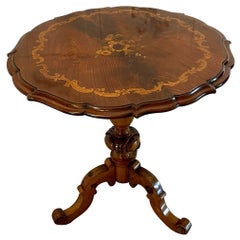
Outstanding quality large antique Victorian walnut marquetry inlaid lamp table having an outstanding quality burr walnut marquetry inlaid shaped top with a moulded edge supported by ...
Category
Antique 1850s English Victorian Side Tables
Materials
Walnut
Edelweis Marquetry Side Table Swiss Brienz 1900
Located in Berghuelen, DE
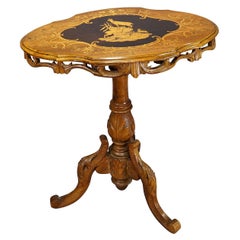
Edelweis Marquetry Side Table Swiss Brienz 1900
A decorative nutwood side table decorated with inlayed and painted sceneries depicting chamois and edelweis flowers surrounded by ebo...
Category
Antique Late 19th Century Italian Victorian Tables
Materials
Wood
19th century carved walnut marquetry center table
Located in Debenham, Suffolk
19th century carved walnut center table with inlay circa 1870.
We are pleased to offer this stunning center table of generous proportions.
Circular top with scalloped moulded edge....
Category
Antique Late 19th Century English High Victorian Center Tables
Materials
Walnut
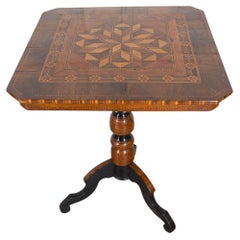
Small Italian Marquetry Table in Walnut, Rosewood, and Maple
Located in Atlanta, GA
A charming small table of Italian origin (Rolo), dating from the first half of the 19th century, finely crafted in walnut with exquisite marquetry details. The square top is richly d...
Category
Antique 19th Century Italian Center Tables
Materials
Maple, Walnut
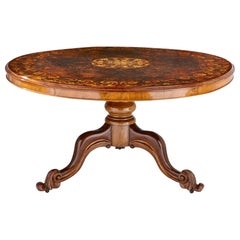
Antique Victorian Walnut and Marquetry Circular Table
Located in London, GB
This wonderful breakfast table was crafted in England in circa 1870, during the reign of Queen Victoria.
The item is notable for its large circular top which is decorated with bea...
Category
Antique 1870s English Victorian Center Tables
Materials
Walnut
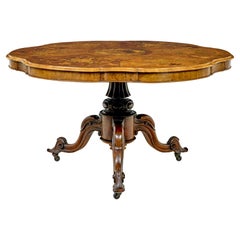
Antique American Renaissance Revival Serpentine Walnut Marquetry Center Table
Located in Dayton, OH
An exceptional American Renaissance Revival center table, circa late 19th century. Features a serpentine form with walnut burl top centered by floral marquetry, inlay and banding. Th...
Category
Antique Late 19th Century Renaissance Revival Center Tables
Materials
Walnut
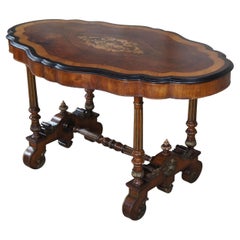
$2,030 Sale Price
30% Off