1 of 5
Jimmy Lee Sudduth Painting Toto
Price:$2,260
$2,800List Price
About the Item
- Creator:Jimmy Sudduth (Artist)
- Dimensions:Height: 24 in (60.96 cm)Width: 24 in (60.96 cm)Depth: 0.25 in (6.35 mm)
- Style:Folk Art (Of the Period)
- Materials and Techniques:
- Place of Origin:
- Period:1990-1999
- Date of Manufacture:1998
- Condition:
- Seller Location:New York, NY
- Reference Number:1stDibs: LU897915782742
Authenticity Guarantee
In the unlikely event there’s an issue with an item’s authenticity, contact us within 1 year for a full refund. DetailsMoney-Back Guarantee
If your item is not as described, is damaged in transit, or does not arrive, contact us within 7 days for a full refund. Details24-Hour Cancellation
You have a 24-hour grace period in which to reconsider your purchase, with no questions asked.Vetted Professional Sellers
Our world-class sellers must adhere to strict standards for service and quality, maintaining the integrity of our listings.Price-Match Guarantee
If you find that a seller listed the same item for a lower price elsewhere, we’ll match it.Trusted Global Delivery
Our best-in-class carrier network provides specialized shipping options worldwide, including custom delivery.You May Also Like
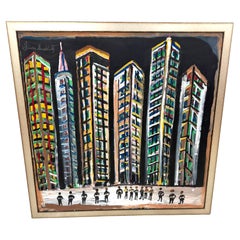
Jimmy Lee Sudduth, (1910–2007) “Untitled (Evening Cityscape, New Orleans)”
By Jimmy Sudduth
Located in West Palm Beach, FL
Jimmy (Lee) Sudduth (1910–2007)
“Untitled (Evening Cityscape, New Orleans)”
48" × 48" (52" × 52" framed) • Signed Upper Left**
A large-scale, highly expressive cityscape by celebrated American Outsider artist Jimmy Lee Sudduth, this 48" × 48" mixed-media painting is executed on the artist’s characteristic hand-prepared panel and signed Jim Sudduth in the upper left corner. Pieces of this size, subject, and clarity are increasingly scarce—particularly examples that evoke one of Sudduth’s most iconic themes: his imaginative visions of New Orleans.
Rendered in bold strokes of house paint, “sweet mud,” and vivid enamel pigments, the composition presents a row of monumental skyscrapers rising dramatically against a deep black evening sky. The buildings—painted in Sudduth’s unmistakable vertical grids of color—tilt and shimmer with energy, capturing the sense of awe he associated with large cities. Though Sudduth’s cityscapes are never literal, this work strongly aligns with his known depictions of New Orleans at night, a city he visited, admired, and frequently reinterpreted in his paintings. The angular, brightly lit towers and the presence of a spire-like structure echo several buildings along New Orleans’ downtown corridor, particularly the postmodern silhouettes near Canal and Poydras.
Along the foreground stands a charming procession of simplified human figures, a classic Sudduth motif associated with the street parades and communal gatherings he connected to New Orleans culture. Their small, rounded forms create a compelling contrast to the towering architecture above—an interplay that speaks to Sudduth’s recurring themes of community, celebration, and the human scale within the modern world.
Sudduth, recognized as one of America’s most important Outsider artists, developed a highly personal visual language rooted in rural Alabama traditions, natural pigments, and improvisational mark-making. His works are held in major institutions, including the Smithsonian American Art Museum, the American Folk Art Museum, the High Museum of Art, and the Souls Grown Deep Foundation. This painting stands as a strong example of his late-career style: bold, intuitive, rhythmic, and unmistakably his own.
Medium: Mixed media (including “sweet mud,” house paint, and enamel) on artist-prepared panel
Image Size: 48" × 48"
Framed Size: 52" × 52"
Signature: Signed upper left “Jim Sudduth”
Provenance: Private Chicago Collection
Condition: Excellent overall; stable surface; ready to hang.
A visually commanding and highly desirable Sudduth cityscape—rare in scale, rich in color, and evocative of the artist’s beloved nighttime visions of New Orleans. Ideal for collectors of folk art, Southern outsider art...
Category
Late 20th Century American Modern Paintings
Materials
Canvas
$9,500
H 52 in W 52 in D 1 in
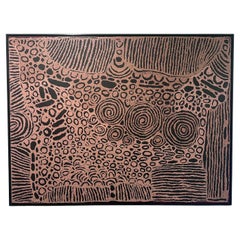
Australian Aboriginal Dreamtime Painting Nyurapayia Nampitjinpa
Located in Atlanta, GA
A stunning abstract painting by Australian Aboriginal artist Nyurapayia Nampitjinpa (also known as Mrs. Bennett; 1935-2013). Acrylic on Belgium Linen and painted in 2006. Untitled, t...
Category
Early 2000s Australian Modern Contemporary Art
Materials
Canvas, Acrylic
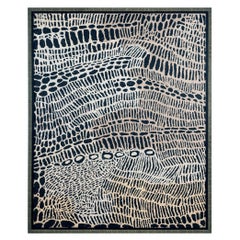
Australian Aboriginal Painting Tjukurla Country Nyurapayia Nampitjinpa
Located in Atlanta, GA
A stunning abstract painting by Australian Aboriginal artist Nyurapayia Nampitjinpa
(also known as Mrs. Bennett; 1935-2013). Entitled "Tjukurla Country", this work was acrylic on Be...
Category
Early 2000s Australian Modern Contemporary Art
Materials
Canvas, Acrylic
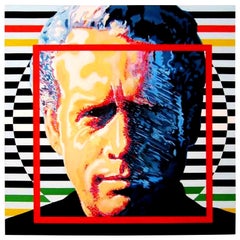
Modern Large Square Acrylic Painting on Canvas, France 1990s
Located in Dallas, TX
"Prisoner" painting by Philippe Delhom; named after the English television shows that starred Patrick McGoohan, in the end 1960s in Great Britain.
Th...
Category
1990s French Modern Paintings
Materials
Canvas, Acrylic, Paint
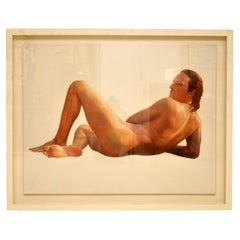
Large Oil on Canvass Nude Painting by Alan Brassington
Located in London, GB
A large and impressive oil painting of a male nude, by acclaimed British artist Alan Brassington. This dates from the late 20th century.
Alan Brassington specialises in portraits an...
Category
1990s British Modern Contemporary Art
Materials
Canvas
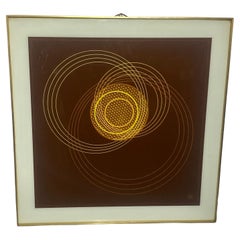
Original Optical Art by Ernst Lurker "Effentricity"
By Ernst Luker
Located in Buffalo, NY
Creator of the "Play Art" movement this renowned artist has been a Pratt Institute Graphics Professor as well as created and manufactured six designs for sale...
Category
Vintage 1970s German Post-Modern Contemporary Art
Materials
Aluminum
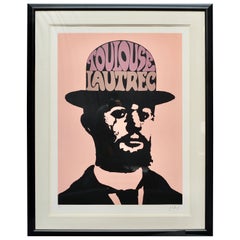
Large Toulouse Lautrec by Peter Max in Peach Pink, Signed and Framed
By Peter Max
Located in Los Angeles, CA
This is the largest of the Toulouse Lautrec portraits by famed artist Peter Max in peach pink. Professionally framed, signed and numbered.
Category
Vintage 1960s American Modern Contemporary Art
Materials
Paper
$10,500 Sale Price
25% Off
H 57.5 in W 49 in D 2 in
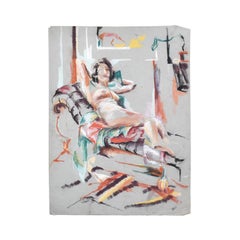
Contemporary Colorful Nude Woman Chalk Sketch on Gray circa 1960 Signed Ball
Located in Oklahoma City, OK
Portrait chalk sketching of a woman reclining nude. This piece features bold greens, blues, oranges, blacks and yellows. Woman is reclining on a fainting sofa, arms behind her head a...
Category
20th Century American Modern Contemporary Art
Materials
Paper
$650 Sale Price
45% Off
H 25 in W 19 in D 0.1 in
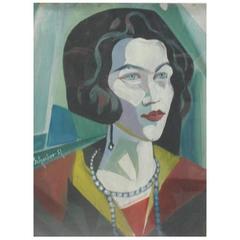
Portrait of an Elegant Woman, Signed Hugo Scheiber
By Hugó Scheiber
Located in New York, NY
Watercolor / painting signed Hugo Scheiber: Budapest (1873-1950).
Hugo Scheiber was born in Budapest in 1873. At the age of eight, he moved with his family from Budapest to Vienna. ...
Category
Mid-20th Century Hungarian Mid-Century Modern Paintings
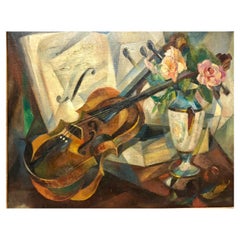
Cubist Still Life "Violin" by Early Modernist, Agnes Weinrich, Signed Dated 1922
By Agnes Weinrich
Located in New York, NY
Still life painting (Violin, Flowers), Oil on canvas, by Agnes Weinrich, Signed and dated "22", Unframed: 20" x 16", Framed 27.5 x 23".
Agnes Weinrich (1873-1946) was an early female, American modernist artist at a time when there was little interest in Modern Art in the USA and when few women were artists. She was a ground breaker in modern art. She was one of the first American artists to make works of art that were modernist, abstract, and influenced by the Cubist style. She was also an energetic and effective proponent of modernist art in America, joining with like-minded others to promote experimentation as an alternative to the generally conservative art of their time. Despite the quality of her work and despite the energy and skill with which she worked both to develop her own talent and to further the progressive movement in American art, Weinrich received little recognition during her lifetime and is only recently being recognized for her leadership as an important female artist bringing the modern movement to the USA. The painting shown is an important example of her mature phase of her work.
Exhibitions
This is a selective list of exhibitions in which she participated during her life. Its main source is Louise Noun's article on Weinrich in Woman's Art Journal, supplemented by contemporary news accounts in The New York Times, the Brooklyn Daily Eagle, the New York Evening Post, The Philadelphia Inquirer, and The Christian Science Monitor.
1915 onward: Provincetown Art Association
1917: Pennsylvania Academy of Fine Arts
1917: Pennsylvania Academy of Fine Arts, Philadelphia
1917-23: Society of Independent Artists, New York
1919: Art Institute of Chicago
1920: Boston Arts Club
1926 onward: New York Society of Women Artists
1928: Grace Horn Gallery, Boston
1929: Pennsylvania Academy of Fine Arts, Philadelphia
1932: Boston Public Library
1936: Harley Perkins Gallery, Boston (solo)
1938: Boston Society of Independent Artists
1938: Washington Public Library, Washington, D.C.
1939: Corcoran Gallery Biennial, Washington, D.C.
1939: Fogg Art Museum Twentieth Century Club, Boston
1939: Witherstine Gallery, Boston
1939: Institute of Modern Art, Boston
1945: Woljeska Gallery, Brooklyn, New York
Detailed Biography:
Agnes Weinrich was born in 1873 on a prosperous farm in south east Iowa. Both her father and mother were German immigrants and German was the language spoken at home. Following her mother's death in 1879 she was raised by her father, Christian Weinrich. In 1894, at the age of 59, he retired from farming and moved his household, including his three youngest children—Christian Jr. (24), Agnes (21), and Lena (17), to nearby Burlington, Iowa, where Agnes attended the Burlington Collegiate Institute from which she graduated in 1897.[1][2][3] Christian took Agnes and Lena with him on a trip to Germany in 1899 to reestablish links with their German relatives. When he returned home later that year, he left the two women in Berlin with some of these relatives, and when, soon after his return, he died, they inherited sufficient wealth to live independently for the rest of their lives.
Either before or during their trip to Germany Lena had decided to become a musician and while in Berlin studied piano at the Stern Conservatory. On her part, Agnes had determined to be an artist and began studies toward that end at the same time.[1][4] In 1904 the two returned from Berlin and settled for two years in Springfield, Illinois, where Lena taught piano in public schools and Agnes painted in a rented studio. At this time Lena changed her name to Helen. In 1905 they moved to Chicago where Agnes studied at the School of the Art Institute of Chicago under John Vanderpoel, Nellie Walker, and others.
In 1909 Agnes and Helen returned to Berlin and traveled from there to Munich, where Agnes studied briefly under Julius Exter, and on to Rome, Florence, and Venice before returning to Chicago.[5] They traveled to Europe for the third, and last, time in 1913, spending a year in Paris. There, they made friends with American artists and musicians who had gathered there around the local art scene. Throughout this period, the work Agnes produced was skillful but unoriginal—drawings, etching, and paintings in the dominant academic and impressionist styles.
On her return from Europe in 1914, she continued to study art, during the warm months of the year in Provincetown, Massachusetts,[1] where she was a member of the Provincetown Printers art colony in Massachusetts,[6] and during the colder ones in New York City. In Provincetown she attended classes at Charles Hawthorne's Cape Cod School of Art and in New York, the Art Students League.[
In 1930 Weinrich put together a group show for modernists at the GRD Gallery in New York. The occasion was the first time a group of Provincetown artists exhibited together in New York. For it she selected works by Knaths, Charles Demuth, Oliver Chaffee, Margarite and William Zorach, Jack Tworkov, Janice Biala, Niles Spencer, E. Ambrose Webster, and others.
Although she had led a full and productive life devoted to development of her own art and to the advancement of modernism in art, she did not cease to work toward both objectives. She continued to work in oil on canvas and board, pastel and crayon on paper, and woodblock printing. Her output continued to vary in subject matter and treatment. For example, Still Life with Leaves, circa 1930 (oil on canvas, 18 x 24 inches) contains panels of contrasting colors with outlining similar to Knaths's style. Movement in C Minor, circa 1932 (oil on board, 9 x 12 inches) is entirely abstract. It too relates to Knaths's work, both in treatment (again, outlined panels of contrasting colors) and in its apparent relationship to music, something in which Knaths was also interested. Fish Shacks...
Category
Early 20th Century American Modern Contemporary Art
Materials
Paint, Canvas
$17,900
H 16 in W 20 in D 0.1 in