Items Similar to Beautiful Massimo Popper Plate, 1911/1914, 20th Century
Want more images or videos?
Request additional images or videos from the seller
1 of 6
Beautiful Massimo Popper Plate, 1911/1914, 20th Century
$1,801.35
£1,334.17
€1,500
CA$2,464.15
A$2,681.75
CHF 1,421.60
MX$32,263.54
NOK 18,030.39
SEK 16,496.54
DKK 11,430.26
About the Item
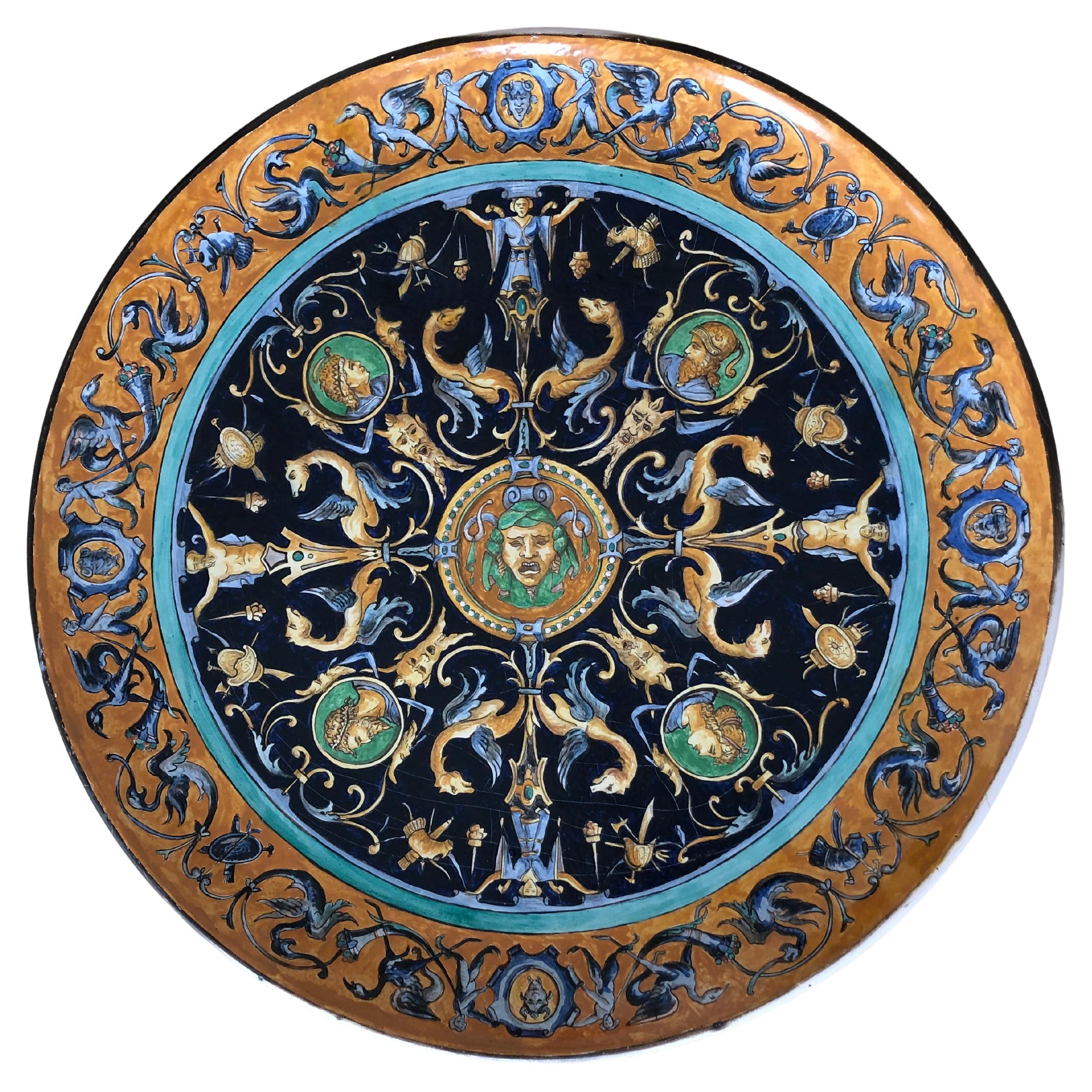
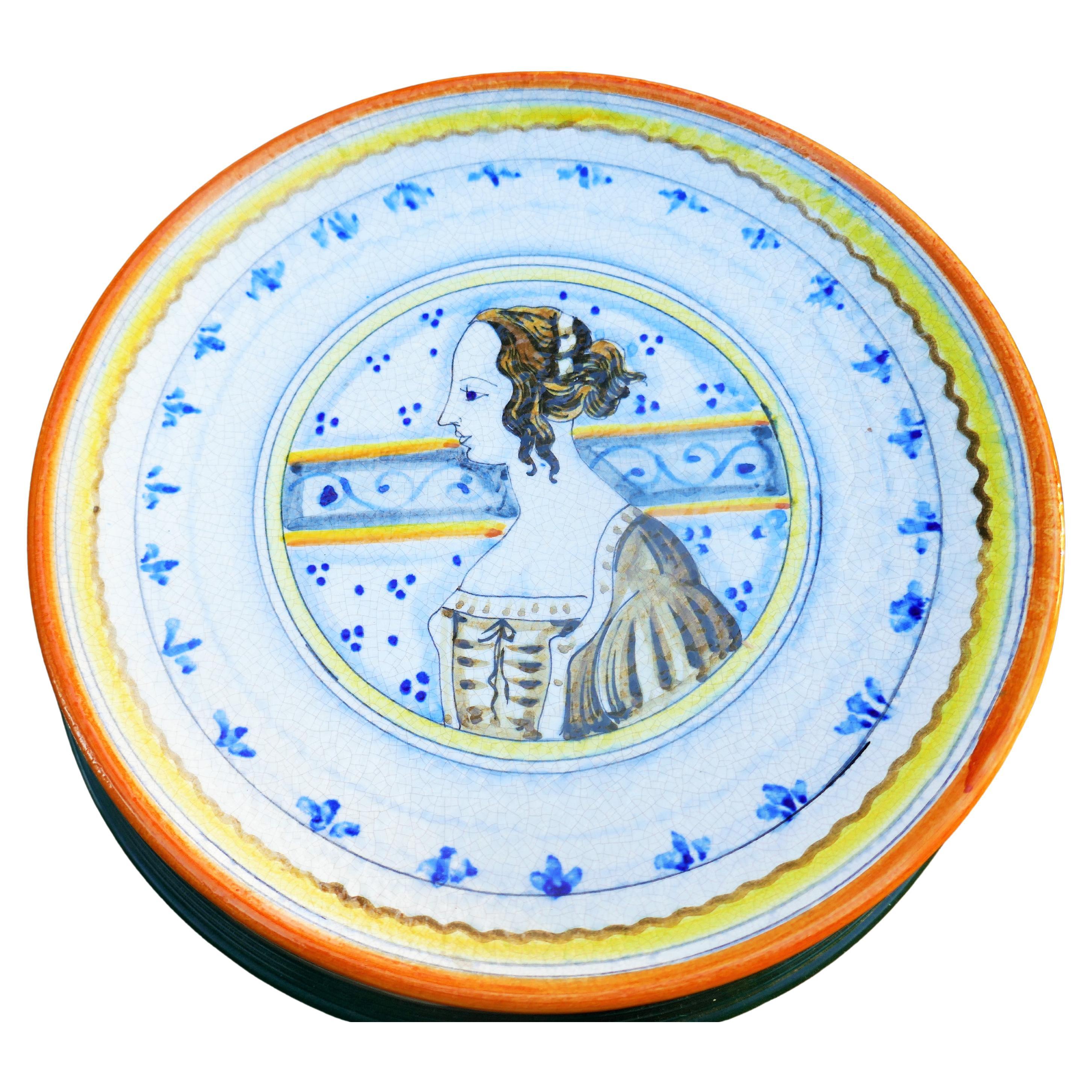
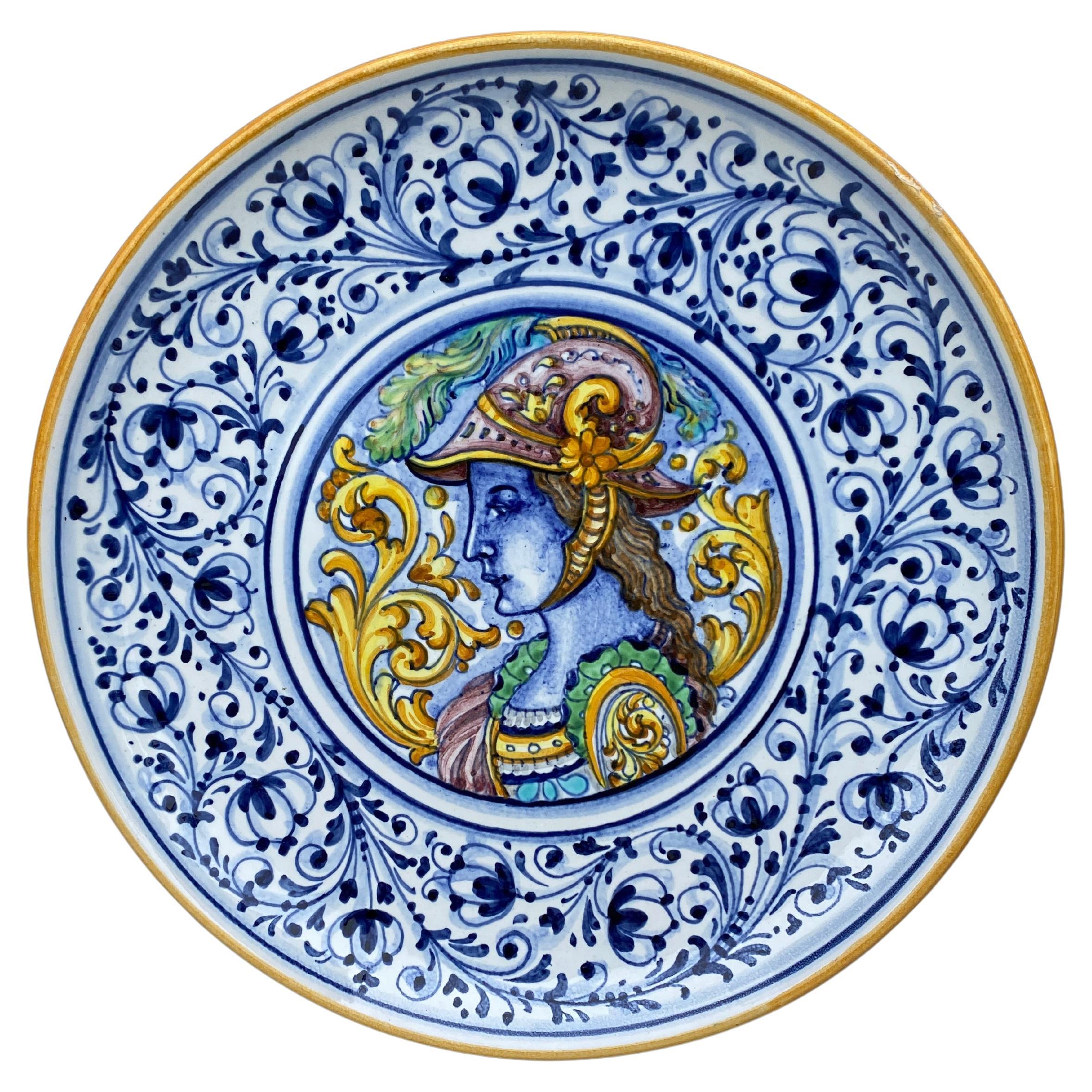
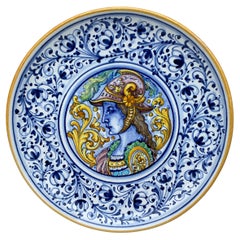
Beautiful Massimo Popper Plate, 1911/1914, 20th Century
Pompous polychrome ceramic "Marguerite" with a wide brim, short frill, and wide base. The rim is decorated with metopes and triglyphs with geometric, floral, and overlapping motifs. The base features a beautiful marguerite in profile on an ochre background in the center. On the reverse, a ring-shaped support with a monochrome white recessed background. In the center, the "Manifattura Ceramica Faentina" factory mark of Massimo Popper is in underglaze blue. Condition: Good, chipped on the upper right margin.
43 x 4.8 cm
- Dimensions:Height: 17.13 in (43.5 cm)Diameter: 17.13 in (43.5 cm)
- Style:Baroque (Of the Period)
- Materials and Techniques:
- Place of Origin:
- Period:
- Date of Manufacture:20th Century
- Condition:Wear consistent with age and use. gold condition.
- Seller Location:Madrid, ES
- Reference Number:1stDibs: LU5779244133592
About the Seller
4.8
Platinum Seller
Premium sellers with a 4.7+ rating and 24-hour response times
Established in 2005
1stDibs seller since 2021
396 sales on 1stDibs
Typical response time: 2 hours
- ShippingRetrieving quote...Shipping from: Madrid, Spain
- Return Policy
More From This Seller
View AllAMAZING PLATE MONTELUPO 17th Century
By FF Montelupo
Located in Madrid, ES
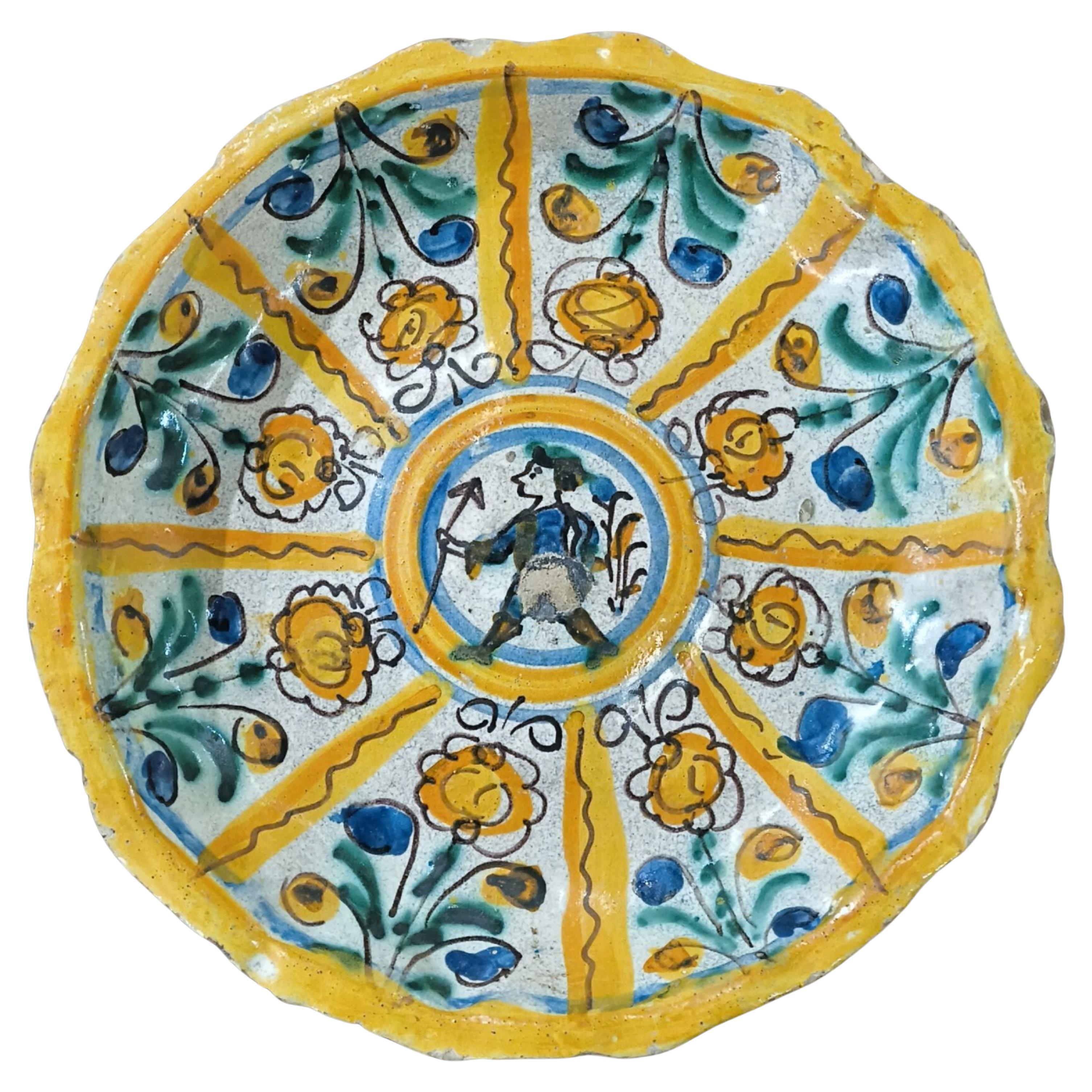
AMAZING PLATE MONTELUPO 17th Century
Round earthenware bowl with contours on a pedestal, polychrome decoration of a soldier in a frame of floral reserves.
Minor restorations.
Diame...
Category
Antique 17th Century Italian Baroque Decorative Art
Materials
Porcelain, Maiolica
Important Plate Fratelli Minardi Faenza 1920 Art Deco
Located in Madrid, ES
Important Plate Fratelli Minardi Faenza 1920
Lady's profile, a polychrome ceramic plate with a wide rim and a deep recess, with a ring-shaped support on the back, on a recessed back...
Category
Early 20th Century Italian Baroque Decorative Art
Materials
Maiolica, Porcelain
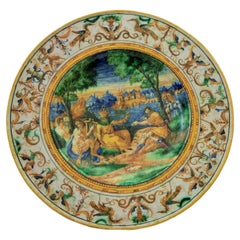
Important 19th Century Italian Parade Plate
Located in Madrid, ES
Important 19th Century Italian Parade Plate
Polychrome ceramic, with a wide brim, short frill, and a wide base. Reverse with ring support. Decoration on the rim with harpies and fan...
Category
Antique Early 19th Century Italian Baroque Decorative Art
Materials
Maiolica, Porcelain
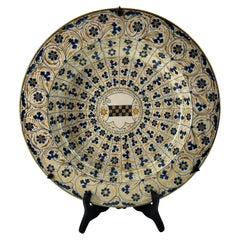
Large Hispano-Moorish earthenware plate, 18th century
Located in Madrid, ES
Large Hispano-Moorish earthenware plate, 18th century
Diameter: 41 cm
Good condition
Category
Antique 18th Century Spanish Rococo Ceramics
Materials
Majolica
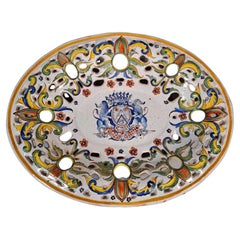
Amazing and Rare French Oval Earthenware Dish 18th Century
Located in Madrid, ES
Amazing and Rare French Oval Earthenware Dish 18th Century
with enameled decoration of a central coat of arms
30 x 39 cm
original condition
Category
Antique 18th Century French French Provincial Decorative Art
Materials
Porcelain
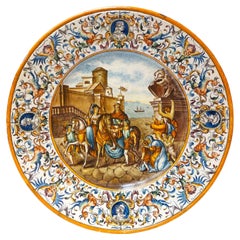
Gaetano BATTAGLIA (Naples-Italy-Active 1850 and 1885) Large Circular Plate
Located in Madrid, ES
Gaetano BATTAGLIA (Naples-Italy-Active between 1850 and 1885)
Large circular earthenware plate
in the style of Italian majolica with polychrome historiated decoration on the basin, t...
Category
Antique 19th Century Italian Rococo Ceramics
Materials
Majolica
You May Also Like
A NEOCLASSICAL ART NOUVEAU Ceramic PLATE by EMILE BALON BLOIS SCHOOL France 1900
By Emile Balon 1
Located in PARIS, FR
An exceptional, rare and large decorative dish, Art-Deco, Art Nouveau, Modernist, Shabby-Chic, in thick circular ceramic featuring rare, complex and superb figurative decorations, by...
Category
Antique Early 1900s French Art Nouveau Ceramics
Materials
Ceramic, Stoneware, Paint
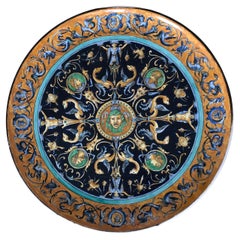
Eugenio Taccini Montelupo majolica plate
Located in Lugo, IT
Eugenio Taccini Montelupo majolica plate.
Good condition.
Thank you.
Category
Vintage 1970s Italian Renaissance Decorative Art
Materials
Maiolica
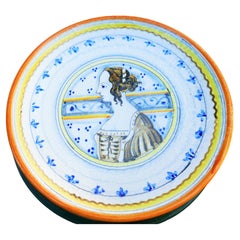
Italian Renaissance Plate, Patanazzi Workshop Urbino, End of 16th Century
By Patanazzi Workshop
Located in Milano, IT
Acquareccia plate
Patanazzi workshop
Urbino, last quarter of the 16th century
It measures diameter 17.12 in; foot diameter 11.53 in; height 1.88 in (43.5 cm; 29.3 cm; 4.8 cm).
Weight
State of conservation: wear and a few small minimal detachments of enamel, chipping on the raised areas, peeling of enamel at the brim on the back.
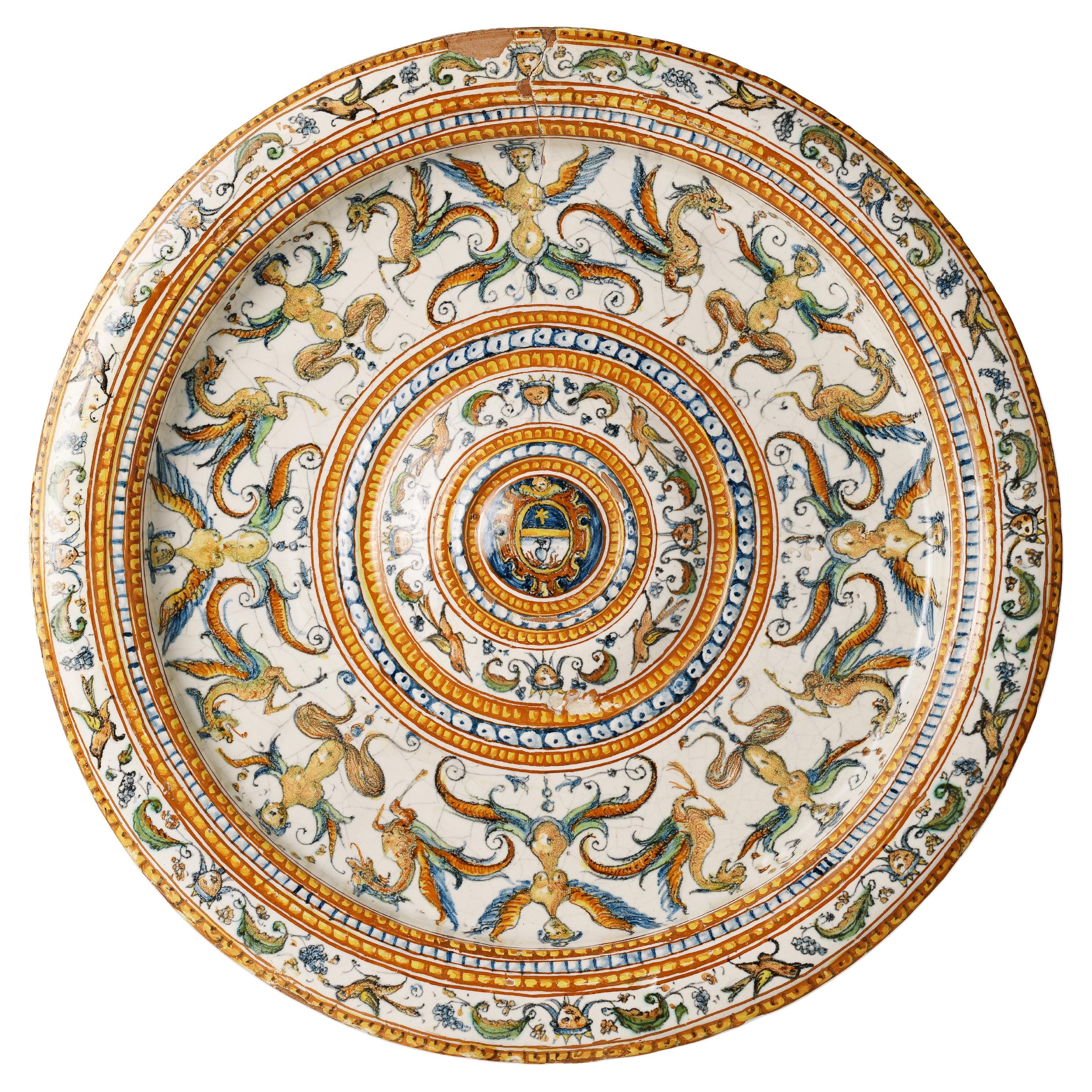
This large, shallow basin is equipped with a wide and convex well. It is umbonate with a contoured center. The brim, short and flat, is enclosed in a double rounded and barely raised edge. The basin has a flat base without rims; it has a slightly concave center in correspondence to the well.
The shape takes inspiration from the basins associated with the metal forged amphora pourers that traditionally adorned the credenza. These were used from the Middle Ages to wash hands during banquets. Two or three people washed their hands in the same basin and it was considered an honor to wash one’s hands with an illustrious person.
The decoration is arranged in concentric bands with, in the center of the umbo, an unidentified shield on a blue background: an oval banded in gold with a blue head, a gold star and a field with a burning pitcher.
Rings of faux pods separate the center from a series of grotesque motifs of small birds and masks. These go around the basin and are, in fact, faithfully repeated on the brim. The main decoration develops inside the flounce of the basin, which sees alternating symmetrical figures of winged harpies and chimeras. The ornamentation, outlined in orange, green and blue, stands out against the white enamel background.
This decorative style, defined since the Renaissance as “grottesche” or “raffaellesche”, refers to the decorations introduced after the discovery of the paintings of the Domus Aurea towards the end of the fifteenth century. The discovery of Nero's palace, buried inside Colle Oppio by damnatio memoriae, occurred by chance when a young Roman, in 1480, fell into a large crack which had opened in the ground on the hill, thus finding himself in a cave with walls covered with painted figures.
The great artists present in the papal city, including Pinturicchio, Ghirlandaio, Raffaello, immediately visited these caves. The decorations found there soon became a decorative subject of immense success: the term grotesque , with the meaning of “unusual,” “caricatured,” or “monstrous,” was later commented by Vasari in 1550 as “una spezie di pittura licenziose e ridicole molto”( “a very licentious and ridiculous kind of painting”).
The decorations “a grottesche” also widely circulated in ceramic factories, through the use of engravings, variously interpreted according to the creativity of the artists or the requests of the client.
Our basin is reflected in similar artifacts produced at the end of the sixteenth century by the factories of the Urbino district. See the series of basins preserved in the main French museums, among which the closest in morphology is that of the Campana collection of the Louvre (Inv. OA1496); this however has a more complex figure decoration, while the decoration of our specimen is sober and with a watercolor style.
The style, sure in its execution, approaches decorative results still close to the works produced around the middle of the sixteenth century by the Fontana workshop. The decoration is closely linked to their taste, which later finds its natural outlet, through the work of Antonio, also in the Patanazzi workshop. Studies show the contiguity between the two workshops due to the kinship and collaboration between the masters Orazio Fontana and Antonio Patanazzi, both trained in the workshop of Guido Fontana il Durantino. It is therefore almost natural that their works, often created according to similar typologies and under the aegis of the same commissions, are not always easily distinguishable, so much so that the presence of historiated or “grottesche” works by Orazio is documented and preserved in Antonio Patanazzi's workshop. Given that the studies have always emphasized the collaboration between several hands in the context of the shops, it is known that the most ancient “grottesche” works thus far known, can be dated from 1560, when the Fontana shop created the so-called Servizio Spagnolo (Spanish Service) and how, from that moment on, this ornamentation became one of the most requested by high-ranking clients. We remember the works created for the Granduchi di Toscana, when Flaminio Fontana along with his uncle Orazio supplied ceramics to Florence, and, later, other commissions of considerable importance: those for the service of the Duchi d’Este or for the Messina Farmacia of Roccavaldina, associated with the Patanazzi workshop when, now after 1580, Antonio Patanazzi began to sign his own work.
Thus, in our basin, the presence of masks hanging from garlands, a theme of more ancient memory, is associated in the work with more advanced stylistic motifs, such as the hatching of the chimeras and harpies. These are found here on the front with the wings painted in two ornate ways. In addition, the theme of the birds on the edge completes the decoration along the thin brim and can be seen as representing an early style typical of the Urbino district during a period of activity and collaboration between the two workshops. Later, a more “doll-like” decorative choice, typical of the end of the century and the beginning of the seventeenth century, characterized the period of the Patanazzi workshop under the direction of Francesco.
Bibliography:
Philippe Morel, Il funzionamento simbolico e la critica delle grottesche nella seconda metà del Cinquecento, in: Marcello Fagiolo, (a cura di), Roma e...
Category
Antique 16th Century Italian Renaissance Ceramics
Materials
Maiolica
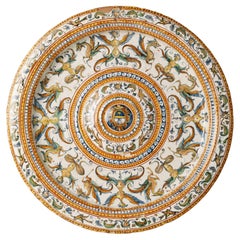
French Neo-Renaissance Majolica Plate circa 1890
Located in Austin, TX
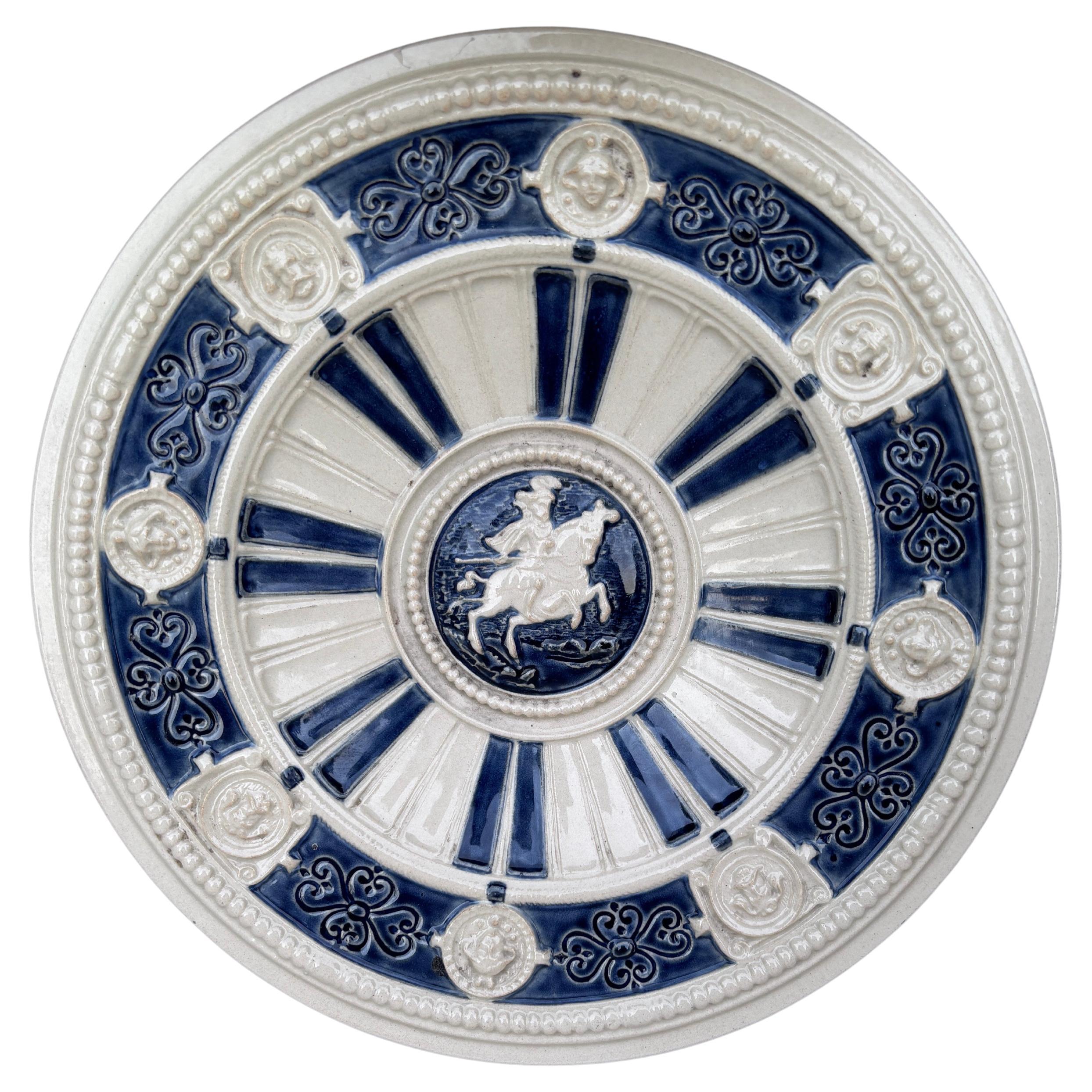
French Neo-Renaissance Majolica Plate circa 1890.
Decorated with a cavalier on the center, border with medallion portraits.
Category
Antique 1890s French Renaissance Revival Decorative Art
Materials
Ceramic, Faience, Majolica
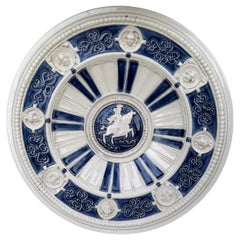
Large Neo-Renaissance Italian Faience Platter Circa 1930
Located in Austin, TX
Large Neo-Renaissance Italian Faience Platter Circa 1930.
Category
Vintage 1930s English Renaissance Revival Platters and Serveware
Materials
Ceramic, Faience
19th Century French Gien Faience Platter
By Gien
Located in Winter Park, FL
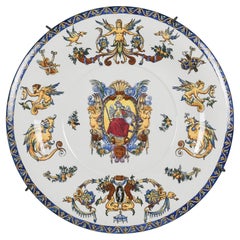
A 19th century French Gien faience decorative charger or shallow bowl, hand-painted in red, orange, yellow, blue, and green on white ground with Renaissance style imagery with a cent...
Category
Antique 19th Century French Renaissance Delft and Faience
Materials
Faience
More Ways To Browse
Vintage Ornamental Brass Plate By Hans Przyrembel
Vintage Sexton Metal Wall Plaques
Vivienne Galowitz
Wall Plaque Knight
Walt Disney Animation Cel
Walter Firle
Wesley Simpson
Witco Wall Art
19 Century American Portraits
1930s Vintage Circus Posters
1930s Circus Poster
A Keany
A M Pattison
Adrian Pearsall Wall Art
Albright Knox Exhibition Poster
Alex Bozickovic
Alonso Perez Tapestry
Anglo Indian Botanicals