Items Similar to John Ogilby Oxford to Salisbury Road Map #82 Circa 1675
Want more images or videos?
Request additional images or videos from the seller
1 of 8
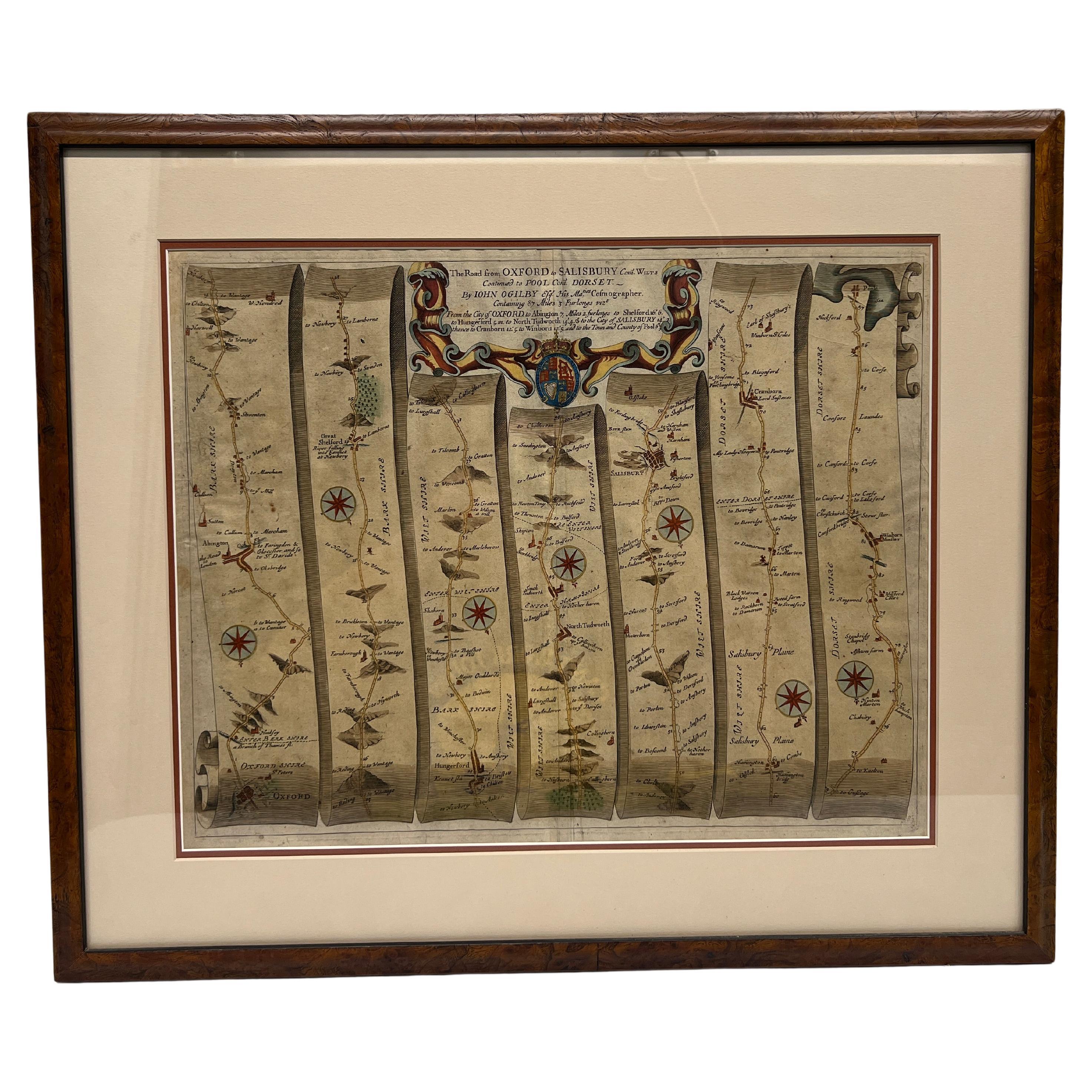
John Ogilby Oxford to Salisbury Road Map #82 Circa 1675
$895
£680.96
€784.61
CA$1,270.62
A$1,363.15
CHF 731.16
MX$16,412.12
NOK 9,217.19
SEK 8,404.80
DKK 5,862.08
About the Item
John Ogilby (Scottish, 1600-1676). - Circa 1675
This map is part of his Britannica publication and is #82.
"The road map was first popularised by John Ogilby (1600-1676), Scotsman, dancing master (until his accident), Deputy Master of the Revels, publisher, and cartographer, who published his Britannia in 1675. This showed all the main routes radiating from London, together with a handful of cross-country routes (e.g. York to Lancaster, Carlisle to Tynemouth, Oxford to Cambridge). Like the old Automobile Association personalized route-maps, they are strip maps which concentrate on the roads, orienting the traveller with a compass rose, and showing side roads, landmarks, and the type of terrain, hills to be surmounted and rivers to be crossed. The scale was a standard inch-to-a-mile."
- Creator:John Ogilby (Maker)
- Dimensions:Height: 21 in (53.34 cm)Width: 24.75 in (62.87 cm)Depth: 0.25 in (6.35 mm)
- Style:French Provincial (In the Style Of)
- Materials and Techniques:
- Place of Origin:
- Period:
- Date of Manufacture:C. 1675
- Condition:Wear consistent with age and use. Minor wear commensurate with age and use.
- Seller Location:Atlanta, GA
- Reference Number:1stDibs: LU7838240398692
About the Seller
5.0
Platinum Seller
Premium sellers with a 4.7+ rating and 24-hour response times
Established in 2012
1stDibs seller since 2022
244 sales on 1stDibs
Typical response time: <1 hour
- ShippingRetrieving quote...Shipping from: Randolph, MA
- Return Policy
More From This Seller
View AllJohn Ogilby Oxford to Salisbury Road Map #83 Circa 1675
By John Ogilby
Located in Atlanta, GA
John Ogilby (Scottish, 1600-1676). - Circa 1675
This map is part of his Britannica publication and is #83.
"The road map was first popularised by John Ogilby (1600-1676), Scotsm...
Category
Antique 17th Century Scottish Regency Decorative Art
Materials
Burl, Paper
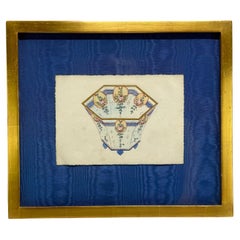
French Porcelain Design Watercolor, Fourmaintraux Manufactory, Desvres, ca. 1900
Located in Atlanta, GA
An original watercolor and ink design for a porcelain or faience vessel, attributed to the Fourmaintraux Manufactory, Desvres, Normandy, circa 1900. The drawing depicts an octagonal ...
Category
Early 20th Century French Art Deco Drawings
Materials
Silk, Giltwood, Paper
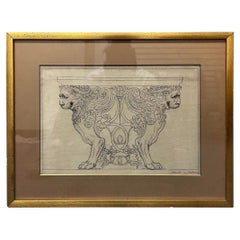
19th Century Italian Grand Tour Era Architectural Drawing on Paper, Framed
Located in Atlanta, GA
An early 18th or 19th century architectural concept drawing of opposing lions with marble top likely as a console table. Marked in early ink to lower r...
Category
Antique 19th Century Drawings
Materials
Paper
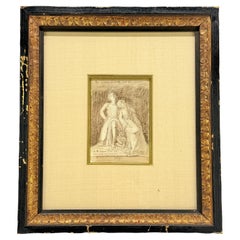
Grand Tour Neoclassical Allegorical Drawing on Paper, 19th Century
Located in Atlanta, GA
This artwork is a finely executed ink drawing with wash, possibly from the late 18th or early 19th century, bearing an inscription that reads, "The letter killeth but the spirit give...
Category
Antique 19th Century Italian Neoclassical Drawings
Materials
Giltwood, Paper
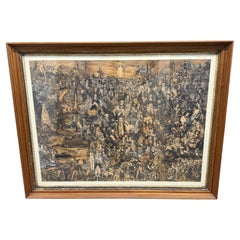
19th C, Decopauge "The Allegory of Civilization" Magnificent
Important Work
Located in Atlanta, GA
“The Allegory of Civilization: A Historical Collage of Progress and Virtue”
This monumental and highly unusual large-scale decoupage tableau—measuring 44.25 inches wide by 35 inches high—is an extraordinary and densely composed visual compendium of 18th- and 19th-century figures of global significance. Executed in a monochrome palette with light hand-tinting, the work comprises hundreds of individual portrait engravings and narrative vignettes intricately collaged together to form a panoramic composition of historical, cultural, scientific, literary, and military figures, interspersed with allegorical and architectural elements.
This form of assemblage is rooted in the 19th-century practice of *papiers collés* and popular scrapbooking traditions, but this work surpasses decorative craft in both ambition and intellectual scope, bordering on the encyclopedic. The hand-cut images appear to have been culled from period illustrated books and engraved portrait sources—most notably from publications such as *The Illustrated London News*, *Harper’s Weekly*, and *The Eclectic Magazine*—as well as engraved frontispieces and serialized pictorial histories. The result is a vast visual lexicon of Enlightenment and Romantic thought, likely intended as a celebration of moral, intellectual, and national achievement.
At the composition’s apex, presiding over the assembled figures, is a classically draped winged allegory—possibly *Fame* or *Liberty*—holding a trumpet and laurel branch. The mountainous background, waterfalls, architectural ruins, and pastoral settings lend the piece a theatrical and didactic ambiance, evoking 19th-century didascalic panoramas.
A partial identification of historical figures visible in the composition includes:
* **George Washington** – Posed centrally, gesturing outward with one hand; he appears multiple times in the scene and is shown in both military uniform and formal dress.
* **Napoleon Bonaparte** – Recognizable by his uniform, bicorne hat, and stern gaze; appears in profile and frontal portraits.
* **Benjamin Franklin** – Seen holding a scroll; a common figure in Enlightenment iconography.
* **William Shakespeare** – Near the lower central register; recognizable from the famous Chandos portrait derivative.
* **Johann Wolfgang von Goethe** and **Friedrich Schiller** – Likely placed in the literary cluster with other Germanic figures.
* **Florence Nightingale** – Shown in nurse’s cap and shawl, likely near a grouping of women in medical service.
* **Queen Victoria** and **Prince Albert** – Appearing in regalia, along with a number of courtly figures.
* **Ludwig van Beethoven**, **Franz Liszt**, and **Niccolò...
Category
Antique 19th Century French High Victorian Decorative Art
Materials
Giltwood, Paper
18th Century Grand Tour Classical Panel with Allegorical Inlaid Figures
Located in Atlanta, GA
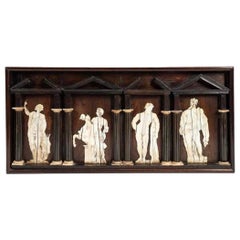
This is an absolutely incredible piece. Having 4 classical figures, each housed under arched forms with Corinthian columns accented by matching inlay. One of my favorite pieces comin...
Category
Antique 18th Century Decorative Art
Materials
Bone, Ebony, Mahogany
You May Also Like
Road Map, John Ogilby, London, Barwick, York, Chester, Darlington, Durham Framed
By John Ogilby
Located in BUNGAY, SUFFOLK
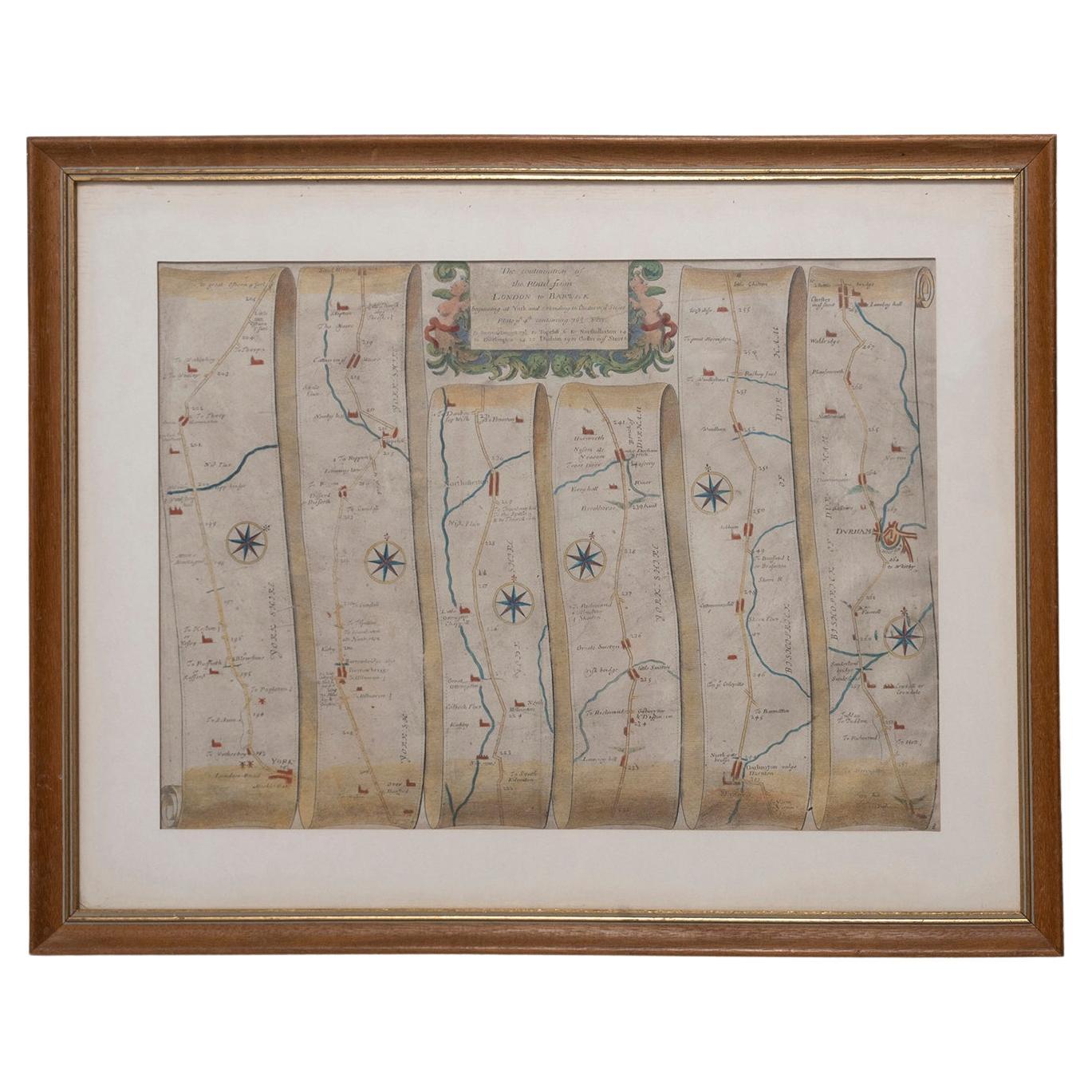
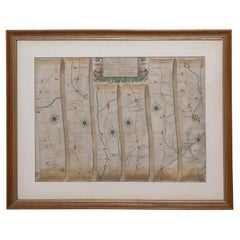
The continuation of the road from London to Barwick beginning at York and extending to Chester in ye Street. Plate ye 4th continuing 76 ½ miles. No 8.
York to Burrowbridge, to Top...
Category
Antique 1670s English Baroque Maps
Materials
Paper
Road Map Britannia No 32 the Road from London to Barnstable John Ogilby Framed
By John Ogilby
Located in BUNGAY, SUFFOLK
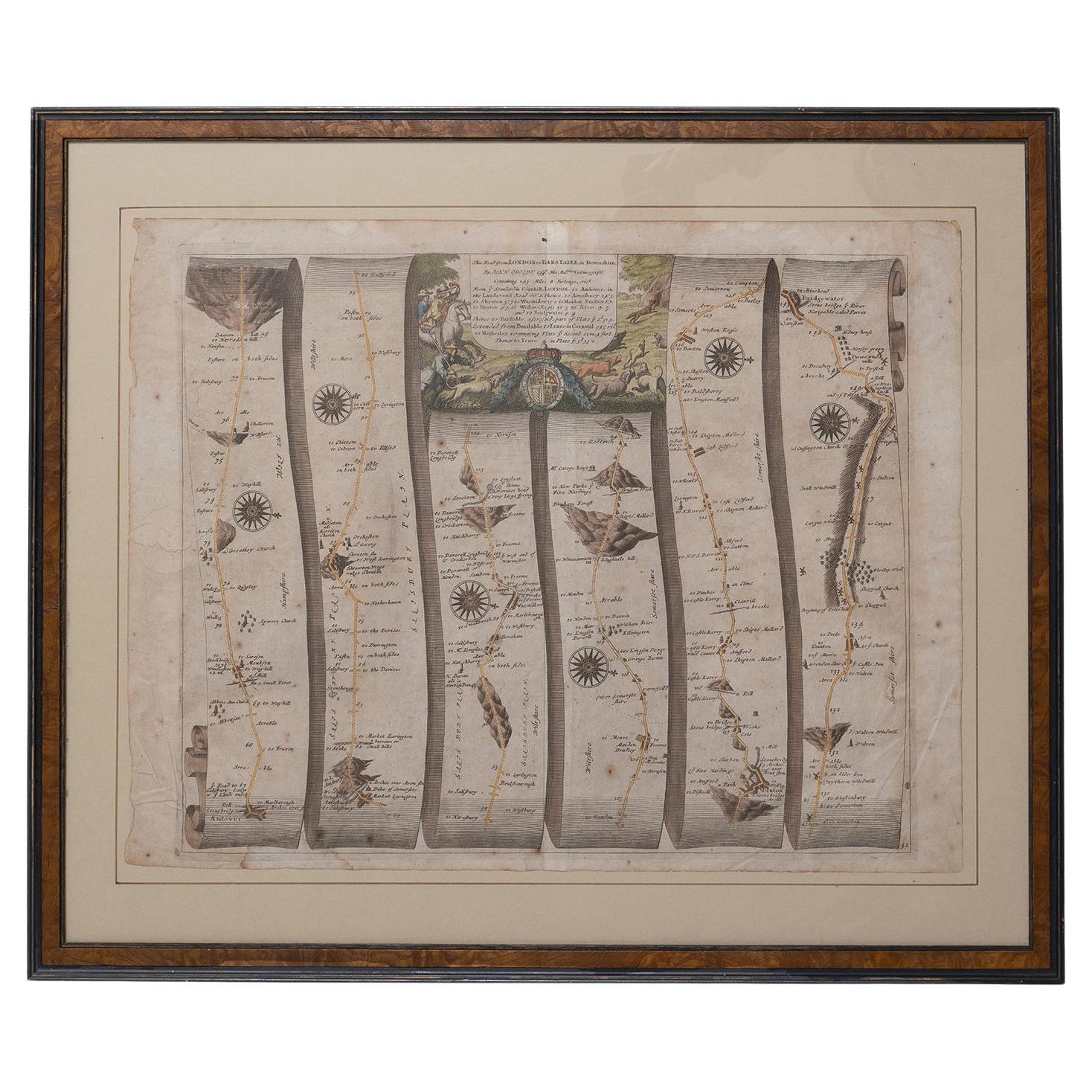
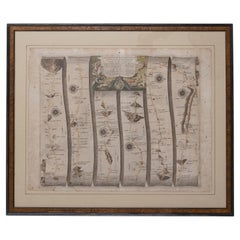
A road map from Britannia, by John Ogilby Esq., Cosmographer and Geographick Printer to Charles II. Containing 293 miles. No 32.
From Standard in Cornhill London to Andover thence to Amesbury, to Shruton, to Warminster, to Maiden-Bradley, to Bruton, to Weston, to Ascot and to Bridgewater
Hand coloured, some foxing and creasing, commensurate with age.
Floated in a cream mount with a gilded linear border within a burr walnut, ebonised and gilded frame.
Provenance : purchased as pair from a collector with no 15 London to St Davids. Framed as a pair.
Measures: Black Linear Border around Map Length 44cm., 17 1/8" Height 36cm., 14".
Full Sheet Length 51cm., 20" Height 39cm., 15 1/4"
Frame Length 62cm., 24 1/2 " Height 52cm., 20 1/2"
Literature: In a remarkable life John Ogilby pursued, several careers, each ending in misfortune, and yet he always emerged undeterred, to carry on. His modern reputation is based on his final career, started in his sixty-sixth year, as a publisher of maps and geographical accounts.
Ogilby was born outside Dundee, in 1600, the son of a Scottish gentleman. While he was still a child, the family moved to London. When the elder Ogilby was imprisoned for debt, the young John invested his savings in a lottery, won a minor prize, and settled his father's debts. Unfortunately, not enough money was left to secure John a good apprenticeship; instead, he was apprenticed to a dance master. Ogilby was soon dancing in masques at court but, one day, while executing a particularly ambitious leap, he landed badly. The accident left him with a permanent limp, and ended his dancing career. However, he had come to the attention of Thomas Wentworth, later Earl of Strafford, Charles I's most senior minister. Ever one to exploit his contacts, Ogilby became a dance instructor in Strafford's household.
When Strafford was sent to Ireland, Ogilby accompanied him as Deputy-Master of the Kings Revels, and then Master of Revels. In Dublin, he built the New Theatre, in St. Werburgh Street, which prospered at first, but the Irish Rebellion, in 1641, cost Ogilby his fortune, which he estimated at £2,000, and almost his life. After brief service as a soldier, he returned to England, survived shipwreck on the way, and arrived back penniless.
On his return, Ogilby turned his attention to the Latin classics, as a translator and publisher. His first faltering attempt, in 1649, was a translation of the works of Virgil, but after his marriage to a wealthy widow the same year, his publishing activities received a considerable boost. One means by which Ogilby financed these volumes was by subscription, securing advance payments from his patrons, in return for including their name and coats-of-arms on the plates of illustrations. Another approach was to secure a patron, preferably in the court circle. Ogilby's first patron was Strafford, who found out too late that all leading ministers are dispensable when Charles I assented to his execution in 1641. As he re-established himself, Ogilby sought a new patron, the King himself.
In 1661, Ogilby was approached to write poetry for Charles II's coronation procession; he later published 'The Relation of His Majesties Entertainment Passing Through the City of London', and a much enlarged edition the following year, which included a Fine set of plates depicting the procession. Royal favour was bestowed in 1674 when John Ogilby received the title of 'His Majesty's Cosmographer and Geographick Printer' with a salary of £13.6s.8d per annum.
In 1665, Ogilby left London to avoid the Plague then ravaging the capital. The following year, in the Great Fire of London, Ogilby claimed that he lost his entire stock of books valued at some £3,000, as well as his shop and house, leaving him worth just £5.
As he sought to restore his fortunes, Ogilby was already looking in new directions. The initial opportunity he seized on was the reconstruction of London's burnt-out centre. He secured appointment as a 'sworn viewer', whose duty was to establish the property boundaries as they existed before the Fire. Ogilby was assisted in the project by his step-grandson, William Morgan...
Category
Antique Late 17th Century English Charles II Maps
Materials
Paper
Road Map John Ogilby London St David
s Britannia No 15 Abingdon Monmouth Framed
By John Ogilby
Located in BUNGAY, SUFFOLK
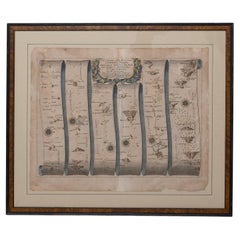
John Ogilby (British 1600-1676) Cosmographer and Geographick Printer to Charles II. A road map from Britannia, 1675/6. No 15.
The continuation of the r...
Category
Antique 1670s English Baroque Maps
Materials
Paper
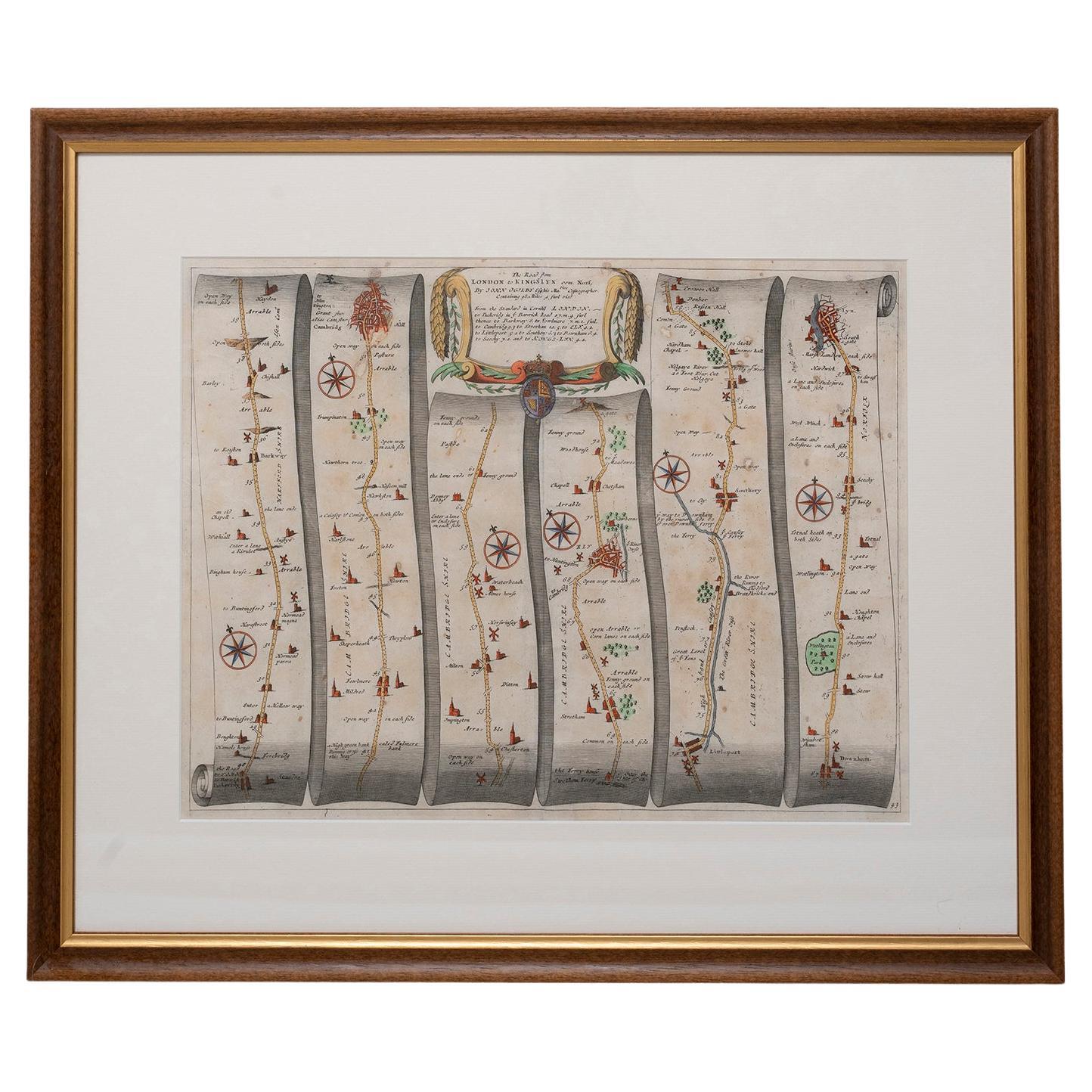
Road Map No43 London to Kings Lynn, Royston to Downham, John Ogilby, Britannia
By John Ogilby
Located in BUNGAY, SUFFOLK
John Ogilby (British 1600-1676) Cosmographer and Geographick Printer to Charles II.
A road map from Britannia, 1675/6. The road from London to Kings Lynn, showing Royston to Downham. In oak and gilded frame.
In a remarkable life John Ogilby pursued, several careers, each ending in misfortune, and yet he always emerged undeterred, to carry on. His modern reputation is based on his final career, started in his sixty-sixth year, as a publisher of maps and geographical accounts.
Ogilby was born outside Dundee, in 1600, the son of a Scottish gentleman...
Category
Antique Late 17th Century British Charles II Maps
Materials
Paper
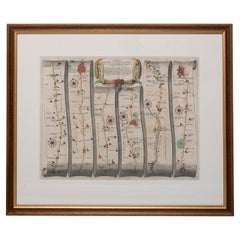
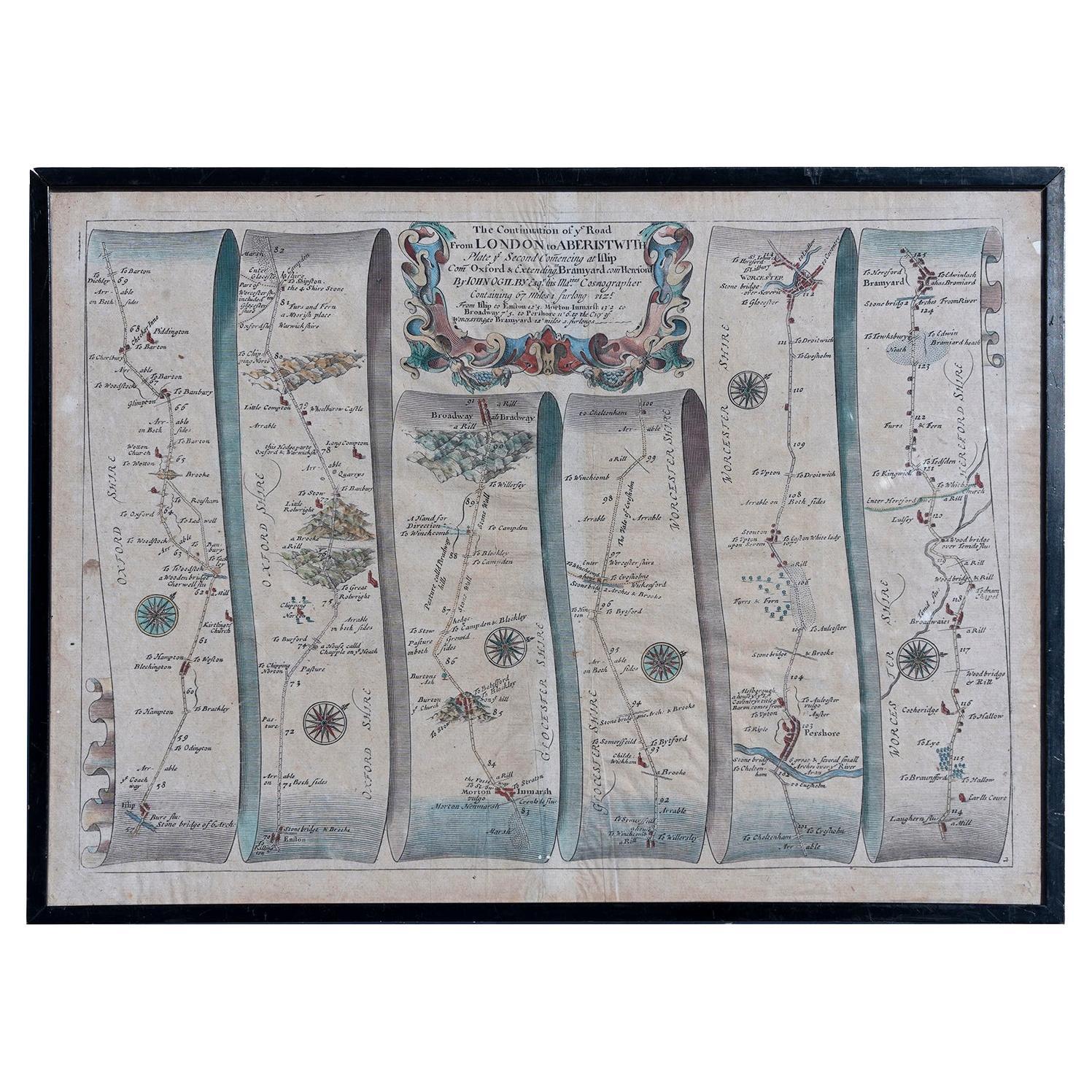
Map Road Strip Britannia Sheet 2 John Ogilby London Aberistwith Islip Bramyard
By John Ogilby
Located in BUNGAY, SUFFOLK
From John Ogilby's, 'Britannia, an Illustration of the Kingdom of
England and Dominion of Wales'. First published in 1675 it remains the greatest advance ...
Category
Antique 17th Century English Baroque Maps
Materials
Paper
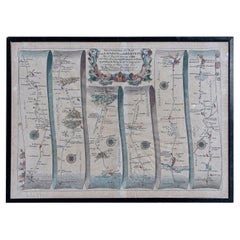
Road Map Britannia No 15 London to St Davids John Ogilby Brown Gilt Frame
By John Ogilby
Located in BUNGAY, SUFFOLK
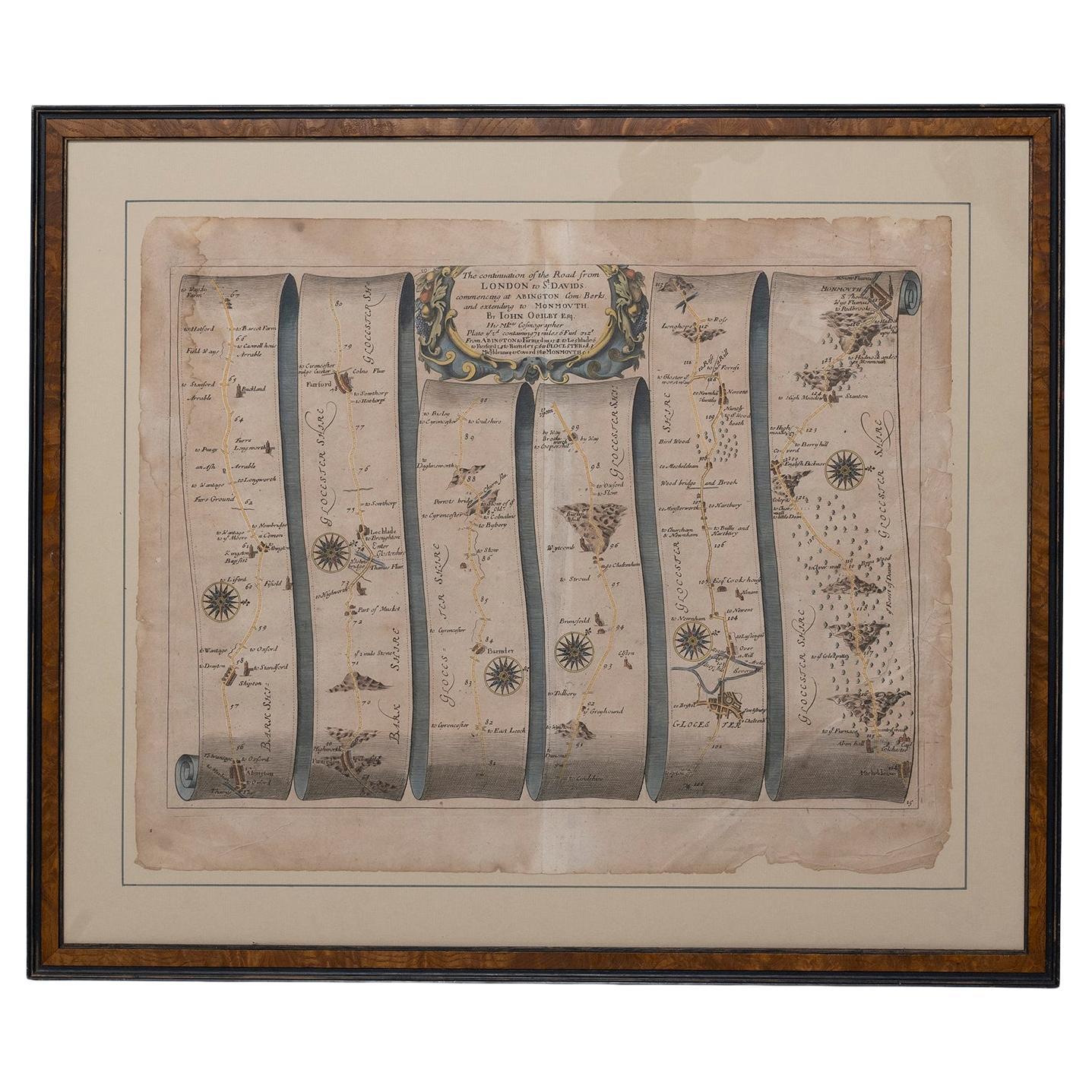
The continuation of the road from London to St Davids, commencing at Abingdon Com Berks and extending to Monmouth By John Ogilby Esq, His Majesties Cosmographer. From Abingdon to Farringdon, to Lechlade, to Fairford, to Barnsley to Gloucester showing Monmouth as the destination. A road map from Britannia, 1675/6. No 15.
Hand coloured and floated on a cream mount within a brown painted and gilded ogee frame. Some foxing and creasing, uneven edge of sheet, all commensurate with age
Provenance : purchased as pair from a collector with no 25 London to Lands End. Framed as a pair.
Sheet width 46.5cm., 18 ¼ ”., height 37.5cm., 14 ¾ “
Frame width 66.5cm., 26”., height 56cm., 22 ”
In a remarkable life John Ogilby pursued, several careers, each ending in misfortune, and yet he always emerged undeterred, to carry on. His modern reputation is based on his final career, started in his sixty-sixth year, as a publisher of maps and geographical accounts.
Ogilby was born outside Dundee, in 1600, the son of a Scottish gentleman. While he was still a child, the family moved to London. When the elder Ogilby was imprisoned for debt, the young John invested his savings in a lottery, won a minor prize, and settled his father's debts. Unfortunately, not enough money was left to secure John a good apprenticeship; instead, he was apprenticed to a dance master. Ogilby was soon dancing in masques at court but, one day, while executing a particularly ambitious leap, he landed badly. The accident left him with a permanent limp, and ended his dancing career. However, he had come to the attention of Thomas Wentworth, later Earl of Strafford, Charles I's most senior minister. Ever one to exploit his contacts, Ogilby became a dance instructor in Strafford's household.
When Strafford was sent to Ireland, Ogilby accompanied him as Deputy-Master of the Kings Revels, and then Master of Revels. In Dublin, he built the New Theatre, in St. Werburgh Street, which prospered at first, but the Irish Rebellion, in 1641, cost Ogilby his fortune, which he estimated at £2,000, and almost his life. After brief service as a soldier, he returned to England, survived shipwreck on the way, and arrived back penniless.
On his return, Ogilby turned his attention to the Latin classics, as a translator and publisher. His first faltering attempt, in 1649, was a translation of the works of Virgil, but after his marriage to a wealthy widow the same year, his publishing activities received a considerable boost. One means by which Ogilby financed these volumes was by subscription, securing advance payments from his patrons, in return for including their name and coats-of-arms on the plates of illustrations. Another approach was to secure a patron, preferably in the court circle. Ogilby's first patron was Strafford, who found out too late that all leading ministers are dispensable when Charles I assented to his execution in 1641. As he re-established himself, Ogilby sought a new patron, the King himself.
In 1661, Ogilby was approached to write poetry for Charles II's coronation procession; he later published 'The Relation of His Majesties Entertainment Passing Through the City of London', and a much enlarged edition the following year, which included a fine set of plates depicting the procession. Royal favour was bestowed in 1674 when John Ogilby received the title of 'His Majesty's Cosmographer and Geographick Printer' with a salary of £13.6s.8d per annum.
In 1665, Ogilby left London to avoid the Plague then ravaging the capital. The following year, in the Great Fire of London, Ogilby claimed that he lost his entire stock of books valued at some £3,000, as well as his shop and house, leaving him worth just £5.
As he sought to restore his fortunes, Ogilby was already looking in new directions. The initial opportunity he seized on was the reconstruction of London's burnt-out centre. He secured appointment as a "sworn viewer", whose duty was to establish the property boundaries as they existed before the Fire. Ogilby was assisted in the project by his step-grandson, William Morgan...
Category
Antique Late 17th Century British Charles II Maps
Materials
Paper
More Ways To Browse
17th Century Scottish
17th Century Scottish Furniture
Family Crest Plaque
Framed Vintage Bathing Suits
Frank Lloyd Wright Tile
Gio Ponti Ceramica Bardelli
Glass Mosaic Art Ackerman
Harris G Strong Tiles
Hermes Glasses Frames
Hilda Rindom
Hummel Plates
Jean Jacques Duval
Jean Pierre Capron
Judith Danner
Kermit Kermit Oliver Painting Oliver
Lemon Tile
Leopoldo Mendez
Mac Duggal