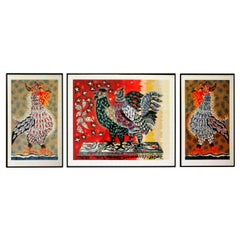
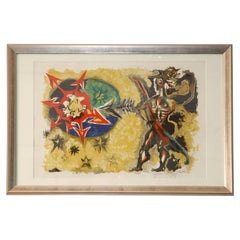
Print/Lithograph of Abstracted Birds by Jean Lurçat, c. 1950
About the Item
- Creator:Jean Lurçat (Artist)
- Dimensions:Height: 23.5 in (59.69 cm)Width: 18.75 in (47.63 cm)Depth: 1.25 in (3.18 cm)
- Style:Modern (Of the Period)
- Materials and Techniques:
- Place of Origin:
- Period:
- Date of Manufacture:c. 1950
- Condition:Wear consistent with age and use. Excellent condition.
- Seller Location:New York City, NY
- Reference Number:Seller: ACC19721stDibs: LU916535268842
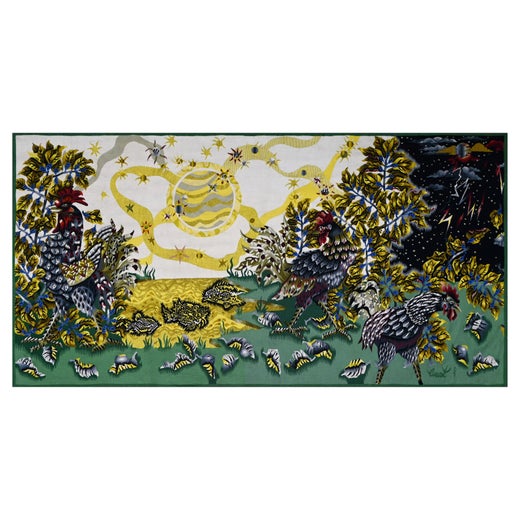
Jean Lurçat
Credited with helping revive the design and production of tapestries during the 20th century, French artist Jean Lurçat rubbed shoulders with some of the greatest painters in the world while weaving his own artistic narrative into the fabric of history.
Lurçat met artists Henri Matisse, Paul Cézanne and Pierre-Auguste Renoir in Paris in his early twenties — when the Bruyères native found himself fully immersed in the French art world. He had studied at Académie Colarossi and worked in the studio of sculptor Victor Prouvé, and later made paintings inspired by Fauvism. Lurçat first exhibited his tapestries in 1917.
Lurçat’s inaugural textiles were constructed with weaver Marthe Hennebert and were marked by Cubism and avant-garde–inspired art styles before he embarked on extensive travels that would enrich his work. Lurçat’s travels exposed him to other movements and styles that ranged from German Expressionism to Spanish and African influences that inspired his later works.
Lurçat’s tapestries found a regular home in 1925 at Jeanne Bucher’s gallery, which featured the work of other artists including Pablo Picasso, Hans Arp, Jacques Lipchitz, Georges Braque and Max Ernst. Between 1930 and 1936, Lurçat had solo exhibitions at the Flechtheim Gallery in Berlin and the Pierre Matisse Gallery in New York. In 1939 — when the popularity of tapestries had long been on the decline — Lurçat opened a factory with other artists in Aubusson, the home of a centuries-old tapestry production industry, in order to create modernist tapestries.
Over the course of his life, Lurçat designed more than 1,000 tapestries. One of his most notable, Apocalypse Tapestry (1948), is on display in the Church of Notre-Dame de Toute-Grâce and complements the original which dates back to the 14th century. His other highly acclaimed works include Song of the World (1957–64) and Four Seasons (1940).
While Lurçat’s best known works are his tapestries, he also produced engravings, book illustrations and ceramics. The Museum of Modern Art in New York City holds some of these book illustrations as well as a few other works in its permanent collection. Other works by Lurçat are held in the collections of the Detroit Museum of Fine Arts, the Musée Nationale d’Art Moderne, the Museum of Chicago, the Philadelphia Museum of Art and the National Gallery in Washington DC.
On 1stDibs, find a collection of Jean Lurçat wall decorations, decorative objects and ceramics.
You May Also Like
Mid-20th Century French Mid-Century Modern Decorative Art
Ceramic
Mid-20th Century French Mid-Century Modern Tapestries
Wool, Tapestry
Vintage 1950s French Mid-Century Modern Decorative Art
Enamel
Mid-20th Century French Mid-Century Modern Prints
Paper
Antique 19th Century Prints
Paper
20th Century Prints
Paper
20th Century Prints
Paper
20th Century Prints
Paper
Vintage 1960s French Modern Prints
Glass, Wood, Paper
Antique Early 19th Century British Prints
Paper
More From This Seller
View AllVintage 1950s American Decorative Art
Mahogany
20th Century American Industrial Decorative Art
Metal
20th Century French Modern Wall Mirrors
Ceramic
21st Century and Contemporary Modern Prints
Paper
Antique 19th Century English Picture Frames
Wood
Vintage 1940s French Pitchers
Ceramic

Still Thinking About These?
All Recently ViewedRead More
Who Were Guillerme et Chambron? French Veterans of WWII with a Knack for Clever, Quirky and Livable Furniture
Their charming solid-oak pieces offer homes utility and comfort.
Robert Stilin’s Interiors Are Infused with a Laid-Back Sophistication
The New York City– and Hamptons-based designer creates deeply layered interiors that project warmth and comfort.