Wool Drawings
to
2
2
Height
to
Width
to
2
125,951
1,728
453
222
108
2
2
2
2
2
Material: Wool
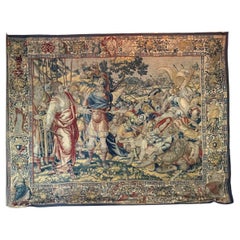
Brussels tapestry, battle scene, second half of the 16th century
Located in Honnelles, WHT
Brussels tapestry, battle scene, second half of the 16th century
Category
Late 18th Century Belgian Louis XIII Antique Wool Drawings
Materials
Wool
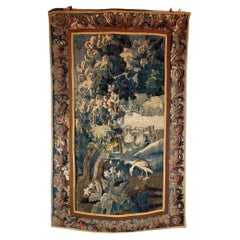
Flanders tapestry depicting a landscape, 18th century
Located in Honnelles, WHT
Flanders tapestry depicting a landscape, 18th century
Category
Late 18th Century Belgian Louis XIII Antique Wool Drawings
Materials
Wool
Related Items
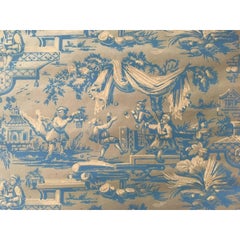
France 18th Century Wallpaper with Landscape Scenes in Turquoise Color
Located in Brescia, IT
It is not easy to find this kind of hand drawed and hand-made French wallpaper in good conditions.
The shining turquoise and the scenes of the games of the characters and jugglers i...
Category
Mid-18th Century French Louis XV Antique Wool Drawings
Materials
Paper

$4,354 Sale Price
20% Off
H 233.08 in W 19.57 in D 0.02 in
16th Century Brussels Tapestry 5980y
Located in Los Angeles, US
16th Century Brussels Tapestry
great condition
beautiful color and design
Category
16th Century Belgian Antique Wool Drawings
Materials
Wool
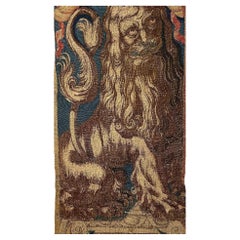
16th Century Brussels Tapestry 5981y
Located in Los Angeles, US
16th Century Brussels Tapestry
Great condition
beautiful color and design
Category
16th Century Belgian Antique Wool Drawings
Materials
Wool
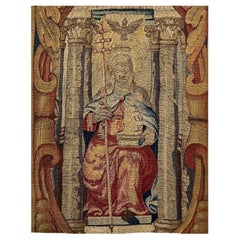
Italian Landscape Oil on Canvas Early 18th Century Gold Frame Venetian School
Located in Prato, IT
Veneto, Italy, early 18th century
Oil on canvas
20th century frame carved and gilded in pure gold
Dimensions: cm W 93 x H 78,5 x D 5.
Category
Early 18th Century Italian Antique Wool Drawings
Materials
Canvas, Wood

$11,249
H 30.91 in W 36.62 in D 1.97 in
Large Red Chalk Drawing, 18th Century Italian School
Located in Kittery Point, ME
Nude male academy.
Red chalk on paper.
While the artist who drew this drawing is not known, the confidence in the trait along with the fascinating perspect...
Category
Mid-18th Century Italian Rococo Antique Wool Drawings
Materials
Paper
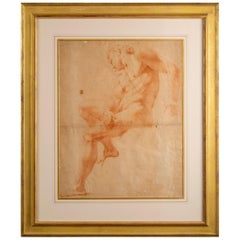
Late 16th Century Flemish Historical Tapestry
Located in Port Washington, NY
This magnificent tapestry was woven in Flanders during the middle of the European Renaissance, in the late 1500s. At this time, Flanders was creating some of the best textiles in the world, and many of the rich wooded scenes with animals and hunting motifs began to appear. Tapestries subjects were thick forests and park lands, hunting scenes filled with deer, birds, exotic animals, and even mythological creatures. These were later referred to as Game Park tapestries...
Category
16th Century Belgian Antique Wool Drawings
Materials
Wool
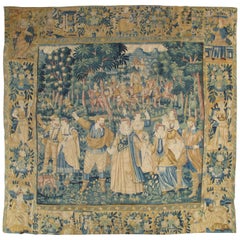
Late 16th Century Brussels Historical Tapestry with the Roman General Scipio
Located in New York, NY
A Brussels historical tapestry, attributed to Martin Reymbouts, late 16th century. From the story of Scipio series, the renowned Roman general, a royal c...
Category
16th Century Belgian Antique Wool Drawings
Materials
Wool
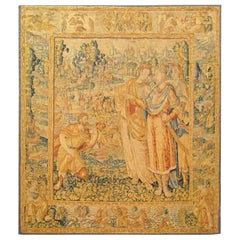
$199,995 Sale Price
33% Off
H 129 in W 136 in D 0.05 in
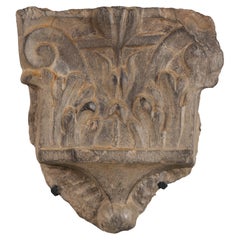
16th Century Ligurian Stone Half-Capital
Located in London, GB
A rare 16th Century Italian stone Corinthian half-capital, carved in Ligurian slate, mounted on a simple wrought iron bracket for wall hanging.
Category
16th Century Italian Renaissance Antique Wool Drawings
Materials
Slate, Iron
Drawing, Flemish School, 18th Century
Located in Kittery Point, ME
Ancient Ruins with Strollers.
Brown wash and graphite.
Category
Mid-18th Century Dutch Neoclassical Antique Wool Drawings
Materials
Paper

Late 16th Century Brussels Historical Tapestry, with Famed Roman General Scipio
Located in New York, NY
A Brussels historical tapestry, attributed to Martin Reymbouts, late 16th century. From the Story of Scipio series, the renowned Roman general, victorious after the Punic War, with k...
Category
16th Century Belgian Antique Wool Drawings
Materials
Wool
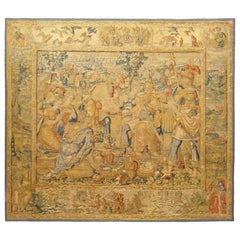
$149,995 Sale Price
25% Off
H 153 in W 136 in D 0.05 in
16th Century, Flemish Storied Wood Tapestry
Located in IT
16th century, Flemish storied wood tapestry
Flanders Brussels
The beautiful and precious tapestry, of fine workmanship and made with wool yarns, was made in the 16th century in F...
Category
16th Century Belgian Renaissance Antique Wool Drawings
Materials
Wool
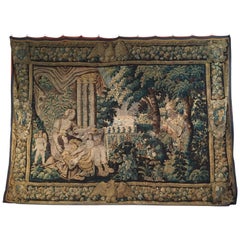
16th Century English Tapestry
Located in LYON, FR
Very rare 16th Century English tapestry. Hand made my candle light over 300 years ago.
Recently professionally cleaned and in good condition.
Sources in Lyon France
Any questions p...
Category
16th Century English Medieval Antique Wool Drawings
Materials
Wool
Previously Available Items
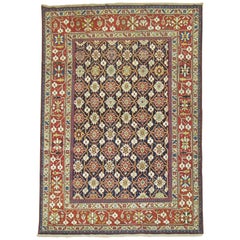
Mini Khani Antique Shirvan Caucasian Wall Rug
Located in New York, NY
19th century Caucasian Shirvan rug with a an all over mini khani motif on a blue ground and Konagkend motif border. This piece is thin and light so it can be used as a wall hanging a...
Category
19th Century Caucasian Kazak Antique Wool Drawings
Materials
Wool
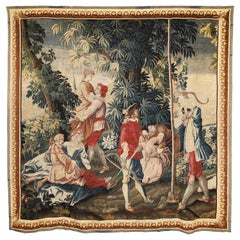
18th Century French Wool and Silk Aubusson Tapestry and Engraving, circa 1750
Located in Milano, IT
La Jeunesse (Youth)
Tapestry
Polychrome wool and silk
France, Aubusson, circa 1750
It measures 107.08 in height x 104.33 in (272 cm height x 265 cm).
State of conservation: good
The tapestry is accompanied by the engraving from which the subject was taken.
The engraving measures 23.50 in x 25.86 in (59.7 cm x 65.7 cm) with the frame.
The Aubusson tapestry has controversial origins: some believe that it was the Saracens who imported this type of work into Europe while other authors believe that the production began at the same time as the marriage between Louis I of Bourbon and Maria de Hainaut in 1310. It was at this time that a considerable importation of tapestries from Flanders into France began, followed shortly thereafter by the importation of their production techniques.
At the beginning of the seventeenth century a royal edict from Henry IV halted the importation of Flemish tapestries, contributing to the subsequent Expansion of Aubusson production. The status of royal manufacture was to be granted only in 1665, even though the Nantes edict caused a drop in production because of the forced migration of weavers to Germany.
The full recovery and the success of the manufacturing took place during the eighteenth century when the great painters and the tapestry manufacturers began to collaborate.
Great French artists of the time and specialist painters, the “cartonniers”, painted “cartons de tapisserie” in oil or tempera, all of which were to be a source for the tapestries. As an alternative to the “cartons”, scenes taken from prints and engravings were freely used.
The tapestry in question, made of wool and silk, is in good condition; the colors are still fresh and the silks, which give brightness to the scene, are well preserved. There are a small number of integrative restorations present, while the lining and the suspension system have been recently refurbished.
The work is made with a flat-weave, according to the custom of the Aubusson manufactures, which is clearly demonstrated by this work since it shows all the technical and material characteristics typical of the first half of the eighteenth-century production: the “Jeunesse” was probably woven in the middle of the XVIII century.
The scene itself is compelling: a rural clearing is depicted, centered around a tall tree with dense fronds with lance-shaped leaves. In the shade of this tree some scenes of courtship can be seen. A couple hugs each other, one is caught stealing a kiss and another, lying softly on the grass, is still at the early stages of courtship: together with the suitor the girl looks with smiling malice at the kissing couple. On the right, two young men practice archery while aiming at a target placed on top of a pole.
The scene, with male and female characters intent on games and gallantry in a festive atmosphere, is taken - faithfully, but in mirror-image - from an engraving, which in turn was itself taken from the painting (now kept at the National Gallery in London, inv. NG103 and part of a series with the four ages of man) by Nicolas Lancret, produced around 1735.
The tapestry is accompanied by a copy of the engraving, which bears, at the bottom, the name of the author (“N. Lancret pinxit”), the name of the engraver (“N. De Larmessin sculpsit”) and four short verses on the subject of love disputes:
Pourquoi tous ces combats si chers a la jeunesse,
Quels frivoles talents veut-elle mettre au jour?
Non: chacun voudroit vaincre aux yeux de sa Maitresse,
La Lice est une Scène ou triomphe l’Amour.
Why all these fights so dear to youth,
What frivolous talents does it want to bring to light?
No: everyone would want to win in the eyes of his Mistress,
The Lice is a Scene where Love triumphs.
At the bottom we read: “A’ Paris chez N. De Larmessin graveur du Roy Rue de Noyer à la 4 (?) porte cochère a droite entrant par la Rue St. Jacques A.P.D.R. [Avec Privilège Du Roy]”.
Nicolas Lancret (1690-1743), along with Antoine Watteau, was a pupil of Pierre Durin and Claude Gillot...
Category
Mid-18th Century French Rococo Antique Wool Drawings
Materials
Tapestry, Wool, Silk
H 107.09 in W 104.34 in D 0.4 in
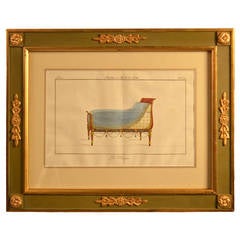
19th c. Framed Hand Colored Engraving Of Furnishings
Located in Vista, CA
Framed hand colored engraving of Interior Design sketches. Matted and framed in gold leaf and olive green, with corner rosettes and raised floral motifs.
Category
Early 19th Century European Antique Wool Drawings
Materials
Glass, Wool