Items Similar to 17th century, Four French paintings depicting biblical subjects

Want more images or videos?
Request additional images or videos from the seller
1 of 20
17th century, Four French paintings depicting biblical subjects
$19,526.63
£14,591.70
€16,500
CA$27,189.85
A$29,218.36
CHF 15,677.34
MX$344,174.38
NOK 197,125.21
SEK 180,072.60
DKK 125,780.77
About the Item
Four paintings depicting biblical subjects, French school, 17th century, tempera on parchment mounted on wooden panel
These four paintings were executed in tempera on parchment, mounted on wooden panels, in the 17th century, most likely in France.
They depict biblical scenes: Bathsheba at the Bath, David Slays Goliath, Esther Before Ahasuerus, and Moses Striking Water from the Rock.
The first painting on the left shows a scene set in an elegant garden, with a carved Baroque fountain, leafy trees, and an architectural structure in the background. At the center, a group of women dressed in classical tunics gathers around a seated female figure near a large basin: this is Bathsheba, surrounded by her attendants. The delicate colours—especially blues, pinks, and ochres—create a luminous, serene atmosphere. The scene refers to the well-known episode in the Second Book of Samuel: King David, looking from the terrace of his palace, sees Bathsheba bathing and becomes captivated by her beauty. Their encounter will lead to a forbidden relationship and dramatic events that will shape the history of Israel. This painting, however, chooses to depict the moment of the bath as a harmonious and tranquil scene, focusing on beauty and stillness before the turmoil to come.
The second painting from the left portrays the decisive moment of the confrontation between the young David and the giant Goliath. In the foreground, Goliath is shown staggering and falling backward, struck on the forehead by the stone launched from David’s sling. His massive body and the red garment add dynamism to the scene. Opposite him, the young David still has his arm raised in the gesture of throwing. Around them, soldiers and camp tents create a vivid military setting. The scene draws on the First Book of Samuel, in which David, a simple shepherd, faces the Philistine champion Goliath armed only with a sling and his faith. With a swift gesture, guided by trust in God, David brings down the giant, securing Israel’s victory and foreshadowing his future as king.
The third painting depicts Queen Esther at the dramatic climax of her encounter with King Ahasuerus. The scene unfolds in a sumptuous court environment, featuring a colonnade, a monumental staircase, and rich draperies. Ahasuerus, seated on the throne beneath a red and blue canopy with lambrequins, extends his arm toward Esther, who faints from tension while two attendants support her. Court figures and architectural elements fill the background, while vivid colours and meticulous details enhance the theatricality of the moment. The episode refers to the Book of Esther: the young queen, risking her life, presents herself before the king without having been summoned, to plead for her threatened people. Overcome by emotion, she faints; the king, moved to compassion, receives her and extends his sceptre toward her, a gesture symbolizing clemency. The painting captures precisely this dramatic instant, embodying courage, intercession, and justice.
Finally, the last painting depicts the famous biblical episode in which Moses brings forth water from the rock to quench the thirst of the Israelites during the Exodus in the desert. In the center, Moses—draped in a light mantle—strikes the rock with his staff, while men, women, and children rush toward the miraculous water, kneeling or reaching forward with containers. The setting is natural and luminous, with trees and mountains in the background and animals in the foreground such as a dog and a bird near the stream. The scene refers to the Book of Numbers (20:1–11) and the Book of Exodus (17:1–7), where Moses, following divine command, strikes the rock at Meribah to provide water for the people in distress. The miracle symbolizes faith in God and His providence, revealing Moses’ role as leader and mediator between God and the Israelites.
The four parchments, with their bright and lively colours, are highly decorative and visually pleasing. In good condition, they are presented in Venetian-style carved and gilded wooden frames.
- Dimensions:Height: 14.97 in (38 cm)Width: 20.48 in (52 cm)Depth: 1.58 in (4 cm)
- Style:Baroque (Of the Period)
- Materials and Techniques:
- Place of Origin:
- Period:
- Date of Manufacture:17th Century
- Condition:Wear consistent with age and use.
- Seller Location:IT
- Reference Number:1stDibs: LU4405247732072
About the Seller
5.0
Vetted Professional Seller
Every seller passes strict standards for authenticity and reliability
Established in 1980
1stDibs seller since 2019
57 sales on 1stDibs
Typical response time: 1 hour
- ShippingRetrieving quote...Shipping from: Italy
- Return Policy
More From This Seller
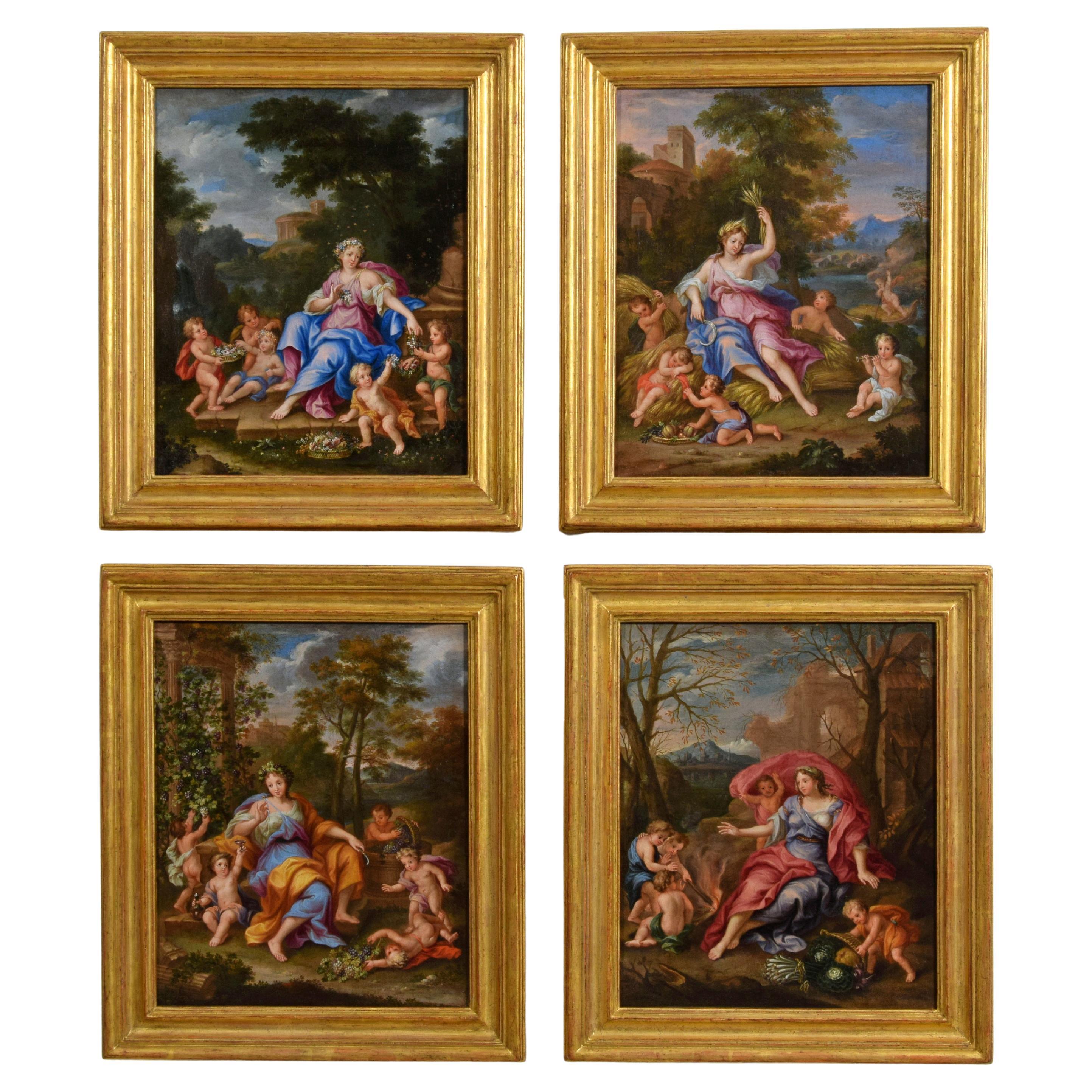
View All17th century, Four French Paintings Depicting The Seasons, Circle of Noel Coypel
By Noël Coypel
Located in IT
Four paintings depicting the seasons, circle of Noel Coypel, second half of the 17th century
Oil on canvas, unsigned
Measures: cm W 37 x H 46 x D 2 cm (canvas)
The four paintings, pr...
Category
Antique Late 17th Century French Baroque Paintings
Materials
Canvas
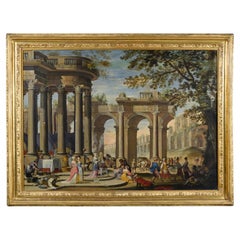
18th Century, Painting Architectural Capriccio, att. to Isaac De Moucheron
Located in IT
18th Century, Painting with Architectural Capriccio with figures, attributed to Isaac De Moucheron
Measures: canvas cm H 108 x L 152; with frame cm H 132 x L 176 x 8
The painting i...
Category
Antique 18th Century Dutch Baroque Paintings
Materials
Canvas
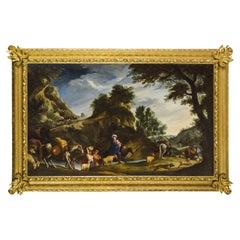
17th Century, Italian Painting by Pier Francesco Cittadini, Jacob and his Family
Located in IT
Pier Francesco Cittadini (Milan, 1616-Bologna, 1681)
"Jacob and his family go to Egypt"
Oil on canvas, cm 109 x 190 (canvas only)
The valuable painting, made in oil on canvas, depicts Jacob and his family go to Egypt and we believe it can be, given the high quality painting, autograph work of Italian Pier Francesco Cittadini (Italy Milan, 1616 - Bologna, 1681) made after 1647. The work, in excellent condition is accompanied by a coeval frame in wood finely carved and golden.
The scene depicted, which was confused with the Flight to Egypt in the past years, is instead identified with the biblical episode of Jacob’s journey. In the foreground, reading the painting from left to right, we see a caravan composed of animals, including donkeys, dromedaries, goats, dogs and horses and people, women, men and slaves, who carry on their journey along the banks of a river, following a path that to the right, would seem to lead to the through of a bridge. In addition to the watercourse is described an environment characterized by large rocks and impervious come far to cover the entire verticality of the canvas. On the left, in the distance, we see the tail of the caravan that runs along the steep path. Large trees enliven and harmonize the environment, as well as white and grey clouds characterize the predominantly clear sky and illuminated on the right by sunlight.
The story is told in the Bible, Book of Genesis, 30, 25, passage in which is described the flight of Jacob from Haran after the contrasts with Laban, father of his wife Rachel. Jacob is the third great patriarch of the Bible. From his descendants originate the twelve generations of the people of Israel. He is the son of Isaac and Rebekah, who led him to flee from the wrath of Esau to Haran to seek refuge from his brother, Laban. At his uncle’s house Jacob met his daughter Rachel. As soon as he saw his cousin, Jacob was taken. Jacob will stay seven years in the service of Laban to marry his beloved Rachel. But Laban, with a deception, will give him in marriage first Lia, the least beautiful eldest daughter, and only after another seven years the splendid Rachel. From his first wife he will have several children, while Rachel will give birth to the beloved son, Joseph, who will become viceroy of Egypt.
After years of service, Jacob asked to be paid with every dark-coloured garment among the sheep and every spotted and dotted garment among the goats. Laban accepted and sent away from his sons all the leaders of that kind. So Jacob took fresh branches of poplar, almond and plane tree, and flayed them, and put them in the troughs. The optical suggestion induced the goats and the sheep to conceive and give birth to dark, striped and dotted garments. He also ensured that all the strongest and healthiest leaders of the flock of Laban would drink near the barked branches, thus assuring a genetic superiority to his part of the flock. His flocks grew numerous and strong and he became richer than his relative, arousing envy. It was clear that Laban would not respect him much longer. At the suggestion of the Lord, Jacob decided to return to Canaan. Trying to avoid any possible dispute, he left with his family while Laban was absent for shearing sheep. But when, three days later, his uncle returned home, he became angry, feeling offended because Jacob had gone secretly and had not allowed him to greet his daughters and grandchildren. In addition, his teraphim, statuettes, or idols, which depicted the family deities, had disappeared. After 7 days of pursuit, Laban and his men reached Jacob’s group on Mount Gilead, in the mountainous region west of the Euphrates River, where his uncle and grandson had a stormy conversation. The younger man was outraged at being accused of stealing idols and told Labano to rummage through his family’s tents at will. Neither of them could know or even imagine that it was Rachel who took the idols and hid them in the saddle of the camel. During the search, she sat down firmly on the saddle, apologizing for not being able to get up, «because I usually have what happens to women» (Gen 31:35). So the loot wasn’t discovered.
The author of this work was inspired by the composition of an engraving by Stefano Della Bella (1610-1664) of circa 1647. The engraving by Stefano della Bella bears the title "Iacob sur ses vieux jours quitte sans fascherie pour voir son filz Ioseph, sa terre et sa patrie" and is signed on the bottom left "Stef. of the Beautiful In. et fe." while on the right it is declared "Cum privil. Regis", that is with license of the king.
Stefano Della Bella (Italy - Florence, May 18, 1610-Florence, July 12, 1664) was born in a family of painters, sculptors and goldsmiths and was left early orphan of his father sculptor, he dedicated himself first to the art of goldsmith at the school of Giovanni Benedetto Castiglione and Gasparo Mola, then turning his attention to drawing and engraving. He soon began drawing figures and copying the etchings of Jacques Callot, which inspired his early works. Under the protection of the Medici, in particular of Don Lorenzo, cadet son of Grand Duke Ferdinand I, Della Bella has the opportunity to make study trips to Rome, where he stayed from 1633-1636; In Rome he met French engravers and publishers of prints such as Israël Henriet and François Langlois, who influenced his decision to move to Paris in 1639, four years after the death of Callot. In Paris he soon reached, thanks to the engravings commissioned by Cardinal Richelieu, the success also worldly; he frequented courtiers, theatre artists and writers, while refusing too oppressive honors. In 1646-1647 he continued his travels in the Netherlands to Amsterdam, Antwerp and Dordrecht. He returned to Florence in 1650 and resumed working under the protection of the Medici court, working for his patrons. In 1656 he became a member of the Academy of Apatists.
The painting object of this study is reasonably attributable to Pier Francesco Cittadini, or Pierfrancesco Cittadini, called the Milanese or the Franceschino (Italy - Milan, 1616-Bologna, 1681) as some exemplary stylistic comparisons proposed to follow can prove.
Pier Francesco Cittadini was an Italian baroque painter, mainly active in Bologna.
His artistic training first took place with the painter Daniele Crespi...
Category
Antique Mid-17th Century European Baroque Paintings
Materials
Canvas, Giltwood
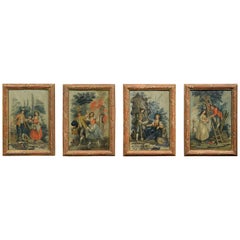
19th Century Four Italian Oil on Panel with Allegory of the Four Elements
Located in IT
19th century four Italian oil on panel with allegory of the four elements
Dimensions with frame: cm H 34.5 x L 25; only the table: cm H 29 x L 20.5
The funny oil on panel, by an artist active in Piedmont, in the north of Ital, in the first half of the 19th century, represent the allegory of the four elements of the Earth.
They are inspired by the group of four etching prints of circa 1730, made to a design by Rococo painter Jacopo Amigoni (Naples 1682- Paris 1752) and engraved in Venice by Joseph Wagner...
Category
Antique 19th Century Italian Rococo Paintings
Materials
Wood
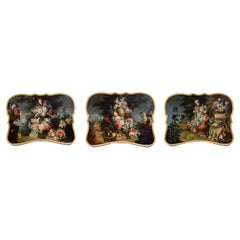
18th Century, Three Italian Paintings Depicting Still Life by M. A. Rapous
By Michele Antonio Rapos
Located in IT
18th Century, Three Italian Paintings Depicting Still Life by Michele Antonio Rapous (Turin, 1733 – 1819)
Oil on canvas. Dimensions: cm H 78.5 x W 104.5
Available individually or as ...
Category
Antique Late 18th Century Italian Rococo Paintings
Materials
Canvas
18th Century, Baroque Austran Painting by August Querfurt
Located in IT
August Querfurt (1696, Wolfenbüttel - 1761, Vienna)
Farmers and villagers at the entrance of a village
Oil on panel , cm 38,5 x 51. frame 66 x 53,5 x 4,5 cm
The valuable painting, ...
Category
Antique 18th Century Austrian Baroque Paintings
Materials
Wood
You May Also Like
Set Of Baroque Paintings, 17th Century, Religious Art
Located in Lisbon, PT
A pair of Oil Italian Baroque paintings:
- A 17th Century baroque painting of a sideview of Jesus Christ Salvator Mundi or Saviour of the World in sfumato
Saint Savior of the Worl...
Category
Antique 17th Century Italian Baroque Paintings
Materials
Copper
$8,665 Sale Price / set
44% Off
18th Century Romantic Italian Paintings
Located in Palm Beach, FL
Here is a set of four 18th century Italian paintings depicting various romantic dramas. All four painted in old world style and presented in the original stretchers and frames. Findi...
Category
Antique 18th Century Italian Romantic Paintings
Materials
Paint
$12,500 / set
A Set of Four Late 18th Century / Early 19th Century Allegorical Paintings
Located in Dallas, TX
A set of four (4) Late 18th Century / Early 19th Century allegorical paintings amongst landscapes amongst classical ruins, relived frames contemporary pictures most likely. Italian.
...
Category
Antique Early 18th Century Italian Neoclassical Decorative Art
Materials
Canvas
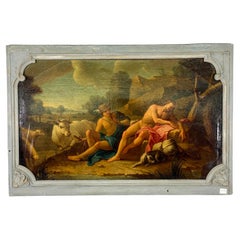
18th Century French Greco Roman Mythological Painting
Located in Scottsdale, AZ
18th Century French Greco Roman Mythological Painting
Beautiful
Large piece purchased in France.
This scene was taken from the Metamorphosis of Ovid.
Inner Frame Dimensions:...
Category
Antique 18th Century French Greco Roman Paintings
Materials
Wood, Paint
$6,320 Sale Price
20% Off
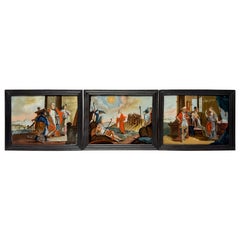
Set of 3, 19th Century Allegorical Reverse Glass Paintings
Located in Atlanta, GA
**Set of 3, 19th Century Allegorical Reverse Glass Paintings**
This captivating set of **three 19th-century allegorical reverse glass paintings** presents richly detailed narratives imbued with symbolism and classical themes. Each painting is executed in the traditional reverse glass technique, providing a smooth and reflective surface that enhances the vibrant palette and fine detailing.
1. **Painting 1 (Left Panel):**
This scene portrays a dramatic encounter, likely a moment of judgment or persuasion, set against a distant landscape. A figure in a flowing blue robe gestures emphatically toward a well-dressed couple, perhaps symbolizing conflict, intervention, or moral decision-making. The background includes a sweeping view of the countryside, with figures in the distance adding depth and context.
2. **Painting 2 (Center Panel):**
The central panel features a pastoral scene steeped in allegorical significance. A central figure dressed in red, resembling a shepherd, commands attention under a radiant sunburst. Surrounding characters appear in moments of tension and repose, including a reclining figure and a soldier-like character. This composition evokes themes of guidance, struggle, and divine providence, with the bright sky and natural elements reinforcing the allegorical tone.
3. **Painting 3 (Right Panel):**
The final panel depicts an intimate interior scene, with two seated women engaged in conversation, one gesturing emphatically as a standing male figure observes. The setting includes detailed furnishings, such as a writing desk, a red draped curtain, and objects hinting at scholarly or domestic pursuits. This tableau may represent themes of wisdom, counsel, or moral reflection, supported by the characters' thoughtful expressions and elaborate dress.
Each painting is framed in its **original dark wooden frame**, complementing the vibrant colors and enhancing their display value. The set embodies the **19th-century European fascination with allegory and storytelling**, making it a significant piece for collectors of reverse glass art...
Category
Antique Mid-19th Century Italian Baroque Paintings
Materials
Glass, Paint
$1,036 Sale Price / set
20% Off
Set of Four Continental 18th Century Collection of Whimsical Paintings
Located in West Palm Beach, FL
A Continental 18th century whimsical collection of charming paintings depicting Ladies of the 18th century. The set of four paintings is meant to...
Category
Antique 18th Century Unknown Paintings
Materials
Canvas, Giltwood