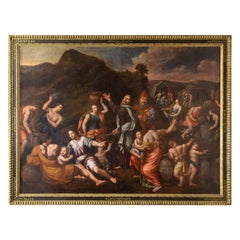
Items Similar to 17th Century, Italian painting Allegory of the Spring Follower of Jacopo Bassano
Want more images or videos?
Request additional images or videos from the seller
1 of 20
17th Century, Italian painting Allegory of the Spring Follower of Jacopo Bassano
$19,764.31
£14,779.26
€16,500
CA$27,230.28
A$29,698.44
CHF 15,732.23
MX$356,042.15
NOK 200,358.70
SEK 183,213.16
DKK 125,736.57
About the Item
Follower of Jacopo Da Ponte, called Jacopo Bassano (Bassano del Grappa, circa 1510 - Bassano del Grappa, 13 February 1592), 17th century
Allegory of the Spring
Measures: With frame: cm W 122,5 x H 89 x D 6,5. Canvas: cm W 106,5 x H 72
The painting, of great decorative effect and accompanied by a frame in carved wood and gilded not coeval, is the work of a painter, active in the mid-seventeenth century, follower of the celebrated Venetian school of Bassano da Ponte, family of painters who developed his prosperous workshop for over two centuries, between the fifteenth and advanced seventeenth century.
It depicts the allegory of Spring with all the peculiar activities of the season: in the foreground on the right is described the milking of goats, while on the left a hunter, with his dogs on a leash is ready for a hunt. The scenes are set in a hilly landscape with some birds flying among the buds of the trees. In the distance, to the right, the expulsion of Adam and Eve from Paradise.
It is a composition from the cycle The Four Seasons now returned to Jacopo da Ponte (called Bassano).
The series of painters from Ponte or Ponte, also known as Bassano, begins with Francesco il Vecchio, born in Bassano del Grappa between 1470 and 1480, late-fifteenth-century artist. He had four children, among them the famous Jacopo, founder of the Bassano school. Jacopo had eight children, including Francesco, Leandro, Giambattista and Girolamo, all painters in his father’s workshop. Jacopo was the initiator of a biblical-pastoral genre that had great fortune, engaging the workshop and the children in numerous variations. As the years passed, these paintings, sometimes taken from the New Testament, or cyclical compositions of the Seasons, Months, Elements, to satisfy the increasingly dense demands of the bourgeois patronage, became a mixture of styles and subjects, with phenomena of mutual assimilation and imitation, within a real proto-industry of images. The Bassano painting did not end with the death of the four sons of Jacopo: it was transmitted instead to their descendants for two generations. The dynasty became extinct in 1661 and activity ceased permanently.
The success of their productions, defined by critics as genre painting and/or biblical-pastoral painting, largely coincided with the fame of the name Bassano or Bassano. The artistic character of their works is distinguished by a "genre" iconography that rarely allowed them to be identified as traditional paintings because the Bassano did not paint them following the established canons of religious history painting.
The fortune of Bassano painting was great and already in the seventeenth century many painters did not scruple to copy, imitate and falsify the paintings and themes of Bassano, thus contributing to often create an inextricable attribute tangle.
The Four Seasons are certainly among the most representative works of Bassano iconography. The metaphorical structure seems obscured by the representation of pastoral environments and rural works. However, against the background of all four canvases is a scene from the Old Testament: in the case of Spring, it depicts the Expulsion of Adam and Eve from earthly Paradise.
Jacopo Bassano uses a simple compositional scheme: against the background of a landscape, the activities of people, pets and equipment used described with vivid narrative realism. The painter portrays the landscapes in the four canvases, as a series of studies on light that changes during the day, creating interconnecting and complementary effects between the works. The changing light of the day becomes more and more evident: Spring begins the series bathed with dawn light, Summer has the full light of the day, while Autumn reveals the last light that changes from the warm tones of the afternoon towards dusk. In Winter, the evening gives way to the night, the waning light reveals the bright splendor of the white peaks of the mountains against the dark night sky. In this series, Jacopo’s appreciation of nature is evident, combined with his interest in the characteristic activities of rural and domestic life.
The most significant group of paintings representing this iconographic theme is now preserved in the Kunst Historisches Museum in Vienna. The series of the Four Seasons by Jacopo Bassano, conceived by the author in 1570, belonged to the famous collection of Archduke Leopoldo Guglielmo (1614-1656). The Archduke’s collection later became a significant part of the present collection of the Kunsthistorisches Museum in Vienna: Spring, Summer, Autumn and Winter (inv. nn. 4303, 4302, 4304, 2869). In the same place is also preserved the series of the Four Seasons by the son of Jacopo Bassano, Francesco, of 1580.
The representation of the months and seasons became the subject of entire pictorial cycles, elaborated in several versions. If the different seasons show absolutely similar characteristics, in the bucolic intonation, in the landscape gently sloping towards blue hills, in the cut of the scene, there are in fact no real replicas or copies of the same subject.
The success of the cycle of the Four Seasons is certainly due to the presence of numerous engravings whose prints circulated in a widespread and widespread way.
In 1660, David Teniers the Younger published his Theatrum Pictorium, in which he recorded most of the collection of Italian paintings that Archduke Leopold Wilhelm of Austria had collected in the palace of Coudenberg in Brussels appointed as governor of the Spanish Netherlands. There are several cycles of prints, some probably taken from the same engravings that circulated. An example is the one engraved by Jan Sadeler I and printed by Jacques Callot, whose printed sheets show the subjects again in contrast to the engravings of Teniers, and therefore in the same direction as the paintings.
There are also other famous series of the Seasons, one preserved at the Sforzesco Castle in Milan, one at the Museo Nacional del Prado in Madrid, one at the Galleria Nazionale in Palazzo Spinola in Genoa, and one at the Galleria Borghese in Rome.
Presumably, the painter of the painting in question, had the opportunity to see and therefore to be inspired by paintings taken from Viennese works or, in the workshop, he owned one of those prints.
We apologize for any translation errors from Italian. Please contact us to have the full expertise, in Italian.
- Similar to:Jacopo Bassano (Painter)
- Dimensions:Height: 35.04 in (89 cm)Width: 48.43 in (123 cm)Depth: 2.76 in (7 cm)
- Style:Baroque (Of the Period)
- Materials and Techniques:
- Place of Origin:
- Period:Late 17th Century
- Date of Manufacture:Late 17th Century
- Condition:Wear consistent with age and use.
- Seller Location:IT
- Reference Number:1stDibs: LU4405238203342
About the Seller
5.0
Vetted Professional Seller
Every seller passes strict standards for authenticity and reliability
Established in 1980
1stDibs seller since 2019
56 sales on 1stDibs
Typical response time: <1 hour
- ShippingRetrieving quote...Shipping from: Italy
- Return Policy
More From This Seller
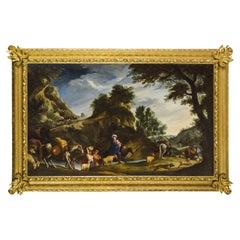
View All17th Century, Italian Painting by Pier Francesco Cittadini, Jacob and his Family
Located in IT
Pier Francesco Cittadini (Milan, 1616-Bologna, 1681)
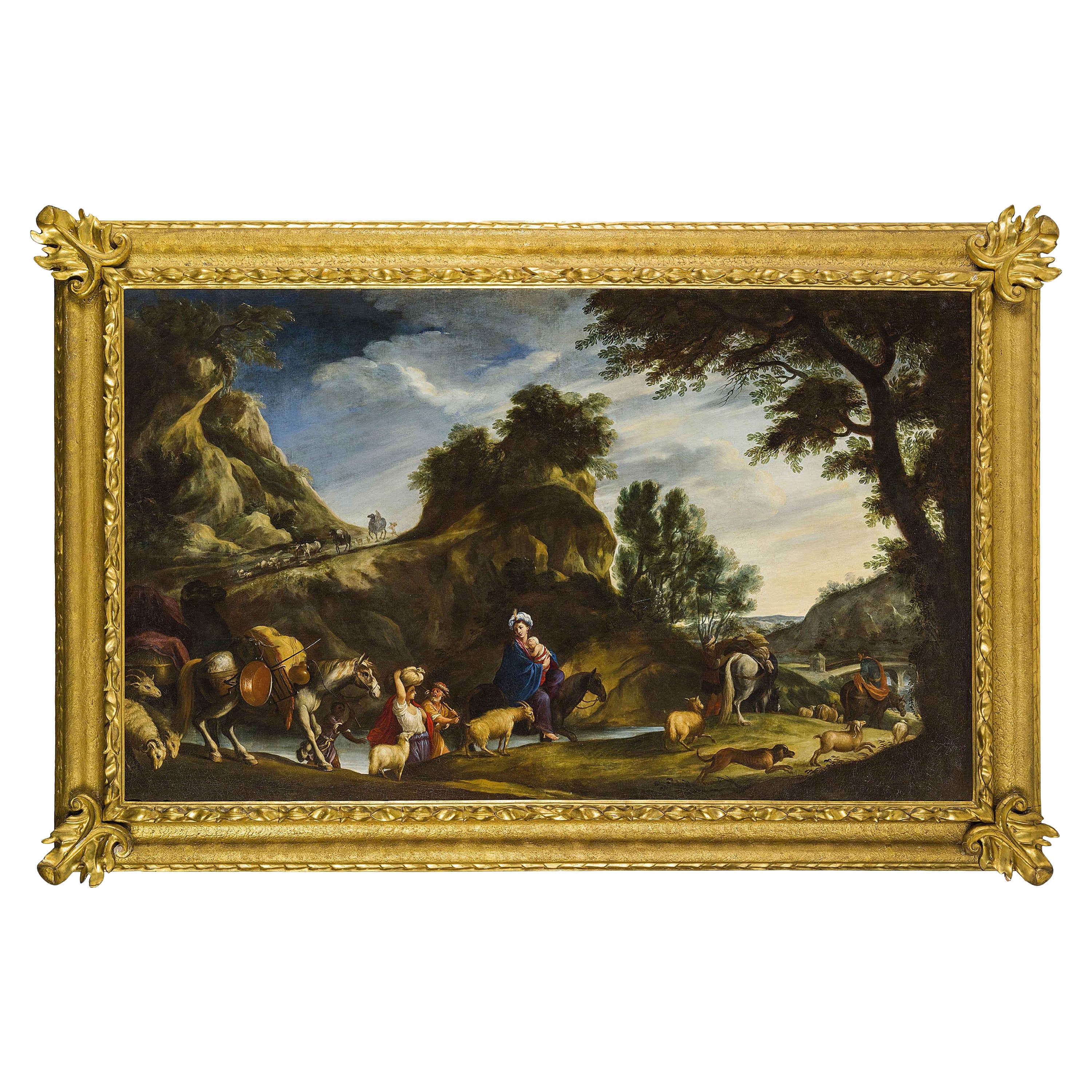
"Jacob and his family go to Egypt"
Oil on canvas, cm 109 x 190 (canvas only)
The valuable painting, made in oil on canvas, depicts Jacob and his family go to Egypt and we believe it can be, given the high quality painting, autograph work of Italian Pier Francesco Cittadini (Italy Milan, 1616 - Bologna, 1681) made after 1647. The work, in excellent condition is accompanied by a coeval frame in wood finely carved and golden.
The scene depicted, which was confused with the Flight to Egypt in the past years, is instead identified with the biblical episode of Jacob’s journey. In the foreground, reading the painting from left to right, we see a caravan composed of animals, including donkeys, dromedaries, goats, dogs and horses and people, women, men and slaves, who carry on their journey along the banks of a river, following a path that to the right, would seem to lead to the through of a bridge. In addition to the watercourse is described an environment characterized by large rocks and impervious come far to cover the entire verticality of the canvas. On the left, in the distance, we see the tail of the caravan that runs along the steep path. Large trees enliven and harmonize the environment, as well as white and grey clouds characterize the predominantly clear sky and illuminated on the right by sunlight.
The story is told in the Bible, Book of Genesis, 30, 25, passage in which is described the flight of Jacob from Haran after the contrasts with Laban, father of his wife Rachel. Jacob is the third great patriarch of the Bible. From his descendants originate the twelve generations of the people of Israel. He is the son of Isaac and Rebekah, who led him to flee from the wrath of Esau to Haran to seek refuge from his brother, Laban. At his uncle’s house Jacob met his daughter Rachel. As soon as he saw his cousin, Jacob was taken. Jacob will stay seven years in the service of Laban to marry his beloved Rachel. But Laban, with a deception, will give him in marriage first Lia, the least beautiful eldest daughter, and only after another seven years the splendid Rachel. From his first wife he will have several children, while Rachel will give birth to the beloved son, Joseph, who will become viceroy of Egypt.
After years of service, Jacob asked to be paid with every dark-coloured garment among the sheep and every spotted and dotted garment among the goats. Laban accepted and sent away from his sons all the leaders of that kind. So Jacob took fresh branches of poplar, almond and plane tree, and flayed them, and put them in the troughs. The optical suggestion induced the goats and the sheep to conceive and give birth to dark, striped and dotted garments. He also ensured that all the strongest and healthiest leaders of the flock of Laban would drink near the barked branches, thus assuring a genetic superiority to his part of the flock. His flocks grew numerous and strong and he became richer than his relative, arousing envy. It was clear that Laban would not respect him much longer. At the suggestion of the Lord, Jacob decided to return to Canaan. Trying to avoid any possible dispute, he left with his family while Laban was absent for shearing sheep. But when, three days later, his uncle returned home, he became angry, feeling offended because Jacob had gone secretly and had not allowed him to greet his daughters and grandchildren. In addition, his teraphim, statuettes, or idols, which depicted the family deities, had disappeared. After 7 days of pursuit, Laban and his men reached Jacob’s group on Mount Gilead, in the mountainous region west of the Euphrates River, where his uncle and grandson had a stormy conversation. The younger man was outraged at being accused of stealing idols and told Labano to rummage through his family’s tents at will. Neither of them could know or even imagine that it was Rachel who took the idols and hid them in the saddle of the camel. During the search, she sat down firmly on the saddle, apologizing for not being able to get up, «because I usually have what happens to women» (Gen 31:35). So the loot wasn’t discovered.
The author of this work was inspired by the composition of an engraving by Stefano Della Bella (1610-1664) of circa 1647. The engraving by Stefano della Bella bears the title "Iacob sur ses vieux jours quitte sans fascherie pour voir son filz Ioseph, sa terre et sa patrie" and is signed on the bottom left "Stef. of the Beautiful In. et fe." while on the right it is declared "Cum privil. Regis", that is with license of the king.
Stefano Della Bella (Italy - Florence, May 18, 1610-Florence, July 12, 1664) was born in a family of painters, sculptors and goldsmiths and was left early orphan of his father sculptor, he dedicated himself first to the art of goldsmith at the school of Giovanni Benedetto Castiglione and Gasparo Mola, then turning his attention to drawing and engraving. He soon began drawing figures and copying the etchings of Jacques Callot, which inspired his early works. Under the protection of the Medici, in particular of Don Lorenzo, cadet son of Grand Duke Ferdinand I, Della Bella has the opportunity to make study trips to Rome, where he stayed from 1633-1636; In Rome he met French engravers and publishers of prints such as Israël Henriet and François Langlois, who influenced his decision to move to Paris in 1639, four years after the death of Callot. In Paris he soon reached, thanks to the engravings commissioned by Cardinal Richelieu, the success also worldly; he frequented courtiers, theatre artists and writers, while refusing too oppressive honors. In 1646-1647 he continued his travels in the Netherlands to Amsterdam, Antwerp and Dordrecht. He returned to Florence in 1650 and resumed working under the protection of the Medici court, working for his patrons. In 1656 he became a member of the Academy of Apatists.
The painting object of this study is reasonably attributable to Pier Francesco Cittadini, or Pierfrancesco Cittadini, called the Milanese or the Franceschino (Italy - Milan, 1616-Bologna, 1681) as some exemplary stylistic comparisons proposed to follow can prove.
Pier Francesco Cittadini was an Italian baroque painter, mainly active in Bologna.
His artistic training first took place with the painter Daniele Crespi...
Category
Antique Mid-17th Century European Baroque Paintings
Materials
Canvas, Giltwood
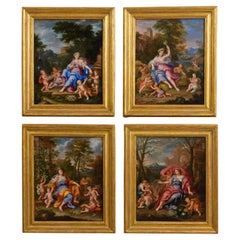
17th century, Four French Paintings Depicting The Seasons, Circle of Noel Coypel
By Noël Coypel
Located in IT
Four paintings depicting the seasons, circle of Noel Coypel, second half of the 17th century
Oil on canvas
Measures: cm W 37 x H 46 x D 2 cm (canvas)
The four paintings, presented in...
Category
Antique Late 17th Century French Baroque Paintings
Materials
Canvas
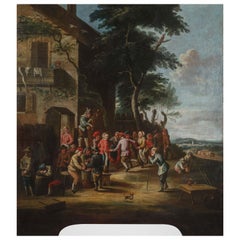
18th Century, Italian painting Depicts Bambocciata by Giovanni Michele Graneri
Located in IT
Giovanni Michele Graneri (Italy, Turin 1708-1762)
Bambocciata (Farmers dancing in front of the inn)
The painting, made in oil on canvas, depicts a moment of celebration where some p...
Category
Antique Mid-18th Century Italian Baroque Paintings
Materials
Canvas
18th Century, Baroque Austran Painting by August Querfurt
Located in IT
August Querfurt (1696, Wolfenbüttel - 1761, Vienna)
Farmers and villagers at the entrance of a village
Oil on panel , cm 38,5 x 51. frame 66 x 53,5 x 4,5 cm
The valuable painting, ...
Category
Antique 18th Century Austrian Baroque Paintings
Materials
Wood
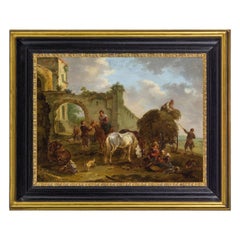
18th Centuy, Italian Painting with Landscape by Giovanni Battista Colomba
Located in IT
Giovanni Battista Innocenzo Colomba (1713 – 1793)
Landscape with figures
Oil on canvas, Frame H 102 x L 112 x P 8; canvas H 77 x L 87
The valuable painting, attributable to the pai...
Category
Antique Mid-18th Century Italian Rococo Paintings
Materials
Canvas
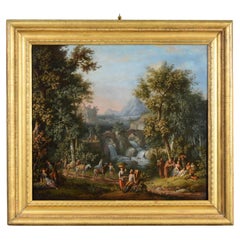
19th Century Four Italian Oil on Panel with Allegory of the Four Elements
Located in IT
19th century four Italian oil on panel with allegory of the four elements
Dimensions with frame: cm H 34.5 x L 25; only the table: cm H 29 x L 20.5
The funny oil on panel, by an artist active in Piedmont, in the north of Ital, in the first half of the 19th century, represent the allegory of the four elements of the Earth.
They are inspired by the group of four etching prints of circa 1730, made to a design by Rococo painter Jacopo Amigoni (Naples 1682- Paris 1752) and engraved in Venice by Joseph Wagner...
Category
Antique 19th Century Italian Rococo Paintings
Materials
Wood
You May Also Like
17th Century Italian School Biblical Scene
Located in Marseille, FR
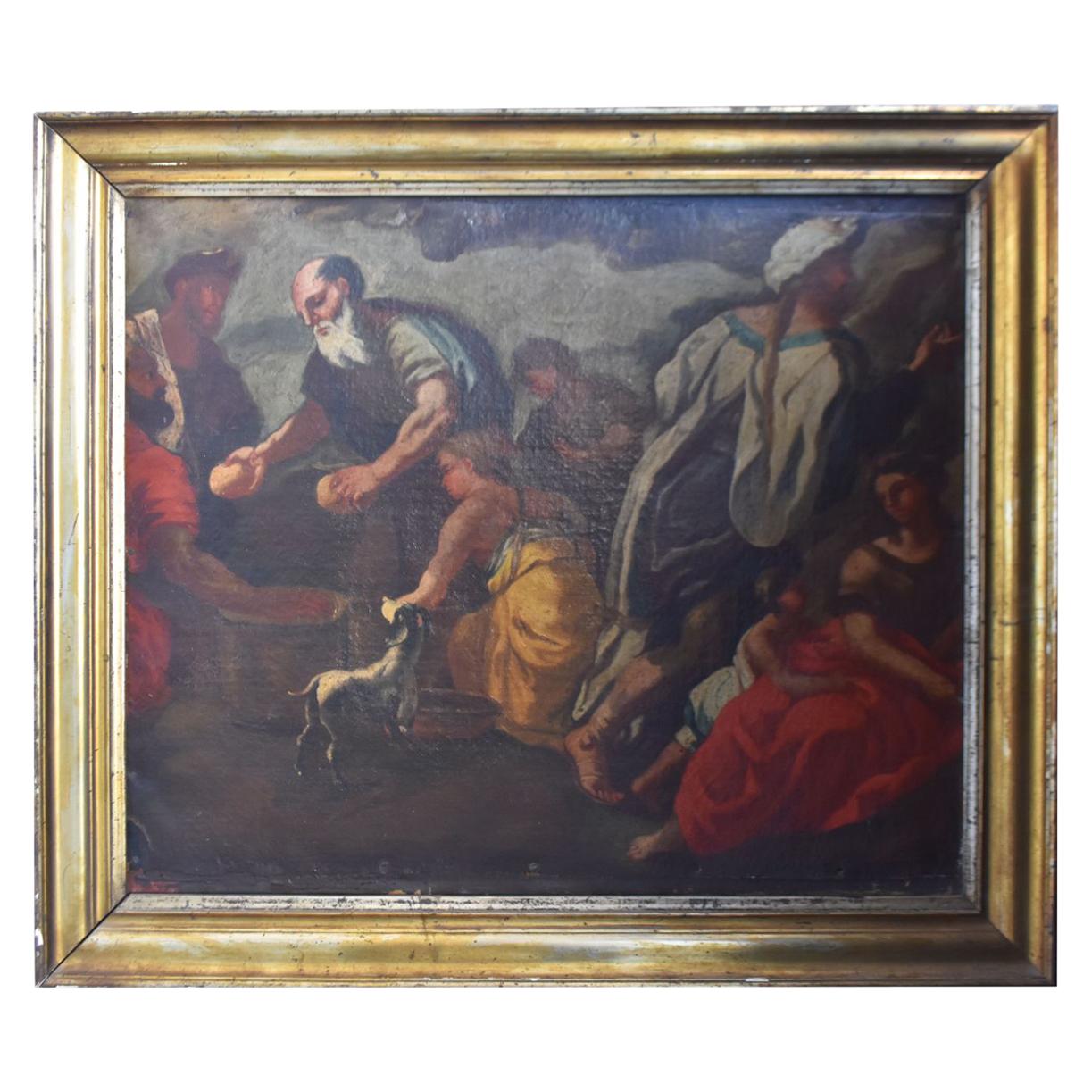
17th century oil on canvas representation of the "Feeding of the 4,000" of Italian school.
Category
Antique 17th Century French Baroque Paintings
Materials
Canvas
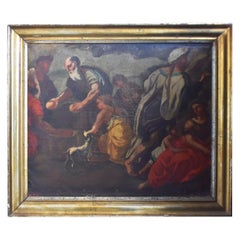
17th Century Oil on Canvas Flemish Mythological Antique Painting, 1660
Located in Vicoforte, Piedmont
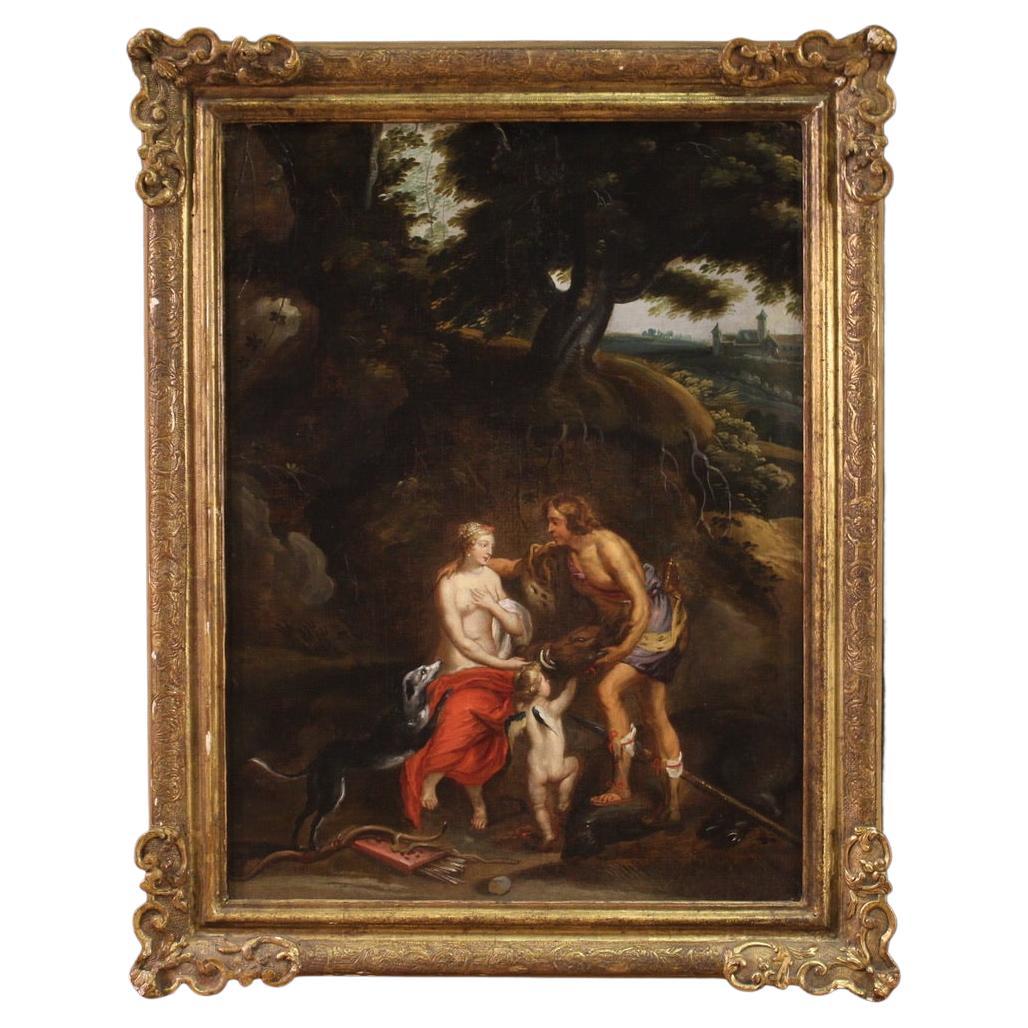
A splendid 17th century Flemish painting. Oil on canvas artwork depicting a mythological subject of great charm, Meleager offers the boar's head to Atalanta. The Fates had predicted ...
Category
Antique 1660s Dutch Paintings
Materials
Canvas
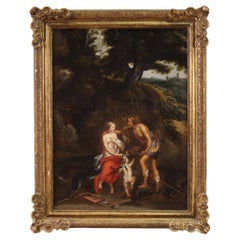
$8,624 Sale Price
20% Off
17th Century Oil on Copper Flemish Antique Painting Mythological Scene, 1630
Located in Vicoforte, Piedmont
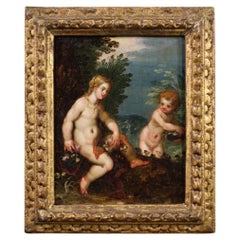
A refined 17th-century Flemish painting. This painting oil on copper depicts a splendid mythological scene, a marvelous landscape with Venus and a cupid. The young goddess is seated ...
Category
Antique 1630s Dutch Paintings
Materials
Copper
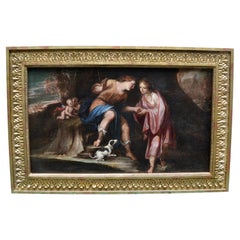
Baroque Painting Depicting the Illicit Romance of Paolo and Francesca
Located in Vancouver, British Columbia
An exceptionally executed oil on canvas Baroque painting depicting "lovebirds" Paolo Malatesta and Francesca Da Rimini whispering to one another. At the feet of Paoio there is a dog symbol...
Category
Antique Early 18th Century Italian Baroque Paintings
Materials
Canvas
17th Century Oil on Canvas Venetian Style Landscape with Characters Painting
Located in Vicoforte, Piedmont
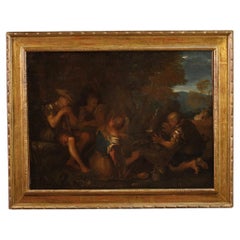
Antique Italian painting from the 17th century. Oil on canvas artwork depicting a landscape with figures from the Venetian school, of good pictorial quality. We see four characters a...
Category
Antique 1640s Italian Paintings
Materials
Canvas
Gathering of Manna, Oil on Canvas, 17th Century
Located in Madrid, ES
Jews in the desert collecting the Manna. Oil on canvas, XVII century.
Oil on canvas arranged horizontally in which a figurative theme is shown with a mountainous landscape in the ba...
Category
Antique 17th Century Spanish Baroque Paintings
Materials
Other