Items Similar to 17th Century Rest on the flight to Egypt Emilian School Painting Oil on panel
Want more images or videos?
Request additional images or videos from the seller
1 of 15
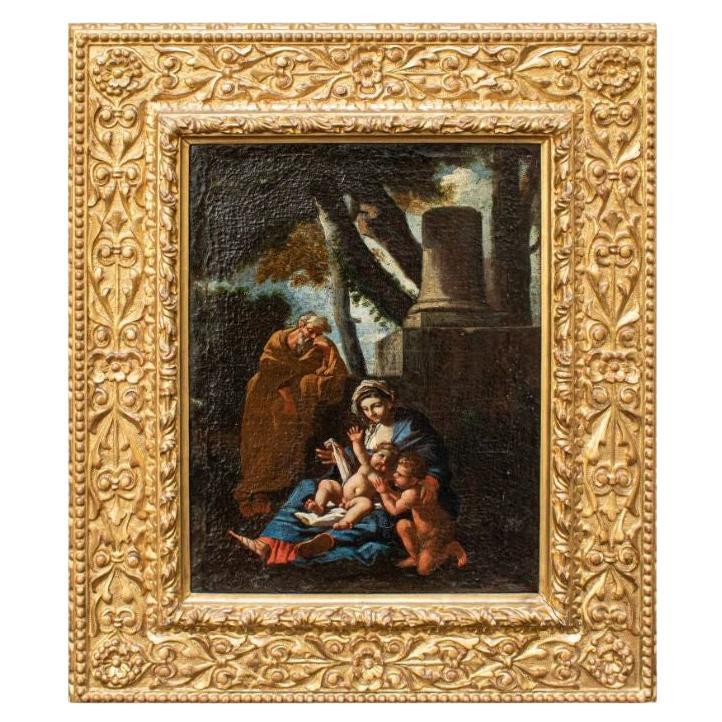
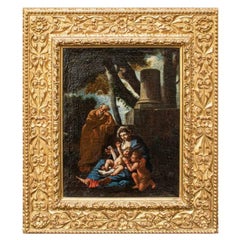
17th Century Rest on the flight to Egypt Emilian School Painting Oil on panel
$5,242.13
£3,894.53
€4,400
CA$7,268.45
A$7,816.60
CHF 4,179.55
MX$94,266.02
NOK 52,853.31
SEK 48,156.17
DKK 33,535.31
About the Item
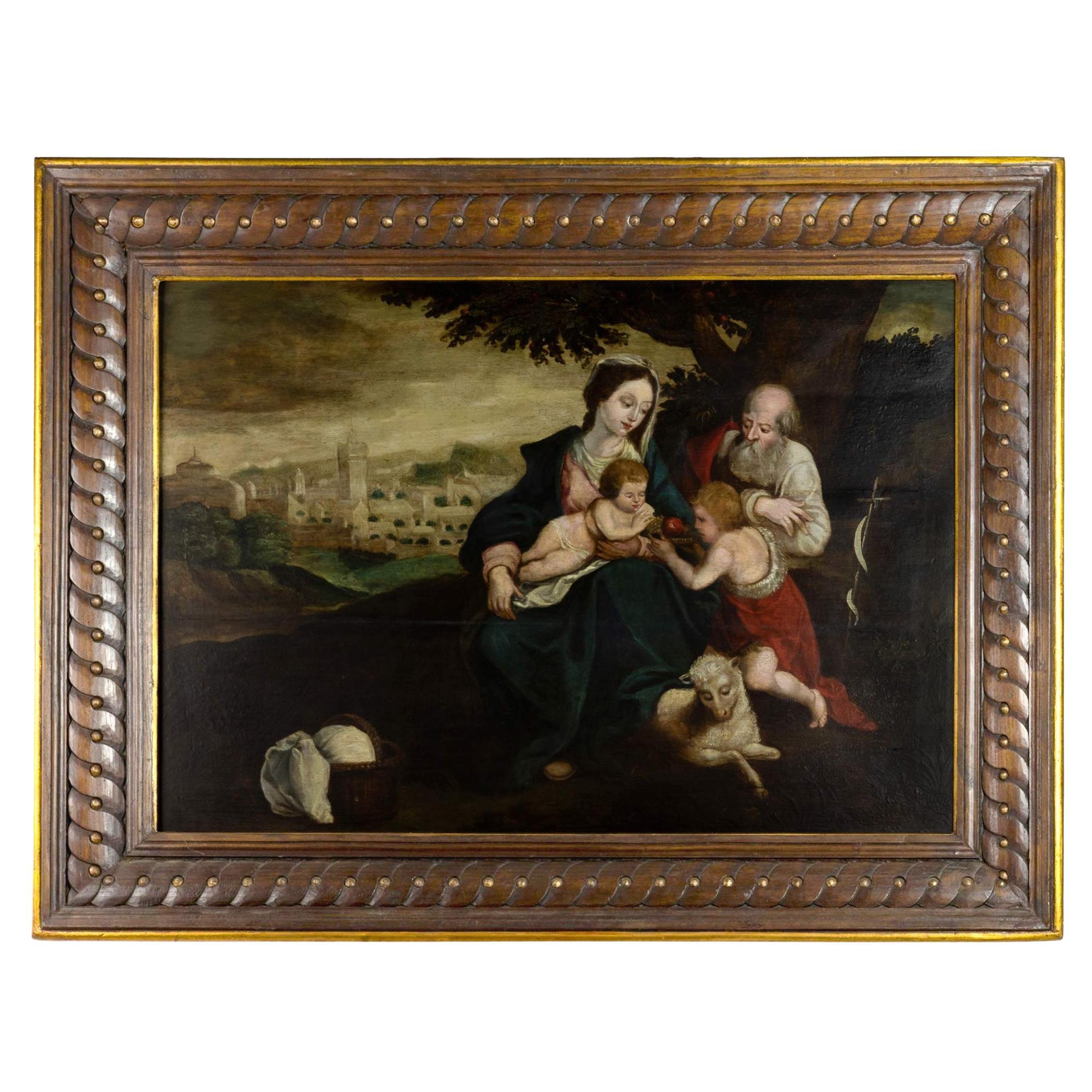
17th century, Emilian school, Pamigianino painter
Rest on the flight to Egypt
Oil on panel, 46 x 39 cm - with frame 55.5 x 48.5 cm
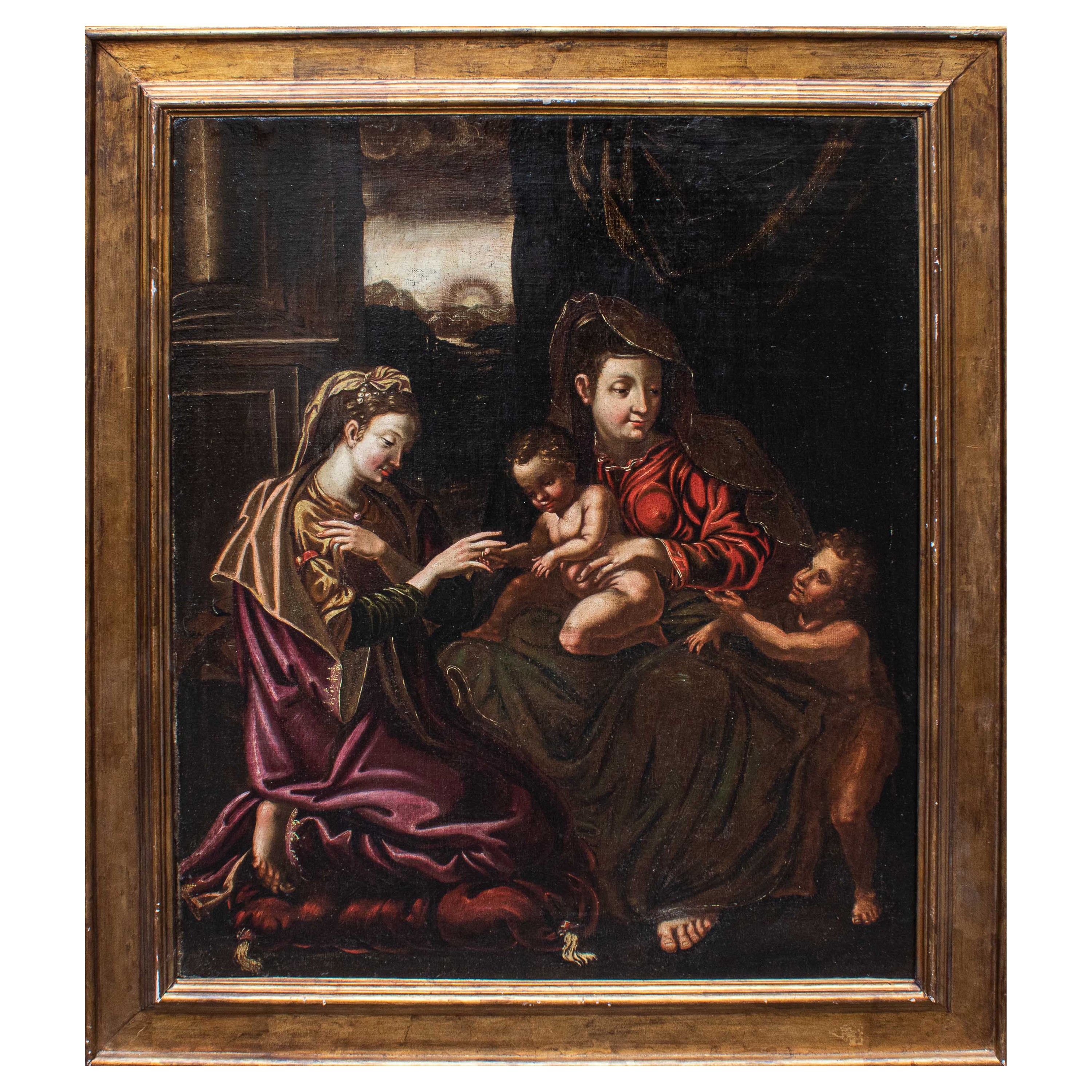
The work in question depicts the episode of the flight into Egypt of the Holy Family, one of the most loved and represented sacred episodes by painters over the centuries, despite the fact that the Gospel of Matthew dedicates very few references to it (Mt 2, vv. 13-15 ). On the other hand, the narratives on this subject contained in the apocryphal Gospels are more extensive, generous in details and anecdotes otherwise not foreseen (Historia monachorum in Aegypto; Arab-Syriac Gospel of Childhood; Pseudo Gospel of Matthew). The episode takes place chronologically in the first year of Christ's life, when King Herod threatens to kill all the firstborn; the Holy Family is thus forced to move, traveling across the Sinai desert to the city of Heliopolis. In the interpretation of the story, the artists usually distinguish two moments, a dynamic one, that is the real escape, with the Madonna on the back of a mule, and a more static one, as in the case in question, a pause on the way, a tender moment and intimate that is chosen both in painting and in sculpture to represent the feeling that pervades the scene and in this way approach the viewer.
Given the style and the chromatic composition, this is to be referred to a painter of the Emilian School of the seventeenth century, familiar with the painting of Girolamo Francesco Maria Mazzola known as Parmigianino (Parma, 11 January 1503 - Casalmaggiore, 24 August 1540), as shown by the elongated and slender shapes of the child and the Virgin. A comparison can be made with the Madonna and Child with San Giovannino from the Capodimonte Museum in Naples, the Madonna with Child from the Doria Gallery in Rome and with Il Riposo during the flight into Egypt by an anonymous Emilian from the National Gallery of Parma.
- Similar to:Parmigianino (Painter)
- Dimensions:Height: 22.05 in (56 cm)Width: 19.3 in (49 cm)Depth: 1.97 in (5 cm)
- Materials and Techniques:
- Place of Origin:
- Period:
- Date of Manufacture:17th Century
- Condition:Refinished. Wear consistent with age and use. The painting has been cleaned.
- Seller Location:Milan, IT
- Reference Number:1stDibs: LU5918229190572
About the Seller
5.0
Vetted Professional Seller
Every seller passes strict standards for authenticity and reliability
Established in 2000
1stDibs seller since 2021
30 sales on 1stDibs
- ShippingRetrieving quote...Shipping from: Milan, Italy
- Return Policy
More From This Seller
View All17th Century Rest on The Flight to Egypt Emilian school Painting Oil on Canvas
Located in Milan, IT
17th century, Emilian school
Rest on the flight to Egypt
Oil on canvas, 42 x 33 cm
Frame 65 x 55 cm
The present Holy Family, ...
Category
Antique 17th Century Italian Paintings
Materials
Canvas
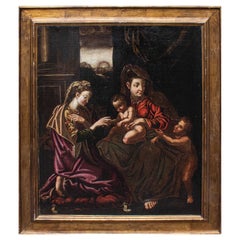
17th Century Mystical Marriage of Saint Catherine Painting Oil on Canvas
Located in Milan, IT
17th century
Mystical marriage of Saint Catherine
Measures: Oil on canvas, 98 x 81 cm - with frame 119 x 102 cm
The scene represents the mystical marriage between Catherine of A...
Category
Antique 17th Century Italian Paintings
Materials
Canvas
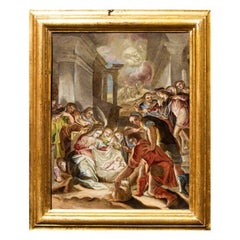
16th Century Adoration of The Shepherds Painting Oil on Copper
Located in Milan, IT
Attr. to Girolamo Siciolante known as da Sermoneta (Sermoneta, 1521 - Rome, 1575)
Adoration of the Shepherds
Oil on copper, 39 x 29.5 cm
Frame 47 x 39 cm
The refined taste, the refined poses, the definition of the anatomies, the vibrant light, allow us to identify for this painting the hand of a Mannerist painter active during the sixteenth century. In particular, the composition and stylistic research allow us to attribute the panel to Girolamo Siciolante, known as da Sermoneta (1521 - 1575). His first training took place under the guidance of Leonardo Grazia known as da Pistoia (1502 - 1548). Later he settled in Rome where he was able to see the painting of Raphael and Michelangelo from life and where he was first a pupil and then a collaborator of Perin del Vaga...
Category
Antique 16th Century Italian Paintings
Materials
Copper
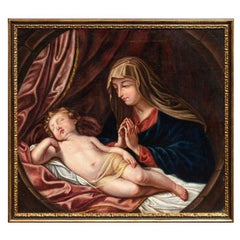
1848 Madonna Adoring The Sleeping Child Painting Oil on Canvas by Adele Pinot
By Guido Reni
Located in Milan, IT
Adele Pinot (1848), by Guido Reni (Bologna, 1575 - 1642)
Madonna Adoring the Sleeping Child
Oil on canvas, 97 x 107 cm
Signed lower right "Adele Pinot 1848"
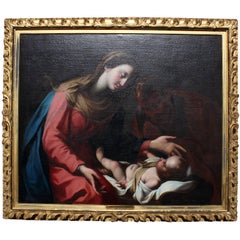
The canvas examined depicts the Madonna and Child, caught in a moment of great tenderness and intimacy. Wrapped in a brilliant luminosity, the little Jesus is depicted in the foreground comfortably lying on some soft drapes. The face appears peacefully asleep and is framed by blond curls; the complexion is white and the legs, just curled up and slightly bent at the knee, help to accentuate the naturalness and sweetness of the composition. Full of tenderness and maternal love, the figure of the Madonna appears, with delicate features and a head covered by a veil, which, placed at three quarters, is totally attracted to the contemplation of her little son. The high quality that can be found in the execution of the figures is also emphasized in the rendering of the soft drapery and in the careful attention to detail.
The work, created in 1848 by the French artist Adele Pinot, re-elaborates the famous Madonna in adoration of the Child by Guido Reni (Bologna, 1575 - 1642) now preserved in the Doria Pamphilj...
Category
Antique 19th Century Italian Baroque Revival Paintings
Materials
Canvas
17th Century Mystical Marriage of Saint Catherine Oli on Canvas Roman School
Located in Milan, IT
17th century, Roman School
Mystical marriage of Saint Catherine of Alexandria
Oil on canvas, 32 x 23 cm
Frame cm 45 x 36
The saint is depicted in front of the Virgin holding the Child portrayed with the wedding ring in his hand, enriched with a precious stone. According to the Golden Legend, Catherine of Alexandria was a very beautiful young woman, the only daughter of the king of Costa, who had refused to marry the emperor Maxentius because she was a Christian and devoted to Christ. Maxentius, unable to convince her to sacrifice to idols, had sent to call the wisest men and fifty philosophers and orators who presented themselves and tried to divert her from faith in Christ. Catherine, however, played so well that she was able to convert them, arousing the anger of the emperor who condemned them to the stake. Catherine, however, who had criticized Maxentius for the new persecutions against the Christians, was sentenced to prison without food. Abandoned for twelve days, she was fed by a dove sent by God. Maxentius then decided to execute her with the torture of the toothed wheel become her attribute iconographic; but by divine intervention this broke and the young was saved. Finally, she was beheaded and milk flowed from her neck. Catherine’s princely status is witnessed here by her sumptuous dress. The iconography of the mystical marriage was born in the fifteenth century, probably because the traditional iconographic attribute, the wheel, was sometimes so small as to look like a ring, and refers to a vision that will always remain present in the mind and heart of the saint. In Heaven she appeared to her, among the Angels and Saints, Christ the Child, in the arms of the Virgin. He took a precious ring that the Virgin Mary handed to her and put it in her finger, saying "I, your Creator and Saviour, take you in marriage; confident that you will keep you pure until you celebrate your eternal wedding with me, in Paradise" When Catherine was laughing, she found in her finger the same ring that she had seen and had in Heaven, and she considered herself forever the bride of Christ.
In this extraordinary episode we can see the heart of Catherine’s religious sense, and of all her spirituality. For her, Christ is like the bridegroom, with whom there is a relationship of intimacy, communion and fidelity; he is the beloved, whom she loves above all...
Category
Antique 17th Century Italian Decorative Art
Materials
Canvas
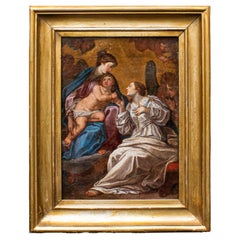
16th Century Adoration of the Shepherds Painting Oil on Copper by Carnevale
By Carnevale Studio
Located in Milan, IT
Domenico Carnevale (Sassuolo, 1524 - Modena, 1579) Adoration of the Shepherds
Oil on copper, 42 x 28 cm
Frame 54 x 36 cm
Expert opinion of Prof. Emilio Negro
The painting represents the Adoration of the Shepherds, the Child in the center, next to the Madonna kneeling in prayer and an angel behind her; towards him in the foreground a woman with a child in her arms, a shepherd with a sheep on the right, a bagpiper on the left and various other male and female characters turn to him. The architectures of the background, between which a glimpse of the landscape can be glimpsed, are hidden in the upper part by the clouds, where a "celestial glory" encamps with three flying angels.
The painting shows mannerist characters that can be traced back to the second half of the sixteenth century, and can be traced back to an author from the Modena area, with stylistic references to the Bolognese Samacchini (1532 - 1577) and Passerotti (1529 - 1592). More precisely, it can be attributed to Domenico Carnevale (1524-1579), one of the most important masters of the sixteenth century active in the local area. The Carnival was formed in Emilia, his homeland, where he worked for many years. However, his works also show a clear Roman influence, dictated by a long experience in the city, during which he also dedicated himself to the restoration of the Sistine Chapel. Trained in the late-mannerist environment of Modena, he is also linked to the Parmesan Corrorese and Ferrarese Dossesque tradition; Carnival also always maintains a slight archaic sentiment in his work,
The main stylistic reference must be identified in a work similar in subject and iconographic setting, coming from the church of the Pio Istituto Orfanelle di San Geminiano di Modena, currently part of the Art Collection of the Province, attributed to the same influence as the Carnival. Another interesting comparison should be identified with A Presentation of Jesus in the Temple...
Category
Antique 16th Century Italian Paintings
Materials
Copper
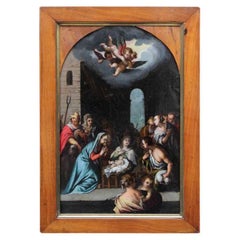
You May Also Like
16th Century Oil on Canvas Tuscan School Antique Religious Painting Holy Family
Located in Vicoforte, Piedmont
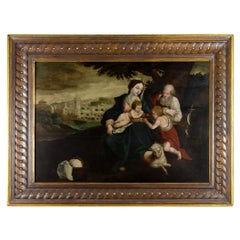
Great Italian painting from the second half of the 16th century. Oil on canvas painting depicting a Holy Family from the Tuscan school of remarkable pictorial quality. We find the typical stylistic features of the Renaissance with a wonderful pyramidal composition, a refined chromatic palette and particular attention to the drapery. In the center is the Madonna with the baby Jesus in her arms who reaches out toward Saint John the Baptist with a lamb at his side, a symbol of Christ's sacrifice. At the top left we see Saint Joseph sleeping...
Category
Antique 16th Century Italian Paintings
Materials
Canvas
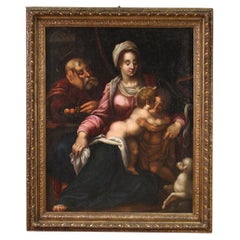
Religious Oil Painting on Canvas, Holy Family, 18th Century Italian School
Located in Casale Monferrato, IT
We are pleased to present this 18th-century Italian school oil on canvas. A splendid religious painting that sensitively depicts the Holy Family.
The Holy Family was a very common d...
Category
Antique 18th Century Italian Paintings
Materials
Canvas
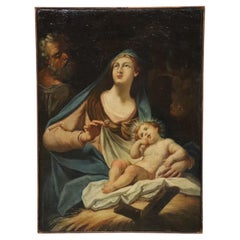
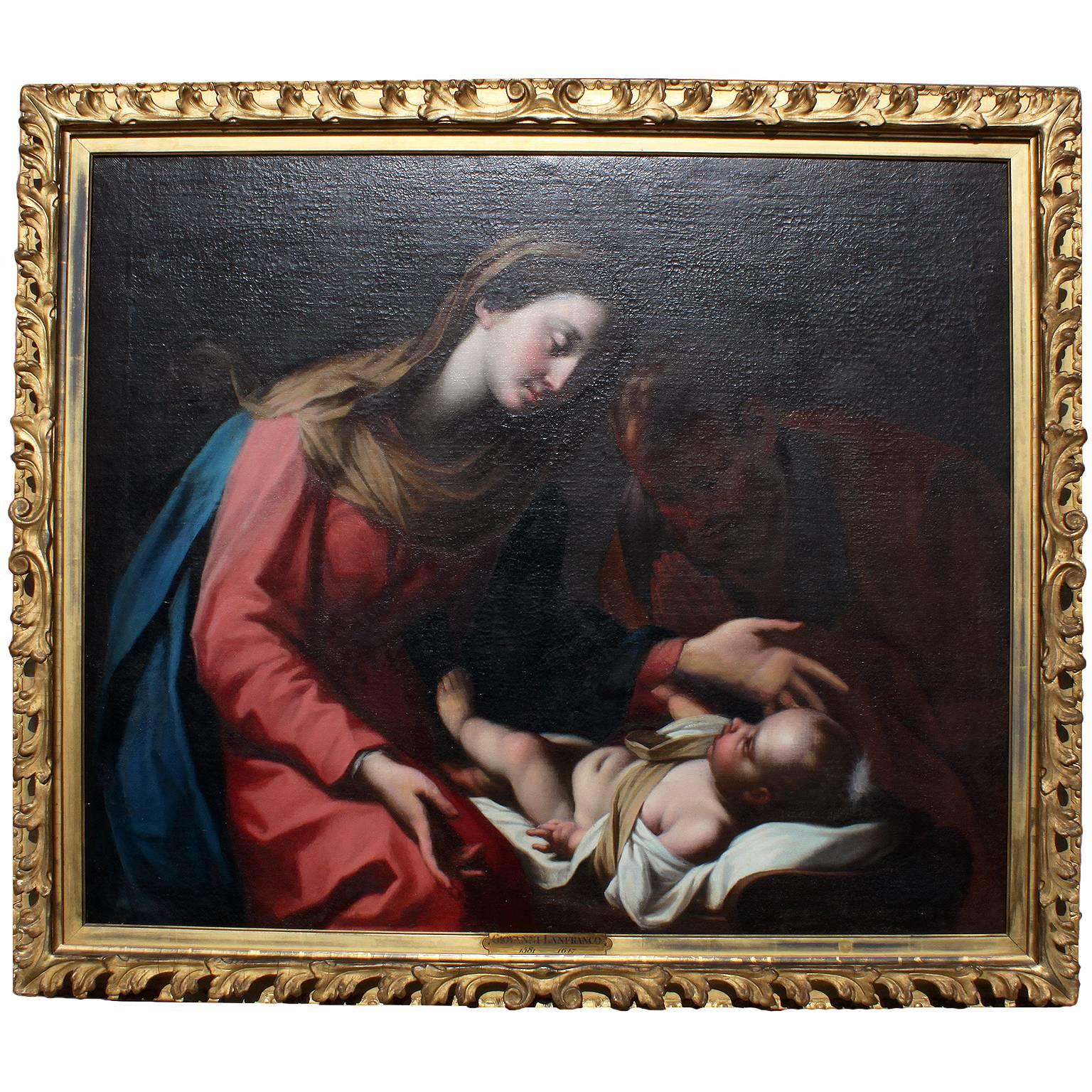
Italian 18th Century Oil on Canvas "Madonna and Child" after Giovanni Lanfranco
By Giovanni Lanfranco
Located in Los Angeles, CA
A very fine Italian 18th century oil on canvas "Madonna and Child" after Giovanni Lanfranco (Italian, 1582-1647). The young Virgin Mary attending to...
Category
Antique 18th Century Italian Baroque Paintings
Materials
Canvas, Giltwood
$19,850 Sale Price
39% Off
17th Century Holy Family St John The Baptist Religious, Panel Painting
Located in Lisbon, PT
This Flemish panel painting, dated circa 1620, masterfully depicts the Holy Family and young Saint John the Baptist.
A Flemish School altarpiece work of art, a masterfully achieved ...
Category
Antique 17th Century Italian Renaissance Paintings
Materials
Wood
$29,318 Sale Price
20% Off
17th Century Original Oil on Canvas Painting of The Flight Into Egypt
Located in Round Top, TX
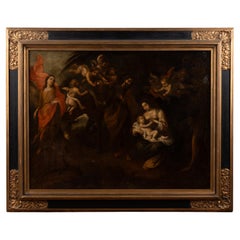
Original oil on canvas painting of The Flight into Egypt with Mary and Christ child.
Spanish School, Seville, 17th Century.
Relined canvas. Age related craquelure throughout. Painti...
Category
Antique Late 17th Century Spanish Paintings
Materials
Canvas, Wood, Paint
Oil on canvas of the Holy Family with the Child Jesus, Spanish School, 18th–19th
By Central School of Arts
Crafts
Located in Madrid, ES
Oil on canvas of the Holy Family with the Child Jesus, Spanish School, 18th–19th century
Medium-sized oil on canvas (approx. 60 cm), depicting the Virgin Mary and Saint Joseph holdi...
Category
Antique Late 18th Century Spanish Baroque Paintings
Materials
Paint