Items Similar to 18th Century, Italian Baroque Painting St Jerome penitent by Antonio Zanchi
Want more images or videos?
Request additional images or videos from the seller
1 of 17
18th Century, Italian Baroque Painting St Jerome penitent by Antonio Zanchi
$42,667.46
£31,605.20
€35,500
CA$58,367.60
A$63,617.70
CHF 33,634.12
MX$765,836.41
NOK 426,900.79
SEK 391,380.76
DKK 270,490.39
About the Item
Antonio Zanchi (Este, 6 December 1631 – Venice, 12 April 1722)
St. Jerome Penitent
Dimensions: canvas W 73 × H 92 cm; frame W 96 × H 115 × D 6 cm
The painting depicts St. Jerome as a penitent, a subject widely explored in Venetian Baroque painting and particularly suited to the poetics of Antonio Zanchi (1631–1722), master of lagoon tenebrism.
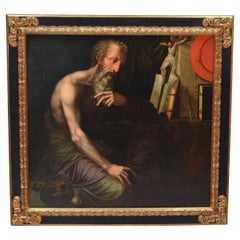
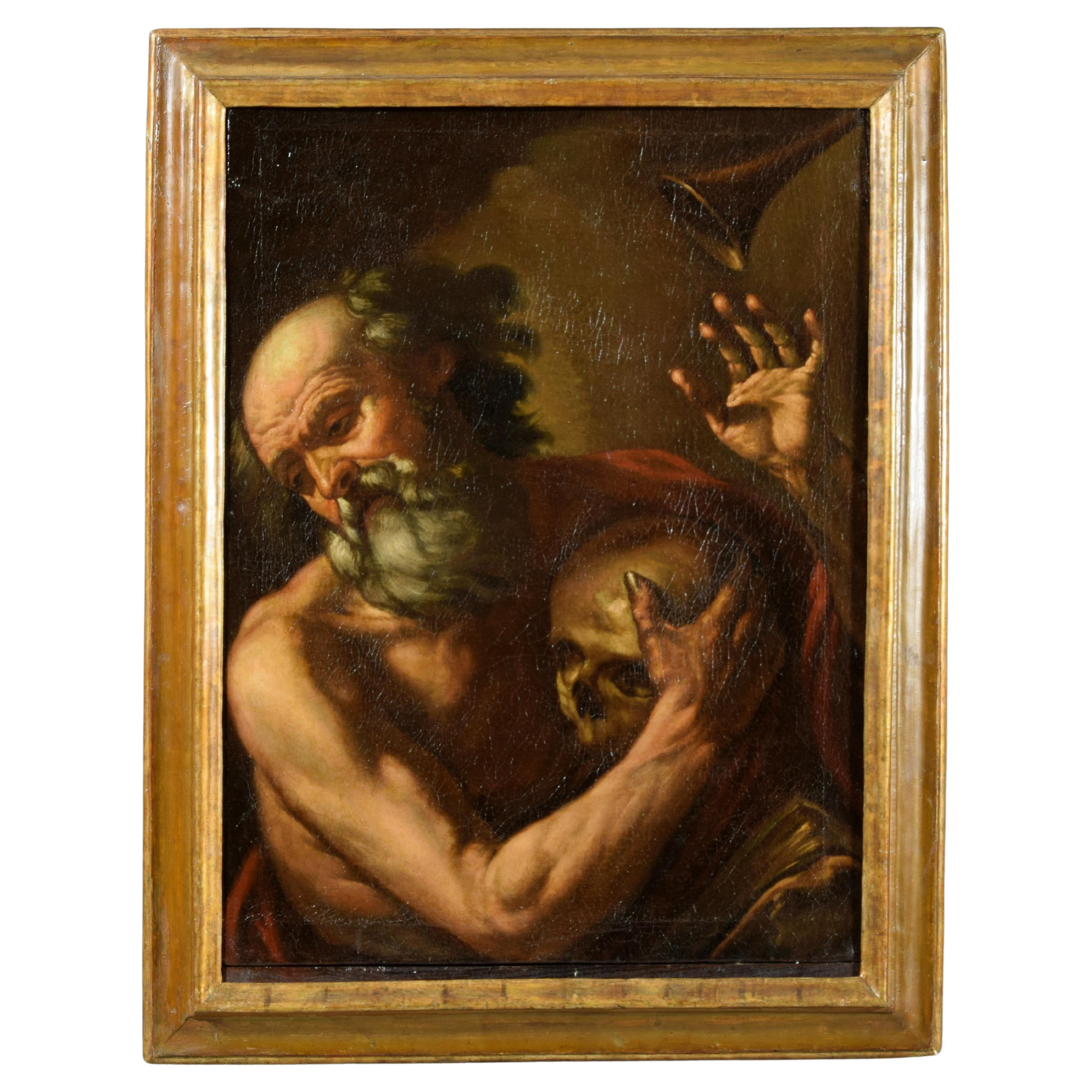
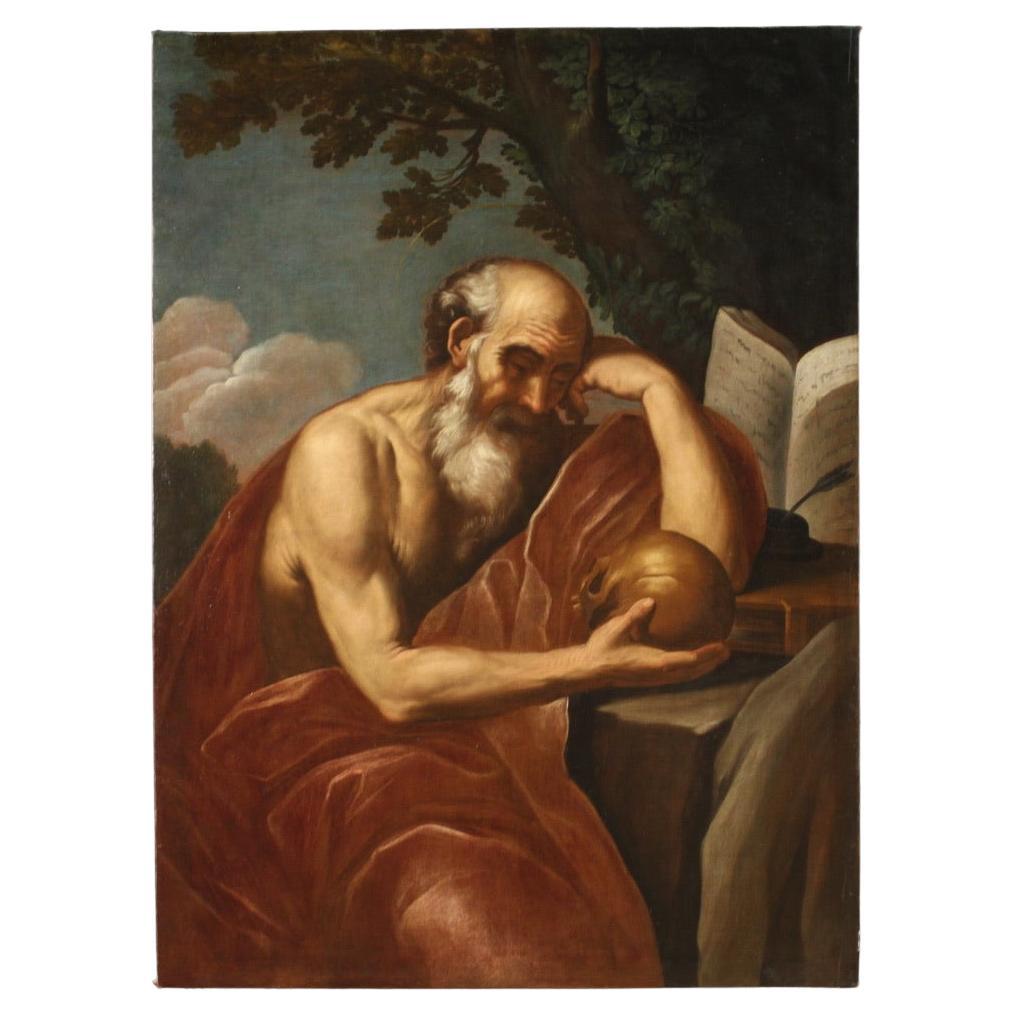
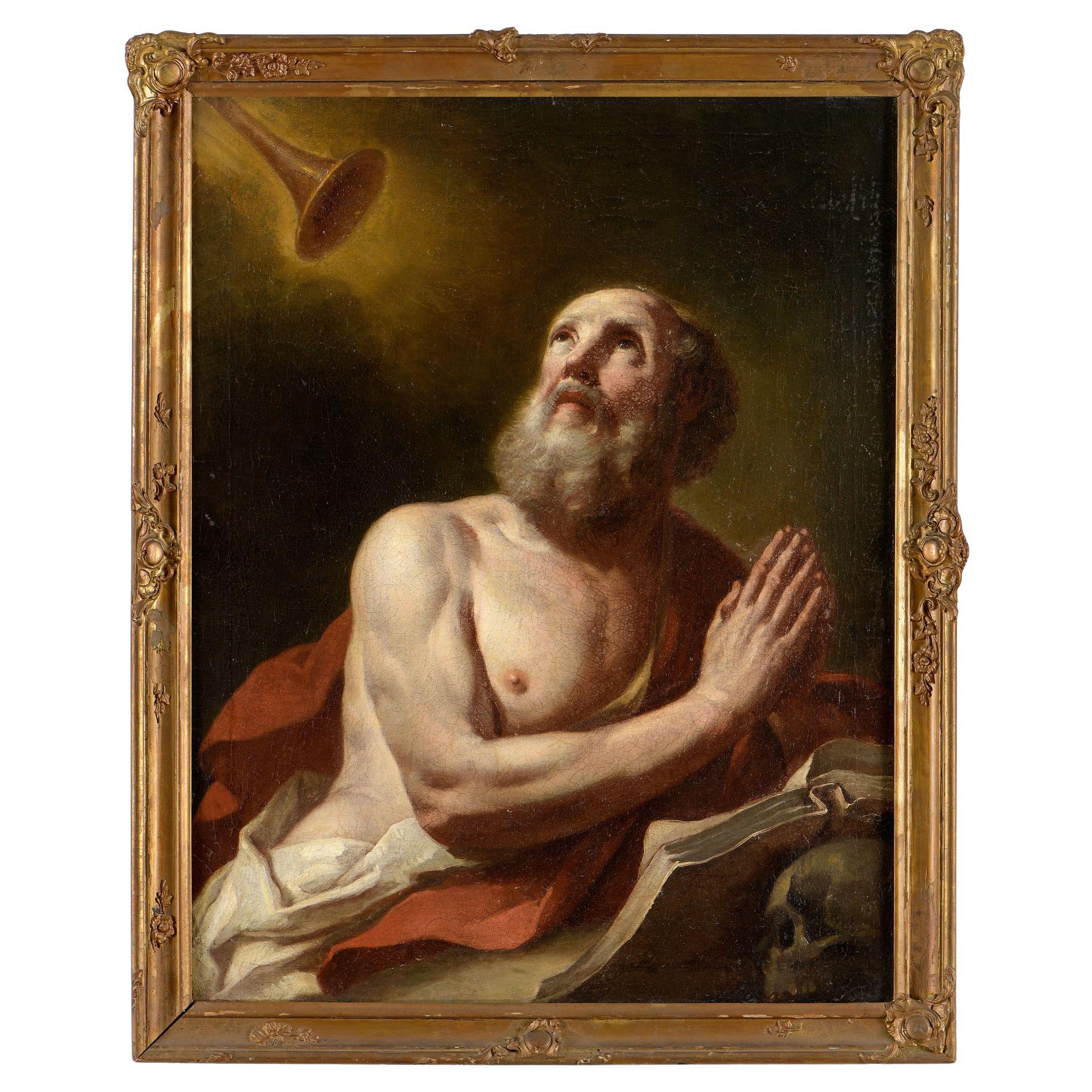
The composition presents the saint in a half-length figure, bare-chested, immersed in a dense chiaroscuro atmosphere. The traditional iconography associated with St. Jerome is confirmed here through the customary symbols of his meditation: a skull, a book bound in leather, and a crucifix. The saint is shown as a hermit, semi-nude, covered with a red mantle richly draped, aged and with a long white beard. His rugged, time-worn face is turned downward, with an absorbed and meditative expression.
Several iconographies of St. Jerome relate to episodes from his life. Among these, the depiction of the saint in meditation, in penance, or intent on study is particularly widespread. The book alludes to his numerous exegetical writings and to the Vulgate. The skull is a symbol of Vanitas, the transience of human life and meditation on death. The red cardinal’s mantle refers to the widespread medieval—yet erroneous—belief, perpetuated by the Legenda Aurea (The Golden Legend), that Jerome was a cardinal because he served as secretary to Pope Damasus; thus, the cardinal’s robe entered his iconography.
Returning to the work under study, the dark background accentuates the saint’s virile physique, marked by time and penance, with intensified muscular rendering, focusing the light on his arms, head, and symbolic objects. The brushwork is swift and vigorous, dense in the more illuminated areas. Furthermore, the oblique lighting, the somber atmosphere, and the plastic anatomical treatment of the figure show clear affinities with authenticated works by Zanchi. His pictorial language, management of chiaroscuro, the intense emotional expressiveness of his figures, the compositional setup, and the iconographic typology are fully consistent with the oeuvre of the master—one of the protagonists of 17th-century Venetian painting, known especially for his dark tones and theatrical figures.
His skill in rendering flesh and his effective handling of chiaroscuro provide a significant example of Zanchi’s “tenebrism” and pathetic style. His persistent use of vehement light-and-shadow contrasts and colors of melancholic tone contributed greatly to his success among his contemporaries.
Antonio Zanchi moved to Venice at a young age and found there the ideal environment to develop a poetics grounded in strong chiaroscuro contrasts, in tune with the research of the so-called tenebrosi and the Caravaggesque influences filtered through local tradition. His rise occurred in the 1660s, when he received important public and confraternal commissions. In the following years, Zanchi became one of the most sought-after painters in Venice and the Veneto. His works also spread to Padua, Treviso, Rovigo, Verona, Vicenza, Loreto, Brescia, Milan, Bergamo, and even Bavaria, thanks to both public and private patronage that appreciated his vigorous style.
Zanchi died in Venice on 12 April 1722, leaving behind a vast and coherent corpus fundamental for understanding the evolution of 17th-century Venetian painting.
The St. Jerome examined here appears consistent with Zanchi’s mature phase, when tenebrism chiaroscuro remained central and the artist pursued strong volumetric investigation of figures, with muscular bodies and well-defined anatomy.
Of particular technical-stylistic interest is the comparison with a canvas depicting The Death of Socrates, which appeared on the art market a few years ago. In both works, the artist uses a single, assured, and fluid brushstroke to define the vein on the hand, rendered in a subtle blue-grey tone.
In conclusion, in light of the stylistic, technical, and comparative analysis conducted, the painting depicting St. Jerome can be attributed to Antonio Zanchi’s mature hand. The solidity of the light construction, the controlled drama of the scene, the quality of the painterly material, and the precise affinities with authenticated works attest to an expert and fully self-aware hand, typical of Zanchi’s production at the height of his maturity.
The painting therefore stands as a significant and coherent contribution to the artist’s catalogue, confirming the expressive hallmark and emotional depth that characterise his finest works.
The work is presented in an oval carved and gilded wooden frame of Emilian origin dating to the 17th century. The state of preservation of the pictorial surface is good; a few small scattered retouching are visible, the result of a conservative restoration. The painting has also been relined and re-stretched in modern times.
We apologize for any errors in the translation from Italian.
Please contact us to receive the expertise in Italian.
- Dimensions:Height: 45.28 in (115 cm)Width: 37.8 in (96 cm)Depth: 2.37 in (6 cm)
- Style:Baroque (Of the Period)
- Materials and Techniques:
- Place of Origin:
- Period:
- Date of Manufacture:Early 18th Century
- Condition:Wear consistent with age and use. The state of preservation of the pictorial surface is good; a few small scattered retouching are visible, the result of a conservative restoration. The painting has also been relined and re-stretched in modern times.
- Seller Location:IT
- Reference Number:1stDibs: LU4405247699822
About the Seller
5.0
Vetted Professional Seller
Every seller passes strict standards for authenticity and reliability
Established in 1980
1stDibs seller since 2019
57 sales on 1stDibs
Typical response time: <1 hour
- ShippingRetrieving quote...Shipping from: Italy
- Return Policy
More From This Seller
View All17th Century, Italian Painting Saint Jerome Hears the Trumpet of Judgment
Located in IT
Saint Jerome Hears the Trumpet of Judgment, Neapolitan School, 17th Century
This exquisite oil-on-canvas painting depicts Saint Jerome hearing the trumpet of the angel of the Last Ju...
Category
Antique 17th Century Italian Baroque Paintings
Materials
Canvas
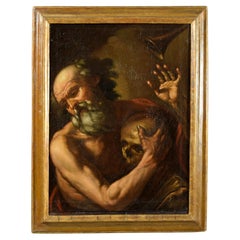
18th Century, Italian painting with Saint Nicholas and the miracle of the brick
Located in IT
18th Century, Italian painting with Saint Nicholas and the miracle of the brick
Oil on canvas; Frame cm H 136 x W 109 x D 10. Canvas cm H 100 x W 74
The oil on canvas painting, with...
Category
Antique 18th Century Italian Baroque Paintings
Materials
Canvas
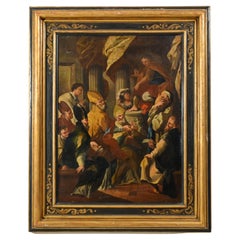
18th Century, Italian painting with Sacred Heart of the Child Jesus by Pietro Ba
By Pietro Bardellino
Located in IT
Pietro Bardellino (Italy - Naples, 1732 - 1806), attr., Sacred Heart of the Child Jesus
Measurements: with frame, cm L 86 x H 99 x P 8; only the canvas, cm L 78 x H 64
The painting, made in oil on canvas, represents the Sacred Heart of the Child Jesus. Stylistically the work is attributable to Pietro Bardellino (Italy, Naples, 1732 - Naples, 1806), a pupil of Francesco De Mura and considered by critics one of the most gifted and sensitive exponents of the Rococo style in Naples.
The canvas represents the Child Jesus, surrounded by flowers in an outdoor setting, while showing the sacred heart. The canvas has a well-balanced color and a strong sweetness of the child’s traits, which with the complicit gesture of the right hand, involves the viewer in the intimate and delicate sharing of the garden in which he sits. The roses, in addition to being a beautiful piece of still life, contribute to enrich the Christological message, being bearers of symbolic meanings. Marian attributes par excellence, are often side by side with Christ, whose thorns foreshadow the Passion. In the canvas, on the top left, two cherubim are observed: among them, according to the Old Testament, is God: the author therefore puts into place an iconographic and iconological hyperbole that amplifies its meaning. The iconographic theme of the Child Jesus with the Sacred Heart in his hand spread between the second half of the eighteenth century and the first of the following century. With the worship of the Sacred Heart of Jesus, the Catholic Church intends to honour the Heart of Jesus Christ, one of the organs symbolizing his humanity, which by intimate union with the Divinity, has the right to worship and love of the Saviour for men, of which His Heart is the symbol. It represents one of the fundamental devotions of Christian life, as it manifests the true face of God, who is prodigal and boundless love. It was the French mystic Saint Margaret Mary Alacoque...
Category
Antique Mid-18th Century Italian Baroque Paintings
Materials
Canvas
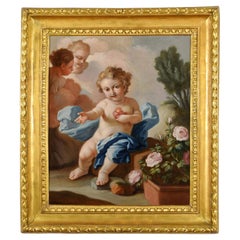
17th Century, Italian Painting by Pier Francesco Cittadini, Jacob and his Family
Located in IT
Pier Francesco Cittadini (Milan, 1616-Bologna, 1681)
"Jacob and his family go to Egypt"
Oil on canvas, cm 109 x 190 (canvas only)
The valuable painting, made in oil on canvas, depicts Jacob and his family go to Egypt and we believe it can be, given the high quality painting, autograph work of Italian Pier Francesco Cittadini (Italy Milan, 1616 - Bologna, 1681) made after 1647. The work, in excellent condition is accompanied by a coeval frame in wood finely carved and golden.
The scene depicted, which was confused with the Flight to Egypt in the past years, is instead identified with the biblical episode of Jacob’s journey. In the foreground, reading the painting from left to right, we see a caravan composed of animals, including donkeys, dromedaries, goats, dogs and horses and people, women, men and slaves, who carry on their journey along the banks of a river, following a path that to the right, would seem to lead to the through of a bridge. In addition to the watercourse is described an environment characterized by large rocks and impervious come far to cover the entire verticality of the canvas. On the left, in the distance, we see the tail of the caravan that runs along the steep path. Large trees enliven and harmonize the environment, as well as white and grey clouds characterize the predominantly clear sky and illuminated on the right by sunlight.
The story is told in the Bible, Book of Genesis, 30, 25, passage in which is described the flight of Jacob from Haran after the contrasts with Laban, father of his wife Rachel. Jacob is the third great patriarch of the Bible. From his descendants originate the twelve generations of the people of Israel. He is the son of Isaac and Rebekah, who led him to flee from the wrath of Esau to Haran to seek refuge from his brother, Laban. At his uncle’s house Jacob met his daughter Rachel. As soon as he saw his cousin, Jacob was taken. Jacob will stay seven years in the service of Laban to marry his beloved Rachel. But Laban, with a deception, will give him in marriage first Lia, the least beautiful eldest daughter, and only after another seven years the splendid Rachel. From his first wife he will have several children, while Rachel will give birth to the beloved son, Joseph, who will become viceroy of Egypt.
After years of service, Jacob asked to be paid with every dark-coloured garment among the sheep and every spotted and dotted garment among the goats. Laban accepted and sent away from his sons all the leaders of that kind. So Jacob took fresh branches of poplar, almond and plane tree, and flayed them, and put them in the troughs. The optical suggestion induced the goats and the sheep to conceive and give birth to dark, striped and dotted garments. He also ensured that all the strongest and healthiest leaders of the flock of Laban would drink near the barked branches, thus assuring a genetic superiority to his part of the flock. His flocks grew numerous and strong and he became richer than his relative, arousing envy. It was clear that Laban would not respect him much longer. At the suggestion of the Lord, Jacob decided to return to Canaan. Trying to avoid any possible dispute, he left with his family while Laban was absent for shearing sheep. But when, three days later, his uncle returned home, he became angry, feeling offended because Jacob had gone secretly and had not allowed him to greet his daughters and grandchildren. In addition, his teraphim, statuettes, or idols, which depicted the family deities, had disappeared. After 7 days of pursuit, Laban and his men reached Jacob’s group on Mount Gilead, in the mountainous region west of the Euphrates River, where his uncle and grandson had a stormy conversation. The younger man was outraged at being accused of stealing idols and told Labano to rummage through his family’s tents at will. Neither of them could know or even imagine that it was Rachel who took the idols and hid them in the saddle of the camel. During the search, she sat down firmly on the saddle, apologizing for not being able to get up, «because I usually have what happens to women» (Gen 31:35). So the loot wasn’t discovered.
The author of this work was inspired by the composition of an engraving by Stefano Della Bella (1610-1664) of circa 1647. The engraving by Stefano della Bella bears the title "Iacob sur ses vieux jours quitte sans fascherie pour voir son filz Ioseph, sa terre et sa patrie" and is signed on the bottom left "Stef. of the Beautiful In. et fe." while on the right it is declared "Cum privil. Regis", that is with license of the king.
Stefano Della Bella (Italy - Florence, May 18, 1610-Florence, July 12, 1664) was born in a family of painters, sculptors and goldsmiths and was left early orphan of his father sculptor, he dedicated himself first to the art of goldsmith at the school of Giovanni Benedetto Castiglione and Gasparo Mola, then turning his attention to drawing and engraving. He soon began drawing figures and copying the etchings of Jacques Callot, which inspired his early works. Under the protection of the Medici, in particular of Don Lorenzo, cadet son of Grand Duke Ferdinand I, Della Bella has the opportunity to make study trips to Rome, where he stayed from 1633-1636; In Rome he met French engravers and publishers of prints such as Israël Henriet and François Langlois, who influenced his decision to move to Paris in 1639, four years after the death of Callot. In Paris he soon reached, thanks to the engravings commissioned by Cardinal Richelieu, the success also worldly; he frequented courtiers, theatre artists and writers, while refusing too oppressive honors. In 1646-1647 he continued his travels in the Netherlands to Amsterdam, Antwerp and Dordrecht. He returned to Florence in 1650 and resumed working under the protection of the Medici court, working for his patrons. In 1656 he became a member of the Academy of Apatists.
The painting object of this study is reasonably attributable to Pier Francesco Cittadini, or Pierfrancesco Cittadini, called the Milanese or the Franceschino (Italy - Milan, 1616-Bologna, 1681) as some exemplary stylistic comparisons proposed to follow can prove.
Pier Francesco Cittadini was an Italian baroque painter, mainly active in Bologna.
His artistic training first took place with the painter Daniele Crespi...
Category
Antique Mid-17th Century European Baroque Paintings
Materials
Canvas, Giltwood
18th Century, Italian Painting Still Life by Giovanni Paolo Castelli Lo Spadino
Located in IT
Giovanni Paolo Castelli, known as "Lo Spadino" (Rome 1659 – around 1730)
Still Life with a Composition of Fruit
Dimensions: frame cm L 76.5 x H 61 x D 6.5. Canvas cm L 55.5 x H 40
Th...
Category
Antique Early 18th Century Italian Baroque Paintings
Materials
Canvas, Wood
18th Century, Italian Still Life Painting Attributed to Francesco Lavagna
By Francesco Lavagna
Located in IT
Francesco Lavagna (Italy -Naples 1684-1724)
"Still life with flowers and watermelon and hermas with garden in the background"
The painting, beautifully made and in good condition, d...
Category
Antique Early 18th Century Italian Baroque Paintings
Materials
Canvas
You May Also Like
17th Century Oil on Canvas Italian Religious Painting Saint Jerome in Meditation
Located in Vicoforte, Piedmont
Italian painting from the second half of the 17th century. The painting, oil on canvas, is an interesting ancient replica of a very famous composition by Guido Reni depicting Saint J...
Category
Antique 1670s Italian Paintings
Materials
Canvas

Amazing Flemish Master 17th Century "Saint Jerome"
Located in Madrid, ES
Amazing Flemish Master 17th Century "Saint Jerome"
Oil/canvas/double,
82 x 64 cm.
good condition
Category
Antique Early 17th Century Dutch Baroque Paintings
Materials
Paint
St. Jerome Religious Painting, circa 19th Century
Located in London, GB
Late 19th century painting of St. Jerome with halo and skull.
A well painted canvas in original gilt frame generally in good condition.
Some losses to the frame and small nic...
Category
Antique 19th Century British Gothic Paintings
Materials
Canvas
17th Century Oil on Canvas Flemish Religious Painting Saint Jerome in his Study
Located in Vicoforte, Piedmont
Flemish painting from the first half of the 17th century. Oil on canvas artwork depicting a religious subject of great charm, Saint Jerome in his study. He lived between the fourth a...
Category
Antique 1630s Dutch Paintings
Materials
Canvas
17th/18th century Flemish old master oil painting of Saint Jerome
Located in Long Island City, NY
17th/18th century Flemish old master painting of Saint Jerome in a landscape with objects. Oil on copper. Framed. Light inscription on reverse. Sight: 9 x 7in. Overall: 14 x 12in.
Co...
Category
Antique 17th Century Unknown Paintings
Materials
Copper
Saint Jerome. Oil on slatted panel. Surroundings of KEY, Willem. 16th century.
Located in Madrid, ES
Saint Jerome. Oil on slatted panel. Surroundings of KEY, Willem. 16th century.
With monogram (illegible) and dated (right ear of the saint).
Oil on oak panel showing a thin, elderl...
Category
Antique 16th Century European Renaissance Religious Items
Materials
Other