Items Similar to 19th century, from Sassoferrato, Madonna Orante
Want more images or videos?
Request additional images or videos from the seller
1 of 11
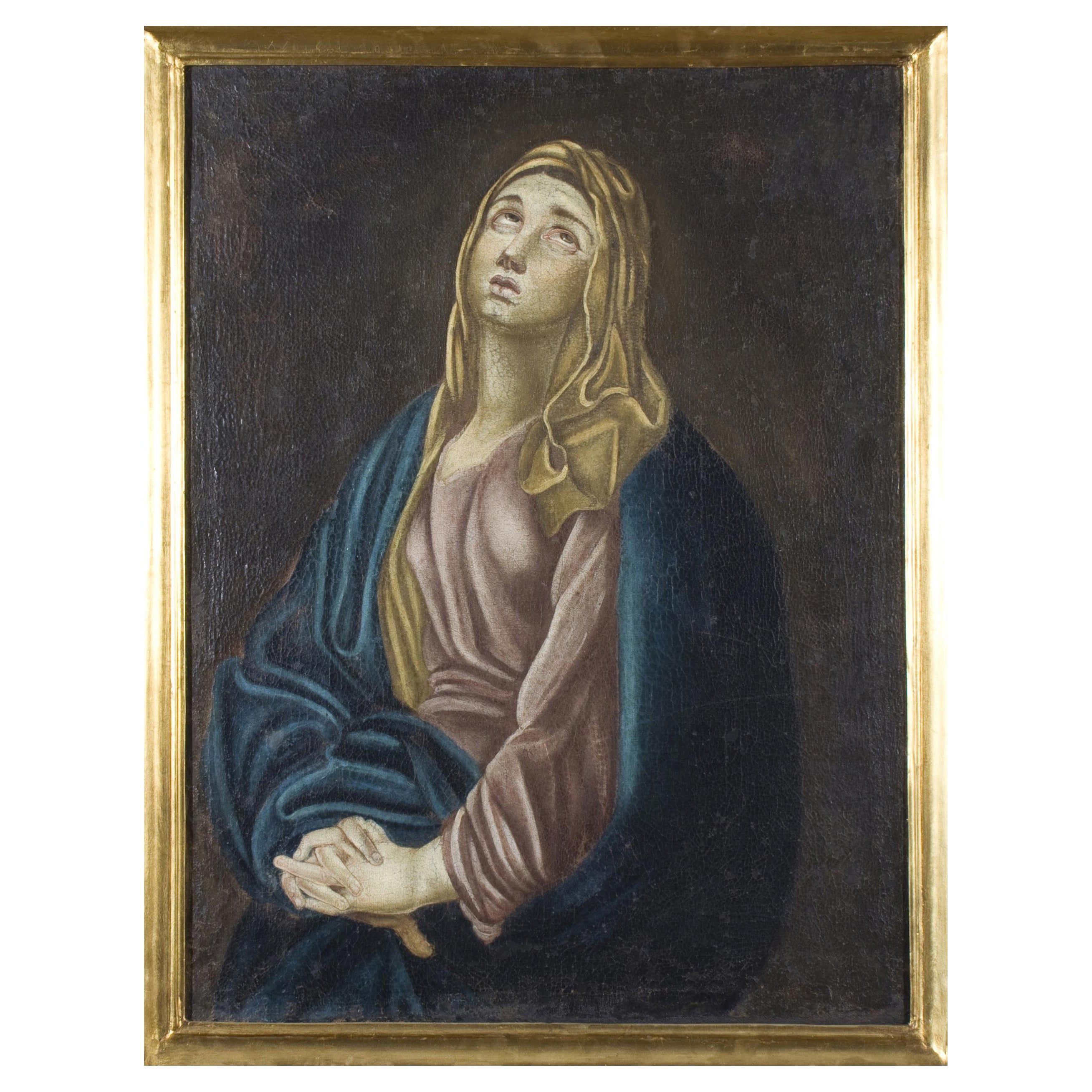
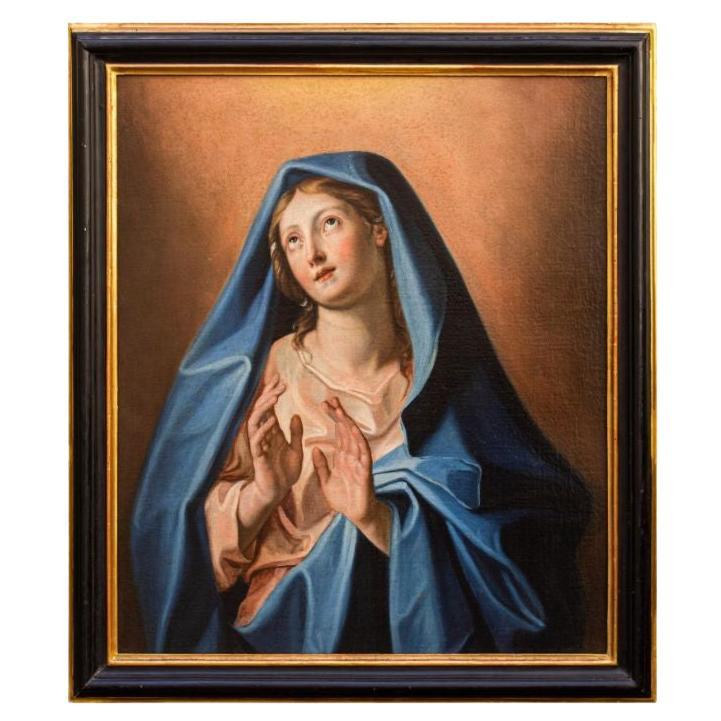
19th century, from Sassoferrato, Madonna Orante
$2,657.17
£1,974.34
€2,220
CA$3,639.77
A$3,970.79
CHF 2,106.03
MX$47,839.09
NOK 26,729.58
SEK 24,471.65
DKK 16,911.68
About the Item
19th century, by Giovanni Battista Salvi, known as Sassoferrato (Sassoferrato, 1609 - Rome, 1685)
Praying Madonna
Oil on canvas, 44 x 54 cm
Framed, 88 x 60 cm
Giovanni Battista Salvi, better known as Il Sassoferrato, named after his hometown in the Marche region of Italy, was a peculiar figure in the artistic landscape of seventeenth-century Italy. Born on August 25, 1609, he was distinguished by a style that, while set in the Baroque period, looked with deep reverence and admiration to Renaissance classicism, particularly the art of Raphael and Perugino. His artistic training began in the workshop of his father, Tarquinio Salvi, also a painter. Although precise information about his youth is scarce, it is plausible that he received a solid grounding in the Umbrian-Marchigiano environment, where the Renaissance tradition was still very much felt. Later, he moved to Rome, the pulsating center of art and culture of his time. Here, it is speculated that he had contact with masters of the time such as Domenichino and Guido Reni, while always maintaining his own strong stylistic independence. Sassoferrato specialized mainly in religious subjects, with a particular fondness for images of the Virgin Mary. His Madonne Oranti, often depicted in moments of deep devotion and contemplation, became his most recognizable stylistic signature. These works are characterized by extraordinary formal purity, an almost porcelain-like smoothness of surfaces, and meticulous attention to detail. The faces of his Madonnas are often idealized, with expressions of serene beauty and deep spirituality, evoking a sense of calm and transcendence. Unlike many of his Baroque contemporaries, who favored dynamism, theatricality, and drama, Il Sassoferrato pursued a more sober and contemplative beauty. His compositions are often simple and balanced, with a harmonious use of color and clear, diffuse light that enhances the figures. This stylistic choice of his, at times almost "anachronistic" for the seventeenth century, earned him both admiration and, in later eras, some criticism for an alleged lack of originality or inventiveness. Nevertheless, Il Sassoferrato enjoyed considerable success and his works were in high demand, especially by private and religious patrons eager for pious and reassuring images. Giovanni Battista Salvi died in Rome on August 8, 1685. His artistic legacy is significant for his ability to keep alive a classical tradition in an era dominated by the Baroque, offering an alternative of grace and devotion that has continued to fascinate and move for centuries.
Our painting constitutes a 19th-century version of Sassoferrato's well-known Madonna Orante preserved at the Galleria Colonna in Rome. Sassoferrato's visual fortunes in the nineteenth century were driven by several factors. At a time when spirituality and the search for transcendent values remained central to large sections of society, his praying Madonnas and sacred subjects perfectly embodied an ideal of pure and unaltered devotion. Their expressions of serene contemplation, the almost ethereal perfection of their complexions and the clarity of their colors responded to a desire for ideal beauty and spiritual reassurance, in contrast to the turbulence and rapid social changes of the time. Moreover, his adherence to a classicist language, albeit with restrained baroque influences, made him particularly appealing to the Neoclassical taste that dominated much of the early 19th century. The clarity of his compositions, formal balance and harmony of line were in keeping with the principles of order and reason advocated by this current. Although the Baroque had been overshadowed for long periods, Sassoferrato's exceptionalism and refinement positioned him outside the strictest classifications, allowing him to be appreciated even by those who sought a more restrained and sober beauty. Another key aspect was his prolific production of small works and copies, particularly of his famous Madonnas. These smaller-format works were easily accessible and spread widely among private collectors, both aristocrats and emerging bourgeois, and in churches. Their reproducibility and ability to immediately evoke a sense of piety made them ideal for domestic devotion and for decorating private rooms, helping to spread its iconography widely. His work was also extolled by critics and art historians who, in the context of a reevaluation of the Italian seventeenth century, were able to recognize in Sassoferrato an artist of refined sensitivity and deep faith. His ability to infuse sincere emotion and pristine beauty into his sacred subjects elevated him above many of his grander but perhaps less intimate contemporaries.
- Dimensions:Height: 21.66 in (55 cm)Width: 17.33 in (44 cm)Depth: 1.97 in (5 cm)
- Style:Other (In the Style Of)
- Materials and Techniques:Canvas,Oiled
- Place of Origin:
- Period:
- Date of Manufacture:19thC
- Condition:Wear consistent with age and use.
- Seller Location:Milan, IT
- Reference Number:1stDibs: LU5918245953202
About the Seller
5.0
Vetted Professional Seller
Every seller passes strict standards for authenticity and reliability
Established in 2000
1stDibs seller since 2021
30 sales on 1stDibs
- ShippingRetrieving quote...Shipping from: Milan, Italy
- Return Policy
More From This Seller
View AllEarly 17th Century Roman School Praying Madonna Painting Oil on Canvas
Located in Milan, IT
Roman school, late 16th-early 17th century Praying Madonna
Oil on canvas, 81 x 69 cm
Frame 83 x 95.5 cm
A divine whiteness reverberates with vibrant luster on the maphorion of the present Virgin. The palpable iridescence that structures the thin rosaceous garment, woven with the same fresh light, produces a slight rustle when she takes her hands off. The Madonna in fact takes a prayerful pose, opening her palms to underline her fervent ecstatic intention; the white neck is rendered with perishable fullness of pigments, like the hands, perfectly alive, and the very shiny eyes. With fine shrewdness the artist of the present styles the Virgin's hair with thin white ribbons, exacerbating the purity. An evocative light falls gently on the bust, a materialized sign of divine glory.
The present can be traced back to the late Mannerist climate that prevailed in the capital after the emanation of the Tridentine council (1545-1563). The late Mannerist licenses that can still be seen there, such as the intense lyricism in the stylistic code adopted by the artist, are innervated in the new basic catechetical intent, which at the end of the century produced a certain figurative rigorism. The present, however, still responds to that extraordinary Roman dynamism that raised the capital to a bulwark for the entire mannerist lesson, matched only by a second artistic center, the Florentine one. The engaging carriage of the Virgin reflects the contemporary examples of Giuseppe Valeriano (1542-1596), a Jesuit painter, returning in the Marriage of the Virgin of the Roman Church of Jesus, as well as in the Madonna of Sorrows in the Recanati Altarpiece, equal ardor. But it is in the Assumption of the Virgin painted in four hands with Scipione Pulzone...
Category
Antique Early 17th Century Italian Paintings
Materials
Canvas
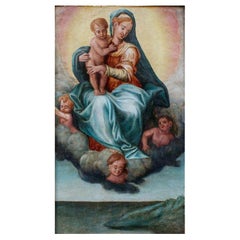
Emilian school, 18th century, Madonna and Child
Located in Milan, IT
Emilian school, 18th century
Madonna and Child
Oil on panel, 45 x 24.5 cm
Framed, 62 x 44 cm
This Madonnai Enthroned with Child fits into the context of the 16th-century Emilian...
Category
Antique 18th Century and Earlier Italian Other Paintings
Materials
Canvas
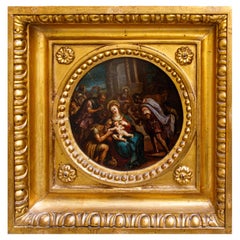
17th century, Flemish School, Adoration of the Magi
Located in Milan, IT
17th century, Flemish School
Adoration of the Magi
Oil on copper, diam. 19.5 cm
Framed 35.3 x 35.3 cm
Engraved on the back in seventeenth-century calligraphy "Fiamingo"
Vivid wo...
Category
Antique 18th Century and Earlier Dutch Other Paintings
Materials
Copper
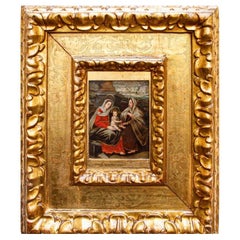
Flemish school, 16th century, St. Anne, the Virgin and Child
Located in Milan, IT
Flemish school, 16th century
St. Anne, the Virgin and Child
Oil on copper, 21 x 16 cm
With period frame, 65 x 56 cm
The painting depicts three central figures: the Madonna, Baby ...
Category
Antique 18th Century and Earlier Belgian Other Paintings
Materials
Copper
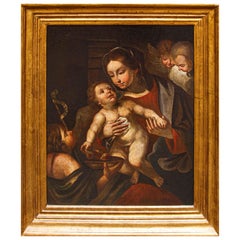
Italian school, 17th century, Madonna and Child with St. John
Located in Milan, IT
Italian School, 17th century
Madonna and Child with St. John
Oil on canvas, 86 x 99 cm
Framed, 113 x 93 cm
The seventeenth-century painting presents the Virgin intent on presenti...
Category
Antique 18th Century and Earlier Italian Other Paintings
Materials
Canvas
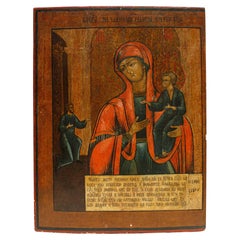
Russia, 19th century Icon Madonna and Child and patron
Located in Milan, IT
Russia, 19th century
Icon Madonna and Child and patron
Tempera on panel, 52 x 40 cm
The icon, from the Greek eikon, image, presents the narration of some episodes from the life of...
Category
Antique 19th Century Russian Other Paintings
Materials
Wood
You May Also Like
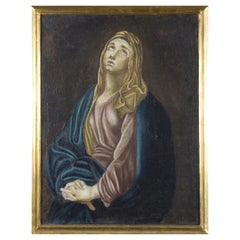
Antique painting Our Lady of Sorrows 18th century
Located in Cesena, FC
Antique painting Our Lady of Sorrows, 18th century
Oil on canvas 101 x 75 cm
Anonymous painter.
The painting in general is assumed to be Lombard from the first half of the 1700s, ye...
Category
Antique 1730s European Paintings
Materials
Canvas
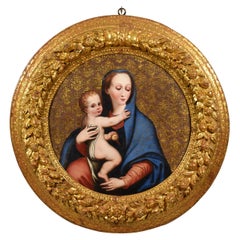
17th Century, Italian Oil on Panel Painting Depicting Madonna della Purità
Located in IT
17th Century, Italian Oil on Panel Painting Depicting Madonna della Purità
The painting, executed in oil on a circular wooden panel and presented in an imposing carved and gilded wo...
Category
Antique 17th Century Italian Renaissance Paintings
Materials
Wood, Giltwood
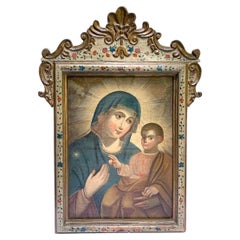
Magnificent 18th Century Venetian Madonna
Located in Rio De Janeiro, BR
Great oil on canvas depicting Madonna and Child. Carved, gilded and polychrome wooden frame with floral arrangements. Venetian, 18th Century.
Dimensions in centimeters: CANVAS 69cm H x 51cm / FRAME 107cm H x 80cm.
In art, a Madonna is a representation of Mary, either alone or with her child Jesus. These images are central icons for both the Catholic and Orthodox churches. The word is from Italian ma donna 'my lady' (archaic). The Madonna and Child type is very prevalent in Christian iconography, divided into many traditional subtypes especially in Eastern Orthodox iconography, often known after the location of a notable icon of the type, such as the Theotokos of Vladimir...
Category
Antique Mid-18th Century Italian Baroque Paintings
Materials
Canvas
20th Century Oil on Canvas Dated Signed Religious Italian Painting Madonna, 1929
Located in Vicoforte, Piedmont
Italian painting dated 1929. Oil on canvas framework depicting Madonna of excellent pictorial quality. First canvas painting, signed and dated lower right (see photo), signature in t...
Category
Vintage 1920s Italian Paintings
Materials
Canvas
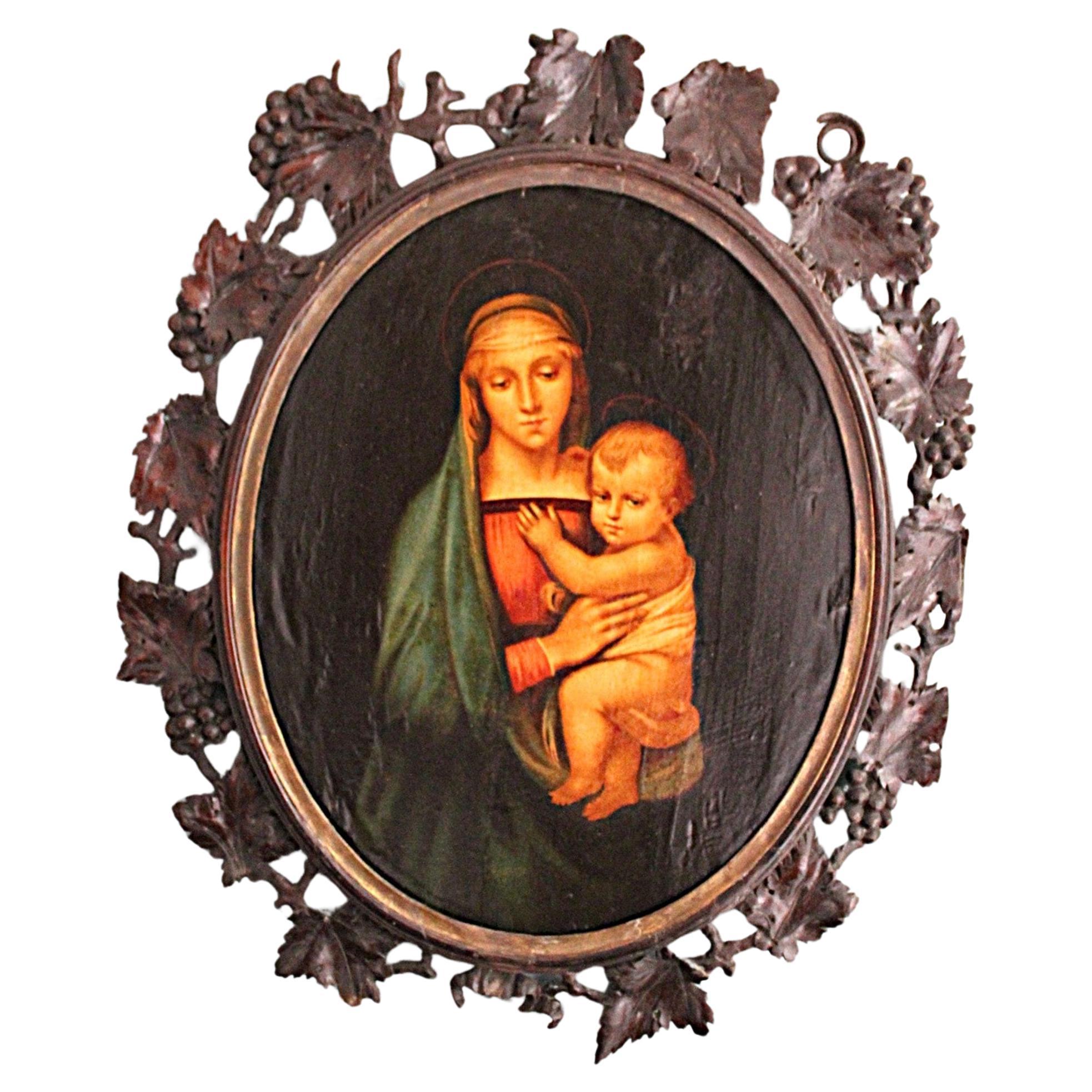
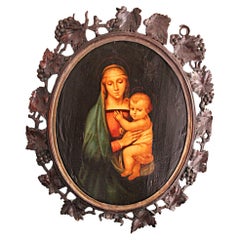
19th century After Rahael Grand Duke’s Madonna Painting
By (after) Raphael (Raffaello Sanzio da Urbino)
Located in Seaford, GB
After Raphael's Grand Duke's Madonna
Grand Duke's Madonna after Raphael, a stunning 19th-century oil painting from the renowned Berkley Collection. This remarkable artwork, inspire...
Category
Antique Late 19th Century Italian Renaissance Paintings
Materials
Paint, Paper
$1,812 Sale Price
20% Off
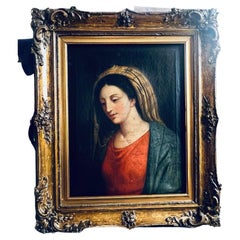
Antique 17th Century Painting Madonna /Virgin Mary Italy Oil on Canvas
Located in Doha, QA
Magnificent Italian 17th century Portrait of Virgin Mary measures 52 x 68 cm without the frame.
The colors are stunning and the paintin...
Category
Antique 17th Century Italian Baroque Paintings
Materials
Canvas
More Ways To Browse
Architectural Wall Hanging
Butterfly Dish
Cabinet With Stone Top
California Furniture Company
Candy Container
Carved Conch
Cast Iron Plaque
Ceramic Pig
Cherry Blossom Design
Chinese Black Lacquer Chest
Chinese Camel
Chinese Hand Painted Chest
Chinese Jade Flower
Chinese Monks
Chinese Red Coral
Chinese Yellow Glass
Chippendale Serpentine Chest
Chocolate Signs