Items Similar to Alberto Carlieri, Capriccio with Christ and the Adulteress, Oil on Canvas
Want more images or videos?
Request additional images or videos from the seller
1 of 9
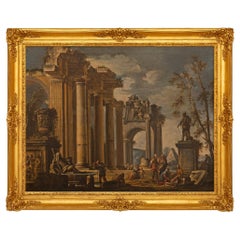
Alberto Carlieri, Capriccio with Christ and the Adulteress, Oil on Canvas
$89,715.02
£66,618.43
€75,000
CA$123,263.96
A$134,063.13
CHF 71,048.56
MX$1,606,356.46
NOK 902,990.68
SEK 827,262.23
DKK 571,807.67
About the Item
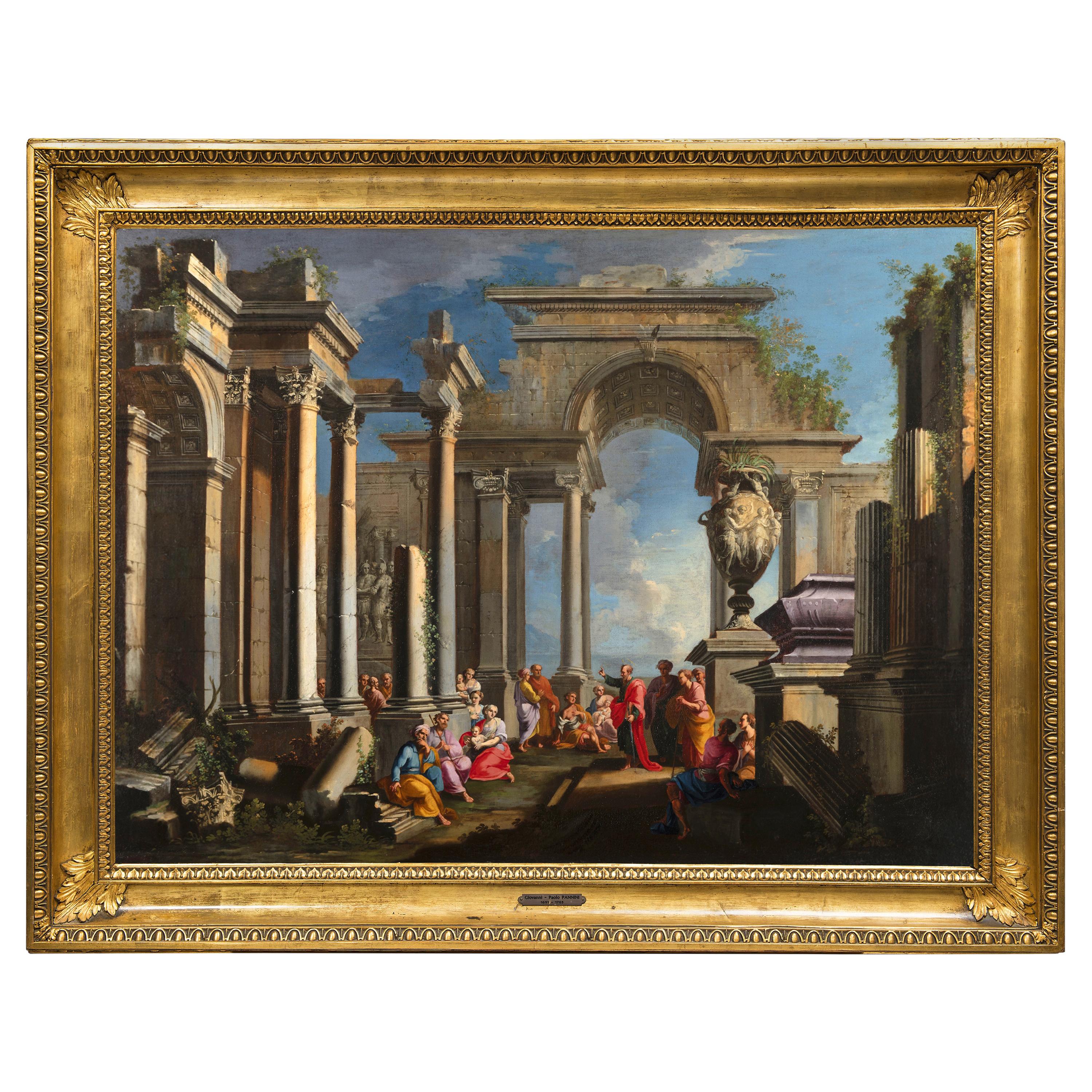
Alberto Carlieri (Italy-Roma 1672-1720), "Christ and the adulteress",
Oil on canvas, with frame cm H 115 x L 151 x 6.5, only canvas H 98.5 x L 135 cm
good conservation conditions
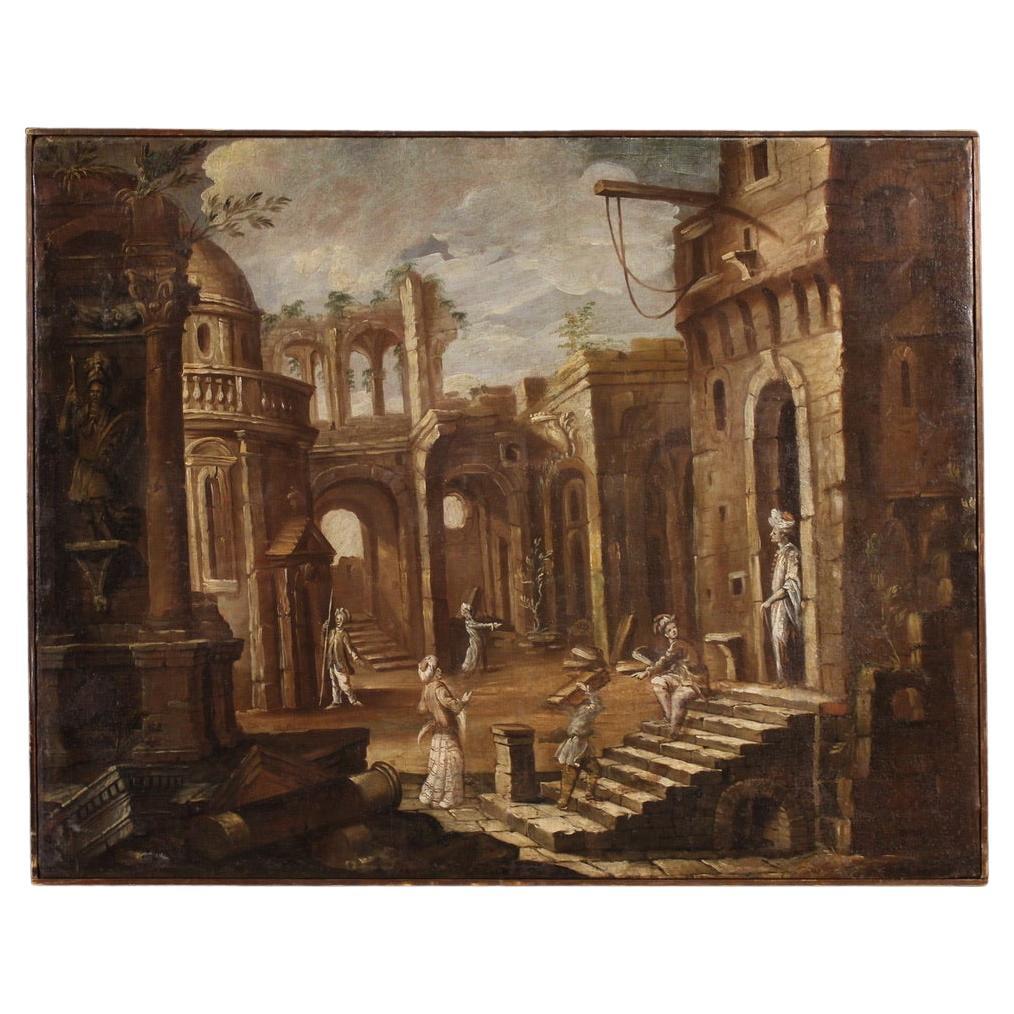
The large and very beautiful painting, made in oil on canvas, represents an architectural whim with in the foreground a powerful building with arches, of which you can see two archways. Large columns and pilasters in the Ionic and Corinthian composite style slender and lighten the architecture, distinguished by a flower-shaped cornice on which some marble sculptures rest. In the background you can see a more graceful structurally colonnade, with balustrade and sculptures, adorned with blunt greens that give picturesque features to the canvas. In addition to the arches of the colonnade we see described in the distance a large seventeenth-century city with turreted houses. The landscape fades on the horizon towards a blue sky marked by fluffy clouds.
The scenic architecture is animated, in the foreground, by some figures. It is a scene from the Bible: the Pericope of the adulteress (popularly known as the episode of Jesus and the adulteress), a passage from the Gospel according to John (8:1-11) in which a woman caught in adultery is brought before Jesus by the scribes and Pharisees to know his opinion about his condemnation to stoning.
Jesus bent down and with his finger began to write on the ground. And as the Pharisees insisted, he lifted up his head and answered, "Let him who is without sin first cast a stone at her". Then he bent down again and continued to write on the ground. When they heard these words, all but the woman who waited departed, and Jesus rose up and asked her, "Woman, where are they? No one condemned you?" He answered: "No one, Lord". Jesus said to her: "I do not condemn you either, go and sin no more".
The architectural whim, an artistic genre that has made its way into Italian painting since the seventeenth century, is characterized by the representation of fantastic architectures or inventions of perspective type, sometimes combined with elements drawn freely from reality. The large canvas in question has a considerable artistic interest. The architecture of invention gives a solemn classicism to the place; creates plays of light and shadows and serves as a frame to the scene.
The work, painted with great finesse even in the details and small figurines, is certainly attributable to the famous Roman painter Alberto Carlieri (Rome, 1672 - 1720), the most appreciated author and requested in Rome between the death of Giovanni Ghisolfi (Milan 1623-1683) and the affirmation of Giovanni Paolo Panini (Piacenza 1691 - Rome 1765). In the work object of this study can be found common stylistic reasons of his works. Characteristic elements are the suggestive compositional dispositions and the remarkable mastery in the direction of the lights, as well as the richness of the architecture and the refined as well as the meticulous descriptiveness of the details. Peculiar to the author is also the lively attitude of the figures, resolved with ease in the use of color, and inserted harmoniously in the architecture.
Carlieri was born in Rome in 1672 and began studying the painting of architecture under the guidance of Giuseppe de Marchis. He became a pupil and later collaborator of Andrea Pozzo. Present in the most illustrious Roman paintings, from the collection of Filippo II Colonna, Rospigliosi and Cardinal Valenti Gonzaga, Carlieri elaborates compositional models well recognizable, influenced, as well as by the painting of the master also that of Viviano and Nicolò Codazzi. His pictorial activity can be traced through the signed works, around which it was possible to build a not small catalogue of canvases. News of the Carlieri and his signed or dated works are between 1690 and 1720. Nothing is known about the life of the painter, who should have died in Rome shortly after 1720.
Among the typical characteristics of Carlieri’s style we point out the way perspective develops in the distance: with light colors, cold shades and pastel shades. The late works of the artist have decidedly clear tones and in this way differ from the darker tones used by him previously.
The author several times depicts the subject described here. Also in the canvas are found both architectural and figurative elements that often Carlieri introduces in his works.
The very setting of the majestic restaurant architecture in several of his works. The same can be said for the pavement, played on the checkerboard effect of a marble pavement that, through perspective, contributes to give great three-dimensionality and scenic effect to the overall composition.
We must also highlight some figures that Carlieri loves to introduce in the compositions. Among these are certainly the dogs that play and run around lively, as well as the figure of a man sitting, with a bent leg and the other half-stretched that supports with an arm on the ground. This particular, very frequent and also depicted in a mirror way, can almost be considered a signature of Carlieri.
Also the couple of men, generally bald and gray and with long beard, that walk and sometimes indicate, are recurrent in the paintings of this painter.
On the basis of the critical considerations set out above, the canvas must be dated to a mature stage of Carlieri’s activity, presumably circa 1700.
We apologize for any errors in translation from Italian.
- Attributed to:Alberto Carlieri (Artist)
- Dimensions:Height: 45.28 in (115 cm)Width: 59.45 in (151 cm)Depth: 2.76 in (7 cm)
- Style:Baroque (Of the Period)
- Materials and Techniques:
- Place of Origin:
- Period:Late 17th Century
- Date of Manufacture:1690-1720
- Condition:Refinished. The painting has been restored with a cleaning of the surface, removal of the yellowed varnish and repainting with transparent finish varnish.
- Seller Location:IT
- Reference Number:1stDibs: LU4405221483312
About the Seller
5.0
Vetted Professional Seller
Every seller passes strict standards for authenticity and reliability
Established in 1980
1stDibs seller since 2019
57 sales on 1stDibs
Typical response time: <1 hour
- ShippingRetrieving quote...Shipping from: Italy
- Return Policy
More From This Seller
View AllAlberto Carlieri, Painting with Architectural Capriccio
By Alberto Carlieri
Located in IT
Alberto Carlieri (Rome 1672-1720)
"Architectural capriccio with the preaching of Saint Paul in the Areopagus of Athens"
Oil on canvas, measures with...
Category
Antique Late 17th Century European Baroque Paintings
Materials
Canvas

18th Century, Painting Architectural Capriccio, att. to Isaac De Moucheron
Located in IT
18th Century, Painting with Architectural Capriccio with figures, attributed to Isaac De Moucheron
Measures: canvas cm H 108 x L 152; with frame cm H 132 x L 176 x 8
The painting i...
Category
Antique 18th Century Dutch Baroque Paintings
Materials
Canvas
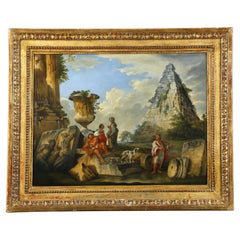
Italian Painting Architectural Capriccio with Caio Cestio Pyramid after Panini
Located in IT
19th century, Italian Painting Architectural Capriccio with the Pyramid of Caio Cestio, Roman painter, after Giovanni Paolo Panini, unsigned.
Dimensions: cm H 48 x W 63.5, frame H 6...
Category
Antique 19th Century Italian Rococo Paintings
Materials
Wood
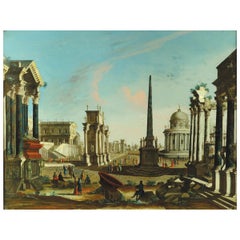
Couple of Italian Paintings Depicting Capricci, Francesco Aviani ‘1662-1715’
Located in IT
Francesco Aviani (Italy - Venice, 25-11-1662 / 1715) att.
Couple of paintings depicting Capricci
Oil on canvas, 135 x 183 cm, without frame
The two large and fine paintings depict two illusionistic architectural renderings, with views of colonnades and arched buildings, animated by figures. The compositions are characterized by the harmony with which the painter introduces the sumptuous architectural monuments, the mirrors of water, the buildings in the distance and the views of the landscape. Dominates with a color on the tones of brown and ochre that stands out on the blue sky, marked by some cloud of steam. The insertion of the figures to enliven the architectural views also balances with the set.
The Capriccio, an artistic genre that has made its way into Italian painting since the 17th Century, is characterized by the representation of fantastic architectures or prospective inventions, sometimes combined with elements drawn freely from reality. The two paintings are an example of this type and they are a very interesting and Fine artwork.
The remarkable pictorial quality emerges both from the composition of the ensemble and from the way in which the artist describes the views with great attention to detail, highlights and refined, perfectly realistic, chiaroscuro.
The same must be recognized for the figures: these are described with a wise brushstroke, quick and quick touches give the dynamism of the moment that is captured, as if time had stopped to show and narrate what is happening.
The painting on the right represents a large Baroque building in stone and paved with marbles, two floors, with moving façade, large columns with corinthian columns, a large portal with a staircase with large footsteps, a balustrade with string, from which some figures appear, and two equestrian monuments in bronze. The sumptuous building overlooks a large POOL of water, with a gushing fountain, around which some characters sit. In the second floor is described a white palace from which rises a tower crowned by a structure with wrought iron loggia. In addition there is a bridge and some architectural ruins behind which some mountainous reliefs fade towards the horizon.
On the staircase is described a particular scene. The people seem to be part of a very precise story. A woman, in the shadow of a parasol supported by a servant, would seem to drive out of the palace a man, who, taken under his arm by two maidens with a determined attitude, is led to a boat.
The scene could be identified with the biblical episode of the parable of the prodigal son (Luke 15,11-32), at the moment when the prodigal son is robbed and driven away by the harlots.
The episode tells of a man with two children. The youngest said to his father: “Father, give me the part of my inheritance”. And the father divided the substances. After not many days, the youngest son, collected his things, left for a far country and there he lost his substances with prostitutes and living as a debaucher. When he had spent everything, there came a great famine in that country and he began to find himself in need. Reduced to hunger, he was forced to be a pig herder to survive. He therefore meditated in his heart to go to his father and ask for his forgiveness and to be welcomed anew, even as a servant.
While still on the road, however, the father saw him and ran towards him, receiving him with open arms. He then ordered his servants to prepare a great feast for the occasion, killing for the purpose the "fatty calf". The firstborn did not understand why his brother was given such treatment, and reminded the parent that he, who had always obeyed him, had never received a single kid to celebrate with his friends. The father answered him: «Son, you are always with me and everything that is mine is yours; but it was necessary to celebrate and rejoice, because this brother of yours was dead and came back to life, was lost and was found».
The parable of the prodigal son was often portrayed in painting and the scene he finds most is certainly that of returning home in his father’s arms. Among the many is a canvas by the famous painter Giovanni Paolo Pannini (or Panini) (Italy – Piacenza, 1691– Rome, 1765) kept at the Hallsborough Gallery in London.
Rather rare, however, is the scene of the prodigal son driven and robbed by harlots. There is an engraving by Hans Collaert II (1561-1620) in which this moment is described in the background compared to the moment, narratively later, in which he is penitent among the pigs.
The second painting, certainly pendant of the first, represents a similar palace, with some characters overlooking the balustrade marcapiano and other figures around the large bathtub quadrilobata. In the foreground is described a monument with two large stone sculptures. In the distance some architectural elements and, beyond, the mountains are lost on the horizon.
The studies related to the numerous painters of architectural views and caprices, active in Italy, and the archival documents found, which could better clarify commissions, biographies and certain works, are scarce and sporadic. Therefore there are still many difficulties in reconstructing a catalogue of autograph works for each author. Through paintings in private collections, in museums and paintings passed on the antique market it is however possible to advance some attributions in order to better delineate the various artistic figures.
The style of the works studied here leads to a dating that runs between the 17th and 18th Centuries, with obvious influences dictated by the perspectives of the brothers Galli Bibiena. The analysis of the architectures and the chromatic palette suggests that we are in the presence of a northern Italian and Venetian author. Observing the decorations and the volutes, the brightness and the perspective disposition in fact, we find several analogies with those used by the Vicenza painter Francesco Aviani, excellent in pictorial perspective and architectural views.
The biographical profile of Francesco Aviani (Italy - Vicenza, 1662-1715) was essentially traced in 1956 by Andreina Ballarin, then re-visited by Federica Spadotto in 2014 and Giancarlo Sestieri in 2015. Certain documents about his life are scarce, as are the documented works.
He was born in Venice, probably on 25 November 1662, to Bernardo and a Magdalene whose surname is unknown, and was baptized on 3 December 1662. Between 1701 and 1703 he worked, together with his brother MarCo, sculptor, for the fresco decoration (now illegible) of the church villa in Soella (Vicenza). On October 16, 1703 he married Isabella Carcano. On March 26, 1715 he made a will and died on April 3 of the same year, in Vicenza.
The frescoes in the refectory of the sanctuary of Monte Berico in Vicenza are considered authentic works by Aviani, probably made in 1708; the paintings preserved in the Civic Museum of Vicenza: “Landscape with Lazzaro and the rich Epulone”; “Christ among the doctors”; “The miraculous fishing”, works not datable but with attribution corroborated by style. In addition, the frescoes in the east and west corridors of the Villa La Rotonda, near Vicenza; the fresco in the apse basin of the chapel of the church S. Croce, Vicenza, now destroyed; the frescoes of the central hall of Villa Camerini a Montruglio (1714) and a painting of a “Porto Regio”, of which we have a print engraved by Dall'Acqua.
From his works emerges the artistic background that animated the Venetian culture in the early eighteenth century. The scenic grandeur with which Aviani treats the architecture also suggests a stay in Emilia of the painter, in which he could have come into contact with the environment of the Bibiena. These contacts would be confirmed by the press of Cristoforo Dall'Acqua (Vicenza 1734-1787), “Il porto regio”, after a painting of Aviani. The press was part of a group of engravings, representing royal buildings, reproducing paintings of the Bibiena. In the eyes of Dall’Acqua, therefore, Aviani’s work was not foreign among those of the Emilians.
Inside the sumptuous architectural whims, Aviani often depicts biblical scenes, in which the characters share the space and the narrative rhythm, along with figures drawn from everyday scenes, memories of the Veronese and Bassano heritage. Also in the works covered by this study the author does not seem to want to give up a biblical subject, though the purpose of the paintings appears to be clearly a staging scenography-architectural within which the characters are relegated to the role of extras.
From the examination of the architectural Capriccio gathered under the name of Aviani then emerge common elements. The comparison between these works and the works in question highlights the proximity of the compositions. The imposing and scenic architectures are in fact equally characterized by the perspective-scenographic ability diffused in emilian “quadraturisti” and in Bibiena work. In fact, you can see the spectacular slender architecture in the lower part, the loggias that create chiaroscuro games with arches and binate columns placed on massive bases and overhung by projecting cornices.
Significant also the comparison with two paintings with architectural whims in a night vision attributed to Francesco Aviani.
In Aviani’s works it is possible to find a certain knowledge of the Roman Codazzi paint nd its early development of the eighteenth century, developed with the Locatelli, the Pannini and the less known Domenico Roberti. To Roberti have been recently attributed two works that have some compositional affinity with the canvases in question. The same can be done for a work on the antique market, attributed to Pietro Francesco...
Category
Antique Late 17th Century Italian Baroque Paintings
Materials
Canvas

18th Century, Roman Architectural Capriccio Attributed to Francesco Chiarottini
Located in IT
Francesco Chiarottini (1748-1796)
Roman Architectural Capriccio
Oil on glass, cm 52 x 67 without frame, 63.5 x 79cm with frame
The valuable painting, attributed to the Italian p...
Category
Antique Mid-18th Century Italian Neoclassical Paintings
Materials
Glass
17th Century, Italian Painting by Pier Francesco Cittadini, Jacob and his Family
Located in IT
Pier Francesco Cittadini (Milan, 1616-Bologna, 1681)
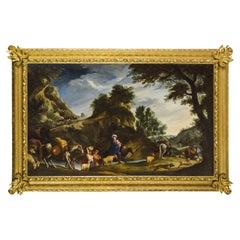
"Jacob and his family go to Egypt"
Oil on canvas, cm 109 x 190 (canvas only)
The valuable painting, made in oil on canvas, depicts Jacob and his family go to Egypt and we believe it can be, given the high quality painting, autograph work of Italian Pier Francesco Cittadini (Italy Milan, 1616 - Bologna, 1681) made after 1647. The work, in excellent condition is accompanied by a coeval frame in wood finely carved and golden.
The scene depicted, which was confused with the Flight to Egypt in the past years, is instead identified with the biblical episode of Jacob’s journey. In the foreground, reading the painting from left to right, we see a caravan composed of animals, including donkeys, dromedaries, goats, dogs and horses and people, women, men and slaves, who carry on their journey along the banks of a river, following a path that to the right, would seem to lead to the through of a bridge. In addition to the watercourse is described an environment characterized by large rocks and impervious come far to cover the entire verticality of the canvas. On the left, in the distance, we see the tail of the caravan that runs along the steep path. Large trees enliven and harmonize the environment, as well as white and grey clouds characterize the predominantly clear sky and illuminated on the right by sunlight.
The story is told in the Bible, Book of Genesis, 30, 25, passage in which is described the flight of Jacob from Haran after the contrasts with Laban, father of his wife Rachel. Jacob is the third great patriarch of the Bible. From his descendants originate the twelve generations of the people of Israel. He is the son of Isaac and Rebekah, who led him to flee from the wrath of Esau to Haran to seek refuge from his brother, Laban. At his uncle’s house Jacob met his daughter Rachel. As soon as he saw his cousin, Jacob was taken. Jacob will stay seven years in the service of Laban to marry his beloved Rachel. But Laban, with a deception, will give him in marriage first Lia, the least beautiful eldest daughter, and only after another seven years the splendid Rachel. From his first wife he will have several children, while Rachel will give birth to the beloved son, Joseph, who will become viceroy of Egypt.
After years of service, Jacob asked to be paid with every dark-coloured garment among the sheep and every spotted and dotted garment among the goats. Laban accepted and sent away from his sons all the leaders of that kind. So Jacob took fresh branches of poplar, almond and plane tree, and flayed them, and put them in the troughs. The optical suggestion induced the goats and the sheep to conceive and give birth to dark, striped and dotted garments. He also ensured that all the strongest and healthiest leaders of the flock of Laban would drink near the barked branches, thus assuring a genetic superiority to his part of the flock. His flocks grew numerous and strong and he became richer than his relative, arousing envy. It was clear that Laban would not respect him much longer. At the suggestion of the Lord, Jacob decided to return to Canaan. Trying to avoid any possible dispute, he left with his family while Laban was absent for shearing sheep. But when, three days later, his uncle returned home, he became angry, feeling offended because Jacob had gone secretly and had not allowed him to greet his daughters and grandchildren. In addition, his teraphim, statuettes, or idols, which depicted the family deities, had disappeared. After 7 days of pursuit, Laban and his men reached Jacob’s group on Mount Gilead, in the mountainous region west of the Euphrates River, where his uncle and grandson had a stormy conversation. The younger man was outraged at being accused of stealing idols and told Labano to rummage through his family’s tents at will. Neither of them could know or even imagine that it was Rachel who took the idols and hid them in the saddle of the camel. During the search, she sat down firmly on the saddle, apologizing for not being able to get up, «because I usually have what happens to women» (Gen 31:35). So the loot wasn’t discovered.
The author of this work was inspired by the composition of an engraving by Stefano Della Bella (1610-1664) of circa 1647. The engraving by Stefano della Bella bears the title "Iacob sur ses vieux jours quitte sans fascherie pour voir son filz Ioseph, sa terre et sa patrie" and is signed on the bottom left "Stef. of the Beautiful In. et fe." while on the right it is declared "Cum privil. Regis", that is with license of the king.
Stefano Della Bella (Italy - Florence, May 18, 1610-Florence, July 12, 1664) was born in a family of painters, sculptors and goldsmiths and was left early orphan of his father sculptor, he dedicated himself first to the art of goldsmith at the school of Giovanni Benedetto Castiglione and Gasparo Mola, then turning his attention to drawing and engraving. He soon began drawing figures and copying the etchings of Jacques Callot, which inspired his early works. Under the protection of the Medici, in particular of Don Lorenzo, cadet son of Grand Duke Ferdinand I, Della Bella has the opportunity to make study trips to Rome, where he stayed from 1633-1636; In Rome he met French engravers and publishers of prints such as Israël Henriet and François Langlois, who influenced his decision to move to Paris in 1639, four years after the death of Callot. In Paris he soon reached, thanks to the engravings commissioned by Cardinal Richelieu, the success also worldly; he frequented courtiers, theatre artists and writers, while refusing too oppressive honors. In 1646-1647 he continued his travels in the Netherlands to Amsterdam, Antwerp and Dordrecht. He returned to Florence in 1650 and resumed working under the protection of the Medici court, working for his patrons. In 1656 he became a member of the Academy of Apatists.
The painting object of this study is reasonably attributable to Pier Francesco Cittadini, or Pierfrancesco Cittadini, called the Milanese or the Franceschino (Italy - Milan, 1616-Bologna, 1681) as some exemplary stylistic comparisons proposed to follow can prove.
Pier Francesco Cittadini was an Italian baroque painter, mainly active in Bologna.
His artistic training first took place with the painter Daniele Crespi...
Category
Antique Mid-17th Century European Baroque Paintings
Materials
Canvas, Giltwood
You May Also Like
Italianate Capriccio Oil of Figures in Classical Ruins
Located in Queens, NY
Italianate style (19th Century) capriccio on an architectural oil on canvas painting with figures among classical ruins in an ebonized frame.
Category
Antique 19th Century Renaissance Paintings
Materials
Paint
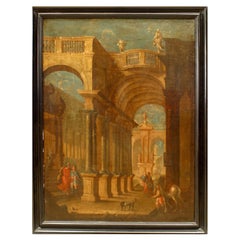
Italian Painter of 1700 "Capriccio with classical ruins and figures"
Located in Cesena, FC
Painter of ruins xviii century:
"capriccio with classical ruins and four figures" , pendant with "capriccio with classical ruins and three figures"
Oil on canvas cm 140 x 95
The ...
Category
Antique 1730s Italian Paintings
Materials
Canvas
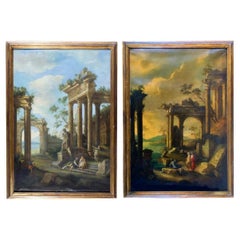
18th Century Oil on Canvas Italian Architectural Capriccio Landscape Painting
Located in Vicoforte, Piedmont
Great 18th-century architectural capriccio with figures. Oil on canvas painting depicts an evocative architectural capriccio with ruins, enlivened by elegant figures in oriental cost...
Category
Antique 1740s Italian Paintings
Materials
Canvas
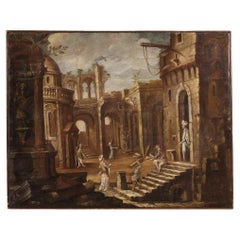
Circle of Alessandro Salucci, 17th Century Italian Oil on Canvas
Capriccio
By Alessandro Salucci
Located in Kinderhook, NY
17th-century Italian Baroque oil on canvas 'capriccio' painting in the manner of Alessandro Salucci depicting an urban battle scene between what appear to be Spanish soldiers...
Category
Antique 17th Century Italian Baroque Paintings
Materials
Paint
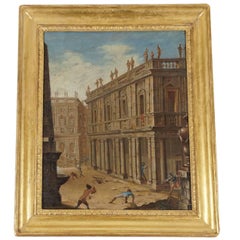
$6,419 Sale Price
34% Off
Italian 18th Century Oil on Canvas Painting of Ruins and Figures
Located in West Palm Beach, FL
A sensational and large scaled Italian 18th century oil on canvas painting of ruins and figures. The painting, with wonderful and vibrant colors throughout, has two young maidens kne...
Category
Antique 18th Century Italian Paintings
Materials
Canvas, Giltwood
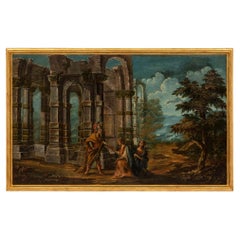
Italian 18th century Louis XV st. Oil on Canvas and Giltwood painting
By Giovanni Paolo (Pannini)
Located in West Palm Beach, FL
A decorative and statement making Italian 18th century Louis XV st. Oil on Canvas and Giltwood painting, in the manner of Giovanni Paolo Panini. This storytelling Capriccio style pai...
Category
Antique 18th Century Italian Louis XV Paintings
Materials
Giltwood
More Ways To Browse
Alberto Carlieri
St Tropez Furniture
Vanguard Studios Oil Painting
Vilhelm Lundstrom
Vintage Hand Sander
Vintage Wall Ducks
Wagner Plaque
Yacht Racing Painting
Yarrow Jones
Alan Green
American Colonial Portrait
Antique Crystoleums
Baroque French Landscape
Bird Paintings On Silk
Canvas Painting By Esther
Carlin Furniture
Del Piombo
Edna Hibel Lithograph