Want more images or videos?
Request additional images or videos from the seller
1 of 6
Dutch oil on canvas farm scene, 1890-1910
$800List Price
About the Item
- Dimensions:Height: 21.5 in (54.61 cm)Width: 22.25 in (56.52 cm)Depth: 1.75 in (4.45 cm)
- Style:Country (In the Style Of)
- Materials and Techniques:
- Place of Origin:
- Period:
- Date of Manufacture:1890-1910
- Condition:Wear consistent with age and use. The work has been surface cleaned and is framed in its original gilt cove molding. Wear commensurate with age and use.
- Seller Location:Kenilworth, IL
- Reference Number:Seller: 13381stDibs: LU6534235006442
About the Seller
4.8
Gold Seller
Premium sellers maintaining a 4.3+ rating and 24-hour response times
Established in 1972
1stDibs seller since 2022
162 sales on 1stDibs
Typical response time: 2 hours
Authenticity Guarantee
In the unlikely event there’s an issue with an item’s authenticity, contact us within 1 year for a full refund. DetailsMoney-Back Guarantee
If your item is not as described, is damaged in transit, or does not arrive, contact us within 7 days for a full refund. Details24-Hour Cancellation
You have a 24-hour grace period in which to reconsider your purchase, with no questions asked.Vetted Professional Sellers
Our world-class sellers must adhere to strict standards for service and quality, maintaining the integrity of our listings.Price-Match Guarantee
If you find that a seller listed the same item for a lower price elsewhere, we’ll match it.Trusted Global Delivery
Our best-in-class carrier network provides specialized shipping options worldwide, including custom delivery.You May Also Like
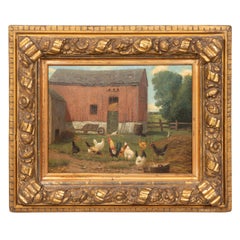
American School Oil on Panel Farm Scene
Located in Essex, MA
Image 14.5 x 11.5. Pleasantly painted farm scene with chickens and barn in a landscape. In a beautifully carved wood and gilt frame.
Category
Antique Late 19th Century American Paintings
Materials
Wood, Giltwood
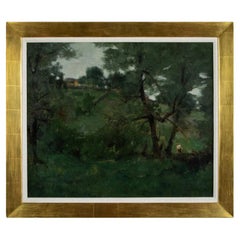
"Farm Scene" Oil on Canvas by American Artist Julian Alden Weir
Located in Stamford, CT
Julian Alden Weir (August 30, 1852 – December 8, 1919) was an American impressionist painter and member of the Cos Cob Art Colony near Greenwich, Connecticut. Weir was also one of th...
Category
Antique Late 19th Century American Other Paintings
Materials
Canvas, Paint
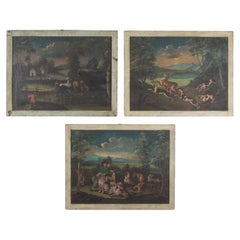
Set of Three Late 18th Century Dutch Oil on Canvas of Rural Scenes
Located in Gloucestershire, GB
A very attractive set of three late 18th Century Dutch landscape paintings.
Oil on canvas, mounted to boards and set in to later frames. Circa 1790.
Category
Antique Late 18th Century Dutch Country Paintings
Materials
Canvas, Paint
$4,908 / set
H 37.01 in W 28.75 in D 3.94 in
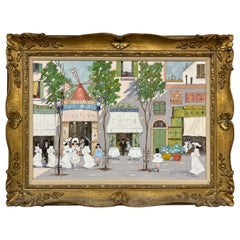
Luigi Cagliani (1910-1987), Oil on Canvas of a Parisian Street Scene
Located in North Palm Beach, FL
This Luigi Cagliani (1910-1987) oil on canvas of a Parisian Street Scene is in impressive condition. With a romantic movement, almost 19th Century sense, Cagliani presents a whimsical oil painting...
Category
Vintage 1930s French Paintings
Materials
Canvas
$3,720 Sale Price
32% Off
H 33 in W 45 in D 2 in
Oil On Canvas Painting of Vienna Farm Scene, Mid 20th Century
Located in Haddonfield, NJ
Austrian Oil on Canvas Painting of European Countryside, circa 1950's.
A very charming lifelike rendering of a Countryside typical in any European city. This 20th Century oil pai...
Category
Mid-20th Century Austrian Mid-Century Modern Paintings
Materials
Canvas, Wood, Paint
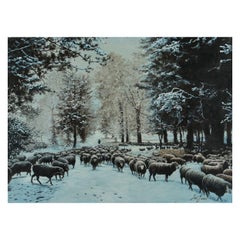
Ted Jones Dublin Ireland Irish Oil Painting on Canvas Winter Farm Scene Sheep
By Ted Jones
Located in Dublin, Ireland
Stunning Irish oil on canvas framed painting painted during the last quarter of the 20th century, by Ted Jones (Irish 1952-2017.
This Painting by Ted Jones (Irish 1952-2017) is a won...
Category
20th Century Irish Victorian Paintings
Materials
Canvas, Giltwood
$7,988
H 27 in W 33.25 in D 1.5 in
Hélène Azenor
1910-1999
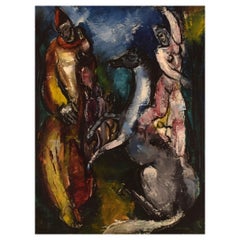
, French Artist, Oil on Canvas, Modern Circus Scene
Located in København, Copenhagen
Hélène Azenor (1910-1999), French artist. Oil on canvas.
Modern circus scene. 1970s.
The canvas measures: 60 x 45 cm.
The frame measures: 6 cm.
In e...
Category
Vintage 1970s French Modern Paintings
Materials
Canvas
$700
H 25.99 in W 20.08 in D 1.19 in
Dutch Landscape Oil on Canvas 1940s
Located in Meer, VAN
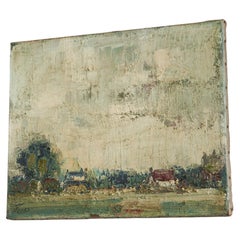
Dutch Landscape Oil on Canvas 1940s.
Beautiful and well painted landscape - most probably Dutch. Very tactile and refined impressionist painting. Thick brush strokes and rich colors...
Category
Early 20th Century Dutch Paintings
Materials
Canvas, Paint
Pfoutz Original Farm Scene Oil Painting
Located in Annville, PA
A very interesting and unusual Pfoutz Original Farm Scene Oil Painting by artist J. Earle Pfoutz. The painting is produced on artist and comes complete with what appears to be an original artist decorated/painted frame. The Pfoutz Original Farm Scene Oil Painting is signed on the front by the artist and appears to be dated 1948 on the rear. Known for his unusual subjects Pfoutz outdid himself with this effort, capturing the essence of a Lancaster County farm but with the startling twist of portraying a large turkey vulture in the foreground. Definitely unique.
Overall frame Size approximately 33″ wide x 3″ deep x 26″ high
J. Earle Pfoutz had a long and distinguished career as a self trained artist. More can be learned about him from reading this article produced by Gary Hawbaker at askART
Earle Pfoutz Born: 1891 – Lancaster, Pennsylvania
Died: 1957
Known for: Landscape, figure, still life painting
An image of J Earle Pfoutz
Biography from the Archives of askART
J. Earle Pfoutz (John Earle Pfoutz) – (Oct 23, 1891-Nov 9, 1957)
“A seventh generation descendant of a Swiss family which arrived in America early in the 17th Century, J. Earle Pfoutz was born in Lancaster, PA, son of John Bachman and Susan Allison Pfoutz. He painted houses for a living and pictures for a life.
A self-taught artist, described as a primitive, he was distinctive for his vivid imagination and bold color application. He painted hundreds of Lancaster County scenes. Pfoutz traveled through the hills near his home and along the Susquehanna River in search of scenes. He began painting with a brush when he was fourteen, but added a palette knife after suffering an eye injury. He completed eighth grade in the Lancaster Public Schools and there his formal education ended. However, the Department of Public Instruction of the State of Pennsylvania thought so highly of his work as an artist that officials certified him as an art instructor and he taught for a year in the York (PA) public schools. He also was an art instructor under the program for disabled veterans, sponsored by the Veterans Administration, when he gave private instruction to veterans in their homes.
In 1947, J. Earle Pfoutz finally earned national recognition as an artist. His painting, Opalescent October, was chosen by the Museum of Art of Dayton Ohio, to travel all over the country for a year with its Group Exhibition. Described as a “very colorful, calm scene, iridescent in color, sweeping in design,” the painting started on its journey around the country early in 1948. In an interview with the Sunday News (Lancaster, PA – Nov 2, 1947), Pfoutz stated that he didn’t know whether he was a “primitive” or an “impressionist.” No master taught him, no school channeled his style. “Sometimes I didn’t eat, but I always managed to paint,” he recalled. Many of his hundreds of canvases -most of them not sold, but given away to friends – found their way to other parts of the country. “I never remember the day when I did not love color,” Pfoutz said. “I was about 12 years old when I saw my first palette – a string of different colored paint paddles that graced the stores of that day. As a boy I had two great desires. One was to be able to eat all the strawberry jam I could, and the other to possess a string of those beautiful paint paddles. Well, I’ve got my fill of jelly, but I’ve never yet got my fill of beautiful colors.”
In 1950, Pfoutz’s one man show of paintings made front page headlines in the Lancaster Intelligencer Journal: “Most of the twenty oil paintings on exhibition are landscapes, although there are several interesting figure studies. Colors again, as in all Pfoutziana are rich and full-bodied, but for the most part not as startlingly as in some of the earlier work. Most of the paintings were done during the past year, and also reveal the painter’s characteristic heavy impasto technique, in which the rich swirls of paint carry their own message. Among the figures, The Banjo Picker, and The Magician, are the most provocative. Both are character studies; the first being of a tramp musician whose drab clothing is set-off by a luminous aqua blue background. Modern in feeling and treatment is The Magician, a clown-faced wizard whose spinning ball in the air suggests the fourth dimension – space. The use of the primary colors in this picture serves to emphasize the theme effectively.
A large colorful landscape, Opalescent October, depicting rolling hills against a late afternoon sky is new to Lancastrians, as it has just returned from Dayton, Ohio, where it hung in the Dayton Art Institute. Another landscape with soft dreamy colors is Fantasie D’Autumne, and one of the loveliest pictures in the show. Pennsylvania Dutch Country is another with eye appeal, and was one of the works which was hung in the Old Customs House in Philadelphia during Pennsylvania Week, and before that in a collection of Pfoutz work in the same place. In deep contrast to the sunny skies and brilliant foliage of many of the pictures, is the somewhat morbid Worry, in which the center of interest is a tremendous rat. This, the painter explains, was symbolic of 1948 in China, which was ‘The Year of The Rat’ in the Chinese calendar. Background material for the picture was furnished to Pfoutz by author Pearl Buck.
Other pictures include Autumn Prelude, Miners Village, painted at Cornwall, PA; Humid Day, Saint Peters Kierch, at Middletown, PA; Lady Pfoutz, inspired by the painter’s wife; Sun Flowers, Sentimental Journey, Gyne, Luzon Woman, Old Bridge, The Cow Path. Lemures, based on Roman mythology, and Ethiopian, painted from an ebony wood carving from Kenya Province, S. Africa.”
In 1953, Pfoutz was installed as President of the Lancaster County Art Association. A. Z. Kruse, New York City artist, writer and member of the faculty of the Brooklyn College and the Cartoonists and Illustrators School, Manhattan, was the guest speaker. In January of 1953, thirty-five Pfoutz oils were exhibited at the Old Custom House in Philadelphia, PA under the sponsorship of the Carl Schurz Memorial Foundation. Several Lancaster County landscapes and covered bridges were included as well as Katy, a Pennsylvania Dutch scene. Symbolic paintings included End of the Second Day, the artist’s visualization of the second coming of Christ, and Twilight, typifying the grief of mothers of all lands for sons lost in battle.
In June of 1953, a Pfoutz oil made history in Lancaster. From the Lancaster New Era: “For the first in local art history, a painting has been withdrawn from an exhibition because of objections from viewers and hostesses serving at the show. The painting, Jeune Fille, a standing nude done by Pfoutz, was one of the paintings in the annual spring exhibition of the Art Association and had become the center of the controversy. Pfoutz said he took the painting down… ‘graciously but reluctantly.’ ‘From an artistic standpoint, there is nothing offensive about the painting,’ Pfoutz said. ‘This community just wants its nudes with clothes on.’ “It is most brilliant in color, and because it is so brilliant I thought it would make a nice lively spot for the show. This is the first time I’ve had to take a picture off the walls. I substituted a seascape for it.’ Pfoutz said he felt the painting brought a lot of viewers to the show because it was so controversial. It had never been exhibited before. ‘If this had been shown in a metropolitan city,’ he commented, ‘people wouldn’t have given it a second glance. But the viewpoint here is more conservative, even though I don’t think moderns would have minded.’ He said he felt the painting was neither ‘objectionable nor pornographic,’ but had complied with the wishes of fellow members of the Art Association who telephoned him to relay the protests they had received. The art controversy was the first to arise here publicly since the showing of Amish Grandmother, an oil by William Gropper which was part of the Gimbel Pennsylvania exhibit at the Griest Building several years ago. — Numerous viewers of Amish Grandmother, [a painting showing an Amish woman holding a white goose], expressed themselves quite vocally, calling it an affront to the Plain Folk. But it stayed on exhibit throughout the length of the Gimbel show. Pfoutz expressed no rancor, implying that if Gropper could take it so could he.”
After his death, there were several shows of Pfoutz’ work organized by his son J. Earle, Jr. J. Earle, Jr. also saw to it that President Eisenhower would receive an oil called The Cow’s Path. The president first saw the painting in 1950 when, as president of Columbia University, he visited Lancaster to address a student assembly at Franklin and Marshall College. After his address was over, the then Gen. Eisenhower stopped at the Fackenthal Library on the campus to view an exhibition of Pfoutz’s paintings. The Cow’s Path intrigued him. For some time, as his aides fumed to get him back on his time schedule, Eisenhower and Pfoutz talked, as artist to artist. Prior to his death, Pfoutz requested that The Cow’s Path be given to the President if he wanted it. The painting was presented to Ike at the White House in November of 1959. Mrs. Eisenhower owned a Pfoutz painting titled, In the Manor.
Though house painting was his livelihood, he worked for Millersville State Teachers College (now a university) for a time during World War II, and called himself “the Chimney Sweep of MSTC.” During that period he knocked out a dizzying canvas in the surrealist style (he thought it was terrible) and got into the campus newspaper when one of the students spotted it.
Earle Pfoutz was not the humble, downtrodden artist, not the Douanier Rousseau type at all. As he developed his skill and style through the years, he also fashioned a resilient confidence in himself as an artist. Whether he was building his own home (he built two) or painting one for somebody else, he never lost faith in his ultimate recognition—though he was never sure he would live to see it.
Whether he was working as a rigger for a hoisting company, in the Stehli Silk Mill of Lancaster, carving Cloister-style chairs, decorating old chests, cementing bricks from the old Safe...
Category
Vintage 1940s American Paintings
Materials
Paint
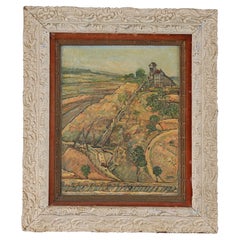
Dutch Landscape 1930s Oil on Canvas
Located in Ljubljana, SI
Beautiful summer impressionistic Dutch landscape with children playing at a lake surrounded by trees and in the background grassland, cornfields and a forest edge. Painted en plein a...
Category
Vintage 1930s Scandinavian International Style Paintings
Materials
Canvas
More From This Seller
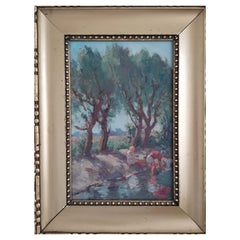
View AllFramed watercolor of a New England coastal scene by Mary Mason Brooks, c. 1910
Located in Kenilworth, IL
Watercolor on paper of the New England coastline, probably New Hampshire.
Signed in graphite, lower left: M.M. Brooks
American, circa 1910.
Category
Early 20th Century American Paintings
Materials
Paper
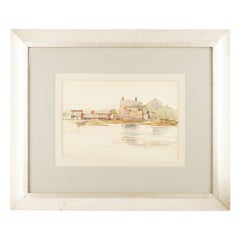
Oil on canvas view of San Giorgio Maggiore, Venice, c. 1800
s
Located in Kenilworth, IL
Oil on canvas view of San Giorgio Maggiore, Venice, as viewed from across the Grand Canal. The painting has been cleaned, the canvas relined, and framed in a gold leafed molding. Thi...
Category
Antique 19th Century Italian Paintings
Materials
Canvas, Paint
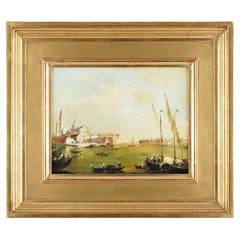
Danish tonalist shoreline seascape, c. 1910
Located in Kenilworth, IL
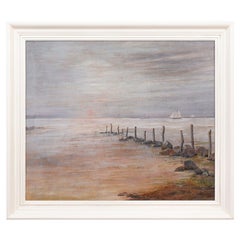
Tonalist shoreline seascape oil on canvas mounted in a painted molding. The painting is defined by a row of pilings projecting into the sea with sailboats on the horizon, where gray ...
Category
Early 20th Century Danish Paintings
Materials
Canvas, Paint
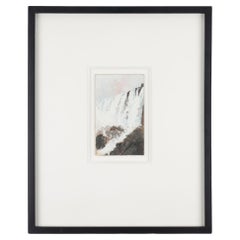
American oil on panel pochard of a waterfall by J.P. Gourlay, 1912
Located in Kenilworth, IL
Oil on board study of a waterfall, likely Niagara Falls. The work has been float mounted in a deep bevel archival mat, under glass, and framed in a black lacquered molding.
American...
Category
Vintage 1910s American Paintings
Materials
Paint
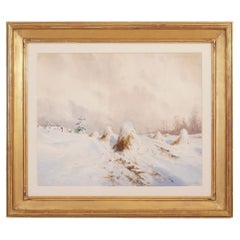
American watercolor winter landscape by Howell Wilson, 1890
Located in Kenilworth, IL
Watercolor on laid paper of snow covered corn rows under a gray winter sky. Archival mount under UV plexi and framed in gold leaf molding style of the period. The artist is known for...
Category
Antique Late 19th Century American Paintings
Materials
Paper
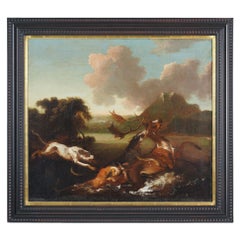
Scene of a stag hunt by Abraham Hondius, c. 1660-80
By Abraham Hondius
Located in Kenilworth, IL
Oil on canvas scene of a stag hunt with hounds in a wooded lakeside landscape. The canvas has been archival cleaned and craquelure arrested with relining. The canvas is framed in a 1...
Category
Antique Mid-17th Century Dutch Paintings
Materials
Canvas, Paint
Still Thinking About These?
All Recently ViewedMore Ways To Browse
Van Thiel
Mid Century Modern Blown Glass Slag Vase
Mid Century Tyrolean Bed
Midcentury Modern Homecrest Riviera Siesta Swivel Rocker
Midcentury Modern Stonehill Stateroom Teak Room Divider
Mikaela Dorfel
Military Campaign Wardrobe
Military Wicker Basket
Milk Bottle Holder
Milk Glass Decanter
Milk Glass Dice Lamp
Miller Oil Lamp
Milling Road Nightstand
Milo Baughman Archie Chair
Milo Bauman
Milwaukee Chair Company
Ming Fresco
Mini Papilio