Items Similar to Georges Rouault Portrait de Marie Thérèse Bonney
Want more images or videos?
Request additional images or videos from the seller
1 of 10
Georges Rouault Portrait de Marie Thérèse Bonney
$135,000
£102,301.46
€117,890.62
CA$190,927.25
A$205,326.26
CHF 109,788.35
MX$2,476,176.34
NOK 1,388,348.82
SEK 1,264,964.53
DKK 880,904.22
About the Item
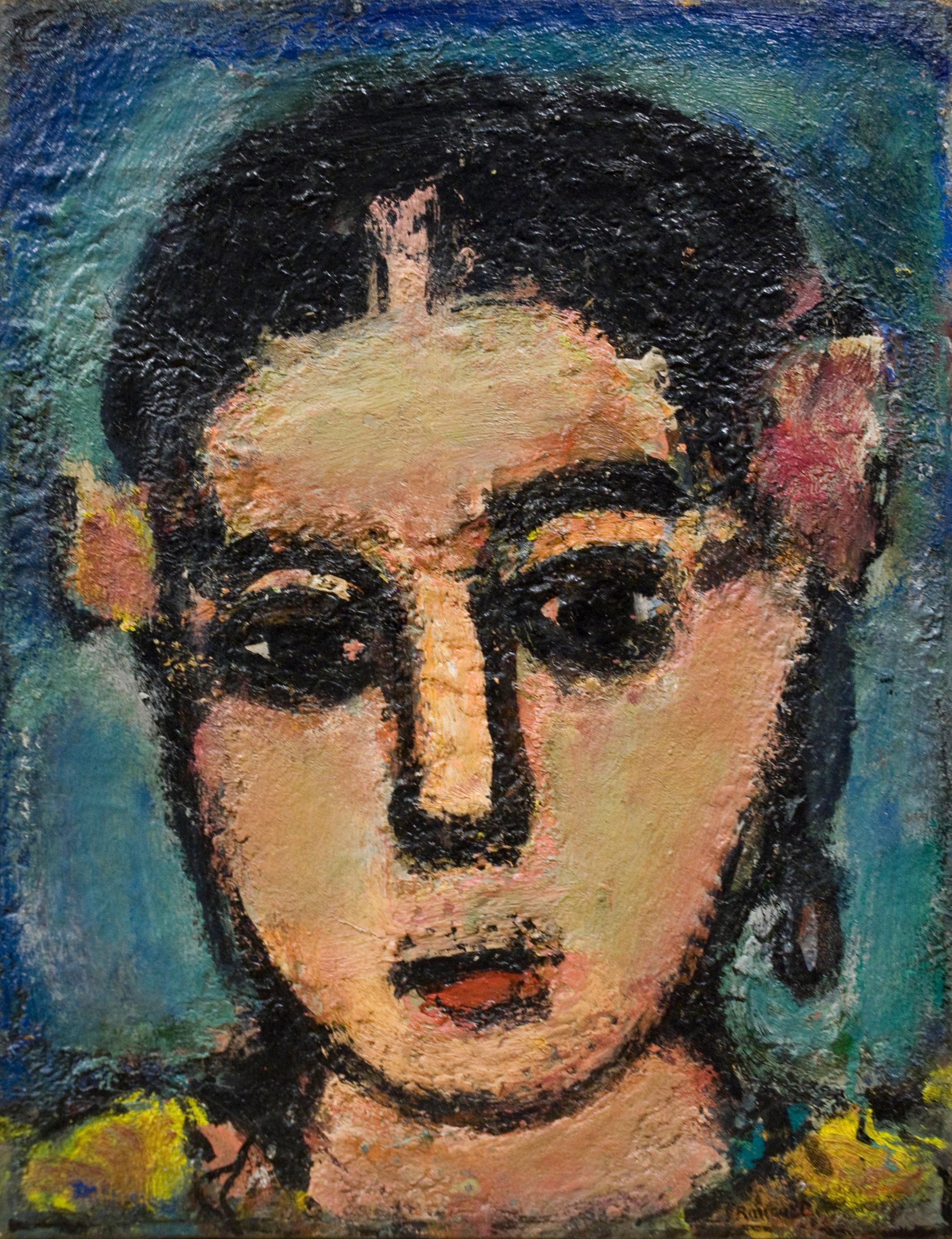
Georges Rouault (French, 1871-1958) - Étude pour le Portrait de Marie Thérèse Bonney. A large specimen painting for Rouault beautifully framed in a shadow fashion making a grandiose piece of art.
Stamped with ‘Atelier de Georges Rouault' and signed by Isabelle Rouault verso, oil with brush and ink on paper laid down to canvas
Canvas: 24 x 19 1/8 in. (61 x 48.6cm)
Framed: 36.5 x 31.25 Inches
Executed circa 1933.
Provenance
Christie's, New York, sale of November 9, 1999, lot 361.
Acquired directly from the above sale.
Private Collection.
Sotheby's, New York, sale of November 8, 2001, lot 339.
Acquired directly from the above sale.
Collection of Sidney Rothberg, Philadelphia, Pennsylvania.
Literature
Bernard Dorival and Isabelle Rouault, Rouault, L'Œuvre Peint, André Sauret, Monaco, 1988, Vol. II, p. 297, no. 2554 (illustrated).
Condition
In overall very good, close to excellent original condition, with no sign of inpainting as seen under UV light. We notice very few chips in the paint layer at center right, which are not detrimental to the composition and appear consistent to the heavy wash used by the artist. The canvas onto which the work is laid down, is itself lined. With all four outer edges apparent, and protected by gold edge tape
Though he joins the ranks of the major artists linked to the heroic avant-garde years in Paris, Rouault cut something of a solitary figure amongst his peers. He nevertheless formed early career associations and friendships with Henri Matisse, Albert Marquet, Henri Manquin and Charles Camoin and this brought him into the fold of the Fauvists with whom he exhibited at their famous 1905 exhibition at the Salon d'Automne. However, his work carried strong elements of Expressionism, which had never found much favor outside of Scandinavia and Germany. By the beginning of the First World War Rouault was turning more and more away from watercolor and oil on paper towards oil and canvas and he applied his paint through thick, rich, layers which helped amplify his raw and bold forms. His colors, awash with deep blues, contained within heavy black lines, produced art that was reminiscent of stained glass windows and supported subject matter that became more overtly religious with a strong recurring theme of the power of redemption. The majority of his career was devoted to the human figure - specifically clowns, prostitutes and Christ - but during the last decade of his life his palette allowed for pastel shades of green and yellow to impinge on canvases that placed his figures in charming mystical landscapes.
Unique amongst modernists, Rouault's artistic evolution was informed by a devout Catholic faith. Drawing on the ideas of religiously-inspired intellectuals of his time, Rouault looked towards symbolism and primary colors to express the core values of Catholicism; a highly unfashionable (and single-minded) worldview when one considers the progressive milieu in which he was working.
As was the norm amongst modernists who wanted to represent the lives of "ordinary" workers, Rouault's prostitute paintings treated his sitters with a genuine, non-judgemental, empathy. Rouault represented his workers with an honest, unadorned, realism that allowed for (or, in his view, insisted upon) an emphasis on naked sensuality. He was thus able to eclipse the aims of his peers by the way he drew attention to the contradictions at play between his models' Rubenesque seductiveness and their societal exploitation.
In an age of science and reason; and age in which faith was considered the philosophical property of only innocent minds, Rouault treated the figure of Jesus, not with irony, nor even distain, but rather as the true saviour of all mankind. His masterpiece is considered to be a book of 58 collated illustrations. Revealing the strong influence of German Expressionist woodcuts, Miserere (1922-1927) lays bare the stark spectacle of everyday human suffering with the figure of Christ presented in these pages as the redeemer of all the wretched souls.
Towards the end of his career, Rouault produced a series of "biblical landscapes" (landscapes populated with religious figures). Unlike the earlier works of artists like Henri Matisse who explored the expressionist landscape via the "joie de vivre" of reveling freely in the physical sensation and direct experiences of nature, Rouault combined his flattened symbolic landscapes with classical influences thereby imbuing them with a spiritual aura that was wanting in the work of his contemporaries.
AVANTIQUES is dedicated to providing an exclusive curated collection of Fine Arts, Paintings, Bronzes, Asian treasures, Art Glass and Antiques. Our inventory represents time-tested investment quality items with everlasting decorative beauty. We look forward to your business and appreciate any reasonable offers. All of our curated items are vetted and guaranteed authentic and as described. Avantiques only deals in original antiques and never reproductions. We stand behind our treasures with a full money back return policy if the items are not as described.
Please also consider Avantique’s eclectic collection of wonderful fine art paintings with artists such as Henri Matisse, Paul Gauguin, Gustavo Klimt, Georges Braque, Anthony Thieme, Emile Albert Gruppe, Alphonse Mucha, Maximilien Luce, Alfred De Breanski, Antoine Blanchard, and Marcel Dyf. We strive to collect the highest-quality paintings in exceptional condition.
- Creator:Georges Rouault (Artist)
- Dimensions:Height: 36.5 in (92.71 cm)Width: 31 in (78.74 cm)Depth: 2.5 in (6.35 cm)
- Style:Expressionist (Of the Period)
- Materials and Techniques:
- Place of Origin:
- Period:
- Date of Manufacture:1933
- Condition:Wear consistent with age and use.
- Seller Location:Dallas, TX
- Reference Number:1stDibs: LU1774238686212
Georges Rouault
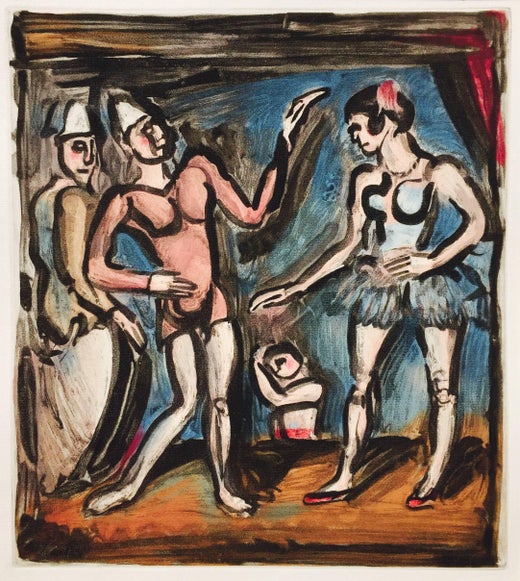
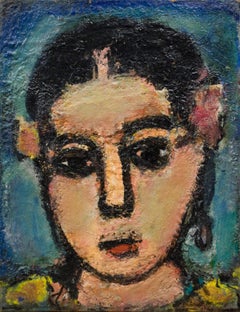
Executed in 1937, Carlotta belongs to a group of portraits of members of society. Unlike Picasso and Toulouse-Lautrec, who portrayed these individuals with pathos, Rouault’s approach was unapologetic and raw. In the present work several layers of pigment can be discerned; the build-up of translucent and opaque layers of paint creates a three-dimensionality that characterizes the artist’s strongest work. Furthermore, the work is highlighted by the deep swaths of black delineating the subject, representing a signature element of Rouault’s portraiture of this period.
About the Seller
4.9
Gold Seller
Premium sellers maintaining a 4.3+ rating and 24-hour response times
Established in 2000
1stDibs seller since 2015
460 sales on 1stDibs
Typical response time: <1 hour
- ShippingRetrieving quote...Shipping from: Dallas, TX
- Return Policy
More From This Seller
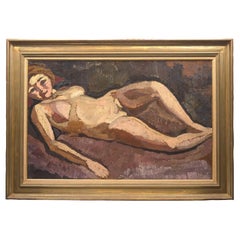
View AllRoger de la Fresnaye (French, 1885-1925) - Femme Nue Couchée
Located in Dallas, TX
Roger de la Fresnaye (French, 1885-1925) - Femme Nue Couchée
Monumental 90% life size nude model painting executed during the zenith and birth of cubism and expressionism.
Oil on ...
Category
Vintage 1910s French Expressionist Paintings
Materials
Paint
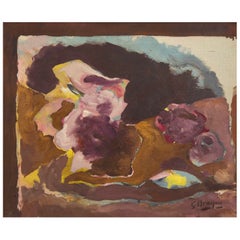
Georges Braque (French, 1882-1963) - Nature Morte au Pot
By Georges Braque
Located in Dallas, TX
Georges Braque (French, 1882-1963) - Nature Morte au Pot
Signed ‘G Braque' (underlined) bottom right
Oil on canvas
Canvas: 18 x 21.75 in. (45.7 x 55.2cm)
Framed: 26 x 30 inches
Execu...
Category
Vintage 1950s French Expressionist Paintings
Materials
Paint
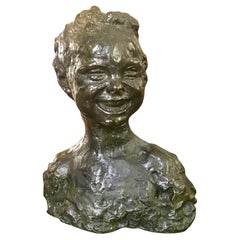
Emile Antoine Bourdelle Enfan
By Émile Antoine Bourdelle
Located in Dallas, TX
Emile Antoine Bourdelle (French, 1861-1929) Bronze Sculpture
Bronze brutalist bust titled Enfant Riant (Laughing Child) Most probably modeled by his daughter; Rhodia. Bourdelle was...
Category
Vintage 1910s French Figurative Sculptures
Materials
Bronze
Francoise Emile Decorchemont Pate De Verre Mold of a Woman’s Face
By Francois Decorchemont
Located in Dallas, TX
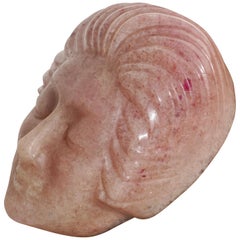
François-Emile Decorchemont Pate-de-Verre Glass Mold Of A Female Ladies Face. A rare, large and very heavy sculpture of either a mask or a modeled face. At 3.5 inches thick in glass with a peach, pink or rose color; this statue was exhibited in the Brooklyn Museum, New York in 1971. With much research; I haven’t seen or heard of a similar form by Decorchemont. The original Brooklyn Museum loan sticker is on verso with the Decorchemont stamp on her left cheek. For serious collectors or rare Art Deco, Art Nouveau glass.
Circa 1910
Molded Signature DECORCHEMONT
Height: 7 Inches (13.3 cm)
Width:. 5.2 Inches (16.5cm).
AVANTIQUES is dedicated to providing an exclusive curated collection of Fine Arts, Paintings, Bronzes, Asian treasures, Art Glass and Antiques. Our inventory represents time-tested investment quality items with everlasting decorative beauty. We look forward to your business and appreciate any reasonable offers. All of our curated items are vetted and guaranteed authentic and as described. Avantiques only deals in original antiques and never reproductions. We stand behind our treasures with a full money back return if the items are not as described.
François-Emile Décorchemont French, 1880-1997
François Décorchemont, originally an accomplished painter and potter of recognized ability, turned to the making of glass in 1904. Pâté de verre was the medium in which he excelled and for which he is best known. After studying decorative art in Paris, François Décorchemont returned to his native Conches in 1910 to develop new techniques in stained glass, particularly in the use of crystal to give multicolored and faceted panes. After 1909, while continuing to produce fine glass paste pieces, Francois Decorchemont began to experiment with a new casting technique. François Decorchemont, Emile's son and also an artist, helped out in his father’s studio, in particular helping him to research the possibilities of creating jeweled adornments in pates d'email (enamel pastes) for Gerome's polychrome sculptural creations.
Francois Décorchemont, a potter and painter at the outset of his career, became fascinated with the IDEA of developing and utilizing a thin translucent glass material in his work. It was in essence the revival and an adaptation of a long forgotten Egyptian glass-making process using colored crystal powdered glass, metallic oxides and an adhesive paste. This "new" material, known as pâte de verre was developed around the turn of the century, principally at the Sevres porcelain factory, by a number of artists working there, notably Henri Cros and Albert Dammouse.
The end of the 19th century was an illuminated period in the history of art. Impressionist painting appeared and created an interest in glass as material. Traditional sculpting materials such as bronze and marble made way for glass with its possibilities of light and color. Henry Cros and François Décorchemont became the leaders of French pâte de verre and facilitated the proliferation of this colorful glass. His first major work, in 1934, was inn the Eglise Sainte-Odile near Porte Champerret in Paris, some 300 square meters of brilliant colors. After the war, he devoted his work to churches in the Eure, including of course Beuzeville where, thanks to the generosity of the local council, the church is lit at night so that his work can be admired from outside. During the first half of the 20th century a number of French artists became famous for their work in pâte de verre, and Francois Decorchemont among them. March 2014, 20th Century’s Greatest Art Dealer Felix Marcilhac’s Collection Privee at Sotheby’s - Chang Yi Entrusts Antoine Leperlier in the Bidding of a Francois Decorchemon's Original. It has been reported that Felix Marcilhac’s Collection Privee auction at Sotheby’s brought in 33,125 Euros (28,000 RMB), three times the estimated price. Marcilhac is considered the greatest Art Deco dealer...
Category
Vintage 1910s French Art Deco Figurative Sculptures
Materials
Art Glass
Pierre Auguste Renoir French, 1841-1919 La Petite Laveuse or L
Eau de la Petite
By Pierre-Auguste Renoir
Located in Dallas, TX
Pierre Auguste Renoir
French, 1841-1919
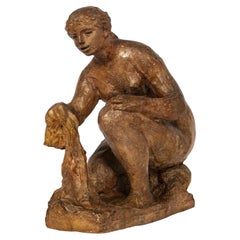
La Petite Laveuse or L'Eau de la Petite Laveuse Accroupie
Inscribed Renoir at the base
Patinated plaster
Height 13 3/8 inches (34 cm)
Conditi...
Category
Vintage 1910s French Beaux Arts Figurative Sculptures
Materials
Plaster
Emile Antoine Bourdelle “Arlequin” Bronze Sculpture Valsuani Foundry
By Émile Antoine Bourdelle
Located in Dallas, TX
Emile Antoine Bourdelle (French, 1861-1929) Bronze Sculpture
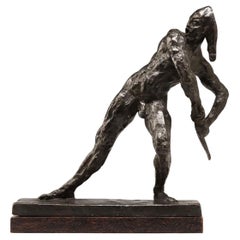
L' Arlequin.
Conceived in 1905 and cast around 1954
A rare museum quality impressionist - Brutalist interpretation of a harlequin swordsman in bronze with black/brown patina.
Bears the cast signature E. A. BOURDELLE top of the base, © by Bourdelle along one side.
Foundry seal of A. VALSUANI CIRE PERDUE. On corner.
Measures 16 x 16.5 x 5 inches.
Very good condition throughout, no damage, repair or heavy wear. Scratches and wear to patina throughout commensurate of material age and use.
Provenance: The estate of Morton and Estelle Sosland.In Kansas City, the Sosland family name is synonymous with both giving, and the arts. Of their many contributions to the community, 'The Soslands gave one of the nation's finest private collections of American Indian art to the Nelson-Atkins' museum. The content of this auction bears testament to their keen eye and varied interests.
In September 1893 Bourdelle joined the studio of Auguste Rodin. His collaboration with Rodin lasted fifteen years. In 1895, he received his first official commission, a war monument for the city of Montauban. His proposed plans, different from traditional monuments, created a scandal. Rodin intervened on his behalf, and the monument was finally erected in 1902.
In 1900, Bourdelle demonstrated his independence from Rodin's style with a bust of Apollo. In the same year, Bourdelle, Rodin and the sculptor Desbois opened a free school of sculpture, the Institut Rodin-Debois-Bourdelle. One of the students was Henri Matisse, who later produced some remarkable sculpture, but the school did not last long.
Bourdelle in his studio sketching Grace Christie
In 1905, Bourdelle had his first personal exhibition, in the gallery of the foundry-owner Hébrand. With the support of Hébrand and the material assistance of his foundry, Bourdelle was able to make larger works and earn greater recognition. His father died in 1906, and Bourdelle changed his first name to simply Antoine, after his father. He married his second wife, Cléopatre Sevastos (1892-1972), who was of Greek origin. She and their daughter, Rhodia, became a frequent inspiration for his works.[6]
In 1908, Bourdelle left the studio of Rodin and set out on his own. In 1909 he exhibited a new work, Hercules the Archer at the annual Salon of the Societé Nationale des Beaux-Arts. He began to teach at the Académie de la Grande Chaumière, where his students included Giacometti, Isaac Frenkel and Adaline Kent...
Category
Vintage 1940s French Brutalist Figurative Sculptures
Materials
Bronze
You May Also Like
Georges Rouault Portrait de Marie Thérèse Bonney
By Georges Rouault
Located in Dallas, TX
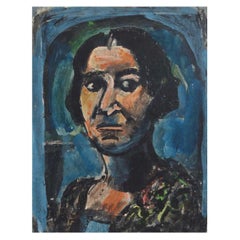
Georges Rouault (French, 1871-1958) - Étude pour le Portrait de Marie Thérèse Bonney. A large specimen painting for Rouault beautifully framed in a shadow fashion making a grandiose ...
Category
1930s Expressionist Paintings
Materials
Paint
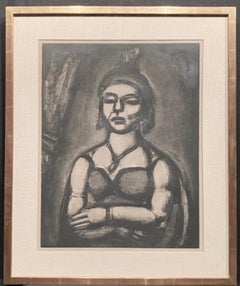
Des Ongles et Du Bec (abstract female portrait)
By Georges Rouault
Located in Wilton Manors, FL
Artist Georges Rouault
(1871, France - 1958, France)
Main title
"Des ongles et du bec"
Etching and aquatint on wove paper.
Creation date
1926 / 1948
Publisher: Etoile Filante, P...
Category
Mid-20th Century Abstract Abstract Prints
Materials
Etching, Aquatint
$990 Sale Price
44% Off
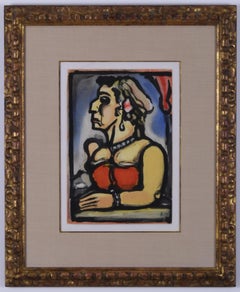
Madame Carmencita, Plate 9
By Georges Rouault
Located in Fairlawn, OH
Madame Carmencita, Plate 9
From: Cirque de l'etoile filante (Circus of the Shooting Star), 1934-1936 (published 1938)
Signed with the artist's initials and dated, lower right of plat...
Category
1930s French School Figurative Prints
Materials
Aquatint
Carlotta
By Georges Rouault
Located in Mc Lean, VA
Literature
Dorival, Bernard & Rouault, Isabelle, Rouault, L’Oeuvre peint(Monaco, 1988), vol. 2, p. 150, no. 1864 (illus.)
Executed in 1937, Carlotta belongs to a group of portraits...
Category
1930s Post-Impressionist Figurative Paintings
Materials
Canvas, Oil
Price Upon Request
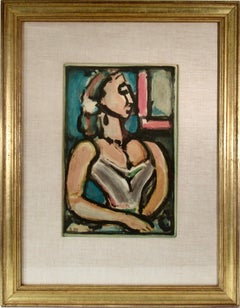
"Femme Fiere" from the suite "Les Fleurs du Mal""
By Georges Rouault
Located in San Francisco, CA
This artwork titled "Femme Fiere" from the suite "Les Fleurs du Mal" created in 1937/38, is an original color aquatint on Montval paper by renown French artist Georges Rouault, 1871-...
Category
Mid-20th Century Expressionist Figurative Prints
Materials
Aquatint
Mademoiselle Irma from Reincarnations du Pere Ubu, by Georges Rouault
By Georges Rouault
Located in Long Island City, NY
Mademoiselle Irma from Reincarnations du Pere Ubu
Georges Rouault, French (1871–1958)
Date: 1928
Aquatint Etching, signed in plate
Edition of 305
Image Size: 11.5 x 7 inches
Frame Si...
Category
1920s Expressionist Figurative Prints
Materials
Etching, Aquatint