1 of 4
A Good Early 19th Century Ex-Voto Retablo Painting
$4,800List Price
About the Item
- Dimensions:Height: 10 in (25.4 cm)Width: 14 in (35.56 cm)Depth: 0.01 in (0.26 mm)
- Style:Folk Art (Of the Period)
- Place of Origin:
- Period:
- Date of Manufacture:1852
- Condition:
- Seller Location:San Francisco, CA
- Reference Number:1stDibs: LU84761090662
Authenticity Guarantee
In the unlikely event there’s an issue with an item’s authenticity, contact us within 1 year for a full refund. DetailsMoney-Back Guarantee
If your item is not as described, is damaged in transit, or does not arrive, contact us within 7 days for a full refund. Details24-Hour Cancellation
You have a 24-hour grace period in which to reconsider your purchase, with no questions asked.Vetted Professional Sellers
Our world-class sellers must adhere to strict standards for service and quality, maintaining the integrity of our listings.Price-Match Guarantee
If you find that a seller listed the same item for a lower price elsewhere, we’ll match it.Trusted Global Delivery
Our best-in-class carrier network provides specialized shipping options worldwide, including custom delivery.You May Also Like
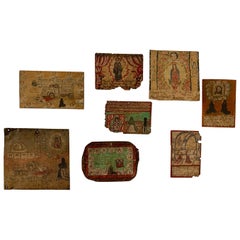
Collection of Mexican Prayer Plaques "Retablos Ex-Votos" from 1950s and 1960s
Located in North Miami, FL
This is an amazing and important collection of 8 plaques (7 tin metal and one in wood) that have been hand painted by Catholic religious devotees in gratitude to either Christ, Virgi...
Category
Vintage 1950s Mexican Folk Art Drawings
Materials
Tin
$2,175 Sale Price / item
25% Off
H 10 in W 10.75 in D 0.25 in
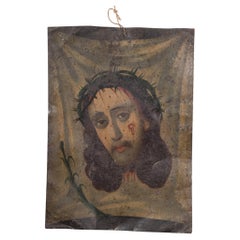
19th c. Mexican Retablo "Veronica
s Veil" c.1880
Located in San Francisco, CA
ABOUT
An original 19th century Mexican folk retablo "Veronica's Veil" or "El Divono Rostro" in Spain . Oil paint on tin.
The Veil of Veronica, known in Italian as the Volto Santo or Holy Face, is a Roman Catholic Relic which, according to legend, bears the likeness of the Face of Jesus that was imprinted on it prior to Jesus' crucifixion. According to Roman Catholicism, Saint Veronica encountered Jesus in Jeruselum on the way to Calvary. When she paused to wipe the sweat (Latin, suda) off his face with her veil, his image was left on the veil.
In the small village of Osa de la Vega in Spain, there lived a couple who led a very pious life. They were Gregorio de la Torre and Isabel Corral. From their father, Juan Montilla, they inherited a picture of the Face of Jesus or the Divino Rostro. A story that is told one day, to the amazement of many who confirmed its veracity, the picture began to perspire with living blood. News of this extraordinary event spread swiftly and widely throughout the land.
CREATOR Unknown.
DATE OF MANUFACTURE c.1880.
MATERIALS AND TECHNIQUES Oil Paint on Tin.
CONDITION Good. Wear consistent with age and use.
DIMENSIONS H 14 in. W 10 in.
HISTORY
Retablos, better known as 'laminas' in Mexico, are small oil paintings on tin, wood and sometimes copper which were used in home altars to venerate the almost infinite number of Catholic saints. The literal translation for 'retablo' is 'behind the altar.' This unique genre of art, deeply rooted in European history, was brought to Mexico with the arrival of the Spanish and then ultimately adopted by New World mestizo natives to become what is known today as the Mexican folk retablo.
The retablo was an art form that flourished in post conquest Mexico and then ultimately, with the introduction of inexpensive mediums such as tin, reached its pinnacle of popularity in the last quarter of the 19th century. With some exceptions, mostly untrained artists from the provinces worked to produce and reproduce these sacred images; some subjects painted more prolifically than others. A typical "retablero" may have reproduced the same image hundreds, if not thousands of times in his or her career.
These oil paintings were sold to devout believers who displayed them in home altars to honor their patron saints. There are virtually hundreds of saints, each invoked to remedy a different situation. "San Ysidro Labrador," the patron saint of farmers, is venerated for good weather...
Category
Antique 19th Century Mexican Folk Art Paintings
Materials
Tin
19th C. Mexican Retablo "Veronica
s Veil", c.1880
Located in San Francisco, CA
About
An original 19th century Mexican folk retablo "Veronica's Veil" or "El Divono Rostro" in Spain . Oil paint on tin.
The Veil of Veronica, known in Italian as the Volto Santo or Holy Face, is a Roman Catholic Relic which, according to legend, bears the likeness of the Face of Jesus that was imprinted on it prior to Jesus' crucifixion. According to Roman Catholicism, Saint Veronica encountered Jesus in Jeruselum on the way to Calvary. When she paused to wipe the sweat (Latin, suda) off his face with her veil, his image was left on the veil.
In the small village of Osa de la Vega in Spain, there lived a couple who led a very pious life. They were Gregorio de la Torre and Isabel Corral. From their father, Juan Montilla, they inherited a picture of the Face of Jesus or the Divino Rostro. A story that is told one day, to the amazement of many who confirmed its veracity, the picture began to perspire with living blood. News of this extraordinary event spread swiftly and widely throughout the land.
CREATOR Unknown.
DATE OF MANUFACTURE c.1880.
MATERIALS AND TECHNIQUES Oil Paint on Tin.
CONDITION Good. Wear consistent with age and use.
DIMENSIONS H 14 in. W 10 in.
HISTORY
Retablos, better known as 'laminas' in Mexico, are small oil paintings on tin, wood and sometimes copper which were used in home altars to venerate the almost infinite number of Catholic saints. The literal translation for 'retablo' is 'behind the altar.' This unique genre of art, deeply rooted in European history, was brought to Mexico with the arrival of the Spanish and then ultimately adopted by New World mestizo natives to become what is known today as the Mexican folk retablo.
The retablo was an art form that flourished in post conquest Mexico and then ultimately, with the introduction of inexpensive mediums such as tin, reached its pinnacle of popularity in the last quarter of the 19th century. With some exceptions, mostly untrained artists from the provinces worked to produce and reproduce these sacred images; some subjects painted more prolifically than others. A typical "retablero" may have reproduced the same image hundreds, if not thousands of times in his or her career.
These oil paintings were sold to devout believers who displayed them in home altars to honor their patron saints. There are virtually hundreds of saints, each invoked to remedy a different situation. "San Ysidro Labrador," the patron saint of farmers, is venerated for good weather...
Category
Antique 19th Century Mexican Folk Art Paintings
Materials
Tin
Early 19th century horse painting
By Dean Wolstenholme
Located in Seaford, GB
A Timeless Depiction of the English Fox Hunt
The early 19th-century fox hunting scene, attributed to Dean Wolstenholme Elder, is a stunning representation of the aristocratic traditi...
Category
Antique 1810s English Regency Paintings
Materials
Canvas

Pair of Early 19th Century Paintings
Located in Martlesham, GB
A lovely pair of early 19th century paintings of flowers within a gilt and red border, some paint loss and in later frames but very decorative, circa 1820.
Category
Antique 1820s English Regency Paintings
Materials
Glass

Early 19th Century Musical Nymphs Painting
Located in Fulton, CA
Fine European school oil painting on canvas, 19th century. Nymphs with musical instruments. Period frame. Unsigned.
Category
Antique Mid-19th Century Victorian Paintings
Materials
Canvas

Early 19th Century French Trumeau Painting
Located in Scottsdale, AZ
Early 19th Century French Trumeau Painting
Gorgeous painting purchased in France.
Age appropriate wear, see detailed photos.
Message us with any questions.
Category
Antique Early 19th Century French French Provincial Paintings
Materials
Paint

18th / Early 19th Century Miniature Painting
Located in Delft, NL
An 18th / early 19th century miniature painting
An 18th / early 19th century miniature painting painted on glass and framed.
The copper framed miniature painting in another copp...
Category
Antique Late 18th Century European Paintings
Materials
Copper

Early 19th Century English Naive Landscape Painting
Located in San Francisco, CA
Early 19th century, English naive landscape painting with bird's-eye maple frame. Cleaned and stretched with good aged surface, circa 1825.
Category
Antique 19th Century English Primitive Paintings
Materials
Birdseye Maple, Canvas

Lepoittevin Early 19th Century Marine Oil Painting
By Eugene Le Poittevin
Located in 263-0031, JP
A marine tableau, oil on wood board, by the French Romantic painter Eugène Lepoittevin (1806-1870). The signature “Poitevin” appears in the lower right: our painter seems to have gon...
Category
Antique Mid-19th Century French Paintings
Materials
Canvas

Still Thinking About These?
All Recently ViewedMore Ways To Browse
Antique Retablos
Our Lady Guadalupe
Clair Seglem
Modernist Landscape Swedish
Small 19th Century Paintings
Antique Paintings Of Jesus
Art Deco Flowers Painting
Italian Paintings 16th Century
Jesus Crucifixion
19th French Portrait Woman
Antique Paintings Of Flowers
Chinese Pith Paintings
French Orientalist Paintings
German Village
Hudson Vintage Furniture
Italian Oil Painting Renaissance
Jaime Parlade
China Export Watercolour