Items Similar to Grand Tour Pen
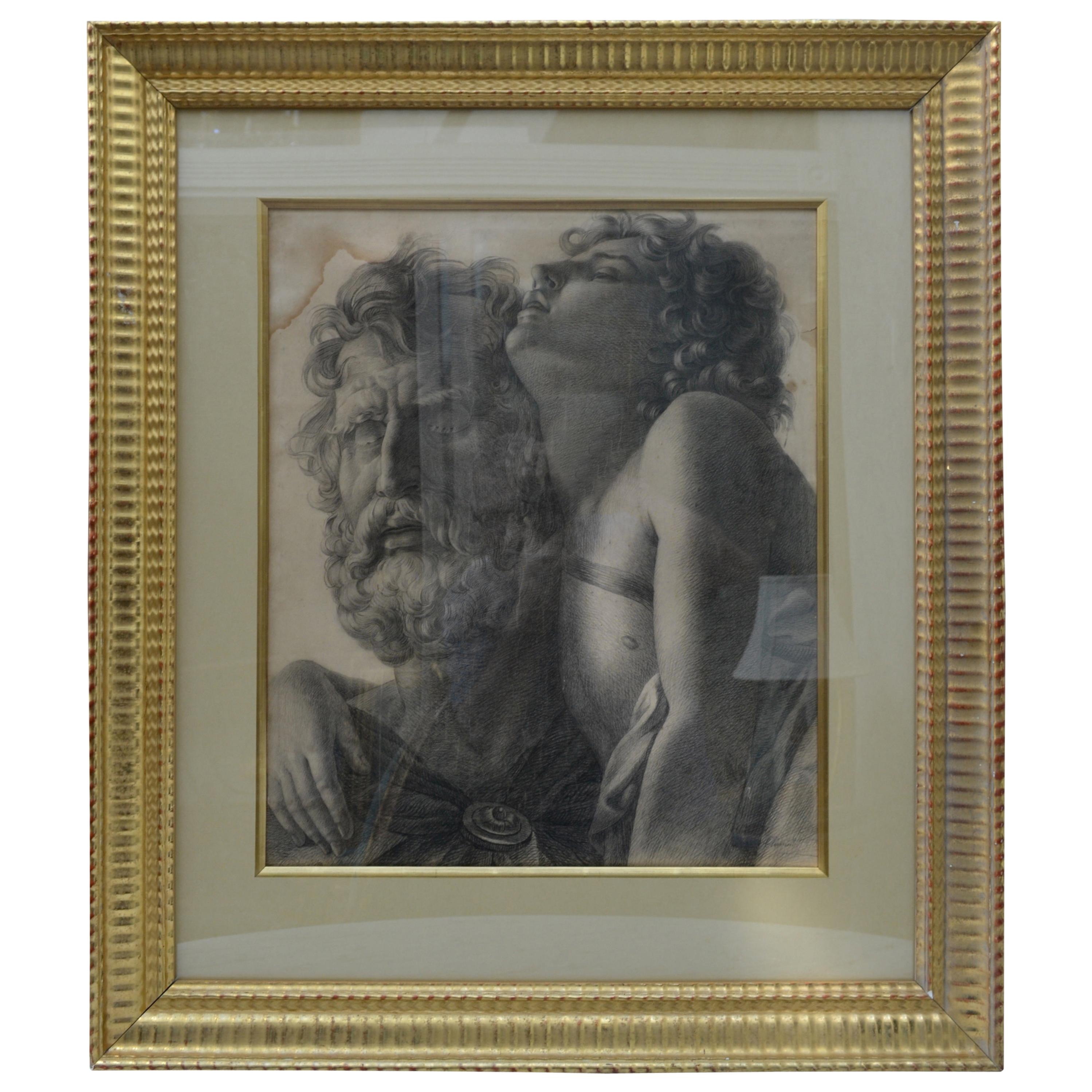
Ink Wash Drawing Bearded Patriarch, After the Italian Baroque
Want more images or videos?
Request additional images or videos from the seller
1 of 9
Grand Tour Pen
Ink Wash Drawing Bearded Patriarch, After the Italian Baroque
$1,300
£991.62
€1,129.76
CA$1,827.16
A$1,993.39
CHF 1,055.49
MX$23,886.43
NOK 13,442.19
SEK 12,291.89
DKK 8,435.75
About the Item
A spirited 19th-century Continental pen and ink wash drawing on laid paper, depicting a bearded patriarchal figure, his robes sweeping in dynamic folds as he gestures commandingly toward the heavens, accompanied by attendant putti. The composition recalls the vigorous figural manner of Italian Baroque masters such as Giovanni Battista Tiepolo or Luca Giordano, whose late 17th- and early 18th-century drawings inspired countless 19th-century academic copies and Grand Tour reinterpretations.
Executed with fluid brown ink and sepia wash, the work captures the tonal energy and atmospheric vitality characteristic of Tiepolo’s Venetian school, emphasizing chiaroscuro contrasts and rhythmic movement. The artist demonstrates an understanding of draftsmanship that bridges study and homage, suggesting a trained hand well-versed in Old Master techniques.
Presented under glass within a mid-19th-century carved walnut frame with a repeating oval bead-and-reel border, the drawing retains its period character and soft patination. The reverse bears remnants of an early paper label from a previous collection or framer.
Such drawings were highly sought-after by Grand Tour travelers and collectors seeking tangible connections to the grandeur of Baroque Rome and Venice. They often served as instructional or devotional images, bridging the line between academic study and fine art.
Measurements: 15.625 in w x 13.635 in h (framed).
- Dimensions:Height: 13.635 in (34.64 cm)Width: 15.625 in (39.69 cm)Depth: 0.25 in (6.35 mm)
- Style:Grand Tour (Of the Period)
- Materials and Techniques:
- Place of Origin:
- Period:
- Date of Manufacture:19th century
- Condition:Wear consistent with age and use. Minor wear commensurate with age. Some wear to frame, paper has some small areas of loss to edges.
- Seller Location:Atlanta, GA
- Reference Number:1stDibs: LU7838247540612
About the Seller
5.0
Platinum Seller
Premium sellers with a 4.7+ rating and 24-hour response times
Established in 2012
1stDibs seller since 2022
239 sales on 1stDibs
Typical response time: <1 hour
- ShippingRetrieving quote...Shipping from: South Easton, MA
- Return Policy
More From This Seller
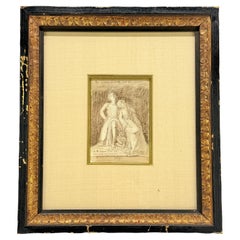
View AllGrand Tour Neoclassical Allegorical Drawing on Paper, 19th Century
Located in Atlanta, GA
This artwork is a finely executed ink drawing with wash, possibly from the late 18th or early 19th century, bearing an inscription that reads, "The letter killeth but the spirit give...
Category
Antique 19th Century Italian Neoclassical Drawings
Materials
Giltwood, Paper
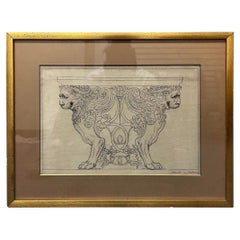
19th Century Italian Grand Tour Era Architectural Drawing on Paper, Framed
Located in Atlanta, GA
An early 18th or 19th century architectural concept drawing of opposing lions with marble top likely as a console table. Marked in early ink to lower r...
Category
Antique 19th Century Drawings
Materials
Paper
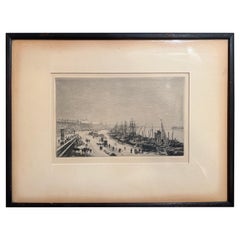
Maxime Lalanne "Rade de Bordeaux" original etching C. 1868
Located in Atlanta, GA
This is a mid 19th century etching entitled "Rade de Bordeaux, Janvier" (Port Of Bordeaux In Winter), Maxime Lalanne in London in 1868. The etching depicts many boats in the busy harbor of Bordeaux, including small sailboats, as well as tall ships. Another harbor is seen in the distance across the river on the left. Snow covered buildings are on the left and extending long distances in the distant background. Many people occupy the road and ground centrally and on the left along with some horses or mules attached to carts. The sky is a wintery gray.
It is signed in the plate in the lower left, the title and date are in the center and Bordeaux and the year are included in script along the top of a wall in the lower left of the engraving. This etching is held by many museums and institutions, including The National Gallery of Art, Washington, D.C.
François Antoine Maxime Lalanne (1827-1886) was a leading French etcher and painter of landscapes and urban views, who was at the forefront of the French revival of etching during the 1860's. He grew up in Bordeaux, but he refined his artistic skills and worked in Paris. His art was first exhibited at the Paris Salon in 1852 and he continued to regularly show both etchings and paintings there until the mid 1880's. He was also the author of several important books on the subjects of etching and other graphic arts. He was a founding member of the Societe des Aquafortistes, along with Auguste Delatre, Cadart, Ribot and Bracquemond. Lalanne created over one hundred and fifty fine etchings. Lalanne's unique style of art influenced many French and English artists in the twentieth century.
Philip Gilbert Hamerton (1834-1894) was a British artist, art critic and author. He was particularly focussed on contemporary graphic art and printmaking techniques. He frequently wrote about the theory of the English Etching Revival, contributing to the establishment of etching as an original and major art medium. He was the editor of The Portfolio (1870-1893), a major arts publication dealing extensively with the art of etching. His most influential book was "Etching and Etchers", which detailed the creative and technical aspects of etching and engraving. The first edition was published in 1868 and included original etchings by Jongkind, Haden and Palmer, as well later states of 17th century Dutch masters. He published a second edition in 1876 without any original etchings. A third edition was published in 1880 in a large paper edition, limited to one thousand copies, which included twenty original etchings from contemporary artists Whistler, Haden, Palmer, Israels, Jacque, Jacquemart, Lalanne, Appian, Legros, Herkomer. including this original Lalanne etching...
Category
Antique 19th Century French Prints
Materials
Paper
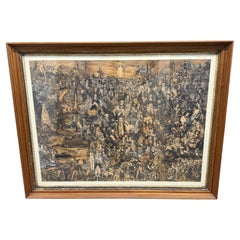
19th C, Decopauge "The Allegory of Civilization" Magnificent
Important Work
Located in Atlanta, GA
“The Allegory of Civilization: A Historical Collage of Progress and Virtue”
This monumental and highly unusual large-scale decoupage tableau—measuring 44.25 inches wide by 35 inches high—is an extraordinary and densely composed visual compendium of 18th- and 19th-century figures of global significance. Executed in a monochrome palette with light hand-tinting, the work comprises hundreds of individual portrait engravings and narrative vignettes intricately collaged together to form a panoramic composition of historical, cultural, scientific, literary, and military figures, interspersed with allegorical and architectural elements.
This form of assemblage is rooted in the 19th-century practice of *papiers collés* and popular scrapbooking traditions, but this work surpasses decorative craft in both ambition and intellectual scope, bordering on the encyclopedic. The hand-cut images appear to have been culled from period illustrated books and engraved portrait sources—most notably from publications such as *The Illustrated London News*, *Harper’s Weekly*, and *The Eclectic Magazine*—as well as engraved frontispieces and serialized pictorial histories. The result is a vast visual lexicon of Enlightenment and Romantic thought, likely intended as a celebration of moral, intellectual, and national achievement.
At the composition’s apex, presiding over the assembled figures, is a classically draped winged allegory—possibly *Fame* or *Liberty*—holding a trumpet and laurel branch. The mountainous background, waterfalls, architectural ruins, and pastoral settings lend the piece a theatrical and didactic ambiance, evoking 19th-century didascalic panoramas.
A partial identification of historical figures visible in the composition includes:
* **George Washington** – Posed centrally, gesturing outward with one hand; he appears multiple times in the scene and is shown in both military uniform and formal dress.
* **Napoleon Bonaparte** – Recognizable by his uniform, bicorne hat, and stern gaze; appears in profile and frontal portraits.
* **Benjamin Franklin** – Seen holding a scroll; a common figure in Enlightenment iconography.
* **William Shakespeare** – Near the lower central register; recognizable from the famous Chandos portrait derivative.
* **Johann Wolfgang von Goethe** and **Friedrich Schiller** – Likely placed in the literary cluster with other Germanic figures.
* **Florence Nightingale** – Shown in nurse’s cap and shawl, likely near a grouping of women in medical service.
* **Queen Victoria** and **Prince Albert** – Appearing in regalia, along with a number of courtly figures.
* **Ludwig van Beethoven**, **Franz Liszt**, and **Niccolò...
Category
Antique 19th Century French High Victorian Decorative Art
Materials
Giltwood, Paper
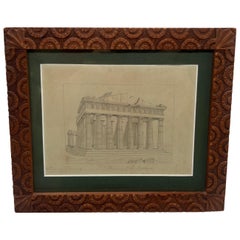
Grand Tour Pencil Drawing "Remains of the Parthenon" Fine Carved Frame
Located in Atlanta, GA
Charles Lamson Swasey (American New Bedford Massachusetts, 1815-1888).
This wonderful grand tour graphite on paper drawing was done in December 1839 and depicts the remains of the ...
Category
Antique 19th Century American Grand Tour Drawings
Materials
Wood, Paper
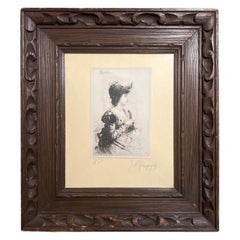
Ignaz Marcel Gaugengigl (German, 1855-1932) Profile of a Women Drypoint etching
Located in Atlanta, GA
Ignaz Marcel Gaugengigl (German, 1855-1932) Profile of a Women Drypoint etching.
A period drypoint etching by the German artist - Profile of a Women or Women with a Bonnet. Many exa...
Category
Early 20th Century German Art Nouveau Prints
Materials
Wood, Paper
You May Also Like
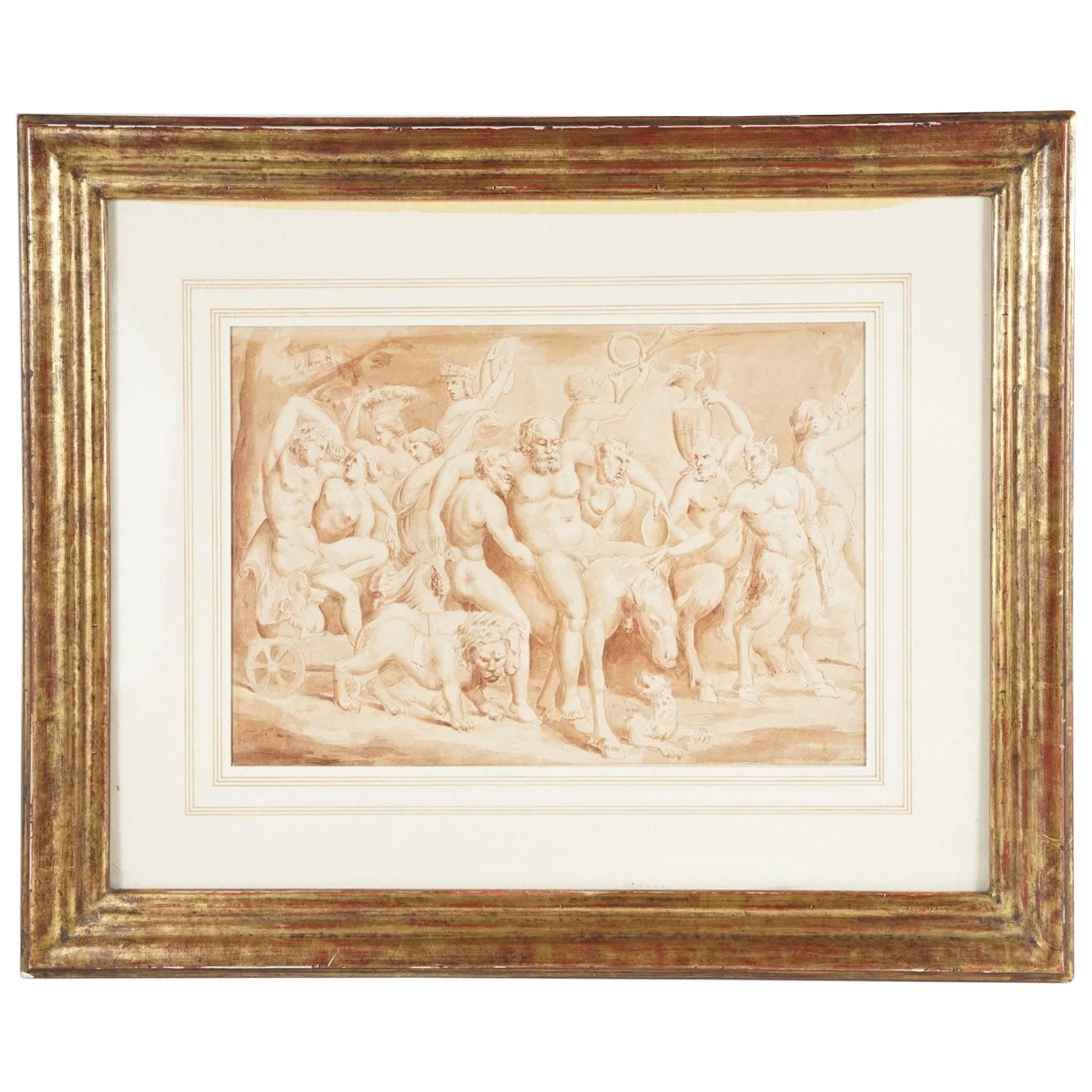
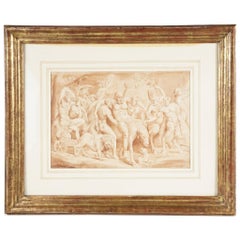
Late 17th Century Italian Ink and Wash Drawing of “The Drunken Silenus"
Located in Hudson, NY
This work likely Italian dates from circa 1680-1700. It relates directly to a 16th century engraving of the same subject after a drawing by Giul...
Category
Antique Late 17th Century Italian Renaissance Drawings
Materials
Paper
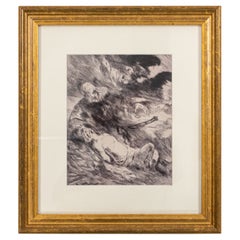
Vintage Pen and Ink Drawing in a Gilt Wood Frame
Located in Queens, NY
French Victorian pen and ink drawing of stylized figures in a gilt wood frame.
Category
Antique Late 19th Century French Victorian Paintings
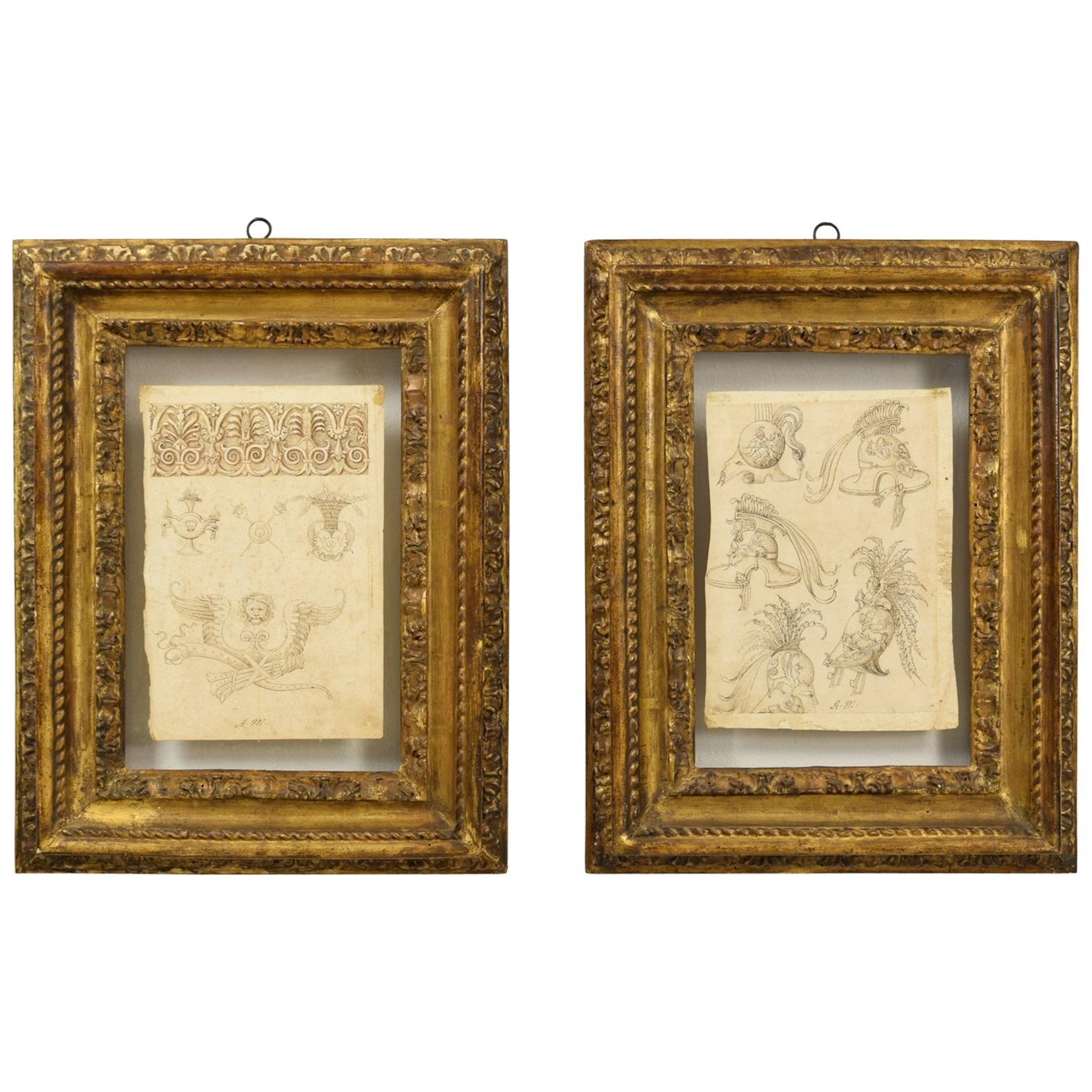
17th Century, Pair of Italian Ink Drawings on Paper with Studies for Grotesques
Located in IT
17th century, pair of ink drawings on paper with studies for grotesques, friezes and helmets.
Painter of central Italy of the 17th century, signed with monogram “A.M.”.
Measurements: cm L 45.5 x H 59.5 x 5.5; cm 22 x 33 / cm L 46.5 x H 59 x 5.5; cm 22.5 x 31.5
The pair of sheets, in good condition, is framed by antique frames in carved and gilded wood. They show some china studies with some studies for different subjects. Specifically, the first sheet represents the design of a frieze of Renaissance taste under which are some studies probably referring to a family coat of arms. Below the center is a monogram “A.M.”.
The sheet is also worked on the back in which are drawn some articulated elements of decoration in the style of the Renaissance grotesque...
Category
Antique 17th Century Italian Baroque Drawings
Materials
Paper
French Academy Drawing of the Byzantine Commander Belisarius after Gerard
Located in Vancouver, British Columbia
Pencil on paper drawing after a late 18th century French neoclassical painting after a painting of Belisarius by Baron Francois Pasal Simo...
Category
Antique Mid-19th Century French Neoclassical Revival Drawings
Materials
Parchment Paper
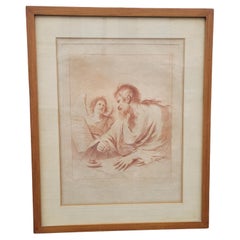
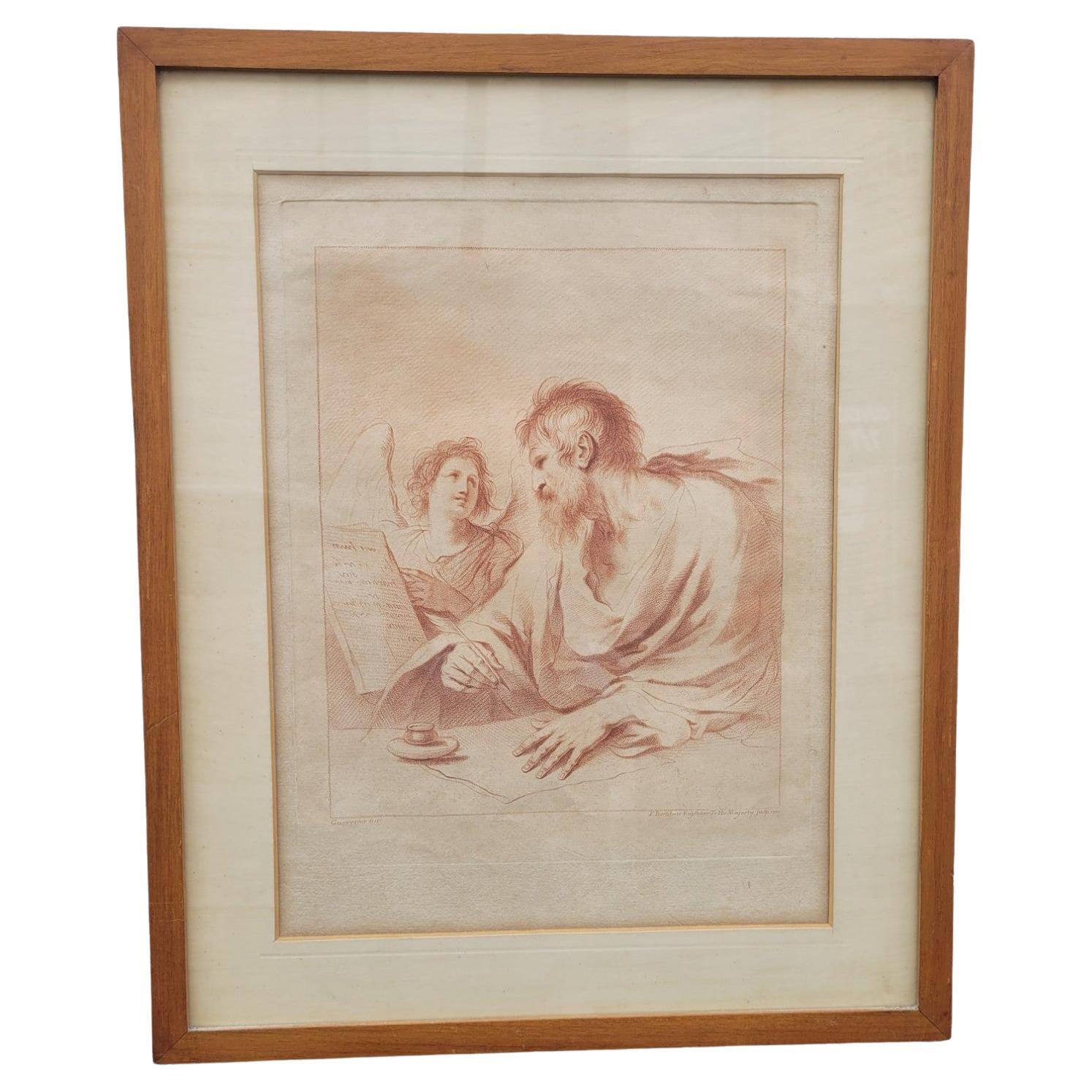
Saint Matthew And The Angel, Engraving After Le Guercin, 18th Century
By Giovanni Francesco Barbieri (Il Guercino)
Located in MARSEILLE, FR
This framed engraving, made in the red chalk style, represents the apostle Matthew writing his Gospel under the dictation of the angel. The angel is Matthew's symbol, because his Gos...
Category
Antique Late 18th Century Italian Baroque Prints
Materials
Paper
Saint Matthew And The Angel, Engraving After Le Guercin, 18th Century
By Giovanni Francesco Barbieri (Il Guercino)
Located in MARSEILLE, FR
This framed engraving, made in the red chalk style, represents the apostle Matthew writing his Gospel under the dictation of the angel. The angel is Matthew's symbol, because his Gos...
Category
Antique Late 18th Century Italian Baroque Prints
Materials
Paper