Want more images or videos?
Request additional images or videos from the seller
1 of 7
Limited Edition 2005 Marielle Guégan Gravure / Engraving
$124.31List Price
About the Item
- Creator:Marielle Guégan (Painter)
- Dimensions:Height: 8.67 in (22 cm)Width: 8.08 in (20.5 cm)Depth: 0.04 in (1 mm)
- Materials and Techniques:Paper,Engraved
- Place of Origin:
- Period:
- Date of Manufacture:2005
- Production Type:New Custom(Limited Edition)
- Estimated Production Time:Available Now
- Condition:
- Seller Location:Paris, FR
- Reference Number:Seller: Pent/G00161stDibs: LU4817215340612
About the Seller
5.0
Vetted Professional Seller
Every seller passes strict standards for authenticity and reliability
Established in 2017
1stDibs seller since 2019
56 sales on 1stDibs
Typical response time: 4 hours
Authenticity Guarantee
In the unlikely event there’s an issue with an item’s authenticity, contact us within 1 year for a full refund. DetailsMoney-Back Guarantee
If your item is not as described, is damaged in transit, or does not arrive, contact us within 7 days for a full refund. Details24-Hour Cancellation
You have a 24-hour grace period in which to reconsider your purchase, with no questions asked.Vetted Professional Sellers
Our world-class sellers must adhere to strict standards for service and quality, maintaining the integrity of our listings.Price-Match Guarantee
If you find that a seller listed the same item for a lower price elsewhere, we’ll match it.Trusted Global Delivery
Our best-in-class carrier network provides specialized shipping options worldwide, including custom delivery.You May Also Like
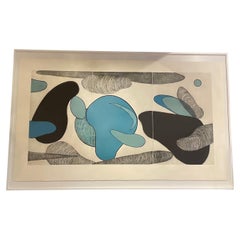
Blue, White, Black Extra, Extra Large Triptych By Marielle Guegan, France
Located in New York, NY
Contemporary French artist Marielle Guegan EXTRA EXTRA large triptych.
Combination of painting and engraving.
White frame with acrylic surface.
Category
21st Century and Contemporary French Contemporary Art
Materials
Paint
$18,650
H 54 in W 86 in D 2.5 in
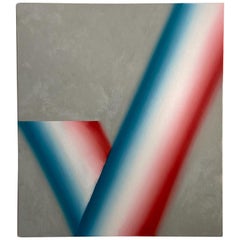
Modern Oil Painting on Canvas by Alex Kwartler Untitled, 2005
Located in Fort Lauderdale, FL
Modern Oil Painting on Canvas by Alex Kwartler Untitled, 2005
Alex Kwartler (b 1979) untitled, 2005 oil on canvas
Red, white and blue 'Check' on a gray b...
Category
Early 2000s American Modern Paintings
Materials
Canvas, Paint
$1,106 Sale Price
38% Off
H 23 in W 20 in D 2 in
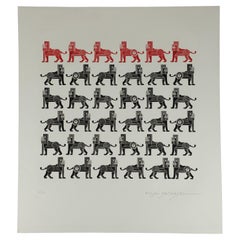
Pedro Friedeberg "Communist Lions By Day" Limited Edition Engraving
By Pedro Friedeberg
Located in Mexico City, MX
"Leones Comunistas de Día" (Communist Monkeys By Day). Engraving print by Mexican artist Pedro Friedeberg. Copperplate engraving on Hahnemühle 300 g. 100% cotton paper. Edition of 86...
Category
21st Century and Contemporary Mexican Post-Modern Prints
Materials
Paper
$3,500
H 33.47 in W 29.53 in D 0.4 in
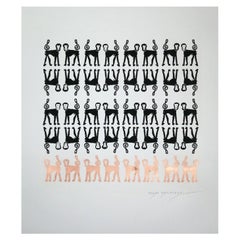
Pedro Friedeberg "Musical Monkeys by Day" Limited Edition Engraving
By Pedro Friedeberg
Located in Mexico City, MX
"Monos Musicales de Día" (Musical Monkeys by Day). Engraving print by Mexican artist Pedro Friedeberg. Copperplate engraving on Hahnemühle 300 g. 100% cotton paper. Edition of 86 pie...
Category
21st Century and Contemporary Mexican Post-Modern Prints
Materials
Paper
$2,800 Sale Price
20% Off
H 33.47 in W 29.53 in D 0.4 in
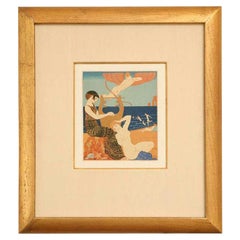
Art Deco Engraving by George Barbier from Chansons De Bilitis Portfolio Framed
By George Barbier
Located in North Miami, FL
This lovely sensual rare French Art Deco engraving from the coveted portfolio Chansons de Bilitis in the 1920s France is by the famed artist; George Barbier. It is exquisitely executed with an Egyptian Revival feel with Art Deco influences of wonderful colors and sensual subject matter. It has been recently custom museum quality reframed with a gold leaf frame with red clay under rub and silk mat. There is a gold thin inner liner frame inside of the silk mat to enhance the custom framing to a higher level. The colored part of the engraving size is 6.5" W x 7" H. There is a tan silk mat that is 3" all around with a 4" Bottom size. This Art Deco work of art is a true beauty. This is from the late 1920s. There were only 133 copies produced making this portfolio a very special and sought after achievement of pure art deco illustration...
Category
Vintage 1920s French Art Deco Paintings
Materials
Gold Leaf
$5,800
H 19.5 in W 17.75 in D 1 in
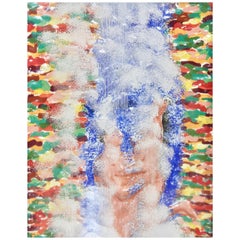
Rosenthal Mural Porcelain Nude Painting, Plate, Painted by Salomé, Limited
By Rosenthal
Located in Berlin, DE
"Wasserfall" - "Waterfall"
Rosenthal mural Porcelain painting, plate, painted by Salomé. Limited.
Waterfall, Rosenthal, studio-line, 1988, ceramic object, design Salome, signed o...
Category
Late 20th Century Modern Contemporary Art
Materials
Porcelain
$2,746 Sale Price
20% Off
H 18.78 in W 14.85 in D 1.82 in
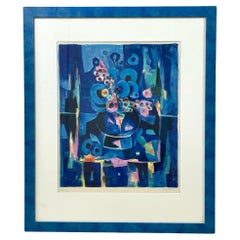
Tony Agostini Pencil Signed Limited Bouquet Au Vase Bleu Lithograph Custom Frame
By Tony Agostini, Claude Monet
Located in Chattanooga, TN
Pencil signed and numbered, limited edition Tony Agostini lithographic print. "Bouquet Au Vase Bleu" is numbered 159/180, printed in 1980. The artwork is housed in an incredibly beau...
Category
Vintage 1980s French Organic Modern Paintings
Materials
Paper, Hardwood
$329 Sale Price
60% Off
H 28.55 in W 24.3 in D 0.6 in
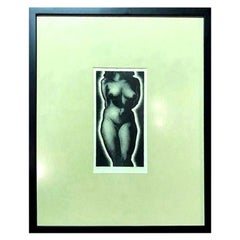
Paul Landacre Signed Limited Edition Mid-Century Modern Nude Wood Engraving Anna
By Paul Landacre
Located in Studio City, CA
A riveting impression on Japanese cream woven paper by famed Modernists wood engraver Paul Landacre. This particular work was purportedly created for the cover of the Prospectus, Pau...
Category
Vintage 1930s American Mid-Century Modern Contemporary Art
Materials
Paper
$2,495
H 21.5 in W 17 in D 1 in
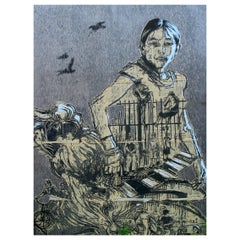
Swoon: Daniella Limited Edition Print
By Phaidon
Located in New York, NY
Print
Digital archival print on Moab Entrada 335 gsm
Measures: 16.00 x 13.00 in
40.6 x 33.0 cm
Edition of 50
This work comes with a signed Certificate of Authenticity.
In partnership with Maison de...
Category
2010s American Prints
Materials
Paper
McDermott
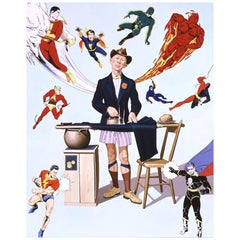
McGough Superhero #4 Limited Edition Print
By Phaidon
Located in New York, NY
Print
Print made with archival pigments on fine art rag paper
Measures: 24.00 x 20.00 in
61.0 x 50.8 cm
Edition of 50
This work is signed and numbered by the artist.
This print by artist duo McDermott and McGough...
Category
2010s American Prints
Materials
Paper
More From This Seller
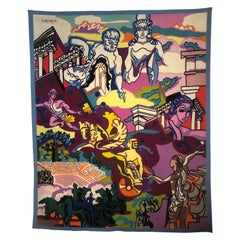
View AllFrench Artist Charles Lapicque Tapestry Limited Edition 1/2 "Pelops", 1964
By Charles Lapicque
Located in Paris, France
Exceptional limited edition 1/2 tapestry "Pelops" with certificate from a private collection,
1964.
Ateliers Pinton brothers in Felletin, under the supervision of Pierre Baudouin
2ex + 1EA Editor Aram Iynedjian. The tapestry will be sold with its certificate of authenticity from the gallery.
From the 15th century, the name of Pinton was associated with the Aubusson tapestry. Since then, over the generations, the Pinton family has largely contributed to the development of this fabulous cultural heritage until the creation in the 19th century, of the Felletin factory, in the department of Creuse. Even today, in these workshops, the craftsmen execute the same correct gestures with the same attention to detail and thus extend the chain of the history of the tapestry of tradition but also contemporary. The hand of specialists, the eye of designers and dyers and the taste of the most demanding clientele find their meaning in the fabric of the carpets. The excellence of French know-how, a living heritage society and custodian of Aubusson's cultural heritage, has always collaborated with great artists. The works of Charles Le Brun, Charles Lapicque, Pablo Picasso, Jean-Michel Othoniel, and many other big names in the world of painting, architecture, design, fell into the looms and know-how ancestral of this unique Creuse creator.
Editor Aram Iynedjian
Aram Iynedjian, Lausanne gallery owner and editor of tapestries from Braque, Estève and Lapicque, the latter meets Pierre Baudouin, the most famous of the cardboard painters of the time. The one who translated the works of Le Corbusier, Calder or Picasso into tapestry then collaborates with Charles Lapicque and they will develop a work of great richness.
Lapicque came to realize these two summits which are "Pélops" and "Diane et Actéon".
I realize that you should never try to describe a work of art
Let’s look at it. Let us admire the science of composition, linear purity, technical perfection, the beauty of color, the truth of the drama. Let us see, if we can, the implacable presence of genius.
"We will now understand that after having based a painting on the love of tapestry, it was relatively easy, and very tempting, to build a tapestry faithful to my painting," explained the artist in the exhibition catalog. of the Galerie Verrière in 1970. It was not until 1961 that he began to produce cardboards both for the tapestry of the Lisse in Aubusson, but also at the Mobilier National, with the help of Pierre Baudouin
Charles Lapicque (1898-1988)
Born in 1898 in Theizé (Rhône) in a family practicing both the arts and the sciences, Charles Lapicque is no exception to the rule: gifted for music and drawing, he graduated from the École Centrale in 1921, works as engineer until 1928 before integrating in 1931 a laboratory at the Faculty of Sciences of Paris, where he carried out research on the perception of colors, crowned by the title of Doctor of Physical Sciences in 1938. He thus studies the reactions of the eye in front of an intense light source, at the origin of the formation of starry images which he will use in his works, and defines a theory of the staggering of colors in space which overturns the rules of the Renaissance: "I had shown that the Classic rule, that of Vinci, advocating placing the blues in the distance, the reds, oranges and yellows in the foreground, is
a nonsense; it makes more sense, more favorable to do the opposite. "(In Red and blue in the arts, 1936)
It was around 1920 that Charles Lapicque began to paint in Brittany where he spent every summer since his childhood, first on the motif and then in a workshop that his stepfather Jean Perrin, Nobel Prize in Physics, had him build in 1927 ; he then definitively adopted the work of memory, in accordance with the art of music which he deeply loved and the Bergsonian philosophy of knowledge: "It is up to us to give reality an appearance that it has no itself, a form, a figure (...). "
His youthful production immediately reveals a great originality, oscillating between figuration and abstraction which sometimes intertwine: alongside synthetic paintings by their simplified drawing and their flat colors, he designs an Homage to Palestrina (1925), composed of a grid derived from Cubism, entirely abstract, relayed by a Christ with Thorns (1939), according to a principle that he will develop after 1939, in line with his optical discoveries. In fact, during the war years, an almost abstract period began, that of the tight blue framework, applied to backgrounds ranging from yellow to red and revealing a more or less identifiable world (Jeanne d'Arc crossing the Loire, 1940; Rencontres series, 1940-1945). Exhibited in 1929 by the gallery owner Jeanne Bucher, Lapicque abandoned his scientific career in 1943 to devote himself entirely to painting.
He continued his work which resulted in 1946-1953 in white-frame structures; their much softer lines lead him to the system of
either black or white interlacing which encloses areas of pure color, most often in solid color. With The Battle of Waterloo in 1949, Lapicque still uses optics - zooming in on a given area - to depict spaces with multiple perspectives and decomposed times.
This new interest in the liveliness of color developed in the following period, which can be described as flamboyant or Baroque (1954-1963): illustrated in particular by the series of Breton lagoons and twilight or nocturnal views of Venice in the light. Stars, which the artist himself describes as “daring sweets”, it begins with the Raoul Dufy Prize of the Venice Biennale, awarded in 1953 to the artist who took the opportunity to give free rein to his passion for the Serenissima until July 1956.
Another point in common with his elder brother is the expression of movement. Begun in 1949 in The Battle of Waterloo then in 1952 with Dimanche aux regates, it became an obsession from 1964, in the exploration of new themes, such as the different shots of tennis players captured on the fly (1965), the mythological scenes and sea storms.
These dizzying years precede the artist's last period: as he comes of age, he discovers serenity, revealed by a painting now with acrylic paint, much more peaceful from 1974, which even borders on a childish naivety at the end. of his life.
All of his work includes an astonishing diversity of themes, also nourished by his travels (Rome in 1957, Greece in 1964, Holland in 1974 ...), with a predilection for the sea, rocks, sailboats, music, tennis, horses, wild beasts, but also for history and mythology, as evidenced by knights, kings and ancient gods. It also deploys, in total creative freedom, a wide variety of styles and orientations. Having been one of the pioneers of non-figurative art, thus paving the way for artists like Manessier, Bazaine, Vieira da Silva, De Staël, etc. Owners of the new non-figurative Paris School of the Postwar period, Charles Lapicque then returned to figuration, in a "new interpretation" of appearance, even if he continued to rub shoulders with abstraction at times.
"Drawing runs after color and color after drawing. "
Heir to the Fauves, Charles Lapicque plays like them on pure colors, whose dissonances, associated with a totally free design and an overloaded composition in a multiple space, make him a precursor of the New Figuration in all its forms: the Narrative Figuration born in France in the early 1960s, represented in particular by Gérard Fromanger, Erró, Bernard Rancillac and Gérard Guyomard; Free Figuration born in the early 1980s, marked by Robert Combas, Hervé and Richard Di Rosa, Louis Jammes and François Boisrond, and which, in turn, influenced the American Bad Painting of a Jean-Michel Basquiat or a Keith Haring, deliberately neglected and Expressionist; Lapicque's “Classic subjects” were able to feed Cultivated Painting, which also appeared in the early 1980s with Jean-Michel Alberola, Patrice Giorda and Gérard Garouste...
Category
Mid-20th Century European Tapestries
Materials
Wool
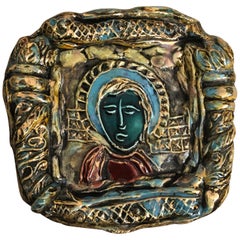
Marc Roussel French Ceramist, Saint Portrait, Vallauris, 1960s
By Marc Roussel
Located in Paris, France
A very rare and beautiful portrait of a Saint, a polychrome ceramic signed hand on the reverse Marc Roussel.
Marc Roussel is the father in Law of François Lembo, as his son-in-law h...
Category
Early 20th Century French Contemporary Art
Materials
Ceramic
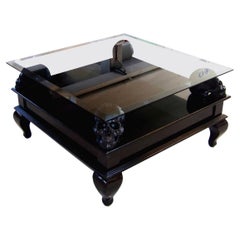
Black Skull Marble Table by John Bizas limited Edition 1/8
Located in Paris, France
The black Skull table is a limited edition of 8, designed and produced in Italy by the artist John Bizas.
Its design following some of the rococo style p...
Category
21st Century and Contemporary Italian Rococo Sofa Tables
Materials
Marble
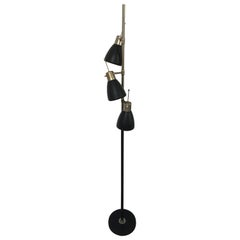
Vintage Monix Floor Lamp 3 Orientable Spots, Édition 1960
By Edition Monix
Located in Paris, France
Rare Monix floor lamp 3 adjustable and orientable spots on a metal barrel nickeled and lacquered black, foot circular base. Each spot has its own switch to be adjusted and can be use...
Category
Antique Mid-19th Century French Floor Lamps
Materials
Metal, Nickel
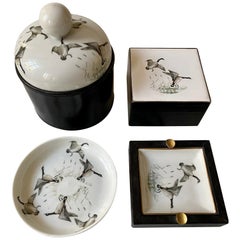
Mallard Duck Desk or Smoker Set in Paris Porcelain, 1960s
By Porcelaine de Paris
Located in Paris, France
A mallard duck desk or smoker set in Parisian porcelain, composed of an ashtray, a desk tray, a business card box and a tobacco jar dressed in cellar leather...
Category
Late 20th Century French Desk Sets
Materials
Leather, Porcelain
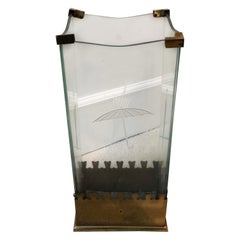
Umbrella Stand Holder by Fontana Arte, Italy, circa 1940
By Fontana Arte
Located in Paris, France
Very rare and beautiful 1940s umbrella stand by Fontana Arte, with a brass frame
and four sheet of glass etched with a delicate umbrellas engraved on the glass.
A gilded metal base...
Category
Mid-20th Century Italian Umbrella Stands
Materials
Brass
$3,267 Sale Price
30% Off