Items Similar to Mid-18th Century Oil Painting: Madonna of the Annunciation
Want more images or videos?
Request additional images or videos from the seller
1 of 15
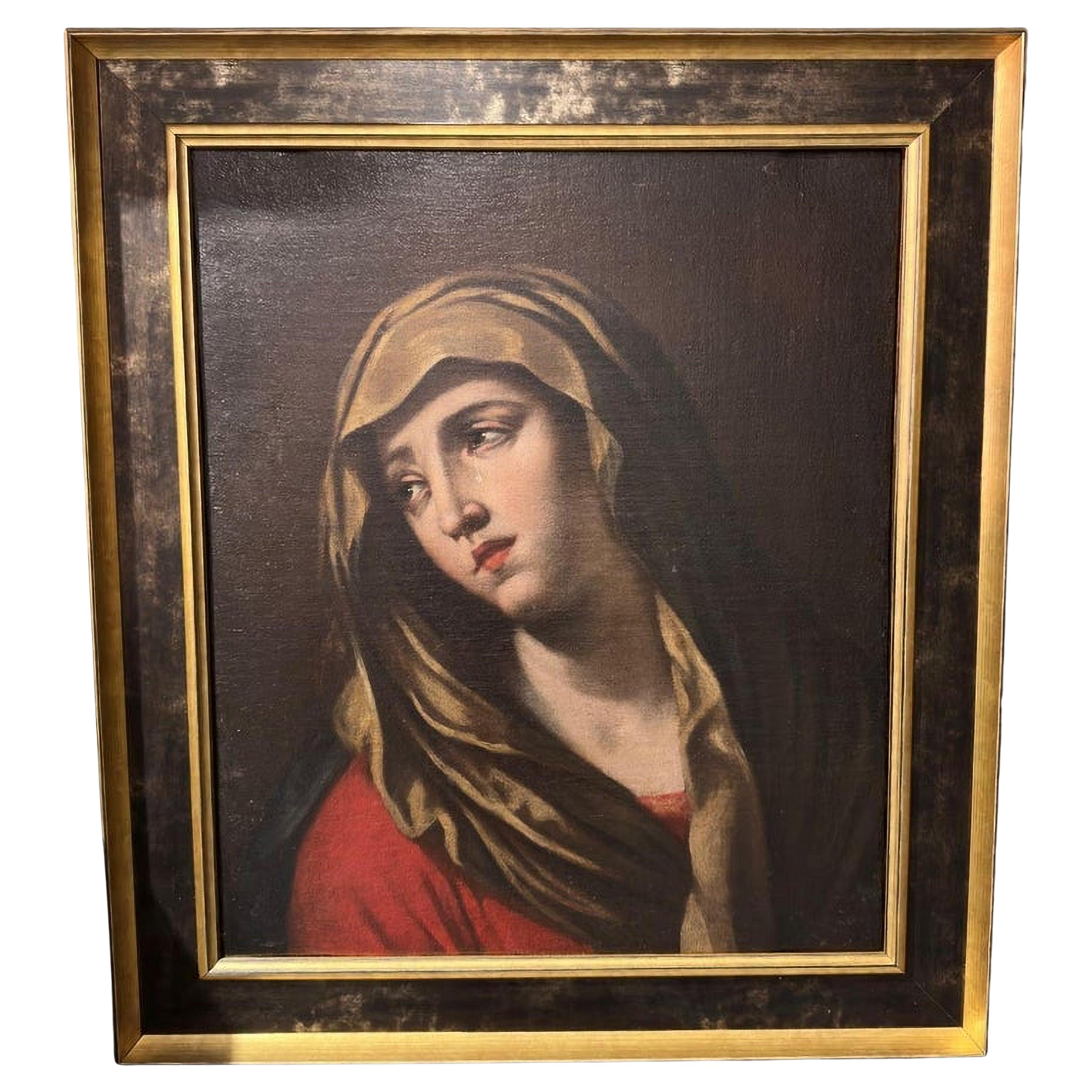
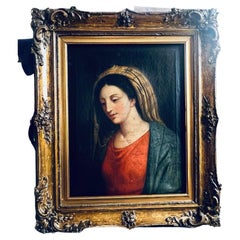
Mid-18th Century Oil Painting: Madonna of the Annunciation
$2,356.50
£1,710
€2,000.95
CA$3,225.05
A$3,511.78
CHF 1,857.92
MX$42,350.69
NOK 23,639.04
SEK 21,611.06
DKK 14,943.89
About the Item
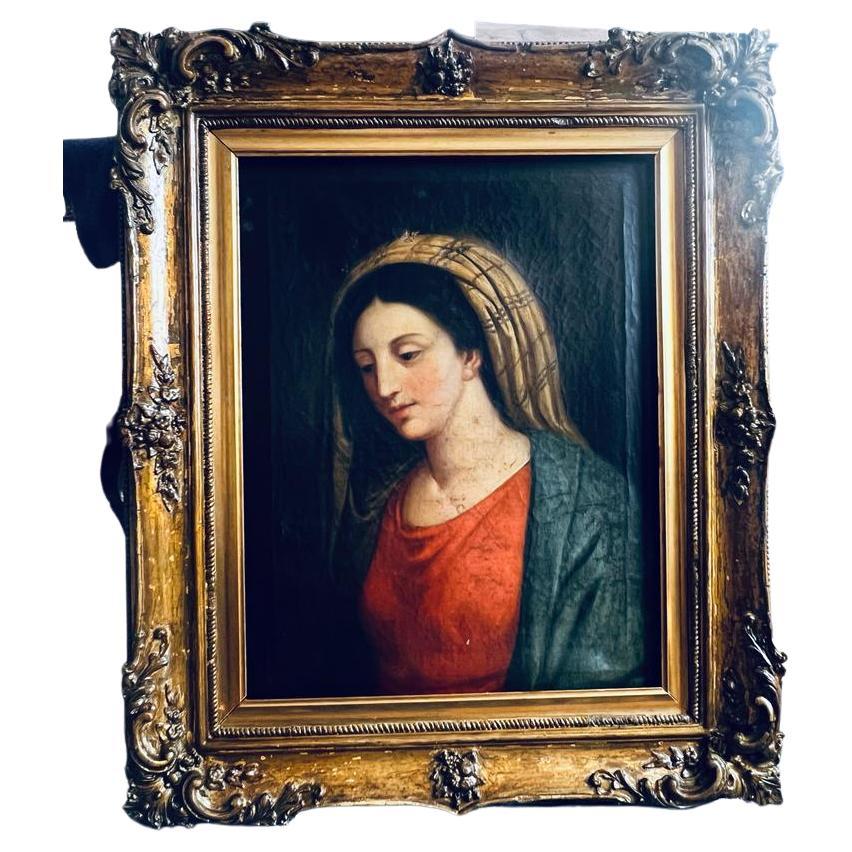
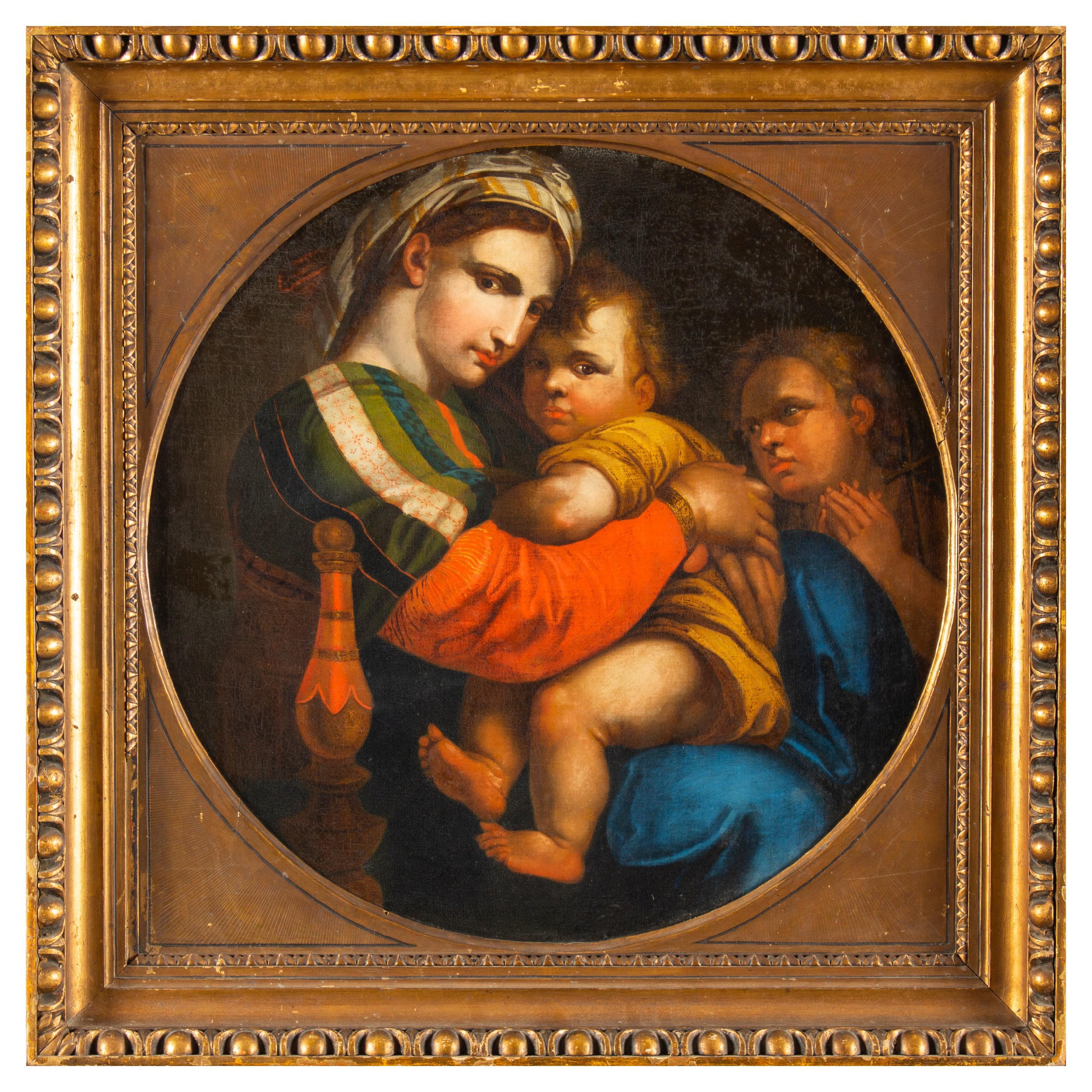
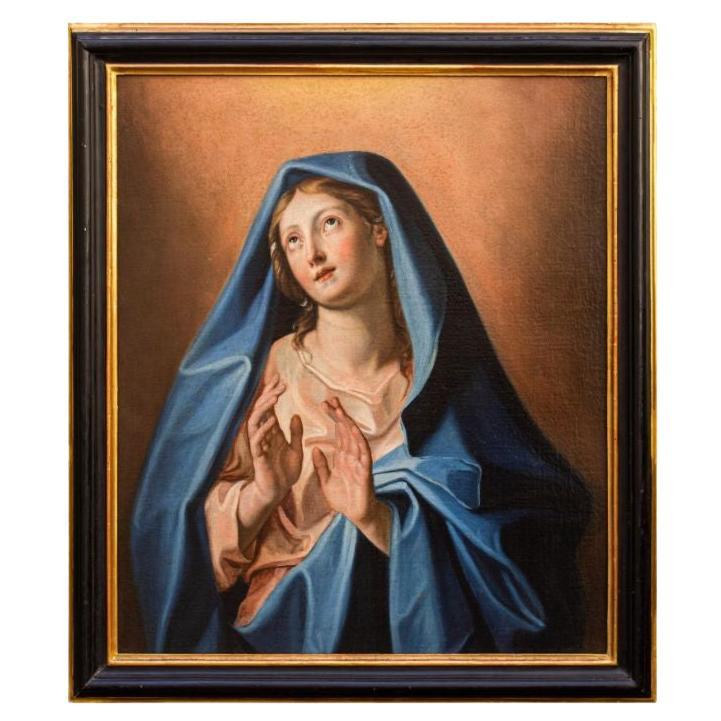
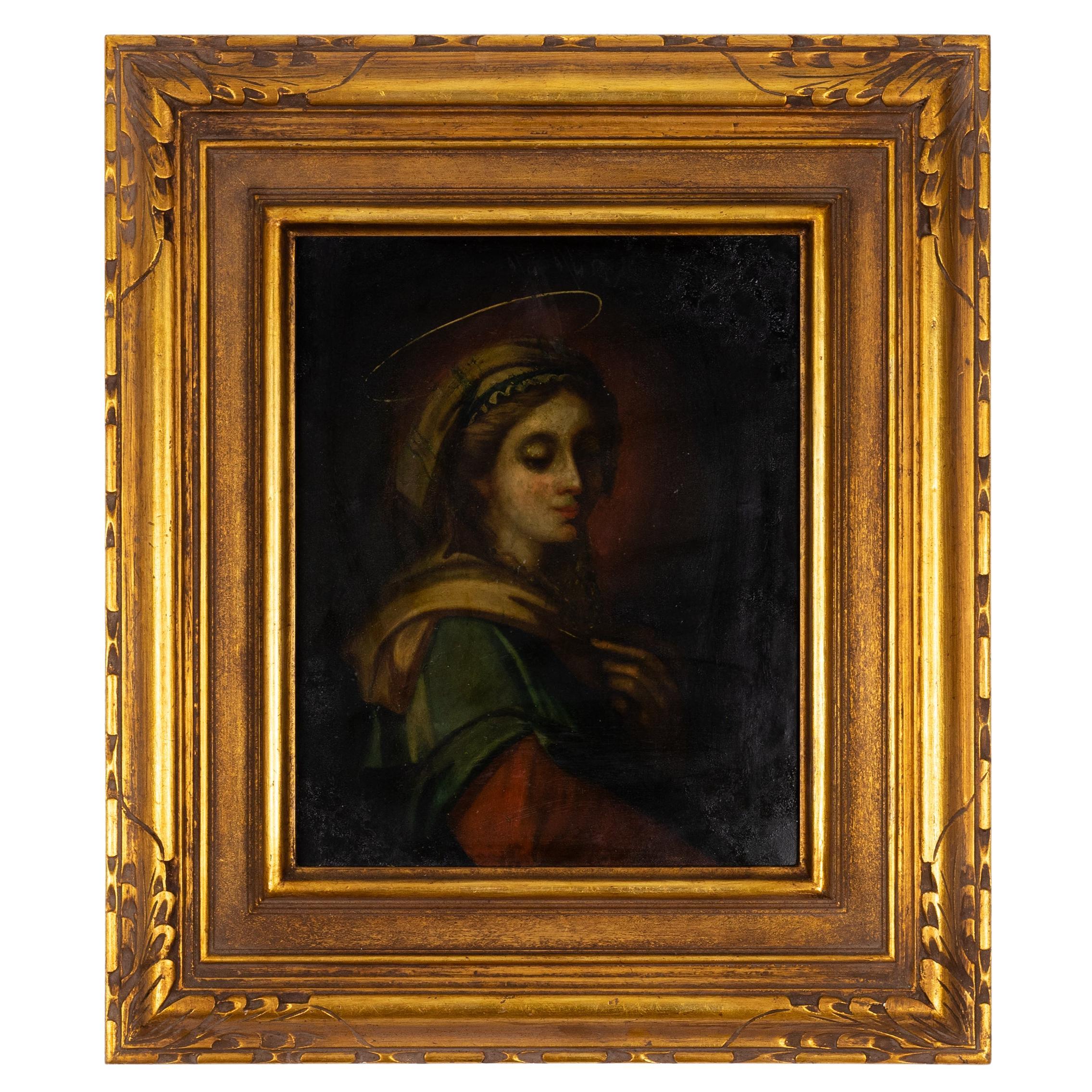
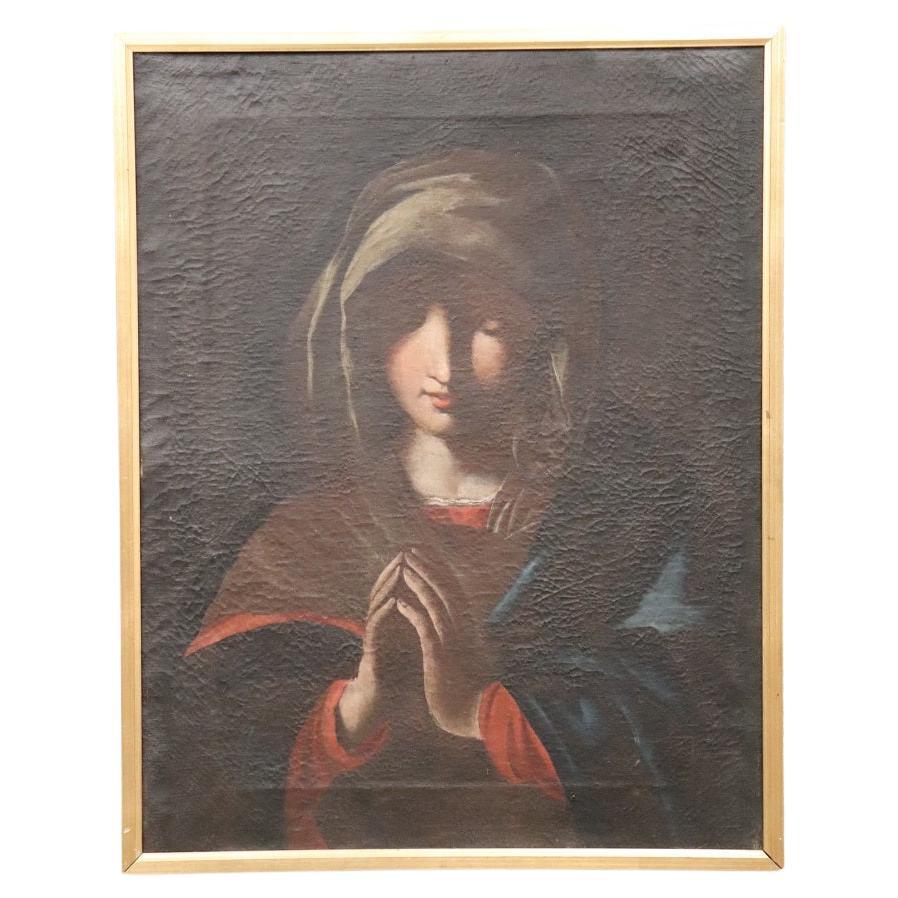
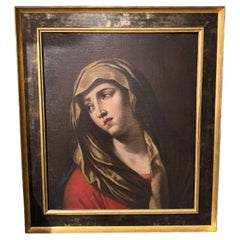
Country HouseAn exceptional mid-18th-century oil painting from the Studio of Pompeo Batoni (1708–1787), presenting a revered composition: The Madonna of the Annunciation. This remarkable work exemplifies Batoni’s celebrated synthesis of Baroque drama and Rococo refinement, echoing the serenity, luminosity, and compositional grace for which the artist is world-renowned.
Born in Lucca and trained in Rome, Batoni became the preeminent portraitist of European aristocracy in the 18th century, painting royalty, popes, and pilgrims alike. His religious compositions, however, remain some of the most spiritually and artistically revered of his oeuvre. The Madonna of the Annunciation stands among his most enduring subjects, interpreted by the master himself and his studio in a series of twelve documented versions.
This particular example—an oil on canvas in unrestored condition—captures the Virgin with quiet reverence and poised emotion. Soft chiaroscuro modeling, a delicately rendered complexion, and harmonious cool-green drapery all underscore the sophisticated painterly technique characteristic of Batoni’s workshop. The luminous, diffused light imbues the composition with both grace and divine intimacy.
Provenance
Condition
Attributed to the Studio of Pompeo Batoni, circa 1750
Retains original 18th-century stretcher and patina
Verso features multiple wax seals, including a Saint Martin mark, suggesting ecclesiastical or noble provenance
Craquelure consistent with age; canvas relining and surface cleaning recommended for preservation and tonal restoration
Comes with supporting documentation and expert attribution references
This is not only a beautiful devotional work, but also a significant acquisition for collectors of Italian Baroque and Rococo religious art. Works from Batoni’s studio rarely come to market in such authentic condition, making this a distinguished investment piece for serious collectors, dealers, or museums.
Key Features
Italian Old Master painting, mid-18th century
Studio of Pompeo Batoni
Subject: The Madonna of the Annunciation
Oil on canvas, unrestored
Original wax seals and historical backing
Ideal for restoration and scholarly inclusion
Private collection in Nottingham, UK
- Dimensions:Height: 24.81 in (63 cm)Width: 22.05 in (56 cm)Depth: 1.58 in (4 cm)
- Style:Grand Tour (Of the Period)
- Materials and Techniques:
- Place of Origin:
- Period:Mid-17th Century
- Date of Manufacture:1760
- Condition:Wear consistent with age and use. Minor losses. In unrestored condition, needs cleaning, and the Canvas to be relined.
- Seller Location:Seaford, GB
- Reference Number:1stDibs: LU10376244745842
About the Seller
No Reviews Yet
Vetted Professional Seller
Every seller passes strict standards for authenticity and reliability
Established in 2021
1stDibs seller since 2025
Typical response time: 1 hour
- ShippingRetrieving quote...Shipping from: Seaford, United Kingdom
- Return Policy
More From This Seller
View All19th century After Rahael Grand Duke’s Madonna Painting
By (after) Raphael (Raffaello Sanzio da Urbino)
Located in Seaford, GB
After Raphael's Grand Duke's Madonna
Grand Duke's Madonna after Raphael, a stunning 19th-century oil painting from the renowned Berkley Collection. This remarkable artwork, inspire...
Category
Antique Late 19th Century Italian Renaissance Paintings
Materials
Paint, Paper
$1,819 Sale Price
20% Off
18th century Antonio Correggio The Mystic Marriage of St Catherine
By Antonio da Correggio
Located in Seaford, GB
Antonio Correggio’s The Mystic Marriage of St. Catherine
This stunning 18th-century copy draws inspiration from the masterpiece The Mystic Marriage of Saint Catherine, originally pa...
Category
Antique Mid-19th Century Italian Renaissance Paintings
Materials
Canvas
$2,425 Sale Price
20% Off
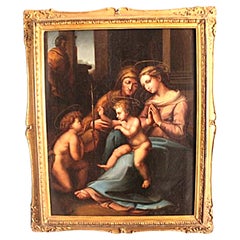
19th Century Oil on Canvas After Raphael: Holy Family Painting
By (after) Raphael (Raffaello Sanzio da Urbino)
Located in Seaford, GB
Early 19th-Century Italian School Oil on Canvas – After Raphael
The Holy Family with Saint Elisabeth and the Infant Saint John the Baptist
Introduction: A Masterpiece Inspired by Rap...
Category
Antique Early 19th Century Italian Renaissance Paintings
Materials
Canvas
$1,642 Sale Price
20% Off
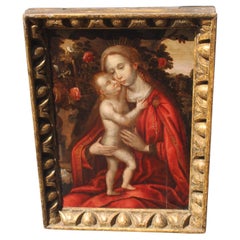
Flemish 16th century Madonna in a Rose Garden
Located in Seaford, GB
The Madonna and Child Oil Painting in a Rose Garden – Flemish (Ambrosius Benson School)
Late 16th Century/ Early 17th Century Flemish Oil Painting on Oak Panel
Artist & Background
This exquisite Flemish Renaissance Madonna and Child oil painting, titled Madonna and Child in a Rose Garden, is attributed to a follower of Ambrosius Benson (circa late 16th - early 17th century). Benson, originally from Lombardy, Italy, became a renowned master painter in Bruges, Flanders, in the early 1500s..
Key Features of This Madonna and Child Painting:
Period & Style – Late 16th-century Flemish School, influenced by Gerard David and Leonardo da Vinci.
Medium – Oil on oak panel, a signature technique of Flemish masters.
Composition – The Virgin Mary and Christ Child are set in a serene rose garden, symbolising purity and divine love.
Influence – This artwork reflects both Netherlandish precision and Lombard artistic traditions.
Provenance & Demand: Benson’s followers were widely sought after, and his compositions commanded high market value among collectors.
Antique Hand-Carved Frame Old Master Madonna and Child Artwork
This painting is housed in an original 17th-century hand-carved wooden frame featuring a classic egg-and-dart motif.
Condition Report
Conservation Status: Professionally cleaned.
Historical Cracking: Some age-related panel cracks are common in antique oil paintings.
Restoration: Minor retouching to the Madonna’s face, enhancing original details.
Why Invest in Flemish Renaissance Art?
Historical Significance – Works by Ambrosius Benson’s followers remain highly collectable in the art market.
Museum-Quality Piece – Suitable for private collectors, investors, and art connoisseurs.
European Heritage – A fine example of an Old Master religious painting...
Category
Antique 1610s Belgian Renaissance Paintings
Materials
Oak, Paint
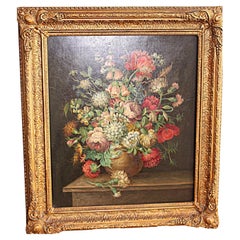
Exquisite 19th Century English Still Life of wild flowers– Oil on Wood Panel
Located in Seaford, GB
A captivating and finely executed 19th-century English still life painting, rendered in oil on wood panel, depicting an abundant bouquet of mixed flowers in a terracotta urn. This hi...
Category
Antique 19th Century English High Victorian Paintings
Materials
Paint
Early 19th century Capriccio Brazil School Painting
Located in Seaford, GB
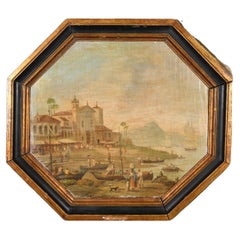
Rare Early 19th century Capriccio view of Rio de Janeiro Painting
Probably painted circa 1810 by one of Jean-Baptiste Debret, Italian Students.
Painted on Sailcloth.
Historical Context of Early 19th Century Portuguese Colonial Brazil
1.1 Transition from Colony to Empire
During the early 19th century, Brazil underwent a seismic shift in its political status. Originally a colony under the Portuguese Empire, the arrival of the Portuguese Royal Court in Rio de Janeiro in 1808 rapidly elevated the city’s cultural and political importance. By 1815, Brazil was declared a kingdom united with Portugal, setting the stage for the emergence of the Empire of Brazil in 1822. This period of transformation—often termed the transitional period from colony to empire—fueled a wave of artistic production in cities like Rio de Janeiro.
1.2 European Artistic Influence in Brazil
With the French Artistic Mission in Rio (initiated in 1816) and the presence of various Portuguese and European artists, Brazilian art of the early 1800s began to reflect diverse influences, from neoclassical painting to the early rumblings of romanticism. Painters such as Jean-Baptiste Debret, and Nicolas-Antoine Taunay, and local luminaries like Manuel de Araújo Porto-Alegre contributed to the fine arts tradition in Brazil. Their works featured scenes of local life, portraits of Brazilian society, and imaginative vistas—sometimes referred to as “capriccios,” in which real elements were combined with artistic liberties to create an idealized panorama.
1.3 Rio de Janeiro as Cultural and Political Hub
Rio de Janeiro, often called the Imperial capital after Brazil’s independence, was home to foundational institutions like the Imperial Academy of Fine Arts (Academia Imperial de Belas Artes). Later evolving into the Escola de Belas Artes (School of Fine Arts in Rio), these academies nurtured the talents of emerging painters, who found patronage under the Royal Court and, subsequently, the Imperial Court. The city’s significance was further enhanced by the construction of significant buildings, the modernization of infrastructure, and the mingling of European courtly customs with the traditions of local inhabitants.
. Description of the Octagonal Oil on Canvas: A Capriccio View of Rio de Janeiro
2.1 Composition and Layout
The most striking characteristic of this 19th-century Brazilian art piece is its octagonal shape, a relatively unusual format that draws the viewer’s gaze toward its centre. The composition showcases Rio de Janeiro’s shoreline in the early 1800s, brimming with merchant ships and smaller boats anchored near the shore. On the sand, there is a bustling crowd of local people—men and women carrying food and goods on their heads, loading and unloading boats, and engaging in everyday commerce. The backdrop of soaring mountains suggests Rio’s iconic topography, embodying the landscape that famously defines the city.
2.2 Architectural and Religious Landmarks
On the left side, one can discern the silhouette of a church believed to be Santa Lucia, a significant religious structure in the heart of early 19th-century Rio. This element provides viewers with a tangible reference point, linking the scene to an actual location. However, because this painting is labelled as a “capriccio,” the artist might have taken creative liberties by rearranging or amplifying certain features of the city. The melding of real and idealized elements is characteristic of these imaginative vistas.
2.3 Evoking Daily Life in Colonial Rio
One of the painting’s greatest appeals lies in its portrayal of daily life during the colonial era. Men and women from various backgrounds populate the scene. Some appear to be carrying goods on their heads, a common practice in Brazil that has persisted through different centuries. Others appear to be haggling or trading near small vessels, revealing the commercial pulse of an active port city. This focus on local people, combined with the grandeur of merchant ships, captures the tension and synergy between the every day and the extraordinary—a hallmark of Brazilian colonial painting that balances the grand narratives of empire with the rhythms of ordinary life.
2.4 An Amalgamation of Neoclassical and Romantic Influences
Although academic art in early 19th century Brazil was highly influenced by neoclassicism, the onset of romanticism can be spotted in the emotional portrayal of the sky, the lively palette, and the dramatic emphasis on nature’s beauty (the mountains, in particular). This duality reflects the fine arts tradition in Brazil during the transitional phase when artists were embracing multiple styles. As part of the School of Rio or the Rio de Janeiro school, painters often integrated academic techniques learned from European masters with emerging local subjects and influences.
3. Institutions and Artistic Movements
3.1 Imperial Academy of Fine Arts
Originally known as the Royal School of Sciences, Arts, and Crafts, the Imperial Academy of Fine Arts in Rio de Janeiro was instrumental in shaping 19th-century Brazilian art. Influential artists and teachers from Portugal, France, and other European nations congregated at the Academy, imparting their expertise to native students. As the monarchy consolidated power, the Academy enjoyed royal patronage, leading to the creation of Imperial Academy-style works that combined European academic rigour with Brazilian-themed subject matter.
3.2 Impact of the French Artistic Mission
The French Artistic Mission, which arrived in 1816, played a pivotal role in introducing advanced European artistic techniques, thereby elevating the overall quality of painting in Brazil. Artists like Jean-Baptiste Debret not only documented Brazilian society but also spearheaded the development of a local visual identity that aligned with both academicism and the national context of a blossoming empire. Debret, alongside others such as Nicolas-Antoine Taunay, mentored Brazilian artists, sowing the seeds of what would become the Brazilian academic art movement.
3.3 Religious, Historical, and Landscape Paintings
In addition to everyday scenes and historical compositions, religious iconography remained crucial throughout Portuguese colonial and imperial Brazil. Churches were omnipresent in cityscapes like Rio de Janeiro. Many colonial-era Brazilian portraits...
Category
Antique Early 19th Century Brazilian Spanish Colonial Paintings
Materials
Canvas
$2,976 Sale Price
20% Off
You May Also Like
Antique 17th Century Painting Madonna /Virgin Mary Italy Oil on Canvas
Located in Doha, QA
Magnificent Italian 17th century Portrait of Virgin Mary measures 52 x 68 cm without the frame.
The colors are stunning and the paintin...
Category
Antique 17th Century Italian Baroque Paintings
Materials
Canvas
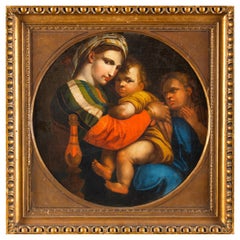
Madonna Della Sedia, After Raffaello Santi, 19th Century
Located in Budapest, Budapest
Raphael's Madonna della Sedia dates to 1513/14 and is kept in the Palazzo Pitti in Florence. Originally it was part of the Uffizi collection, and has then been brough to Paris during...
Category
Antique Mid-19th Century European Renaissance Revival Paintings
Materials
Canvas, Paint
$3,363 Sale Price
20% Off
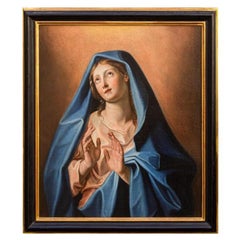
Early 17th Century Roman School Praying Madonna Painting Oil on Canvas
Located in Milan, IT
Roman school, late 16th-early 17th century Praying Madonna
Oil on canvas, 81 x 69 cm
Frame 83 x 95.5 cm
A divine whiteness reverberates with vibrant luster on the maphorion of the present Virgin. The palpable iridescence that structures the thin rosaceous garment, woven with the same fresh light, produces a slight rustle when she takes her hands off. The Madonna in fact takes a prayerful pose, opening her palms to underline her fervent ecstatic intention; the white neck is rendered with perishable fullness of pigments, like the hands, perfectly alive, and the very shiny eyes. With fine shrewdness the artist of the present styles the Virgin's hair with thin white ribbons, exacerbating the purity. An evocative light falls gently on the bust, a materialized sign of divine glory.
The present can be traced back to the late Mannerist climate that prevailed in the capital after the emanation of the Tridentine council (1545-1563). The late Mannerist licenses that can still be seen there, such as the intense lyricism in the stylistic code adopted by the artist, are innervated in the new basic catechetical intent, which at the end of the century produced a certain figurative rigorism. The present, however, still responds to that extraordinary Roman dynamism that raised the capital to a bulwark for the entire mannerist lesson, matched only by a second artistic center, the Florentine one. The engaging carriage of the Virgin reflects the contemporary examples of Giuseppe Valeriano (1542-1596), a Jesuit painter, returning in the Marriage of the Virgin of the Roman Church of Jesus, as well as in the Madonna of Sorrows in the Recanati Altarpiece, equal ardor. But it is in the Assumption of the Virgin painted in four hands with Scipione Pulzone...
Category
Antique Early 17th Century Italian Paintings
Materials
Canvas
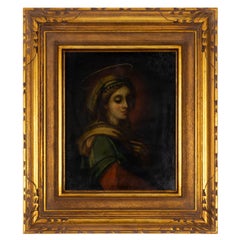
Baroque Religious Painting Of Immaculate Conception, Gilt Frame, 17th Century
Located in Lisbon, PT
This 17th-century Baroque painting, in oil on copper, captures a serene portrayal of the Immaculate Conception, draped in yellow silk robes with accents of green and red. The divine ...
Category
Antique 17th Century Italian Renaissance Paintings
Materials
Copper
$6,474 Sale Price
23% Off
Beautiful 17th Century Italian School " Virgin of Sorrows "
Located in Madrid, ES
Beautiful 17th century Italian school " Virgin of Sorrows "
Oil on canvas
Measures : 50.5 x 42.5 cm
very good condition
Category
Antique Mid-17th Century Italian Baroque Paintings
Materials
Paint
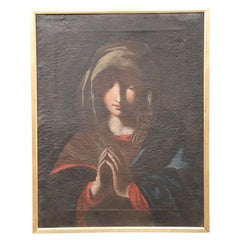
18th Century Italian Antique Oil Painting on Canvas, Madonna in prayer
Located in Casale Monferrato, IT
We are pleased to present this captivating religious painting of the Italian school, painted in oil on canvas in the 18th century. This wonderful painting depicting the Madonna in pr...
Category
Antique 18th Century Italian Paintings
Materials
Canvas
$2,402 Sale Price
20% Off
More Ways To Browse
Gun Sign
Gustavian 3 Drawer Chest
Heart Dish
Hens And Chicks
Imperial Porphyry
India Silk Hand Painted Painting
Industrial Cog
Industrial Metal Drawers
Jade Cloisonne
Japanese Small Cabinets
John Widdicomb Company
John Widdicomb Painted
Key Greek Antique Glass
La Piscine
Large Silk Screens
Leather Faux Drawers
Limoges Gold And Blue China
Lion Bowl