Items Similar to Mixed Media Composition "Desert Rider, " by Charles Melohs, circa 1956
Want more images or videos?
Request additional images or videos from the seller
1 of 10
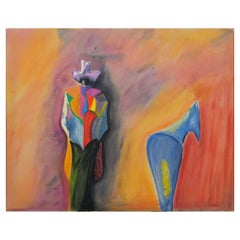
Mixed Media Composition "Desert Rider, " by Charles Melohs, circa 1956
$4,500
£3,449.82
€3,947.57
CA$6,359.51
A$6,912.54
CHF 3,700.39
MX$83,556.58
NOK 46,632.17
SEK 43,006.97
DKK 29,482.01
About the Item
Charles Melohs (American, 1908 – 1982)
Desert Rider, circa 1956
Mixed media composition on canvas
Signed to the lower left
Inscribed to the verso
Introducing the captivating Mixed Media Composition "Desert Rider" by Charles Melohs, a remarkable art piece dating back to circa 1956. This stunning painting is a true testament to Melohs' artistic genius and his ability to evoke emotion through his work.
Melohs' masterful use of colors adds depth and vibrancy to the composition, while intricate shapes delicately adorn the figure's body, adding an extra layer of complexity to the artwork.
This exquisite art piece is not only a visual delight but also a conversation starter. It effortlessly complements any space, making it a perfect addition to your home or office. Whether displayed in a living room, bedroom, or even a study, "Desert Rider" will undoubtedly become the focal point of any room, captivating viewers with its enigmatic allure.
Measurements:
29 inches wide x 37 inches high x 1.25 inches deep/projection from wall.
Charles Melohs (Charles Weissman 1908-1982) was born in Brooklyn, New York. He spent his childhood and adolescence in Brooklyn orphan asylum. It was, perhaps, this emotional deprivation that led to his seeking solace and expression in the art of painting. He received his first payment $100 for a painting when he was 13 years old. His imagination roamed free and his natural ability with a brush gave structural form to his mind’s eye. By a chance, his remarkable untutored development was brought to the attention of patrons of the orphanage who provide him with a full art scholarship to Pratt Institute.
Melohs has his own painting style. His excellent color choosing, fancy approach, and unlimited imaginations have built thousands of unique paintings. He has traveled many places including California; therefore, some of his paintings appeared to be California’s style, his travel experiences also provided him a plentiful theme. ?
Melohs once said, “If governments would consult the artists, there would be a paradise on earth — not just a dull, peaceful world, but one bursting with life and excitement.”(Sunday News, 8.29.1971) He is a less social person, it caused his character became lonely and lived in his own world; however, it allowed him to focus on his paints and created his exquisite brushworks.
Mehol’s paintings are mysterious that people with different moods, under different situations, or has different characters will have different feelings toward the paintings. The curator of paintings at the Metropolitan Museum of Art wrote: ”This is color the impression painter was looking for. Your romantic paintings remind me of Van Gogh...”(Sunday News, 8.29.1971)
Charles Melohs’ imaginations and his paintings were much surpassed the time he was living. He left a lot of paintings in many museums and universities, including MoMA(Museum of Modern Art), which still surprising people today. Charles Melohs is not just a person that full of fashion imagination, but also a greatness artist for society.
- Dimensions:Height: 37 in (93.98 cm)Width: 29 in (73.66 cm)Depth: 1.25 in (3.18 cm)
- Style:Expressionist (In the Style Of)
- Materials and Techniques:
- Place of Origin:
- Period:
- Date of Manufacture:1956
- Condition:Wear consistent with age and use. - discoloration to pigments; wear and abrasions to the frame; cracks and abrasions throughout the surface.
- Seller Location:Los Angeles, CA
- Reference Number:1stDibs: LU881727085862
About the Seller
4.9
Platinum Seller
Premium sellers with a 4.7+ rating and 24-hour response times
Established in 2008
1stDibs seller since 2009
320 sales on 1stDibs
Typical response time: <1 hour
- ShippingRetrieving quote...Shipping from: Los Angeles, CA
- Return Policy
More From This Seller
View AllOriginal painting by Philip Williams Titled ABS TRACT
By Matthew Philip Williams
Located in Los Angeles, CA
Introducing the captivating "ABS TRACT" Original Oil Painting by Philip Williams, a true masterpiece that effortlessly blends colors and shapes to create a visually stunning artwork....
Category
Vintage 1960s American Mid-Century Modern Paintings
Materials
Canvas, Acrylic
Murat Kaboulov Abstract Mixed Media Painting of Figure, 1997
By Murat Kaboulov
Located in Los Angeles, CA
Murat Kaboulov (Russian/American, 1939-2010)
Untitled, 1997
Watercolor painting with pastel embellishments on paper
Signed to the lower right
Measurements:
10.50 inches wide x...
Category
1990s American Expressionist Decorative Art
Materials
Paint, Paper
Large Mixed Media Painting by Tricia Strickfaden
Located in Los Angeles, CA
Introducing the striking "Large Mixed Media Painting" by renowned artist Tricia Strickfaden - a captivating piece that effortlessly blends modern artistry with timeless elegance. Thi...
Category
21st Century and Contemporary American Modern Paintings
Materials
Canvas, Acrylic
Acrylic on Masonite Painting by Jesus Leuus, Mexico 1970
s
By Jesus Leuus
Located in Los Angeles, CA
Introducing our exquisite Acrylic on Masonite Painting by renowned Mexican artist, Jesus Leuus, created in 1979.
This captivating piece showcases a heartwarming scene of a family en...
Category
Vintage 1970s Organic Modern Paintings
Materials
Acrylic, Masonite
Lrg Watercolor by Colorado Artist Keith Finch, 1919-1993
By Keith Bruce Finch
Located in Los Angeles, CA
Large and beautiful original watercolor painted by Colorado artist Keith Finch and dated 87.
The piece shows beautiful colors and is very vibrant.
...
Category
Vintage 1980s American Minimalist Paintings
Materials
Paint, Paper
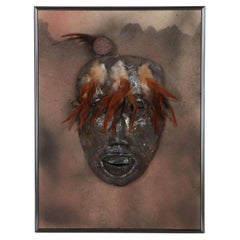
Mixed Media Sculpture, Late 20th Century
Located in Los Angeles, CA
Artist unknown
Untitled, late 20th century
Ceramic, feathers, metal, and mixed media on panel
Unsigned
Introducing our exquisite Ceramic, Paint, and Feathers Sculpture Mounted on a ...
Category
Vintage 1980s Tribal Wall-mounted Sculptures
Materials
Metal
You May Also Like
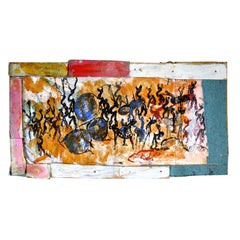
Untitled, Purvis Young Mixed-Media Painting, 1980s
By Purvis Young
Located in Miami, FL
Abstract mixed-media work by artist Purvis Young. Folk Art portraying bleeding and pregnant figures in a crowd, policemen on horseback and large blue eyes. Young used eyes as symbols...
Category
Vintage 1980s American Folk Art Paintings
Materials
Paint, Reclaimed Wood, Canvas, Paper
$7,500 Sale Price
50% Off
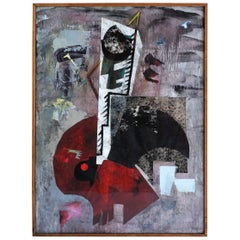
Charlotte Henschel, Oil on Canvas, France, 1950
By Charlotte Henschel
Located in Catonvielle, FR
Composition abstracted from Charlotte Henschel (1905-1985), France, 1950, signed low right.
Frame of origin, under glass.
99.5cm/72.5cm (off frame)
Raise of the school of Paris, ...
Category
Vintage 1950s French Mid-Century Modern Paintings
Materials
Canvas
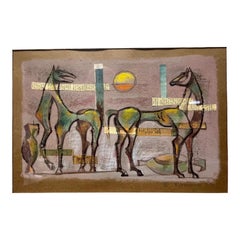
1957 E. Romano "Horse Collage" Gouache Mixed Media
By Emanuel Glicenstein Romano
Located in Sarasota, FL
A gouache mixed media by listed artist E.Romano titled "Horse Collage". Strong use of color and simplistic lines create the primitive style frequently seen in Romano's work. Signed i...
Category
Vintage 1950s American Mid-Century Modern Paintings
Materials
Paper
Cowboy and Horse Paint on Canvas by J. Holden
Located in Oklahoma City, OK
The abstract artwork signed by J. Holden is a captivating and vibrant piece, depicting a cowboy and his horse with a modern, imaginative twist. Rendered in bright, bold colors on a s...
Category
Late 20th Century American Native American Contemporary Art
Materials
Canvas, Paint
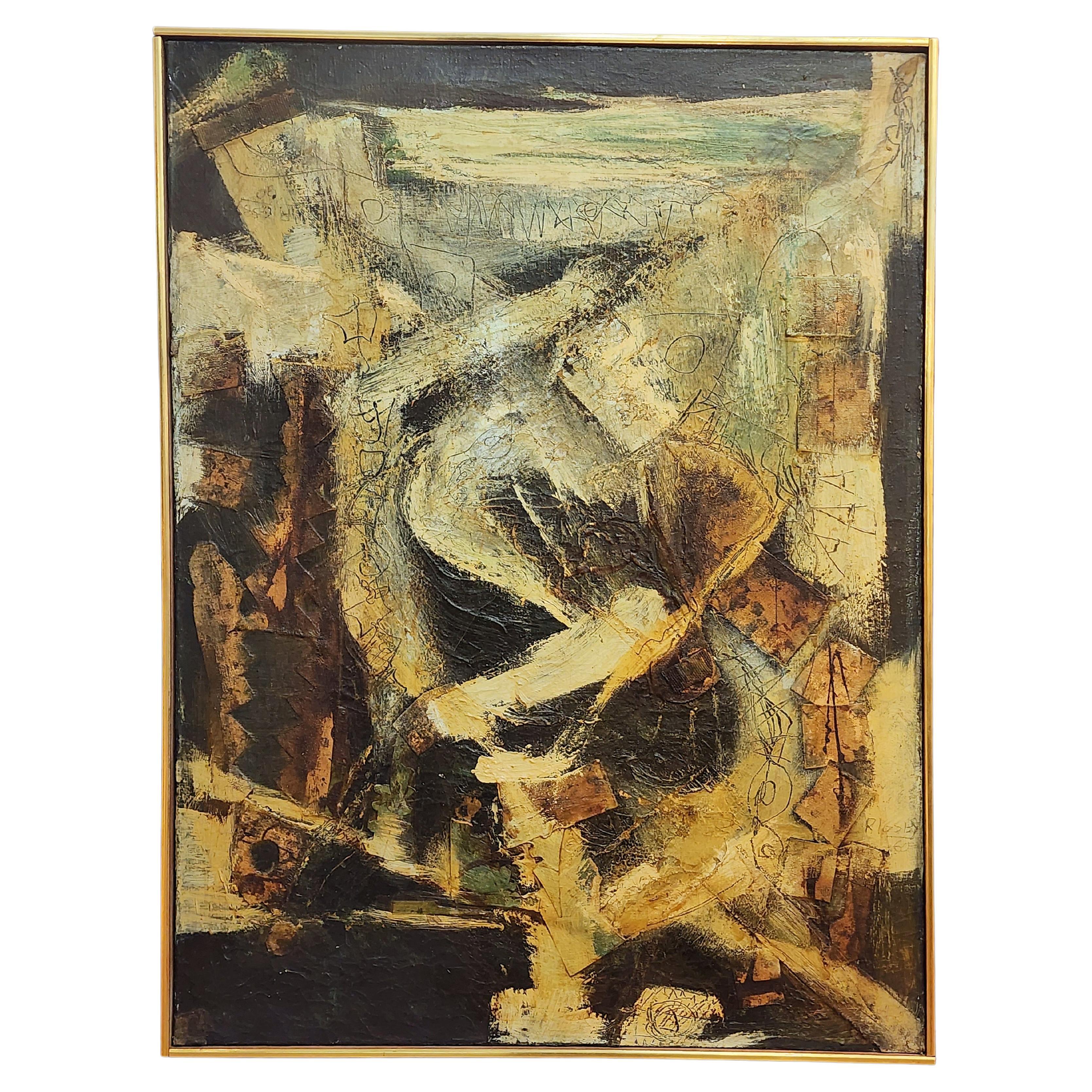
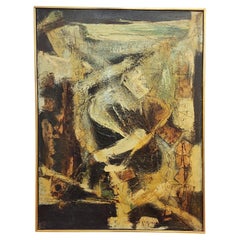
John David Rigsby Abstract Mixed Media on Canvas, American 1960
Located in Hudson, NY
A handsome and sophisticated mixed media on canvas by American artist John Rigsby. Found in a original state of preservation. His works are few and far between.
The following biography was submitted by John David Rigsby, Jr., son of the artist. The author is Lisa Rigsby Peterson, daughter of the artist, and owner of the copyright of the biography.
John David Rigsby was born on October 10, 1934, the seventh child of an Alabama Depression-era sharecropper's son. He and his family moved frequently, from one one-room structure to another, often with no running water, no plumbing, no heat but the stove. His father was killed in a car accident when Rigsby was just 9 years old. Life for the remaining eight family members proved tumultuous and difficult -- food wasn't plentiful, nor money. The family moved from place to place, following work -- Rigsby attended 30 different schools before graduating from high school. Despite living in poverty, Rigsby demonstrated academic and artistic aptitude at a young age. Two oil paintings on covers ripped off of old books that he painted when he was eight years old show the promise of an imaginative and gifted eye.
Rigsby was drafted by the U.S. Army in 1953. As he later wrote, "When basic training at Fort Jackson, South Carolina, was over, I was told to go out and find a job. Jasper Johns was painting visual aids for the 28th Regimental Headquarters. He suggested the Band Training Unit." Rigsby played the clarinet in that unit, and after 2 years of service, he enrolled at the University of Alabama on the G.I. Bill to study art. After just two years, he left school and followed his mentor (and one of the greatest and longest-lasting influences on his art), Japanese artist and U of A art instructor Tatsu Heima, to New York City. Heima introduced him to Isamu Noguchi and suggested that Rigsby work as Noguchi's assistant. Instead, Rigsby chose a job as a guard at the Metropolitan Museum of Art, since "the notion of seeing all of that art appealed more to me than the boring task of studio assistant." The opportunity was a rich one for Rigsby. He had a chance to study the masters, and cited Rembrandt with his simplicity and elegance as another of the most important influences on his work.
In the years between 1957 and 1963, when Rigsby eventually earned his BFA in sculpture, the artist traveled back and forth between New York and Tuscaloosa, alternating study with forays into the fertile New York art scene. Rigsby exhibited some of his early sculpture work in 1958 at a small New York gallery, which was also exhibiting the work of Willem and Elaine de Kooning and Theodore Stamos. Shortly thereafter, searching for an educational venue closer to New York City, Rigsby visited New Haven, Connecticut, and spent an afternoon speaking with Josef Albers at Yale. Albers agreed to accept Rigsby into the Yale program on the condition that he take freshman drawing all over again. A brilliant opportunity, but, in Rigsby's words, "When it was time to register, I was hitchhiking back to Alabama, looking for food and shelter."
Rigsby had his first one-man show at the University of Alabama in 1959. A visiting critic from New York, J.F. Goosen, reviewed the show and wrote "here is a talent which produces art because that is the thing for a gifted person to do. In his effortless ease of conception and execution, he has already achieved a goal that eludes many artists for a lifetime." Finally, in 1963, Rigsby received his degree in sculpture, dissolved a short-lived marriage, visited his family, packed up his car and headed permanently for New York. That year, his work was included in a group show at the Delgado Museum in New Orleans - which led to a one-man exhibit at the Delgado in 1964. During 1964, Rigsby took drawing classes at Columbia University, and worked at the General Post Office at night. He met his future wife, Linda Palmieri, and married. In 1965, his daughter Lisa was born, followed in 1966 by the birth of his son, John David Jr.
In 1966, Rigsby had a successful one-man show at the Pietrantonio Gallery in New York. Shortly thereafter, he and the family moved to Tunis, Tunisia at the suggestion of a colleague, who urged him to "come paint by the light of Klee." Rigsby worked for the United States Information Agency as a teacher, and he spent the next year and a half painting over ninety paintings inspired by the smells, light, and Phoenician and Roman art surrounding him. He also executed a number of character and landscape drawings, capturing the Tunisian way of life. During his time in Tunisia, Rigsby's work was shown there in two major exhibits.
Upon the family's return to the U.S. in 1968, Rigsby once again exhibited at the Pietrantonio Gallery. Later that year, Rigsby enrolled in Southern Connecticut State College's Urban Studies program, earning a master's degree in 1970. During his time at SCSU, Rigsby worked as the city of Bridgeport's Curator of Exhibits, driving a mobile art gallery from schools to neighborhood fairs and housing projects. After completing his degree, Rigsby had an exhibit at the Telfair Museum in Savannah, Georgia. This exhibit caught the attention of a member of the search committee looking to hire an artist for a newly-developed program in neighboring South Carolina.
In 1970, Rigsby was selected as the first Artist-in-Residence in the state of South Carolina for the National Endowment for the Arts Artists in Schools program. His work with the newly-integrated students at Beaufort (SC) High School over the term of his residency precluded substantial work on his own art. He did, however, set up a studio in downtown Beaufort, and was able to create a modest number of paintings, which were included in exhibits at the Columbia Museum in South Carolina in 1971 and Yale University in 1973.
At the end of his residency in 1974, Rigsby was named the National Visual Arts Coordinator of the Artists in Schools program for the NEA, a post he held for two years. In this position, Rigsby traveled the country, reviewing grant applications, meeting with state leaders in government, education and the arts to promote program concepts and explore local opportunities. The message he repeated over and over again echoed that of one of the other major influences on Rigsby as an artist - Ruth Asawa Lanier, whose words taught him that all of the work that the artist does is the artist's work, not simply the paintings he creates. In his capacity as National Coordinator, as well as many times in the future, Rigsby stressed that artists function in the same way as any other person in society, and deserved the same respect and place for their work as did all other professions. After two years traveling the country, Rigsby was ready for a change, saying "for the first time in my adult life, there was not a body of paintings to show for the years put into my work."
In 1976, a summer retreat to the mountain community of Central City, Colorado, led to a permanent relocation. Eventually settling in the small town of Evergreen, Rigsby followed his own advice about artists becoming actively involved in their communities, and he established the Evergreen Visual Arts Center. The Center provided working space for artists, classes for adults and children, and, most importantly, a place for Rigsby to create his own work. Buoyed by the opportunity to concentrate once again on his art, and inspired by his new surroundings, Rigsby entered an extremely prolific period in his career. In 1977, he organized a traveling exhibition of his paintings, which showed at the Kimball Arts Center in Utah, the Kennedy Center in Washington, D.C., and the Arvada Center in Colorado.
1978 brought more exhibits, notably in Aspen and Denver, as Rigsby's work continued. He took an extended trip to visit his mentor, Tatsu Heima, in Japan, where he climbed Mt. Fuji, followed by travels to Tehran, Delhi, and several European countries. He chronicled his impressions from his travels in a small collection of paintings upon his return to the U.S. - the beginning of a practice which would continue through the rest of his life. In 1979, Rigsby's marriage failed, and at the same time he lost the lease to his Evergreen studio to redevelopment plans. In response to the personal chaos around him, Rigsby began a series of what he called "hard-nosed process paintings," the watercolor paintings of dots which marked his work from this period. The paintings gained him an NEA Individual Artist grant in 1980, as well as a Yaddo fellowship in 1981. The polka dot paintings were followed by a series of cupcake-like images, again examining space and color.
During the early 1980s, Rigsby lived in a suite of old dentists' offices in a rundown part of Denver, with a studio in an area that reminded him of the Bowery in New York. In 1984, Rigsby founded the Progreso Gallery in the building where he lived, using the space both to show his own work and also to mount shows of the work of many Colorado artists. The gallery also served as a focal point for Denver's local arts community, hosting weekly discussion groups and classes. In 1984, Rigsby traveled to the Baja Peninsula and then in 1985 to Yugoslavia. After each sojourn, Rigsby returned to create vibrant and explosive paintings based on his experiences, showing them at his Progreso gallery and another alternative gallery in Denver, the Edge Gallery. The economic recession of the mid-eighties hit the art market and Rigsby hard, however, and although he continued to create new works of art, major exhibitions were difficult to come by.
In 1987, Rigsby decided to leave Denver and spent six months in Barcelona, Spain. It was an electrifying trip for him. Rigsby wrote of that time:
"The streets alone are a visual feast, and the additions of museums from Saarinen, Picasso and Miro to 12th century icons produced artistic indigestion. My paintings are always about the way things look and feel. Barcelona was a time machine extending those sensory and emotional concerns back to the Middle Ages. I felt the need to reduce my work to essential elements of color, scale, drawing and format. The [resulting] color studies speak eloquently for themselves, and in doing so, redefine all of the work I've done in the past 35 years of painting."
Rigsby completed over a hundred paintings while in Barcelona - color studies, street portraits of the characters he encountered on a daily basis, and a number of dark landscape paintings. He found time to run with the bulls in Pamplona, and began writing stories about his adventures that were later published.
Upon his return to Denver in 1988, Rigsby continued to explore the alter egos of the color studies - he concentrated on a series of dark paintings, all prominently featuring back. He commented about these black paintings that he " decided it was time to explore the perception of the eye and physical space as defined by low -light conditions…I find these paintings elegant, joyous and light-filled, with no feeling of heaviness at all." In mid-1988, Rigsby moved permanently to Houston, Texas, where he would spend the last five years of his life.
Once in Houston, Rigsby made a discovery that would serve as the inspiration and material for some of the last works of his career. In 1989, he discovered a salvage yard filled with scrap rubber, and he began working on black rubber sculptures, as well as paintings with rubber elements incorporated. He made strong connections in the Houston alternative arts scene, and became a regular contributor and art critic for a local weekly newspaper, The Public News. From 1989 through 1992, he exhibited his sculptures and paintings at Houston's Brent Gallery, Fountainhead Gallery, and Blaffer Gallery. He also produced an installation of his rubber sculptures on the roof of the Diverse Works Gallery in Houston. 1992 also marked Rigsby's return to Denver when he exhibited his sculptures at the Payton-Rule Gallery in Denver, leading to an Absolut Rigsby commission by Carillon Importers.
The 1990s were a tremendous struggle for Rigsby, with financial crises compounded by physical trauma (he accidentally sawed off the top joint of the index finger of his left hand while working in his studio). Although his work was being shown, it wasn't selling, and the tremendous financial pressure he felt weighed heavily upon him. He spent an increasing proportion of his time going to flea markets and garage sales, rehabilitating and repairing the things he bought there, and then re-selling them simply to raise enough money to keep a roof over his head. He had little time to paint or sculpt, the things in life that had always, no matter what the circumstances, brought him joy.
Rigsby's final works were a series of intricate paintings and drawings on used books that he purchased at the flea market. Most of these drawings, which he referred to as sculptural form drawings, were executed on page after page of science texts, music books, and a Korean bible and fill hundreds of pages. Additionally, Rigsby created an exquisite book he titled 28 de los Angeles, in which his twenty-eight simple and elegant drawings of angels resonated with the influence of Rembrandt he had so admired in his early days. In a sense, Rigsby's final works, art created on used books which were the only materials he could afford, brought his work and life full circle from his childhood days. Rigsby's life, though begun and ended in adversity, was nonetheless illuminated and enriched by the irresistible impulse he had to create art and beauty.
John David Rigsby was killed in a one-car accident in Colorado in August, 1993.
Biography from the Archives of askART
Following is a review by Michael Paglia of the artist's July 2004 retrospective at the Denver Museum of Contemporary Art. It was submitted by John Rigsby, Jr., son of the artist.
There's a magnificent retrospective at Denver's Museum of Contemporary Art devoted to the work of the late John David Rigsby, who was a major powerhouse in Colorado's art scene. "Dots, Blobs and Angels" surveys more than forty years' worth of the remarkable artist's paintings and sculptures.
The year 1993 was strange, and by that I mean terrible. Many of the city's galleries closed because of bad economic times, and then the artists started dying. In a matter of a few months, Denver lost three significant artists: Rigsby, experimental photographer Wes Kennedy...
Category
Vintage 1960s American Mid-Century Modern Paintings
Materials
Canvas, Paint
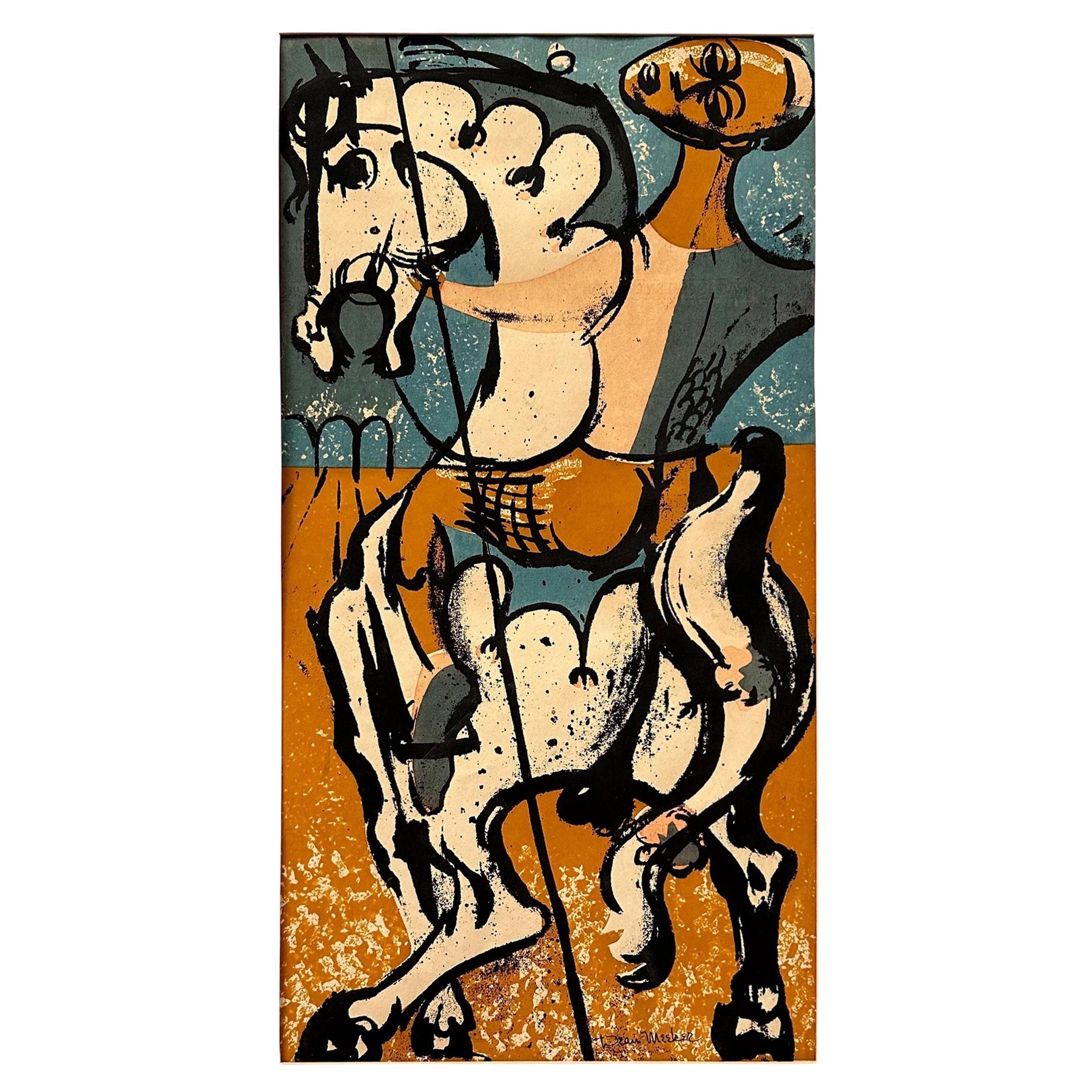
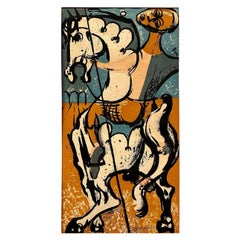
Dean Meeker Horse and Rider, Silkscreen Print, 1970s
By Dean Meeker
Located in Littleton, CO
A powerful and graphic work by renowned American artist and printmaker Dean Meeker (1920–2002), this original mid-century print captures the dynamic energy of a stylized horse and ri...
Category
Vintage 1970s American Mid-Century Modern Prints
Materials
Paper
$595 Sale Price / item
25% Off