Want more images or videos?
Request additional images or videos from the seller
1 of 12
Sacrificio a Minerva Monumentale Scena Mitologica Italiana della Fine 1600
$9,540.02List Price
About the Item
- Dimensions:Height: 63.78 in (162 cm)Width: 90.56 in (230 cm)Depth: 1.97 in (5 cm)
- Style:Baroque (In the Style Of)
- Materials and Techniques:
- Place of Origin:
- Period:Late 17th Century
- Date of Manufacture:1690
- Condition:Repaired: shows an horizontal seam at the top and restoration signs throughout the surface, the craquelure is very textural in some areas and appears to have already been consolidated. Wear consistent with age and use. Minor losses. Set in an original gilt frame with damages and gilding losses consistent with the age.
- Seller Location:Milano, IT
- Reference Number:Seller: A10921stDibs: LU2160333652612
About the Seller
5.0
Platinum Seller
Premium sellers with a 4.7+ rating and 24-hour response times
Established in 1990
1stDibs seller since 2016
193 sales on 1stDibs
Typical response time: 7 hours
Associations
International Confederation of Art and Antique Dealers
Associations
Authenticity Guarantee
In the unlikely event there’s an issue with an item’s authenticity, contact us within 1 year for a full refund. DetailsMoney-Back Guarantee
If your item is not as described, is damaged in transit, or does not arrive, contact us within 7 days for a full refund. Details24-Hour Cancellation
You have a 24-hour grace period in which to reconsider your purchase, with no questions asked.Vetted Professional Sellers
Our world-class sellers must adhere to strict standards for service and quality, maintaining the integrity of our listings.Price-Match Guarantee
If you find that a seller listed the same item for a lower price elsewhere, we’ll match it.Trusted Global Delivery
Our best-in-class carrier network provides specialized shipping options worldwide, including custom delivery.You May Also Like
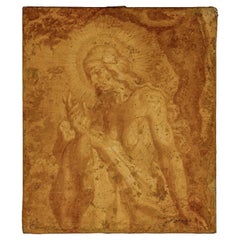
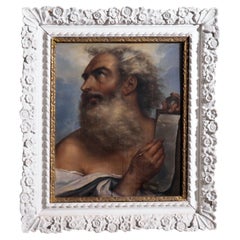
1600s Guercino Follower Italian Religious Painting
By Giovanni Francesco Barbieri (Il Guercino)
Located in Roma, IT
1600s Guercino Follower Italian Religious Painting
Beautiful oil painting on canvas depicting the Penitent Magdalene.
This important painting is unique in that it shows Magdalene wit...
Category
Antique 17th Century Italian Baroque Paintings
Materials
Canvas
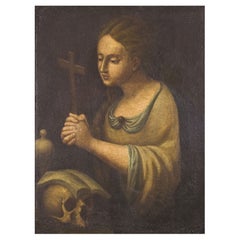
1600s painting Mary Magdalene
Located in Cesena, FC
Painting of 1600 Mary Magdalene: Iconography of the 17th and 18th centuries
Painter from central and southern Italy
17th century - Magdalene Orante
Oil on canvas 70 x 57 cm
In this...
Category
Antique 17th Century European Paintings
Materials
Canvas
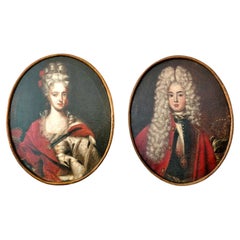
1600s Paintings of French Nobility
Located in Cesena, FC
1600s Paintings of French Nobility
1600s Portraits of Nobility:
Seventeenth-century Paintings
Size: 18.5 x 14.6 inches
French Artist
Featured here are six oval paintings depicting ...
Category
Antique Early 17th Century French Paintings
Materials
Canvas, Wood, Paint
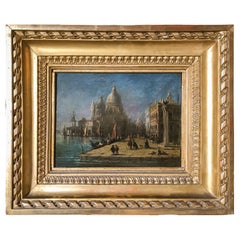
Venetian Capriccio, Santa Maria della Salute - Italian School, 18th century
Located in TEYJAT, FR
Venetian Capriccio with Santa Maria della Salute and Figures
Italian School, 18th Century
Oil on Oak Panel
Dimensions: Panel – 16 x 21.5 cm (6.3 x 8.5 in).
Provenance: Private Europe...
Category
Antique Late 18th Century Italian Baroque Paintings
Materials
Oak
$2,635
H 6.3 in W 8.47 in D 2.37 in
Old Master Italian Painting, circa 1600
Located in Aalsgaarde, DK
Rare old master Italian painting, oil on wood, probably Venetian, circa 1500 - 1600
With frame:
H. 64 W. 55 D. 5 cm
H. 25.1 W. 21.6 D. 1.9 in
Wit...
Category
Antique 16th Century Paintings
Materials
Wood, Paint
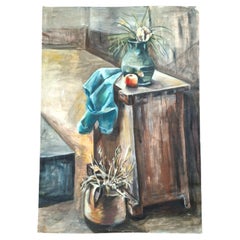
Italian Natura Morta Dead Nature from Accademia Italiana Florence
Located in Los Angeles, CA
Tempera, a painting made by blending colored pigments with a water-soluble binder medium like egg yolk, has been used since antiquity and was especially popular in Italian art during...
Category
Vintage 1960s Italian Mid-Century Modern Paintings
Materials
Paint
$1,000
H 39.5 in W 27.075 in D 0.07 in
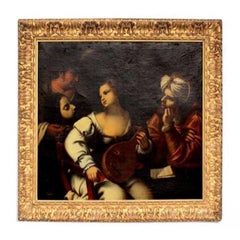
18th Biblical Oil on Canvas Pietro della Vecchia Aka Pietro Muttoni
By Pietro della Vecchia
Located in Marseille, FR
Oil on canvas Italian 18th century represents biblical scene: the beheading of St. Jean Baptist and the gift of his head to Salome. Obviously Caravagesque this painting is assigned t...
Category
Antique 18th Century French Baroque Paintings
Materials
Canvas
$35,775 / set
H 46.46 in W 54.34 in D 11.82 in
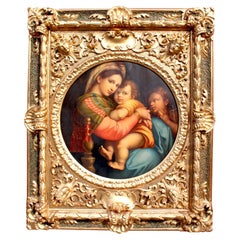
After Raffaello Sanzio 1483-1520 Raphael La Madonna della Seggiola Oil on Canvas
By (after) Raphael (Raffaello Sanzio da Urbino)
Located in Los Angeles, CA
A Fine Italian 19th Century Oil Painting on Canvas "La Madonna della Seggiola" after Raphael (Raffaello Sanzio da Urbino 1483-1520). The circular painted canvas depicting a seated Madonna holding an infant Jesus Christ next to a child Saint John the Baptist, all within a massive carved two-tone gilt wood, gilt-patinated and gesso frame, which is identical to the frame on Raphael's original artwork. This painting is a 19th Century copy of Raphael's Madonna della Seggiola painted in 1514 and currently exhibited and part of the permanent collection at the Palazzo Pitti, Galleria Palatina, Florence, Italy. The bodies of the Virgin, Christ, and the boy Baptist fill the whole picture. The tender, natural looking embrace of the Mother and Child, and the harmonious grouping of the figures in the round, have made this one of Raphael's most popular Madonnas. The isolated chair leg is reminiscent of papal furniture, which has led to the assumption that Leo X himself commissioned the painting. Circa: 1890-1900.
Subject: Religious painting
Painting diameter: 28 inches (71.1 cm)
Frame height: 55 1/8 inches (140 cm)
Frame width: 46 inches (116.8 cm)
Frame depth: 5 1/8 inches (13 cm)
Raffaello Sanzio da Urbino (Italian, March 28 or April 6, 1483 - April 6, 1520), known as Raphael, was an Italian painter and architect of the High Renaissance. His work is admired for its clarity of form, ease of composition, and visual achievement of the Neoplatonic ideal of human grandeur. Together with Michelangelo and Leonardo da Vinci, he forms the traditional trinity of great masters of that period.
Raphael was enormously productive, running an unusually large workshop and, despite his death at 37, leaving a large body of work. Many of his works are found in the Vatican Palace, where the frescoed Raphael Rooms were the central, and the largest, work of his career. The best known work is The School of Athens in the Vatican Stanza della Segnatura. After his early years in Rome much of his work was executed by his workshop from his drawings, with considerable loss of quality. He was extremely influential in his lifetime, though outside Rome his work was mostly known from his collaborative printmaking.
After his death, the influence of his great rival Michelangelo was more widespread until the 18th and 19th centuries, when Raphael's more serene and harmonious qualities were again regarded as the highest models. His career falls naturally into three phases and three styles, first described by Giorgio Vasari: his early years in Umbria, then a period of about four years (1504–1508) absorbing the artistic traditions of Florence, followed by his last hectic and triumphant twelve years in Rome, working for two Popes and their close associates.
Raphael was born in the small but artistically significant central Italian city of Urbino in the Marche region, where his father Giovanni Santi was court painter to the Duke. The reputation of the court had been established by Federico III da Montefeltro, a highly successful condottiere who had been created Duke of Urbino by the Pope - Urbino formed part of the Papal States - and who died the year before Raphael was born. The emphasis of Federico's court was rather more literary than artistic, but Giovanni Santi was a poet of sorts as well as a painter, and had written a rhymed chronicle of the life of Federico, and both wrote the texts and produced the decor for masque-like court entertainments. His poem to Federico shows him as keen to show awareness of the most advanced North Italian painters, and Early Netherlandish artists as well. In the very small court of Urbino he was probably more integrated into the central circle of the ruling family than most court painters.
Federico was succeeded by his son Guidobaldo da Montefeltro, who married Elisabetta Gonzaga, daughter of the ruler of Mantua, the most brilliant of the smaller Italian courts for both music and the visual arts. Under them, the court continued as a centre for literary culture. Growing up in the circle of this small court gave Raphael the excellent manners and social skills stressed by Vasari. Court life in Urbino at just after this period was to become set as the model of the virtues of the Italian humanist court through Baldassare Castiglione's depiction of it in his classic work The Book of the Courtier, published in 1528. Castiglione moved to Urbino in 1504, when Raphael was no longer based there but frequently visited, and they became good friends. He became close to other regular visitors to the court: Pietro Bibbiena and Pietro Bembo, both later cardinals, were already becoming well known as writers, and would be in Rome during Raphael's period there. Raphael mixed easily in the highest circles throughout his life, one of the factors that tended to give a misleading impression of effortlessness to his career. He did not receive a full humanistic education however; it is unclear how easily he read Latin.
Early Life and Works
His mother Màgia died in 1491 when Raphael was eight, followed on August 1, 1494 by his father, who had already remarried. Raphael was thus orphaned at eleven; his formal guardian became his only paternal uncle Bartolomeo, a priest, who subsequently engaged in litigation with his stepmother. He probably continued to live with his stepmother when not staying as an apprentice with a master. He had already shown talent, according to Vasari, who says that Raphael had been "a great help to his father". A self-portrait drawing from his teenage years shows his precocity. His father's workshop continued and, probably together with his stepmother, Raphael evidently played a part in managing it from a very early age. In Urbino, he came into contact with the works of Paolo Uccello, previously the court painter (d. 1475), and Luca Signorelli, who until 1498 was based in nearby Città di Castello.
According to Vasari, his father placed him in the workshop of the Umbrian master Pietro Perugino as an apprentice "despite the tears of his mother". The evidence of an apprenticeship comes only from Vasari and another source, and has been disputed—eight was very early for an apprenticeship to begin. An alternative theory is that he received at least some training from Timoteo Viti, who acted as court painter in Urbino from 1495.Most modern historians agree that Raphael at least worked as an assistant to Perugino from around 1500; the influence of Perugino on Raphael's early work is very clear: "probably no other pupil of genius has ever absorbed so much of his master's teaching as Raphael did", according to Wölfflin. Vasari wrote that it was impossible to distinguish between their hands at this period, but many modern art historians claim to do better and detect his hand in specific areas of works by Perugino or his workshop. Apart from stylistic closeness, their techniques are very similar as well, for example having paint applied thickly, using an oil varnish medium, in shadows and darker garments, but very thinly on flesh areas. An excess of resin in the varnish often causes cracking of areas of paint in the works of both masters. The Perugino workshop was active in both Perugia and Florence, perhaps maintaining two permanent branches. Raphael is described as a "master", that is to say fully trained, in December 1500.
His first documented work was the Baronci altarpiece for the church of Saint Nicholas of Tolentino in Città di Castello, a town halfway between Perugia and Urbino. Evangelista da Pian di Meleto, who had worked for his father, was also named in the commission. It was commissioned in 1500 and finished in 1501; now only some cut sections and a preparatory drawing remain. In the following years he painted works for other churches there, including the Mond Crucifixion (about 1503) and the Brera Wedding of the Virgin (1504), and for Perugia, such as the Oddi Altarpiece. He very probably also visited Florence in this period. These are large works, some in fresco, where Raphael confidently marshals his compositions in the somewhat static style of Perugino. He also painted many small and exquisite cabinet paintings in these years, probably mostly for the connoisseurs in the Urbino court, like the Three Graces and St. Michael, and he began to paint Madonnas and portraits. In 1502 he went to Siena at the invitation of another pupil of Perugino, Pinturicchio, "being a friend of Raphael and knowing him to be a draughtsman of the highest quality" to help with the cartoons, and very likely the designs, for a fresco series in the Piccolomini Library in Siena Cathedral. He was evidently already much in demand even at this early stage in his career.
Influence of Florence
Raphael led a "nomadic" life, working in various centres in Northern Italy, but spent a good deal of time in Florence, perhaps from about 1504. Although there is traditional reference to a "Florentine period...
Category
Antique Early 1900s Italian Baroque Paintings
Materials
Canvas, Giltwood
$19,880 Sale Price
20% Off
H 55.13 in W 46 in D 5.13 in
After Raffaello Sanzio 1483-1520 Raphael La Madonna della Seggiola Oil on Canvas
By (after) Raphael (Raffaello Sanzio da Urbino)
Located in Los Angeles, CA
A Fine Italian 19th Century Oil Painting on Canvas "La Madonna della Seggiola" after Raphael (Raffaello Sanzio da Urbino 1483-1520). The circular painted canvas depicting a seated Madonna holding an infant Jesus Christ next to a child Saint John the Baptist, all within a massive carved gilt wood and gesso frame, which is identical to the frame on Raphael's original artwork. This painting is a 19th Century copy of Raphael's Madonna della Seggiola painted in 1514 and currently exhibited and part of the permanent collection at the Palazzo Pitti, Galleria Palatina, Florence, Italy. The bodies of the Virgin, Christ, and the boy Baptist fill the whole picture. The tender, natural looking embrace of the Mother and Child, and the harmonious grouping of the figures in the round, have made this one of Raphael's most popular Madonnas. The isolated chair leg is reminiscent of papal furniture, which has led to the assumption that Leo X himself commissioned the painting. A retailer's label reads " Fred K/ Keer's Sons - Framers and Fine Art Dealers - 917 Broad St. Newark, N.J." - Another label from the gilder reads "Carlo Bartolini - Doratore e Verniciatori - Via Maggio 1924 - Firenze". Circa: 1890-1900.
Subject: Religious painting
Canvas diameter: 28 inches (71.1 cm)
Frame height: 54 inches (137.2 cm)
Frame width: 42 1/2 inches (108 cm)
Frame depth: 5 1/2 inches (14 cm)
Raffaello Sanzio da Urbino (Italian, March 28 or April 6, 1483 - April 6, 1520), known as Raphael, was an Italian painter and architect of the High Renaissance. His work is admired for its clarity of form, ease of composition, and visual achievement of the Neoplatonic ideal of human grandeur. Together with Michelangelo and Leonardo da Vinci, he forms the traditional trinity of great masters of that period.
Raphael was enormously productive, running an unusually large workshop and, despite his death at 37, leaving a large body of work. Many of his works are found in the Vatican Palace, where the frescoed Raphael Rooms were the central, and the largest, work of his career. The best known work is The School of Athens in the Vatican Stanza della Segnatura. After his early years in Rome much of his work was executed by his workshop from his drawings, with considerable loss of quality. He was extremely influential in his lifetime, though outside Rome his work was mostly known from his collaborative printmaking.
After his death, the influence of his great rival Michelangelo was more widespread until the 18th and 19th centuries, when Raphael's more serene and harmonious qualities were again regarded as the highest models. His career falls naturally into three phases and three styles, first described by Giorgio Vasari: his early years in Umbria, then a period of about four years (1504–1508) absorbing the artistic traditions of Florence, followed by his last hectic and triumphant twelve years in Rome, working for two Popes and their close associates.
Raphael was born in the small but artistically significant central Italian city of Urbino in the Marche region, where his father Giovanni Santi was court painter to the Duke. The reputation of the court had been established by Federico III da Montefeltro, a highly successful condottiere who had been created Duke of Urbino by the Pope - Urbino formed part of the Papal States - and who died the year before Raphael was born. The emphasis of Federico's court was rather more literary than artistic, but Giovanni Santi was a poet of sorts as well as a painter, and had written a rhymed chronicle of the life of Federico, and both wrote the texts and produced the decor for masque-like court entertainments. His poem to Federico shows him as keen to show awareness of the most advanced North Italian painters, and Early Netherlandish artists as well. In the very small court of Urbino he was probably more integrated into the central circle of the ruling family than most court painters.
Federico was succeeded by his son Guidobaldo da Montefeltro, who married Elisabetta Gonzaga, daughter of the ruler of Mantua, the most brilliant of the smaller Italian courts for both music and the visual arts. Under them, the court continued as a centre for literary culture. Growing up in the circle of this small court gave Raphael the excellent manners and social skills stressed by Vasari. Court life in Urbino at just after this period was to become set as the model of the virtues of the Italian humanist court through Baldassare Castiglione's depiction of it in his classic work The Book of the Courtier, published in 1528. Castiglione moved to Urbino in 1504, when Raphael was no longer based there but frequently visited, and they became good friends. He became close to other regular visitors to the court: Pietro Bibbiena and Pietro Bembo, both later cardinals, were already becoming well known as writers, and would be in Rome during Raphael's period there. Raphael mixed easily in the highest circles throughout his life, one of the factors that tended to give a misleading impression of effortlessness to his career. He did not receive a full humanistic education however; it is unclear how easily he read Latin.
Early Life and Works
His mother Màgia died in 1491 when Raphael was eight, followed on August 1, 1494 by his father, who had already remarried. Raphael was thus orphaned at eleven; his formal guardian became his only paternal uncle Bartolomeo, a priest, who subsequently engaged in litigation with his stepmother. He probably continued to live with his stepmother when not staying as an apprentice with a master. He had already shown talent, according to Vasari, who says that Raphael had been "a great help to his father". A self-portrait drawing from his teenage years shows his precocity. His father's workshop continued and, probably together with his stepmother, Raphael evidently played a part in managing it from a very early age. In Urbino, he came into contact with the works of Paolo Uccello, previously the court painter (d. 1475), and Luca Signorelli, who until 1498 was based in nearby Città di Castello.
According to Vasari, his father placed him in the workshop of the Umbrian master Pietro Perugino as an apprentice "despite the tears of his mother". The evidence of an apprenticeship comes only from Vasari and another source, and has been disputed—eight was very early for an apprenticeship to begin. An alternative theory is that he received at least some training from Timoteo Viti, who acted as court painter in Urbino from 1495.Most modern historians agree that Raphael at least worked as an assistant to Perugino from around 1500; the influence of Perugino on Raphael's early work is very clear: "probably no other pupil of genius has ever absorbed so much of his master's teaching as Raphael did", according to Wölfflin. Vasari wrote that it was impossible to distinguish between their hands at this period, but many modern art historians claim to do better and detect his hand in specific areas of works by Perugino or his workshop. Apart from stylistic closeness, their techniques are very similar as well, for example having paint applied thickly, using an oil varnish medium, in shadows and darker garments, but very thinly on flesh areas. An excess of resin in the varnish often causes cracking of areas of paint in the works of both masters. The Perugino workshop was active in both Perugia and Florence, perhaps maintaining two permanent branches. Raphael is described as a "master", that is to say fully trained, in December 1500.
His first documented work was the Baronci altarpiece for the church of Saint Nicholas of Tolentino in Città di Castello, a town halfway between Perugia and Urbino. Evangelista da Pian di Meleto, who had worked for his father, was also named in the commission. It was commissioned in 1500 and finished in 1501; now only some cut sections and a preparatory drawing remain. In the following years he painted works for other churches there, including the Mond Crucifixion (about 1503) and the Brera Wedding of the Virgin (1504), and for Perugia, such as the Oddi Altarpiece. He very probably also visited Florence in this period. These are large works, some in fresco, where Raphael confidently marshals his compositions in the somewhat static style of Perugino. He also painted many small and exquisite cabinet paintings in these years, probably mostly for the connoisseurs in the Urbino court, like the Three Graces and St. Michael, and he began to paint Madonnas and portraits. In 1502 he went to Siena at the invitation of another pupil of Perugino, Pinturicchio, "being a friend of Raphael and knowing him to be a draughtsman of the highest quality" to help with the cartoons, and very likely the designs, for a fresco series in the Piccolomini Library in Siena Cathedral. He was evidently already much in demand even at this early stage in his career.
Influence of Florence
Raphael led a "nomadic" life, working in various centres in Northern Italy, but spent a good deal of time in Florence, perhaps from about 1504. Although there is traditional reference to a "Florentine period...
Category
Antique Early 1900s Italian Baroque Paintings
Materials
Canvas, Giltwood
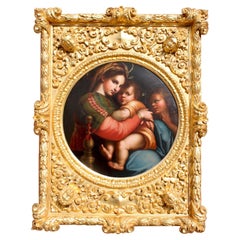
$19,850 Sale Price
39% Off
H 54 in W 42.5 in D 5.5 in
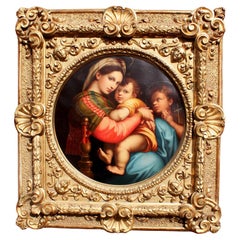
After Raffaello Sanzio 1483-1520 Raphael La Madonna Della Seggiola Oil on Canvas
By (after) Raphael (Raffaello Sanzio da Urbino)
Located in Los Angeles, CA
A fine Italian 19th century oil painting on canvas "La Madonna della Seggiola" after Raphael (Raffaello Sanzio da Urbino 1483-1520). The circular painted canvas depicting a seated Ma...
Category
Antique Late 19th Century Italian Baroque Paintings
Materials
Canvas, Giltwood
$18,950 Sale Price
42% Off
H 50.5 in W 46.63 in D 4.75 in
More From This Seller
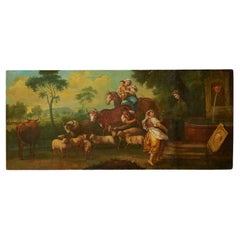
View AllPaesaggio Con Figure E Animali Scena Rurale Fine 1800 Scuola Ungherese
Located in Milano, MI
Scuola Ungherese Paesaggio con Figure e Armenti fine 1800 dipinto ad olio su tela orizzontale, raffigurante un’animata scena agreste. Sulla destra della composizione bucolica, una fi...
Category
Antique Late 19th Century Hungarian Bohemian Paintings
Materials
Canvas
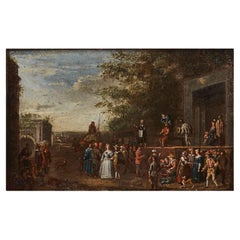
Dipinto Fiammingo su Rame 1650 circa Scena di Genere con Commedia delle Arti
Located in Milano, MI
Dipinto Fiammingo del 1600 a olio su rame raffigurante uno scorcio di paesaggio con figure, una scena di genere con una moltitudine di personaggi affollati in una strada con delle ar...
Category
Antique Mid-17th Century Baroque Paintings
Materials
Copper
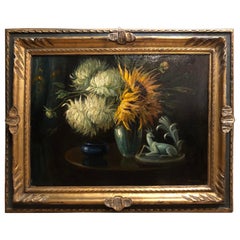
Girasoli e Dalie Natura Morta Di Fiori Italiana Firmata Sorgiani 1930 circa
Located in Milano, MI
Girasoli e Dalie, Natura Morta di Fiori Italiana firmata Sorgiani risalente al 1930 Circa, dipinta ad olio su cartone riportato su compensato di pioppo. Questo quadro di fiori itali...
Category
20th Century Italian Art Deco Paintings
Materials
Poplar
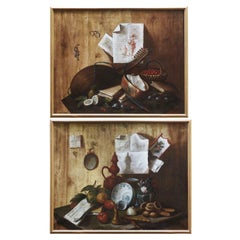
18th Century Pair of Italian Still Life Trompe L
Oeil Vision Jokes after Munari
By Cristoforo Munari
Located in Milano, MI
A stunning pair of antique Italian trompe l’oeil still life paintings, a pair of 18th century oil on canvas vision jokes, false still life paintings known as deception paintings by a follower of Cristoforo Munari (Reggio Emilia 1667- Pisa 1720) of Italian origin, dating back to the first half of 1700s.
These 18th century Italian Baroque trompe l'oeil paintings depict an abundance of objects are arranged on a table. The background of the disordered compositions consists of a wooden board wall with hanging sketches and other objects. Both still life compositions are painted in soft ocher tones and have the same unseen source illuminating the display from the left, creating a dark shadow on the right side of both paintings.
Biscuits, a glass vase of flowers, earthenware pots, a wooden instrument...
Category
Antique Early 18th Century European Baroque Paintings
Materials
Wood, Canvas
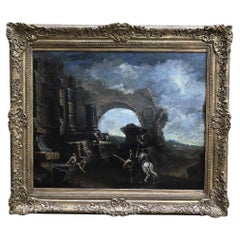
Large Landscape with Ruins and Figures Italian Capriccio 18th Century
By Alessandro Magnasco il Lissandrino
Located in Milano, MI
Baroque capriccio with architectural ruins and figures, an early 18th century Italian painting showing an imaginary landscape with Roman ruins and figures, an early Italian oil-on-ca...
Category
Antique Early 18th Century Italian Baroque Paintings
Materials
Gesso, Canvas, Giltwood
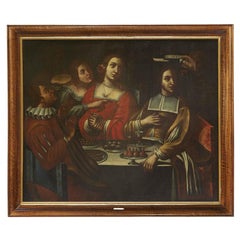
Death Comes to the Table Memento Mori by Giovanni Martinelli c. 1670
Located in Milano, MI
Italian painting from 1600 Banquet with Figures Memento Mori by Giovanni Martinelli, titled Death Comes to the Banquet Table, vanitas circa 1635. The oil-on-canvas painting is inspi...
Category
Antique Late 17th Century Italian Baroque Paintings
Materials
Canvas, Oak
Still Thinking About These?
All Recently ViewedMore Ways To Browse
J Franco
Letizia Pitigliani
Velvet Underground Poster
Vertigo Film Poster
Vintage Burlesque Posters
Vintage Peeping Tom
Vintage Whisky Poster
Warhol Tate Gallery
Whisky Poster
Willsons Leicester
The Dark Knight Poster
Vertigo Movie Poster
Vintage Bruce Lee Movie Posters
Vintage Fairground Posters
Vintage Poster Texas
Mid Century Modern Blown Glass Slag Vase
Mid Century Tyrolean Bed
Midcentury Modern Homecrest Riviera Siesta Swivel Rocker