1 of 7
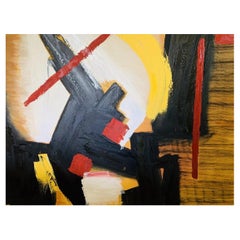
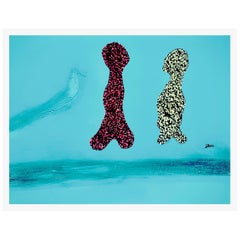
Tricia Gillman
$4,095.20List Price
About the Item
- Creator:Tricia Gillman (Artist)
- Dimensions:Height: 48.43 in (123 cm)Width: 60.24 in (153 cm)Depth: 2.84 in (7.2 cm)
- Materials and Techniques:
- Place of Origin:
- Period:1980-1989
- Date of Manufacture:1983
- Condition:Wear consistent with age and use.
- Seller Location:London, GB
- Reference Number:1stDibs: LU2461312514252
Authenticity Guarantee
In the unlikely event there’s an issue with an item’s authenticity, contact us within 1 year for a full refund. DetailsMoney-Back Guarantee
If your item is not as described, is damaged in transit, or does not arrive, contact us within 7 days for a full refund. Details24-Hour Cancellation
You have a 24-hour grace period in which to reconsider your purchase, with no questions asked.Vetted Professional Sellers
Our world-class sellers must adhere to strict standards for service and quality, maintaining the integrity of our listings.Price-Match Guarantee
If you find that a seller listed the same item for a lower price elsewhere, we’ll match it.Trusted Global Delivery
Our best-in-class carrier network provides specialized shipping options worldwide, including custom delivery.You May Also Like
Large Mixed Media Painting by Tricia Strickfaden
Located in Los Angeles, CA
Introducing the striking "Large Mixed Media Painting" by renowned artist Tricia Strickfaden - a captivating piece that effortlessly blends modern artistry with timeless elegance. Thi...
Category
21st Century and Contemporary American Modern Paintings
Materials
Canvas, Acrylic
Colorful Modern Abstract Original Painting Meta-Futurism. Blue, gold, light blue
By Marzia Boaglio
Located in Torino, IT
"DREAM," contemporary painting, abstract art, acrylic on canvas, original work, blue, Italian design, Meta-Futurism.
"DREAM" is an original work by Marzia Boaglio that captures the...
Category
2010s Italian Futurist Paintings
Materials
Canvas
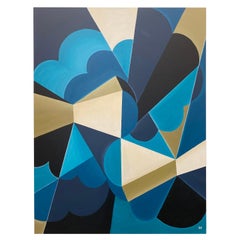
$3,622 / item
H 66.93 in W 51.19 in D 0.79 in
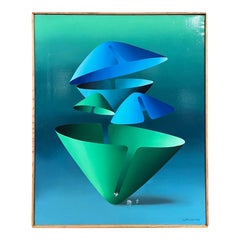
Kurt Larisch Surrealist Oil on Canvas, Circa 1960
By Kurt Larisch
Located in Sarasota, FL
A surrealist oil on canvas by listed artist Kurt Larisch, circa 1960. Scene depicts floating cone like shapes in blue and green with small figures that appear to be emerging from the...
Category
Mid-20th Century American Expressionist Paintings
Materials
Canvas, Paint
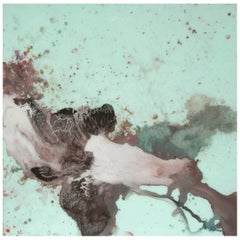
Composition 0967 by Matière 28°, Acrylic on Plexiglas
By Matière 28°
Located in Paris, FR
Composition 0967 by Matière 28°, acrylic on plexiglas
Matière 28° is the pseudonym of a Paris-based artist who was born in St. Petersburg and has liv...
Category
2010s French Other Paintings
Materials
Acrylic, Plexiglass
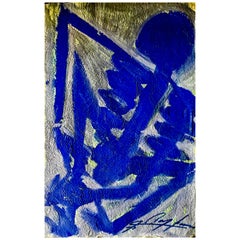
Jesús Chucho Reyes Ferreira, Blue Skeleton, Anilines on China Paper
By "Jesus ""Chucho"" Reyes Ferriera"
Located in Mexico City, MX
Jesús Reyes Ferreira is a fundamental character for Mexican art. Prolific artist reluctant to conventional forms and media, Chucho Reyes developed...
Category
20th Century Mexican Paintings
Materials
Paper
$14,000
H 29.53 in W 19.3 in D 0.04 in
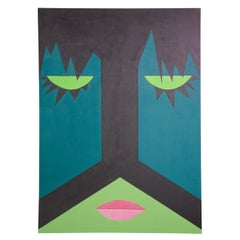
Painting green black Geometric face Modern Acrylic Canvas by Cecilia Setterdahl
By Cecilia Setterdahl
Located in Dubai, Dubai
About the painting “Goodnight” 2016
About the artist:
Cecilia’s is working with all geometrical forms, lines and shadows.
Her style developed to be clean and sharp forms in different combinations.
Often they are in juxtaposition to create a three dimensional effect.
Since two decades she has only painted in acrylic on canvas.
Her art characteristics are uniform geometrical shapes with pristine borders,
often in bold colours.
Born in Sweden in 1954, Cecilia Setterdahl has always been painting from Swedish
inspiration. Studied ascetics in High School and then went on to the Technical University of Lulea and graduated as a teacher. Moved to Stockholm and studied at the “Konstskolan” First exhibition 1988. Through a move to Neuchatel, Switzerland Cecilia continued her studies at the M-Art and Accademie Maximilien de Meuron. “Art Studio Bv5”, together with 4 other artists, she continued to work until moving to Dubai in 2015. Several part exhibitions in Neuchatel, Lausanne, Geneva, Brussels, London, New York, Hong Kong and Sweden.
In the United Arab Emirates she has exhibited both acrylic paintings and hand- made carpets at Downtown Design...
Category
21st Century and Contemporary Emirian Modern Paintings
Materials
Canvas, Acrylic
$3,300
H 59.06 in W 39.38 in D 1.58 in
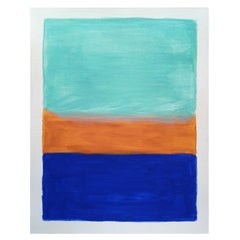
Landscape, Acrylic on Paper, Free Delivery
By Leonardo Di Caprio
Located in Roma, IT
Abstract views of landscape are interpreted and painted by the artist. During travels around the world designs and notes are made, which are later abstractly interpreted into paintin...
Category
2010s Italian Paintings
Materials
Paper
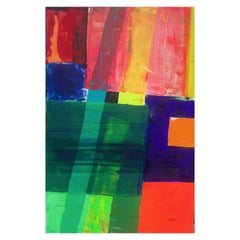
Mixed Media Painting by Steven Colucci
By John Byard
Located in New York City, NY
Steven Colucci’s iconoclastic approach to performance and the visual arts
have not only long blurred the boundaries between these disciplines, but have
challenged its most basic assumptions. The title of this show references a
most rudimentary dance move --the plié --and our assumptions of what to
expect in relation to this. Also the suggestion that we can simply press a
button and a preconceived outcome will be courteously delivered --a form of
prefabricated belief in itself. Steven Colucci’s artwork turns such basic
assumptions on their heads. Finding early inspiration in the New York school
of abstract expressionists such as Jackson Pollock with his action painting,
and then further by his professor --a then young Vito Acconci while studying
at the School of Visual Arts, Steven Colucci went from exploring the raw
existentialist experimentation of New York’s early painting and performance
scenes, to investigating the other end of the spectrum --the rigorously
measured and controlled disciplines of pantomime and ballet; studying in
Paris under the tutelage of world-famous Marcelle Marceau, and engaging
with the concepts of dramatic movement pioneer and intellectual Etienne
Decroux. Colucci has explained the difference between the extremes of
pantomime and dance as being that pantomime forces movement via an
internal capacity --movement directed inward to the core of one’s self --a
source requiring extreme mental and physical control. Dance by contrast is
an external expression; likewise requiring great precision, although instead
an extension of self or sentiment that projects outwardly. While such
historical ‘movement’ disciplines serve as foundation blocks for Steven’s
artistic explorations, it is the realm in between that he is best known for his
contributions --an experimental movement and performance art that
simultaneously honors, yet defiantly refutes tradition; rejecting a
compartmentalization regarding art and movement, yet incorporating its
elements into his own brand of experimental pastiche. Colucci’s performance
works manifest as eerily candy-coated and familiar, yet incorporate
unexpected jags of the uncanny throughout, exploiting a sort of coulrophobia
in the viewer; an exploration of a cumulative artifice that binds human
nature against its darker tendencies; highlighting traditions of artifice itself -
the fabricated systemologies that necessitate compartmentalization in the
first place.
It is evident in Steven Colucci’s paintings that he has established a uniquely
distinctive pictorial vocabulary; a strong allusion to --or moreso an extension
of --his performance works. Colucci’s paintings depict a sort of kinetic
spectrum, or as he refers to them “a technical expression of physicality and
movement”. Whereas the French performance and visual artist Yves Klein
used the human body as a “paint brush” to demarcate his paintings and
thereby signify a residue of performance, Colucci’s utilization of nonsensical
numbers and number sequences taken from dance scores, as well as heat-
induced image abstraction depicting traces of movement likewise inform his
vocabulary. In the strand of the choreographed, yet incorporating moments of
chance, Colucci’s paintings represent an over arching structure; a rhythm of
being and state, yet detail erratic moments --moments that denote a certain
frailty --the edge of human stamina. Colucci’s paintings dually represent a
form of gestural abstraction --and also the reverse of this --a unique
anthropomorphization of varying states of movement – that sometimes
present as a temperature induced color field, at others are juxtapositions of
movement and depictions of physical gestural images themselves. Colucci’s
use of vernacular and found materials such as cardboard evoke his mastery of
set design, and also reference a sort of collective experience of urbanity and
the ephemeral. Such contradictions seem to permeate not only Steven
Colucci’s artwork, but also are reflected in his person – one who grew up in
New York’s Bronx during a zeitgeist moment in visual and performing arts in
the 1960s – one who shifts with ease from happenings and experiments in
New York City, to his meticulously choreographed megaproductions at
Lincoln Center or starring in the Paris ballet...
Category
2010s Paintings
Materials
Acrylic
Mixed Media Painting by Steven Colucci- Two Men
By Jeff Koons
Located in New York City, NY
Steven Colucci’s iconoclastic approach to performance and the visual arts
have not only long blurred the boundaries between these disciplines, but have
challenged its most basic assumptions. The title of this show references a
most rudimentary dance move --the plié --and our assumptions of what to
expect in relation to this. Also the suggestion that we can simply press a
button and a preconceived outcome will be courteously delivered --a form of
prefabricated belief in itself. Steven Colucci’s artwork turns such basic
assumptions on their heads. Finding early inspiration in the New York school
of abstract expressionists such as Jackson Pollock with his action painting,
and then further by his professor --a then young Vito Acconci while studying
at the School of Visual Arts, Steven Colucci went from exploring the raw
existentialist experimentation of New York’s early painting and performance
scenes, to investigating the other end of the spectrum --the rigorously
measured and controlled disciplines of pantomime and ballet; studying in
Paris under the tutelage of world-famous Marcelle Marceau, and engaging
with the concepts of dramatic movement pioneer and intellectual Etienne
Decroux. Colucci has explained the difference between the extremes of
pantomime and dance as being that pantomime forces movement via an
internal capacity --movement directed inward to the core of one’s self --a
source requiring extreme mental and physical control. Dance by contrast is
an external expression; likewise requiring great precision, although instead
an extension of self or sentiment that projects outwardly. While such
historical ‘movement’ disciplines serve as foundation blocks for Steven’s
artistic explorations, it is the realm in between that he is best known for his
contributions --an experimental movement and performance art that
simultaneously honors, yet defiantly refutes tradition; rejecting a
compartmentalization regarding art and movement, yet incorporating its
elements into his own brand of experimental pastiche. Colucci’s performance
works manifest as eerily candy-coated and familiar, yet incorporate
unexpected jags of the uncanny throughout, exploiting a sort of coulrophobia
in the viewer; an exploration of a cumulative artifice that binds human
nature against its darker tendencies; highlighting traditions of artifice itself -
the fabricated systemologies that necessitate compartmentalization in the
first place.
It is evident in Steven Colucci’s paintings that he has established a uniquely
distinctive pictorial vocabulary; a strong allusion to --or moreso an extension
of --his performance works. Colucci’s paintings depict a sort of kinetic
spectrum, or as he refers to them “a technical expression of physicality and
movement”. Whereas the French performance and visual artist Yves Klein
used the human body as a “paint brush” to demarcate his paintings and
thereby signify a residue of performance, Colucci’s utilization of nonsensical
numbers and number sequences taken from dance scores, as well as heat-
induced image abstraction depicting traces of movement likewise inform his
vocabulary. In the strand of the choreographed, yet incorporating moments of
chance, Colucci’s paintings represent an over arching structure; a rhythm of
being and state, yet detail erratic moments --moments that denote a certain
frailty --the edge of human stamina. Colucci’s paintings dually represent a
form of gestural abstraction --and also the reverse of this --a unique
anthropomorphization of varying states of movement – that sometimes
present as a temperature induced color field, at others are juxtapositions of
movement and depictions of physical gestural images themselves. Colucci’s
use of vernacular and found materials such as cardboard evoke his mastery of
set design, and also reference a sort of collective experience of urbanity and
the ephemeral. Such contradictions seem to permeate not only Steven
Colucci’s artwork, but also are reflected in his person – one who grew up in
New York’s Bronx during a zeitgeist moment in visual and performing arts in
the 1960s – one who shifts with ease from happenings and experiments in
New York City, to his meticulously choreographed megaproductions at
Lincoln Center or starring in the Paris ballet...
Category
2010s Paintings
Materials
Acrylic
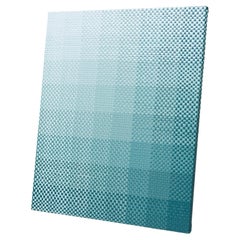
Acrylic Painting by David Svensson, Sweden, 2002, Blue, geometic, woven
By David Svenson
Located in Stockholm, SE
Painting by David Svensson, Sweden,
2002.
Mixed-media on board.
Category
Early 2000s Swedish Modern Paintings
Materials
Acrylic
$5,899
H 28.75 in W 24.81 in D 0.01 in